- Brinda Ramesh
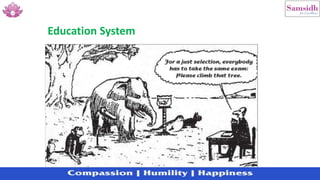
Education System
The NEP 2020 calls for a ‘shift from [an assessment system] that is summative and
primarily tests rote memorization skills to one that is more regular and formative,
is more competency-based, promotes learning development for our students, and
tests higher-order skills, such as analysis, critical thinking and conceptual clarity.
NEP 2020
Competency-based education (CBE) is an approach to teaching, learning, and
assessment that focuses on the student’s demonstration of learning outcomes and
attaining proficiency in particular competencies in each subject.
Teaching which uses a CBE methodology works to empower students and provide
them with a meaningful and positive learning experience. It places the learner at
the center and actively engages them in the learning process.
It emphasizes real-world applications of knowledge and skills and the authenticity
of the learning experience.
What is Competency-Based Education (CBE)?
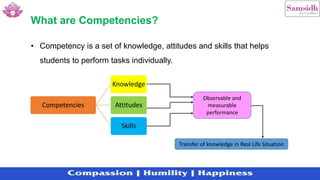
• Competency is a set of knowledge, attitudes and skills that helps
students to perform tasks individually.
What are Competencies?
Competencies
Knowledge
Attitudes
Skills
Observable and
measurable
performance
Transfer of knowledge in Real Life Situation
• Competencies are critical as they will need to successfully navigate
their personal journeys to lead a productive and joyful life.
• Competencies help students draw and build upon what they know,
how they think and what they can do.
Why Competencies?
Features of Effective CBE:
An effective CBE should be able to answer the following questions:
• What is it that the student should be able to do after he/she has undergone
the learning process?
Learning Outcome
• What is it that the student needs to learn /know in order to reach that LO?
Curriculum-based learning resources, not limited to textbooks
• What are the kinds of classroom transactions or activities which will become
the basis for this learning?
Experiential and Activity-based pedagogy
Features of Effective CBE:
An effective CBE should be able to answer the following questions:
• How will the teacher check the learning? or How will the student
demonstrate that learning?
Competency-Based Assessment
• How will a teacher gauge the level of proficiency of a student?
Criterion referenced testing
Features of Effective CBE:
An effective CBE should be able to answer the following questions:
• What is it that the student should be able to do after he/she has undergone
the learning process?
• What is it that the student needs to learn /know in order to reach that LO?
• What are the kinds of classroom transactions or activities which will become
the basis for this learning?
• How will the teacher check the learning? or How will the student
demonstrate that learning?
• How will a teacher gauge the level of proficiency of a student?
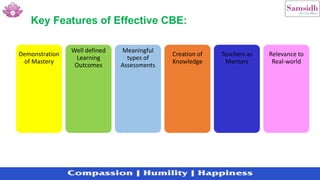
Key Features of Effective CBE:
Demonstration
of Mastery
Well defined
Learning
Outcomes
Meaningful
types of
Assessments
Creation of
Knowledge
Teachers as
Mentors
Relevance to
Real-world
Competencies in Mathematics:
• Number sense
• Algebraic thinking
• Geometric thinking
• Data Analysis
• Problem solving
• Mathematical thinking
• Mathematical Modelling
• Communication
• Critical thinking
• Mathematical reasoning
• Technological proficiency
• Collaboration
• Lucid Learning Outcomes or LOs with reference to the skills and
proficiencies
• Flexibility in time frame to acquire the skills
• Selection of innovative pedagogies to acquire the skills
• Availability of a range of engaging content
• Criterion referenced testing /assessment of LO
• Certification of level of proficiency in learning based on demonstrated LOs
Critical components of CBE:
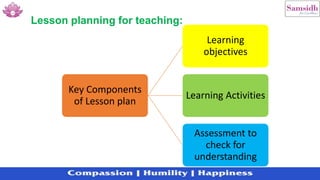
Key Components
of Lesson plan
Learning
objectives
Learning Activities
Assessment to
check for
understanding
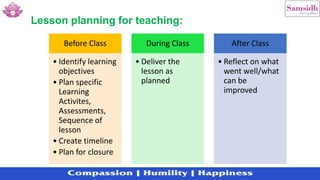
Lesson planning for teaching:
Before Class
• Identify learning
objectives
• Plan specific
Learning
Activites,
Assessments,
Sequence of
lesson
• Create timeline
• Plan for closure
During Class
• Deliver the
lesson as
planned
After Class
• Reflect on what
went well/what
can be
improved
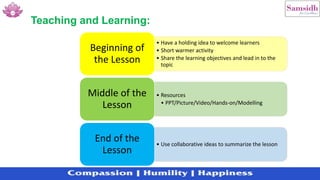
Teaching and Learning:
• Have a holding idea to welcome learners
• Short warmer activity
• Share the learning objectives and lead in to the
topic
Beginning of
the Lesson
• Resources
• PPT/Picture/Video/Hands-on/Modelling
Middle of the
Lesson
• Use collaborative ideas to summarize the lesson
End of the
Lesson
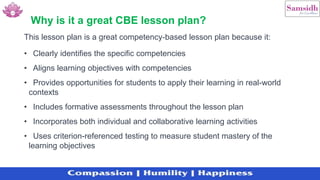
Why is it a great CBE lesson plan?
This lesson plan is a great competency-based lesson plan because it:
• Clearly identifies the specific competencies
• Aligns learning objectives with competencies
• Provides opportunities for students to apply their learning in real-world
contexts
• Includes formative assessments throughout the lesson plan
• Incorporates both individual and collaborative learning activities
• Uses criterion-referenced testing to measure student mastery of the
learning objectives
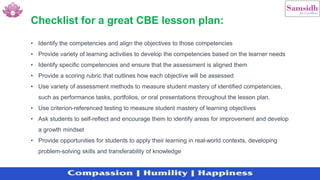
Checklist for a great CBE lesson plan:
• Identify the competencies and align the objectives to those competencies
• Provide variety of learning activities to develop the competencies based on the learner needs
• Identify specific competencies and ensure that the assessment is aligned them
• Provide a scoring rubric that outlines how each objective will be assessed
• Use variety of assessment methods to measure student mastery of identified competencies,
such as performance tasks, portfolios, or oral presentations throughout the lesson plan.
• Use criterion-referenced testing to measure student mastery of learning objectives
• Ask students to self-reflect and encourage them to identify areas for improvement and develop
a growth mindset
• Provide opportunities for students to apply their learning in real-world contexts, developing
problem-solving skills and transferability of knowledge
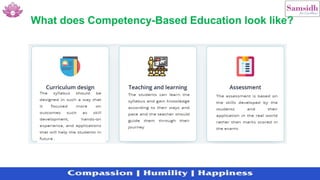
What does Competency-Based Education look like?
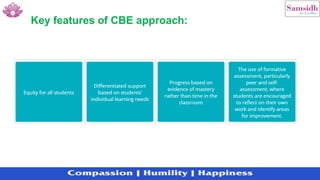
Key features of CBE approach:
https://cbseacademic.nic.in/cbe/index.html
http://schoolofeducators.com/2023/04/what-is-competency-based-education/
file:///C:/Users/USER/Downloads/SAS_CBLF_Math-Literacy_-Final.pdf
https://aurora-institute.org/wp-content/uploads/what-is-competency-based-
education-an-updated-definition-web.pdf
https://cbseacademic.nic.in/cbe/documents/Lesson-Plan-Mathematics-Final.pdf
https://cbseacademic.nic.in/web_material/term/10Math.pdf
https://www.britishcouncil.in/sites/default/files/cbse_assessment_framework_f
or_science_maths_and_english_of_classes_6-10.pdf
References and Resources:
Thank you

Competency Based Education for the cbse schools

  • 1.
  • 2.
  • 3.
    The NEP 2020calls for a ‘shift from [an assessment system] that is summative and primarily tests rote memorization skills to one that is more regular and formative, is more competency-based, promotes learning development for our students, and tests higher-order skills, such as analysis, critical thinking and conceptual clarity. NEP 2020
  • 4.
    Competency-based education (CBE)is an approach to teaching, learning, and assessment that focuses on the student’s demonstration of learning outcomes and attaining proficiency in particular competencies in each subject. Teaching which uses a CBE methodology works to empower students and provide them with a meaningful and positive learning experience. It places the learner at the center and actively engages them in the learning process. It emphasizes real-world applications of knowledge and skills and the authenticity of the learning experience. What is Competency-Based Education (CBE)?
  • 5.
    • Competency isa set of knowledge, attitudes and skills that helps students to perform tasks individually. What are Competencies? Competencies Knowledge Attitudes Skills Observable and measurable performance Transfer of knowledge in Real Life Situation
  • 6.
    • Competencies arecritical as they will need to successfully navigate their personal journeys to lead a productive and joyful life. • Competencies help students draw and build upon what they know, how they think and what they can do. Why Competencies?
  • 7.
    Features of EffectiveCBE: An effective CBE should be able to answer the following questions: • What is it that the student should be able to do after he/she has undergone the learning process? Learning Outcome • What is it that the student needs to learn /know in order to reach that LO? Curriculum-based learning resources, not limited to textbooks • What are the kinds of classroom transactions or activities which will become the basis for this learning? Experiential and Activity-based pedagogy
  • 8.
    Features of EffectiveCBE: An effective CBE should be able to answer the following questions: • How will the teacher check the learning? or How will the student demonstrate that learning? Competency-Based Assessment • How will a teacher gauge the level of proficiency of a student? Criterion referenced testing
  • 9.
    Features of EffectiveCBE: An effective CBE should be able to answer the following questions: • What is it that the student should be able to do after he/she has undergone the learning process? • What is it that the student needs to learn /know in order to reach that LO? • What are the kinds of classroom transactions or activities which will become the basis for this learning? • How will the teacher check the learning? or How will the student demonstrate that learning? • How will a teacher gauge the level of proficiency of a student?
  • 10.
    Key Features ofEffective CBE: Demonstration of Mastery Well defined Learning Outcomes Meaningful types of Assessments Creation of Knowledge Teachers as Mentors Relevance to Real-world
  • 11.
    Competencies in Mathematics: •Number sense • Algebraic thinking • Geometric thinking • Data Analysis • Problem solving • Mathematical thinking • Mathematical Modelling • Communication • Critical thinking • Mathematical reasoning • Technological proficiency • Collaboration
  • 12.
    • Lucid LearningOutcomes or LOs with reference to the skills and proficiencies • Flexibility in time frame to acquire the skills • Selection of innovative pedagogies to acquire the skills • Availability of a range of engaging content • Criterion referenced testing /assessment of LO • Certification of level of proficiency in learning based on demonstrated LOs Critical components of CBE:
  • 13.
    Key Components of Lessonplan Learning objectives Learning Activities Assessment to check for understanding Lesson planning for teaching:
  • 14.
    Lesson planning forteaching: Before Class • Identify learning objectives • Plan specific Learning Activites, Assessments, Sequence of lesson • Create timeline • Plan for closure During Class • Deliver the lesson as planned After Class • Reflect on what went well/what can be improved
  • 15.
    Teaching and Learning: •Have a holding idea to welcome learners • Short warmer activity • Share the learning objectives and lead in to the topic Beginning of the Lesson • Resources • PPT/Picture/Video/Hands-on/Modelling Middle of the Lesson • Use collaborative ideas to summarize the lesson End of the Lesson
  • 16.
    Why is ita great CBE lesson plan? This lesson plan is a great competency-based lesson plan because it: • Clearly identifies the specific competencies • Aligns learning objectives with competencies • Provides opportunities for students to apply their learning in real-world contexts • Includes formative assessments throughout the lesson plan • Incorporates both individual and collaborative learning activities • Uses criterion-referenced testing to measure student mastery of the learning objectives
  • 17.
    Checklist for agreat CBE lesson plan: • Identify the competencies and align the objectives to those competencies • Provide variety of learning activities to develop the competencies based on the learner needs • Identify specific competencies and ensure that the assessment is aligned them • Provide a scoring rubric that outlines how each objective will be assessed • Use variety of assessment methods to measure student mastery of identified competencies, such as performance tasks, portfolios, or oral presentations throughout the lesson plan. • Use criterion-referenced testing to measure student mastery of learning objectives • Ask students to self-reflect and encourage them to identify areas for improvement and develop a growth mindset • Provide opportunities for students to apply their learning in real-world contexts, developing problem-solving skills and transferability of knowledge
  • 18.
    What does Competency-BasedEducation look like?
  • 19.
    Key features ofCBE approach:
  • 20.
  • 21.

Editor's Notes

  • #20 http://schoolofeducators.com/2023/04/what-is-competency-based-education/