B Y : Á G UE D A C A S T I L L O
COMPETENCE BASED
EDUCATION
BACKGROUND TO CBE
• Competency-based education was introduced
in America towards the end of the 1960s in reaction
to concerns that students are not taught the skills
they require in life after school.
BASIC CONCEPTS
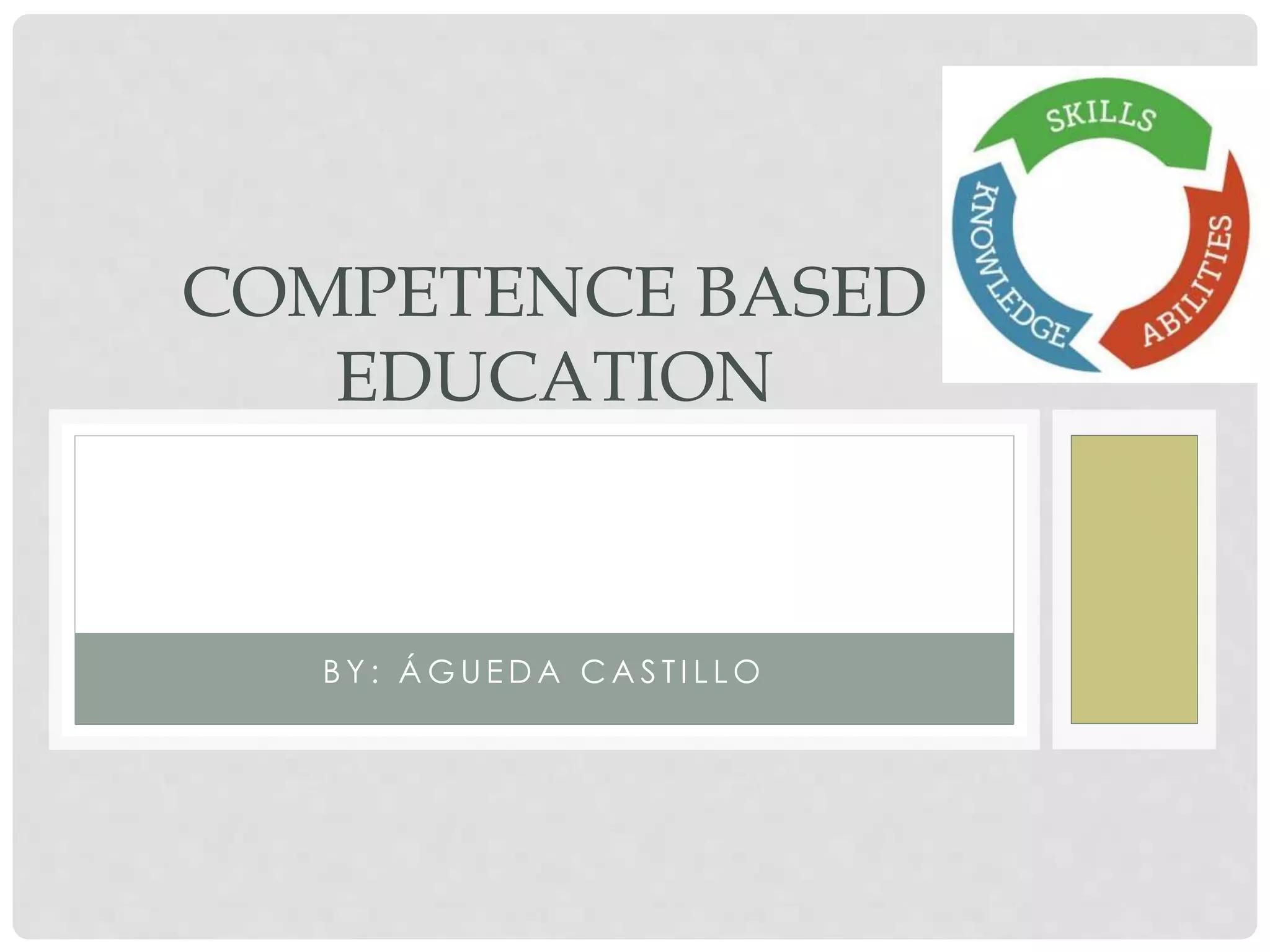
• Competency: is the capability to choose and use (
apply) and integrated combination of knowledge,
skills and attitude with the intention to realise a task
in a certain context. (generic)
• Competence: is the capacity to relise «up to
standard» the key ocupational task that
characterise a profession. (specific)
CLASSIFICATION
• Domain specific: ( cluster of knowledge, skills and
attitutes within a specific content domain related to
a profession)
• Generic domain: ( basic set of transferable-
capabilities used outside the profession) needed in
all content domains.
GENERIC COMPETENCIES
• 1. Collecting, analyzing, and organizing information;
• 2. Communicating ideas and information;
• 3. Planning and organizing activities;
• 4. Working with others in a team;
• 5. Using mathematical ideas and techniques;
• 6. Problem-solving
• 7. Using technology
• 8. Using cultural understanding
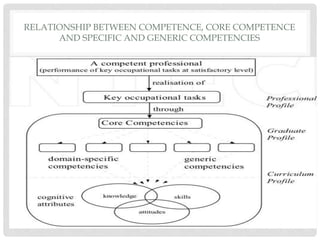
RELATIONSHIP BETWEEN COMPETENCE, CORE COMPETENCE
AND SPECIFIC AND GENERIC COMPETENCIES
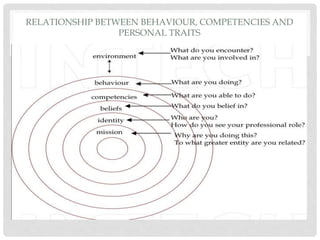
RELATIONSHIP BETWEEN BEHAVIOUR, COMPETENCIES AND
PERSONAL TRAITS
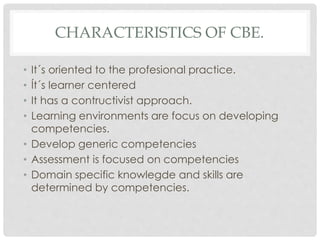
CHARACTERISTICS OF CBE.
• It´s oriented to the profesional practice.
• Ít´s learner centered
• It has a contructivist approach.
• Learning environments are focus on developing
competencies.
• Develop generic competencies
• Assessment is focused on competencies
• Domain specific knowlegde and skills are
determined by competencies.
CBE IN HIGHER EDUCATION
• Knowledge is seen as integrative
• From acquisition to application of knowledge
CRITIQUES OF CBE AND ITS USE IN
HIGHER EDUCATION
• Minor role of disciplinary knowledge
• A haphazard taking in of disciplinary knowledge by
students.
• Without knowledge, the learning task can not be
performened
• Specific knowledge and skills are required to
discover similarities and differences between old
and new.
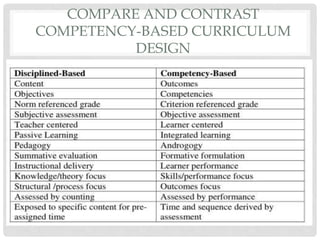
COMPARE AND CONTRAST
COMPETENCY-BASED CURRICULUM
DESIGN
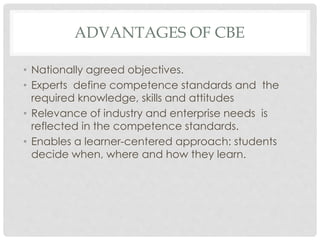
ADVANTAGES OF CBE
• Nationally agreed objectives.
• Experts define competence standards and the
required knowledge, skills and attitudes
• Relevance of industry and enterprise needs is
reflected in the competence standards.
• Enables a learner-centered approach: students
decide when, where and how they learn.
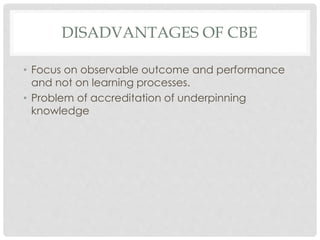
DISADVANTAGES OF CBE
• Focus on observable outcome and performance
and not on learning processes.
• Problem of accreditation of underpinning
knowledge

Competence based education

  • 1.
    B Y :Á G UE D A C A S T I L L O COMPETENCE BASED EDUCATION
  • 3.
    BACKGROUND TO CBE •Competency-based education was introduced in America towards the end of the 1960s in reaction to concerns that students are not taught the skills they require in life after school.
  • 4.
    BASIC CONCEPTS • Competency:is the capability to choose and use ( apply) and integrated combination of knowledge, skills and attitude with the intention to realise a task in a certain context. (generic) • Competence: is the capacity to relise «up to standard» the key ocupational task that characterise a profession. (specific)
  • 5.
    CLASSIFICATION • Domain specific:( cluster of knowledge, skills and attitutes within a specific content domain related to a profession) • Generic domain: ( basic set of transferable- capabilities used outside the profession) needed in all content domains.
  • 6.
    GENERIC COMPETENCIES • 1.Collecting, analyzing, and organizing information; • 2. Communicating ideas and information; • 3. Planning and organizing activities; • 4. Working with others in a team; • 5. Using mathematical ideas and techniques; • 6. Problem-solving • 7. Using technology • 8. Using cultural understanding
  • 7.
    RELATIONSHIP BETWEEN COMPETENCE,CORE COMPETENCE AND SPECIFIC AND GENERIC COMPETENCIES
  • 8.
    RELATIONSHIP BETWEEN BEHAVIOUR,COMPETENCIES AND PERSONAL TRAITS
  • 9.
    CHARACTERISTICS OF CBE. •It´s oriented to the profesional practice. • Ít´s learner centered • It has a contructivist approach. • Learning environments are focus on developing competencies. • Develop generic competencies • Assessment is focused on competencies • Domain specific knowlegde and skills are determined by competencies.
  • 10.
    CBE IN HIGHEREDUCATION • Knowledge is seen as integrative • From acquisition to application of knowledge
  • 11.
    CRITIQUES OF CBEAND ITS USE IN HIGHER EDUCATION • Minor role of disciplinary knowledge • A haphazard taking in of disciplinary knowledge by students. • Without knowledge, the learning task can not be performened • Specific knowledge and skills are required to discover similarities and differences between old and new.
  • 12.
  • 13.
    ADVANTAGES OF CBE •Nationally agreed objectives. • Experts define competence standards and the required knowledge, skills and attitudes • Relevance of industry and enterprise needs is reflected in the competence standards. • Enables a learner-centered approach: students decide when, where and how they learn.
  • 14.
    DISADVANTAGES OF CBE •Focus on observable outcome and performance and not on learning processes. • Problem of accreditation of underpinning knowledge