Student Name: A.Nithlavarnan
Registration No: 70943424
Subject: ESU4303-Project
Course: BACHELOR OF EDUCATION (NATURAL
SCIENCES) DEGREE PROGRAMME, ACADEMIC YEAR -
2011/12
IMPROVING STUDENTS’
ACADEMIC ACHIEVEMENT IN
BIOLOGY SUBJECT
Problem of the study
In today’s climate of school accountability, it is of paramount
importance for educators to search for ways to improve
student achievement.
Jaffna Hindu College is a leading national school in Jaffna
district.
There are 2315 students studying in this school. Students
selected to this school by merit based. Most of the students
passed the Grade-5 examination. Students’ achievement
G.C.E (O/L) of also in satisfactory level. In last two years this
school obtained 100% pass in G.C.E (O/L).
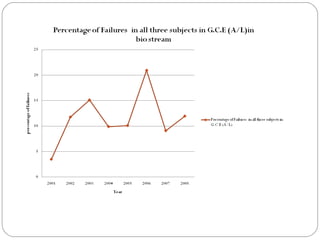
But in the G.C.E (A/L) performance is degreasing in recent
years. 65 students not passed any one of the subject in last
year. So, due to the above reason this project is becomes
predominant.
Introduction
 This action research purpose was to improve the
academic achievement of a group of G.C.E(A/L)
students in the subject of biology.
 Twenty two students from a J/Hindu College and
their parents participated in this study .
 There are 61 students studying bio – stream in the
class of 13D (batch of 2012). Out of 61 students only
22 weak students were selected for this study.
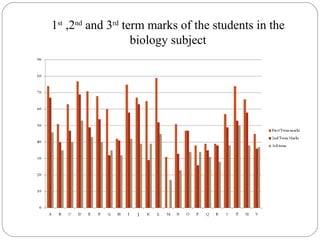
 Their performance in the biology subject in last
three terms were degreased. (The following graph
illustrated their performance.
1st
,2nd
and 3rd
term marks of the students in the
biology subject
Objectives of the project
To identify the problems faced by students
regarding learning of biology within the school.
To identify the problems faced by students
regarding learning of biology in their home and
private tuitions.
To increase the academic achievement level of each
students in the subject of biology by 10%.
Review of literature
 Academic culture
Students who become disengaged, discouraged and were unable
to develop strong bonds with teachers were most vulnerable to failure.
(Wheelock,1993)
In addition, other factors such as tedious lessons, over crowded
classrooms, and indifferent teachers contributed to students’ lack of
success in G.C.E(A/L).
The inventory was designed to explore various study habits and
note taking behaviours. The three areas of weaknesses detected were:
1. Failure to recopy lecture notes soon after class.
2. Failure to use any special method for learning new
terms, and
3. Waiting until the last minute to study for tests.
Review of literature(Cont..)
 Factors influencing student achievement
1) School size: The research conducted by Pool(2002) and
Bracey(2001) indicated that schools with lower student enrolment had
greater levels of student achievement than similar schools with higher
enrolment.
2.) Parents’ role: Parents play a key role in their children’s
development and learning; they can work as facilitators of their
children’s development and can effective in raising their children
academic level(Beveridge,2004).
3.) Teacher:Research shows that having a highly qualified teacher in
the classroom is the single most important factor in the academic
success.
Data collection methods
To collect data a variety of techniques were used
1. Pre-survey for students
2. Post-survey for students
3. Interviews with parents
4. Conducted parent-teacher conferences
5. Pre test in Biology
6. Post test in Biology
7. Data got from documents(Marks schedule, Attendance
Register)
Problems faced by students regarding learning of biology
in their home(based of student’s responses)
Sleeping feels when studying
Laziness
Duration of learning is less in home
No self learning in home
Often sleeping
There is no proper place for study in home
There is no hard work
Memorization is difficult
There is no freedom in home
Forgotten the studied matter
Methods which were used to improve the
students’ academic achievement
Conducted extra classes (morning & evening classes)
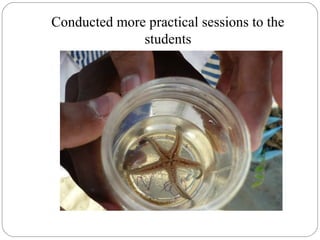
Conducted more practical sessions
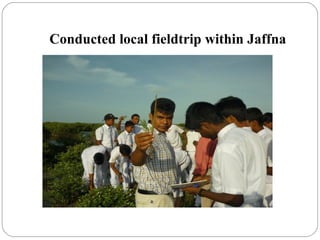
Organized and arranged local fieldtrip within Jaffna
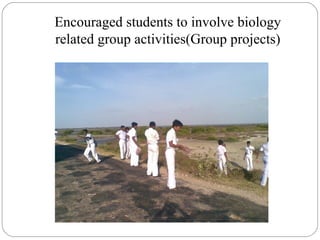
Encouraged biology related group activities
Conducted remedial teaching
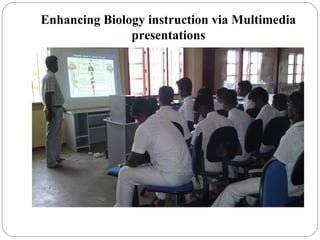
Enhancing Biology instruction via Multimedia
presentations
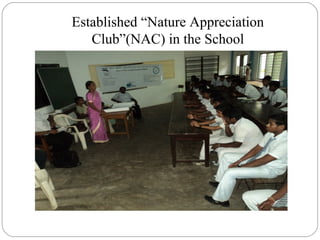
Established “Nature Appreciation Club”(NAC) in school
and encouraged students to involved biology related
activities through this club.
Conducted parent-teacher meeting regularly.
Encouraged students participate in biology seminar, which
conducted by Professor. Sarath Gottagama
Enhancing Biology instruction via Multimedia
presentations
Encouraged students to involve biology
related group activities(Group projects)
Established “Nature Appreciation
Club”(NAC) in the School
Conducted more practical sessions to the
students
Conducted local fieldtrip within Jaffna
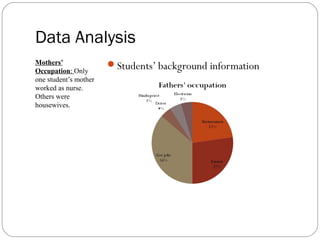
Data Analysis
Mothers’
Occupation: Only
one student’s mother
worked as nurse.
Others were
housewives.
Students’ background information
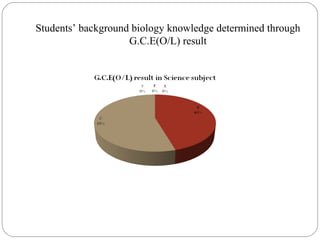
Students’ background biology knowledge determined through
G.C.E(O/L) result
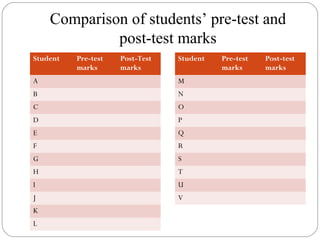
Comparison of students’ pre-test and
post-test marks
Student Pre-test
marks
Post-Test
marks
A
B
C
D
E
F
G
H
I
J
K
L
Student Pre-test
marks
Post-test
marks
M
N
O
P
Q
R
S
T
U
V
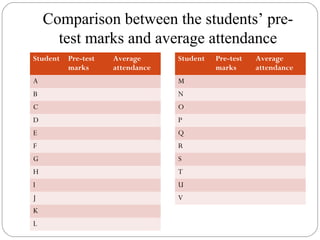
Comparison between the students’ pre-
test marks and average attendance
Student Pre-test
marks
Average
attendance
A
B
C
D
E
F
G
H
I
J
K
L
Student Pre-test
marks
Average
attendance
M
N
O
P
Q
R
S
T
U
V
Conclusions
The incorporation of IT into the biology classroom can be
accomplished by approaching a variety avenues. The
complexity of the biology topics introduced can be overcome
by connecting the biological principles to the students’ “real-
world” experiences.
Part of the solution to improve biology education is to help
ensure that students are taught by teachers with expertise in
their subject areas.
Parents often with their child’s teachers not to disturb but to
receive feedback as how your child is doing in science
courses and to uplift the child’s performance.
Limitations of the study
This work was limited by the narrow scope of those
factors related to students achievement that were
analyzed,
 the relatively brief time frame of the study, and
the small geographic region selected for the study.
Recommendations for future research
The researcher recommended that this study be;
o Replicated to include other factors
o Replicated for other subjects and other G.C.E(A/L)
streams to generate longitudinal data.
o Expanded to a larger population
References
1. Moza Ali Essa Alboainain(2008), Improving students’ achievement
through parent communication
2. Styron,R.&Peasant , E.(2010), Improving Student Achievement: can 9th
Grade Academies Make a Difference? International Journal of Education
Policy and Leadership 5(3). Retrived[DATE] from http://www.ijepl.org.
3. Cheryl Berg(2008), Academic Emotions in student achievement:
Promoting Engagement and Critical Thinking through Lessons in
Bioethical Dilemmas.
4. Karla B.Duvall, Increasing student achievement through the use of
reading strategy: Accelerated Reader
5. De.Fonseka,P&N (2007), Teaching the science of life at G.C.E (A/L), Daily
News,06/11/2007.
6. Vinobaba,P , Importance of Science education to students and society.

BEd.project ppt presentation

  • 1.
    Student Name: A.Nithlavarnan RegistrationNo: 70943424 Subject: ESU4303-Project Course: BACHELOR OF EDUCATION (NATURAL SCIENCES) DEGREE PROGRAMME, ACADEMIC YEAR - 2011/12 IMPROVING STUDENTS’ ACADEMIC ACHIEVEMENT IN BIOLOGY SUBJECT
  • 2.
    Problem of thestudy In today’s climate of school accountability, it is of paramount importance for educators to search for ways to improve student achievement. Jaffna Hindu College is a leading national school in Jaffna district. There are 2315 students studying in this school. Students selected to this school by merit based. Most of the students passed the Grade-5 examination. Students’ achievement G.C.E (O/L) of also in satisfactory level. In last two years this school obtained 100% pass in G.C.E (O/L). But in the G.C.E (A/L) performance is degreasing in recent years. 65 students not passed any one of the subject in last year. So, due to the above reason this project is becomes predominant.
  • 4.
    Introduction  This actionresearch purpose was to improve the academic achievement of a group of G.C.E(A/L) students in the subject of biology.  Twenty two students from a J/Hindu College and their parents participated in this study .  There are 61 students studying bio – stream in the class of 13D (batch of 2012). Out of 61 students only 22 weak students were selected for this study.  Their performance in the biology subject in last three terms were degreased. (The following graph illustrated their performance.
  • 5.
    1st ,2nd and 3rd term marksof the students in the biology subject
  • 6.
    Objectives of theproject To identify the problems faced by students regarding learning of biology within the school. To identify the problems faced by students regarding learning of biology in their home and private tuitions. To increase the academic achievement level of each students in the subject of biology by 10%.
  • 7.
    Review of literature Academic culture Students who become disengaged, discouraged and were unable to develop strong bonds with teachers were most vulnerable to failure. (Wheelock,1993) In addition, other factors such as tedious lessons, over crowded classrooms, and indifferent teachers contributed to students’ lack of success in G.C.E(A/L). The inventory was designed to explore various study habits and note taking behaviours. The three areas of weaknesses detected were: 1. Failure to recopy lecture notes soon after class. 2. Failure to use any special method for learning new terms, and 3. Waiting until the last minute to study for tests.
  • 8.
    Review of literature(Cont..) Factors influencing student achievement 1) School size: The research conducted by Pool(2002) and Bracey(2001) indicated that schools with lower student enrolment had greater levels of student achievement than similar schools with higher enrolment. 2.) Parents’ role: Parents play a key role in their children’s development and learning; they can work as facilitators of their children’s development and can effective in raising their children academic level(Beveridge,2004). 3.) Teacher:Research shows that having a highly qualified teacher in the classroom is the single most important factor in the academic success.
  • 9.
    Data collection methods Tocollect data a variety of techniques were used 1. Pre-survey for students 2. Post-survey for students 3. Interviews with parents 4. Conducted parent-teacher conferences 5. Pre test in Biology 6. Post test in Biology 7. Data got from documents(Marks schedule, Attendance Register)
  • 10.
    Problems faced bystudents regarding learning of biology in their home(based of student’s responses) Sleeping feels when studying Laziness Duration of learning is less in home No self learning in home Often sleeping There is no proper place for study in home There is no hard work Memorization is difficult There is no freedom in home Forgotten the studied matter
  • 11.
    Methods which wereused to improve the students’ academic achievement Conducted extra classes (morning & evening classes) Conducted more practical sessions Organized and arranged local fieldtrip within Jaffna Encouraged biology related group activities Conducted remedial teaching Enhancing Biology instruction via Multimedia presentations Established “Nature Appreciation Club”(NAC) in school and encouraged students to involved biology related activities through this club. Conducted parent-teacher meeting regularly. Encouraged students participate in biology seminar, which conducted by Professor. Sarath Gottagama
  • 12.
    Enhancing Biology instructionvia Multimedia presentations
  • 13.
    Encouraged students toinvolve biology related group activities(Group projects)
  • 14.
  • 15.
    Conducted more practicalsessions to the students
  • 16.
  • 17.
    Data Analysis Mothers’ Occupation: Only onestudent’s mother worked as nurse. Others were housewives. Students’ background information
  • 18.
    Students’ background biologyknowledge determined through G.C.E(O/L) result
  • 19.
    Comparison of students’pre-test and post-test marks Student Pre-test marks Post-Test marks A B C D E F G H I J K L Student Pre-test marks Post-test marks M N O P Q R S T U V
  • 20.
    Comparison between thestudents’ pre- test marks and average attendance Student Pre-test marks Average attendance A B C D E F G H I J K L Student Pre-test marks Average attendance M N O P Q R S T U V
  • 21.
    Conclusions The incorporation ofIT into the biology classroom can be accomplished by approaching a variety avenues. The complexity of the biology topics introduced can be overcome by connecting the biological principles to the students’ “real- world” experiences. Part of the solution to improve biology education is to help ensure that students are taught by teachers with expertise in their subject areas. Parents often with their child’s teachers not to disturb but to receive feedback as how your child is doing in science courses and to uplift the child’s performance.
  • 22.
    Limitations of thestudy This work was limited by the narrow scope of those factors related to students achievement that were analyzed,  the relatively brief time frame of the study, and the small geographic region selected for the study.
  • 23.
    Recommendations for futureresearch The researcher recommended that this study be; o Replicated to include other factors o Replicated for other subjects and other G.C.E(A/L) streams to generate longitudinal data. o Expanded to a larger population
  • 24.
    References 1. Moza AliEssa Alboainain(2008), Improving students’ achievement through parent communication 2. Styron,R.&Peasant , E.(2010), Improving Student Achievement: can 9th Grade Academies Make a Difference? International Journal of Education Policy and Leadership 5(3). Retrived[DATE] from http://www.ijepl.org. 3. Cheryl Berg(2008), Academic Emotions in student achievement: Promoting Engagement and Critical Thinking through Lessons in Bioethical Dilemmas. 4. Karla B.Duvall, Increasing student achievement through the use of reading strategy: Accelerated Reader 5. De.Fonseka,P&N (2007), Teaching the science of life at G.C.E (A/L), Daily News,06/11/2007. 6. Vinobaba,P , Importance of Science education to students and society.