WELCOME
TO CAPACITY BUILDING PROGRAMME
SEMINAR CUM WORKSHOP
FOR PRIMARY SCIENCE
UNDERTHE AEGIS OF DAV CAE
DATE- 31-03-2022
by – Amrita Singh
ICE BREAKING
ACTIVITY
IFYOU
GET A
CHANCE
TO BE A
UTENSIL
WHICH
UTENSIL
YOU
WANT
TO BE
AND
WHY?
COMPETENCEY BASED EDUCATION (CBE)
What?
• Competency Based Education is a model education that focuses on the
demonstrations and application of learning, rather than on the time spend
for a course.
• CBL is an outcome based approach.
• CBL focuses on Minimum required core content.
• CBL does not believe on traditional learning principle, “greater the content”,
“greater the achievement” on the students.
PURPOSE OF CBE
• Measure student learning rather than time.
• Harness the power of technology for teaching and learning.
• Fundamentally change the faculty role.
• Define competencies and develop valid, reliable assessments.
Characteristics of CBE
• Learning should be self-paced.
• Flexible training approaches including large group methos, small group
activities and individual study are essential components.
• Satisfactory completion of training is based on achievement of all specified
competencies.
• Supporting theory is integrated with skill practice.
• Essential knowledge is learned to support the performance skills.
• Participants knowledge and skills are assessed as they entire the program.
• Competencies are carefully selected.
• Variety of support materials including print, audiovisual and simulations key
to the skills being mastered is used.
EXAMPLES OF
COMPETENCY
BASED LEARNING
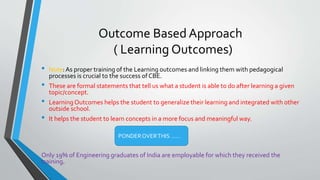
Outcome Based Approach
( Learning Outcomes)
• Note: As proper training of the Learning outcomes and linking them with pedagogical
processes is crucial to the success of CBE.
• These are formal statements that tell us what a student is able to do after learning a given
topic/concept.
• LearningOutcomes helps the student to generalize their learning and integrated with other
outside school.
• It helps the student to learn concepts in a more focus and meaningful way.
Only 19% of Engineering graduates of India are employable for which they received the
training.
PONDEROVERTHIS ……
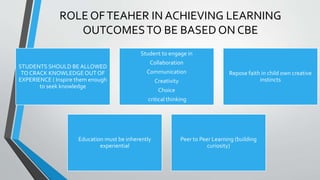
ROLE OFTEAHER IN ACHIEVING LEARNING
OUTCOMESTO BE BASED ON CBE
STUDENTS SHOULD BE ALLOWED
TO CRACK KNOWLEDGE OUT OF
EXPERIENCE ( Inspire them enough
to seek knowledge
Student to engage in
Collaboration
Communication
Creativity
Choice
critical thinking
Repose faith in child own creative
instincts
Education must be inherently
experiential
Peer to Peer Learning (building
curiosity)
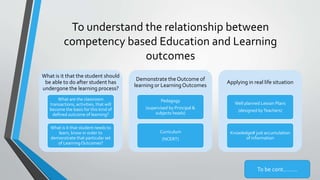
To understand the relationship between
competency based Education and Learning
outcomes
What is it that the student should
be able to do after student has
undergone the learning process?
What are the classroom
transactions, activities, that will
become the basis for this kind of
defined outcome of learning?
What is it that student needs to
learn, know in order to
demonstrate that particular set
of LearningOutcomes?
Demonstrate the Outcome of
learning or LearningOutcomes
Pedagogy
(supervised by Principal &
subjects heads)
Curriculum
(NCERT)
Applying in real life situation
Well planned Lesson Plans
(designed byTeachers)
Knowledge# just accumulation
of information
To be cont………
How will teacher know at
what level of learning the
student is?
How will the
teacher check
the learning or
how will the
student
demonstrate
that learning?
Criterion Referenced
Testing
Assessment
based on
Learning
Outcomes.
Concise and written
descriptions of what
students are expected to
know and be able to do at a
specific stage of their
education.
Continuous and
Comprehensive
Evaluation
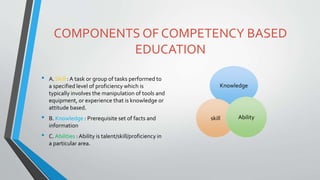
COMPONENTS OF COMPETENCY BASED
EDUCATION
• A. Skill : A task or group of tasks performed to
a specified level of proficiency which is
typically involves the manipulation of tools and
equipment, or experience that is knowledge or
attitude based.
• B. Knowledge : Prerequisite set of facts and
information
• C. Abilities : Ability is talent/skill/proficiency in
a particular area.
Knowledge
skill Ability
HOW IS COMPETENCY DIFFERENT FROM SKILLS?
Skills + knowledge+ Abilities+Attitude= Enable
learner to perform a task effectively and efficiently
in real life situations.
•Skills are specific to a
task.
•Skills can be learnt quicker
than competency ( less
time is required).
• Competencies incorporate a
set of skills with abilities and
knowledge.
• To develop the competency in
learner comparatively more
time is required,
TRADITIONAL EDUCATIONVS COMPETENCY
BASED EDUCATION
SCHOOLS ARE INVITEDTO SHIFTTHE FOCUS
FROM SYLLABUS TO LEARNING OUTCOMES
PASSIVE
LEARNING
FRAGMENTED
CURRICULUM
FACTS AND
MEMORIZATION
SPOON FEED
FACTS
School centrality (restricted to
classroom teaching)
Active learning/
Experiential learning
Integrated
curriculum
High OrderThinking
Leave space for
independent thinking
Society centrality
(hands on project)
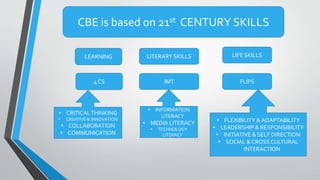
CBE is based on 21st CENTURY SKILLS
LEARNING LITERARY SKILLS LIFE SKILLS
• CRITICALTHINKING
• CREATIVE & INNOVATION
• COLLABORATION
• COMMUNICATION
4 CS IMT FLIPS
• INFORMATION
LITERACY
• MEDIA LITERACY
• TECHNOLOGY
LITERACY
• FLEXIBILITY & ADAPTABILITY
• LEADERSHIP & RESPONSIBILITY
• INITIATIVE & SELF DIRECTION
• SOCIAL & CROSS CULTURAL
INTERACTION
Innovation
Project Based Learning Virtual reality
Two is Enough
Give them a Break
Let them Free
Activities
To explore, research and use all the tools to uncover
something new. It involves a different way of looking
at problems and solving them.
Communication skills convey your feelings, views, reasons, suggestions, arguments and information to
the other person through your words, action, facial expressions and build up social and interpersonal
skills.
COMPETENCIES AT PRIMARY LEVEL
• LANGUAGE COMPETENCIES
• MATHEMATICS COMPETENCIES
• ENVIRONMENTAL STUDIES COMPETENCIES
ENVIRONMENTAL STUDIES COMPETENCIES
• CLASS I – Courtesy to elders, peers, family, neighbours
• CLASS III – List of occupations produces daily need activities
• CLASS IV – Experiment HOWTO PURIFY DRINKING WATER?
• CLASSV – Identifies physical features of the map and describe them.
LANGUAGE COMPETENCIES
• CLASS III – Speak with correct pronunciation
• CLASS IV – After reading text he or she is able to answer questions like
since/because.
• CLASSV – Read Print & Handwriting freely
IMT makes the learning environment more interesting than a traditional classroom
environment and helps the students perform better in their respective careers.
RECAPITULATION
• 1. CBE is a …………………….. Not a product.
• 2. CBE has fundamentally changed the faculty role. (true/false)
• 3.Enlist the components of Competency Based Education.
• 4. Define the term 4’c.
ANSWERS
• 1. PROCESS
• 2.TRUE
• 3. SKILLS, KNOWLEDGE, ABILITIES
• 4. CRITICALTHINKING, CREATIVE AND INNOVATION, COLLABORATION,
COMMUNICATION
THANKYOU
“DON’T
ASPIRETO BE
THE BEST IN
THETEAM.
ASPIRETO BE
THE BEST FORTHE
TEAM.”

COMPETENCEY BASED EDUCATION (CBE).pptx

  • 1.
    WELCOME TO CAPACITY BUILDINGPROGRAMME SEMINAR CUM WORKSHOP FOR PRIMARY SCIENCE UNDERTHE AEGIS OF DAV CAE DATE- 31-03-2022 by – Amrita Singh
  • 2.
  • 3.
    IFYOU GET A CHANCE TO BEA UTENSIL WHICH UTENSIL YOU WANT TO BE AND WHY?
  • 6.
    COMPETENCEY BASED EDUCATION(CBE) What? • Competency Based Education is a model education that focuses on the demonstrations and application of learning, rather than on the time spend for a course. • CBL is an outcome based approach. • CBL focuses on Minimum required core content. • CBL does not believe on traditional learning principle, “greater the content”, “greater the achievement” on the students.
  • 7.
    PURPOSE OF CBE •Measure student learning rather than time. • Harness the power of technology for teaching and learning. • Fundamentally change the faculty role. • Define competencies and develop valid, reliable assessments.
  • 8.
    Characteristics of CBE •Learning should be self-paced. • Flexible training approaches including large group methos, small group activities and individual study are essential components. • Satisfactory completion of training is based on achievement of all specified competencies. • Supporting theory is integrated with skill practice. • Essential knowledge is learned to support the performance skills. • Participants knowledge and skills are assessed as they entire the program. • Competencies are carefully selected. • Variety of support materials including print, audiovisual and simulations key to the skills being mastered is used.
  • 9.
  • 11.
    Outcome Based Approach (Learning Outcomes) • Note: As proper training of the Learning outcomes and linking them with pedagogical processes is crucial to the success of CBE. • These are formal statements that tell us what a student is able to do after learning a given topic/concept. • LearningOutcomes helps the student to generalize their learning and integrated with other outside school. • It helps the student to learn concepts in a more focus and meaningful way. Only 19% of Engineering graduates of India are employable for which they received the training. PONDEROVERTHIS ……
  • 12.
    ROLE OFTEAHER INACHIEVING LEARNING OUTCOMESTO BE BASED ON CBE STUDENTS SHOULD BE ALLOWED TO CRACK KNOWLEDGE OUT OF EXPERIENCE ( Inspire them enough to seek knowledge Student to engage in Collaboration Communication Creativity Choice critical thinking Repose faith in child own creative instincts Education must be inherently experiential Peer to Peer Learning (building curiosity)
  • 13.
    To understand therelationship between competency based Education and Learning outcomes What is it that the student should be able to do after student has undergone the learning process? What are the classroom transactions, activities, that will become the basis for this kind of defined outcome of learning? What is it that student needs to learn, know in order to demonstrate that particular set of LearningOutcomes? Demonstrate the Outcome of learning or LearningOutcomes Pedagogy (supervised by Principal & subjects heads) Curriculum (NCERT) Applying in real life situation Well planned Lesson Plans (designed byTeachers) Knowledge# just accumulation of information To be cont………
  • 14.
    How will teacherknow at what level of learning the student is? How will the teacher check the learning or how will the student demonstrate that learning? Criterion Referenced Testing Assessment based on Learning Outcomes. Concise and written descriptions of what students are expected to know and be able to do at a specific stage of their education. Continuous and Comprehensive Evaluation
  • 15.
    COMPONENTS OF COMPETENCYBASED EDUCATION • A. Skill : A task or group of tasks performed to a specified level of proficiency which is typically involves the manipulation of tools and equipment, or experience that is knowledge or attitude based. • B. Knowledge : Prerequisite set of facts and information • C. Abilities : Ability is talent/skill/proficiency in a particular area. Knowledge skill Ability
  • 16.
    HOW IS COMPETENCYDIFFERENT FROM SKILLS? Skills + knowledge+ Abilities+Attitude= Enable learner to perform a task effectively and efficiently in real life situations. •Skills are specific to a task. •Skills can be learnt quicker than competency ( less time is required). • Competencies incorporate a set of skills with abilities and knowledge. • To develop the competency in learner comparatively more time is required,
  • 17.
    TRADITIONAL EDUCATIONVS COMPETENCY BASEDEDUCATION SCHOOLS ARE INVITEDTO SHIFTTHE FOCUS FROM SYLLABUS TO LEARNING OUTCOMES PASSIVE LEARNING FRAGMENTED CURRICULUM FACTS AND MEMORIZATION SPOON FEED FACTS School centrality (restricted to classroom teaching) Active learning/ Experiential learning Integrated curriculum High OrderThinking Leave space for independent thinking Society centrality (hands on project)
  • 18.
    CBE is basedon 21st CENTURY SKILLS LEARNING LITERARY SKILLS LIFE SKILLS • CRITICALTHINKING • CREATIVE & INNOVATION • COLLABORATION • COMMUNICATION 4 CS IMT FLIPS • INFORMATION LITERACY • MEDIA LITERACY • TECHNOLOGY LITERACY • FLEXIBILITY & ADAPTABILITY • LEADERSHIP & RESPONSIBILITY • INITIATIVE & SELF DIRECTION • SOCIAL & CROSS CULTURAL INTERACTION
  • 21.
    Innovation Project Based LearningVirtual reality Two is Enough Give them a Break Let them Free Activities To explore, research and use all the tools to uncover something new. It involves a different way of looking at problems and solving them.
  • 23.
    Communication skills conveyyour feelings, views, reasons, suggestions, arguments and information to the other person through your words, action, facial expressions and build up social and interpersonal skills.
  • 24.
    COMPETENCIES AT PRIMARYLEVEL • LANGUAGE COMPETENCIES • MATHEMATICS COMPETENCIES • ENVIRONMENTAL STUDIES COMPETENCIES
  • 25.
    ENVIRONMENTAL STUDIES COMPETENCIES •CLASS I – Courtesy to elders, peers, family, neighbours • CLASS III – List of occupations produces daily need activities • CLASS IV – Experiment HOWTO PURIFY DRINKING WATER? • CLASSV – Identifies physical features of the map and describe them.
  • 26.
    LANGUAGE COMPETENCIES • CLASSIII – Speak with correct pronunciation • CLASS IV – After reading text he or she is able to answer questions like since/because. • CLASSV – Read Print & Handwriting freely
  • 27.
    IMT makes thelearning environment more interesting than a traditional classroom environment and helps the students perform better in their respective careers.
  • 29.
    RECAPITULATION • 1. CBEis a …………………….. Not a product. • 2. CBE has fundamentally changed the faculty role. (true/false) • 3.Enlist the components of Competency Based Education. • 4. Define the term 4’c.
  • 30.
    ANSWERS • 1. PROCESS •2.TRUE • 3. SKILLS, KNOWLEDGE, ABILITIES • 4. CRITICALTHINKING, CREATIVE AND INNOVATION, COLLABORATION, COMMUNICATION
  • 31.
    THANKYOU “DON’T ASPIRETO BE THE BESTIN THETEAM. ASPIRETO BE THE BEST FORTHE TEAM.”