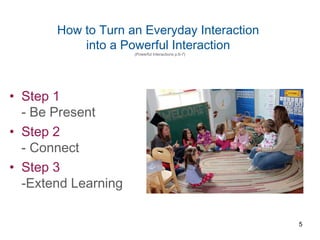
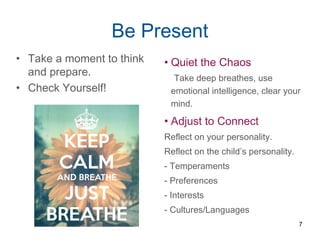
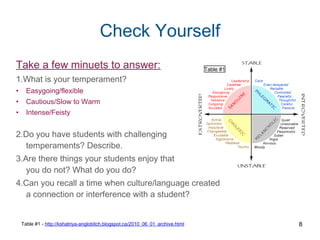
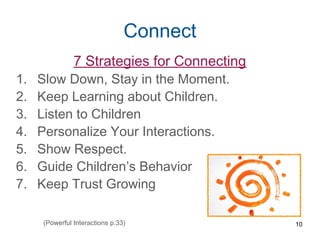
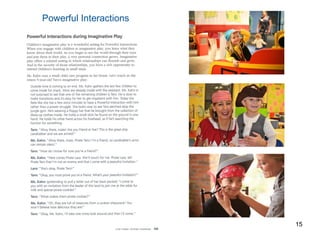
This presentation discusses creating powerful interactions with children in the classroom to facilitate growth and development. It describes the three steps of powerful interactions as: 1) be present by preparing and checking your own mindset and temperament, 2) connect with children by learning about them and personalizing interactions, and 3) extend learning through strategies like inspiring imaginative play and problem solving. Specific techniques are provided for each step, like slowing down, listening, asking questions, and using rich vocabulary. The benefits of powerful interactions for teachers include more intentional and individualized instructions and an improved classroom climate.


![References
• Amy Laura Dombro, Judy Jablon, Charlotte Stetson (2011)
Powerful Interactions: How to connect with children to extend
their learning
• Hans Eysenck (2014) Psychology Topics: Personality [0nline]
http://www.alleydog.com/topicspersonality.php#.U58p9qjPq2w
17](https://image.slidesharecdn.com/ourhappyclassroom-stafftraining-140616145409-phpapp02/85/Our-Happy-Classroom-Staff-Training-17-320.jpg)


