2022-2023 AY
Competency-based Curriculum:
Improving Secondary Teaching & Learning
COMPETENCY-BASED
CURRICULUM
COMPETENCY-BASED
STRATEGIES
COMPETENCY-BASED
ASSESSMENTS
TENTATIVE TRAINING
PROGRAM
PRESENTATION OVERVIEW
Hon. Dr. Louis Zabaneh
Minister of State
Ministry of Education, Culture,
Science & Technology
HOW DID WE GET HERE?
OPENING REMARKS
*
Conducted between January and August 2021
Virtual meetings with 18 stakeholder groups
Unanimous agreement on the elephant in the room
Small sample chosen for a pilot project
Leading in this area according to UNESCO-IBE
*
*
*
*
Consultations on Curriculum Overload
CURRICULUM
REFORM STEERING
COMMITTEE (CRSC)
ESTABLISHED WITH
MAJOR
STAKEHOLDERS
PARALLEL
CONSULTATIONS
WITH TEACHERS
HELD ACROSS THE
COUNTRY
CRSC USED BEST
PRACTICE
(UNESCO IBE
FRAMEWORK) TO
COMPLETE WORK
IN MAY 2022
WORKING GROUPS
ESTABLISHED;
CONSULTANTS
CONTRACTED; WORK
IN PROGRESS
New Curriculum Framework and Revolution
Curriculum & Assessment Unit
Mrs. Ines Paquiul and
Ms. Michelle Turton
NATIONAL CURRICULUM FRAMEWORK
[COMPETENCY-BASED EDUCATION]
COMPETENCY-BASED CURRICULUM
High quality
education
focused on
competencies
Productive
local and
global citizens
living
harmoniously
Sustainable
human
development
Teach values
and principles,
innovative
knowledge and
skills
❖ Unity through Diversity
❖ Hospitality
❖ Cooperation
❖ Responsibility
❖ Equity
❖ Virtue
❖ Faith in God
AREAS
OF
LEARNING
FOSTERING
COMPETENCES
CROSS-
CURRICULAR
LEARNING
❏ Language
❏ Mathematics
❏ Expressive Arts
❏ Physical Education &
Wellness
❏ Science &
Technology
❏ Civics Education &
History
❏ Religion / Personal
Leadership
❖ appreciation of sacred nature
of human person & character
development
❖ emotional intelligence &
effective communication skills
❖ critical & innovative/inventive
thinking
❖ collaboration
❖ multicultural appreciation
❖ digital literacy
❖ understanding of & advocacy
for sustainable human
development
● integrated throughout
curriculum
● embedded in all learning
areas across several
subjects
● Top 4 identified:
1. Education for sustainable
human development
2. preservation and
promotion of our
multicultural society
3. Media awareness
4. challenges, opportunities
and impact of technology
COMPETENCY-BASED EDUCATION (CBE)
❏ places students at the center of the teaching and
learning experience
❏ the teacher prepares the classroom for active student
engagement and guides the learning process
❏ helps to create an inclusive culture where all students
feel safe and respected
“To increase student engagement and ownership of learning, we should give students opportunities to
do meaningful work-work that makes a difference locally, nationally and globally” (Eric Williams)
Role of School Leaders Role of Teachers Role of Students
❏ lead and support teachers
and students in transitioning
to CBE
❏ provide guidance and
assistance on teaching
learning matters
❏ plan and lead on-going
school-based training
❏ monitor and evaluate the
transition to CBE
❏ engage the Managing
Authority to support CBE
● develop learning experiences
that engage and support
students
● provide students with timely &
descriptive feedback to guide
their progress
● create opportunities for
students to generate &
evaluate new ideas
● guide students to apply
content knowledge & skills
across the curriculum
● provide multiple opportunities
so as to develop higher-order
thinking skills.
● document students progress
and provide accurate reports
➢ develop their capacities to
become independent and
lifelong learners.
➢ feel safe and take on
challenging tasks to gain
new knowledge and skills
➢ take responsibility for their
learning, produce original
work
➢ demonstrate learning in
ways that are relevant
(transfer of learning)
➢ develop confidence and
remain engaged
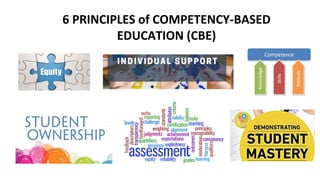
6 PRINCIPLES of COMPETENCY-BASED
EDUCATION (CBE)
Dr. Priscilla Brown
Education Consultant
COMPETENCY-BASED STRATEGIES
COMPETENCY-BASED TEACHING STRATEGIES
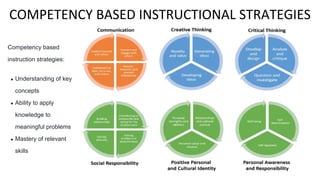
COMPETENCY BASED INSTRUCTIONAL STRATEGIES
Competency based
instruction strategies:
● Understanding of key
concepts
● Ability to apply
knowledge to
meaningful problems
● Mastery of relevant
skills
COMPETENCY BASED INSTRUCTIONAL STRATEGIES
● PROBLEM BASED LEARNING (PBL)
PBL is a student-
centered, inquiry-based
instructional model in
which learners engage
with an authentic, ill-
structured problem.
PROBLEM BASED LEARNING (Secondary)
FOCUS: CRITICAL THINKING AND SKILLS DEVELOPMENT
-5 E’s of Inquiry
-Project Based Learning
-Cooperative Learning
(constructivism)
-Infusion Model of Teaching
-Scientific Method
Dr. Mathias R. Vairez Jr.
Education Consultant
COMPETENCY-BASED ASSESSMENTS
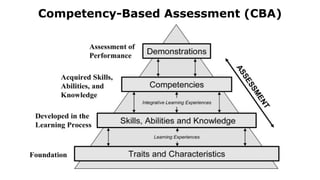
Competency-Based Assessment (CBA)
What is Competency-Based Assessment (CBA)
CBA is:
● A learning experience that is
○ meaningful,
○ positive, &
○ empowering
● Yields evidence that is
○ timely,
○ relevant, &
○ actionable
What is Competency-Based Assessment (CBA)
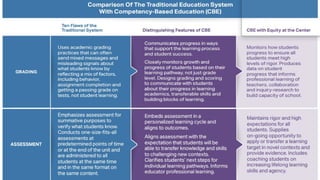
Paradigm Shift in Assessment
Less of … More of …
Assessment of Learning (Summative) Assessment for Learning (Formative)
Assessment of Knowledge acquired via
rote learning (T-Centered)
Assessment of Competencies developed via
meaningful & authentic learning (S-Centered)
Norm-Referenced Assessments Criterion-Referenced Assessments
Competition Collaboration & Cooperation (PBL & PBL)
Elements of CBA
Meaningful Assessment & CBA
Meaningful assessment includes:
● Formative feedback
○ that is useful, growth-oriented, and actionable.
● Data from formative assessments and student feedback in
real time
○ to differentiate instruction, and
○ to provide robust supports.
● Summative assessments
○ that provide multiple opportunities for students to
advance
■ by demonstrating what they know and can do.
● Diverse forms of evidence
○ that encourage student voice.
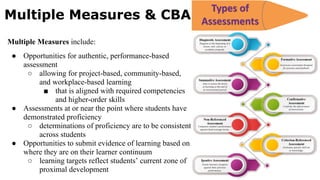
Multiple Measures & CBA
Multiple Measures include:
● Opportunities for authentic, performance-based
assessment
○ allowing for project-based, community-based,
and workplace-based learning
■ that is aligned with required competencies
and higher-order skills
● Assessments at or near the point where students have
demonstrated proficiency
○ determinations of proficiency are to be consistent
across students
● Opportunities to submit evidence of learning based on
where they are on their learner continuum
○ learning targets reflect students’ current zone of
proximal development
Process of Assessing in CBA
● Teachers assess competencies in multiple contexts and multiple ways.
○ Examples of techniques for assessing student knowledge & level of proficiency include:
■ formative assessments,
■ digital learning tools,
■ performance-based assessments,
■ presentations, and
■ peer-to-peer instruction.
● Attention on student learning, not student grades.
○ Student progress is often categorized in three or four levels that capture:
■ 1) mastery or high performance;
■ 2) proficient; and
■ 3) novice or still working toward proficiency.
● Grades may still be used to rank progress toward proficiency.
○ Essentially, students progress when they have demonstrated A- or B-level work.
■ Students may not progress with a C or lower as they have not demonstrated
proficiency.
CBA 6 Steps
1. Conduct Diagnostic Activity - Pre-Assessment
a. Assess prior learning in terms of competencies to personalizing teaching
2. Design Instructional Activities
3. Design Assessment Activities
4. Define Learning Outcomes
a. Use clear action verbs
b. Discreetly measurable
c. Learners understand what their goals are
5. Choose Assessment Tools
a. Authentic assessment or Evidence-based assessment
b. Should be in line with real-life experiences
6. Design Student-Friendly Rubrics
a. Working guide for teachers and students
b. Given before the commencement of assessments to let the students know the criteria on what their work
will be judged
c. Evaluate student's performance based on the total range of criteria rather than a numerical score
Assessment Literacy
Assessment Literacy: Educators and Educational Leaders
● Develop a collection of knowledge and skills of appropriate assessment
designs, implementation, interpretation, and use
● Know to create and/or select a variety of assessments to improve learning
and teaching, grading, program evaluation, and accountability
● Able to appropriately interpret assessments data and then take defensible
instructional and policy actions to improve students success in school and
life
Mrs. Cecilia Ramirez-Smith
Deputy Chief Education Officer
TENTATIVE TRAINING PROGRAM
25 SECONDARY SCHOOLS
12 GOV’T & 13 GRANT-AIDED SCHOOLS
11 SCHOOLS NEW TO CBE
VARIED TRAINING REQUIREMENT
ROUND 1 TRAINING
Competency-
based
Assessment
Strategies
Competency-
based Teaching
Strategies
Competency-
based Education
NORTH
Muffles College
Belize High School of Agriculture
Belize Adventist College
Bishop Martin High School
Orange Walk Technical High
School
Chunox St. Viator Vocational HS
CENTRAL
Pallotti High School
St. Catherine’s Academy
Excelsior High School
Gwen Lizarraga High School
Sadie Vernon High School
Maud Williams High School
King’s College
Belize Rural High School
Anglican Cathedral College
Ladyville Technical High
School
WEST
St. Ignatius High School
Sacred Heart College
Belmopan Methodist HS
Alvin Young Nazarene HS
Mopan Technical High School
SOUTH
Bella Vista Government HS
Georgetown Technical HS
Stann Creek Ecumenical
College
Corazon Creek Technical HS
SEPTEMBER 2022
Monday Tuesday Wednesday Thursday Friday
12 13 ACC (34)
SCEC (59)
BMHS-CY (24)
MTHS (31)
CSVVHS (7)
AYNHS (8)
MWHS (24)
EHS (12)
BHSA (15)
214
14 BAC (24)
PHS (29)
SCA (40)
SHC (50)
SIHS (22)
KC (8)
GLHS (24)
SVHS (16)
213
15 OWTHS (53)
LTHS (30)
GTHS (34)
BMHS-OW (26)
CCTHS (21)
BRHS (12)
BVGHS (7)
183
16
19 20 ACC (34)
SCEC (59)
BMHS-CY (24)
MTHS (31)
CSVVHS (7)
AYNHS (8)
163
21 22 OWTHS (53)
LTHS (30)
GTHS (34)
BMHS-OW (26)
CCTHS (21)
MC (40)
204
23
26 27 ACC (34)
SCEC (59)
BMHS-CY (24)
MTHS (31)
CSVVHS (7)
AYNHS (8)
163
28 29 OWTHS (53)
LTHS (30)
GTHS (34)
BMHS-OW (26)
CCTHS (21)
MC (40)
204
30
OCTOBER 2022
3 4 ACC (34)
SCEC (59)
BMHS-CY (24)
MTHS (31)
CSVVHS (7)
AYNHS (8)
MWHS (24)
EHS (12)
BHSA (15)
214
5 BAC (24)
PHS (29)
SCA (40)
SHC (50)
SIHS (22)
KC (8)
GLHS (24)
SVHS (16)
213
6 OWTHS (53)
LTHS (30)
GTHS (34)
BMHS-OW (26)
CCTHS (21)
BRHS (12)
BVGHS (7)
MC (40)
223
7
CBE-Assessment
CBE-Strategies
CBE-CF
References
Dewey, J. (1961). Dewey on Education. New York: Bureau of Publications, Teachers College,
Columbia University, LB875, D368 1961X.
Hmelo-Silver, C.E. (2004) Problem-Based Learning: What and How Do Students Learn?
Educational Psychology Review, 16, 235-266.
http://dx.doi.org/10.1023/B:EDPR.0000034022.16470.f3
Ho, M.-C., Hung, Y.-C., & Chou, C.-H. (2002, April 1). Phase and anti-phase synchronization of two chaotic
systems by using active control. Physics Letters A. Retrieved August 18, 2022, from
https://www.sciencedirect.com/science/article/abs/pii/S0375960102000749
Theories of learning in educational psychology. (n.d.). Retrieved August 18, 2022, from
https://www.demenzemedicinagenerale.net/images/mens-
sana/Theories_of_Learning_in_Educational_Psychology.pdf

Competency-based Curriculum_Improving Secondary Teaching Learning.pdf

  • 1.
  • 2.
  • 3.
    Hon. Dr. LouisZabaneh Minister of State Ministry of Education, Culture, Science & Technology HOW DID WE GET HERE? OPENING REMARKS
  • 4.
    * Conducted between Januaryand August 2021 Virtual meetings with 18 stakeholder groups Unanimous agreement on the elephant in the room Small sample chosen for a pilot project Leading in this area according to UNESCO-IBE * * * * Consultations on Curriculum Overload
  • 5.
    CURRICULUM REFORM STEERING COMMITTEE (CRSC) ESTABLISHEDWITH MAJOR STAKEHOLDERS PARALLEL CONSULTATIONS WITH TEACHERS HELD ACROSS THE COUNTRY CRSC USED BEST PRACTICE (UNESCO IBE FRAMEWORK) TO COMPLETE WORK IN MAY 2022 WORKING GROUPS ESTABLISHED; CONSULTANTS CONTRACTED; WORK IN PROGRESS New Curriculum Framework and Revolution
  • 6.
    Curriculum & AssessmentUnit Mrs. Ines Paquiul and Ms. Michelle Turton NATIONAL CURRICULUM FRAMEWORK [COMPETENCY-BASED EDUCATION] COMPETENCY-BASED CURRICULUM
  • 9.
    High quality education focused on competencies Productive localand global citizens living harmoniously Sustainable human development Teach values and principles, innovative knowledge and skills
  • 10.
    ❖ Unity throughDiversity ❖ Hospitality ❖ Cooperation ❖ Responsibility ❖ Equity ❖ Virtue ❖ Faith in God
  • 11.
    AREAS OF LEARNING FOSTERING COMPETENCES CROSS- CURRICULAR LEARNING ❏ Language ❏ Mathematics ❏Expressive Arts ❏ Physical Education & Wellness ❏ Science & Technology ❏ Civics Education & History ❏ Religion / Personal Leadership ❖ appreciation of sacred nature of human person & character development ❖ emotional intelligence & effective communication skills ❖ critical & innovative/inventive thinking ❖ collaboration ❖ multicultural appreciation ❖ digital literacy ❖ understanding of & advocacy for sustainable human development ● integrated throughout curriculum ● embedded in all learning areas across several subjects ● Top 4 identified: 1. Education for sustainable human development 2. preservation and promotion of our multicultural society 3. Media awareness 4. challenges, opportunities and impact of technology
  • 13.
    COMPETENCY-BASED EDUCATION (CBE) ❏places students at the center of the teaching and learning experience ❏ the teacher prepares the classroom for active student engagement and guides the learning process ❏ helps to create an inclusive culture where all students feel safe and respected “To increase student engagement and ownership of learning, we should give students opportunities to do meaningful work-work that makes a difference locally, nationally and globally” (Eric Williams)
  • 14.
    Role of SchoolLeaders Role of Teachers Role of Students ❏ lead and support teachers and students in transitioning to CBE ❏ provide guidance and assistance on teaching learning matters ❏ plan and lead on-going school-based training ❏ monitor and evaluate the transition to CBE ❏ engage the Managing Authority to support CBE ● develop learning experiences that engage and support students ● provide students with timely & descriptive feedback to guide their progress ● create opportunities for students to generate & evaluate new ideas ● guide students to apply content knowledge & skills across the curriculum ● provide multiple opportunities so as to develop higher-order thinking skills. ● document students progress and provide accurate reports ➢ develop their capacities to become independent and lifelong learners. ➢ feel safe and take on challenging tasks to gain new knowledge and skills ➢ take responsibility for their learning, produce original work ➢ demonstrate learning in ways that are relevant (transfer of learning) ➢ develop confidence and remain engaged
  • 15.
    6 PRINCIPLES ofCOMPETENCY-BASED EDUCATION (CBE)
  • 16.
    Dr. Priscilla Brown EducationConsultant COMPETENCY-BASED STRATEGIES COMPETENCY-BASED TEACHING STRATEGIES
  • 17.
    COMPETENCY BASED INSTRUCTIONALSTRATEGIES Competency based instruction strategies: ● Understanding of key concepts ● Ability to apply knowledge to meaningful problems ● Mastery of relevant skills
  • 19.
  • 20.
    ● PROBLEM BASEDLEARNING (PBL) PBL is a student- centered, inquiry-based instructional model in which learners engage with an authentic, ill- structured problem.
  • 21.
  • 22.
    FOCUS: CRITICAL THINKINGAND SKILLS DEVELOPMENT -5 E’s of Inquiry -Project Based Learning -Cooperative Learning (constructivism) -Infusion Model of Teaching -Scientific Method
  • 23.
    Dr. Mathias R.Vairez Jr. Education Consultant COMPETENCY-BASED ASSESSMENTS COMPETENCY-BASED ASSESSMENTS
  • 24.
  • 25.
    What is Competency-BasedAssessment (CBA) CBA is: ● A learning experience that is ○ meaningful, ○ positive, & ○ empowering ● Yields evidence that is ○ timely, ○ relevant, & ○ actionable
  • 26.
    What is Competency-BasedAssessment (CBA)
  • 27.
    What is Competency-BasedAssessment (CBA) Paradigm Shift in Assessment Less of … More of … Assessment of Learning (Summative) Assessment for Learning (Formative) Assessment of Knowledge acquired via rote learning (T-Centered) Assessment of Competencies developed via meaningful & authentic learning (S-Centered) Norm-Referenced Assessments Criterion-Referenced Assessments Competition Collaboration & Cooperation (PBL & PBL)
  • 28.
  • 30.
    Meaningful Assessment &CBA Meaningful assessment includes: ● Formative feedback ○ that is useful, growth-oriented, and actionable. ● Data from formative assessments and student feedback in real time ○ to differentiate instruction, and ○ to provide robust supports. ● Summative assessments ○ that provide multiple opportunities for students to advance ■ by demonstrating what they know and can do. ● Diverse forms of evidence ○ that encourage student voice.
  • 31.
    Multiple Measures &CBA Multiple Measures include: ● Opportunities for authentic, performance-based assessment ○ allowing for project-based, community-based, and workplace-based learning ■ that is aligned with required competencies and higher-order skills ● Assessments at or near the point where students have demonstrated proficiency ○ determinations of proficiency are to be consistent across students ● Opportunities to submit evidence of learning based on where they are on their learner continuum ○ learning targets reflect students’ current zone of proximal development
  • 32.
    Process of Assessingin CBA ● Teachers assess competencies in multiple contexts and multiple ways. ○ Examples of techniques for assessing student knowledge & level of proficiency include: ■ formative assessments, ■ digital learning tools, ■ performance-based assessments, ■ presentations, and ■ peer-to-peer instruction. ● Attention on student learning, not student grades. ○ Student progress is often categorized in three or four levels that capture: ■ 1) mastery or high performance; ■ 2) proficient; and ■ 3) novice or still working toward proficiency. ● Grades may still be used to rank progress toward proficiency. ○ Essentially, students progress when they have demonstrated A- or B-level work. ■ Students may not progress with a C or lower as they have not demonstrated proficiency.
  • 33.
    CBA 6 Steps 1.Conduct Diagnostic Activity - Pre-Assessment a. Assess prior learning in terms of competencies to personalizing teaching 2. Design Instructional Activities 3. Design Assessment Activities 4. Define Learning Outcomes a. Use clear action verbs b. Discreetly measurable c. Learners understand what their goals are 5. Choose Assessment Tools a. Authentic assessment or Evidence-based assessment b. Should be in line with real-life experiences 6. Design Student-Friendly Rubrics a. Working guide for teachers and students b. Given before the commencement of assessments to let the students know the criteria on what their work will be judged c. Evaluate student's performance based on the total range of criteria rather than a numerical score
  • 34.
    Assessment Literacy Assessment Literacy:Educators and Educational Leaders ● Develop a collection of knowledge and skills of appropriate assessment designs, implementation, interpretation, and use ● Know to create and/or select a variety of assessments to improve learning and teaching, grading, program evaluation, and accountability ● Able to appropriately interpret assessments data and then take defensible instructional and policy actions to improve students success in school and life
  • 35.
    Mrs. Cecilia Ramirez-Smith DeputyChief Education Officer TENTATIVE TRAINING PROGRAM TENTATIVE TRAINING PROGRAM
  • 36.
    25 SECONDARY SCHOOLS 12GOV’T & 13 GRANT-AIDED SCHOOLS 11 SCHOOLS NEW TO CBE VARIED TRAINING REQUIREMENT ROUND 1 TRAINING Competency- based Assessment Strategies Competency- based Teaching Strategies Competency- based Education
  • 37.
    NORTH Muffles College Belize HighSchool of Agriculture Belize Adventist College Bishop Martin High School Orange Walk Technical High School Chunox St. Viator Vocational HS CENTRAL Pallotti High School St. Catherine’s Academy Excelsior High School Gwen Lizarraga High School Sadie Vernon High School Maud Williams High School King’s College Belize Rural High School Anglican Cathedral College Ladyville Technical High School WEST St. Ignatius High School Sacred Heart College Belmopan Methodist HS Alvin Young Nazarene HS Mopan Technical High School SOUTH Bella Vista Government HS Georgetown Technical HS Stann Creek Ecumenical College Corazon Creek Technical HS
  • 38.
    SEPTEMBER 2022 Monday TuesdayWednesday Thursday Friday 12 13 ACC (34) SCEC (59) BMHS-CY (24) MTHS (31) CSVVHS (7) AYNHS (8) MWHS (24) EHS (12) BHSA (15) 214 14 BAC (24) PHS (29) SCA (40) SHC (50) SIHS (22) KC (8) GLHS (24) SVHS (16) 213 15 OWTHS (53) LTHS (30) GTHS (34) BMHS-OW (26) CCTHS (21) BRHS (12) BVGHS (7) 183 16 19 20 ACC (34) SCEC (59) BMHS-CY (24) MTHS (31) CSVVHS (7) AYNHS (8) 163 21 22 OWTHS (53) LTHS (30) GTHS (34) BMHS-OW (26) CCTHS (21) MC (40) 204 23 26 27 ACC (34) SCEC (59) BMHS-CY (24) MTHS (31) CSVVHS (7) AYNHS (8) 163 28 29 OWTHS (53) LTHS (30) GTHS (34) BMHS-OW (26) CCTHS (21) MC (40) 204 30 OCTOBER 2022 3 4 ACC (34) SCEC (59) BMHS-CY (24) MTHS (31) CSVVHS (7) AYNHS (8) MWHS (24) EHS (12) BHSA (15) 214 5 BAC (24) PHS (29) SCA (40) SHC (50) SIHS (22) KC (8) GLHS (24) SVHS (16) 213 6 OWTHS (53) LTHS (30) GTHS (34) BMHS-OW (26) CCTHS (21) BRHS (12) BVGHS (7) MC (40) 223 7 CBE-Assessment CBE-Strategies CBE-CF
  • 40.
    References Dewey, J. (1961).Dewey on Education. New York: Bureau of Publications, Teachers College, Columbia University, LB875, D368 1961X. Hmelo-Silver, C.E. (2004) Problem-Based Learning: What and How Do Students Learn? Educational Psychology Review, 16, 235-266. http://dx.doi.org/10.1023/B:EDPR.0000034022.16470.f3 Ho, M.-C., Hung, Y.-C., & Chou, C.-H. (2002, April 1). Phase and anti-phase synchronization of two chaotic systems by using active control. Physics Letters A. Retrieved August 18, 2022, from https://www.sciencedirect.com/science/article/abs/pii/S0375960102000749 Theories of learning in educational psychology. (n.d.). Retrieved August 18, 2022, from https://www.demenzemedicinagenerale.net/images/mens- sana/Theories_of_Learning_in_Educational_Psychology.pdf