HOLISTIC PROGRESS CARD (HPC)
1
2
3
4
NEP Mandate: GOALS
The shift from testing rote memorization skills to competency-
based and testing higher-order skills such as analysis, critical
thinking, and conceptual clarity.
Enabling assessment to help the school system to continuously
revisit teaching-learning processes to optimize the learning and
development of all students.
Ensuring that the primary purpose of assessment is to
promote the learning and development of students.
Focus on regular formative assessment for learning rather
than a summative assessment that encourages today’s
‘coaching culture'
1
2
3
4
NEP Mandate: PROCESS
Provisions for self-assessment and peer assessment along with teacher
assessment.
Development of a 360-degree holistic multidimensional Progress Card which
would reflect the progress as well as the uniqueness of each learner in the
cognitive, affective, and psychomotor domains; and be an important link between
parents and teachers. (Para 4.35)
Along with paper-pencil tests, the scope for alternate assessment procedures
that record the progress of children in project-based and inquiry-based
learning, quizzes, role-plays, group work, portfolios etc.
Development of interactive software to enable students to track their progress
and get information on their strengths, areas of interest and needed areas of
focus.
Grades do not give a clear picture of student learning. What
are the substitutes ?
What do parents, teachers and students want to know from a
progress card ?
What are the various ways in which the school can
communicate progress?
Why HPC?
Performance is never static ,it has to be measured over a
period of time.
How does a Parent know the uniqueness in their child?
How can the teacher`s burden to fill in progress reports be
decreased?
How does the Progress report provide feedback for the
student ,so as to facilitate progress in learning?
Is it possible to help parents see the connections and
possibilites of the direction in which the student is growing ?
How can the Progress be a log of performance and
conversation with Parents and students?
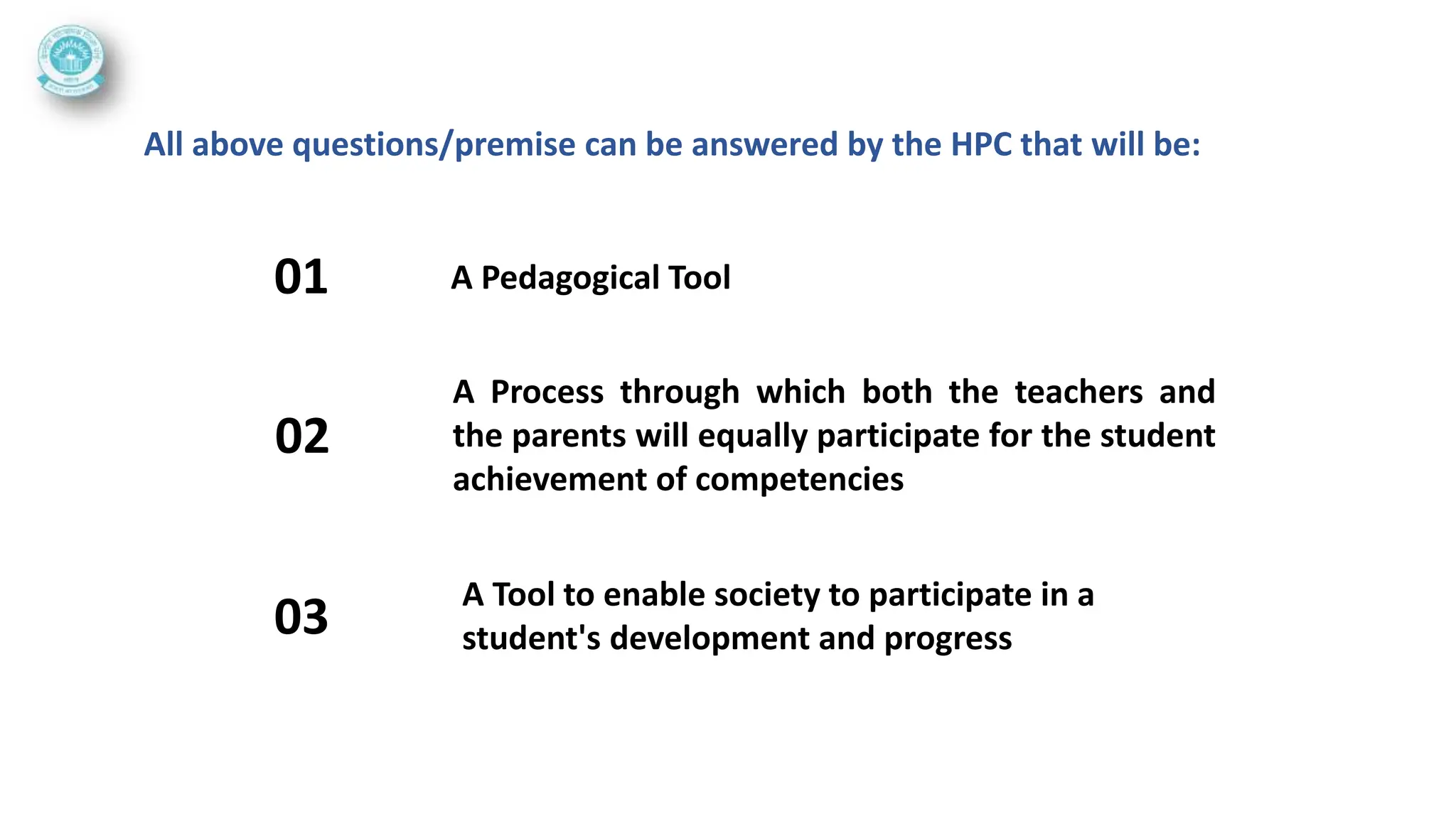
A Pedagogical Tool
01
All above questions/premise can be answered by the HPC that will be:
A Process through which both the teachers and
the parents will equally participate for the student
achievement of competencies
02
A Tool to enable society to participate in a
student's development and progress
03
HPC is , thus, a Collaborative endeavor.
HPC
Parents
Learner
Peers
Teachers
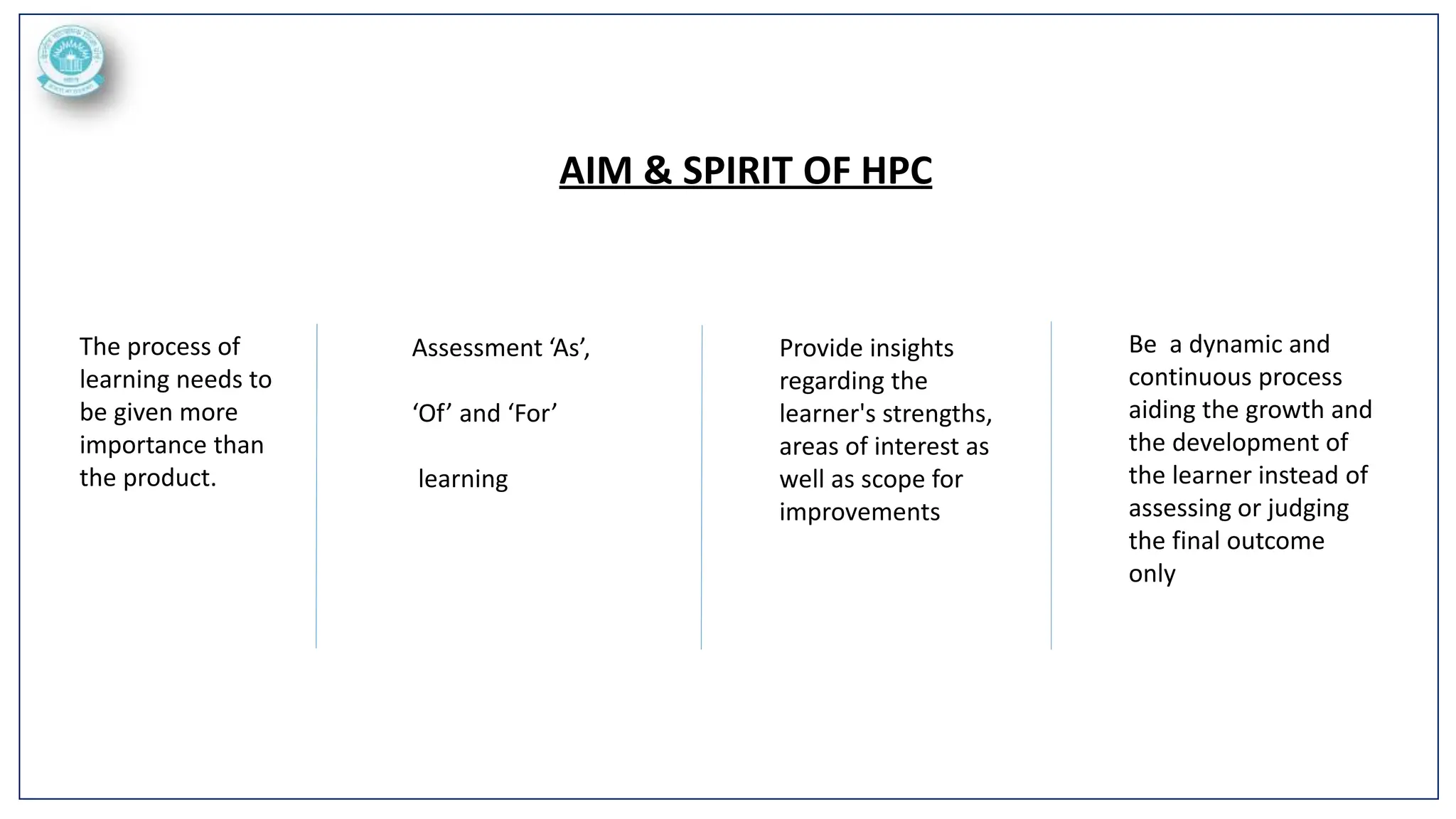
AIM & SPIRIT OF HPC
The process of
learning needs to
be given more
importance than
the product.
Assessment ‘As’,
‘Of’ and ‘For’
learning
Provide insights
regarding the
learner's strengths,
areas of interest as
well as scope for
improvements
Be a dynamic and
continuous process
aiding the growth and
the development of
the learner instead of
assessing or judging
the final outcome
only
Trace the progress
or all-round
development of
the learner
Recommended to include
multiple forms of assessment
tools having varying and
flexible formats (e.g. objective
to descriptive, visual, or any
other format)to assess all
aspects of development in
their entirety
Acknowledge
and celebrate
the uniqueness
of each learner
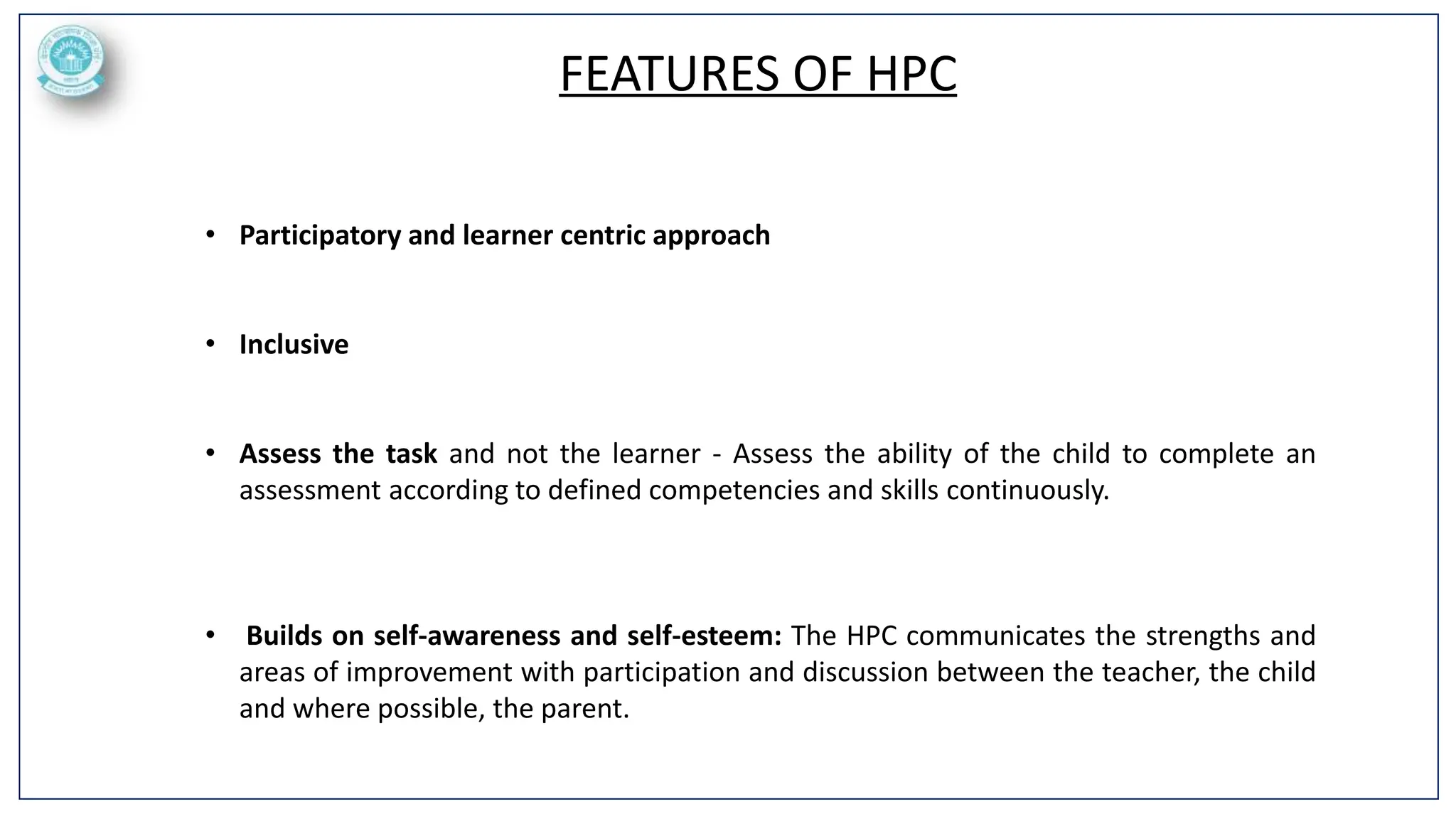
FEATURES OF HPC
• Participatory and learner centric approach
• Inclusive
• Assess the task and not the learner - Assess the ability of the child to complete an
assessment according to defined competencies and skills continuously.
• Builds on self-awareness and self-esteem: The HPC communicates the strengths and
areas of improvement with participation and discussion between the teacher, the child
and where possible, the parent.
• Goal setting: The HPC includes opportunities for the child in consultation with the teacher to set
future goals thus providing direction to both, teacher and the child in terms of future action.
• Tracks skills and competencies: Assesses the competencies and skills as laid down in NIPUN
• Inter-disciplinary: The HPC encourages and offers possibility for inter-disciplinary task assessment
under which individual tasks can be assessed, in alignment with the recommendations of the NEP
2020 to break the subject silos.
• Flexible: Activities/ Tasks, Prompts, Templates and formats will be provided to the teacher. And,
there will be a possibility to customise them according to a school’s individual needs, making the
HPC a flexible tool.
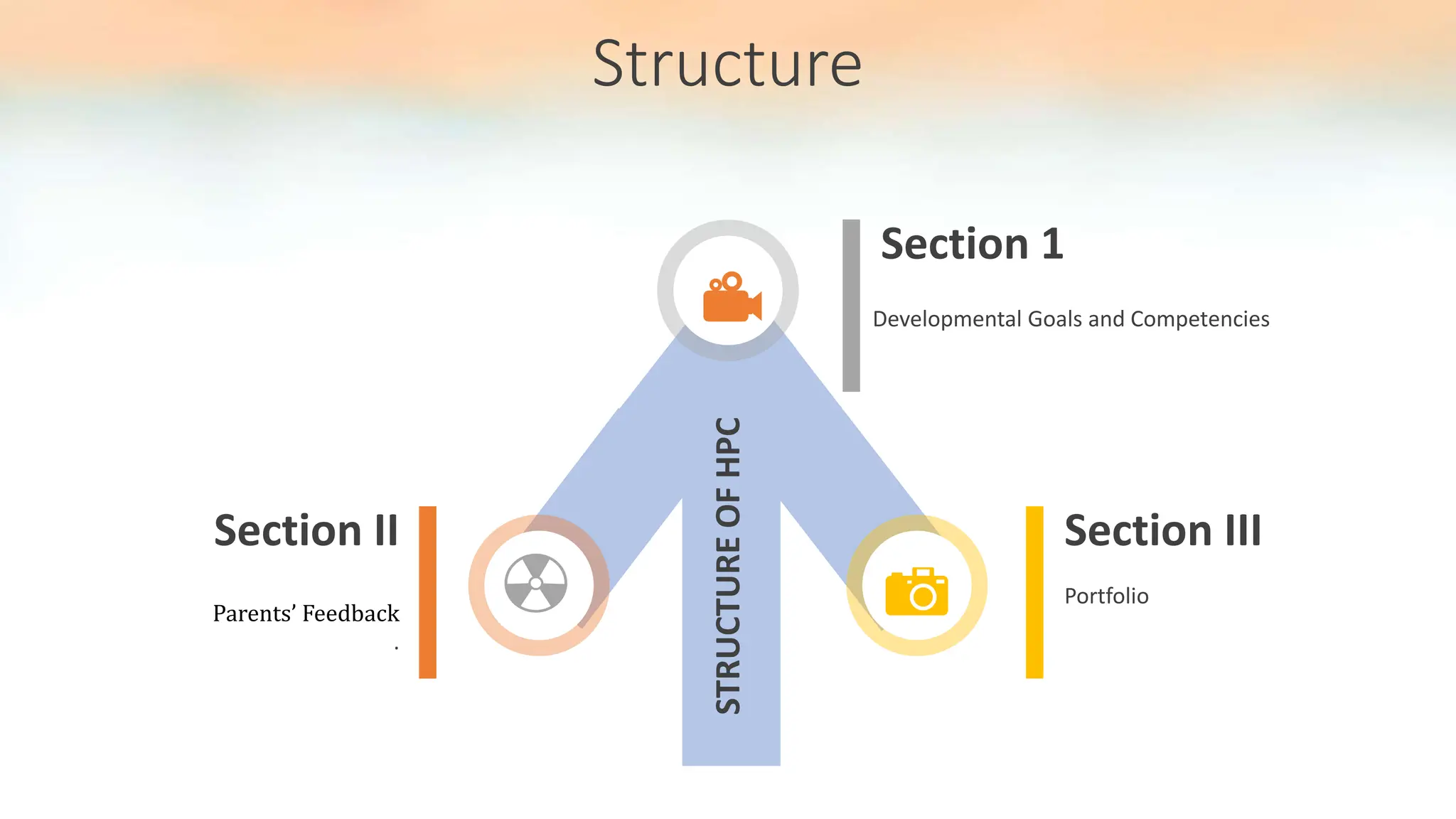
Structure
Section 1
Developmental Goals and Competencies
Section III
Portfolio
Section II
Parents’ Feedback
.
STRUCTURE
OF
HPC
HPC Format
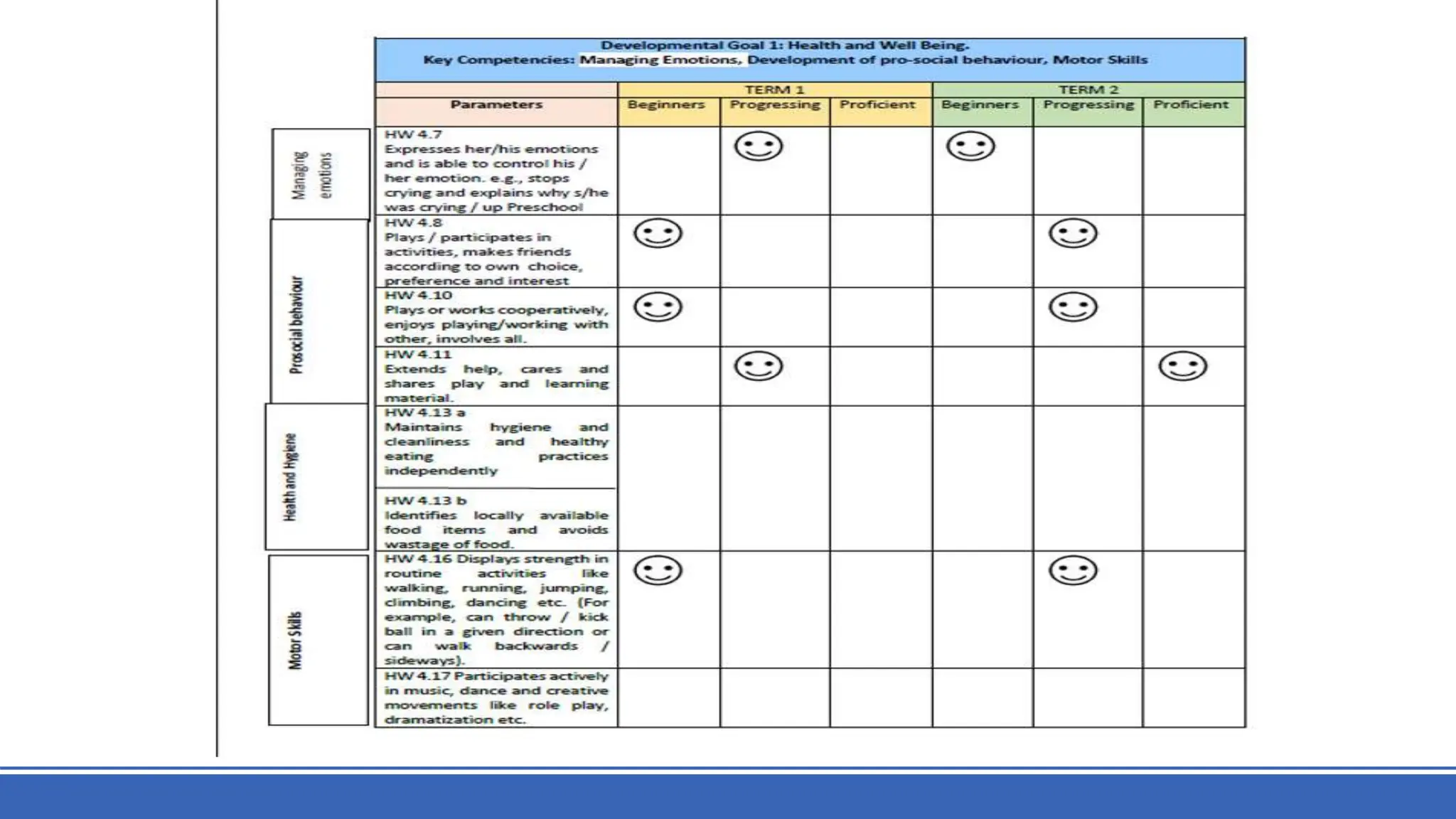
This is a suggestive exemplar card based on the NIPUN BHARAT Guidelines prepared for classes Pre-school 1 to grade 3.
CBSE affiliated schools may adopt / adapt the card as per their requirement, context, locality and priorities.
This card is an individualized and comprehensive representation of a student’s progress.
HPC builds on continuous assessment to present a picture of the student’s progress across a specific
time. It provides disaggregated reporting, unlike a single score or letter grade in a subject area.
A comprehensive list of age/grade-wise outcomes is given in the Foundation Literacy and
Numeracy Framework NIPUN which are expected to be covered during classroom sessions.
However, for the purpose of reporting the progress of a student, selected competencies that
represent the critical areas of instruction and development are highlighted in this Card along
with each developmental goal.
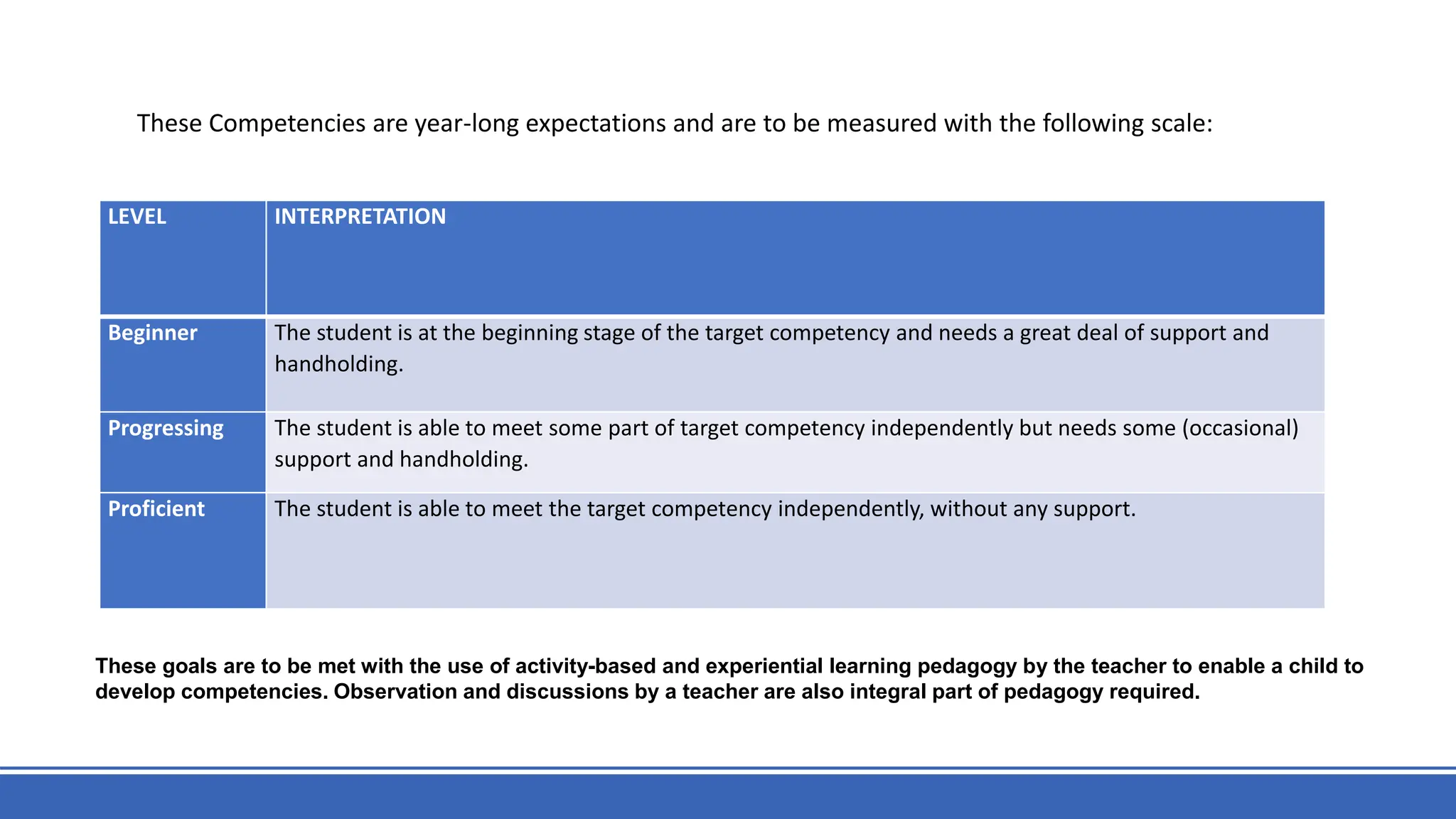
These Competencies are year-long expectations and are to be measured with the following scale:
LEVEL INTERPRETATION
Beginner The student is at the beginning stage of the target competency and needs a great deal of support and
handholding.
Progressing The student is able to meet some part of target competency independently but needs some (occasional)
support and handholding.
Proficient The student is able to meet the target competency independently, without any support.
These goals are to be met with the use of activity-based and experiential learning pedagogy by the teacher to enable a child to
develop competencies. Observation and discussions by a teacher are also integral part of pedagogy required.
When a child is at the beginner level, it would be desirable that a teacher include a narrative
how she/he will support the child and what parental support is required.
For the purpose of representation of the level in the card, schools must select any non-
hierarchical and neutral icon such as a flower, tree, smiley etc.
Teachers must keep the record of the baseline level for each student at the beginning of the
session. Child’s records of the previous class can be the baseline.
The Progress Card document is a combination of a child’s own expression of self as well as the teacher’s
assessment of the child on the mentioned standards. There is also a section on Self-Assessment and Peer
Assessment, which shall reflect child’s self-reflection and peer-reflection on the basis of some tasks of activity-
based/ experiential learning.
This gives a complete picture of the child and provides an evidence as well as an opportunity to the
child to present her growth in the progress review over years.
Finally, a pictorial evidence of the child’s work is represented in the portfolio section. This will
essentially present the child’s work in the task assigned.
THANK YOU!

Dr. Praggya Singh.pptx on holistic progress

  • 2.
  • 3.
    1 2 3 4 NEP Mandate: GOALS Theshift from testing rote memorization skills to competency- based and testing higher-order skills such as analysis, critical thinking, and conceptual clarity. Enabling assessment to help the school system to continuously revisit teaching-learning processes to optimize the learning and development of all students. Ensuring that the primary purpose of assessment is to promote the learning and development of students. Focus on regular formative assessment for learning rather than a summative assessment that encourages today’s ‘coaching culture'
  • 4.
    1 2 3 4 NEP Mandate: PROCESS Provisionsfor self-assessment and peer assessment along with teacher assessment. Development of a 360-degree holistic multidimensional Progress Card which would reflect the progress as well as the uniqueness of each learner in the cognitive, affective, and psychomotor domains; and be an important link between parents and teachers. (Para 4.35) Along with paper-pencil tests, the scope for alternate assessment procedures that record the progress of children in project-based and inquiry-based learning, quizzes, role-plays, group work, portfolios etc. Development of interactive software to enable students to track their progress and get information on their strengths, areas of interest and needed areas of focus.
  • 5.
    Grades do notgive a clear picture of student learning. What are the substitutes ? What do parents, teachers and students want to know from a progress card ? What are the various ways in which the school can communicate progress? Why HPC? Performance is never static ,it has to be measured over a period of time.
  • 6.
    How does aParent know the uniqueness in their child? How can the teacher`s burden to fill in progress reports be decreased? How does the Progress report provide feedback for the student ,so as to facilitate progress in learning? Is it possible to help parents see the connections and possibilites of the direction in which the student is growing ? How can the Progress be a log of performance and conversation with Parents and students?
  • 7.
    A Pedagogical Tool 01 Allabove questions/premise can be answered by the HPC that will be: A Process through which both the teachers and the parents will equally participate for the student achievement of competencies 02 A Tool to enable society to participate in a student's development and progress 03
  • 8.
    HPC is ,thus, a Collaborative endeavor. HPC Parents Learner Peers Teachers
  • 9.
    AIM & SPIRITOF HPC The process of learning needs to be given more importance than the product. Assessment ‘As’, ‘Of’ and ‘For’ learning Provide insights regarding the learner's strengths, areas of interest as well as scope for improvements Be a dynamic and continuous process aiding the growth and the development of the learner instead of assessing or judging the final outcome only
  • 10.
    Trace the progress orall-round development of the learner Recommended to include multiple forms of assessment tools having varying and flexible formats (e.g. objective to descriptive, visual, or any other format)to assess all aspects of development in their entirety Acknowledge and celebrate the uniqueness of each learner
  • 11.
    FEATURES OF HPC •Participatory and learner centric approach • Inclusive • Assess the task and not the learner - Assess the ability of the child to complete an assessment according to defined competencies and skills continuously. • Builds on self-awareness and self-esteem: The HPC communicates the strengths and areas of improvement with participation and discussion between the teacher, the child and where possible, the parent.
  • 12.
    • Goal setting:The HPC includes opportunities for the child in consultation with the teacher to set future goals thus providing direction to both, teacher and the child in terms of future action. • Tracks skills and competencies: Assesses the competencies and skills as laid down in NIPUN • Inter-disciplinary: The HPC encourages and offers possibility for inter-disciplinary task assessment under which individual tasks can be assessed, in alignment with the recommendations of the NEP 2020 to break the subject silos. • Flexible: Activities/ Tasks, Prompts, Templates and formats will be provided to the teacher. And, there will be a possibility to customise them according to a school’s individual needs, making the HPC a flexible tool.
  • 13.
    Structure Section 1 Developmental Goalsand Competencies Section III Portfolio Section II Parents’ Feedback . STRUCTURE OF HPC
  • 14.
    HPC Format This isa suggestive exemplar card based on the NIPUN BHARAT Guidelines prepared for classes Pre-school 1 to grade 3. CBSE affiliated schools may adopt / adapt the card as per their requirement, context, locality and priorities. This card is an individualized and comprehensive representation of a student’s progress. HPC builds on continuous assessment to present a picture of the student’s progress across a specific time. It provides disaggregated reporting, unlike a single score or letter grade in a subject area. A comprehensive list of age/grade-wise outcomes is given in the Foundation Literacy and Numeracy Framework NIPUN which are expected to be covered during classroom sessions. However, for the purpose of reporting the progress of a student, selected competencies that represent the critical areas of instruction and development are highlighted in this Card along with each developmental goal.
  • 15.
    These Competencies areyear-long expectations and are to be measured with the following scale: LEVEL INTERPRETATION Beginner The student is at the beginning stage of the target competency and needs a great deal of support and handholding. Progressing The student is able to meet some part of target competency independently but needs some (occasional) support and handholding. Proficient The student is able to meet the target competency independently, without any support. These goals are to be met with the use of activity-based and experiential learning pedagogy by the teacher to enable a child to develop competencies. Observation and discussions by a teacher are also integral part of pedagogy required.
  • 16.
    When a childis at the beginner level, it would be desirable that a teacher include a narrative how she/he will support the child and what parental support is required. For the purpose of representation of the level in the card, schools must select any non- hierarchical and neutral icon such as a flower, tree, smiley etc. Teachers must keep the record of the baseline level for each student at the beginning of the session. Child’s records of the previous class can be the baseline. The Progress Card document is a combination of a child’s own expression of self as well as the teacher’s assessment of the child on the mentioned standards. There is also a section on Self-Assessment and Peer Assessment, which shall reflect child’s self-reflection and peer-reflection on the basis of some tasks of activity- based/ experiential learning.
  • 17.
    This gives acomplete picture of the child and provides an evidence as well as an opportunity to the child to present her growth in the progress review over years. Finally, a pictorial evidence of the child’s work is represented in the portfolio section. This will essentially present the child’s work in the task assigned.
  • 20.