Competency Based
Education(CBE)
Table Contents
Definition
Introduction
Principles of Competency Based Education
Pros of Competency Based Education
Cons of Competency Based Education
Conclusion
2
Definition
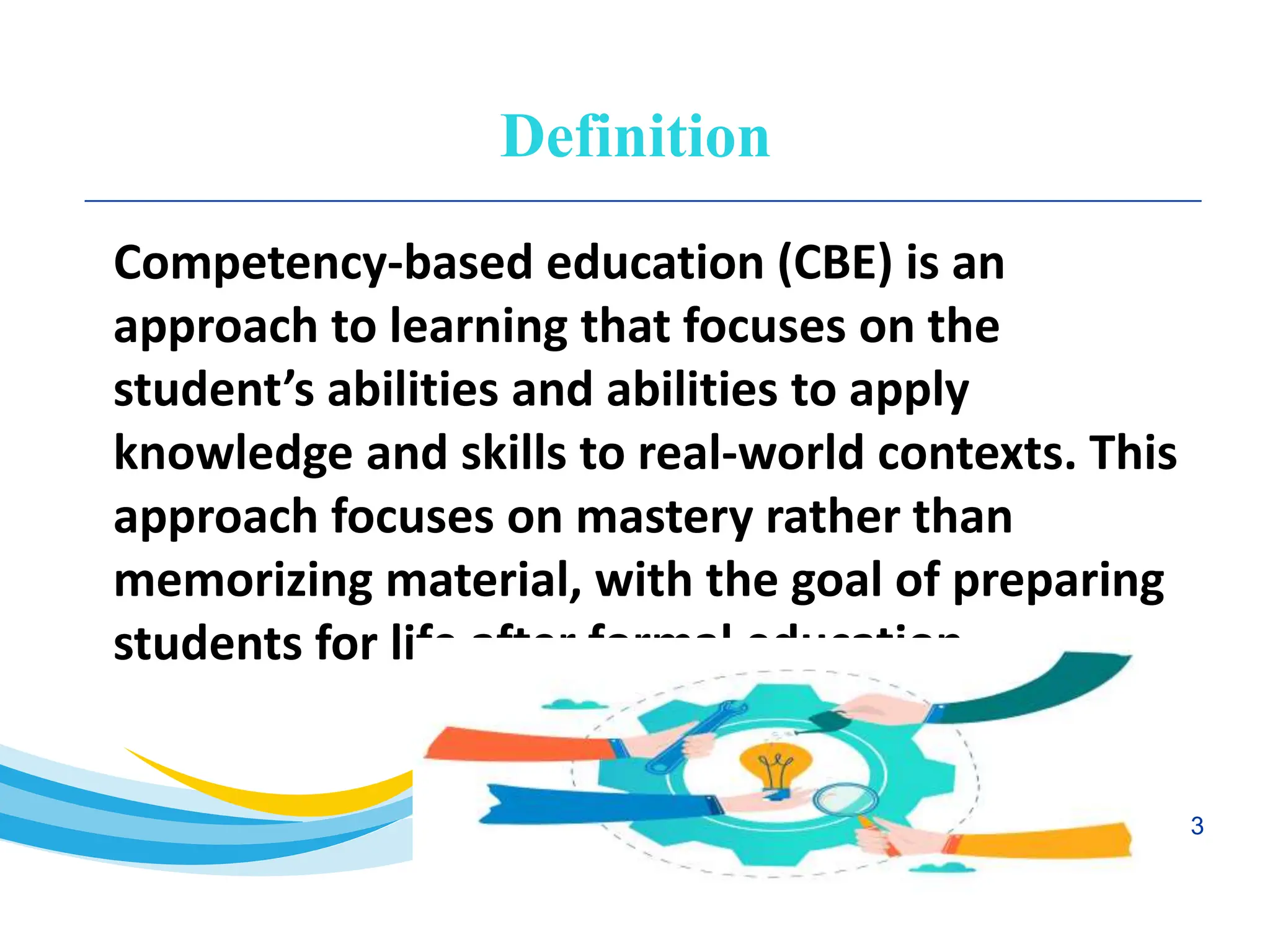
Competency-based education (CBE) is an
approach to learning that focuses on the
student’s abilities and abilities to apply
knowledge and skills to real-world contexts. This
approach focuses on mastery rather than
memorizing material, with the goal of preparing
students for life after formal education.
3
Introduction
• In CBE, students are challenged to apply
their knowledge and skills to meaningful
problems, and their progress is tracked
throughout the program.
• Competency based education gives a
clear focus on preparing students for the
next stage of their life, whether it be
college or a career.
4
5
Principles of Competency
Based Education
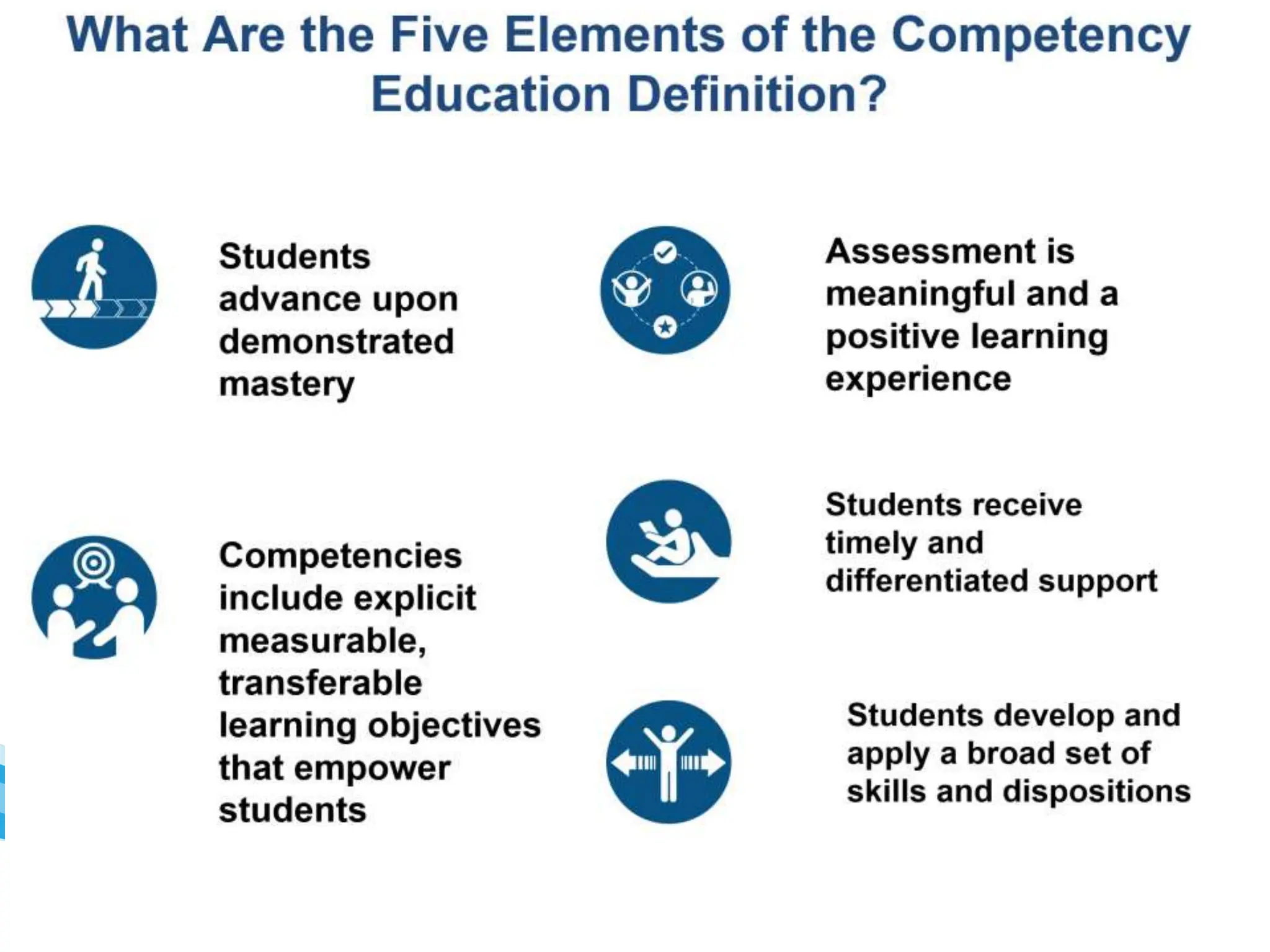
Equity is set before all else
• Equity does not mean giving each student
the same thing as everyone else. Instead,
it means giving each student what they
need to reach the same end goal.
●●●
6
Principles of Competency
Based Education
Classes emphasize measurable
competencies that help build skills for life
• Competencies must be defined in advance
and set as learning objectives for each
student.
• Rather than just testing for head knowledge,
competencies focus on the practical
understanding that a student has of the
subject.
●●●
7
Principles of Competency
Based Education
Transparency helps students take ownership
• What is the end goal for each student in a
particular class?
• The answer to this question shouldn’t only
be available to teachers.
• The learning objectives that are set for the
class (and the school as a whole) should
be clear to both students and parents.
●●●
8
Principles of Competency
Based Education
Students get the support they need
individually
• This is where teacher availability comes into
the picture. In a competency based education
environment, students should have a
framework to understand how long they
should work on a problem before asking for
help, and when in the class time they can
approach the teacher.
●●●
9
Principles of Competency
Based Education
Teachers assess for growth and mastery
• Assessments come in many shapes and
sizes. Here are three types of assessments
that are especially useful for competency
based education:
• Formative assessments
• Authentic assessments
• Digital content assessment
●●●
10
Principles of Competency
Based Education
Students move forward when they
demonstrate mastery
• By including regular assessments and
data-based progress reporting, teachers
understand where each individual student
is in the learning process.
11
12
Conclusion
 Competency-Based Education (CBE) is an
increasingly popular approach to learning in the
Early Years Care and Education sector. This
approach enables educators to create
meaningful, active, and purposeful learning
experiences for children and encourages students
to take control of their own learning. Ultimately,
Competency-based learning provides students
with the tools and skills they need to become
successful lifelong learners..
13

cbe competency based education in early years education.pptx

  • 1.
  • 2.
    Table Contents Definition Introduction Principles ofCompetency Based Education Pros of Competency Based Education Cons of Competency Based Education Conclusion 2
  • 3.
    Definition Competency-based education (CBE)is an approach to learning that focuses on the student’s abilities and abilities to apply knowledge and skills to real-world contexts. This approach focuses on mastery rather than memorizing material, with the goal of preparing students for life after formal education. 3
  • 4.
    Introduction • In CBE,students are challenged to apply their knowledge and skills to meaningful problems, and their progress is tracked throughout the program. • Competency based education gives a clear focus on preparing students for the next stage of their life, whether it be college or a career. 4
  • 5.
  • 6.
    Principles of Competency BasedEducation Equity is set before all else • Equity does not mean giving each student the same thing as everyone else. Instead, it means giving each student what they need to reach the same end goal. ●●● 6
  • 7.
    Principles of Competency BasedEducation Classes emphasize measurable competencies that help build skills for life • Competencies must be defined in advance and set as learning objectives for each student. • Rather than just testing for head knowledge, competencies focus on the practical understanding that a student has of the subject. ●●● 7
  • 8.
    Principles of Competency BasedEducation Transparency helps students take ownership • What is the end goal for each student in a particular class? • The answer to this question shouldn’t only be available to teachers. • The learning objectives that are set for the class (and the school as a whole) should be clear to both students and parents. ●●● 8
  • 9.
    Principles of Competency BasedEducation Students get the support they need individually • This is where teacher availability comes into the picture. In a competency based education environment, students should have a framework to understand how long they should work on a problem before asking for help, and when in the class time they can approach the teacher. ●●● 9
  • 10.
    Principles of Competency BasedEducation Teachers assess for growth and mastery • Assessments come in many shapes and sizes. Here are three types of assessments that are especially useful for competency based education: • Formative assessments • Authentic assessments • Digital content assessment ●●● 10
  • 11.
    Principles of Competency BasedEducation Students move forward when they demonstrate mastery • By including regular assessments and data-based progress reporting, teachers understand where each individual student is in the learning process. 11
  • 12.
  • 13.
    Conclusion  Competency-Based Education(CBE) is an increasingly popular approach to learning in the Early Years Care and Education sector. This approach enables educators to create meaningful, active, and purposeful learning experiences for children and encourages students to take control of their own learning. Ultimately, Competency-based learning provides students with the tools and skills they need to become successful lifelong learners.. 13

Editor's Notes

  • #3 SAY: Before we wrap up the course, let’s review what we have learned today. During this course, we have <READ the bullets from the slide.> GO to next slide.
  • #4 SAY: Before we wrap up the course, let’s review what we have learned today. During this course, we have <READ the bullets from the slide.> GO to next slide.
  • #5 SAY: Before we wrap up the course, let’s review what we have learned today. During this course, we have <READ the bullets from the slide.> GO to next slide.
  • #6 SAY: The purpose of epidemiology in public health practice is to discover the agent, host, and environmental factors that affect health; determine the relative importance of causes of illness, disability, and death; identify those segments of the population that have the greatest risk from specific causes of ill health; and evaluate the effectiveness of health programs and services in improving population health. GO to next slide.
  • #7 SAY: The purpose of epidemiology in public health practice is to discover the agent, host, and environmental factors that affect health; determine the relative importance of causes of illness, disability, and death; identify those segments of the population that have the greatest risk from specific causes of ill health; and evaluate the effectiveness of health programs and services in improving population health. GO to next slide.
  • #8 SAY: The purpose of epidemiology in public health practice is to discover the agent, host, and environmental factors that affect health; determine the relative importance of causes of illness, disability, and death; identify those segments of the population that have the greatest risk from specific causes of ill health; and evaluate the effectiveness of health programs and services in improving population health. GO to next slide.
  • #9 SAY: The purpose of epidemiology in public health practice is to discover the agent, host, and environmental factors that affect health; determine the relative importance of causes of illness, disability, and death; identify those segments of the population that have the greatest risk from specific causes of ill health; and evaluate the effectiveness of health programs and services in improving population health. GO to next slide.
  • #10 SAY: The purpose of epidemiology in public health practice is to discover the agent, host, and environmental factors that affect health; determine the relative importance of causes of illness, disability, and death; identify those segments of the population that have the greatest risk from specific causes of ill health; and evaluate the effectiveness of health programs and services in improving population health. GO to next slide.
  • #11 SAY: The purpose of epidemiology in public health practice is to discover the agent, host, and environmental factors that affect health; determine the relative importance of causes of illness, disability, and death; identify those segments of the population that have the greatest risk from specific causes of ill health; and evaluate the effectiveness of health programs and services in improving population health. GO to next slide.
  • #12 SAY: The purpose of epidemiology in public health practice is to discover the agent, host, and environmental factors that affect health; determine the relative importance of causes of illness, disability, and death; identify those segments of the population that have the greatest risk from specific causes of ill health; and evaluate the effectiveness of health programs and services in improving population health. GO to next slide.
  • #14 SAY: The purpose of epidemiology in public health practice is to discover the agent, host, and environmental factors that affect health; determine the relative importance of causes of illness, disability, and death; identify those segments of the population that have the greatest risk from specific causes of ill health; and evaluate the effectiveness of health programs and services in improving population health. GO to next slide.