COMPETENCY &
OUTCOME BASED
EDUCATION
Presented by
Manisha Paul
1st
Sem MSc.
Nursing
Competency-based education is an approach to teaching & learning
more often used in learning concrete skills than abstract learning.
Large skill sets are broken down into competencies, which may
have sequential level of mastery. Competencies reinforce one
another from basic to advance as learning process.
Competencies with in different contexts may require
different bundles of skills, knowledge & attitudes. In essence
CBE is a process, not a product.
Introduction
“Competency based education focuses on outcome of
learning. CBE addresses what the learners are expected to do
rather than on what they expected to learn about.”
• “ Richards and Rodgers”
“Competency – based education programs are an alternative
way for learners to gain the skills employers want from
employees.”
Competency based education is an outcome focused approach
that concentrates on the mastery of skills at the learners pace
Definition
:
Purposes of CBE
Measure student learning rather than time.
Harness the power of technology for
teaching & learning.
Fundamentally change the faculty role.
Define competencies & develop valid,
reliable assessments.
Procedure of Competency Based Education
Design
 To set training approach.
 To develop learning purposes.
 To determine operation scale.
 To design education.
:-
Development :-
 To prepare learning guide.
 To verify a task.
 To prepare course plans.
 To prepare auxiliary medium.
 Guide tests/ to review materials &
procedures
To implement a course plan.
To train.
To do derived assessment.
•To train a document
Implement :-
Flexible training approaches including large group methods, small
group activities & individual study are essential components.
Satisfactory completion of training is based on achievement of all
specified competencies.
Variety of support materials including print, audiovisual &
stimulations (models) key to the skills being mastered is used.
Method of instruction involves mastery learning, that premise that
all participants can master the required knowledge or skills,
provided sufficient time & appropriate training methods are used.
Characteristics
Function of competency based education
CURRICULAR
CRITERION
 The curriculum gives learners a clear indication
of what is expected of them in terms of
performance, conditions & standard.
Also, if appropriate, workplace and off the job
training and assessment responsibilities should be
identified.
Delivery is flexible & learners can exercise
initiative in the learning process.
Learning materials used by providers indicate the
degree to which program delivery is learner
centered
DELIVERY
CRITERION
ASSESSMENT
CRITERION
 Measure performance demonstrated
against a specified competence standard.
 Be available for competencies gained
outside the course.
 Include workplace or off the job
components if appropriate.

Reports of competencies gained should be provided to
learners.

Reporting may be in terms of completed modules provided
that the relationship between competencies and modules is
understood.
REPORTING /
RECORDING
CRITERION
CERTIFICATION
CRITERION
Person demonstrating all prescribed
competences in an accredited course or
training programme should obtain a
credential or statement of attainment
which is recognized with the national
framework.
Step 1: Understand the benefits and challenges of competency
based education.
Step 2: Evaluate and catalogue the objectives of academic
program.
Step 3: Review the curriculum structure of programme and the
list of core competencies, if available.
Process Of Competency Based Education
Step 4: Consider adding missing disciplines and skill
sets to existing program.
Step 5: Make the core competencies of program
publicly visible.
Step 6: Solicit feedback from students, graduates,
faculty, & alumni to continue revising and optimizing
core competencies & associated curricular offerings.
Downloadable mode empowers to offer education in a
dynamic from to students. Student can assess lesson,
assignments & submit their script online.
They can downloaded their lesson notes & assess archived lessons,
tutorial sessions, lectures etc.
Method of instruction involves mastery learning, that premise that all
participants can master the required knowledge or skills, provided
sufficient time & appropriate training methods are used.
Mode of Competency
Based Education
DOWNLOADABLE
MODE
Students will be able to only
read the course concepts.
Downloading or interacting is
unavailable.
READ ONLY
MODE
CLASSROOM
INTERACTION
The interactive learning provides an
environment for students to talk &
discuss freely about any related
topics online.
There are two ways of classroom
interaction.
X
chart
Client server models that works with
internet relay chat server protocol, it
allows servers to connect to each other
effectively forming a network. Protocol
is used by servers to talk to each other.
Instructor & participants can talk with
each other & discuss on related topic for
stipulated time given by the instructor.
Mailing
group
Participants can become member of
mailing group by registering their names
in their group. Once approved by the
instructor, participants can post their
questions to this group ID.
This way course instructor or any other
participant can reply to questions that
will be read by all the members in that
group including the instructor.
Advantages of CBE
Participant builds confidence as they succeed in mastering
specific competencies.
Participant will achieve competencies required in the
performance of their job.
Self pacing: - participants can move quickly through material
they know or take more time if they need it.
Participants receive a transcript or list of the competencies they
have achieved.
Provide standards for determining how well learning has
occurred both at the individuals & organizational level.
A CBE course is only as effective as the process used to
identify the competencies. When little or no attention is given to
identification of the essential job skills, then the resulting
training course is likely to be ineffective.
Unless initial training & follow up assistance is provided for
the trainers, there is tendency to “teach as we were taught” &
CBT trainers quickly slip back into the role of the traditional
teacher.
Disadvantages of CBE
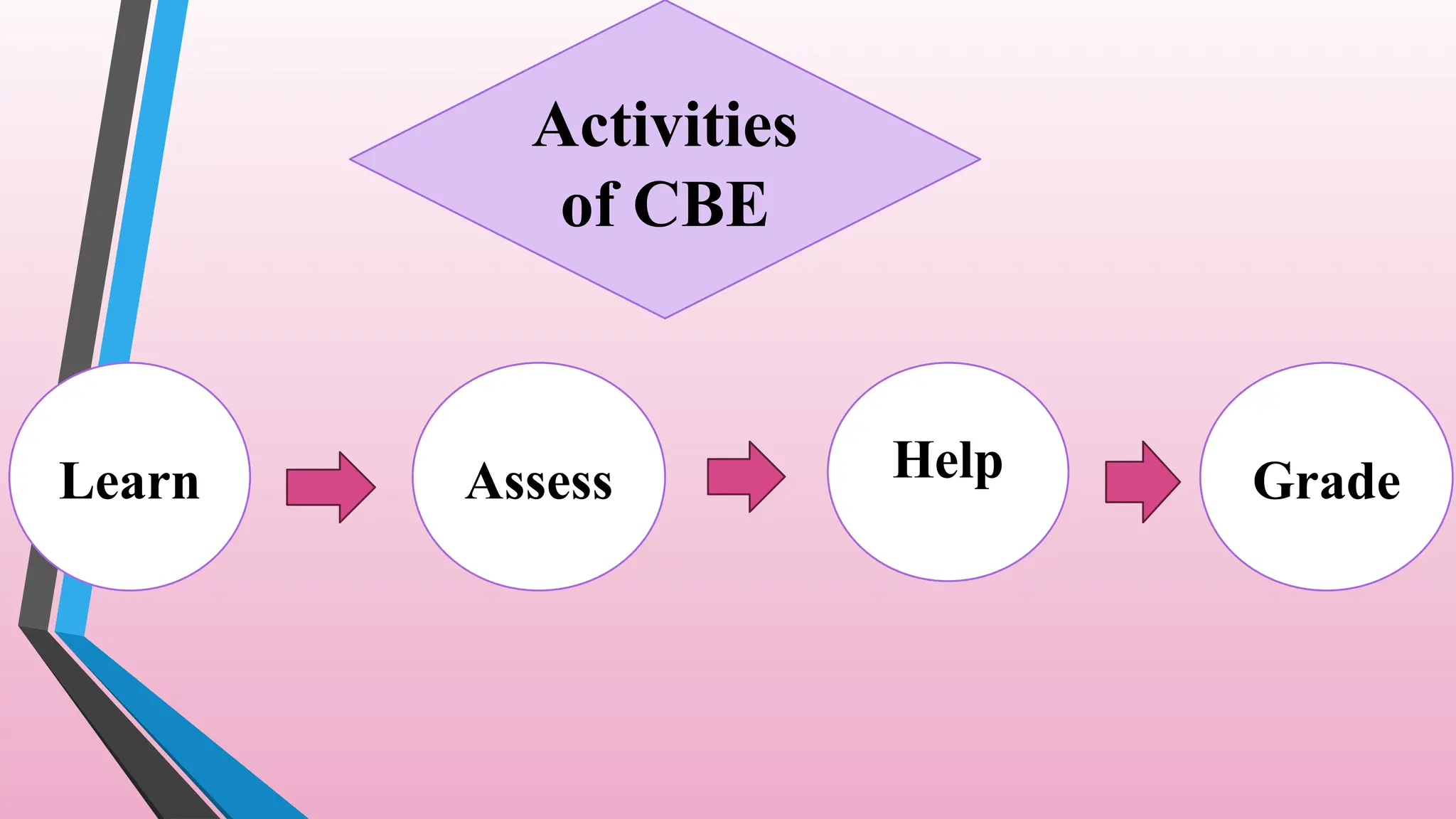
Activities
of CBE
Learn Assess Help Grade
Outcome
based
education
Introduction
 Outcome based education is an theory that bases education
around pre-defined goals (outcome).
By the end of the education experience, each student is expected
to have achieved that goal.
It is also called standards based education reforms, mastery
education, & performance based education.
Definition
Outcome based education (OBE) is a process that involves the
restructuring of curriculum, assessment & reporting practices in
education to reflect the achievement of high order learning &
mastery rather than the accumulation of course credits.
In outcome based learning, all school programs & instructional
efforts are designed to have produced specific, lasting results in
students by the time they leave school.
Characteristics
 It has program objective, program outcomes, & performance
indicators.
 It is objective & outcome driven, where every stated objective &
outcome can be assessed & evaluated.
 Program objectives address the graduate attainment within 3-5
years after their graduation.
 Program outcomes, which consist of abilities to be attained by
students before they graduate, are formulated based on the
program objective.
Four Essential
Principles In OBE
Clarity of
focus
Teachers should focus on helping students to
develop the knowledge, skills & personalities that
will enable them to achieve the intended outcome
that have been clearly articulated.
Designing
Down
It means that the curriculum design must starts with a
clear definition of the intended outcomes that students
are to achieve by the end of the program.
Once this has been done all instructional decision are
then made to ensure achieve this desired end result.
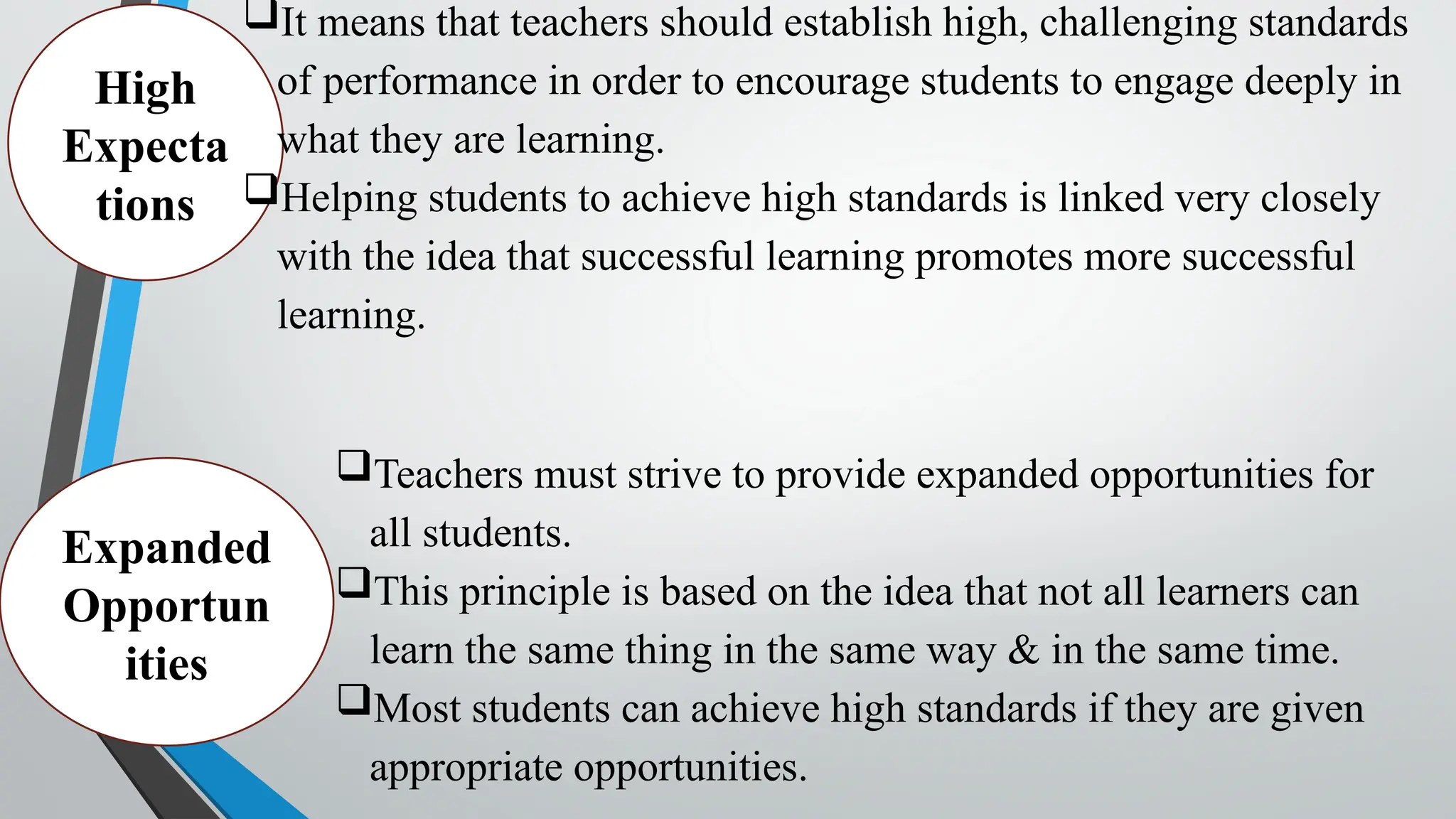
High
Expecta
tions
It means that teachers should establish high, challenging standards
of performance in order to encourage students to engage deeply in
what they are learning.
Helping students to achieve high standards is linked very closely
with the idea that successful learning promotes more successful
learning.
Expanded
Opportun
ities
Teachers must strive to provide expanded opportunities for
all students.
This principle is based on the idea that not all learners can
learn the same thing in the same way & in the same time.
Most students can achieve high standards if they are given
appropriate opportunities.
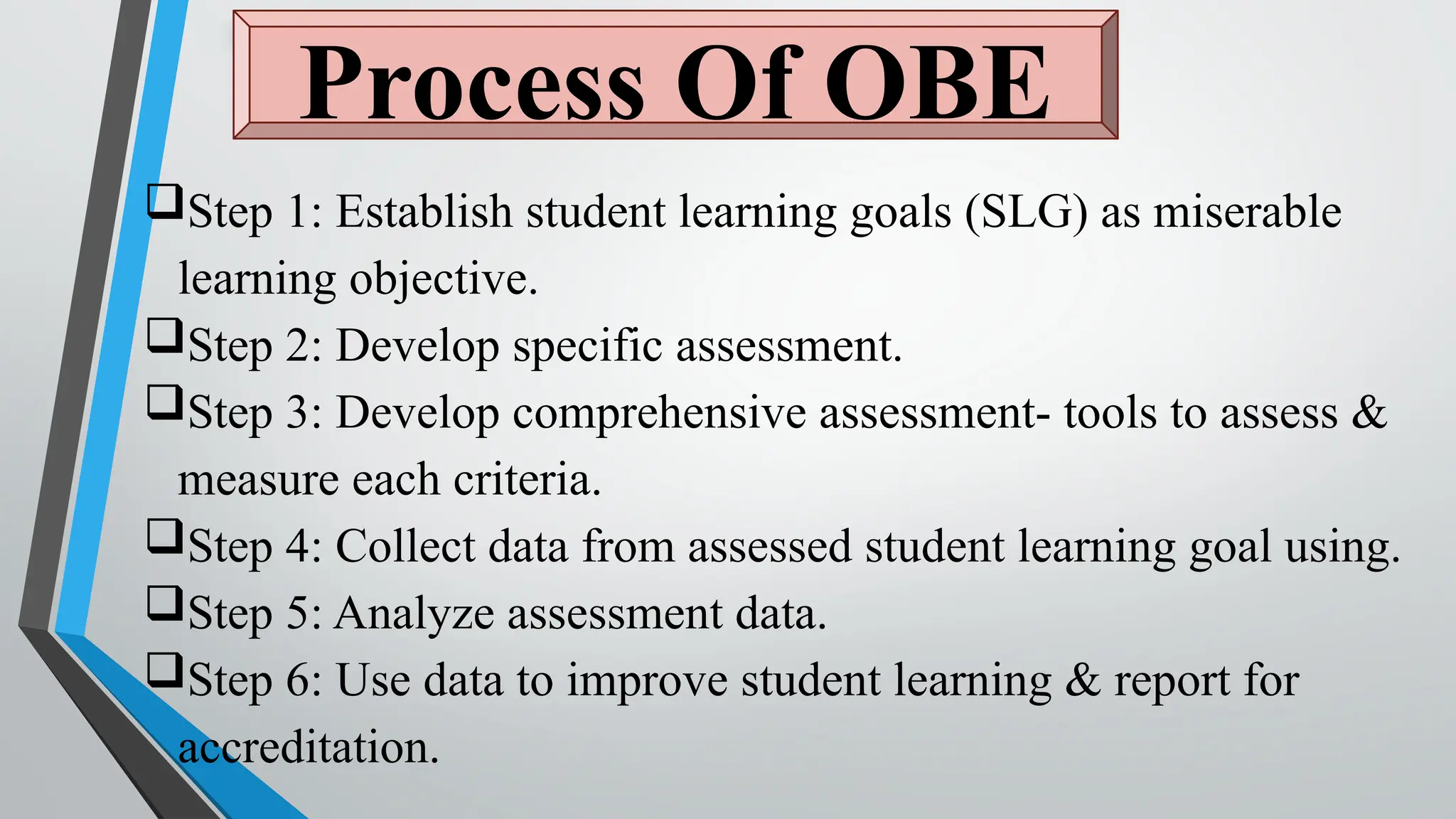
Process Of OBE
Step 1: Establish student learning goals (SLG) as miserable
learning objective.
Step 2: Develop specific assessment.
Step 3: Develop comprehensive assessment- tools to assess &
measure each criteria.
Step 4: Collect data from assessed student learning goal using.
Step 5: Analyze assessment data.
Step 6: Use data to improve student learning & report for
accreditation.
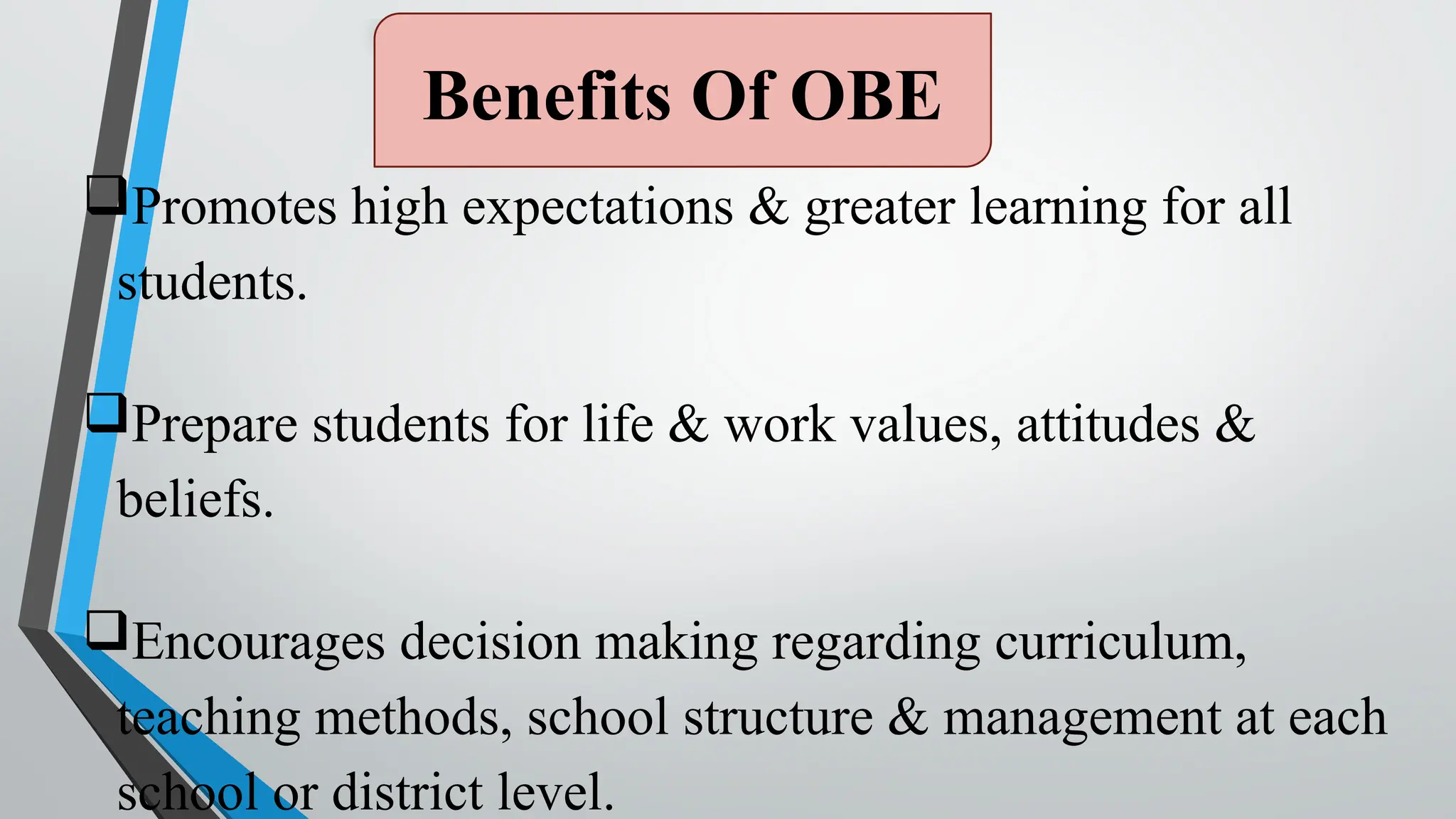
Benefits Of OBE
Promotes high expectations & greater learning for all
students.
Prepare students for life & work values, attitudes &
beliefs.
Encourages decision making regarding curriculum,
teaching methods, school structure & management at each
school or district level.
Disadvantages Of OBE
Outcome based education is that it conflicts with the
admission requirement and practices of some colleges &
universities.
Outcome based learning focus on feeling, values, attitudes
& beliefs over attaining factual knowledge.
Outcome based education also relies on evaluation that are
subjective, rather than objective tests & measurements.
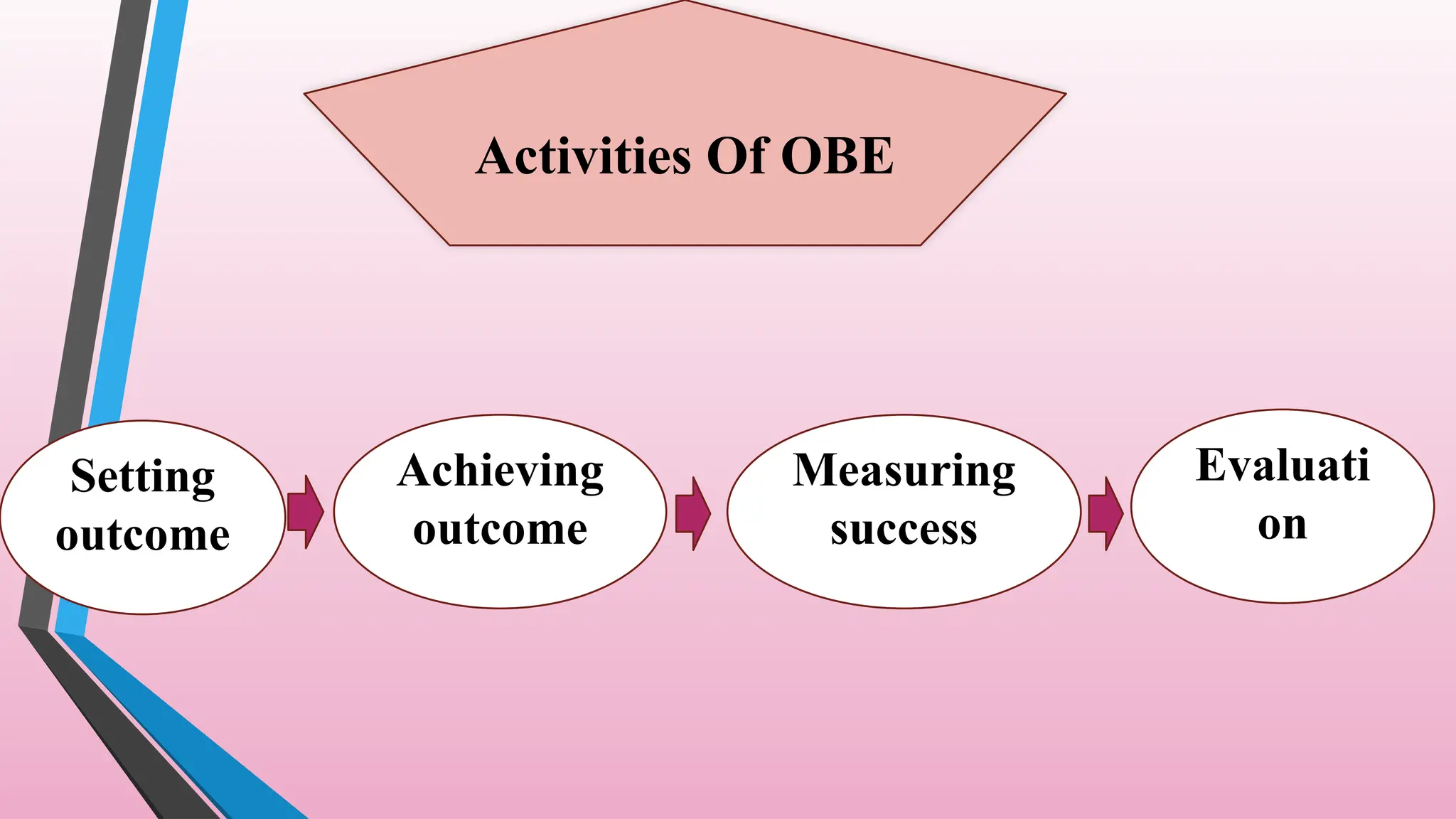
Activities Of OBE
Setting
outcome
Achieving
outcome
Measuring
success
Evaluati
on
SUMMARY
Today I had discussed about the
introduction, definition, purpose,
procedures, characteristics,
function, process, advantages,
disadvantages of Competency &
Outcome Based Education.
Conclusion
Competency based education approach allows students to
advance based on their ability to master a skill or competency
at their own pace regardless of environment.
Outcome based education is an theory that bases education
around pre defined goals by the end of the educational
experiences, each students is expected to have achieve that
goal.
BIBLIOGRAPHY
Neerja K P. Textbook of nursing education, fifth edition,
Jaypee publishers, page no. 267-269.
www.slideshare.com. On viewed > 15-3-2020 Elvina Edwin.
Sodhi Kaur Jaspreet, comprehensive textbook of nursing
education, Jaypee publisher, 2017, page no 233-234.
https://www.slideshare.net on viewed > 20-4-2020 Nidhi
Chauhan, Stephi Poulose.
competency based education & outcome based education

competency based education & outcome based education

  • 1.
    COMPETENCY & OUTCOME BASED EDUCATION Presentedby Manisha Paul 1st Sem MSc. Nursing
  • 2.
    Competency-based education isan approach to teaching & learning more often used in learning concrete skills than abstract learning. Large skill sets are broken down into competencies, which may have sequential level of mastery. Competencies reinforce one another from basic to advance as learning process. Competencies with in different contexts may require different bundles of skills, knowledge & attitudes. In essence CBE is a process, not a product. Introduction
  • 3.
    “Competency based educationfocuses on outcome of learning. CBE addresses what the learners are expected to do rather than on what they expected to learn about.” • “ Richards and Rodgers” “Competency – based education programs are an alternative way for learners to gain the skills employers want from employees.” Competency based education is an outcome focused approach that concentrates on the mastery of skills at the learners pace Definition
  • 4.
    : Purposes of CBE Measurestudent learning rather than time. Harness the power of technology for teaching & learning. Fundamentally change the faculty role. Define competencies & develop valid, reliable assessments.
  • 5.
    Procedure of CompetencyBased Education Design  To set training approach.  To develop learning purposes.  To determine operation scale.  To design education. :- Development :-  To prepare learning guide.  To verify a task.  To prepare course plans.  To prepare auxiliary medium.  Guide tests/ to review materials & procedures
  • 6.
    To implement acourse plan. To train. To do derived assessment. •To train a document Implement :-
  • 7.
    Flexible training approachesincluding large group methods, small group activities & individual study are essential components. Satisfactory completion of training is based on achievement of all specified competencies. Variety of support materials including print, audiovisual & stimulations (models) key to the skills being mastered is used. Method of instruction involves mastery learning, that premise that all participants can master the required knowledge or skills, provided sufficient time & appropriate training methods are used. Characteristics
  • 8.
    Function of competencybased education CURRICULAR CRITERION  The curriculum gives learners a clear indication of what is expected of them in terms of performance, conditions & standard. Also, if appropriate, workplace and off the job training and assessment responsibilities should be identified.
  • 9.
    Delivery is flexible& learners can exercise initiative in the learning process. Learning materials used by providers indicate the degree to which program delivery is learner centered DELIVERY CRITERION ASSESSMENT CRITERION  Measure performance demonstrated against a specified competence standard.  Be available for competencies gained outside the course.  Include workplace or off the job components if appropriate.
  • 10.
     Reports of competenciesgained should be provided to learners.  Reporting may be in terms of completed modules provided that the relationship between competencies and modules is understood. REPORTING / RECORDING CRITERION CERTIFICATION CRITERION Person demonstrating all prescribed competences in an accredited course or training programme should obtain a credential or statement of attainment which is recognized with the national framework.
  • 11.
    Step 1: Understandthe benefits and challenges of competency based education. Step 2: Evaluate and catalogue the objectives of academic program. Step 3: Review the curriculum structure of programme and the list of core competencies, if available. Process Of Competency Based Education
  • 12.
    Step 4: Consideradding missing disciplines and skill sets to existing program. Step 5: Make the core competencies of program publicly visible. Step 6: Solicit feedback from students, graduates, faculty, & alumni to continue revising and optimizing core competencies & associated curricular offerings.
  • 13.
    Downloadable mode empowersto offer education in a dynamic from to students. Student can assess lesson, assignments & submit their script online. They can downloaded their lesson notes & assess archived lessons, tutorial sessions, lectures etc. Method of instruction involves mastery learning, that premise that all participants can master the required knowledge or skills, provided sufficient time & appropriate training methods are used. Mode of Competency Based Education DOWNLOADABLE MODE
  • 14.
    Students will beable to only read the course concepts. Downloading or interacting is unavailable. READ ONLY MODE CLASSROOM INTERACTION The interactive learning provides an environment for students to talk & discuss freely about any related topics online. There are two ways of classroom interaction.
  • 15.
    X chart Client server modelsthat works with internet relay chat server protocol, it allows servers to connect to each other effectively forming a network. Protocol is used by servers to talk to each other. Instructor & participants can talk with each other & discuss on related topic for stipulated time given by the instructor.
  • 16.
    Mailing group Participants can becomemember of mailing group by registering their names in their group. Once approved by the instructor, participants can post their questions to this group ID. This way course instructor or any other participant can reply to questions that will be read by all the members in that group including the instructor.
  • 17.
    Advantages of CBE Participantbuilds confidence as they succeed in mastering specific competencies. Participant will achieve competencies required in the performance of their job. Self pacing: - participants can move quickly through material they know or take more time if they need it. Participants receive a transcript or list of the competencies they have achieved. Provide standards for determining how well learning has occurred both at the individuals & organizational level.
  • 18.
    A CBE courseis only as effective as the process used to identify the competencies. When little or no attention is given to identification of the essential job skills, then the resulting training course is likely to be ineffective. Unless initial training & follow up assistance is provided for the trainers, there is tendency to “teach as we were taught” & CBT trainers quickly slip back into the role of the traditional teacher. Disadvantages of CBE
  • 19.
  • 20.
  • 21.
    Introduction  Outcome basededucation is an theory that bases education around pre-defined goals (outcome). By the end of the education experience, each student is expected to have achieved that goal. It is also called standards based education reforms, mastery education, & performance based education.
  • 22.
    Definition Outcome based education(OBE) is a process that involves the restructuring of curriculum, assessment & reporting practices in education to reflect the achievement of high order learning & mastery rather than the accumulation of course credits. In outcome based learning, all school programs & instructional efforts are designed to have produced specific, lasting results in students by the time they leave school.
  • 23.
    Characteristics  It hasprogram objective, program outcomes, & performance indicators.  It is objective & outcome driven, where every stated objective & outcome can be assessed & evaluated.  Program objectives address the graduate attainment within 3-5 years after their graduation.  Program outcomes, which consist of abilities to be attained by students before they graduate, are formulated based on the program objective.
  • 24.
    Four Essential Principles InOBE Clarity of focus Teachers should focus on helping students to develop the knowledge, skills & personalities that will enable them to achieve the intended outcome that have been clearly articulated. Designing Down It means that the curriculum design must starts with a clear definition of the intended outcomes that students are to achieve by the end of the program. Once this has been done all instructional decision are then made to ensure achieve this desired end result.
  • 25.
    High Expecta tions It means thatteachers should establish high, challenging standards of performance in order to encourage students to engage deeply in what they are learning. Helping students to achieve high standards is linked very closely with the idea that successful learning promotes more successful learning. Expanded Opportun ities Teachers must strive to provide expanded opportunities for all students. This principle is based on the idea that not all learners can learn the same thing in the same way & in the same time. Most students can achieve high standards if they are given appropriate opportunities.
  • 26.
    Process Of OBE Step1: Establish student learning goals (SLG) as miserable learning objective. Step 2: Develop specific assessment. Step 3: Develop comprehensive assessment- tools to assess & measure each criteria. Step 4: Collect data from assessed student learning goal using. Step 5: Analyze assessment data. Step 6: Use data to improve student learning & report for accreditation.
  • 27.
    Benefits Of OBE Promoteshigh expectations & greater learning for all students. Prepare students for life & work values, attitudes & beliefs. Encourages decision making regarding curriculum, teaching methods, school structure & management at each school or district level.
  • 28.
    Disadvantages Of OBE Outcomebased education is that it conflicts with the admission requirement and practices of some colleges & universities. Outcome based learning focus on feeling, values, attitudes & beliefs over attaining factual knowledge. Outcome based education also relies on evaluation that are subjective, rather than objective tests & measurements.
  • 29.
  • 30.
    SUMMARY Today I haddiscussed about the introduction, definition, purpose, procedures, characteristics, function, process, advantages, disadvantages of Competency & Outcome Based Education.
  • 31.
    Conclusion Competency based educationapproach allows students to advance based on their ability to master a skill or competency at their own pace regardless of environment. Outcome based education is an theory that bases education around pre defined goals by the end of the educational experiences, each students is expected to have achieve that goal.
  • 32.
    BIBLIOGRAPHY Neerja K P.Textbook of nursing education, fifth edition, Jaypee publishers, page no. 267-269. www.slideshare.com. On viewed > 15-3-2020 Elvina Edwin. Sodhi Kaur Jaspreet, comprehensive textbook of nursing education, Jaypee publisher, 2017, page no 233-234. https://www.slideshare.net on viewed > 20-4-2020 Nidhi Chauhan, Stephi Poulose.