Competency based teaching
By
Mahmoud shaqria
‫شقريه‬ ‫محمود‬
GOAL:
By the end of this lecture
the learner will be able to:
Understand all about
Competency based teaching
General Objectives:
At the end of this session each
participant will be able to identify
,determine ,define the whole
picture of competency based
teaching
Specific objectives
At the end of this lecture the participant will
be able to:
Define the key terms concerned with CBL
Determine the characteristics of CBE
Identify:
Practical benefits of competency based education
Elements of a competency-based system
Readiness assessment for competency based
education
Key terms
Competency
A competency is a specific skill, knowledge, or ability that is
both observable and measurable.
Competency Based Learning (CBL)
Learning processes focused on acquiring specific skills and
developing specific abilities
Skills
Skills are a type of competency referring to observable
and measurable tasks a student can accomplish as a
result of education, training, and/or practice
Program Learning Outcomes
Observable and measurable statements about
what a specific program delivers and expects to
see in each of its graduates.
Differentiated Learning
a variety of methodologies that direct students along different
pathways based on their needs and mastery of competencies
Certifications
Certifications are awarded by third-party non-governmental
certification bodies, such as an industry or occupational
association, based on an individual demonstrating through an
examination process that she or he has mastered the required
knowledge, skills, and abilities to perform a specific job.
Credentials
Credentials is an umbrella term that includes degrees,
diplomas, certificates, badges, professional/industry
certifications , apprenticeships, and licenses. Credentials vary in
the awarding organization, the standards on which the award is
based, and the rigor and type of assessment and validation
processes used to attest to the skills, knowledge, and abilities
people possess
Practical benefits of competency base education:
Efficient and potentially lower-cost degree/credential options
for students
Greater understanding of learning outcomes throughout the
academic institution
Courses, learning resources, and assessments aligned to
well-defined goals
Motivated and engaged students
 Increased student retention and completion rates, particularly when
prior learning can be applied to degree progress
 Learners’ improved ability to recognize, manage, and continuously
build upon their own competencies and evidence of learning
 Employers’ improved ability to understand graduates’ competencies
and learning achievements
 Outcomes-based frameworks for continuous improvement at course,
program, and institutional levels
characteristics of CBE:
1. Acquisition of essential cognitive, psychomotor, and affective
skills;
2. Continued development of skills.
3. Broadly based competency development derived from the
best professional evidence, current standards, and regulations.
4. Authentic assessments which are valid and reliable.
5. The use of adult learning principles.
6. Individual learning styles and abilities are recognized and
appreciated.
Ten elements of a competency-based system:
Intellectual mission that focuses resources and behaviors on
productive habits of mind and preparation for participation in
college, careers, and civic life.
Standards that express in some detail what students should
know and be able to do.
Progress monitoring, historically thought of as grading, and
achievement recognition systems, historically thought of as
class rank.
Grouping and scheduling systems—when, why and
how groups are used when learning not age cohorts is
the dominant organizing principle.
Reporting to the outside world that still thinks in
courses, credits, and grades.
Content that supports self-directed and customized
learning.
Tools that facilitate standards-based challenges,
collaboration, and scheduling.
Teacher support, preparation and development for a
dynamic environment with differentiated (i.e.,
different levels) and distributed (i.e., different
locations) staffing.
Evaluation systems that helps to determine student
learning and how experiences and adults are
contributing.
Community connections and supports for student
success
Readiness assessment for competency
based education
1. INITIAL MARKET ANALYSIS
We know which degrees are in demand and where future
growth will occur.
We understand local employer's needs and have identified
target students.
Goal:
Prioritize potential program(s) for development.
2. INSTITUTIONAL READINESS
CBE aligns with our mission. Faculty and executives support it.
We’ve identified existing capabilities, infrastructure, and
financial resources. We’ve conceptualized our model,
considered its impact on campus functions, and identified third
party support. We have an accreditation plan and can offer
federal student aid.
Goal:
Formalize plan for program development through the entire
student lifecycle.
Secure internal support. It’s “go”/ “no go” decision time.
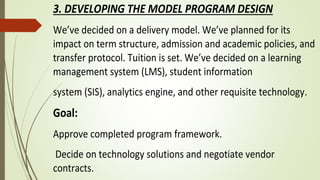
3. DEVELOPING THE MODEL PROGRAM DESIGN
We’ve decided on a delivery model. We’ve planned for its
impact on term structure, admission and academic policies, and
transfer protocol. Tuition is set. We’ve decided on a learning
management system (LMS), student information
system (SIS), analytics engine, and other requisite technology.
Goal:
Approve completed program framework.
Decide on technology solutions and negotiate vendor
contracts.
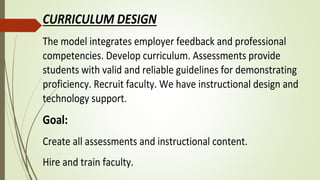
CURRICULUM DESIGN
The model integrates employer feedback and professional
competencies. Develop curriculum. Assessments provide
students with valid and reliable guidelines for demonstrating
proficiency. Recruit faculty. We have instructional design and
technology support.
Goal:
Create all assessments and instructional content.
Hire and train faculty.
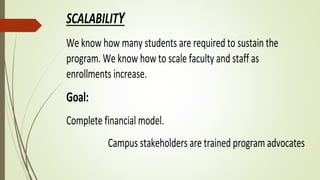
SCALABILITY
We know how many students are required to sustain the
program. We know how to scale faculty and staff as
enrollments increase.
Goal:
Complete financial model.
Campus stakeholders are trained program advocates
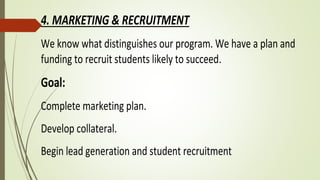
4. MARKETING & RECRUITMENT
We know what distinguishes our program. We have a plan and
funding to recruit students likely to succeed.
Goal:
Complete marketing plan.
Develop collateral.
Begin lead generation and student recruitment
5. ADMISSIONS & REGISTRATION
We’ve tailored admission requirements for CBE applicants and
have a clear process to award prior learning credit. Our
application, registration, degree planning, and new student
orientation match our delivery modality.
Goal:
Complete orientation.
Students can apply, receive advisement, and enroll in
competency modules.
6. ENROLLED STUDENT ENGAGEMENT
We know how to keep students engaged and can intervene
with at-risk learners. We have evaluated advising, student
services, and technology to sustain students including a 24/7
help desk, library, bookstore, and tutoring.
Goal:
Students actively participate in learning environment.
Mentors can identify at-risk students and provide data-
informed
support services.
7. DATA & IMPROVEMENT
We have key performance indicators for evaluation and
improvement. We have the ability to use data to support
students and revise curriculum.
Goal:
Track performance.
Monitor effectiveness.
Modify and instruction (ongoing

Competency based teaching

  • 1.
    Competency based teaching By Mahmoudshaqria ‫شقريه‬ ‫محمود‬
  • 2.
    GOAL: By the endof this lecture the learner will be able to: Understand all about Competency based teaching
  • 3.
    General Objectives: At theend of this session each participant will be able to identify ,determine ,define the whole picture of competency based teaching
  • 4.
    Specific objectives At theend of this lecture the participant will be able to: Define the key terms concerned with CBL Determine the characteristics of CBE Identify: Practical benefits of competency based education Elements of a competency-based system Readiness assessment for competency based education
  • 5.
    Key terms Competency A competencyis a specific skill, knowledge, or ability that is both observable and measurable. Competency Based Learning (CBL) Learning processes focused on acquiring specific skills and developing specific abilities
  • 6.
    Skills Skills are atype of competency referring to observable and measurable tasks a student can accomplish as a result of education, training, and/or practice Program Learning Outcomes Observable and measurable statements about what a specific program delivers and expects to see in each of its graduates.
  • 7.
    Differentiated Learning a varietyof methodologies that direct students along different pathways based on their needs and mastery of competencies Certifications Certifications are awarded by third-party non-governmental certification bodies, such as an industry or occupational association, based on an individual demonstrating through an examination process that she or he has mastered the required knowledge, skills, and abilities to perform a specific job.
  • 8.
    Credentials Credentials is anumbrella term that includes degrees, diplomas, certificates, badges, professional/industry certifications , apprenticeships, and licenses. Credentials vary in the awarding organization, the standards on which the award is based, and the rigor and type of assessment and validation processes used to attest to the skills, knowledge, and abilities people possess
  • 9.
    Practical benefits ofcompetency base education: Efficient and potentially lower-cost degree/credential options for students Greater understanding of learning outcomes throughout the academic institution Courses, learning resources, and assessments aligned to well-defined goals Motivated and engaged students
  • 10.
     Increased studentretention and completion rates, particularly when prior learning can be applied to degree progress  Learners’ improved ability to recognize, manage, and continuously build upon their own competencies and evidence of learning  Employers’ improved ability to understand graduates’ competencies and learning achievements  Outcomes-based frameworks for continuous improvement at course, program, and institutional levels
  • 11.
    characteristics of CBE: 1.Acquisition of essential cognitive, psychomotor, and affective skills; 2. Continued development of skills. 3. Broadly based competency development derived from the best professional evidence, current standards, and regulations. 4. Authentic assessments which are valid and reliable. 5. The use of adult learning principles. 6. Individual learning styles and abilities are recognized and appreciated.
  • 12.
    Ten elements ofa competency-based system: Intellectual mission that focuses resources and behaviors on productive habits of mind and preparation for participation in college, careers, and civic life. Standards that express in some detail what students should know and be able to do. Progress monitoring, historically thought of as grading, and achievement recognition systems, historically thought of as class rank.
  • 13.
    Grouping and schedulingsystems—when, why and how groups are used when learning not age cohorts is the dominant organizing principle. Reporting to the outside world that still thinks in courses, credits, and grades. Content that supports self-directed and customized learning. Tools that facilitate standards-based challenges, collaboration, and scheduling.
  • 14.
    Teacher support, preparationand development for a dynamic environment with differentiated (i.e., different levels) and distributed (i.e., different locations) staffing. Evaluation systems that helps to determine student learning and how experiences and adults are contributing. Community connections and supports for student success
  • 15.
    Readiness assessment forcompetency based education 1. INITIAL MARKET ANALYSIS We know which degrees are in demand and where future growth will occur. We understand local employer's needs and have identified target students. Goal: Prioritize potential program(s) for development.
  • 16.
    2. INSTITUTIONAL READINESS CBEaligns with our mission. Faculty and executives support it. We’ve identified existing capabilities, infrastructure, and financial resources. We’ve conceptualized our model, considered its impact on campus functions, and identified third party support. We have an accreditation plan and can offer federal student aid. Goal: Formalize plan for program development through the entire student lifecycle. Secure internal support. It’s “go”/ “no go” decision time.
  • 17.
    3. DEVELOPING THEMODEL PROGRAM DESIGN We’ve decided on a delivery model. We’ve planned for its impact on term structure, admission and academic policies, and transfer protocol. Tuition is set. We’ve decided on a learning management system (LMS), student information system (SIS), analytics engine, and other requisite technology. Goal: Approve completed program framework. Decide on technology solutions and negotiate vendor contracts.
  • 18.
    CURRICULUM DESIGN The modelintegrates employer feedback and professional competencies. Develop curriculum. Assessments provide students with valid and reliable guidelines for demonstrating proficiency. Recruit faculty. We have instructional design and technology support. Goal: Create all assessments and instructional content. Hire and train faculty.
  • 19.
    SCALABILITY We know howmany students are required to sustain the program. We know how to scale faculty and staff as enrollments increase. Goal: Complete financial model. Campus stakeholders are trained program advocates
  • 20.
    4. MARKETING &RECRUITMENT We know what distinguishes our program. We have a plan and funding to recruit students likely to succeed. Goal: Complete marketing plan. Develop collateral. Begin lead generation and student recruitment
  • 21.
    5. ADMISSIONS &REGISTRATION We’ve tailored admission requirements for CBE applicants and have a clear process to award prior learning credit. Our application, registration, degree planning, and new student orientation match our delivery modality. Goal: Complete orientation. Students can apply, receive advisement, and enroll in competency modules.
  • 22.
    6. ENROLLED STUDENTENGAGEMENT We know how to keep students engaged and can intervene with at-risk learners. We have evaluated advising, student services, and technology to sustain students including a 24/7 help desk, library, bookstore, and tutoring. Goal: Students actively participate in learning environment. Mentors can identify at-risk students and provide data- informed support services.
  • 23.
    7. DATA &IMPROVEMENT We have key performance indicators for evaluation and improvement. We have the ability to use data to support students and revise curriculum. Goal: Track performance. Monitor effectiveness. Modify and instruction (ongoing