SURVEYING
& LEVELLING
Lecture # 1
Theodolite
Traversing
Introduction to Theodolite Traversing
 Theodolites are telescopic instruments with high
precision used for measuring angles in the horizontal and
vertical planes.
 Theodolites may also be used for
 Measuring Horizontal distances
 Measuring Vertical heights of objects
 Measuring deflection angles
 Measuring Magnetic Bearings of lines
(requires trough compass or in-built compass with theodolite)
 Ranging of lines
Types of Theodolite
A-Classification Based upon Telescope
1- Transit Theodolites
In transit theodolites, Telescope can be revolved through a complete
revolution about its horizontal axis in a vertical plane.
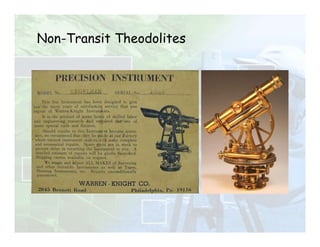
2- Non-Transit Theodolites
In non-transit theodolites, the telescope cannot be revolved through a
complete revolution in the vertical plane.
But it can be revolved to a certain extent in the vertical plane, in
order to measure the angle of elevation or depression.
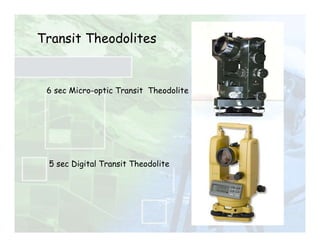
Transit Theodolites
6 sec Micro-optic Transit Theodolite
5 sec Digital Transit Theodolite
Non-Transit Theodolites
Types of Theodolite
1- Vernier Theodolites
Vernier theodolites are fitted with a vernier scale.
Vernier scale measures the main scale reading and the rest of the
fractional reading is read from vernier scale.
Large scale is divided into smaller divisions on the vernier scale.
2- Micrometer Theodolites
When the theodolite is fitted with a micrometer to read the angle, it
will be classified under Micrometer Theodolite. Micrometer is more
precise than Vernier Thedolites.
In Micrometer, main scale reading is brought to a lower defined value,
and this adjustment is read from the micrometer scale.
Large scale is divided into smaller divisions on the micrometer.
B-Classification Based upon Angle Measurement
Definitions
1- Size of Theodolite
Size of theodolite is defined according to the diameter of the main
horizontal graduated circle. Main horizontal circle is in the upper
parallel plate of the theodolite.
In engineering surveys, 8cm to 12cm theodolites are generally used.
2- Centring
The setting of theodolite exactly over a station mark by means of a
plumb-bob is known as centring.
It means that the vertical axis which is passing through the center of
the horizontal circle of the theodolite is passing exactly through the
center of the station point on ground.
Definitions
3- Transiting
The method of turning the telescope about its horizontal axis in a
vertical plane through 180º is termed as transiting.
Transiting results in the change of face of the theodolite.
4- Face Left
It means that the vertical circle of the theodolite is on the left of
the observer at the time of taking readings.
Observation taken in this position is known as face left observation.
5- Face Right
It means that the vertical circle of the theodolite is on the right of
the observer at the time of taking readings.
Observation taken in this position is known as face right observation.
Definitions
6- Telescope Normal
The face left position is called ‘telescope normal’ or ‘telescope direct’
7- Telescope Inverted
The face right position is called ‘telescope inverted’ or ‘telescope
reversed’
8- Changing Face
The operation of bringing the vertical circle from one side of the
observer to the other is known as changing face of the theodolite.
9- Swinging the telescope
This indicates turning of the telescope in a horizontal plane.
It is called ‘right swing’ when the telescope is turned clockwise and ‘left
swing’ when the telescope is turned anti-clockwise.
Definitions
10- Line of Collimation
It is an imaginary line passing through the intersection of the cross
hairs at the diaphragm and the optical center of the object glass and
its continuation.
11- Axis of the Telescope
This axis is an imaginary line passing through the optical center of the
object glass and optical center of the eye-piece.
12- Axis of the bubble tube
It is the straight line tangential to the longitudinal curve of the plate
level tube at its centre.
The axis of the plate level is horizontal when the bubble is centered.
Definitions
12- Vertical Axis
It is the axis of rotation of telescope in the horizontal plane.
13- Horizontal Axis
It is the axis of rotation of the telescope in the vertical plane. It is
also known as trunnion axis.
14- The Diaphragm
The diaphragm is a brass ring consisting of cross-hairs, or one
containing a glass disc with fine lines engraved on it. It is fixed in front
of the eye-piece.
15- Magnification Power of Telescope
The magnifying power of a telescope is the ratio of the focal length of
the object glass to the focal length of the eye-piece. It is expressed in
terms of diameter, e.g. 20 diameters, 30 diameters
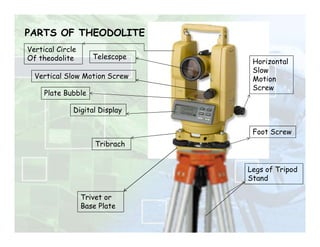
PARTS OF THEODOLITE
Trivet or
Base Plate
Legs of Tripod
Stand
Tribrach
Foot Screw
Digital Display
Plate Bubble
Vertical Slow Motion Screw
Horizontal
Slow
Motion
Screw
Telescope
Vertical Circle
Of theodolite
Temporary adjustment of Theodolite
Following steps are involved in the temporary adjustment of
theodolite.
1. Opening the tripod stand approximately over the instrument station
point.
2. Setting the theodolite over the tripod stand.
3. Bringing the leveling foot screws of the theodolite to zero level.
4. Centering the instrument and the stand over the inst. station point.
5. Leveling
– Leveling the Plate bubble along two axis that are perpendicular to each
other.
– Leveling by adjusting the heights of the legs of the tripod stand and
using the circular bubble.
6. Centering
– Centering by using optical plumet
– Centering by using plumb line.
7. Focusing the eye-piece to clear the cross hairs image
8. Focusing the object glass to clear the object image by rotating the
focusing ring.
CONCLUDED

Theodolite lecture 1 1

  • 1.
    SURVEYING & LEVELLING Lecture #1 Theodolite Traversing
  • 2.
    Introduction to TheodoliteTraversing  Theodolites are telescopic instruments with high precision used for measuring angles in the horizontal and vertical planes.  Theodolites may also be used for  Measuring Horizontal distances  Measuring Vertical heights of objects  Measuring deflection angles  Measuring Magnetic Bearings of lines (requires trough compass or in-built compass with theodolite)  Ranging of lines
  • 3.
    Types of Theodolite A-ClassificationBased upon Telescope 1- Transit Theodolites In transit theodolites, Telescope can be revolved through a complete revolution about its horizontal axis in a vertical plane. 2- Non-Transit Theodolites In non-transit theodolites, the telescope cannot be revolved through a complete revolution in the vertical plane. But it can be revolved to a certain extent in the vertical plane, in order to measure the angle of elevation or depression.
  • 4.
    Transit Theodolites 6 secMicro-optic Transit Theodolite 5 sec Digital Transit Theodolite
  • 5.
  • 6.
    Types of Theodolite 1-Vernier Theodolites Vernier theodolites are fitted with a vernier scale. Vernier scale measures the main scale reading and the rest of the fractional reading is read from vernier scale. Large scale is divided into smaller divisions on the vernier scale. 2- Micrometer Theodolites When the theodolite is fitted with a micrometer to read the angle, it will be classified under Micrometer Theodolite. Micrometer is more precise than Vernier Thedolites. In Micrometer, main scale reading is brought to a lower defined value, and this adjustment is read from the micrometer scale. Large scale is divided into smaller divisions on the micrometer. B-Classification Based upon Angle Measurement
  • 7.
    Definitions 1- Size ofTheodolite Size of theodolite is defined according to the diameter of the main horizontal graduated circle. Main horizontal circle is in the upper parallel plate of the theodolite. In engineering surveys, 8cm to 12cm theodolites are generally used. 2- Centring The setting of theodolite exactly over a station mark by means of a plumb-bob is known as centring. It means that the vertical axis which is passing through the center of the horizontal circle of the theodolite is passing exactly through the center of the station point on ground.
  • 8.
    Definitions 3- Transiting The methodof turning the telescope about its horizontal axis in a vertical plane through 180º is termed as transiting. Transiting results in the change of face of the theodolite. 4- Face Left It means that the vertical circle of the theodolite is on the left of the observer at the time of taking readings. Observation taken in this position is known as face left observation. 5- Face Right It means that the vertical circle of the theodolite is on the right of the observer at the time of taking readings. Observation taken in this position is known as face right observation.
  • 9.
    Definitions 6- Telescope Normal Theface left position is called ‘telescope normal’ or ‘telescope direct’ 7- Telescope Inverted The face right position is called ‘telescope inverted’ or ‘telescope reversed’ 8- Changing Face The operation of bringing the vertical circle from one side of the observer to the other is known as changing face of the theodolite. 9- Swinging the telescope This indicates turning of the telescope in a horizontal plane. It is called ‘right swing’ when the telescope is turned clockwise and ‘left swing’ when the telescope is turned anti-clockwise.
  • 10.
    Definitions 10- Line ofCollimation It is an imaginary line passing through the intersection of the cross hairs at the diaphragm and the optical center of the object glass and its continuation. 11- Axis of the Telescope This axis is an imaginary line passing through the optical center of the object glass and optical center of the eye-piece. 12- Axis of the bubble tube It is the straight line tangential to the longitudinal curve of the plate level tube at its centre. The axis of the plate level is horizontal when the bubble is centered.
  • 11.
    Definitions 12- Vertical Axis Itis the axis of rotation of telescope in the horizontal plane. 13- Horizontal Axis It is the axis of rotation of the telescope in the vertical plane. It is also known as trunnion axis. 14- The Diaphragm The diaphragm is a brass ring consisting of cross-hairs, or one containing a glass disc with fine lines engraved on it. It is fixed in front of the eye-piece. 15- Magnification Power of Telescope The magnifying power of a telescope is the ratio of the focal length of the object glass to the focal length of the eye-piece. It is expressed in terms of diameter, e.g. 20 diameters, 30 diameters
  • 12.
    PARTS OF THEODOLITE Trivetor Base Plate Legs of Tripod Stand Tribrach Foot Screw Digital Display Plate Bubble Vertical Slow Motion Screw Horizontal Slow Motion Screw Telescope Vertical Circle Of theodolite
  • 13.
    Temporary adjustment ofTheodolite Following steps are involved in the temporary adjustment of theodolite. 1. Opening the tripod stand approximately over the instrument station point. 2. Setting the theodolite over the tripod stand. 3. Bringing the leveling foot screws of the theodolite to zero level. 4. Centering the instrument and the stand over the inst. station point. 5. Leveling – Leveling the Plate bubble along two axis that are perpendicular to each other. – Leveling by adjusting the heights of the legs of the tripod stand and using the circular bubble. 6. Centering – Centering by using optical plumet – Centering by using plumb line. 7. Focusing the eye-piece to clear the cross hairs image 8. Focusing the object glass to clear the object image by rotating the focusing ring.
  • 14.