HEIGHT GAUGES:
BASIC INTRODUCTION
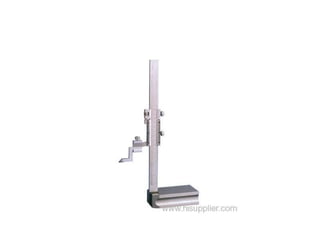
• Height gauge, also called Vernier height gauge, is a widely used
bench top tool.
• A height gauge is a measuring device used either for determining
the height of something, or for repetitious marking of items.
• It is much more capable than calipers but not as complex as a
coordinate measuring machine (CMM).
• Vernier height gauges, however, greatly rely on users’ skill.
• The first electronic height gauge emerged during the mid-1980s.
• These measuring tools are used in metalworking or metrology to
either set or measure vertical distances.
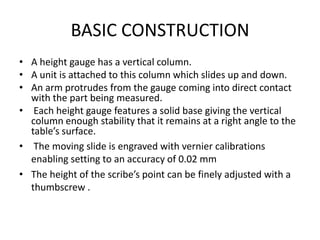
BASIC CONSTRUCTION
• A height gauge has a vertical column.
• A unit is attached to this column which slides up and down.
• An arm protrudes from the gauge coming into direct contact
with the part being measured.
• Each height gauge features a solid base giving the vertical
column enough stability that it remains at a right angle to the
table’s surface.
• The moving slide is engraved with vernier calibrations
enabling setting to an accuracy of 0.02 mm
• The height of the scribe’s point can be finely adjusted with a
thumbscrew .
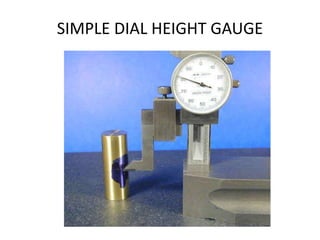
SIMPLE DIAL HEIGHT GAUGE
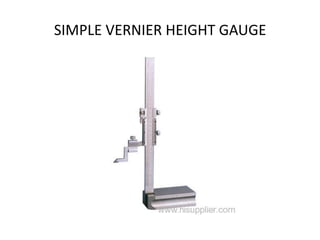
SIMPLE VERNIER HEIGHT GAUGE
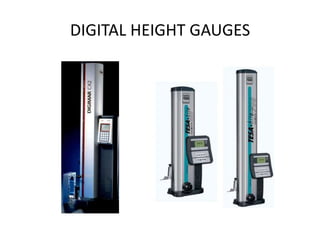
DIGITAL HEIGHT GAUGES
Applications
• These are used to mark out lines and widely used on surface
plates and on machine tables.
• The height gauge with an indicator attachment is used for
checking of surface holes.
• The height gauge with a scribe attachment is used to mark
reference lines and locations on castings and forgings.
Working
• The work to be marked out with a vernier height gauge must be set
vertically on a surface plate.
• The height of the scribe is set with the moving slide’s fine adjusting screw.
• The marking out lines are then scribed onto the work’s surface by steadily
moving the vernier height gauge along the surface plate .
• On some vernier height gauges, the height of the main scale can also be
finely adjusted.
• This enables measurements to start from a convenient reading, which is
useful if the shape of the workpiece is such that it needs to be mounted
on a parallel strip .
OTHER TYPES
• Digital dial height gauge: It is like a dial height
gauge, but with a counter for more precise
measurement.
• Electronic digital height gauge. A height gauge
featuring a digital display of measurements.
– These units can also include features such as instant inch-
to-millimeter conversion, a hold option that temporarily
saves your measurements and the ability to set any
position to zero.
DIGITAL / ELECTRONIC GAUGES
 High specification electronic height gauges can carry
out different measuring tasks including step
heights, internal/external diameters and centre-line
distances. The electronic height gauge is extremely
precise up to 0.001in. and claims consistency of
±0.0001in.
 The digital height gauge is made from high
quality, hardened stainless steel. It comprises a solid
cast iron base which is robust to ensure rigidity and
stability of the instrument; and extending from the
base up is the beam which includes a printed scale in
both imperial and metric format.
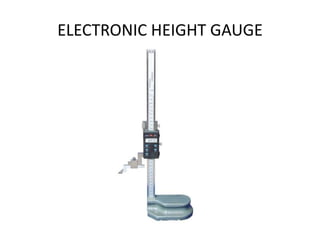
ELECTRONIC HEIGHT GAUGE
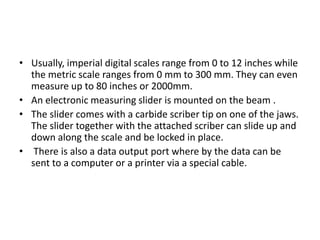
• Usually, imperial digital scales range from 0 to 12 inches while
the metric scale ranges from 0 mm to 300 mm. They can even
measure up to 80 inches or 2000mm.
• An electronic measuring slider is mounted on the beam .
• The slider comes with a carbide scriber tip on one of the jaws.
The slider together with the attached scriber can slide up and
down along the scale and be locked in place.
• There is also a data output port where by the data can be
sent to a computer or a printer via a special cable.
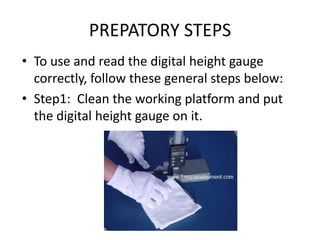
PREPATORY STEPS
• To use and read the digital height gauge
correctly, follow these general steps below:
• Step1: Clean the working platform and put
the digital height gauge on it.
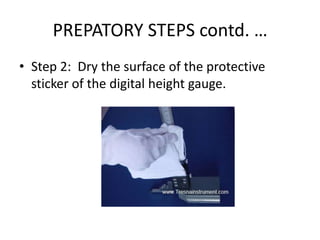
PREPATORY STEPS contd. …
• Step 2: Dry the surface of the protective
sticker of the digital height gauge.
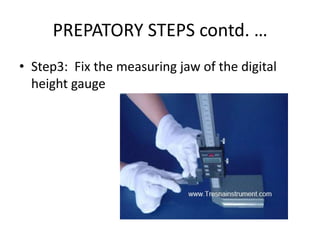
PREPATORY STEPS contd. …
• Step3: Fix the measuring jaw of the digital
height gauge
PREPATORY STEPS contd. …
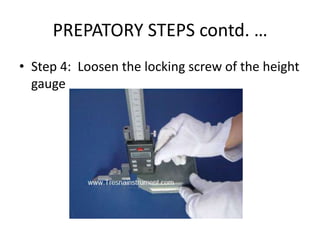
• Step 4: Loosen the locking screw of the height
gauge
.
PREPATORY STEPS contd. …
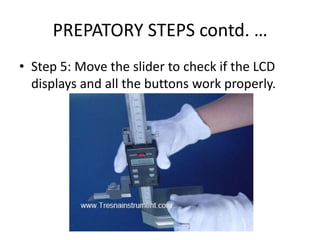
• Step 5: Move the slider to check if the LCD
displays and all the buttons work properly.
TAKING MEASUREMENTS
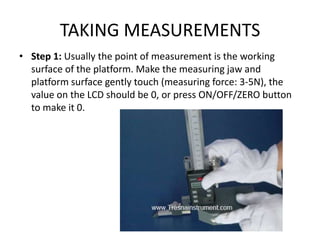
• Step 1: Usually the point of measurement is the working
surface of the platform. Make the measuring jaw and
platform surface gently touch (measuring force: 3-5N), the
value on the LCD should be 0, or press ON/OFF/ZERO button
to make it 0.
TAKING MEASUREMENTS contd. …
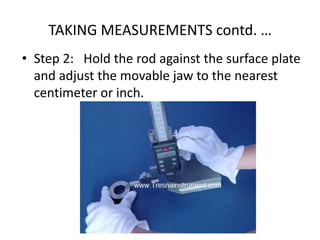
• Step 2: Hold the rod against the surface plate
and adjust the movable jaw to the nearest
centimeter or inch.
TAKING MEASUREMENTS contd. …
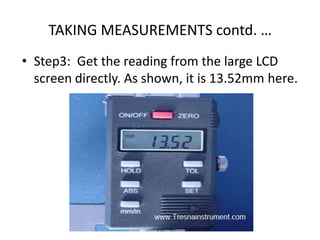
• Step3: Get the reading from the large LCD
screen directly. As shown, it is 13.52mm here.

Height gauge

  • 1.
    HEIGHT GAUGES: BASIC INTRODUCTION •Height gauge, also called Vernier height gauge, is a widely used bench top tool. • A height gauge is a measuring device used either for determining the height of something, or for repetitious marking of items. • It is much more capable than calipers but not as complex as a coordinate measuring machine (CMM). • Vernier height gauges, however, greatly rely on users’ skill. • The first electronic height gauge emerged during the mid-1980s. • These measuring tools are used in metalworking or metrology to either set or measure vertical distances.
  • 2.
    BASIC CONSTRUCTION • Aheight gauge has a vertical column. • A unit is attached to this column which slides up and down. • An arm protrudes from the gauge coming into direct contact with the part being measured. • Each height gauge features a solid base giving the vertical column enough stability that it remains at a right angle to the table’s surface. • The moving slide is engraved with vernier calibrations enabling setting to an accuracy of 0.02 mm • The height of the scribe’s point can be finely adjusted with a thumbscrew .
  • 3.
  • 4.
  • 5.
  • 6.
    Applications • These areused to mark out lines and widely used on surface plates and on machine tables. • The height gauge with an indicator attachment is used for checking of surface holes. • The height gauge with a scribe attachment is used to mark reference lines and locations on castings and forgings.
  • 7.
    Working • The workto be marked out with a vernier height gauge must be set vertically on a surface plate. • The height of the scribe is set with the moving slide’s fine adjusting screw. • The marking out lines are then scribed onto the work’s surface by steadily moving the vernier height gauge along the surface plate . • On some vernier height gauges, the height of the main scale can also be finely adjusted. • This enables measurements to start from a convenient reading, which is useful if the shape of the workpiece is such that it needs to be mounted on a parallel strip .
  • 9.
    OTHER TYPES • Digitaldial height gauge: It is like a dial height gauge, but with a counter for more precise measurement. • Electronic digital height gauge. A height gauge featuring a digital display of measurements. – These units can also include features such as instant inch- to-millimeter conversion, a hold option that temporarily saves your measurements and the ability to set any position to zero.
  • 10.
    DIGITAL / ELECTRONICGAUGES  High specification electronic height gauges can carry out different measuring tasks including step heights, internal/external diameters and centre-line distances. The electronic height gauge is extremely precise up to 0.001in. and claims consistency of ±0.0001in.  The digital height gauge is made from high quality, hardened stainless steel. It comprises a solid cast iron base which is robust to ensure rigidity and stability of the instrument; and extending from the base up is the beam which includes a printed scale in both imperial and metric format.
  • 11.
  • 12.
    • Usually, imperialdigital scales range from 0 to 12 inches while the metric scale ranges from 0 mm to 300 mm. They can even measure up to 80 inches or 2000mm. • An electronic measuring slider is mounted on the beam . • The slider comes with a carbide scriber tip on one of the jaws. The slider together with the attached scriber can slide up and down along the scale and be locked in place. • There is also a data output port where by the data can be sent to a computer or a printer via a special cable.
  • 13.
    PREPATORY STEPS • Touse and read the digital height gauge correctly, follow these general steps below: • Step1: Clean the working platform and put the digital height gauge on it.
  • 14.
    PREPATORY STEPS contd.… • Step 2: Dry the surface of the protective sticker of the digital height gauge.
  • 15.
    PREPATORY STEPS contd.… • Step3: Fix the measuring jaw of the digital height gauge
  • 16.
    PREPATORY STEPS contd.… • Step 4: Loosen the locking screw of the height gauge .
  • 17.
    PREPATORY STEPS contd.… • Step 5: Move the slider to check if the LCD displays and all the buttons work properly.
  • 18.
    TAKING MEASUREMENTS • Step1: Usually the point of measurement is the working surface of the platform. Make the measuring jaw and platform surface gently touch (measuring force: 3-5N), the value on the LCD should be 0, or press ON/OFF/ZERO button to make it 0.
  • 19.
    TAKING MEASUREMENTS contd.… • Step 2: Hold the rod against the surface plate and adjust the movable jaw to the nearest centimeter or inch.
  • 20.
    TAKING MEASUREMENTS contd.… • Step3: Get the reading from the large LCD screen directly. As shown, it is 13.52mm here.