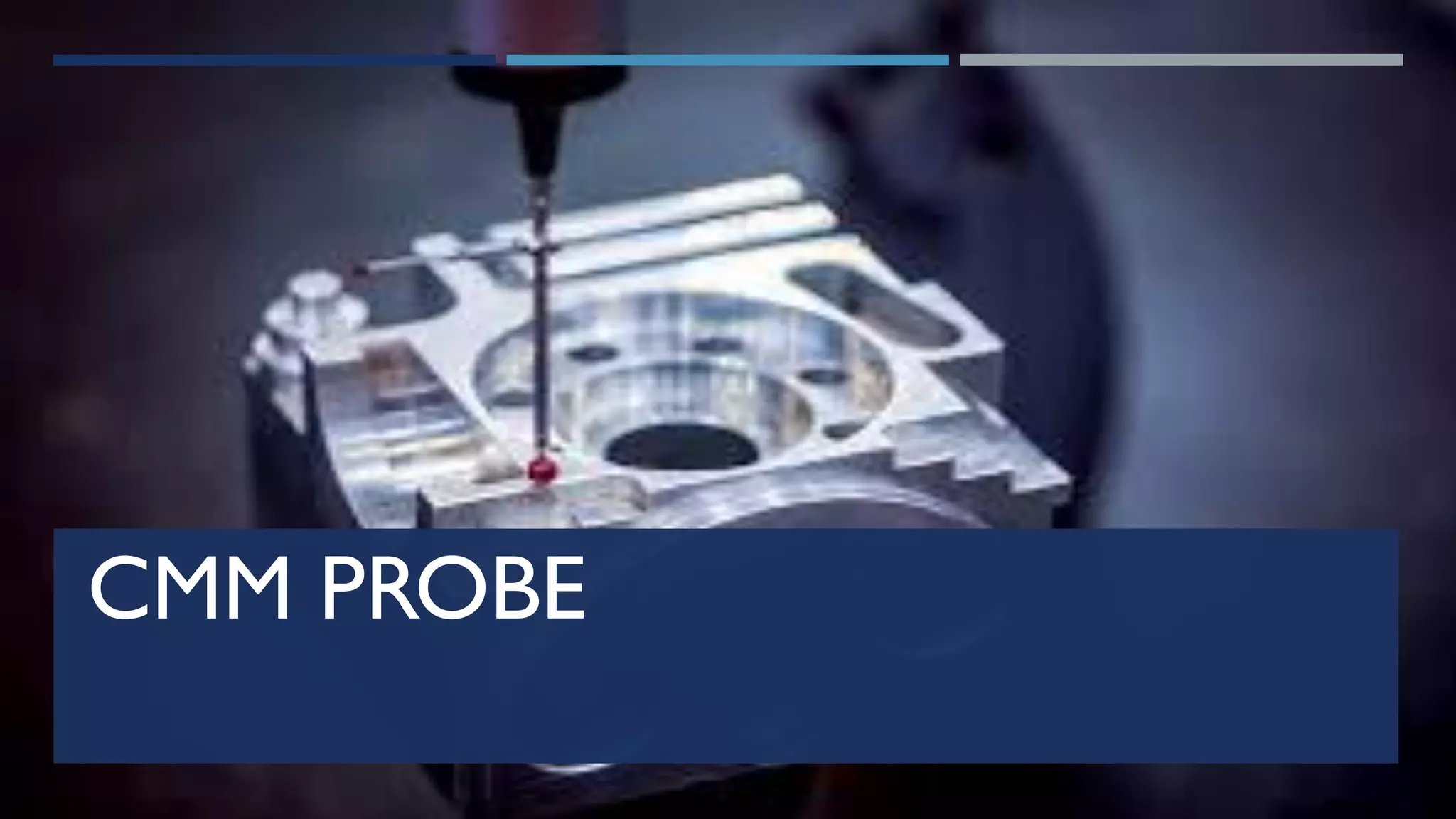
CMM PROBE
CONTENT
 Introduction
 Types of probes
 Parts of Probe
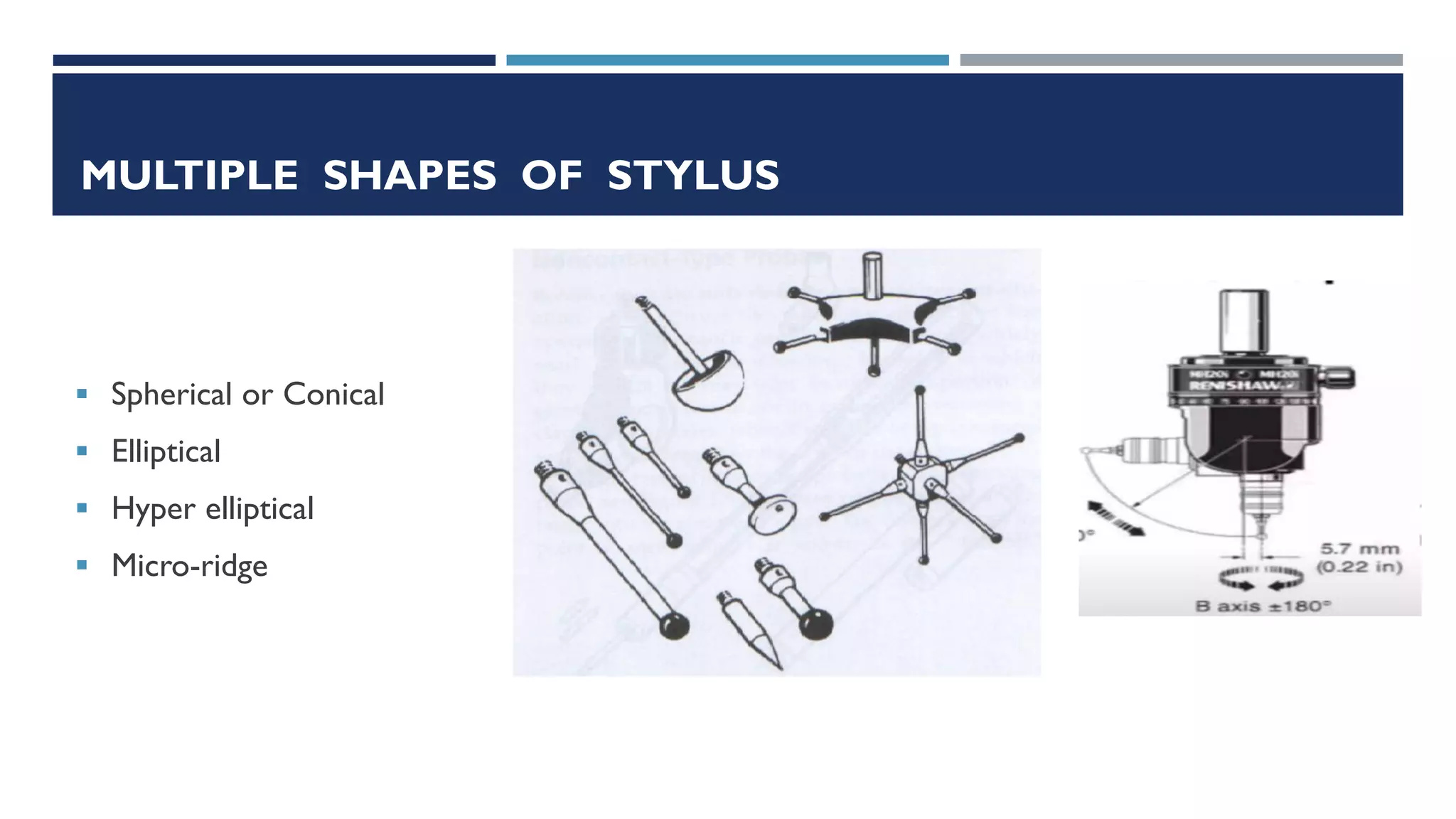
 Multiple shapes of Stylus
 Features of CMM probes
 CMM Probes Specifications
 Probe Calibration
 Material specification
 Standardization
 Limitations
 Conclusions
 References
INTRODUCTION
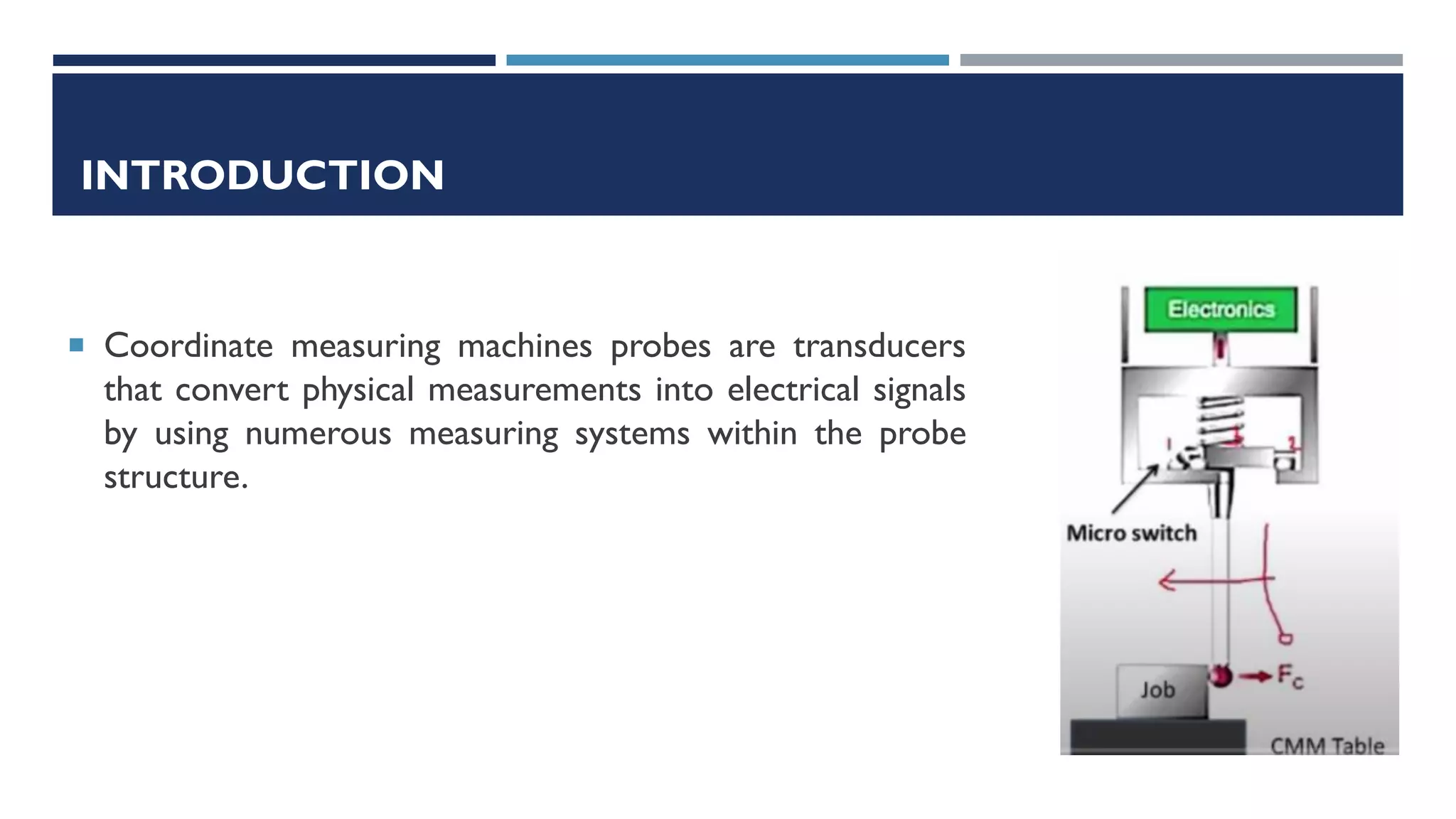
 Coordinate measuring machines probes are transducers
that convert physical measurements into electrical signals
by using numerous measuring systems within the probe
structure.
TYPES OF PROBES
Types of Probe
ContactType Probe
TouchTrigger/
discrete Point
Probe
Analog
Scanning
Probe
Non-ContactType probe
Laser probe Video probe
TOUCH TRIGGER / DISCRETE POINT PROBE
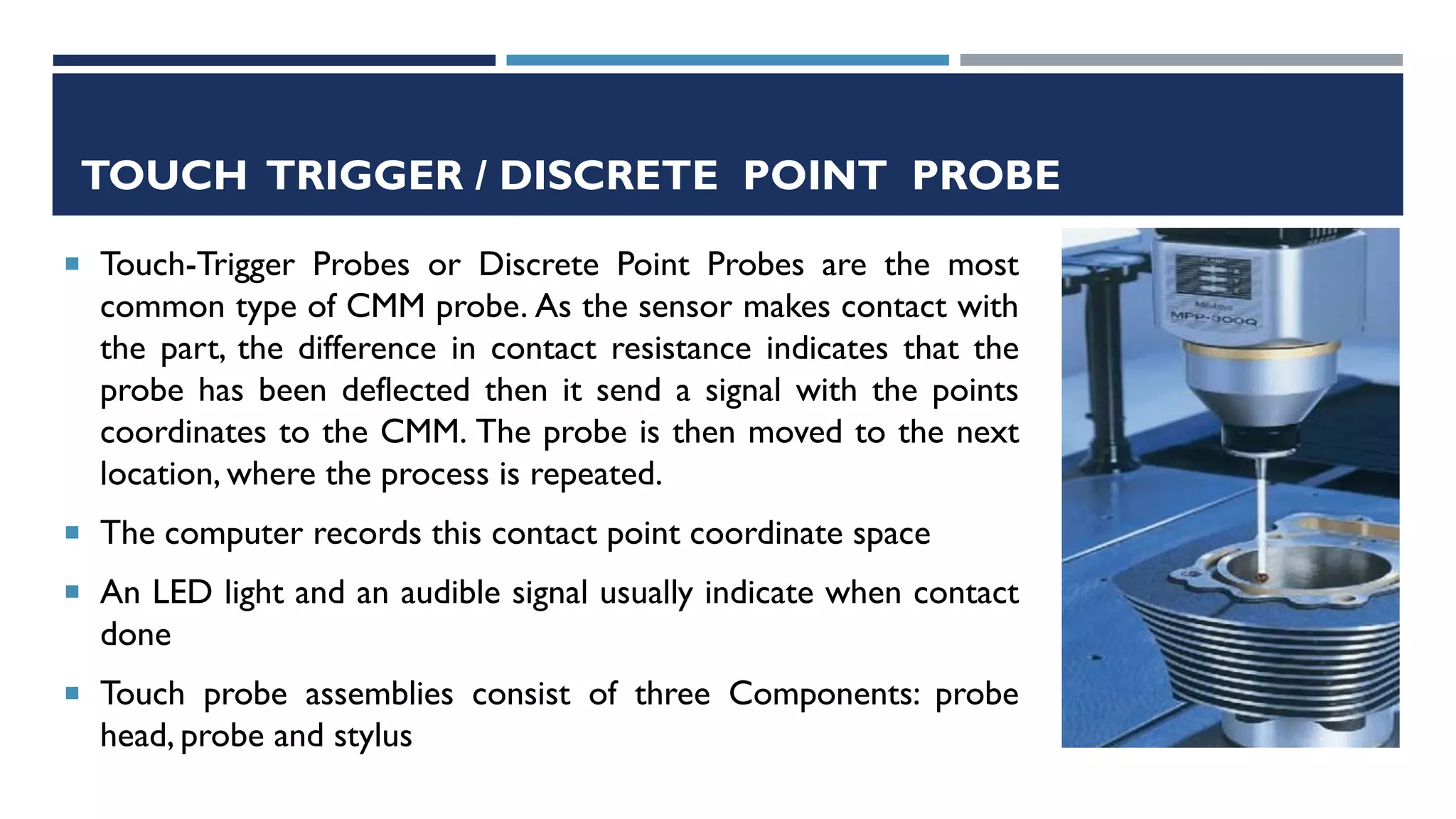
 Touch-Trigger Probes or Discrete Point Probes are the most
common type of CMM probe. As the sensor makes contact with
the part, the difference in contact resistance indicates that the
probe has been deflected then it send a signal with the points
coordinates to the CMM. The probe is then moved to the next
location, where the process is repeated.
 The computer records this contact point coordinate space
 An LED light and an audible signal usually indicate when contact
done
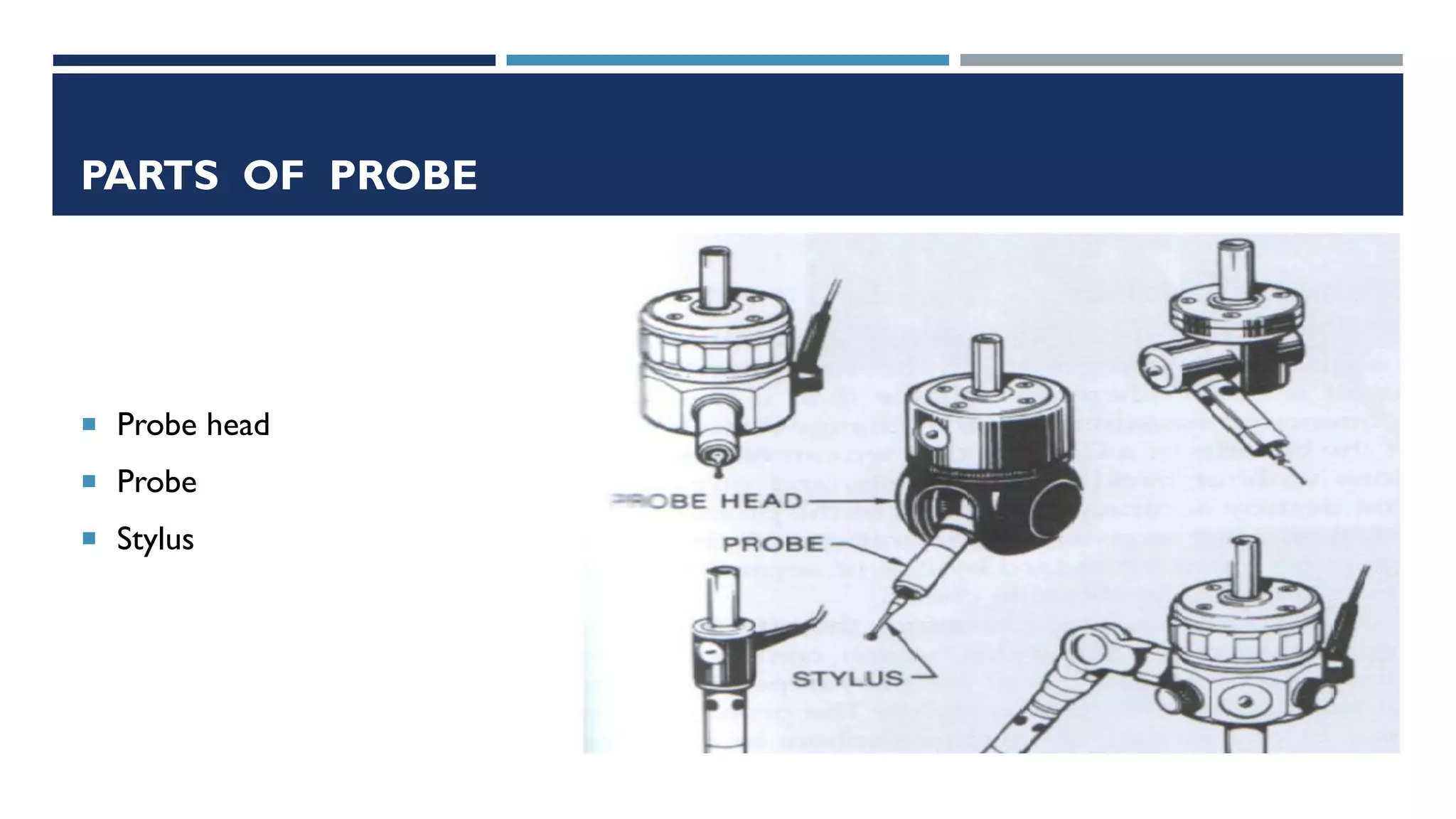
 Touch probe assemblies consist of three Components: probe
head, probe and stylus
ANALOG SCANNING PROBE
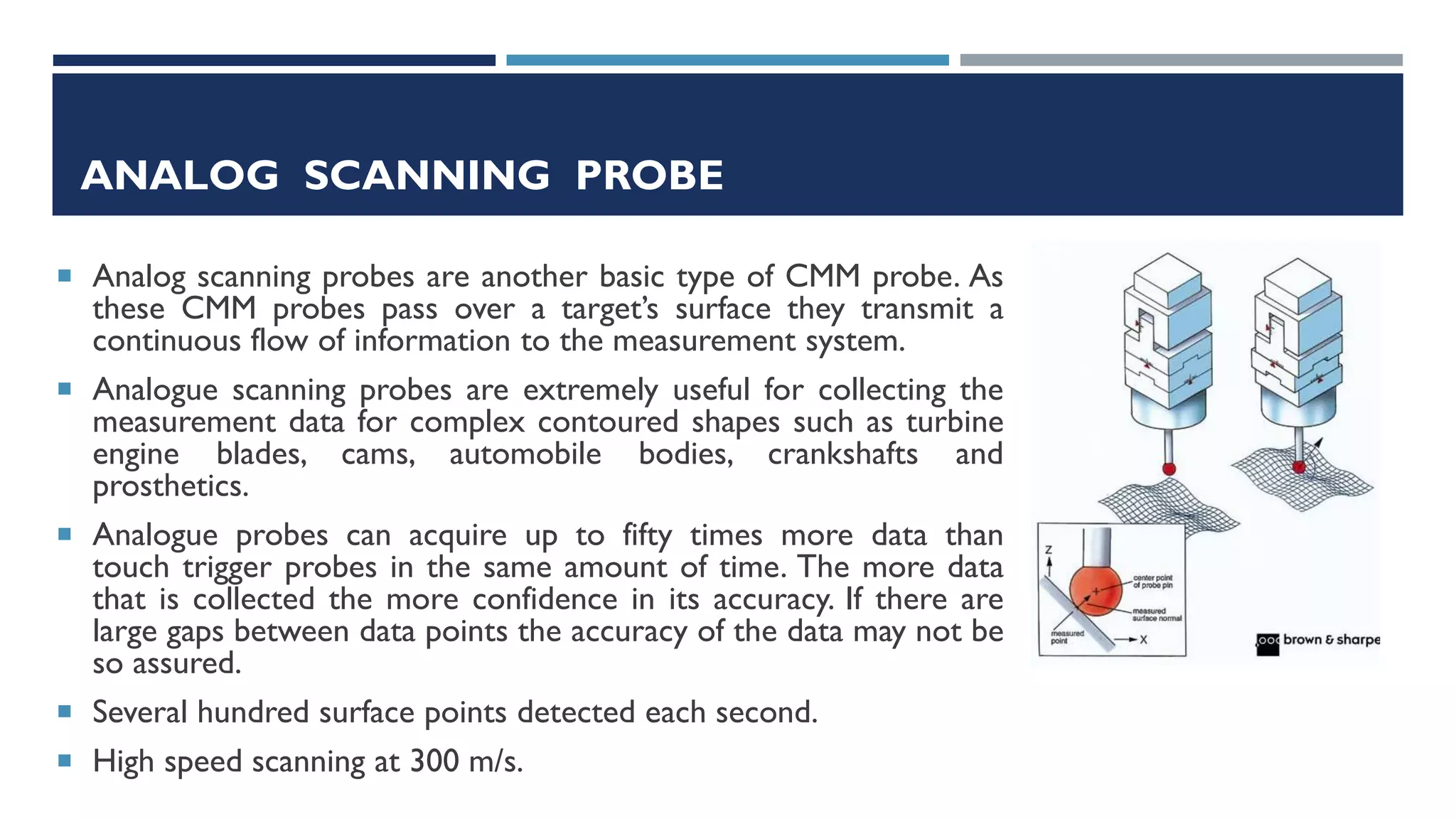
 Analog scanning probes are another basic type of CMM probe. As
these CMM probes pass over a target’s surface they transmit a
continuous flow of information to the measurement system.
 Analogue scanning probes are extremely useful for collecting the
measurement data for complex contoured shapes such as turbine
engine blades, cams, automobile bodies, crankshafts and
prosthetics.
 Analogue probes can acquire up to fifty times more data than
touch trigger probes in the same amount of time. The more data
that is collected the more confidence in its accuracy. If there are
large gaps between data points the accuracy of the data may not be
so assured.
 Several hundred surface points detected each second.
 High speed scanning at 300 m/s.
LASER PROBE
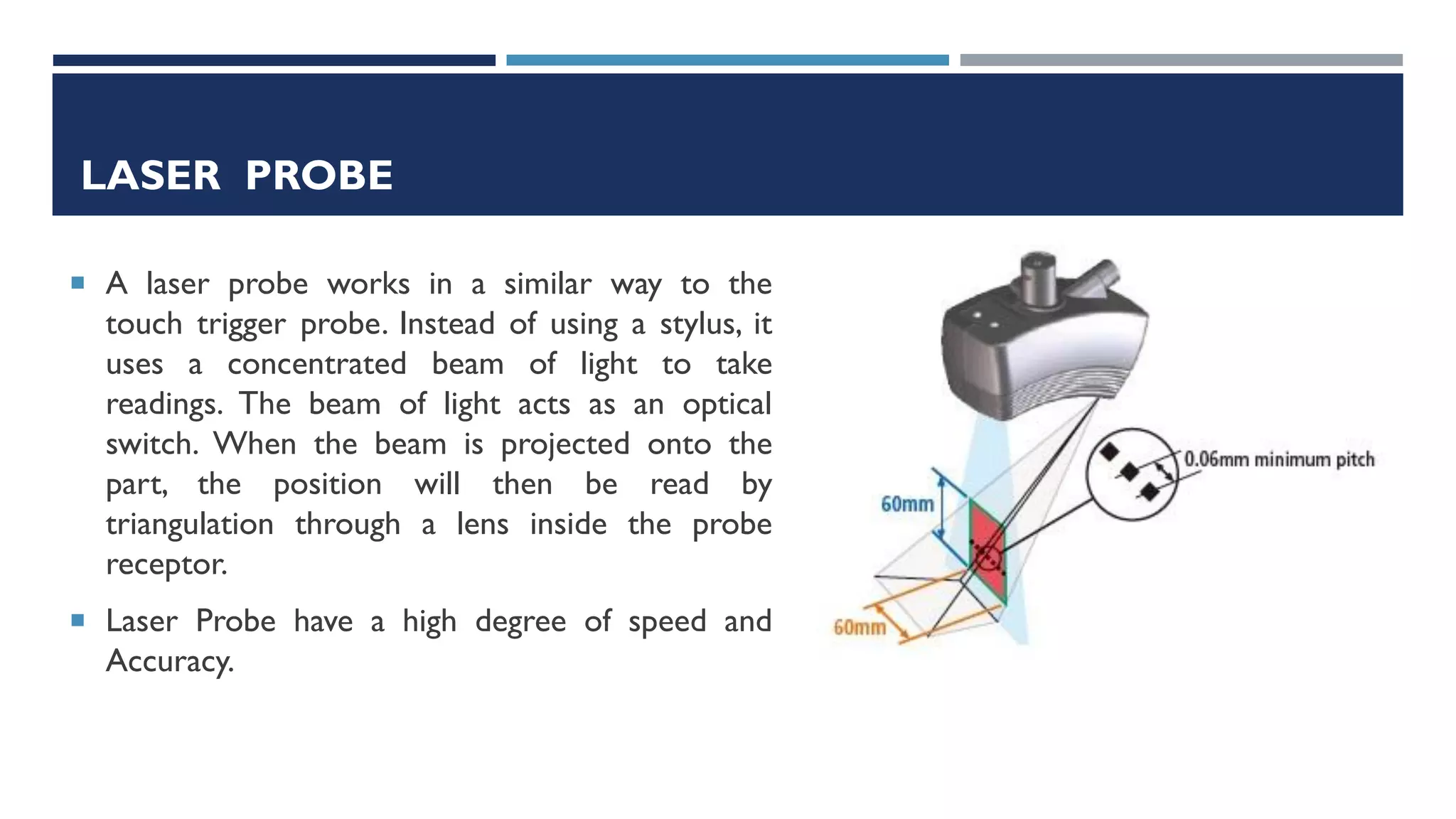
 A laser probe works in a similar way to the
touch trigger probe. Instead of using a stylus, it
uses a concentrated beam of light to take
readings. The beam of light acts as an optical
switch. When the beam is projected onto the
part, the position will then be read by
triangulation through a lens inside the probe
receptor.
 Laser Probe have a high degree of speed and
Accuracy.
VIDEO PROBE
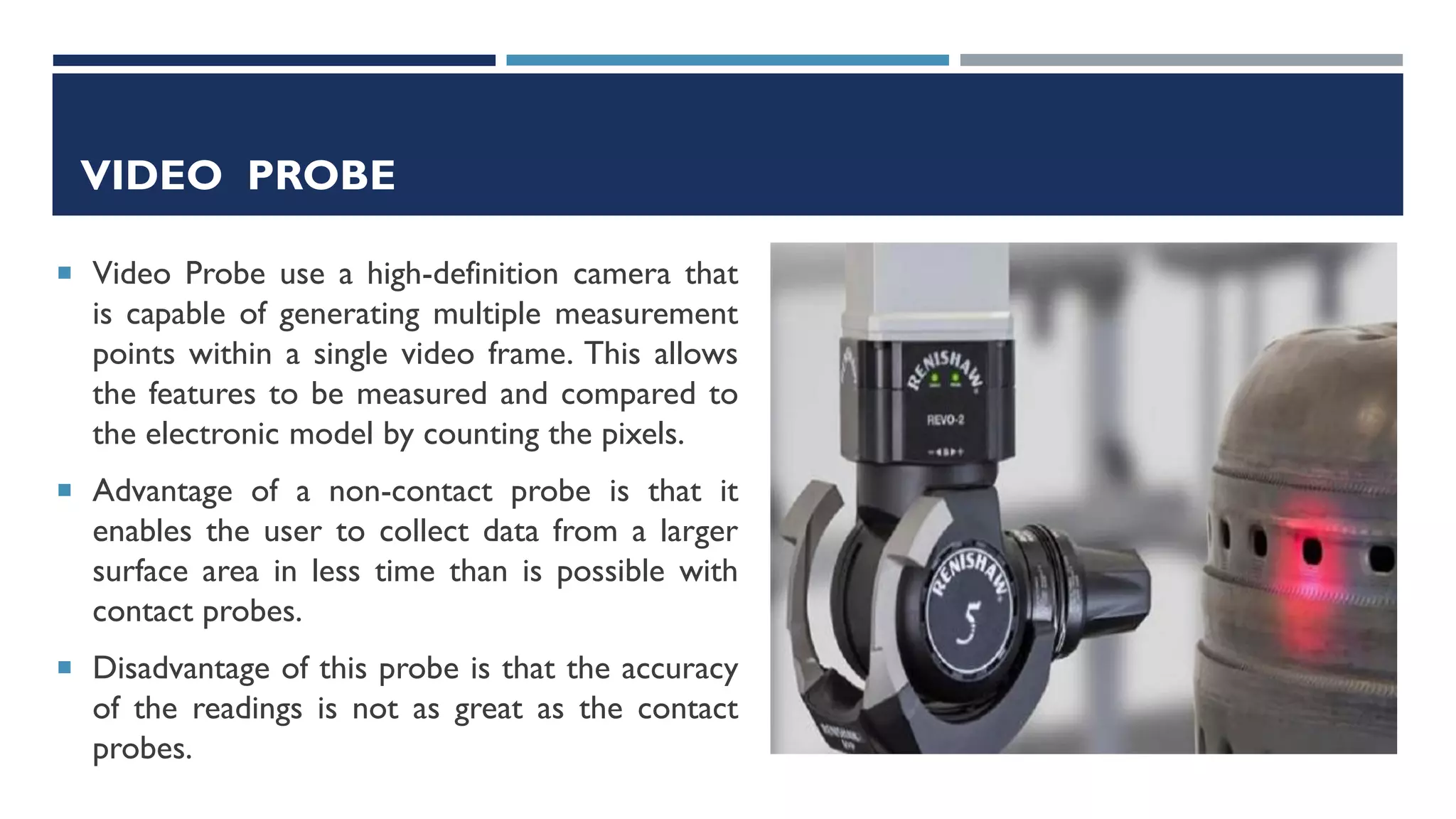
 Video Probe use a high-definition camera that
is capable of generating multiple measurement
points within a single video frame. This allows
the features to be measured and compared to
the electronic model by counting the pixels.
 Advantage of a non-contact probe is that it
enables the user to collect data from a larger
surface area in less time than is possible with
contact probes.
 Disadvantage of this probe is that the accuracy
of the readings is not as great as the contact
probes.
COMPARISON
 Contact Probe
 Speed –slow
 Accuracy- higher
 Cost - higher
 Stationary and portable
 Non-contact Probe
 Speed –Fast
 Accuracy- become higher as cost increas
 Cost - comparatively lower
 highly portable and flexible to use and
PARTS OF PROBE
 Probe head
 Probe
 Stylus
MULTIPLE SHAPES OF STYLUS
 Spherical or Conical
 Elliptical
 Hyper elliptical
 Micro-ridge
SPHERICAL OR CONICAL
 Spherical or conical is the most common stylus type and are the
least expensive.
 It looks a bit like the tip of a ballpoint pen up close.
 Due to large radius, spherical styli trace less of the smaller
groove.
 This type of stylus has high contact area compared to other
because of large radius So, more wear occurs.
 Average tool life - 150hrs
ELLIPTICAL
 Elliptical Stylus makes contact across a larger area of
the groove wall due to its dual radii.
 This allows for more precise tracking.
 These types of stylus has less wear compared to
spherical Stylus.
 Average tool life - 250hrs
HYPER ELLIPTICAL
 This stylus offers excellent high-frequency
performance, longer tip life, improved tracking, and
lower record wear.
 Due to their advanced design and difficulty to
manufacture it is expensive than the elliptical stylus.
 Average tool life - 400hrs
MICRO-RIDGE
 The micro-ridge stylus is the most advanced of the
four stylus types.
 thus stylus is very difficult to manufacture and very
expensive.
 It gives best high-frequency performance with
extended record of stylus life.
 Average tool life - 500hrs
FEATURES OF CMM PROBES
•Kinematic :
Kinematic technologies are available in a wide range of CMM probes. In terms of size, they are
the smallest of the CMM probe types.They offer low travel force, simple interfacing and robust.
•Strain Sensing:
Strain-sensing CMM probes offer fewer lobing errors, long operating life, wide operating speed
range, and long stylus carrying.
•Piezoelectric:
piezoelectric devices include very few lobing errors, large stylus-carrying capability, multi-mode
sensor operating, extended versatility, and restricted operating-speed range.
FEATURES OF CMM PROBES
•LVDT(LinearVariable DifferentialTransformer):
LVDT sensor types provide a high degree of accuracy and large stylus carrying capacity.
•Optoelectronic:
Optoelectronic devices offer a higher degree of accuracy than kinematic sensor types and high
data rates.
•LaserTriangulation:
Laser triangulation sensor types are equipped with single axis profile measurements. The laser
reflected by surface reflectivity.
FEATURES OF CMM PROBES
•Capacitive
Capacitive CMM probes provide another form of non-contact technology. Material types may
affect profile, form, surface flaw measurements, or surface chemistry; therefore, they use a fixed
stylus.
•Video Imaging
Video imaging sensor types are suitable for 2-D, flexible parts, and automatic edge detection;
however, they may be affected by surface reflectivity and ambient light.
CMM PROBES SPECIFICATIONS
• ProbeType:
Touch-Trigger (Discrete Point) Probe
Displacement Measuring Probe
Proximity (Noncontact) Probe
•Type of Mounting:
Vertical
Horizontal
•Axes:
+X / -X / +Y / -Y / +Z / -Z
CMM PROBES SPECIFICATIONS
•Measuring Range:
Greatest distance the probe can travel
•Stylus Force:
Maximum force applied by the stylus when contacting with the surface being measured.
•Detachable Stylus Module
•SensorType:
Kinematic Strain Sensing
Piezoelectric LVDT
Optoelectronic Laser Triangulation
Capacitive Video Imaging
CMM PROBES SPECIFICATIONS
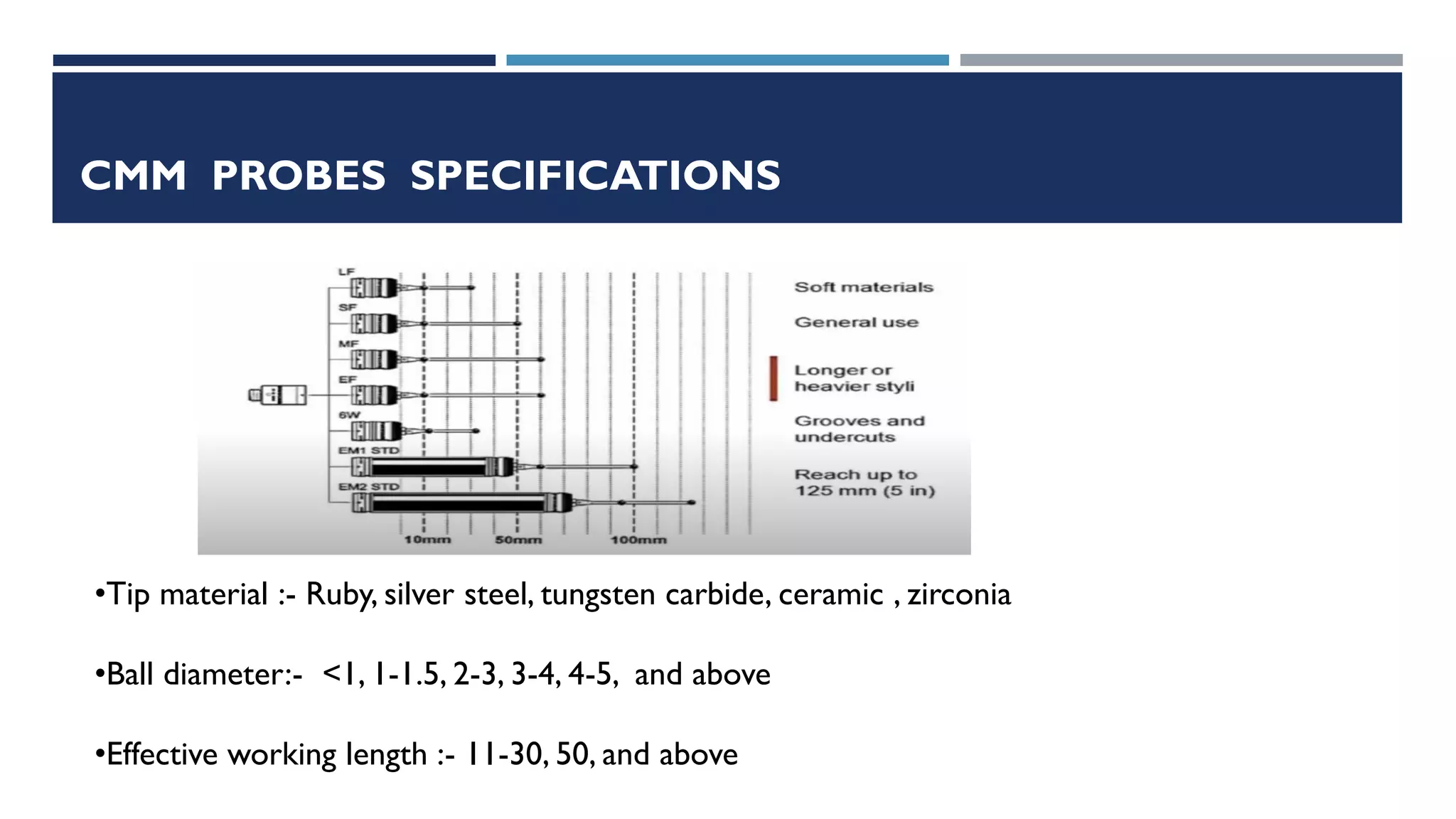
•Tip material :- Ruby, silver steel, tungsten carbide, ceramic , zirconia
•Ball diameter:- <1, 1-1.5, 2-3, 3-4, 4-5, and above
•Effective working length :- 11-30, 50, and above
PROBE CALIBRATION
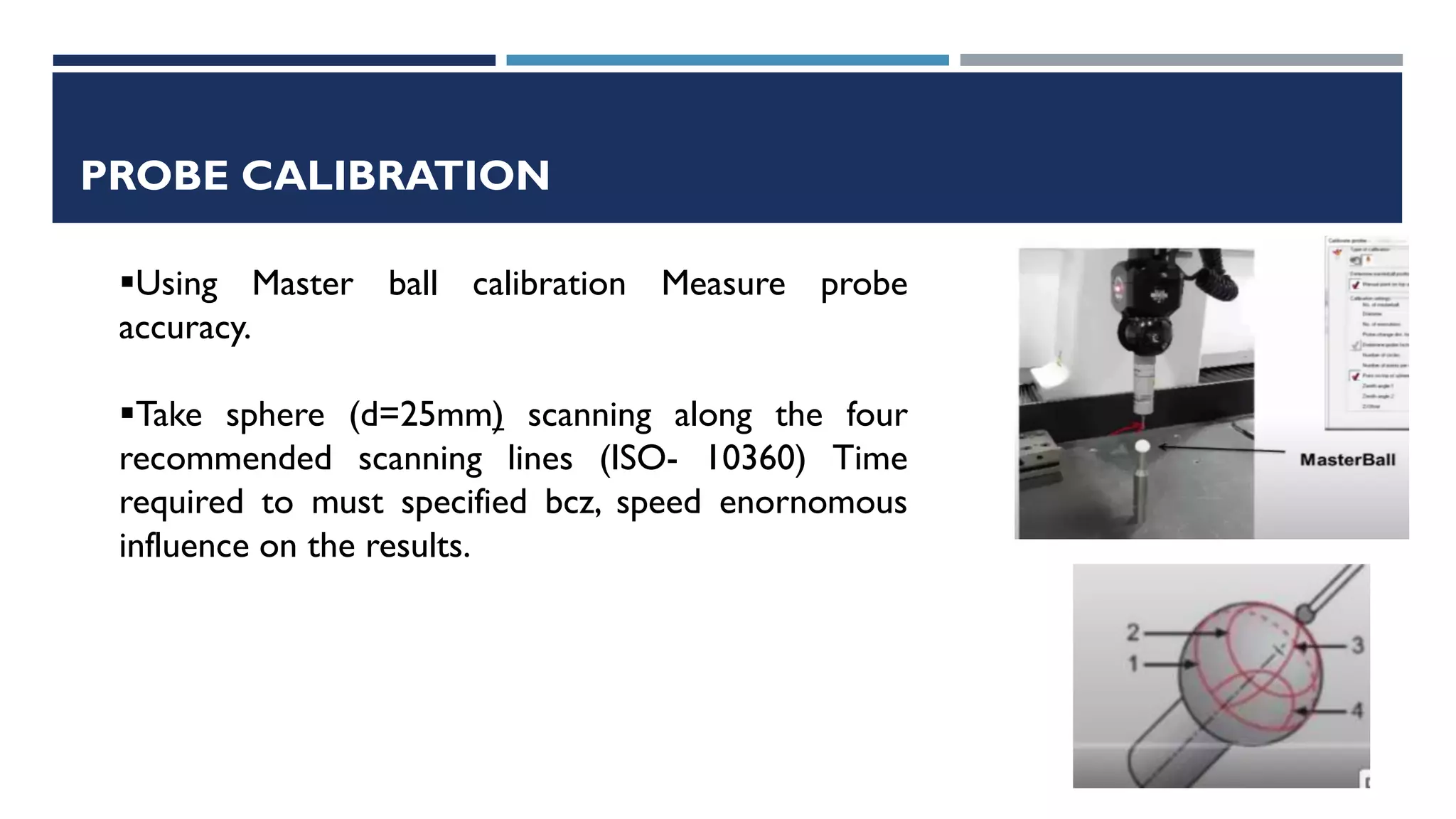
Using Master ball calibration Measure probe
accuracy.
Take sphere (d=25mm) scanning along the four
recommended scanning lines (ISO- 10360) Time
required to must specified bcz, speed enornomous
influence on the results.
MATERIAL SPECIFICATION
Steel & Granite :-
Over the years steels and granite are used bcz it is easy to apply , material dynamics and low
technology approach.
Al, Sc, ceramics :-
Today, this material is mostly use in scanning application where it is increase the stiffnesss in the
moving axis z direction.
 Stylus material should be lighter, Stiffer, and harder.
 Ball of the probe should have high wear resistance material
 Normally industries use ruby ball with carbide shafts, and stainless steel bases, bcz it is
cheaper but it is not used on aluminum surfaces.
STANDARDIZATION
 Performance of a CMM, the ISO 10360 (Geometrical product specifications-GPS) series is available. This
series of standards define the characteristics of the probing system and the length measurement error:
 ISO 10360-1:Vocabulary
 ISO 10360-2 : CMMs used for measuring linear dimensions
 ISO 10360-3 : CMM with rotary axis table as fourth axis
 IS0 10360-4 : Used in scanning measure mode
 ISO 10360-5 : single and multiple stylus contact probing system
 ISO 10360-6 : Estimating errors in computing
 ISO 10360-7 : Used in imaging probing system
 ISO 10360-8 : CMM with optical distance sensors
 IS0 10360-9 : CMM with multiple probing system
LIMITATIONS
 CMM Touch and trigger have low measuring speed, only discrete point are collected so
partially information are covered.
 Manually measurement is done at that time while don’t know an information of the
measuring part but its time-consuming process and also it causes of some errors, radius
compensation or dynamic errors.
 The part is delicate or soft (rubbers or elastomers for example), then the process could
potentially damage them.
 Temperature of work piece also affect to accuracy of measurement.
CONCLUSIONS
 The evolution of the probes starting with touch trigger probe which generates points from
the surface and automatically records in XYZ position of point taken. Star probe which takes
multiple reading but its contact type probe while multi probe being contact and non-contact
probe which has highest accuracy and less time consumption had studied.
 Also, the type of material which are used for making probe ball is mentioned. In industrial
application ruby is used since it is cheaper. Its disadvantage is that it doesn’t work on
untreated aluminum. It is overcome by using zirconium probe which can be used for cast
iron and abrasive surfaces. In electrically conductive material, hardened steel ball is used and
whenever the size requirement is greater than 8 mm then ceramic ball is used.
REFERENCES
1. CMM Probes Specifications. (n.d.). Retrieved October 01, 2020, from
https://www.globalspec.com/SpecSearch/SearchForm/manufacturing_process_equipment/ins
pection_tools_instruments/cmm_probes
2. Coordinate Measuring Machine Probes. (2019, November 12). Retrieved October 02, 2020,
from https://eleymet.com/2019/04/27/coordinate-measuring-machine-probes/
3. False priest. (2020, February 18).The Different Types Of Turntable Styli (And Which Is Right
ForYou). Retrieved October 0, 2020, from https://blog.discogs.com/en/different-types-
turntable-styli/
4. Soni, J., & Pantawane, P. D. REVIEW PAPER ON PROBING SYSTEM OF CMM.
THANKYOU

CMM Probe

  • 1.
  • 2.
    CONTENT  Introduction  Typesof probes  Parts of Probe  Multiple shapes of Stylus  Features of CMM probes  CMM Probes Specifications  Probe Calibration  Material specification  Standardization  Limitations  Conclusions  References
  • 3.
    INTRODUCTION  Coordinate measuringmachines probes are transducers that convert physical measurements into electrical signals by using numerous measuring systems within the probe structure.
  • 4.
    TYPES OF PROBES Typesof Probe ContactType Probe TouchTrigger/ discrete Point Probe Analog Scanning Probe Non-ContactType probe Laser probe Video probe
  • 5.
    TOUCH TRIGGER /DISCRETE POINT PROBE  Touch-Trigger Probes or Discrete Point Probes are the most common type of CMM probe. As the sensor makes contact with the part, the difference in contact resistance indicates that the probe has been deflected then it send a signal with the points coordinates to the CMM. The probe is then moved to the next location, where the process is repeated.  The computer records this contact point coordinate space  An LED light and an audible signal usually indicate when contact done  Touch probe assemblies consist of three Components: probe head, probe and stylus
  • 6.
    ANALOG SCANNING PROBE Analog scanning probes are another basic type of CMM probe. As these CMM probes pass over a target’s surface they transmit a continuous flow of information to the measurement system.  Analogue scanning probes are extremely useful for collecting the measurement data for complex contoured shapes such as turbine engine blades, cams, automobile bodies, crankshafts and prosthetics.  Analogue probes can acquire up to fifty times more data than touch trigger probes in the same amount of time. The more data that is collected the more confidence in its accuracy. If there are large gaps between data points the accuracy of the data may not be so assured.  Several hundred surface points detected each second.  High speed scanning at 300 m/s.
  • 7.
    LASER PROBE  Alaser probe works in a similar way to the touch trigger probe. Instead of using a stylus, it uses a concentrated beam of light to take readings. The beam of light acts as an optical switch. When the beam is projected onto the part, the position will then be read by triangulation through a lens inside the probe receptor.  Laser Probe have a high degree of speed and Accuracy.
  • 8.
    VIDEO PROBE  VideoProbe use a high-definition camera that is capable of generating multiple measurement points within a single video frame. This allows the features to be measured and compared to the electronic model by counting the pixels.  Advantage of a non-contact probe is that it enables the user to collect data from a larger surface area in less time than is possible with contact probes.  Disadvantage of this probe is that the accuracy of the readings is not as great as the contact probes.
  • 9.
    COMPARISON  Contact Probe Speed –slow  Accuracy- higher  Cost - higher  Stationary and portable  Non-contact Probe  Speed –Fast  Accuracy- become higher as cost increas  Cost - comparatively lower  highly portable and flexible to use and
  • 10.
    PARTS OF PROBE Probe head  Probe  Stylus
  • 11.
    MULTIPLE SHAPES OFSTYLUS  Spherical or Conical  Elliptical  Hyper elliptical  Micro-ridge
  • 12.
    SPHERICAL OR CONICAL Spherical or conical is the most common stylus type and are the least expensive.  It looks a bit like the tip of a ballpoint pen up close.  Due to large radius, spherical styli trace less of the smaller groove.  This type of stylus has high contact area compared to other because of large radius So, more wear occurs.  Average tool life - 150hrs
  • 13.
    ELLIPTICAL  Elliptical Stylusmakes contact across a larger area of the groove wall due to its dual radii.  This allows for more precise tracking.  These types of stylus has less wear compared to spherical Stylus.  Average tool life - 250hrs
  • 14.
    HYPER ELLIPTICAL  Thisstylus offers excellent high-frequency performance, longer tip life, improved tracking, and lower record wear.  Due to their advanced design and difficulty to manufacture it is expensive than the elliptical stylus.  Average tool life - 400hrs
  • 15.
    MICRO-RIDGE  The micro-ridgestylus is the most advanced of the four stylus types.  thus stylus is very difficult to manufacture and very expensive.  It gives best high-frequency performance with extended record of stylus life.  Average tool life - 500hrs
  • 16.
    FEATURES OF CMMPROBES •Kinematic : Kinematic technologies are available in a wide range of CMM probes. In terms of size, they are the smallest of the CMM probe types.They offer low travel force, simple interfacing and robust. •Strain Sensing: Strain-sensing CMM probes offer fewer lobing errors, long operating life, wide operating speed range, and long stylus carrying. •Piezoelectric: piezoelectric devices include very few lobing errors, large stylus-carrying capability, multi-mode sensor operating, extended versatility, and restricted operating-speed range.
  • 17.
    FEATURES OF CMMPROBES •LVDT(LinearVariable DifferentialTransformer): LVDT sensor types provide a high degree of accuracy and large stylus carrying capacity. •Optoelectronic: Optoelectronic devices offer a higher degree of accuracy than kinematic sensor types and high data rates. •LaserTriangulation: Laser triangulation sensor types are equipped with single axis profile measurements. The laser reflected by surface reflectivity.
  • 18.
    FEATURES OF CMMPROBES •Capacitive Capacitive CMM probes provide another form of non-contact technology. Material types may affect profile, form, surface flaw measurements, or surface chemistry; therefore, they use a fixed stylus. •Video Imaging Video imaging sensor types are suitable for 2-D, flexible parts, and automatic edge detection; however, they may be affected by surface reflectivity and ambient light.
  • 19.
    CMM PROBES SPECIFICATIONS •ProbeType: Touch-Trigger (Discrete Point) Probe Displacement Measuring Probe Proximity (Noncontact) Probe •Type of Mounting: Vertical Horizontal •Axes: +X / -X / +Y / -Y / +Z / -Z
  • 20.
    CMM PROBES SPECIFICATIONS •MeasuringRange: Greatest distance the probe can travel •Stylus Force: Maximum force applied by the stylus when contacting with the surface being measured. •Detachable Stylus Module •SensorType: Kinematic Strain Sensing Piezoelectric LVDT Optoelectronic Laser Triangulation Capacitive Video Imaging
  • 21.
    CMM PROBES SPECIFICATIONS •Tipmaterial :- Ruby, silver steel, tungsten carbide, ceramic , zirconia •Ball diameter:- <1, 1-1.5, 2-3, 3-4, 4-5, and above •Effective working length :- 11-30, 50, and above
  • 22.
    PROBE CALIBRATION Using Masterball calibration Measure probe accuracy. Take sphere (d=25mm) scanning along the four recommended scanning lines (ISO- 10360) Time required to must specified bcz, speed enornomous influence on the results.
  • 23.
    MATERIAL SPECIFICATION Steel &Granite :- Over the years steels and granite are used bcz it is easy to apply , material dynamics and low technology approach. Al, Sc, ceramics :- Today, this material is mostly use in scanning application where it is increase the stiffnesss in the moving axis z direction.  Stylus material should be lighter, Stiffer, and harder.  Ball of the probe should have high wear resistance material  Normally industries use ruby ball with carbide shafts, and stainless steel bases, bcz it is cheaper but it is not used on aluminum surfaces.
  • 24.
    STANDARDIZATION  Performance ofa CMM, the ISO 10360 (Geometrical product specifications-GPS) series is available. This series of standards define the characteristics of the probing system and the length measurement error:  ISO 10360-1:Vocabulary  ISO 10360-2 : CMMs used for measuring linear dimensions  ISO 10360-3 : CMM with rotary axis table as fourth axis  IS0 10360-4 : Used in scanning measure mode  ISO 10360-5 : single and multiple stylus contact probing system  ISO 10360-6 : Estimating errors in computing  ISO 10360-7 : Used in imaging probing system  ISO 10360-8 : CMM with optical distance sensors  IS0 10360-9 : CMM with multiple probing system
  • 25.
    LIMITATIONS  CMM Touchand trigger have low measuring speed, only discrete point are collected so partially information are covered.  Manually measurement is done at that time while don’t know an information of the measuring part but its time-consuming process and also it causes of some errors, radius compensation or dynamic errors.  The part is delicate or soft (rubbers or elastomers for example), then the process could potentially damage them.  Temperature of work piece also affect to accuracy of measurement.
  • 26.
    CONCLUSIONS  The evolutionof the probes starting with touch trigger probe which generates points from the surface and automatically records in XYZ position of point taken. Star probe which takes multiple reading but its contact type probe while multi probe being contact and non-contact probe which has highest accuracy and less time consumption had studied.  Also, the type of material which are used for making probe ball is mentioned. In industrial application ruby is used since it is cheaper. Its disadvantage is that it doesn’t work on untreated aluminum. It is overcome by using zirconium probe which can be used for cast iron and abrasive surfaces. In electrically conductive material, hardened steel ball is used and whenever the size requirement is greater than 8 mm then ceramic ball is used.
  • 27.
    REFERENCES 1. CMM ProbesSpecifications. (n.d.). Retrieved October 01, 2020, from https://www.globalspec.com/SpecSearch/SearchForm/manufacturing_process_equipment/ins pection_tools_instruments/cmm_probes 2. Coordinate Measuring Machine Probes. (2019, November 12). Retrieved October 02, 2020, from https://eleymet.com/2019/04/27/coordinate-measuring-machine-probes/ 3. False priest. (2020, February 18).The Different Types Of Turntable Styli (And Which Is Right ForYou). Retrieved October 0, 2020, from https://blog.discogs.com/en/different-types- turntable-styli/ 4. Soni, J., & Pantawane, P. D. REVIEW PAPER ON PROBING SYSTEM OF CMM.
  • 28.