SAKEENA ASMI T
INTRODUCTION
 Cellulase is an enzyme that catalyze the splitting of cellulose,
the most abundant organic compound in nature.
 Cellulase is produced by fungi, bacteria and actinomycetes.
 Fungi has the ability to secrete large amount of cellulase than
other organisms and hence suited for large scale production of
the enzyme.
 Cellulase production on a commercial scale can be done by
Solid State Fermentation (SSF) and Submerged Fermentation
(SmF).
 The enzymes are inducible by cellulose, hence it
is possible to use various cellulosic waste
products like jute, corncob, rice, wheat straw,
sawdust, cane bagasse etc for the production of
cellulase.
 Cellulase is used in various industries like paper and
pulp, detergent, laundry, food, textile, biofuel
production etc.
 In the present study, cellulase is produced by
Aspergillus niger and Trichoderma viridae from
cellulosic waste substrates: Sawdust, Cane bagasse,
Newspaper, Watermelon rind using SSF.
AIM
 Cellulase production by Solid State Fermentation from agro
industrial cellulosic wastes using Aspergillus niger and
Trichoderma viridae.
OBJECTIVES
 To produce cellulase from four different substrates(sawdust,
watermelon rind, newspaper and cane bagasse).
 Optimization of pH and temperature of cellulase produced by
fungal isolates.
 Comparison of cellulase production by Aspergillus niger and
Trichoderma viridae from the different sources.
MATERIALS
 SUBSTRATES: Sugarcane bagasse (juice shop), sawdust (saw
mills), watermelon rind (fruit shop) and newspaper.
 MICROORGANISMS: Aspergillus niger and Trichoderma
viridae.
 MEDIA: Sabouraud Dextrose Agar (SDA), Czapek-Dox agar,
Inoculum media, Production media.
 REAGENTS: Dinitro Salicylic Acid (DNSA), Folins reagent.
 STAINS: Lactophenol Cotton Blue (LPCB), Congo red (1%).
METHODS
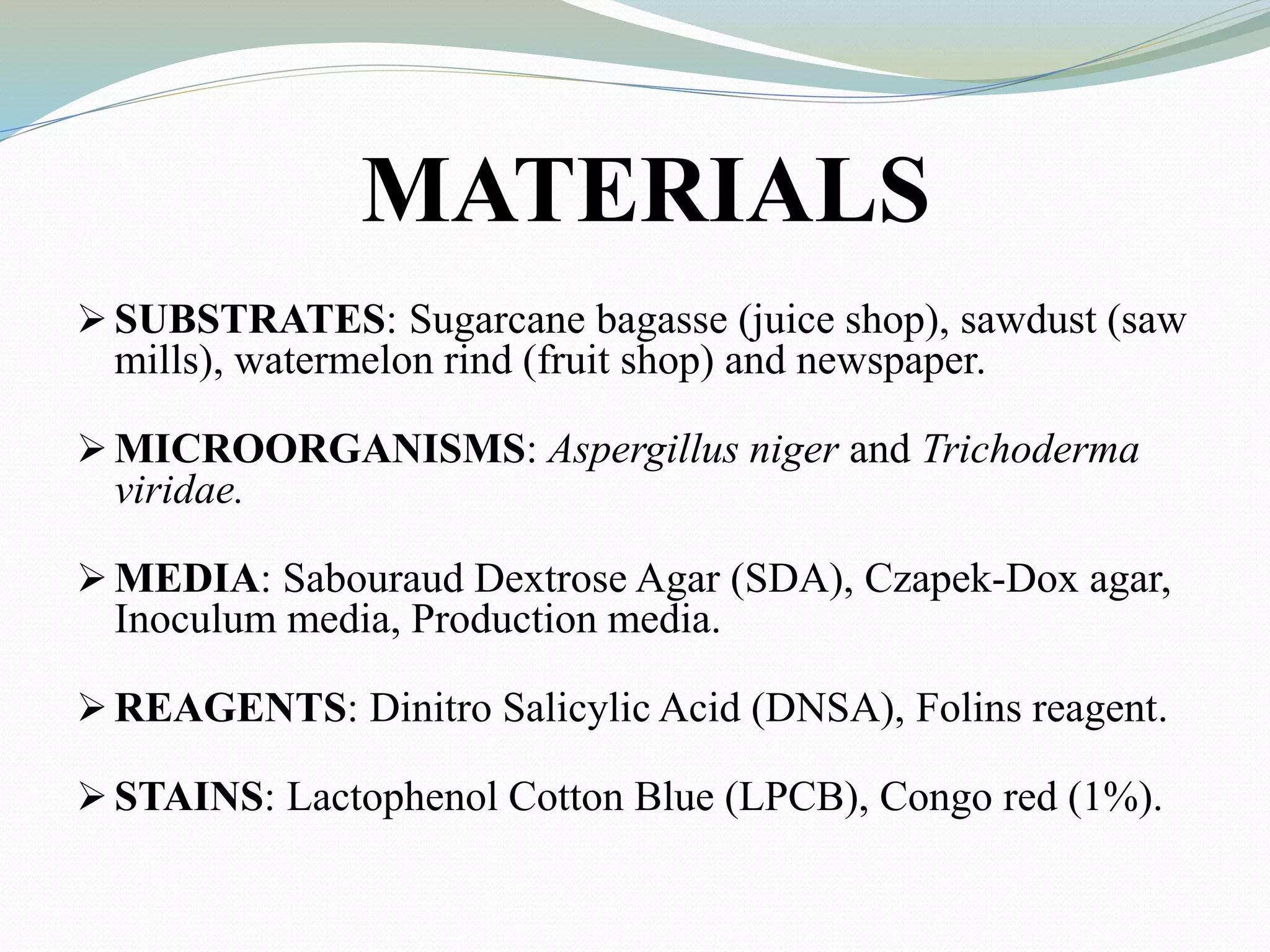
COLLECTION OF SAMPLE
(Spoiled vegetable waste containing soil,
T.viridae powder)
ISOLATION OF FUNGI
(By serial dilution and spread plating on SDA)
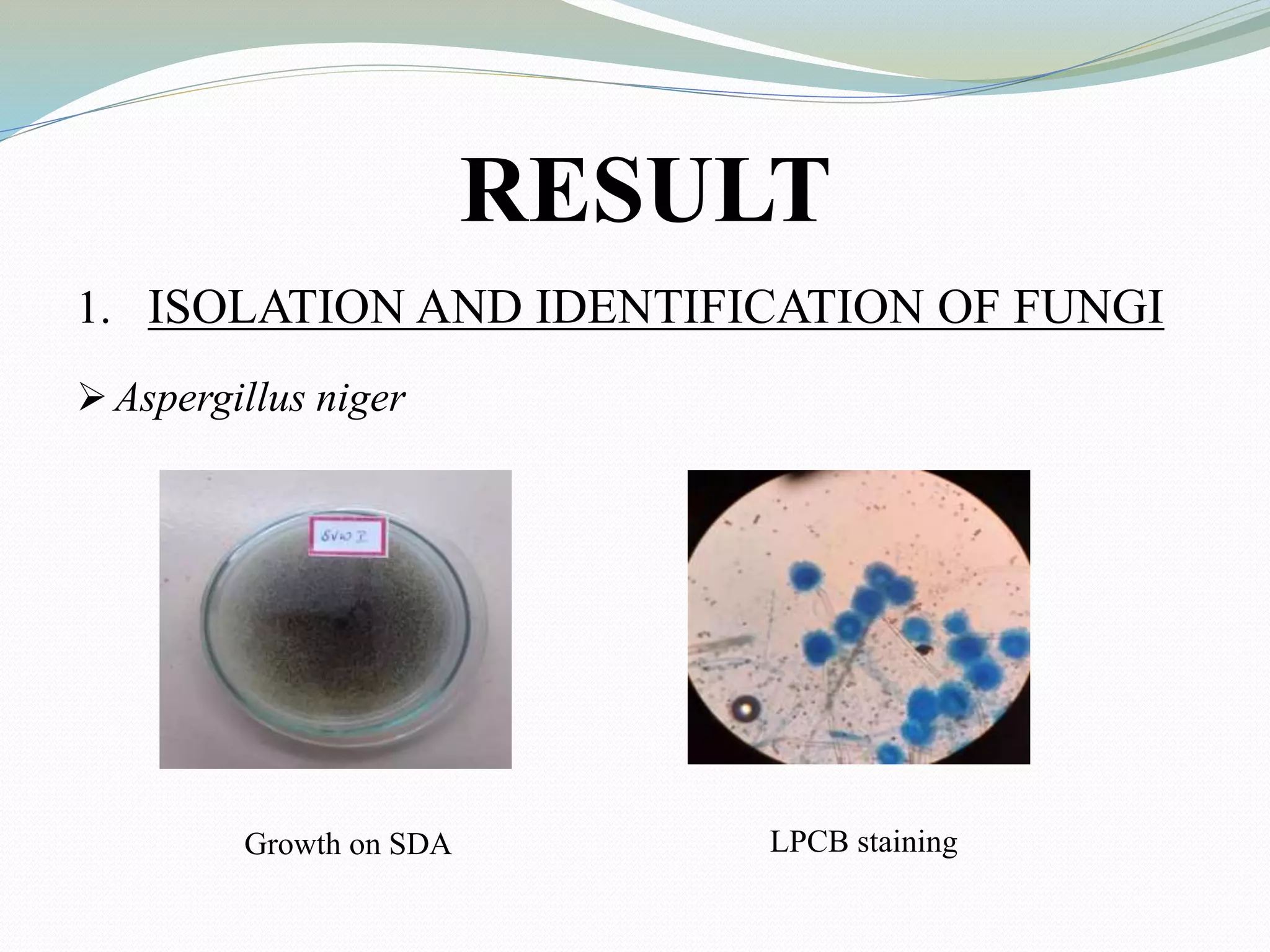
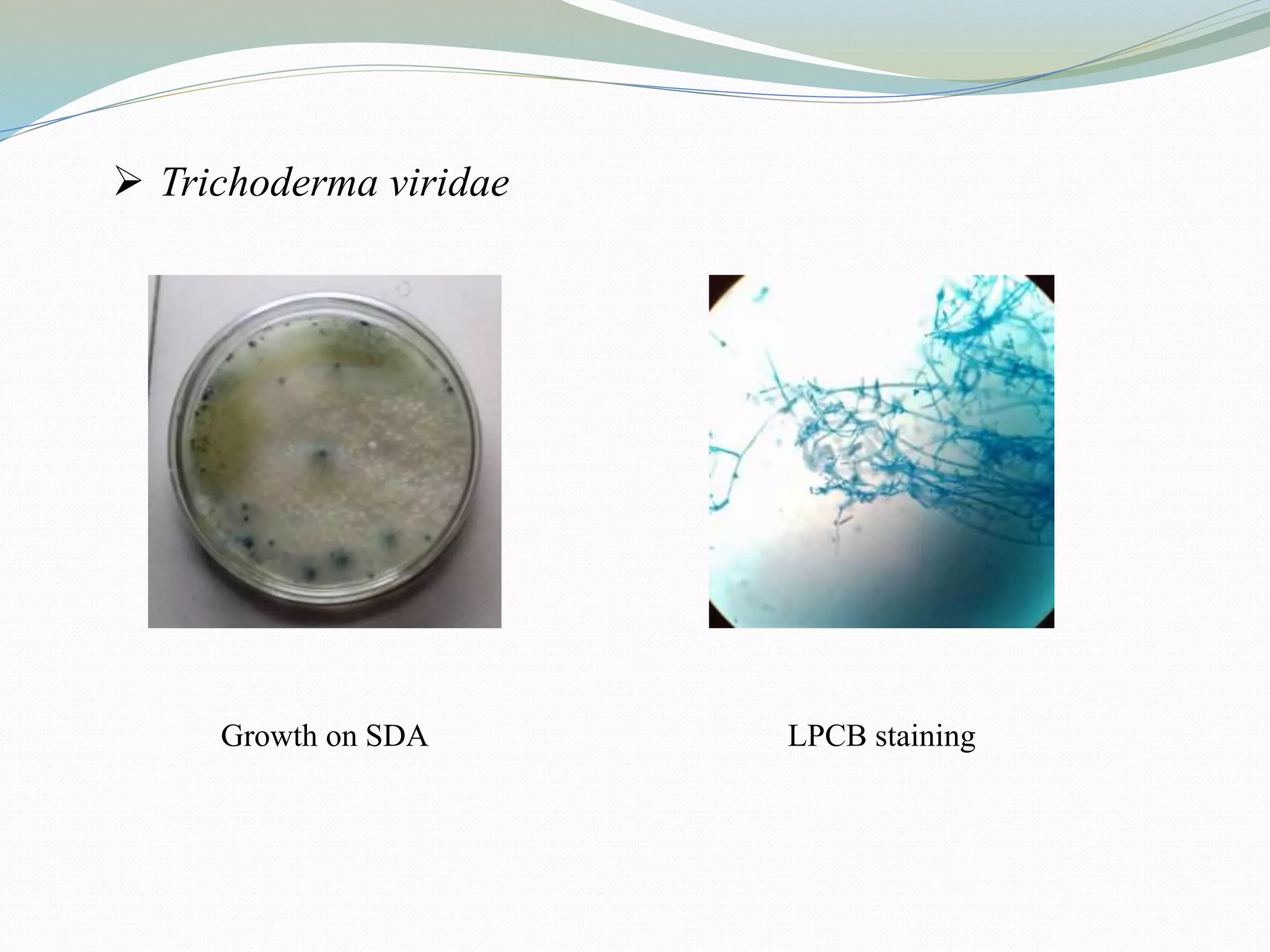
IDENIFICATION OF FUNGI
(By colony morphology and LPCB staining)
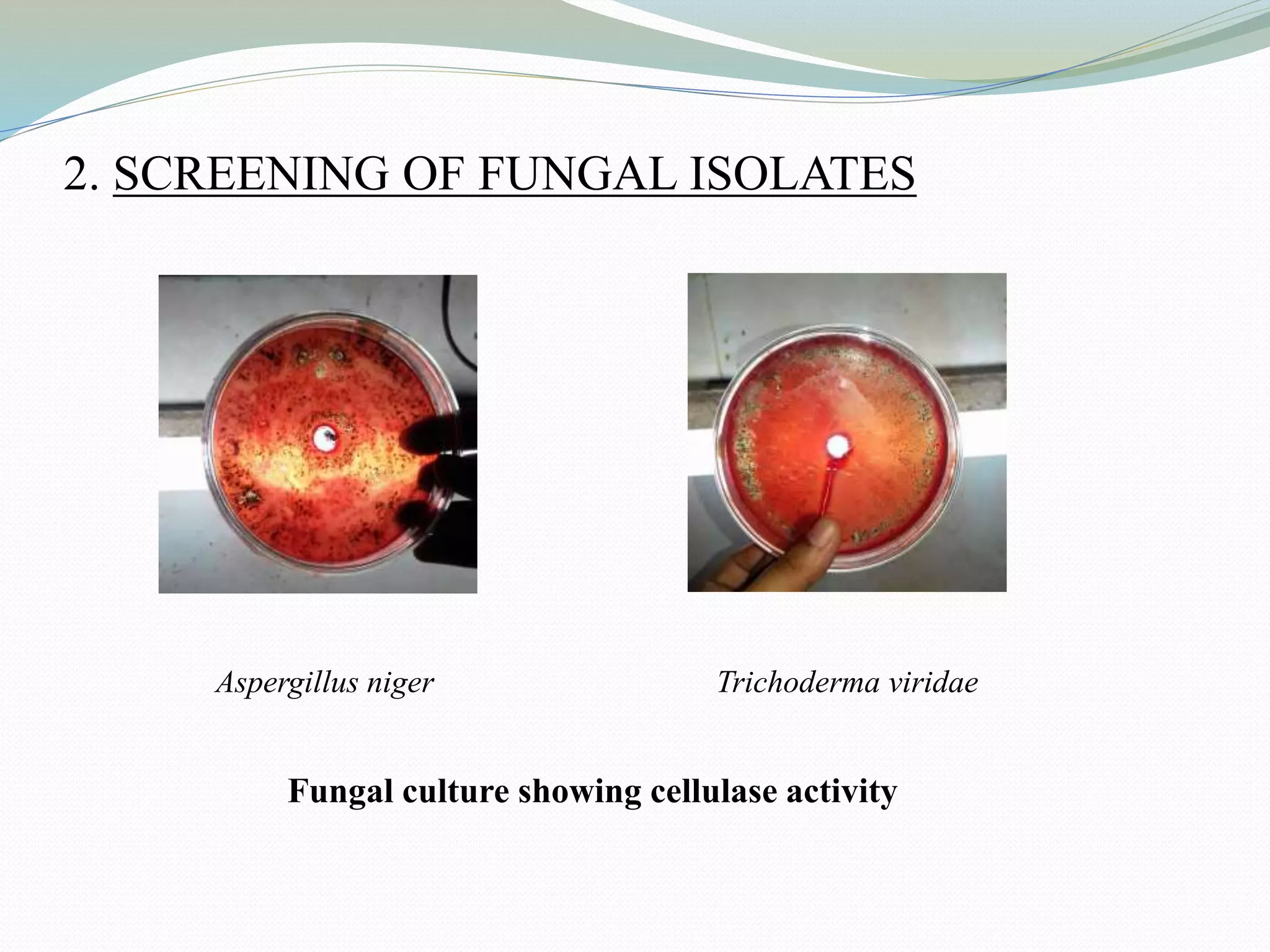
SCREENING FOR CELLULOLYTIC ACTIVITY
(Czapek-Dox agar + 5 days incubation + 50ºC for 18hrs +
1%Congo red + 1N NaOH)
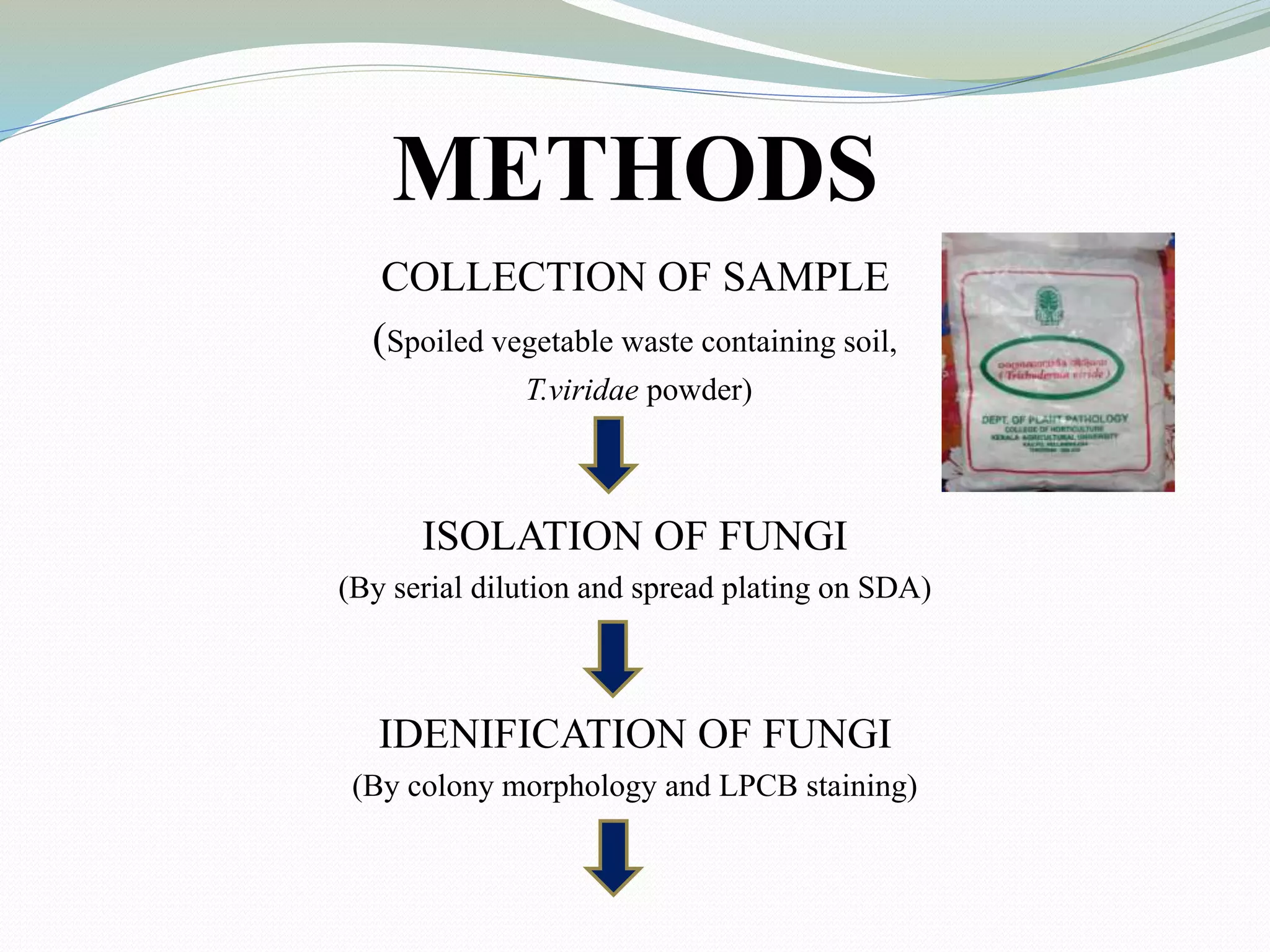
PREPARATION OF INOCULUM
(50 ml inoculum media + fungal spore)
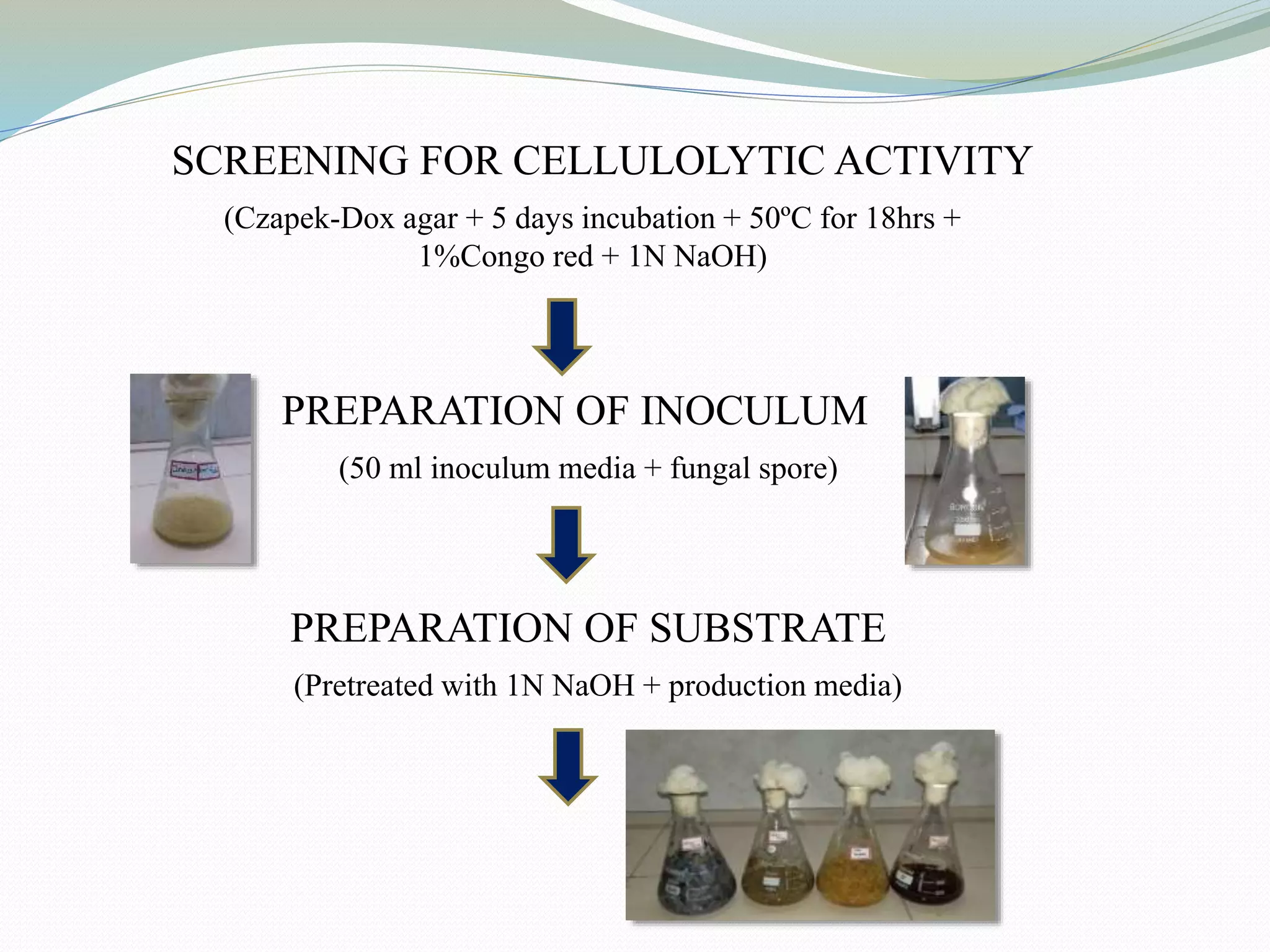
PREPARATION OF SUBSTRATE
(Pretreated with 1N NaOH + production media)
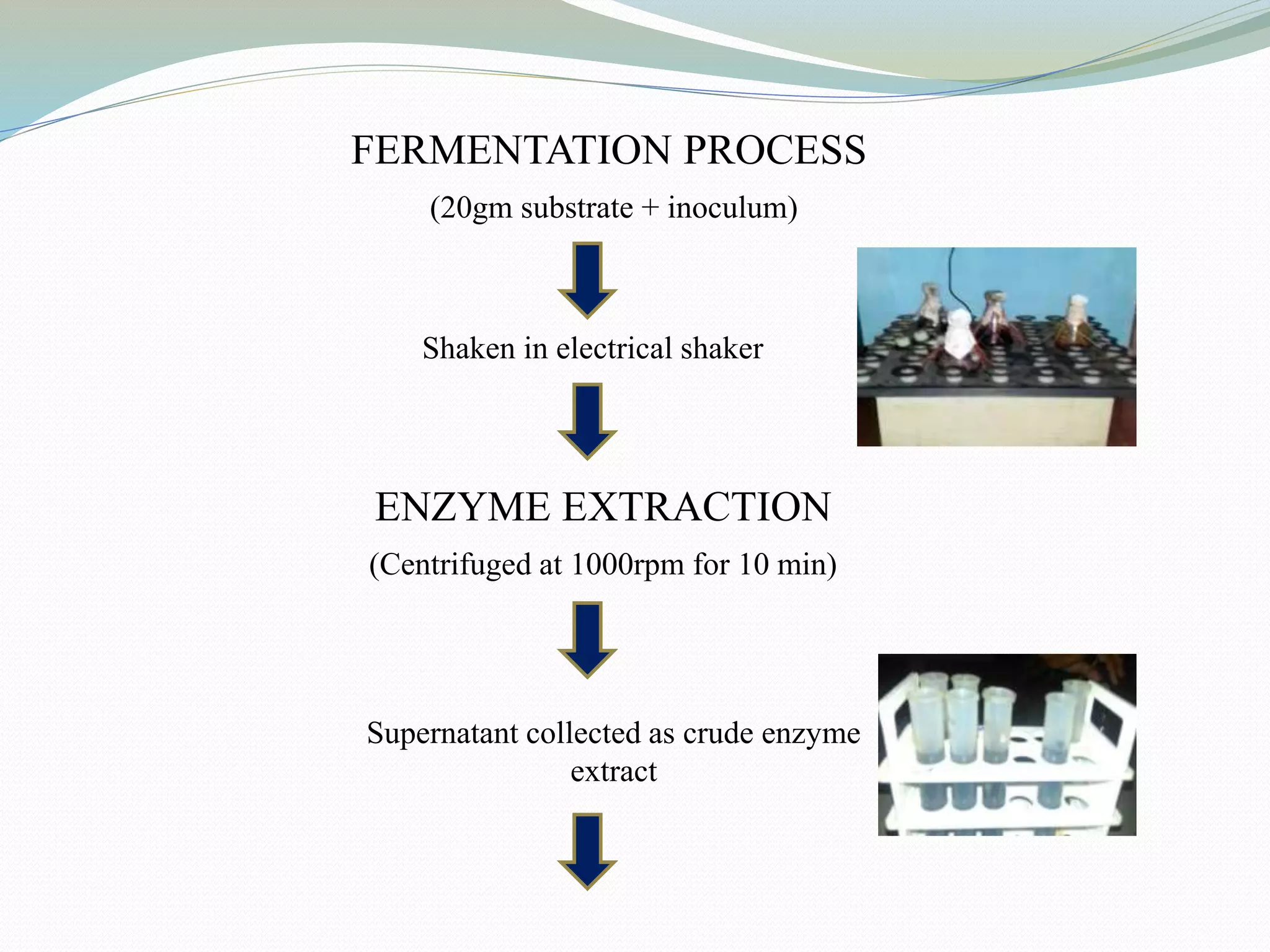
FERMENTATION PROCESS
(20gm substrate + inoculum)
Shaken in electrical shaker
ENZYME EXTRACTION
(Centrifuged at 1000rpm for 10 min)
Supernatant collected as crude enzyme
extract
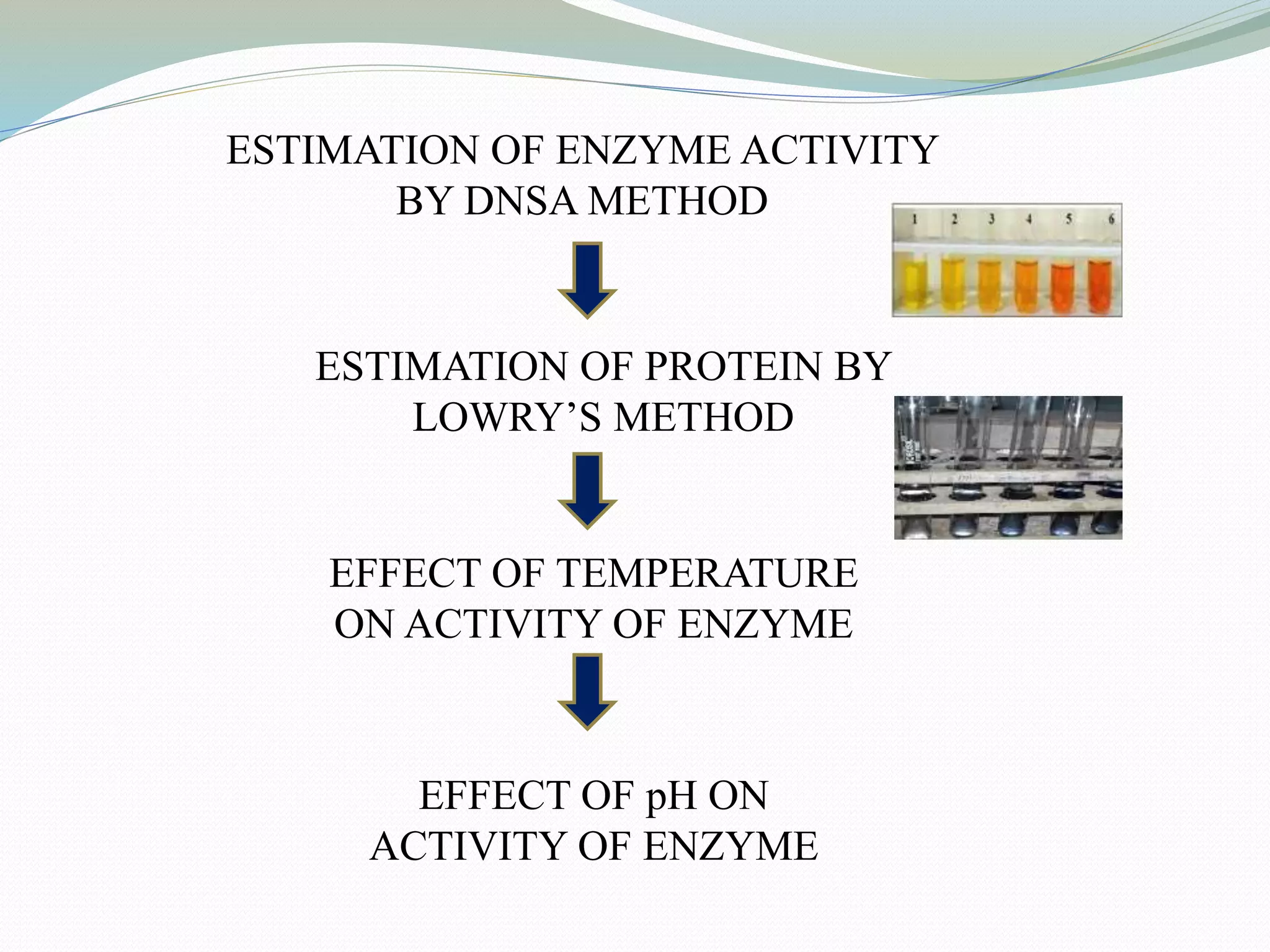
ESTIMATION OF ENZYME ACTIVITY
BY DNSA METHOD
ESTIMATION OF PROTEIN BY
LOWRY’S METHOD
EFFECT OF TEMPERATURE
ON ACTIVITY OF ENZYME
EFFECT OF pH ON
ACTIVITY OF ENZYME
RESULT
1. ISOLATION AND IDENTIFICATION OF FUNGI
 Aspergillus niger
Growth on SDA LPCB staining
 Trichoderma viridae
Growth on SDA LPCB staining
2. SCREENING OF FUNGAL ISOLATES
Aspergillus niger Trichoderma viridae
Fungal culture showing cellulase activity
3. DETERMINATION OF ENZYME ACTIVITY
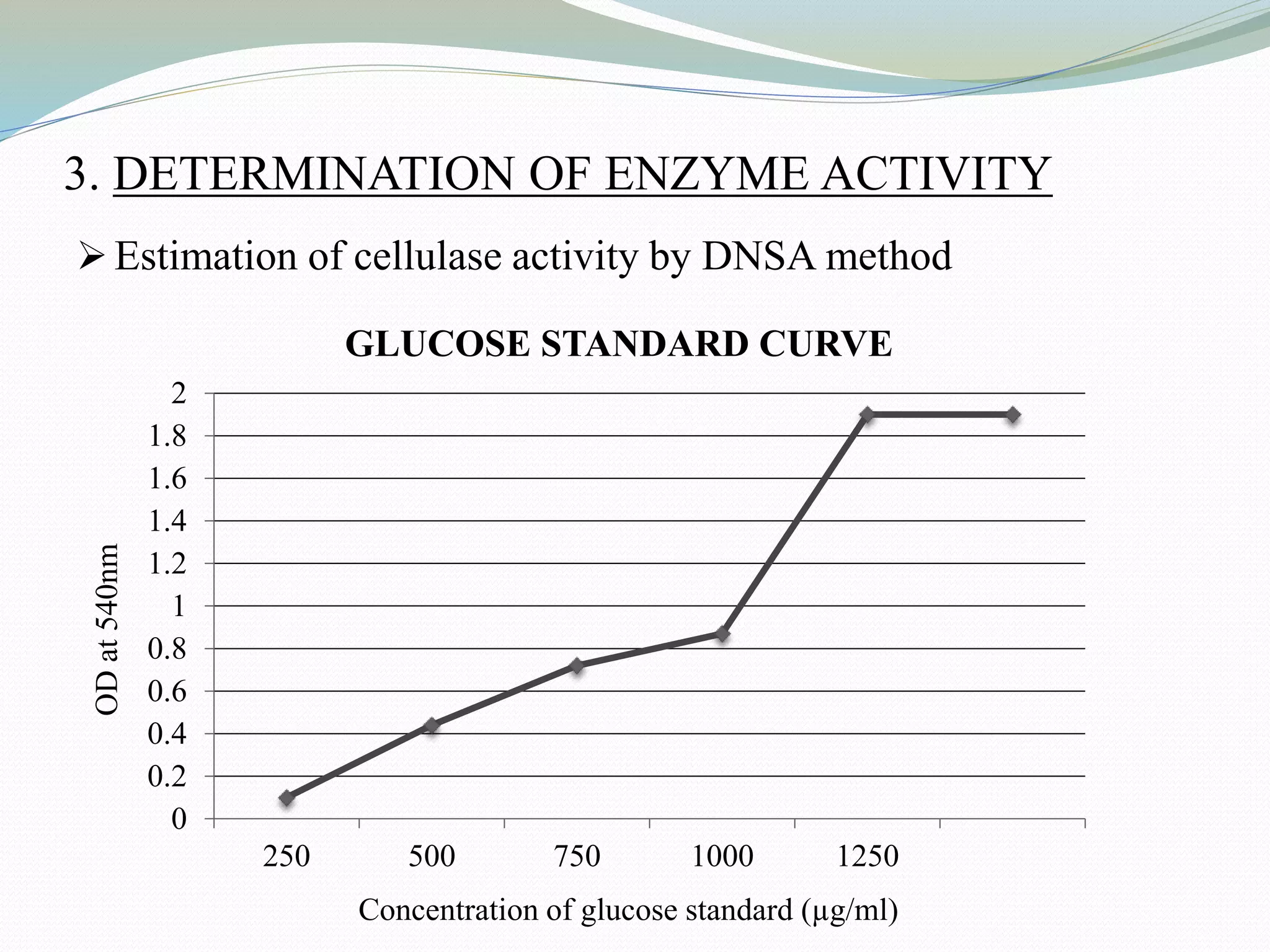
 Estimation of cellulase activity by DNSA method
0
0.2
0.4
0.6
0.8
1
1.2
1.4
1.6
1.8
2
250 500 750 1000 1250
ODat540nm
Concentration of glucose standard (µg/ml)
GLUCOSE STANDARD CURVE
0
500
1000
1500
2000
2500
3000
3500
4000
4500
Enzymeactivity(IU/L)
SUBSTRATES
ESTIMATION OF CELLULASE BY DNSA METHOD
0
500
1000
1500
2000
2500
3000
3500
Enzymeactivity(IU/L)
SUBSTRATES
ESTIMATION OF CELLULASE BY DNSA METHOD
Sawdust
Sawdust
Watermelon
rind
Watermelon
rind
News
paper
News
paper
Cane
bagasse
Cane
bagasse
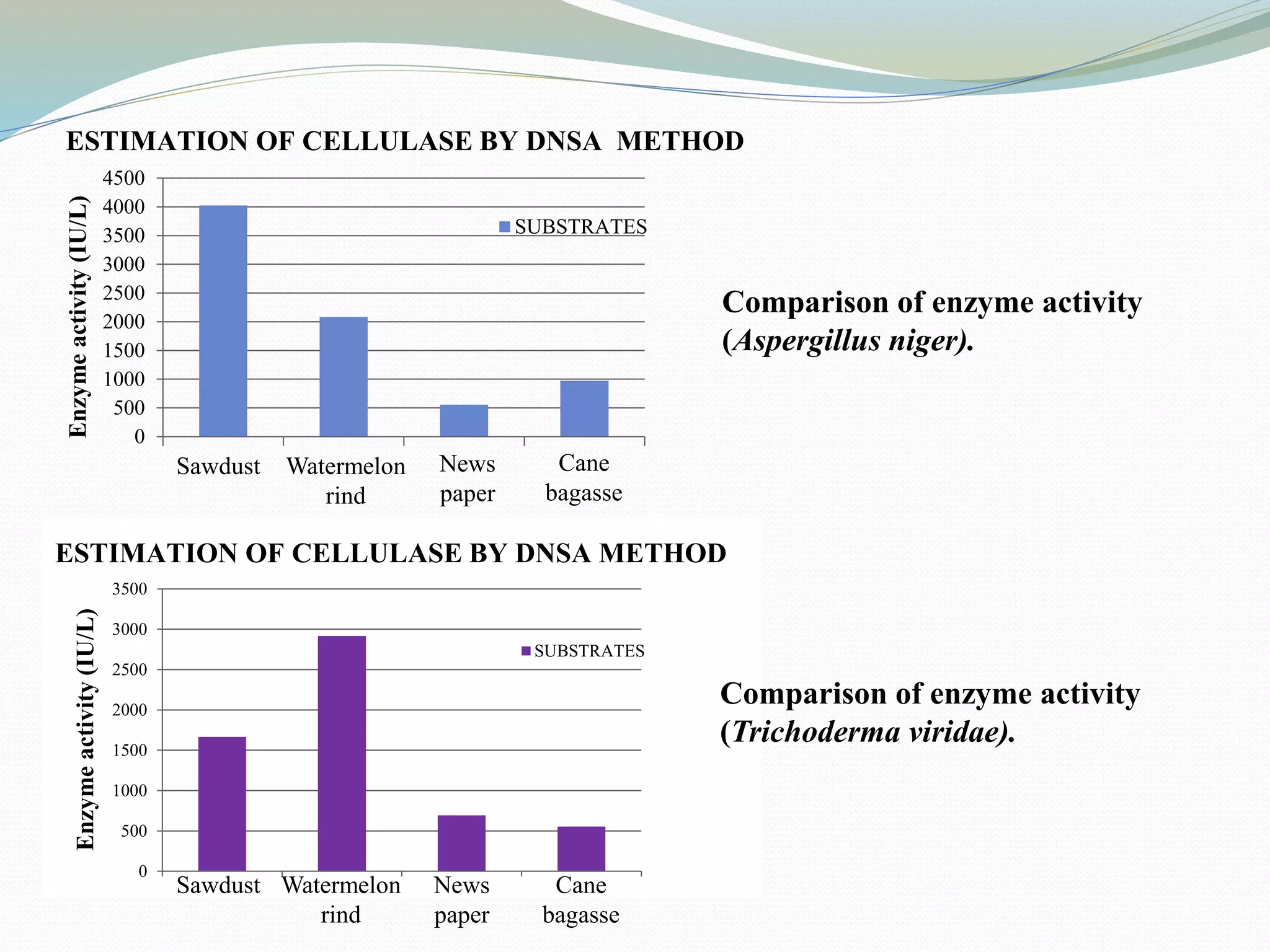
Comparison of enzyme activity
(Aspergillus niger).
Comparison of enzyme activity
(Trichoderma viridae).
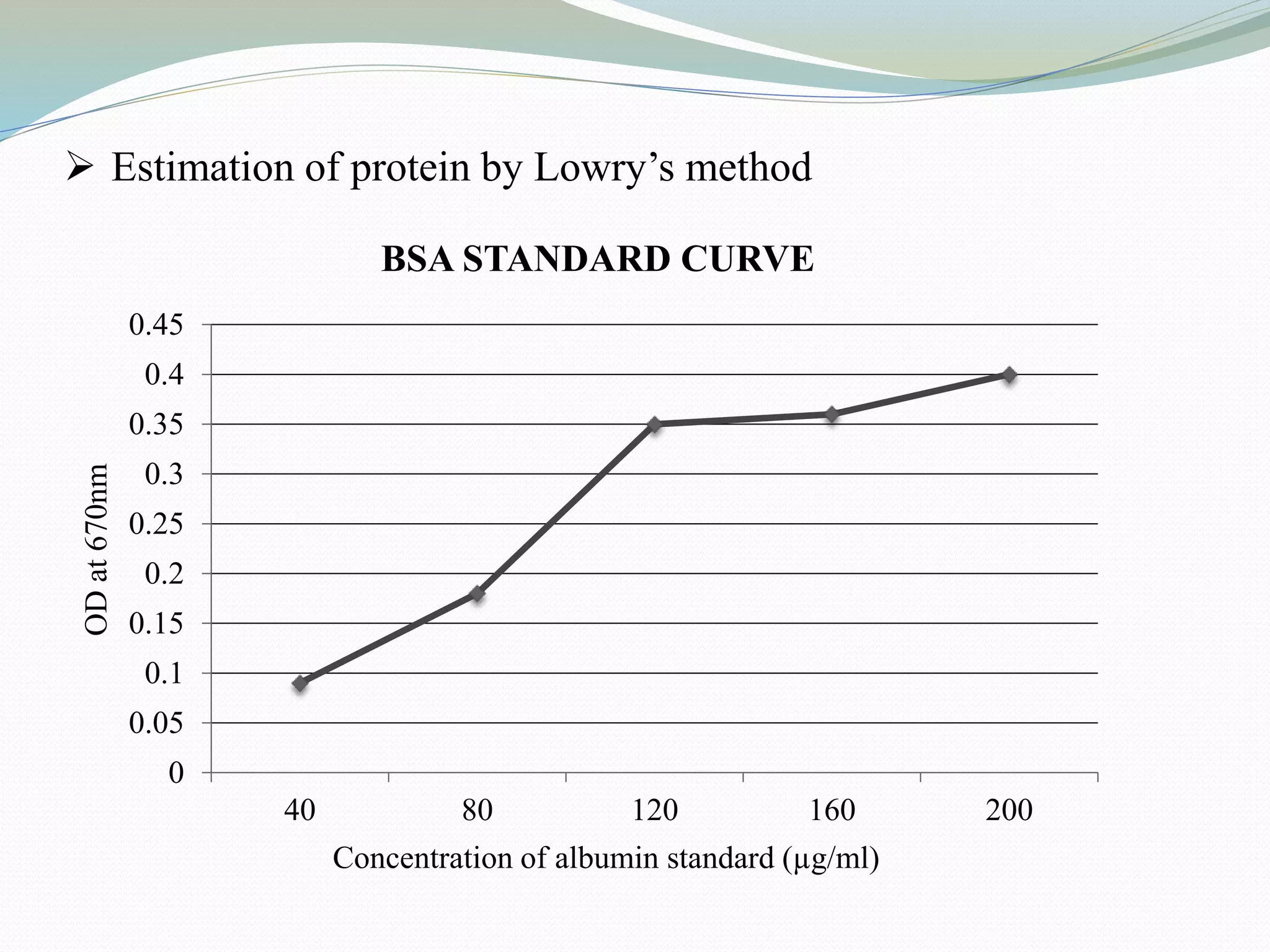
 Estimation of protein by Lowry’s method
0
0.05
0.1
0.15
0.2
0.25
0.3
0.35
0.4
0.45
40 80 120 160 200
ODat670nm
Concentration of albumin standard (µg/ml)
BSA STANDARD CURVE
0
50000
100000
150000
200000
250000
300000
350000
Proteincontent(µg)
SUBSTRATES
ESTIMATION OF PROTEIN BY LOWRY'S METHOD
0
50000
100000
150000
200000
250000
300000
350000
Proteincontent(µg)
SUBSTRATES
ESTIMATION OF PROTEIN BY LOWRY'S METHOD
Sawdust Watermelon
rind
News
paper
Cane
bagasse
Sawdust Watermelon
rind
News
paper
Cane
bagasse
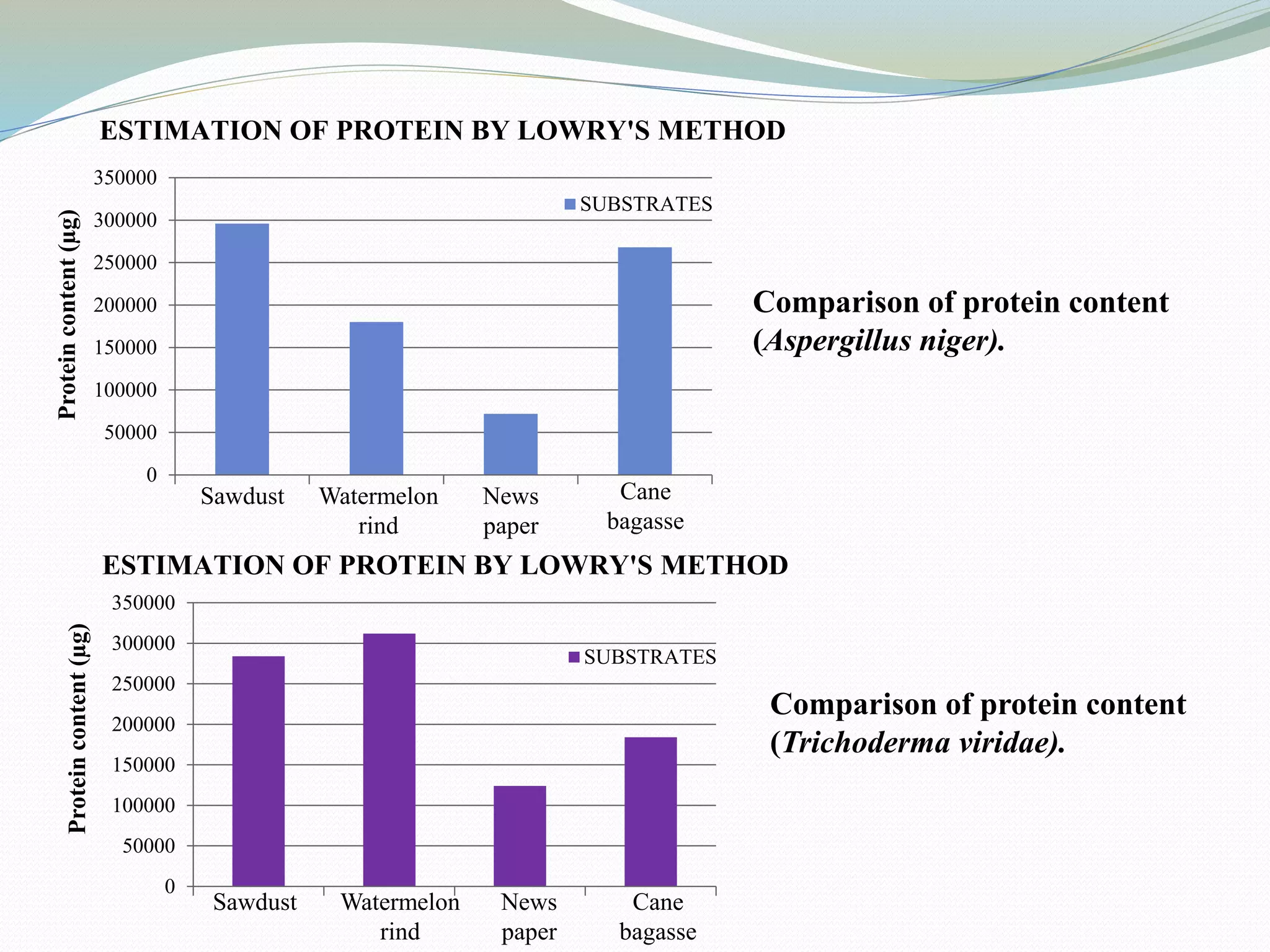
Comparison of protein content
(Aspergillus niger).
Comparison of protein content
(Trichoderma viridae).
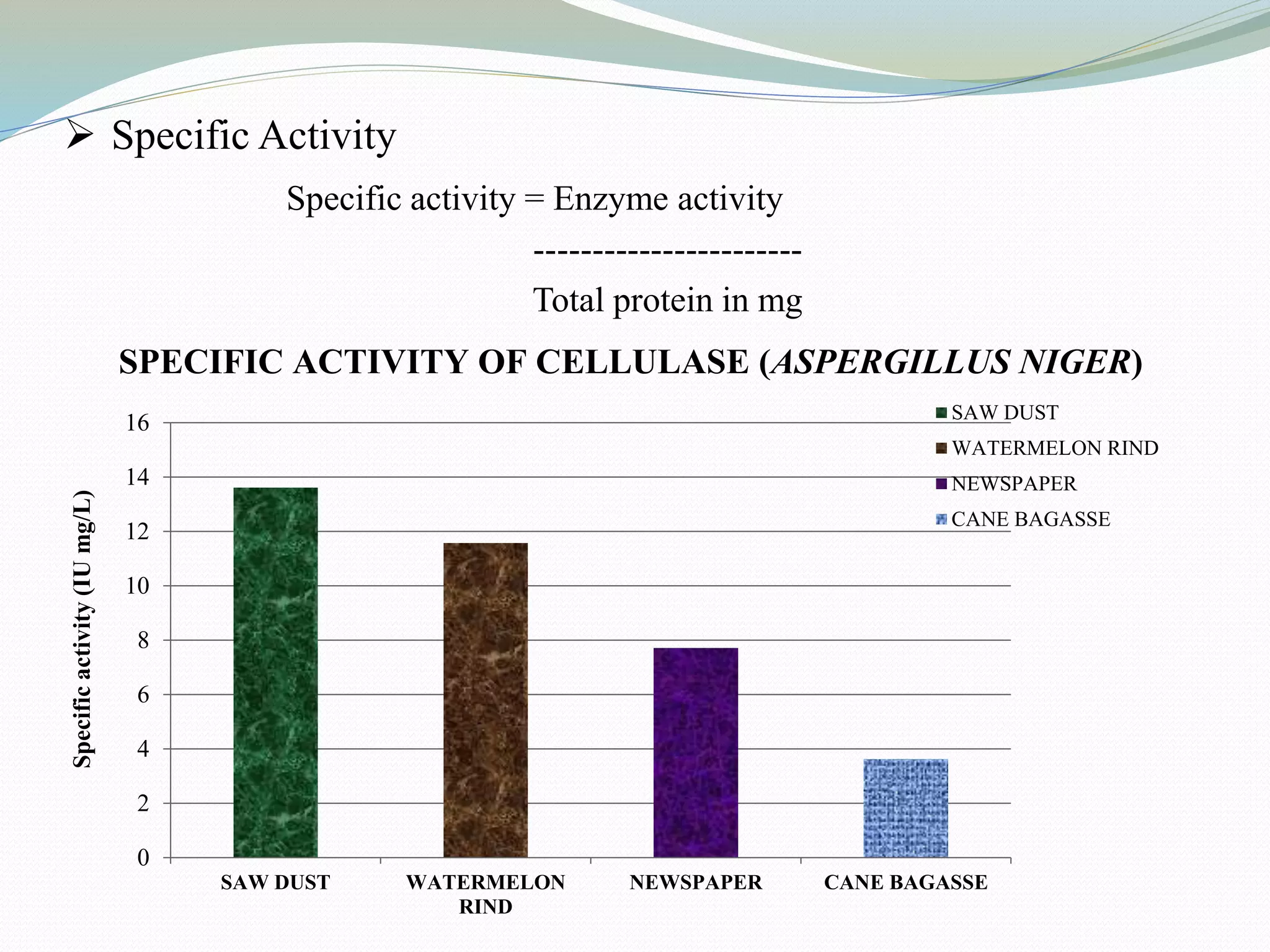
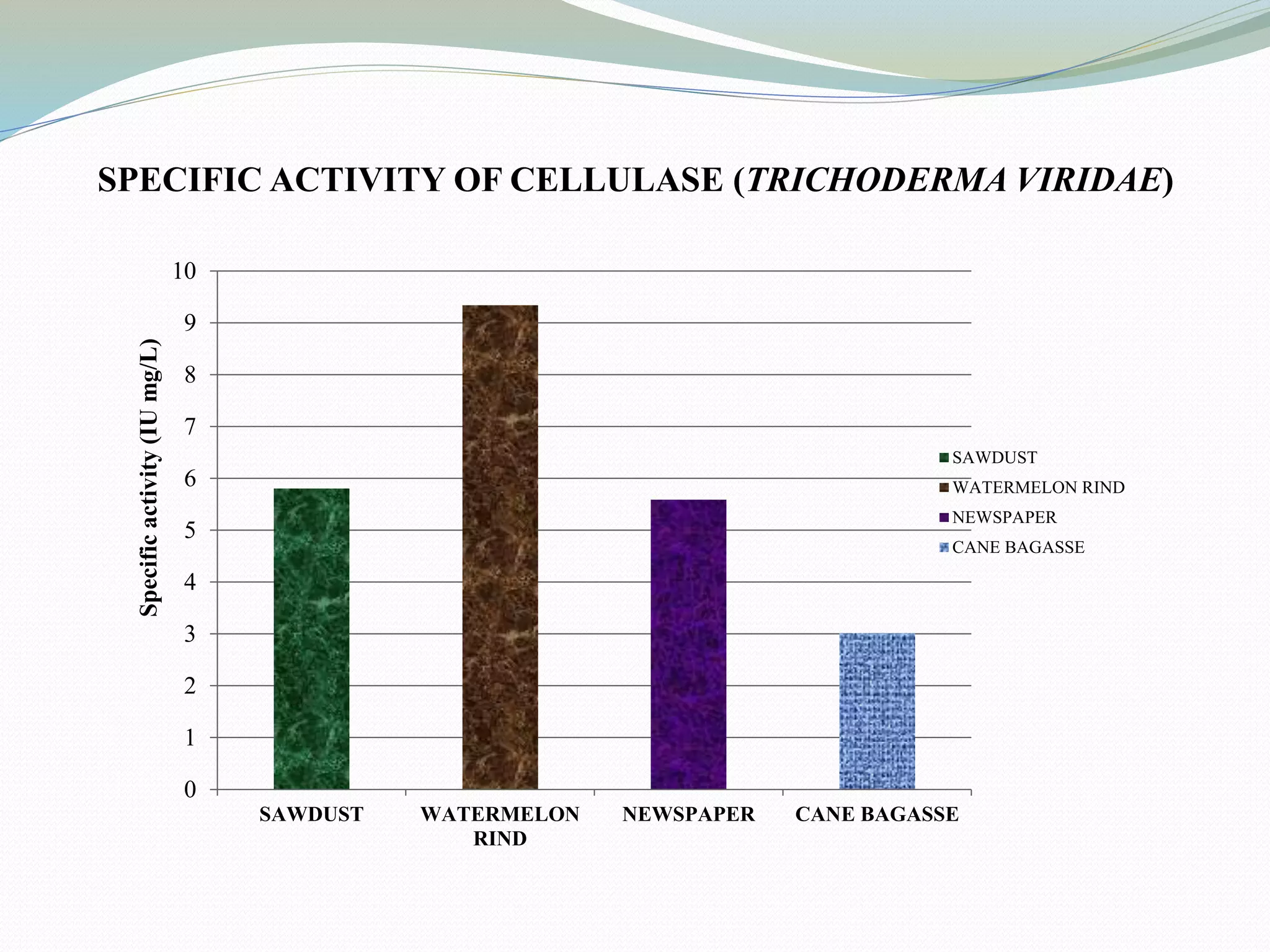
 Specific Activity
Specific activity = Enzyme activity
-----------------------
Total protein in mg
0
2
4
6
8
10
12
14
16
SAW DUST WATERMELON
RIND
NEWSPAPER CANE BAGASSE
Specificactivity(IUmg/L)
SAW DUST
WATERMELON RIND
NEWSPAPER
CANE BAGASSE
SPECIFIC ACTIVITY OF CELLULASE (ASPERGILLUS NIGER)
0
1
2
3
4
5
6
7
8
9
10
SAWDUST WATERMELON
RIND
NEWSPAPER CANE BAGASSE
Specificactivity(IUmg/L)
SAWDUST
WATERMELON RIND
NEWSPAPER
CANE BAGASSE
SPECIFIC ACTIVITY OF CELLULASE (TRICHODERMA VIRIDAE)
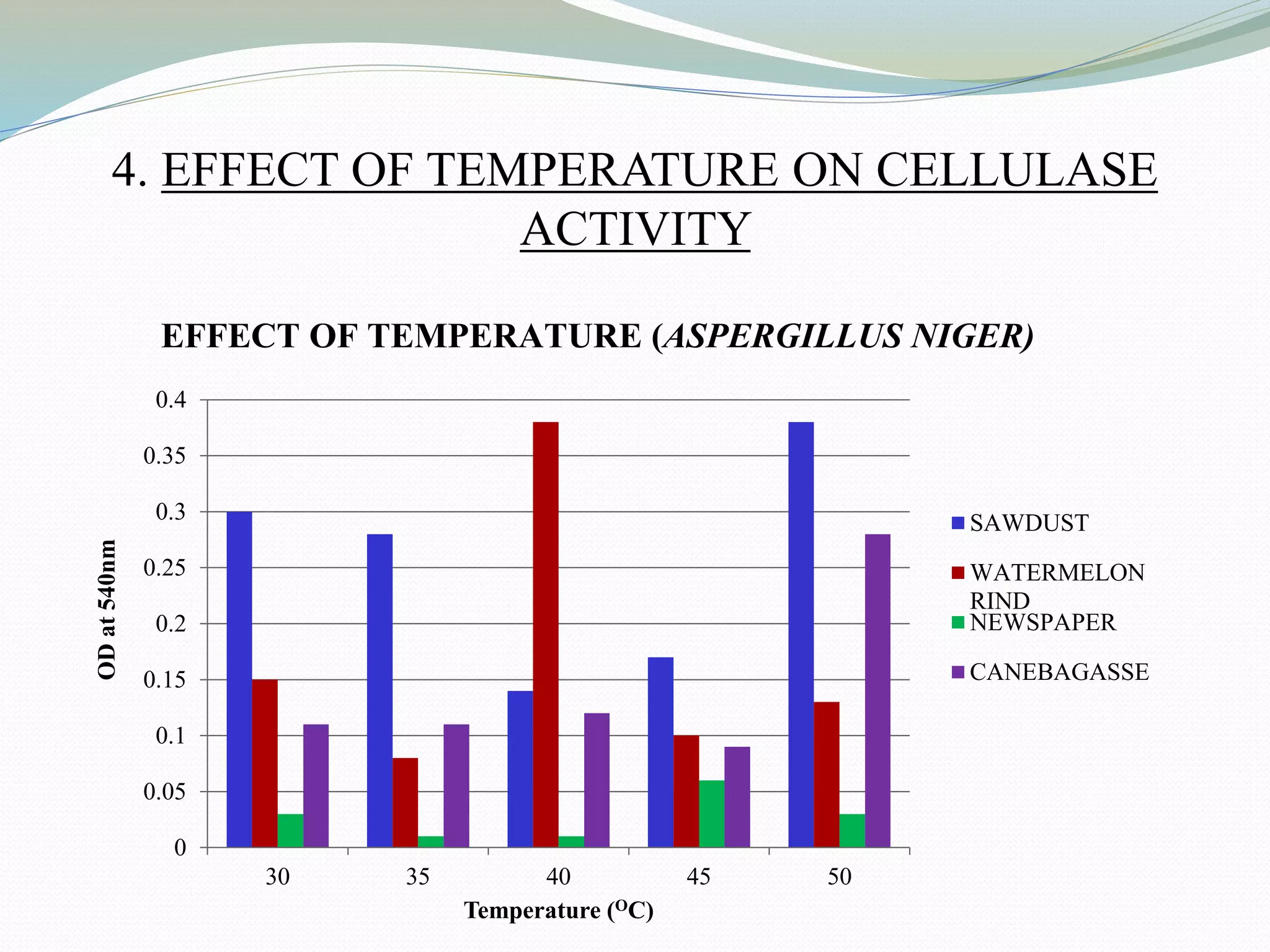
4. EFFECT OF TEMPERATURE ON CELLULASE
ACTIVITY
0
0.05
0.1
0.15
0.2
0.25
0.3
0.35
0.4
30 35 40 45 50
ODat540nm
Temperature (OC)
SAWDUST
WATERMELON
RIND
NEWSPAPER
CANEBAGASSE
EFFECT OF TEMPERATURE (ASPERGILLUS NIGER)
0
0.05
0.1
0.15
0.2
0.25
0.3
0.35
0.4
0.45
0.5
30 35 40 45 50
ODat540nm
Temperature (OC)
SAWDUST
WATERMELON
RIND
NEWSPAPER
CANEBAGASSE
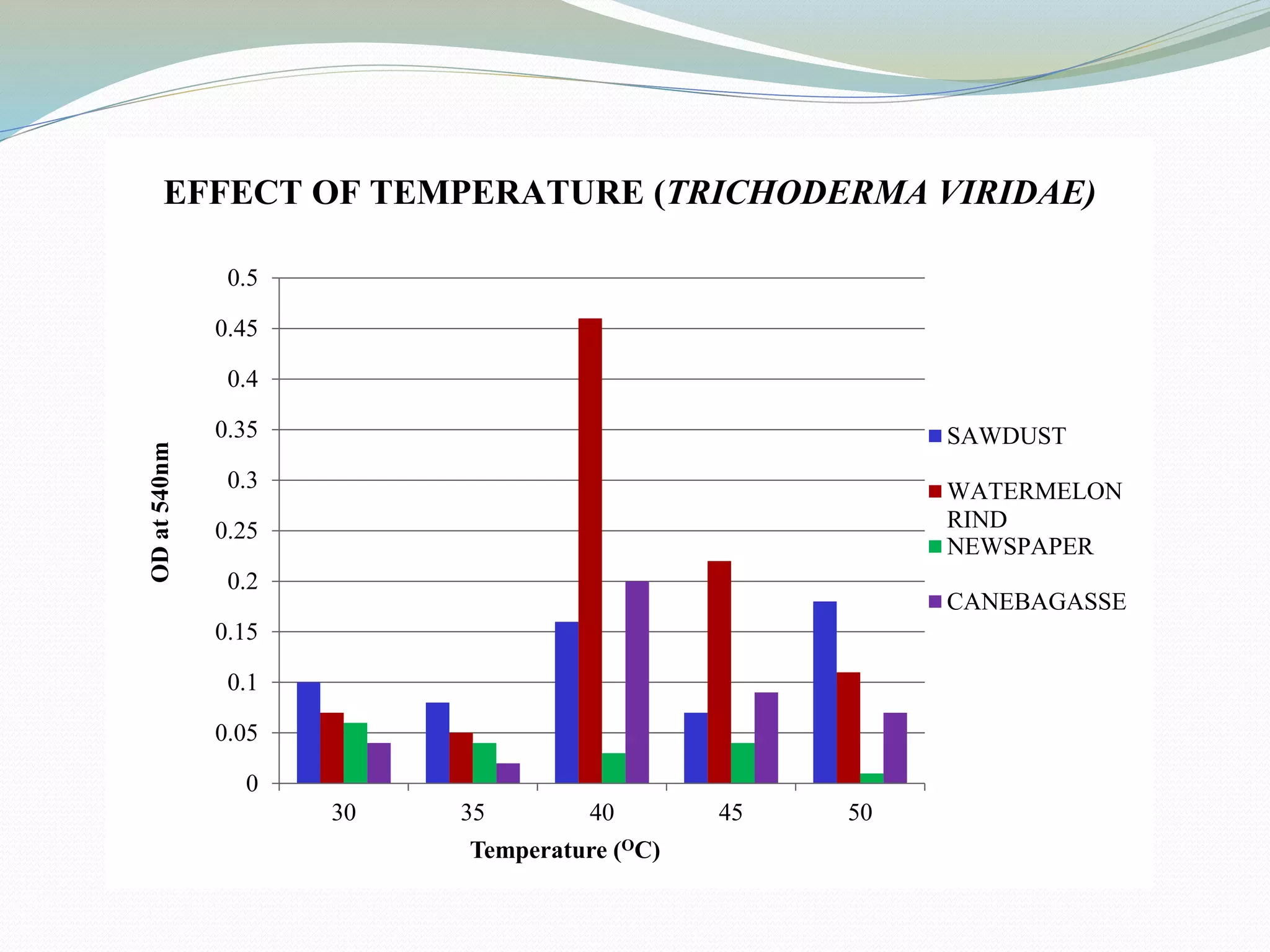
EFFECT OF TEMPERATURE (TRICHODERMA VIRIDAE)
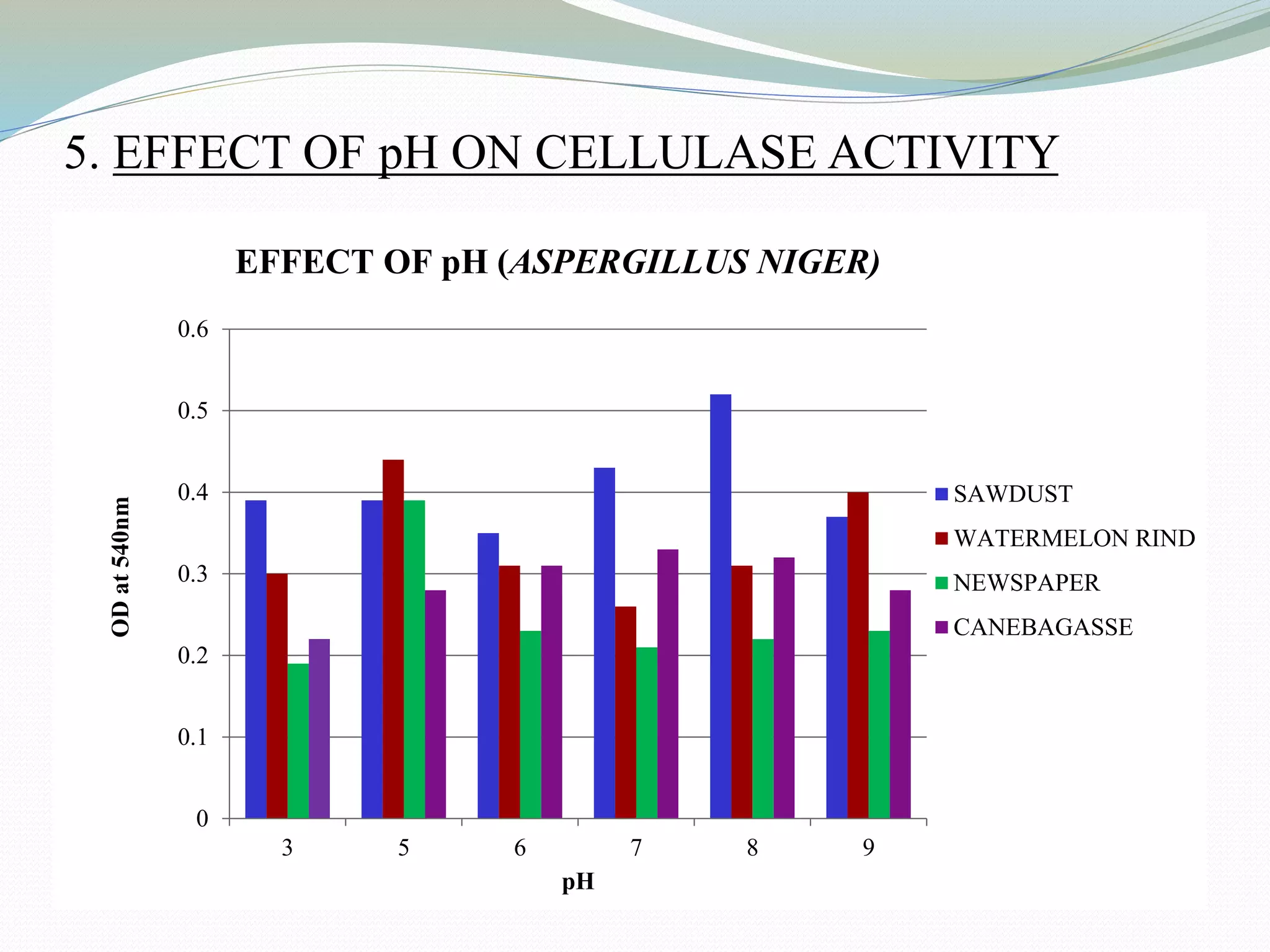
5. EFFECT OF pH ON CELLULASE ACTIVITY
0
0.1
0.2
0.3
0.4
0.5
0.6
3 5 6 7 8 9
ODat540nm
pH
SAWDUST
WATERMELON RIND
NEWSPAPER
CANEBAGASSE
EFFECT OF pH (ASPERGILLUS NIGER)
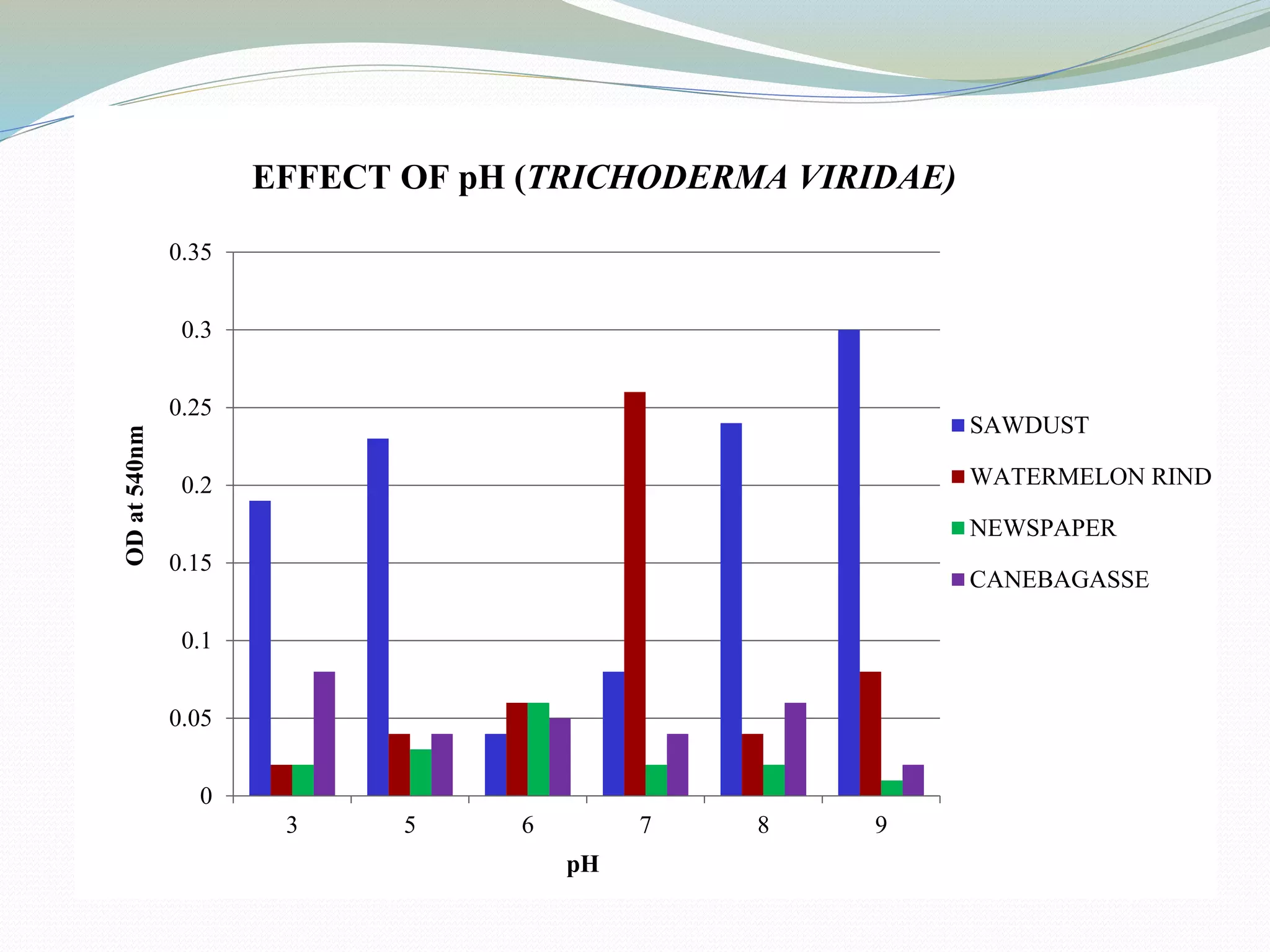
0
0.05
0.1
0.15
0.2
0.25
0.3
0.35
3 5 6 7 8 9
ODat540nm
pH
SAWDUST
WATERMELON RIND
NEWSPAPER
CANEBAGASSE
EFFECT OF pH (TRICHODERMA VIRIDAE)
DISCUSSION
 Cellulase are being commercially produced by several industries
globally and widely being studied for their importance in the
conversion of biomass and other cellulosic materials.
 In the present study four agro industrial wastes like sawdust, cane
bagasse, newspaper and watermelon rind are used for the production
of cellulase using two different fungi: Aspergillus niger and
Trichoderma viridae by Solid State Fermentation.
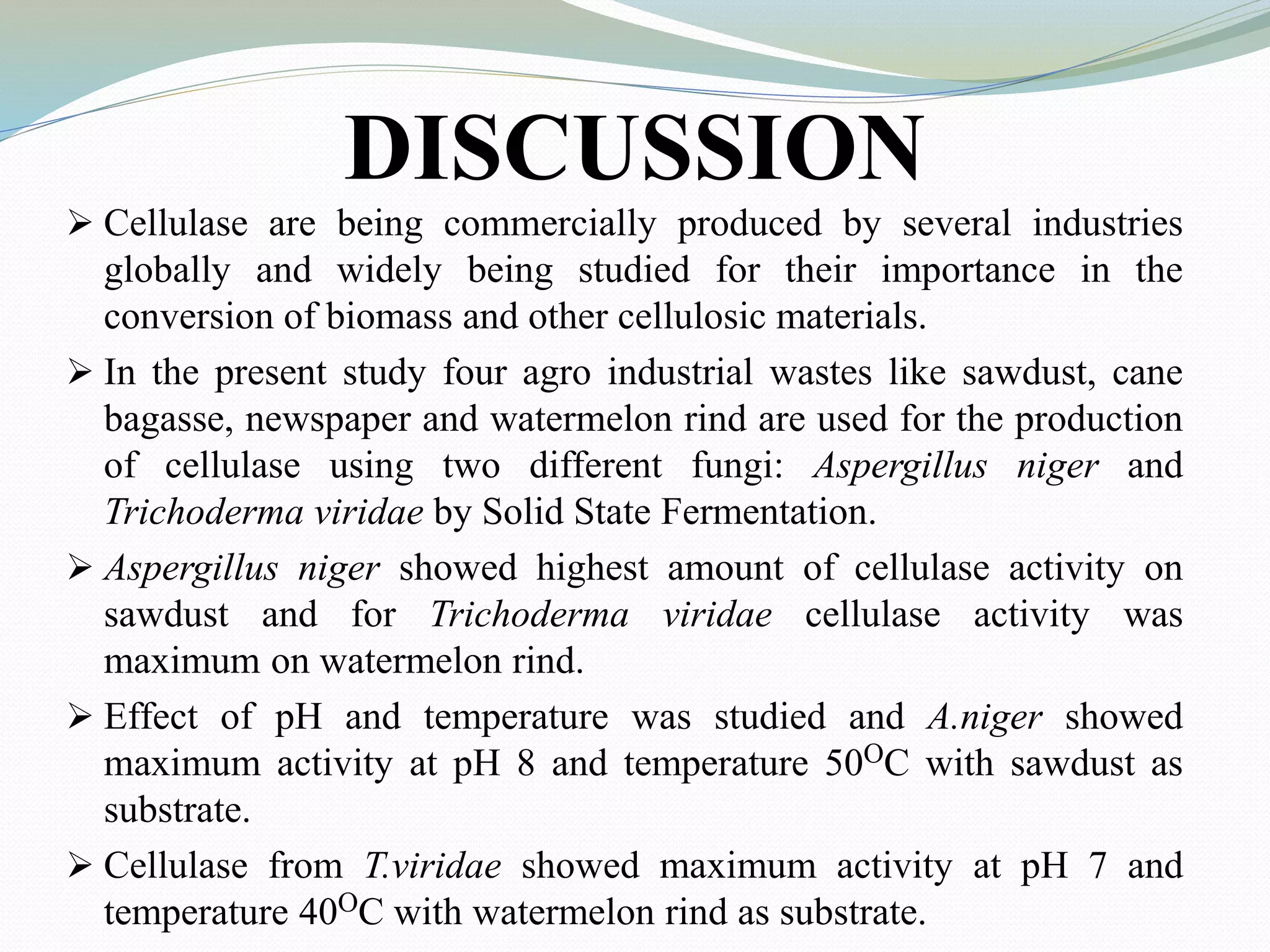
 Aspergillus niger showed highest amount of cellulase activity on
sawdust and for Trichoderma viridae cellulase activity was
maximum on watermelon rind.
 Effect of pH and temperature was studied and A.niger showed
maximum activity at pH 8 and temperature 50OC with sawdust as
substrate.
 Cellulase from T.viridae showed maximum activity at pH 7 and
temperature 40OC with watermelon rind as substrate.
CONCLUSION
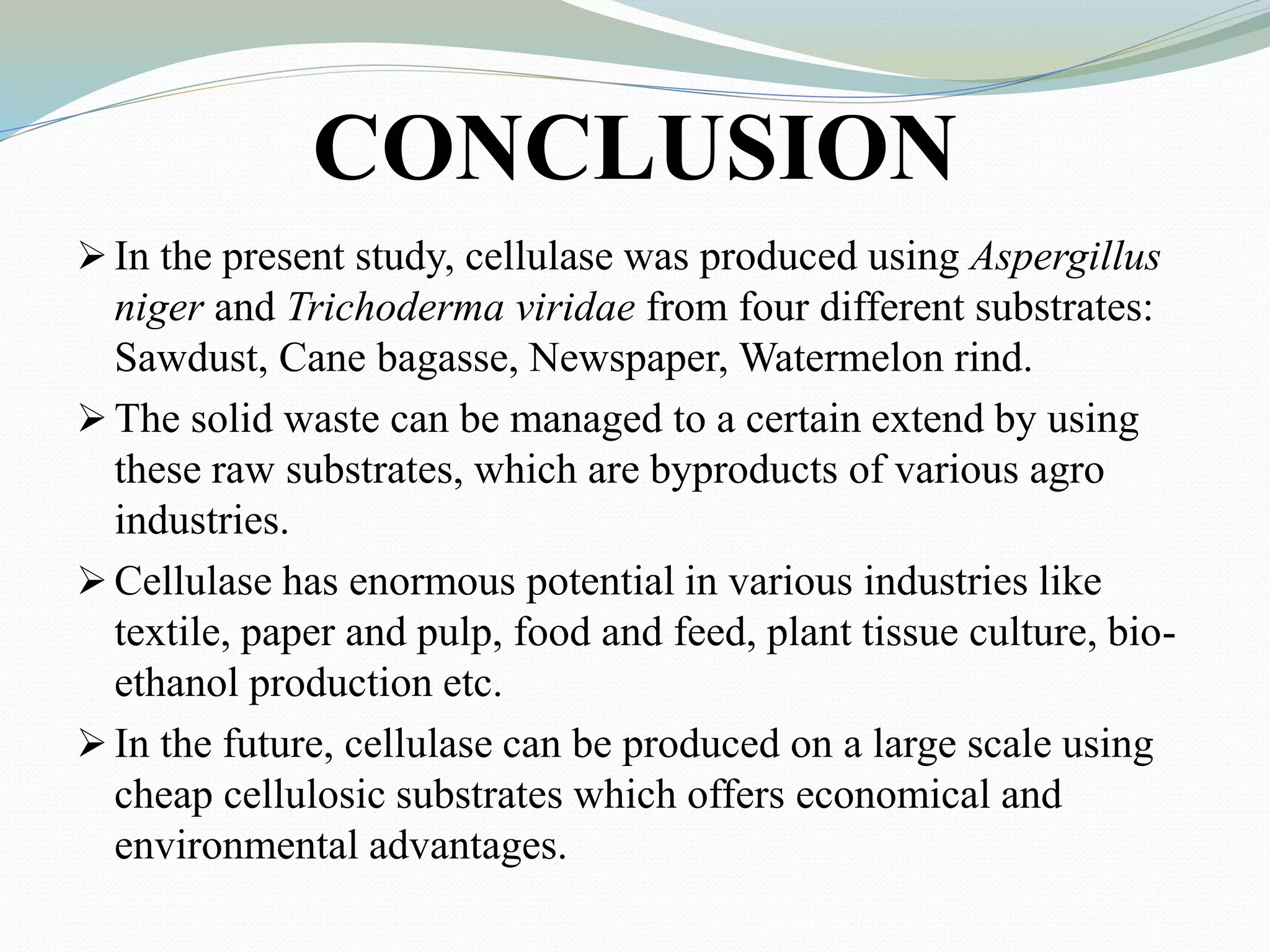
 In the present study, cellulase was produced using Aspergillus
niger and Trichoderma viridae from four different substrates:
Sawdust, Cane bagasse, Newspaper, Watermelon rind.
 The solid waste can be managed to a certain extend by using
these raw substrates, which are byproducts of various agro
industries.
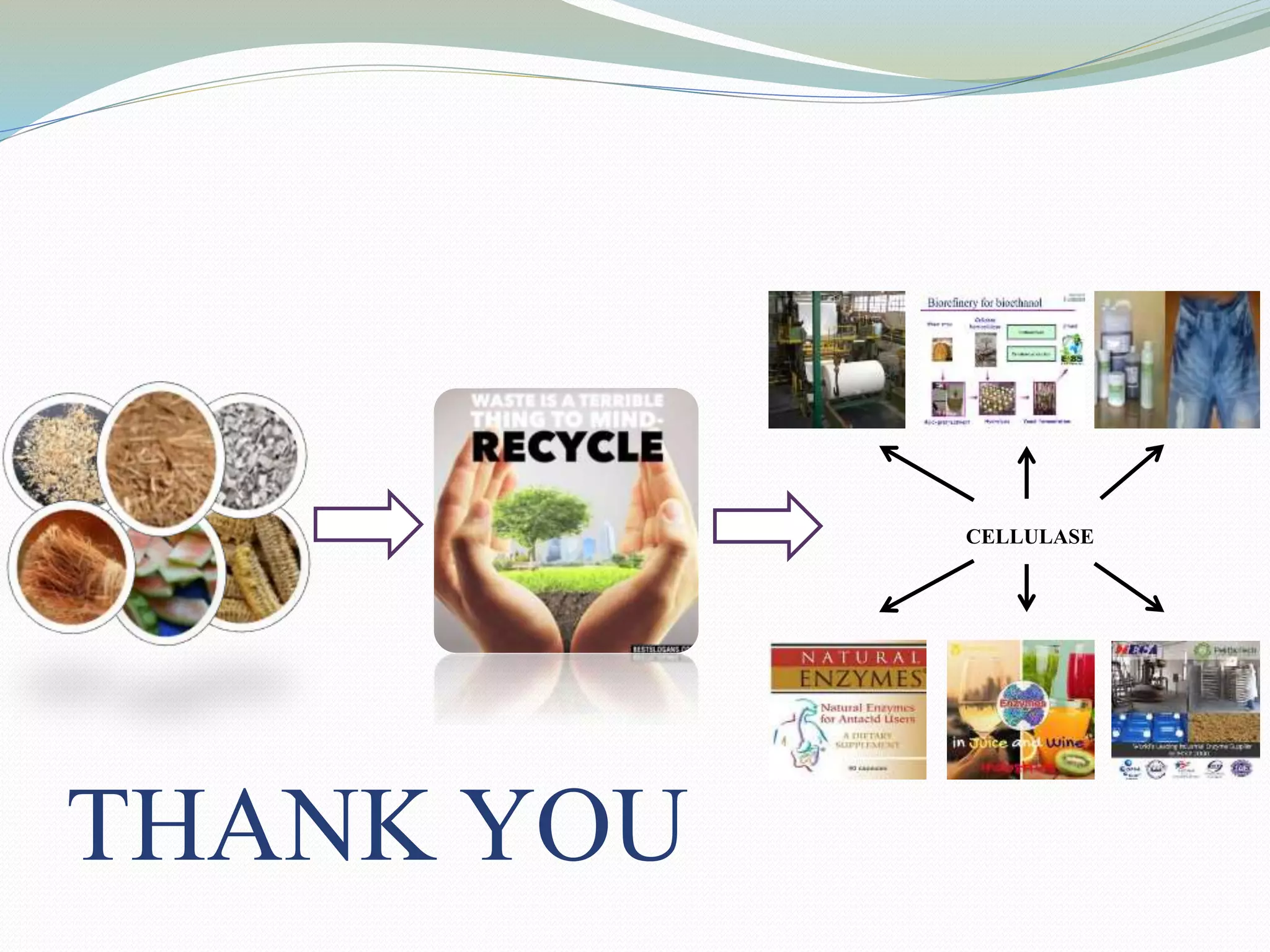
 Cellulase has enormous potential in various industries like
textile, paper and pulp, food and feed, plant tissue culture, bio-
ethanol production etc.
 In the future, cellulase can be produced on a large scale using
cheap cellulosic substrates which offers economical and
environmental advantages.
CELLULASE
THANK YOU

Comparative study of cellulase production by aspergillus niger and trichoderma viridae using solid state fermentation on cellulosic substrates

  • 1.
  • 2.
    INTRODUCTION  Cellulase isan enzyme that catalyze the splitting of cellulose, the most abundant organic compound in nature.  Cellulase is produced by fungi, bacteria and actinomycetes.  Fungi has the ability to secrete large amount of cellulase than other organisms and hence suited for large scale production of the enzyme.  Cellulase production on a commercial scale can be done by Solid State Fermentation (SSF) and Submerged Fermentation (SmF).
  • 3.
     The enzymesare inducible by cellulose, hence it is possible to use various cellulosic waste products like jute, corncob, rice, wheat straw, sawdust, cane bagasse etc for the production of cellulase.  Cellulase is used in various industries like paper and pulp, detergent, laundry, food, textile, biofuel production etc.  In the present study, cellulase is produced by Aspergillus niger and Trichoderma viridae from cellulosic waste substrates: Sawdust, Cane bagasse, Newspaper, Watermelon rind using SSF.
  • 4.
    AIM  Cellulase productionby Solid State Fermentation from agro industrial cellulosic wastes using Aspergillus niger and Trichoderma viridae. OBJECTIVES  To produce cellulase from four different substrates(sawdust, watermelon rind, newspaper and cane bagasse).  Optimization of pH and temperature of cellulase produced by fungal isolates.  Comparison of cellulase production by Aspergillus niger and Trichoderma viridae from the different sources.
  • 5.
    MATERIALS  SUBSTRATES: Sugarcanebagasse (juice shop), sawdust (saw mills), watermelon rind (fruit shop) and newspaper.  MICROORGANISMS: Aspergillus niger and Trichoderma viridae.  MEDIA: Sabouraud Dextrose Agar (SDA), Czapek-Dox agar, Inoculum media, Production media.  REAGENTS: Dinitro Salicylic Acid (DNSA), Folins reagent.  STAINS: Lactophenol Cotton Blue (LPCB), Congo red (1%).
  • 6.
    METHODS COLLECTION OF SAMPLE (Spoiledvegetable waste containing soil, T.viridae powder) ISOLATION OF FUNGI (By serial dilution and spread plating on SDA) IDENIFICATION OF FUNGI (By colony morphology and LPCB staining)
  • 7.
    SCREENING FOR CELLULOLYTICACTIVITY (Czapek-Dox agar + 5 days incubation + 50ºC for 18hrs + 1%Congo red + 1N NaOH) PREPARATION OF INOCULUM (50 ml inoculum media + fungal spore) PREPARATION OF SUBSTRATE (Pretreated with 1N NaOH + production media)
  • 8.
    FERMENTATION PROCESS (20gm substrate+ inoculum) Shaken in electrical shaker ENZYME EXTRACTION (Centrifuged at 1000rpm for 10 min) Supernatant collected as crude enzyme extract
  • 9.
    ESTIMATION OF ENZYMEACTIVITY BY DNSA METHOD ESTIMATION OF PROTEIN BY LOWRY’S METHOD EFFECT OF TEMPERATURE ON ACTIVITY OF ENZYME EFFECT OF pH ON ACTIVITY OF ENZYME
  • 10.
    RESULT 1. ISOLATION ANDIDENTIFICATION OF FUNGI  Aspergillus niger Growth on SDA LPCB staining
  • 11.
     Trichoderma viridae Growthon SDA LPCB staining
  • 12.
    2. SCREENING OFFUNGAL ISOLATES Aspergillus niger Trichoderma viridae Fungal culture showing cellulase activity
  • 13.
    3. DETERMINATION OFENZYME ACTIVITY  Estimation of cellulase activity by DNSA method 0 0.2 0.4 0.6 0.8 1 1.2 1.4 1.6 1.8 2 250 500 750 1000 1250 ODat540nm Concentration of glucose standard (µg/ml) GLUCOSE STANDARD CURVE
  • 14.
    0 500 1000 1500 2000 2500 3000 3500 4000 4500 Enzymeactivity(IU/L) SUBSTRATES ESTIMATION OF CELLULASEBY DNSA METHOD 0 500 1000 1500 2000 2500 3000 3500 Enzymeactivity(IU/L) SUBSTRATES ESTIMATION OF CELLULASE BY DNSA METHOD Sawdust Sawdust Watermelon rind Watermelon rind News paper News paper Cane bagasse Cane bagasse Comparison of enzyme activity (Aspergillus niger). Comparison of enzyme activity (Trichoderma viridae).
  • 15.
     Estimation ofprotein by Lowry’s method 0 0.05 0.1 0.15 0.2 0.25 0.3 0.35 0.4 0.45 40 80 120 160 200 ODat670nm Concentration of albumin standard (µg/ml) BSA STANDARD CURVE
  • 16.
    0 50000 100000 150000 200000 250000 300000 350000 Proteincontent(µg) SUBSTRATES ESTIMATION OF PROTEINBY LOWRY'S METHOD 0 50000 100000 150000 200000 250000 300000 350000 Proteincontent(µg) SUBSTRATES ESTIMATION OF PROTEIN BY LOWRY'S METHOD Sawdust Watermelon rind News paper Cane bagasse Sawdust Watermelon rind News paper Cane bagasse Comparison of protein content (Aspergillus niger). Comparison of protein content (Trichoderma viridae).
  • 17.
     Specific Activity Specificactivity = Enzyme activity ----------------------- Total protein in mg 0 2 4 6 8 10 12 14 16 SAW DUST WATERMELON RIND NEWSPAPER CANE BAGASSE Specificactivity(IUmg/L) SAW DUST WATERMELON RIND NEWSPAPER CANE BAGASSE SPECIFIC ACTIVITY OF CELLULASE (ASPERGILLUS NIGER)
  • 18.
    0 1 2 3 4 5 6 7 8 9 10 SAWDUST WATERMELON RIND NEWSPAPER CANEBAGASSE Specificactivity(IUmg/L) SAWDUST WATERMELON RIND NEWSPAPER CANE BAGASSE SPECIFIC ACTIVITY OF CELLULASE (TRICHODERMA VIRIDAE)
  • 19.
    4. EFFECT OFTEMPERATURE ON CELLULASE ACTIVITY 0 0.05 0.1 0.15 0.2 0.25 0.3 0.35 0.4 30 35 40 45 50 ODat540nm Temperature (OC) SAWDUST WATERMELON RIND NEWSPAPER CANEBAGASSE EFFECT OF TEMPERATURE (ASPERGILLUS NIGER)
  • 20.
    0 0.05 0.1 0.15 0.2 0.25 0.3 0.35 0.4 0.45 0.5 30 35 4045 50 ODat540nm Temperature (OC) SAWDUST WATERMELON RIND NEWSPAPER CANEBAGASSE EFFECT OF TEMPERATURE (TRICHODERMA VIRIDAE)
  • 21.
    5. EFFECT OFpH ON CELLULASE ACTIVITY 0 0.1 0.2 0.3 0.4 0.5 0.6 3 5 6 7 8 9 ODat540nm pH SAWDUST WATERMELON RIND NEWSPAPER CANEBAGASSE EFFECT OF pH (ASPERGILLUS NIGER)
  • 22.
    0 0.05 0.1 0.15 0.2 0.25 0.3 0.35 3 5 67 8 9 ODat540nm pH SAWDUST WATERMELON RIND NEWSPAPER CANEBAGASSE EFFECT OF pH (TRICHODERMA VIRIDAE)
  • 23.
    DISCUSSION  Cellulase arebeing commercially produced by several industries globally and widely being studied for their importance in the conversion of biomass and other cellulosic materials.  In the present study four agro industrial wastes like sawdust, cane bagasse, newspaper and watermelon rind are used for the production of cellulase using two different fungi: Aspergillus niger and Trichoderma viridae by Solid State Fermentation.  Aspergillus niger showed highest amount of cellulase activity on sawdust and for Trichoderma viridae cellulase activity was maximum on watermelon rind.  Effect of pH and temperature was studied and A.niger showed maximum activity at pH 8 and temperature 50OC with sawdust as substrate.  Cellulase from T.viridae showed maximum activity at pH 7 and temperature 40OC with watermelon rind as substrate.
  • 24.
    CONCLUSION  In thepresent study, cellulase was produced using Aspergillus niger and Trichoderma viridae from four different substrates: Sawdust, Cane bagasse, Newspaper, Watermelon rind.  The solid waste can be managed to a certain extend by using these raw substrates, which are byproducts of various agro industries.  Cellulase has enormous potential in various industries like textile, paper and pulp, food and feed, plant tissue culture, bio- ethanol production etc.  In the future, cellulase can be produced on a large scale using cheap cellulosic substrates which offers economical and environmental advantages.
  • 25.