LIPASE
PRODUCTION AND PURIFICATION
BY
LIKHITH. K
BISEP-2021, DEPT OF BIOTECHNOLOGY
ST ALOYSIUS COLLEGE MANGALURU, KARNATAKA
CONTENTS
Enzymes
Structure of enzymes
Characterization
Classification of enzymes
Lipase and its activity
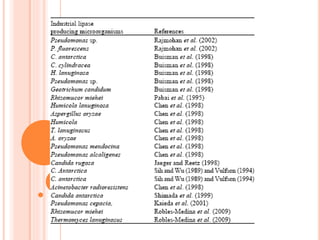
Industrial lipase producing microorganism
Experimental design
Isolation, inoculum preparation and maintenance
 Assay for lipolytic activity
Lipase production
Characterization of lipase activity
Achievement of enzyme activity
Application
Reference
ENZYMES
 Enzymes are biological catalysts that speed up the rate of the
biochemical reaction.
Most enzymes are three dimensional globular proteins.
 Some special RNA species also act as enzymes and are called
Ribo zymes e.g. Hammer head ribo zyme.
STRUCTURE OF ENZYMES
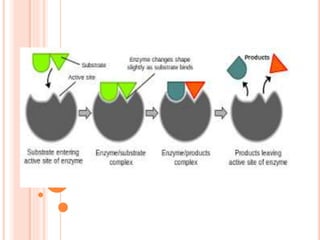
 The active site of an enzyme is the region that binds substrates,
co-factors and prosthetic groups and contains residue that helps to
hold the substrate.
 Active sites generally occupy less than 5% of the total surface
area of enzyme.
 Active site has a specific shape due to tertiary structure of
protein.
 A change in the shape of protein affects the shape of active site
and function of the enzyme.
CHARACTERISTICS
 Enzymes speed up the reaction by lowering the activation
energy of the reaction.
 Their presence does not effect the nature and properties of
end product.
 They are highly specific in their action that is each enzyme
can catalyze one kind of substrate.
Small amount of enzymes can accelerate chemical reactions.
 Enzymes are sensitive to change in pH, temperature and
substrate concentration.
 Turnover number is defined as the number of substrate
molecules transformed per minute by one enzyme molecule.
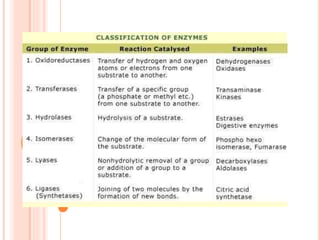
CLASSIFICATION OF ENZYMES
A systematic classification of enzymes has been developed by
International Enzyme Commission.
 This classification is based on the type of reactions catalyzed by
enzymes.
 There are six major classes.
 Each class is further divided into sub classes, sub sub-classes and
so on, to describe the huge number of different enzyme catalyzed
reactions.
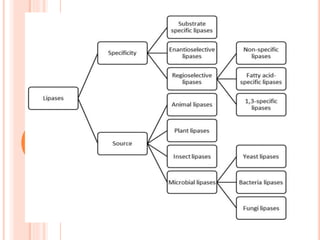
LIPASES
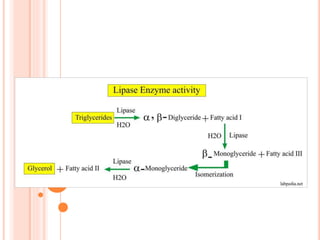
Lipase (tri acyl glycerol acyl hydrolase, EC 3.1.1.3) catalyzes the
hydrolysis of the carboxyl ester bonds in tri acyl glycerols to produce
di acyl glycerols, mono acyl glycerols, fatty acids and glycerol under
aqueous conditions and the synthesis of esters in organic solvents.
 Under the controlled conditions, lipases are able to catalyze a large
number of reactions. Lipases of microbial origin are of considerable
commercial importance, because of the high versatility and high
stability, moreover, the advantage of being readily produced in high
yields.
Many microbial lipases have been commercially available in free
or immobilized form. Numerous species of bacteria (Bacillus,
Pseudomonas, and Burkholderia), yeasts (Candida rugosa,
Yarrowia lipolytica, and Candida antarctica) and molds
(Aspergillus, Trichoderma viride) produce lipases with different
enzymological properties and specificities but microbes are known
to be more potent lipase producer
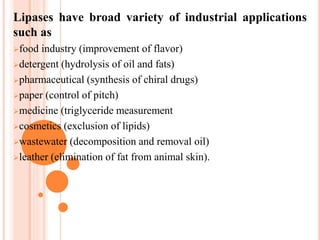
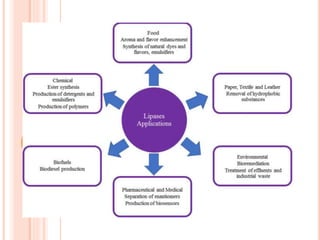
Lipases have broad variety of industrial applications
such as
food industry (improvement of flavor)
detergent (hydrolysis of oil and fats)
pharmaceutical (synthesis of chiral drugs)
paper (control of pitch)
medicine (triglyceride measurement
cosmetics (exclusion of lipids)
wastewater (decomposition and removal oil)
leather (elimination of fat from animal skin).
EXPERIMENTAL DESIGN
Isolation, screening and identification of lipase producing Bacteria
Assay for lipolytic activity
Lipase purification
 Characterization of lipase enzyme
Isolation, Screening and identification of lipase producing
bacteria : The sludge and oil contaminated sediment samples were
collected from effluent.
 Screening on tributyrin rich media .
 DNA isolation and 16 s rDNA sequencing.
Assay for lipolytic activity: para-Nitro phenyl phosphate (p-NPP
method)
Production of lipase enzyme: Culture of microorganisms will be
done under optimum conditions.
Purification of lipase enzyme
Ammonium Sulphate precipitation
 Colum Chromatography
Characterization of lipase enzyme
 Effect of pH and Temperature
Effect of organic solvent and detergents
ISOLATION, INOCULUMS PREPARATION AND
MAINTENANCE
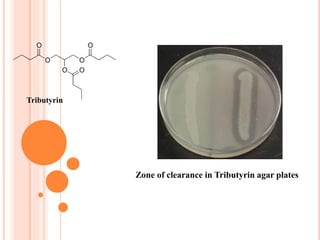
 The soil samples were enriched by adding 1 % of tributyrin, kept
at 37 °C and incubated for 3 days. The samples were serially diluted
and spreaded on nutrient agar medium containing 1 % tributyrin,
kept at 37 °C for 24 h of incubation.
The pure cultures obtained were maintained at 4 °C on medium.
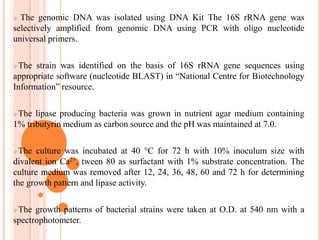
The zone forming bacterial strains were further screened for
quantitative analysis of lipase using titrimetric method.
Tributyrin
Zone of clearance in Tributyrin agar plates
 The genomic DNA was isolated using DNA Kit The 16S rRNA gene was
selectively amplified from genomic DNA using PCR with oligo nucleotide
universal primers.
The strain was identified on the basis of 16S rRNA gene sequences using
appropriate software (nucleotide BLAST) in “National Centre for Biotechnology
Information” resource.
The lipase producing bacteria was grown in nutrient agar medium containing
1% tributyrin medium as carbon source and the pH was maintained at 7.0.
The culture was incubated at 40 °C for 72 h with 10% inoculum size with
divalent ion Ca2+, tween 80 as surfactant with 1% substrate concentration. The
culture medium was removed after 12, 24, 36, 48, 60 and 72 h for determining
the growth pattern and lipase activity.
The growth patterns of bacterial strains were taken at O.D. at 540 nm with a
spectrophotometer.
ASSAY FOR LIPOLYTIC ACTIVITY
Bacterial culture grown in nutrient medium with 1% tributyrin
was centrifuged at 10,000 rpm for 20 min at 4 °C in a
refrigerated centrifuge.
Lipase activity was determined titrimetrically on the basis of
olive oil hydrolysis. One ml of the culture supernatant was
added to the reaction mixture containing 1 ml of 0.1 M Tris–
HCl buffer (pH 8.0), 2.5 ml of deionized water and 3 ml of
olive oil and incubated at 37 °C for 30 min.
Both test (in which all the reaction mixture were added with
enzyme) and blank (in which all the reaction mixture were
added without enzyme) were performed.
After 30 min the test solution was transferred to a 50 ml
Erlenmeyer flask. 3 ml of 95% ethanol was added to stop the
reaction.
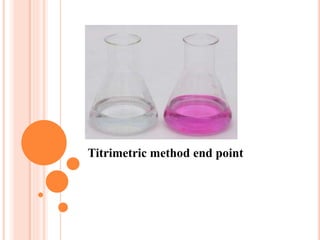
Liberated fatty acids were titrated against 0.1 M NaOH using
phenolphthalein as an indicator.
End point was an appearance of pink colour.
A unit lipase is defined as the amount of enzyme, which releases
one micromole fatty acid per min under specified assay conditions.
Titrimetric method end point
LIPASE PURIFICATION
Bacterial culture grown in nutrient medium with 1% tributyrin was
centrifuged at 10,000 rpm for 20 min at 4 °C in a refrigerated
centrifuge.
Cell free supernatant was saturated with (0–70%) ammonium
sulfate with continuous stirring at 4 °C followed by centrifugation at
14,000 rpm for 20 min.
Ammonium sulfate fraction was dialyzed against phosphate buffer
(pH 7.0) for 6 h at 4 °C in a dialysis bag.
The concentrated enzyme after dialysis was loaded onto Sephadex
G-100 column.
The lipase was eluted from the column at a flow rate of 3 ml/min.
Enzyme fractions (5 ml each) were collected and the protein
content was measured spectrophotometrically at 280 nm.
Lipase assay was performed using fractions containing highest
protein content.
CHARACTERIZATION OF LIPASE ENZYME
Effect of pH on the activity and stability
The effect of pH on enzyme activity was determined by incubating
the reaction mixture at various pHs ranging from 4.0 to 11.0 at
50 ± 2 °C for 30 min.
The buffers used were citrate phosphate buffer (pH 4.0 to 7.0), Tris
HCl buffer (pH 8.0) and glycine - NaOH buffer (pH 9.0 to 11.0).
Temperature optimum and thermal stability
To evaluate the optimal temperature for the enzyme activity, the
assay was conducted at varying temperatures ranging from 35 to
121 °C.
The lipase was pre-incubated at different temperatures ranging
from 30, 40 ……121 °C for 0–180 min.
Effect of metal ions
0.5 ml of purified lipase in 2.5 ml 20 mM Tris HCl buffer (pH 8.0)
was incubated for 30 min with various metal ions (1 mM) Ca2+,
Mg2+, Cu2+, Fe2+, Co2+, and Zn2+.
Shelf stability of lipase
Shelf stability of lipase was determined by pre incubating the
enzyme at 4 °C in 20 mM Tris HCl buffer (pH 8.0). Enzyme activity
was determined every 3 days till 9 days.
Effect of media additives
To determine the influence of different additives viz. SDS, EDTA,
CTAB, Tween 20, Tween 80, Triton X 100 and Glycerol etc.,
purified lipase in 1 M phosphate buffer (pH 7.0) was pre-incubated
for 30 min at 50 ± 2 °C.
CULTURE MEDIUM TO SOLID-STATE AND SUBMERGED
FERMENTATION
The medium to submerged fermentation is prepared with 10% (w/v)
of wheat bran, which was boiled at 100°C for 30 min.
Following, the medium was filtered and the soluble extract is added
to 10% (v/v) of saline solution, 45 g/L of yeast extract as nitrogen
source and 20 g/L of soybean oil as inducer.
The composition of saline solution is 2 g/L KH2PO4, 1 g/L MgSO4,
and 10 mL/L of trace solution containing (mg/L) FeSO4·7H2O (0.63),
MnSO4 (0.01), ZnSO4  (0.62).
The medium was autoclaved at 103 kPa for 20 min and the pH
adjusted to 7.0 using HCl 1.5 mol/L or NaOH 1 mol/L.
After inoculation, the cultures were incubated for 4 days at 30°C
with agitation of 160 min−1.
The medium for solid-state fermentation is with 85% of soybean
or wheat bran and 15% of rice husk. The medium was added to
71% (v/w) of saline solution and 2% of sodium nitrate as nitrogen
source.
The medium was autoclaved at 103 kPa for 20 min and
subsequently added to 2% olive oil as an inducer of lipase
production.
The pH was adjusted to 4.5 by the addition of a 1.5 mol/L solution
of H2SO4 and moisture was adjusted to 60% by adding sterile
distilled water.
Fermentations were carried out in 300 mL Erlenmeyer's flasks
containing 50 g of the medium, which were incubated at 30°C for
96 h after inoculation. The fermented brans were kept at −20°C until
use.
ACHIEVEMENT OF ENZYMATIC EXTRACTS
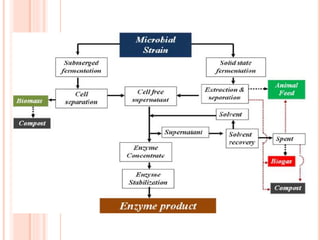
After the production of lipase by submerged and solid-state
fermentation, procedures for obtaining the enzymatic extracts were
conducted, which are described below.
The fermented medium obtained under submerged fermentation
by the microbes are filtered in cotton for the retention of cell debris
and frozen at −20°C, being after used in the determinations of
enzymatic activities.
The extraction of lipase from the fermented bran obtained in
solid-state fermentation by the microbes was carried out by adding
10 mL buffer with pH established in each methodology at 1 g of
fermented medium, followed by agitation of 160 min−1 for 30 min
at 37°C.
The extract was cotton-filtered and used as enzyme extract in
subsequent reactions.
REFERENCES
Woodbury.: Biochemistry for the Pharmaceutical
Sciences
Pfeiffer, J.: Enzymes, the Physics and Chemistry of Life
 Martinek, R.: Practical Clinical Enzymology

Lipase production and purification Likhith K

  • 1.
    LIPASE PRODUCTION AND PURIFICATION BY LIKHITH.K BISEP-2021, DEPT OF BIOTECHNOLOGY ST ALOYSIUS COLLEGE MANGALURU, KARNATAKA
  • 2.
    CONTENTS Enzymes Structure of enzymes Characterization Classificationof enzymes Lipase and its activity Industrial lipase producing microorganism Experimental design Isolation, inoculum preparation and maintenance  Assay for lipolytic activity Lipase production Characterization of lipase activity Achievement of enzyme activity Application Reference
  • 3.
    ENZYMES  Enzymes arebiological catalysts that speed up the rate of the biochemical reaction. Most enzymes are three dimensional globular proteins.  Some special RNA species also act as enzymes and are called Ribo zymes e.g. Hammer head ribo zyme.
  • 4.
    STRUCTURE OF ENZYMES The active site of an enzyme is the region that binds substrates, co-factors and prosthetic groups and contains residue that helps to hold the substrate.  Active sites generally occupy less than 5% of the total surface area of enzyme.  Active site has a specific shape due to tertiary structure of protein.  A change in the shape of protein affects the shape of active site and function of the enzyme.
  • 6.
    CHARACTERISTICS  Enzymes speedup the reaction by lowering the activation energy of the reaction.  Their presence does not effect the nature and properties of end product.  They are highly specific in their action that is each enzyme can catalyze one kind of substrate. Small amount of enzymes can accelerate chemical reactions.  Enzymes are sensitive to change in pH, temperature and substrate concentration.  Turnover number is defined as the number of substrate molecules transformed per minute by one enzyme molecule.
  • 7.
    CLASSIFICATION OF ENZYMES Asystematic classification of enzymes has been developed by International Enzyme Commission.  This classification is based on the type of reactions catalyzed by enzymes.  There are six major classes.  Each class is further divided into sub classes, sub sub-classes and so on, to describe the huge number of different enzyme catalyzed reactions.
  • 9.
    LIPASES Lipase (tri acylglycerol acyl hydrolase, EC 3.1.1.3) catalyzes the hydrolysis of the carboxyl ester bonds in tri acyl glycerols to produce di acyl glycerols, mono acyl glycerols, fatty acids and glycerol under aqueous conditions and the synthesis of esters in organic solvents.  Under the controlled conditions, lipases are able to catalyze a large number of reactions. Lipases of microbial origin are of considerable commercial importance, because of the high versatility and high stability, moreover, the advantage of being readily produced in high yields.
  • 10.
    Many microbial lipaseshave been commercially available in free or immobilized form. Numerous species of bacteria (Bacillus, Pseudomonas, and Burkholderia), yeasts (Candida rugosa, Yarrowia lipolytica, and Candida antarctica) and molds (Aspergillus, Trichoderma viride) produce lipases with different enzymological properties and specificities but microbes are known to be more potent lipase producer
  • 12.
    Lipases have broadvariety of industrial applications such as food industry (improvement of flavor) detergent (hydrolysis of oil and fats) pharmaceutical (synthesis of chiral drugs) paper (control of pitch) medicine (triglyceride measurement cosmetics (exclusion of lipids) wastewater (decomposition and removal oil) leather (elimination of fat from animal skin).
  • 15.
    EXPERIMENTAL DESIGN Isolation, screeningand identification of lipase producing Bacteria Assay for lipolytic activity Lipase purification  Characterization of lipase enzyme
  • 16.
    Isolation, Screening andidentification of lipase producing bacteria : The sludge and oil contaminated sediment samples were collected from effluent.  Screening on tributyrin rich media .  DNA isolation and 16 s rDNA sequencing. Assay for lipolytic activity: para-Nitro phenyl phosphate (p-NPP method) Production of lipase enzyme: Culture of microorganisms will be done under optimum conditions.
  • 17.
    Purification of lipaseenzyme Ammonium Sulphate precipitation  Colum Chromatography Characterization of lipase enzyme  Effect of pH and Temperature Effect of organic solvent and detergents
  • 18.
    ISOLATION, INOCULUMS PREPARATIONAND MAINTENANCE  The soil samples were enriched by adding 1 % of tributyrin, kept at 37 °C and incubated for 3 days. The samples were serially diluted and spreaded on nutrient agar medium containing 1 % tributyrin, kept at 37 °C for 24 h of incubation. The pure cultures obtained were maintained at 4 °C on medium. The zone forming bacterial strains were further screened for quantitative analysis of lipase using titrimetric method.

  • 19.
    Tributyrin Zone of clearancein Tributyrin agar plates
  • 20.
     The genomicDNA was isolated using DNA Kit The 16S rRNA gene was selectively amplified from genomic DNA using PCR with oligo nucleotide universal primers. The strain was identified on the basis of 16S rRNA gene sequences using appropriate software (nucleotide BLAST) in “National Centre for Biotechnology Information” resource. The lipase producing bacteria was grown in nutrient agar medium containing 1% tributyrin medium as carbon source and the pH was maintained at 7.0. The culture was incubated at 40 °C for 72 h with 10% inoculum size with divalent ion Ca2+, tween 80 as surfactant with 1% substrate concentration. The culture medium was removed after 12, 24, 36, 48, 60 and 72 h for determining the growth pattern and lipase activity. The growth patterns of bacterial strains were taken at O.D. at 540 nm with a spectrophotometer.
  • 21.
    ASSAY FOR LIPOLYTICACTIVITY Bacterial culture grown in nutrient medium with 1% tributyrin was centrifuged at 10,000 rpm for 20 min at 4 °C in a refrigerated centrifuge. Lipase activity was determined titrimetrically on the basis of olive oil hydrolysis. One ml of the culture supernatant was added to the reaction mixture containing 1 ml of 0.1 M Tris– HCl buffer (pH 8.0), 2.5 ml of deionized water and 3 ml of olive oil and incubated at 37 °C for 30 min. Both test (in which all the reaction mixture were added with enzyme) and blank (in which all the reaction mixture were added without enzyme) were performed.
  • 22.
    After 30 minthe test solution was transferred to a 50 ml Erlenmeyer flask. 3 ml of 95% ethanol was added to stop the reaction. Liberated fatty acids were titrated against 0.1 M NaOH using phenolphthalein as an indicator. End point was an appearance of pink colour. A unit lipase is defined as the amount of enzyme, which releases one micromole fatty acid per min under specified assay conditions.
  • 23.
  • 24.
    LIPASE PURIFICATION Bacterial culturegrown in nutrient medium with 1% tributyrin was centrifuged at 10,000 rpm for 20 min at 4 °C in a refrigerated centrifuge. Cell free supernatant was saturated with (0–70%) ammonium sulfate with continuous stirring at 4 °C followed by centrifugation at 14,000 rpm for 20 min. Ammonium sulfate fraction was dialyzed against phosphate buffer (pH 7.0) for 6 h at 4 °C in a dialysis bag. The concentrated enzyme after dialysis was loaded onto Sephadex G-100 column.
  • 25.
    The lipase waseluted from the column at a flow rate of 3 ml/min. Enzyme fractions (5 ml each) were collected and the protein content was measured spectrophotometrically at 280 nm. Lipase assay was performed using fractions containing highest protein content.
  • 26.
    CHARACTERIZATION OF LIPASEENZYME Effect of pH on the activity and stability The effect of pH on enzyme activity was determined by incubating the reaction mixture at various pHs ranging from 4.0 to 11.0 at 50 ± 2 °C for 30 min. The buffers used were citrate phosphate buffer (pH 4.0 to 7.0), Tris HCl buffer (pH 8.0) and glycine - NaOH buffer (pH 9.0 to 11.0).
  • 27.
    Temperature optimum andthermal stability To evaluate the optimal temperature for the enzyme activity, the assay was conducted at varying temperatures ranging from 35 to 121 °C. The lipase was pre-incubated at different temperatures ranging from 30, 40 ……121 °C for 0–180 min.
  • 28.
    Effect of metalions 0.5 ml of purified lipase in 2.5 ml 20 mM Tris HCl buffer (pH 8.0) was incubated for 30 min with various metal ions (1 mM) Ca2+, Mg2+, Cu2+, Fe2+, Co2+, and Zn2+. Shelf stability of lipase Shelf stability of lipase was determined by pre incubating the enzyme at 4 °C in 20 mM Tris HCl buffer (pH 8.0). Enzyme activity was determined every 3 days till 9 days.
  • 29.
    Effect of mediaadditives To determine the influence of different additives viz. SDS, EDTA, CTAB, Tween 20, Tween 80, Triton X 100 and Glycerol etc., purified lipase in 1 M phosphate buffer (pH 7.0) was pre-incubated for 30 min at 50 ± 2 °C.
  • 30.
    CULTURE MEDIUM TOSOLID-STATE AND SUBMERGED FERMENTATION The medium to submerged fermentation is prepared with 10% (w/v) of wheat bran, which was boiled at 100°C for 30 min. Following, the medium was filtered and the soluble extract is added to 10% (v/v) of saline solution, 45 g/L of yeast extract as nitrogen source and 20 g/L of soybean oil as inducer. The composition of saline solution is 2 g/L KH2PO4, 1 g/L MgSO4, and 10 mL/L of trace solution containing (mg/L) FeSO4·7H2O (0.63), MnSO4 (0.01), ZnSO4  (0.62).
  • 31.
    The medium wasautoclaved at 103 kPa for 20 min and the pH adjusted to 7.0 using HCl 1.5 mol/L or NaOH 1 mol/L. After inoculation, the cultures were incubated for 4 days at 30°C with agitation of 160 min−1. The medium for solid-state fermentation is with 85% of soybean or wheat bran and 15% of rice husk. The medium was added to 71% (v/w) of saline solution and 2% of sodium nitrate as nitrogen source. The medium was autoclaved at 103 kPa for 20 min and subsequently added to 2% olive oil as an inducer of lipase production.
  • 32.
    The pH wasadjusted to 4.5 by the addition of a 1.5 mol/L solution of H2SO4 and moisture was adjusted to 60% by adding sterile distilled water. Fermentations were carried out in 300 mL Erlenmeyer's flasks containing 50 g of the medium, which were incubated at 30°C for 96 h after inoculation. The fermented brans were kept at −20°C until use.
  • 33.
    ACHIEVEMENT OF ENZYMATICEXTRACTS After the production of lipase by submerged and solid-state fermentation, procedures for obtaining the enzymatic extracts were conducted, which are described below. The fermented medium obtained under submerged fermentation by the microbes are filtered in cotton for the retention of cell debris and frozen at −20°C, being after used in the determinations of enzymatic activities.
  • 34.
    The extraction oflipase from the fermented bran obtained in solid-state fermentation by the microbes was carried out by adding 10 mL buffer with pH established in each methodology at 1 g of fermented medium, followed by agitation of 160 min−1 for 30 min at 37°C. The extract was cotton-filtered and used as enzyme extract in subsequent reactions.
  • 37.
    REFERENCES Woodbury.: Biochemistry forthe Pharmaceutical Sciences Pfeiffer, J.: Enzymes, the Physics and Chemistry of Life  Martinek, R.: Practical Clinical Enzymology