



Pectinase BY  SHUMAILA TABASUM DEPTT  BIOTECHNOLOGY  SINDH AGRI; UNIVERSITY TANDO JAM SINDH
PECTNASE Pectinase  is a general term for  enzymes , such as  pectolyase , pectozyme and polygalacturonase, commonly referred to in brewing as pectic enzymes.  These break down  pectin , a polysaccharide substrate that is found in the cell walls of  plants . pectinase enzymes are commonly used in processes involving the degradation of plant materials, such as speeding up the extraction of  fruit juice  from  fruit , including  apples  and  sapota . Pectin have also been used in wine production since the 1960s.
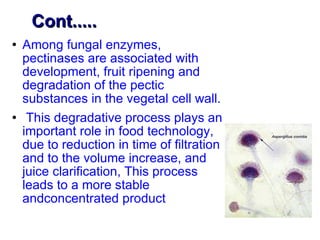
Cont..... Among fungal enzymes, pectinases are associated with development, fruit ripening and degradation of the pectic substances in the vegetal cell wall. This degradative process plays an important role in food technology, due to reduction in time of filtration and to the volume increase, and juice clarification, This process leads to a more stable andconcentrated product
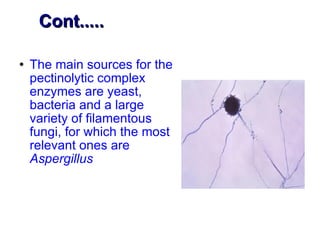
Cont..... The main sources for the pectinolytic complex enzymes are yeast, bacteria and a large variety of filamentous fungi, for which the most relevant ones are  Aspergillus
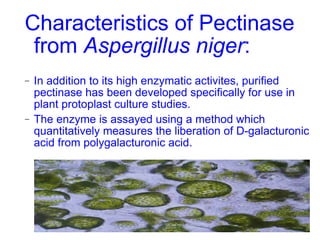
Characteristics of Pectinase from  Aspergillus niger : In addition to its high enzymatic activites, purified pectinase has been developed specifically for use in plant protoplast culture studies.  The enzyme is assayed using a method which quantitatively measures the liberation of D-galacturonic acid from polygalacturonic acid.
CONT... This method is based upon determination of reducing sugars using a neocuprine hydrochloride color reagent assay.  When used with Worthington purified cellulase, purified pectinase has been found to be useful for generating good yields of viable protoplast in several plant systems, e.g., corn, soybean, red beet, sunflower, tomato and citrus.  In general, a concentration range of 0.1% to 0.5% pectinase (with accompanying 0.5% to 1.5% cellulase) used at 24°C to 37°C for periods of 1 to 16 hours will yield good results.
TYPES Different types of pectic enzymes vary in how they degrade  pectin  — a long polysaccharide of sugars that forms a gel. Pectin forms the center of the plant cell wall. Other molecules, like cellulose, are embedded in it. When pectin is degraded by pectinase, the cell walls become weaker. For instance, during fruit ripening, the enzyme polygalacturonase helps certain fruit, such as tomatoes, become soft and edible
polygalacturonase . It is useful because pectin is the jelly-like matrix which helps cement plant cells together and in which other cell wall components, such as cellulose fibrils, are embedded. One of the most studied and widely used commercial pectinases is  polygalacturonase .
FUNCTION The function of Pectinase in brewing is twofold, first it helps breakdown the plant (typically fruit) material and so helps the extraction of flavors from the mash.  Secondly the presence of pectin in finished wine causes a haze or slight cloudiness, Pectinase is used to break this down and so clear the wine. Pectinases are also used for  retting . Addition of chelating agents or pretreatment of the plant material with acid enhance the effect of the enzyme.
COMMERTIAL PRODUCTION Commercially, pectinase is added to livestock feed to help the animals better digest the food. This improves the health of their digestive systems and helps them to better digest  nutrients .  It also allows them to be fed food that has not been processed too much, and costs less. Supplements containing enzymes that degrade plant materials, including pectinase, are sold to help aid human digestion. Such supplements are not regulated by the United States Food and Drug Administration ( FDA ), so their efficacy is unclear.
EXTRACTION They can be extracted from fungi such as  Aspergillus niger .  The fungus produces these enzymes to break down the middle lamella in plants so that it can extract nutrients from the plant tissues and insert fungal  hyphae .  If pectinase is boiled it is denatured (unfolded) making it harder to connect with the pectin at the active site, and produce as much juice.
Optimum environment As they are  enzymes , pectinases have an optimum temperature and  pH  at which they are most active. For example, a commercial pectinase might typically be activated at 45 to 55 °C and work well at a pH of 4.5 to 5.5.
Gene technology Pektinases primarily are obtained through fermentation with fungal cultures ( Aspergillus, Penicillium  and  Trichoderma  types). · Several enzymes from the group of pectinases (for example, polygalacturonase and pektinlyase) are obtained with the aid of genetically modified moulds. Pectatlyase can be obtained with genetically modified bacteria ( Bacillus ), however is utilised only for technical industrial purposes. · A variety of  ·· ··pektinesterases  (enzymes that modify pectin) are produced with the aid of genetically modified moulds  Aspergillus, Penicillium) . These may be found in various pectinase preparations.
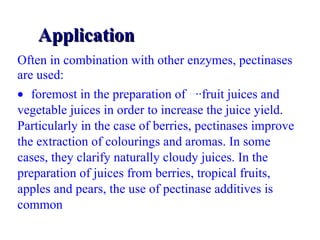
Application Often in combination with other enzymes, pectinases are used:   foremost in the preparation of  ·· ··fruit juices  and vegetable juices in order to increase the juice yield. Particularly in the case of berries, pectinases improve the extraction of colourings and aromas. In some cases, they clarify naturally cloudy juices. In the preparation of juices from berries, tropical fruits, apples and pears, the use of pectinase additives is common
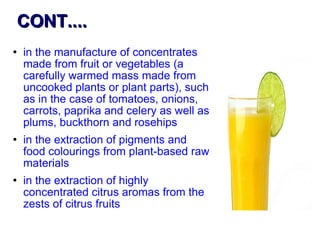
CONT.... in the manufacture of concentrates made from fruit or vegetables (a carefully warmed mass made from uncooked plants or plant parts), such as in the case of tomatoes, onions, carrots, paprika and celery as well as plums, buckthorn and rosehips in the extraction of pigments and food colourings from plant-based raw materials in the extraction of highly concentrated citrus aromas from the zests of citrus fruits
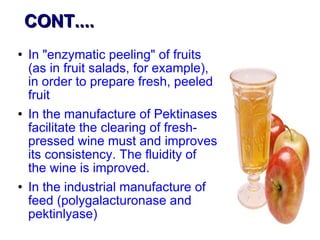
CONT.... In "enzymatic peeling" of fruits (as in fruit salads, for example), in order to prepare fresh, peeled fruit In the manufacture of Pektinases facilitate the clearing of fresh-pressed wine must and improves its consistency. The fluidity of the wine is improved. In the industrial manufacture of feed (polygalacturonase and pektinlyase)

Pectinase

  • 1.
  • 2.
    Pectinase BY SHUMAILA TABASUM DEPTT BIOTECHNOLOGY SINDH AGRI; UNIVERSITY TANDO JAM SINDH
  • 3.
    PECTNASE Pectinase is a general term for enzymes , such as pectolyase , pectozyme and polygalacturonase, commonly referred to in brewing as pectic enzymes. These break down pectin , a polysaccharide substrate that is found in the cell walls of plants . pectinase enzymes are commonly used in processes involving the degradation of plant materials, such as speeding up the extraction of fruit juice from fruit , including apples and sapota . Pectin have also been used in wine production since the 1960s.
  • 4.
    Cont..... Among fungalenzymes, pectinases are associated with development, fruit ripening and degradation of the pectic substances in the vegetal cell wall. This degradative process plays an important role in food technology, due to reduction in time of filtration and to the volume increase, and juice clarification, This process leads to a more stable andconcentrated product
  • 5.
    Cont..... The mainsources for the pectinolytic complex enzymes are yeast, bacteria and a large variety of filamentous fungi, for which the most relevant ones are Aspergillus
  • 6.
    Characteristics of Pectinasefrom Aspergillus niger : In addition to its high enzymatic activites, purified pectinase has been developed specifically for use in plant protoplast culture studies. The enzyme is assayed using a method which quantitatively measures the liberation of D-galacturonic acid from polygalacturonic acid.
  • 7.
    CONT... This methodis based upon determination of reducing sugars using a neocuprine hydrochloride color reagent assay. When used with Worthington purified cellulase, purified pectinase has been found to be useful for generating good yields of viable protoplast in several plant systems, e.g., corn, soybean, red beet, sunflower, tomato and citrus. In general, a concentration range of 0.1% to 0.5% pectinase (with accompanying 0.5% to 1.5% cellulase) used at 24°C to 37°C for periods of 1 to 16 hours will yield good results.
  • 8.
    TYPES Different typesof pectic enzymes vary in how they degrade pectin — a long polysaccharide of sugars that forms a gel. Pectin forms the center of the plant cell wall. Other molecules, like cellulose, are embedded in it. When pectin is degraded by pectinase, the cell walls become weaker. For instance, during fruit ripening, the enzyme polygalacturonase helps certain fruit, such as tomatoes, become soft and edible
  • 9.
    polygalacturonase . Itis useful because pectin is the jelly-like matrix which helps cement plant cells together and in which other cell wall components, such as cellulose fibrils, are embedded. One of the most studied and widely used commercial pectinases is polygalacturonase .
  • 10.
    FUNCTION The functionof Pectinase in brewing is twofold, first it helps breakdown the plant (typically fruit) material and so helps the extraction of flavors from the mash. Secondly the presence of pectin in finished wine causes a haze or slight cloudiness, Pectinase is used to break this down and so clear the wine. Pectinases are also used for retting . Addition of chelating agents or pretreatment of the plant material with acid enhance the effect of the enzyme.
  • 11.
    COMMERTIAL PRODUCTION Commercially,pectinase is added to livestock feed to help the animals better digest the food. This improves the health of their digestive systems and helps them to better digest nutrients . It also allows them to be fed food that has not been processed too much, and costs less. Supplements containing enzymes that degrade plant materials, including pectinase, are sold to help aid human digestion. Such supplements are not regulated by the United States Food and Drug Administration ( FDA ), so their efficacy is unclear.
  • 12.
    EXTRACTION They canbe extracted from fungi such as Aspergillus niger . The fungus produces these enzymes to break down the middle lamella in plants so that it can extract nutrients from the plant tissues and insert fungal hyphae . If pectinase is boiled it is denatured (unfolded) making it harder to connect with the pectin at the active site, and produce as much juice.
  • 13.
    Optimum environment Asthey are enzymes , pectinases have an optimum temperature and pH at which they are most active. For example, a commercial pectinase might typically be activated at 45 to 55 °C and work well at a pH of 4.5 to 5.5.
  • 14.
    Gene technology Pektinasesprimarily are obtained through fermentation with fungal cultures ( Aspergillus, Penicillium and Trichoderma types). · Several enzymes from the group of pectinases (for example, polygalacturonase and pektinlyase) are obtained with the aid of genetically modified moulds. Pectatlyase can be obtained with genetically modified bacteria ( Bacillus ), however is utilised only for technical industrial purposes. · A variety of ·· ··pektinesterases (enzymes that modify pectin) are produced with the aid of genetically modified moulds Aspergillus, Penicillium) . These may be found in various pectinase preparations.
  • 15.
    Application Often incombination with other enzymes, pectinases are used:  foremost in the preparation of ·· ··fruit juices and vegetable juices in order to increase the juice yield. Particularly in the case of berries, pectinases improve the extraction of colourings and aromas. In some cases, they clarify naturally cloudy juices. In the preparation of juices from berries, tropical fruits, apples and pears, the use of pectinase additives is common
  • 16.
    CONT.... in themanufacture of concentrates made from fruit or vegetables (a carefully warmed mass made from uncooked plants or plant parts), such as in the case of tomatoes, onions, carrots, paprika and celery as well as plums, buckthorn and rosehips in the extraction of pigments and food colourings from plant-based raw materials in the extraction of highly concentrated citrus aromas from the zests of citrus fruits
  • 17.
    CONT.... In "enzymaticpeeling" of fruits (as in fruit salads, for example), in order to prepare fresh, peeled fruit In the manufacture of Pektinases facilitate the clearing of fresh-pressed wine must and improves its consistency. The fluidity of the wine is improved. In the industrial manufacture of feed (polygalacturonase and pektinlyase)