ANIMAL MODELS FOR
HUMAN DISEASE
SAKEENAASMI
MAHATMA GANDHI
UNIVERSITY
2
WHAT IS AN ANIMAL MODEL?
•Weggler in 1983 defined an animal model as a living organism with
an inherited, naturally acquired, or induced pathological process that
in one or more respects closely resembles the same phenomenon in
men.
•The institute of laboratory animal resources (ILAR) of the National
Academy of Sciences adopted and modified Weggler’s definition as
follows:
“An animal model is a living organism in which normative
biology or behaviour can be studied, or in which a
spontaneous or induced pathological process can be
investigated, and in which the phenomenon in one or more
respects resembles the same phenomenon in humans or
other species of animal.”
3
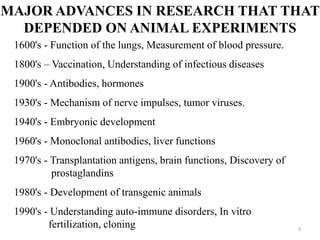
MAJOR ADVANCES IN RESEARCH THAT THAT
DEPENDED ON ANIMAL EXPERIMENTS
1600's - Function of the lungs, Measurement of blood pressure.
1800's – Vaccination, Understanding of infectious diseases
1900's - Antibodies, hormones
1930's - Mechanism of nerve impulses, tumor viruses.
1940's - Embryonic development
1960's - Monoclonal antibodies, liver functions
1970's - Transplantation antigens, brain functions, Discovery of
prostaglandins
1980's - Development of transgenic animals
1990's - Understanding auto-immune disorders, In vitro
fertilization, cloning
4
5
CRITERIA FOR SELECTION OF
ANIMAL MODELS
1) appropriateness as an analog
2) background knowledge of biological properties
3) cost and availability
4) ease of and adaptability to experimental manipulation
5) ecological consequences
6) ethical implications
6
7
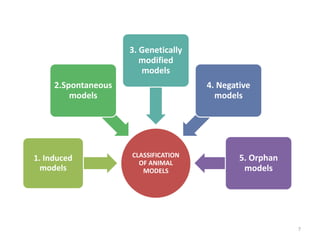
CLASSIFICATION
OF ANIMAL
MODELS
1. Induced
models
2.Spontaneous
models
3. Genetically
modified
models
4. Negative
models
5. Orphan
models
8
ANIMALS USED IN RESEARCH
RODENT ANIMAL MODELS:
Rat
Mice
Guinea pigs
Hamster
NON – RODENT ANIMAL
MODELS:
Rabbit
Monkey
Cat
Dog
TRANSGENIC ANIMALS
9
• The rat is much larger in size and has greater body weight as
compared to the mouse.
• The mouse has a pointed face when compared to the rat.
• The rat has a thick and heavy tail. On the other hand, a mouse
has a very thin tail.
• The rat has a higher pair of chromosomes, ie 22 pairs. On the
contrary, the mouse has only a 20 pairs.
• The rats have a longer gestation period compared with the
mice.
DIFFERENCE BETWEEN RAT AND MICE
10
CREATING ANIMAL MODELS OF DISEASE
USING TRANSGENIC TECHNOLOGYAND
GENE TARGETING
• Animal models of human disease are crucially important to medical
research. They allow detailed examination of the physiological basis
of disease.
• They also offer a frontline testing system for studying the efficacy of
novel treatments before conducting clinical trials on human subjects.
• Although many individual human disorders do not have a good
animal model, animal models exist for some representatives of all
the major human disease classes: genetically determined diseases,
disease due to infectious agents, sporadic cancers and autoimmune
disorders.
• Some animal models of human disease originated spontaneously;
others have been generated artificially by a variety of different
routes.
11
12
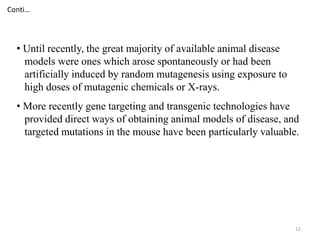
• Until recently, the great majority of available animal disease
models were ones which arose spontaneously or had been
artificially induced by random mutagenesis using exposure to
high doses of mutagenic chemicals or X-rays.
• More recently gene targeting and transgenic technologies have
provided direct ways of obtaining animal models of disease, and
targeted mutations in the mouse have been particularly valuable.
Conti…
13
SPONTANEOUS ANIMAL DISEASE MODELS
• Mutant human phenotypes, especially those associated with obvious
disease symptoms, are subject to intense scrutiny.
• If they present with a previously undescribed phenotype their case
may well be referred to experts who often will document the
phenotype in the medical literature.
• In contrast, many animal disease phenotypes will go unrecorded.
Only a small percentage of the animal population is in captivity, and
recording of spontaneous mutant phenotypes is largely dependent on
examination of animal colonies bred for research purposes and, to a
lesser extent, live stock and pet populations.
• Only mutants with obvious external abnormalities are likely to be
noticed.
14
• Despite the difficulty in identifying spontaneous animal mutants, a
number of animal phenotypes have been described as likely
models of human diseases.
• In some cases, the animal mutant phenotype closely parallels the
corresponding clinical phenotype, but in others there is
considerable divergence because of species differences in
biochemical and developmental pathways.
Conti…
15
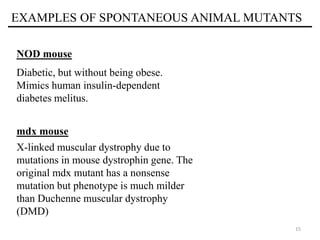
EXAMPLES OF SPONTANEOUS ANIMAL MUTANTS
NOD mouse
Diabetic, but without being obese.
Mimics human insulin-dependent
diabetes melitus.
mdx mouse
X-linked muscular dystrophy due to
mutations in mouse dystrophin gene. The
original mdx mutant has a nonsense
mutation but phenotype is much milder
than Duchenne muscular dystrophy
(DMD)
16
Hemophiliac dog
Missense mutation in canine factor IX gene
causes complete loss of function. Human
homolog is hemophilia B
Watanabe heritable hyperlipidemic (WHHL) rabbit
Hyperlipidemic as a result of a deletion
of four codons of the low density
lipoprotein receptor gene (LDLR);
human homolog is familial
hypercholesterolemia
Atherosclerotic pigs
Marked hypercholesterolemia. Normal
LDL receptor activity, but variant
apolipoproteins, including apolipoprotein B
17
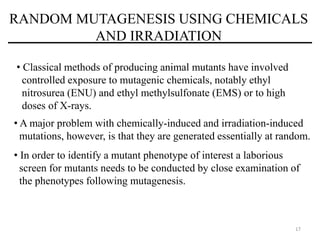
RANDOM MUTAGENESIS USING CHEMICALS
AND IRRADIATION
• Classical methods of producing animal mutants have involved
controlled exposure to mutagenic chemicals, notably ethyl
nitrosurea (ENU) and ethyl methylsulfonate (EMS) or to high
doses of X-rays.
• A major problem with chemically-induced and irradiation-induced
mutations, however, is that they are generated essentially at random.
• In order to identify a mutant phenotype of interest a laborious
screen for mutants needs to be conducted by close examination of
the phenotypes following mutagenesis.
18
MICE HAVE BEEN WIDELY USED AS ANIMAL
MODELS OF HUMAN DISEASE LARGELY BECAUSE
SPECIFIC MUTATIONS CAN BE
CREATED AT A PREDETERMINED LOCUS
• Spontaneous and artificially produced disease phenotypes have
been described in a wide range of animal species with differing
potentials for modeling human disease.
• In some cases, the species may be too evolutionarily remote from
humans to provide useful disease models.
• The great advantage of transgenic/gene targeted mouse models of
disease is that specific disease models can be constructed to order.
• Provided that the relevant gene clones are available, including
mutant genes in some cases, mice can be generated with a desired
alteration in a chosen target gene.
19
• All the major classes of disease, inherited disorders, cancers,
infectious diseases and autoimmune disorders can be modeled in
this way.
• In most cases, the transgenic/gene targeting approaches have been
used to model single gene disorders but, increasingly, attempts are
being made to produce mouse models of complex genetic diseases,
such as Alzheimer's disease, atherosclerosis and essential
hypertension effects.
Conti…
20
SINGLE GENE DISORDERS RESULTING FROM
LOSS OF FUNCTION AND GAIN OF FUNCTION
MUTATIONS CAN BE CONVENIENTLY
MODELED BY GENE TARGETING AND BY
INTEGRATION OF MUTANT GENES
RESPECTIVELY
21
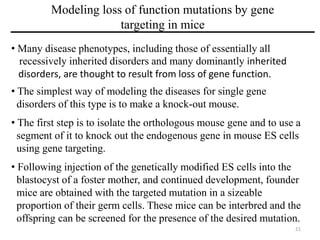
Modeling loss of function mutations by gene
targeting in mice
• Many disease phenotypes, including those of essentially all
recessively inherited disorders and many dominantly inherited
disorders, are thought to result from loss of gene function.
• The simplest way of modeling the diseases for single gene
disorders of this type is to make a knock-out mouse.
• The first step is to isolate the orthologous mouse gene and to use a
segment of it to knock out the endogenous gene in mouse ES cells
using gene targeting.
• Following injection of the genetically modified ES cells into the
blastocyst of a foster mother, and continued development, founder
mice are obtained with the targeted mutation in a sizeable
proportion of their germ cells. These mice can be interbred and the
offspring can be screened for the presence of the desired mutation.
22
Modeling gain of function mutations by insertion of a
mutant gene
• This general experimental design has been used frequently in
conjunction with the pronuclear microinjection technique of gene
transfer.
• The disease to be modeled must be one where the presence of an
introduced DNA is itself sufficient to induce pathogenesis, and can
include inherited gain of function mutations, oncogenes, etc.
• To model such disorders, it is necessary to clone a mutant gene or,
if necessary, design one by in vitro mutagenesis.
• The mutant gene is then simply inserted as a transgene, e.g by
microinjection into fertilized oocytes. Because there is no
requirement for the introduced mutant gene to integrate at a
specific location, human mutant geneş will suffice although, in
some cases, mouse mutant genes have been used.
23
Modeling human cancers
• Gain of function :
Disease due to inappropriate inactivation of a proto-
oncogene can be modeled by constructing a transgenic
mouse: the appropriate oncogene is introduced into the
mouse genome by simple transgene integration.
• Loss of function :
Disease due to inactivation of tumor suppressor genes can be
modeled by constructing knock-out mice through gene
targeting.
24
Modeling chromosomal disorders
• Existing mouse models for human chromosomal disorders are
sparse. In some cases this is due to insufficent conservation of
synteny between the two species.
• Taking the example of Down syndrome (trisomy 21), human
chromosome 21 shares a large region of genetic homology with
mouse chromosome 16, but trisomy 16 (Ts16) mice are not good
models because they die in utero.
• The Ts16 mouse could never be expected to be a good model of
human trisomy 21: it is not trisomic for all human chromosome 21
genes and is trisomic for some genes which have human orthologs
on chromosomes other than chromosome 21.
25
• In order to produce a better Down syndrome model in the mouse,
attention has focused on the Down syndrome critical region at
21q21.3-q22.2.
• Within this region, the human mini brain gene at 21q22.2 may be
an important contributory locus to the associated learning defects:
transgenic mice in which a 180 kb YAC containing the 100 kb
human mini brain gene but apparently no other gene, develop
learning defects (Smith et al., 1997).
Conti…
26
MOUSE MODELS FOR HUMAN DISEASE MAY BE
DIFFICULT TO CONSTRUCT BECAUSE OF A
VARIETY OF HUMAN/MOUSE DIFFERENCES
• It is not uncommon for spontaneous or artificially generated mouse
models of disease to show phenotypes that are considerably
different from the homologous human disorders.
• For example, gene targeting to inactivate several mouse tumor
suppressor genes has often produced disappointing mouse models,
as in the case of TP53 and RB1 (retinoblastoma) knock-outs.
• There may be problems in achieving the desired type of mutation.
For example, in gene targeting intended null mutations may be
offset in some cases by exon skipping or some other form of ‘leaky’
transcription, or the expression of a transgene may be affected by
various parameters causing an unexpected phenotype.
27
• Setting aside these possibilities, there are several areas where
differences between mice and humans could be expected to result
in divergent disease phenotypes for mutations in orthologous
genes :
BIOCHEMICAL PATHWAYS
DEVELOPMENTAL PATHWAYS
ABSOLUTE TIME
Conti…
28
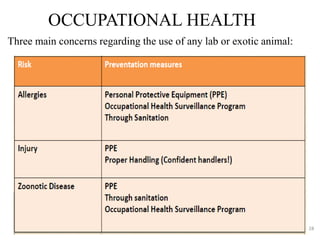
OCCUPATIONAL HEALTH
Three main concerns regarding the use of any lab or exotic animal:
29
APPROACHES TO ANIMAL TESTING
• Russel and Burch in 1959 proposed that “if animals were to be used
in experiments, every effort should be made to replace them with
non-sentient alternatives”
• They developed the 3R strategy which includes :
 Refinement - refine experimental methods to decrease unnecessary
pain and trauma to animals
 Reduction - reduce the number of animals used in these
experiments
 Replacement - replace the animal experiments eg- computer
simulation models, In-vitro methods, cell culture techniques
30
• They are most widely used in clinical research as
they are small, inexpensive and easy to handle .
• Mice are used in a vast range of experiments,
many of which are classified as fundamental
research, investigating the physiology of
mammals.
• They have similar reproductive and nervous
systems to humans, and suffer from same diseases
such as cancer, diabetes and even anxiety.
• Their short life span and fast reproductive rate,
makes it possible to investigate biological
processes at all stages of the life cycle.
• Swiss albino mice are the most commonly used.
MICE(Mus musculus)
31
RODENT ANIMAL MODELS :
RAT(Rattus norvegicus)
Rats have been useful for research in the following fields :
• Study of analgesics and anticonvulsants.
• Study of oestrus cycle, mating behavior and lactation.
• Gastric acid secretion
• Hepatotoxicity studies
• Study on mast cells
• Bioassay of various hormones, such as insulin, oxytocin,
vasopressin .
• Rats are better at removing toxins from their bodies than
humans, so it may be possible to refine the use of rats in
toxicology studies.
• Rat brain tissue is extensively employed in radio-receptor
ligand studies.
32
• Guinea pigs have biological similarities to humans, which make
them useful in many fields of research.
• Vitamin C was discovered through research on guinea pigs.
• Their serum contains enzyme Aspariginase which shows anti-
leukemic action.
They were also crucial to the development of :
• Vaccines for diphtheria, TB etc
• Evaluation of local anesthetics, antibiotics, histamine and
antihistamines, anticoagulants, bronchodilators, bioassay of
digitalis.
GUINEA PIG(Cavia porcellus)
33
NON – RODENT ANIMAL MODELS :
RABBIT(Oryctolagus cuniculus)
• Historically, Louis Pasteur used rabbits to
develop the rabies vaccine.
• Studies in rabbits are key to many aspects of
medical research, including cancer, glaucoma,
eye and ear infections, skin conditions, diabetes
and emphysema.
• The rabbit has been important in the study of
cardiovascular diseases , particularly
hypertension and atherosclerosis.
• Enzyme atropine esterase is present in rabbit
liver and plasma so it can tolerate large doses
of belladona (atropine).
34
RABBITS HAVE BEEN USED FOR RESEARCH IN
FOLLOWING FIELDS :
• Bioassay of anti-diabetic drugs
• Screening of agents affecting capillary permeability
• Drugs used in glaucoma
• Studies related to anti-fertility agents
• It has simple cardiac tissue free of connective tissue and hence is
the animal of choice for cardiac studies.
• The rabbit has provided an excellent model system to simulate the
response of human tissue to the radiation produced by surgical
lasers.
• Laser advancements made possible by research on rabbits include
eye surgery and the dissolving of plaque build-up on the walls of
arteries.
35
TESTING OF COSMETICS USING DRAIZE TEST :
• Rabbits - particularly albino rabbits - are commonly used in testing
for cosmetics and other chemicals, where they are used to perform
the Draize test.
• This test involves the substance being placed on the rabbit's eyes or
skin, which are then observed for redness, irritation or any other
damage.
36
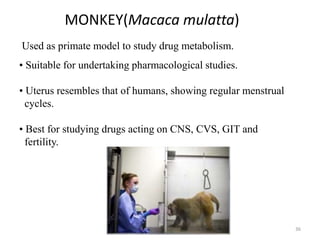
Used as primate model to study drug metabolism.
• Suitable for undertaking pharmacological studies.
• Uterus resembles that of humans, showing regular menstrual
cycles.
• Best for studying drugs acting on CNS, CVS, GIT and
fertility.
MONKEY(Macaca mulatta)
37
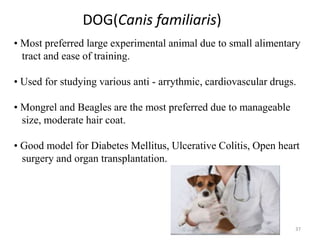
• Most preferred large experimental animal due to small alimentary
tract and ease of training.
• Used for studying various anti - arrythmic, cardiovascular drugs.
• Mongrel and Beagles are the most preferred due to manageable
size, moderate hair coat.
• Good model for Diabetes Mellitus, Ulcerative Colitis, Open heart
surgery and organ transplantation.
DOG(Canis familiaris)
38
• Zebra fish mutants are currently used to model many human
diseases, including Alzheimer’s disease, congenital heart disease,
polycystic kidney disease , cancers and development of the nervous
system.
• Its aim is to use the zebra fish to produce new disease models, find
new drug targets and learn more about the gene- regulation
pathways involved in human development and disease. .
• Creating zebra fish which develop leukemia will enable
researchers to test the effect of various anti-cancer agents.
CREATING TRANSGENIC MODELS
39
THANK
YOU

Animal models

  • 1.
    ANIMAL MODELS FOR HUMANDISEASE SAKEENAASMI MAHATMA GANDHI UNIVERSITY
  • 2.
    2 WHAT IS ANANIMAL MODEL? •Weggler in 1983 defined an animal model as a living organism with an inherited, naturally acquired, or induced pathological process that in one or more respects closely resembles the same phenomenon in men. •The institute of laboratory animal resources (ILAR) of the National Academy of Sciences adopted and modified Weggler’s definition as follows: “An animal model is a living organism in which normative biology or behaviour can be studied, or in which a spontaneous or induced pathological process can be investigated, and in which the phenomenon in one or more respects resembles the same phenomenon in humans or other species of animal.”
  • 3.
    3 MAJOR ADVANCES INRESEARCH THAT THAT DEPENDED ON ANIMAL EXPERIMENTS 1600's - Function of the lungs, Measurement of blood pressure. 1800's – Vaccination, Understanding of infectious diseases 1900's - Antibodies, hormones 1930's - Mechanism of nerve impulses, tumor viruses. 1940's - Embryonic development 1960's - Monoclonal antibodies, liver functions 1970's - Transplantation antigens, brain functions, Discovery of prostaglandins 1980's - Development of transgenic animals 1990's - Understanding auto-immune disorders, In vitro fertilization, cloning
  • 4.
  • 5.
    5 CRITERIA FOR SELECTIONOF ANIMAL MODELS 1) appropriateness as an analog 2) background knowledge of biological properties 3) cost and availability 4) ease of and adaptability to experimental manipulation 5) ecological consequences 6) ethical implications
  • 6.
  • 7.
    7 CLASSIFICATION OF ANIMAL MODELS 1. Induced models 2.Spontaneous models 3.Genetically modified models 4. Negative models 5. Orphan models
  • 8.
    8 ANIMALS USED INRESEARCH RODENT ANIMAL MODELS: Rat Mice Guinea pigs Hamster NON – RODENT ANIMAL MODELS: Rabbit Monkey Cat Dog TRANSGENIC ANIMALS
  • 9.
    9 • The ratis much larger in size and has greater body weight as compared to the mouse. • The mouse has a pointed face when compared to the rat. • The rat has a thick and heavy tail. On the other hand, a mouse has a very thin tail. • The rat has a higher pair of chromosomes, ie 22 pairs. On the contrary, the mouse has only a 20 pairs. • The rats have a longer gestation period compared with the mice. DIFFERENCE BETWEEN RAT AND MICE
  • 10.
    10 CREATING ANIMAL MODELSOF DISEASE USING TRANSGENIC TECHNOLOGYAND GENE TARGETING • Animal models of human disease are crucially important to medical research. They allow detailed examination of the physiological basis of disease. • They also offer a frontline testing system for studying the efficacy of novel treatments before conducting clinical trials on human subjects. • Although many individual human disorders do not have a good animal model, animal models exist for some representatives of all the major human disease classes: genetically determined diseases, disease due to infectious agents, sporadic cancers and autoimmune disorders. • Some animal models of human disease originated spontaneously; others have been generated artificially by a variety of different routes.
  • 11.
  • 12.
    12 • Until recently,the great majority of available animal disease models were ones which arose spontaneously or had been artificially induced by random mutagenesis using exposure to high doses of mutagenic chemicals or X-rays. • More recently gene targeting and transgenic technologies have provided direct ways of obtaining animal models of disease, and targeted mutations in the mouse have been particularly valuable. Conti…
  • 13.
    13 SPONTANEOUS ANIMAL DISEASEMODELS • Mutant human phenotypes, especially those associated with obvious disease symptoms, are subject to intense scrutiny. • If they present with a previously undescribed phenotype their case may well be referred to experts who often will document the phenotype in the medical literature. • In contrast, many animal disease phenotypes will go unrecorded. Only a small percentage of the animal population is in captivity, and recording of spontaneous mutant phenotypes is largely dependent on examination of animal colonies bred for research purposes and, to a lesser extent, live stock and pet populations. • Only mutants with obvious external abnormalities are likely to be noticed.
  • 14.
    14 • Despite thedifficulty in identifying spontaneous animal mutants, a number of animal phenotypes have been described as likely models of human diseases. • In some cases, the animal mutant phenotype closely parallels the corresponding clinical phenotype, but in others there is considerable divergence because of species differences in biochemical and developmental pathways. Conti…
  • 15.
    15 EXAMPLES OF SPONTANEOUSANIMAL MUTANTS NOD mouse Diabetic, but without being obese. Mimics human insulin-dependent diabetes melitus. mdx mouse X-linked muscular dystrophy due to mutations in mouse dystrophin gene. The original mdx mutant has a nonsense mutation but phenotype is much milder than Duchenne muscular dystrophy (DMD)
  • 16.
    16 Hemophiliac dog Missense mutationin canine factor IX gene causes complete loss of function. Human homolog is hemophilia B Watanabe heritable hyperlipidemic (WHHL) rabbit Hyperlipidemic as a result of a deletion of four codons of the low density lipoprotein receptor gene (LDLR); human homolog is familial hypercholesterolemia Atherosclerotic pigs Marked hypercholesterolemia. Normal LDL receptor activity, but variant apolipoproteins, including apolipoprotein B
  • 17.
    17 RANDOM MUTAGENESIS USINGCHEMICALS AND IRRADIATION • Classical methods of producing animal mutants have involved controlled exposure to mutagenic chemicals, notably ethyl nitrosurea (ENU) and ethyl methylsulfonate (EMS) or to high doses of X-rays. • A major problem with chemically-induced and irradiation-induced mutations, however, is that they are generated essentially at random. • In order to identify a mutant phenotype of interest a laborious screen for mutants needs to be conducted by close examination of the phenotypes following mutagenesis.
  • 18.
    18 MICE HAVE BEENWIDELY USED AS ANIMAL MODELS OF HUMAN DISEASE LARGELY BECAUSE SPECIFIC MUTATIONS CAN BE CREATED AT A PREDETERMINED LOCUS • Spontaneous and artificially produced disease phenotypes have been described in a wide range of animal species with differing potentials for modeling human disease. • In some cases, the species may be too evolutionarily remote from humans to provide useful disease models. • The great advantage of transgenic/gene targeted mouse models of disease is that specific disease models can be constructed to order. • Provided that the relevant gene clones are available, including mutant genes in some cases, mice can be generated with a desired alteration in a chosen target gene.
  • 19.
    19 • All themajor classes of disease, inherited disorders, cancers, infectious diseases and autoimmune disorders can be modeled in this way. • In most cases, the transgenic/gene targeting approaches have been used to model single gene disorders but, increasingly, attempts are being made to produce mouse models of complex genetic diseases, such as Alzheimer's disease, atherosclerosis and essential hypertension effects. Conti…
  • 20.
    20 SINGLE GENE DISORDERSRESULTING FROM LOSS OF FUNCTION AND GAIN OF FUNCTION MUTATIONS CAN BE CONVENIENTLY MODELED BY GENE TARGETING AND BY INTEGRATION OF MUTANT GENES RESPECTIVELY
  • 21.
    21 Modeling loss offunction mutations by gene targeting in mice • Many disease phenotypes, including those of essentially all recessively inherited disorders and many dominantly inherited disorders, are thought to result from loss of gene function. • The simplest way of modeling the diseases for single gene disorders of this type is to make a knock-out mouse. • The first step is to isolate the orthologous mouse gene and to use a segment of it to knock out the endogenous gene in mouse ES cells using gene targeting. • Following injection of the genetically modified ES cells into the blastocyst of a foster mother, and continued development, founder mice are obtained with the targeted mutation in a sizeable proportion of their germ cells. These mice can be interbred and the offspring can be screened for the presence of the desired mutation.
  • 22.
    22 Modeling gain offunction mutations by insertion of a mutant gene • This general experimental design has been used frequently in conjunction with the pronuclear microinjection technique of gene transfer. • The disease to be modeled must be one where the presence of an introduced DNA is itself sufficient to induce pathogenesis, and can include inherited gain of function mutations, oncogenes, etc. • To model such disorders, it is necessary to clone a mutant gene or, if necessary, design one by in vitro mutagenesis. • The mutant gene is then simply inserted as a transgene, e.g by microinjection into fertilized oocytes. Because there is no requirement for the introduced mutant gene to integrate at a specific location, human mutant geneş will suffice although, in some cases, mouse mutant genes have been used.
  • 23.
    23 Modeling human cancers •Gain of function : Disease due to inappropriate inactivation of a proto- oncogene can be modeled by constructing a transgenic mouse: the appropriate oncogene is introduced into the mouse genome by simple transgene integration. • Loss of function : Disease due to inactivation of tumor suppressor genes can be modeled by constructing knock-out mice through gene targeting.
  • 24.
    24 Modeling chromosomal disorders •Existing mouse models for human chromosomal disorders are sparse. In some cases this is due to insufficent conservation of synteny between the two species. • Taking the example of Down syndrome (trisomy 21), human chromosome 21 shares a large region of genetic homology with mouse chromosome 16, but trisomy 16 (Ts16) mice are not good models because they die in utero. • The Ts16 mouse could never be expected to be a good model of human trisomy 21: it is not trisomic for all human chromosome 21 genes and is trisomic for some genes which have human orthologs on chromosomes other than chromosome 21.
  • 25.
    25 • In orderto produce a better Down syndrome model in the mouse, attention has focused on the Down syndrome critical region at 21q21.3-q22.2. • Within this region, the human mini brain gene at 21q22.2 may be an important contributory locus to the associated learning defects: transgenic mice in which a 180 kb YAC containing the 100 kb human mini brain gene but apparently no other gene, develop learning defects (Smith et al., 1997). Conti…
  • 26.
    26 MOUSE MODELS FORHUMAN DISEASE MAY BE DIFFICULT TO CONSTRUCT BECAUSE OF A VARIETY OF HUMAN/MOUSE DIFFERENCES • It is not uncommon for spontaneous or artificially generated mouse models of disease to show phenotypes that are considerably different from the homologous human disorders. • For example, gene targeting to inactivate several mouse tumor suppressor genes has often produced disappointing mouse models, as in the case of TP53 and RB1 (retinoblastoma) knock-outs. • There may be problems in achieving the desired type of mutation. For example, in gene targeting intended null mutations may be offset in some cases by exon skipping or some other form of ‘leaky’ transcription, or the expression of a transgene may be affected by various parameters causing an unexpected phenotype.
  • 27.
    27 • Setting asidethese possibilities, there are several areas where differences between mice and humans could be expected to result in divergent disease phenotypes for mutations in orthologous genes : BIOCHEMICAL PATHWAYS DEVELOPMENTAL PATHWAYS ABSOLUTE TIME Conti…
  • 28.
    28 OCCUPATIONAL HEALTH Three mainconcerns regarding the use of any lab or exotic animal:
  • 29.
    29 APPROACHES TO ANIMALTESTING • Russel and Burch in 1959 proposed that “if animals were to be used in experiments, every effort should be made to replace them with non-sentient alternatives” • They developed the 3R strategy which includes :  Refinement - refine experimental methods to decrease unnecessary pain and trauma to animals  Reduction - reduce the number of animals used in these experiments  Replacement - replace the animal experiments eg- computer simulation models, In-vitro methods, cell culture techniques
  • 30.
    30 • They aremost widely used in clinical research as they are small, inexpensive and easy to handle . • Mice are used in a vast range of experiments, many of which are classified as fundamental research, investigating the physiology of mammals. • They have similar reproductive and nervous systems to humans, and suffer from same diseases such as cancer, diabetes and even anxiety. • Their short life span and fast reproductive rate, makes it possible to investigate biological processes at all stages of the life cycle. • Swiss albino mice are the most commonly used. MICE(Mus musculus)
  • 31.
    31 RODENT ANIMAL MODELS: RAT(Rattus norvegicus) Rats have been useful for research in the following fields : • Study of analgesics and anticonvulsants. • Study of oestrus cycle, mating behavior and lactation. • Gastric acid secretion • Hepatotoxicity studies • Study on mast cells • Bioassay of various hormones, such as insulin, oxytocin, vasopressin . • Rats are better at removing toxins from their bodies than humans, so it may be possible to refine the use of rats in toxicology studies. • Rat brain tissue is extensively employed in radio-receptor ligand studies.
  • 32.
    32 • Guinea pigshave biological similarities to humans, which make them useful in many fields of research. • Vitamin C was discovered through research on guinea pigs. • Their serum contains enzyme Aspariginase which shows anti- leukemic action. They were also crucial to the development of : • Vaccines for diphtheria, TB etc • Evaluation of local anesthetics, antibiotics, histamine and antihistamines, anticoagulants, bronchodilators, bioassay of digitalis. GUINEA PIG(Cavia porcellus)
  • 33.
    33 NON – RODENTANIMAL MODELS : RABBIT(Oryctolagus cuniculus) • Historically, Louis Pasteur used rabbits to develop the rabies vaccine. • Studies in rabbits are key to many aspects of medical research, including cancer, glaucoma, eye and ear infections, skin conditions, diabetes and emphysema. • The rabbit has been important in the study of cardiovascular diseases , particularly hypertension and atherosclerosis. • Enzyme atropine esterase is present in rabbit liver and plasma so it can tolerate large doses of belladona (atropine).
  • 34.
    34 RABBITS HAVE BEENUSED FOR RESEARCH IN FOLLOWING FIELDS : • Bioassay of anti-diabetic drugs • Screening of agents affecting capillary permeability • Drugs used in glaucoma • Studies related to anti-fertility agents • It has simple cardiac tissue free of connective tissue and hence is the animal of choice for cardiac studies. • The rabbit has provided an excellent model system to simulate the response of human tissue to the radiation produced by surgical lasers. • Laser advancements made possible by research on rabbits include eye surgery and the dissolving of plaque build-up on the walls of arteries.
  • 35.
    35 TESTING OF COSMETICSUSING DRAIZE TEST : • Rabbits - particularly albino rabbits - are commonly used in testing for cosmetics and other chemicals, where they are used to perform the Draize test. • This test involves the substance being placed on the rabbit's eyes or skin, which are then observed for redness, irritation or any other damage.
  • 36.
    36 Used as primatemodel to study drug metabolism. • Suitable for undertaking pharmacological studies. • Uterus resembles that of humans, showing regular menstrual cycles. • Best for studying drugs acting on CNS, CVS, GIT and fertility. MONKEY(Macaca mulatta)
  • 37.
    37 • Most preferredlarge experimental animal due to small alimentary tract and ease of training. • Used for studying various anti - arrythmic, cardiovascular drugs. • Mongrel and Beagles are the most preferred due to manageable size, moderate hair coat. • Good model for Diabetes Mellitus, Ulcerative Colitis, Open heart surgery and organ transplantation. DOG(Canis familiaris)
  • 38.
    38 • Zebra fishmutants are currently used to model many human diseases, including Alzheimer’s disease, congenital heart disease, polycystic kidney disease , cancers and development of the nervous system. • Its aim is to use the zebra fish to produce new disease models, find new drug targets and learn more about the gene- regulation pathways involved in human development and disease. . • Creating zebra fish which develop leukemia will enable researchers to test the effect of various anti-cancer agents. CREATING TRANSGENIC MODELS
  • 39.