Y5E02 BIOPROCESS
TECHNOLOGY – Unit IV –
Acetic acid Production
Dr. S. SIVASANKARA NARAYANI
ASSISTANT PROFESSOR
DEPARTMENT OF MICROBIOLOGY
AYYA NADAR JANAKI AMMAL COLLEGE
SIVAKASI
UniT -IV
• Microbial production technology: antibiotics (penicillin) - organic acids (citric acid and acetic acid) - vitamins (b12 and
riboflavin) - *enzymes (amylase) - alcoholic beverages (beer and wine). Single cell protein.
03-09-2020Dr.SS
Acetic acid
• Acetic Acid is systematically named as ethanoic acid
• It is a colorless liquid organic compound.
• It has a pungent/ vinegar-like odor
• Vinegar is product of Acetic acid
• It has melting point 16 to 17°C; 61 to 62°F
03-09-2020Dr.SS
History
• Acetic acid production is as old as wine making(10,000 years).
• In 3rd centaury Greek philosopher described how vinegar acted on metals to produce pigments useful in art.
• Ancient Romans boiled sour wine in lead pots to produce highly sweet syrup called sypa.
• In 8th centaury Persian chemist Jabir Ibn Hayyan concentrated Acetic acid from vinegar through distillation
processes.
• In 1847 German chemist Hermann Kolbe synthesized acetic acid from inorganic materials for first time.
• By 1910 most of the acetic acid was obtained from the from distillation of wood.
• At this time Germany is producing 10,000 tons of acetic acid.
• About 30% of which is used for the manufacturing of indigo dyes.
03-09-2020Dr.SS
03-09-2020Dr.SS
Acetic acid bacteria
• Acetic acid bacteria is a gram-negative bacteria which oxidize sugar or ethanol
and produce acetic acid during fermentation.
• Acetic acid bacteria are rod-shaped & obligate aerobes.
• Pasteur in 1864 claimed that the transformation of wine into vinegar was due to
the veil of Mycoderma aceti on it surface pungency of acetic acid.
03-09-2020Dr.SS
Bacteria
• Acetic acid bacteria are commonly used for the production of acetic acid.
• The three important genera's are..
• 1 -Genus acetobacterium:
• The commonly used species are. Acetobacterium aceti Acetobacterium xylinum
• 2- Genus clostridium: the commonly used species is Clostridium
thermoaceticum…which is an anaerobic thermophile.
• 3-Acetic acid bacteria: Acetobacter and Gulocanobacter are commonly used,
03-09-2020Dr.SS
Raw materials
• Biomass Feedstock (beach wood, Silicon tube, sieving, wood chips)
• Ethanol is used as substrate.
• Microbes Acetic Acid Bacteria (Acetobacter aceti ) used as bio reactor
• Following substrates are commonly used.
• Ethanol
• Wine and whey
• Molasses
• Fermented grains
• malt and rice.
03-09-2020Dr.SS
Production
• Acetic acid is produced in following four steps.
• Conversion of starch to sugar by using amylases enzymes.
• Anaerobic conversion of sugars to ethanol by yeast fermentation.
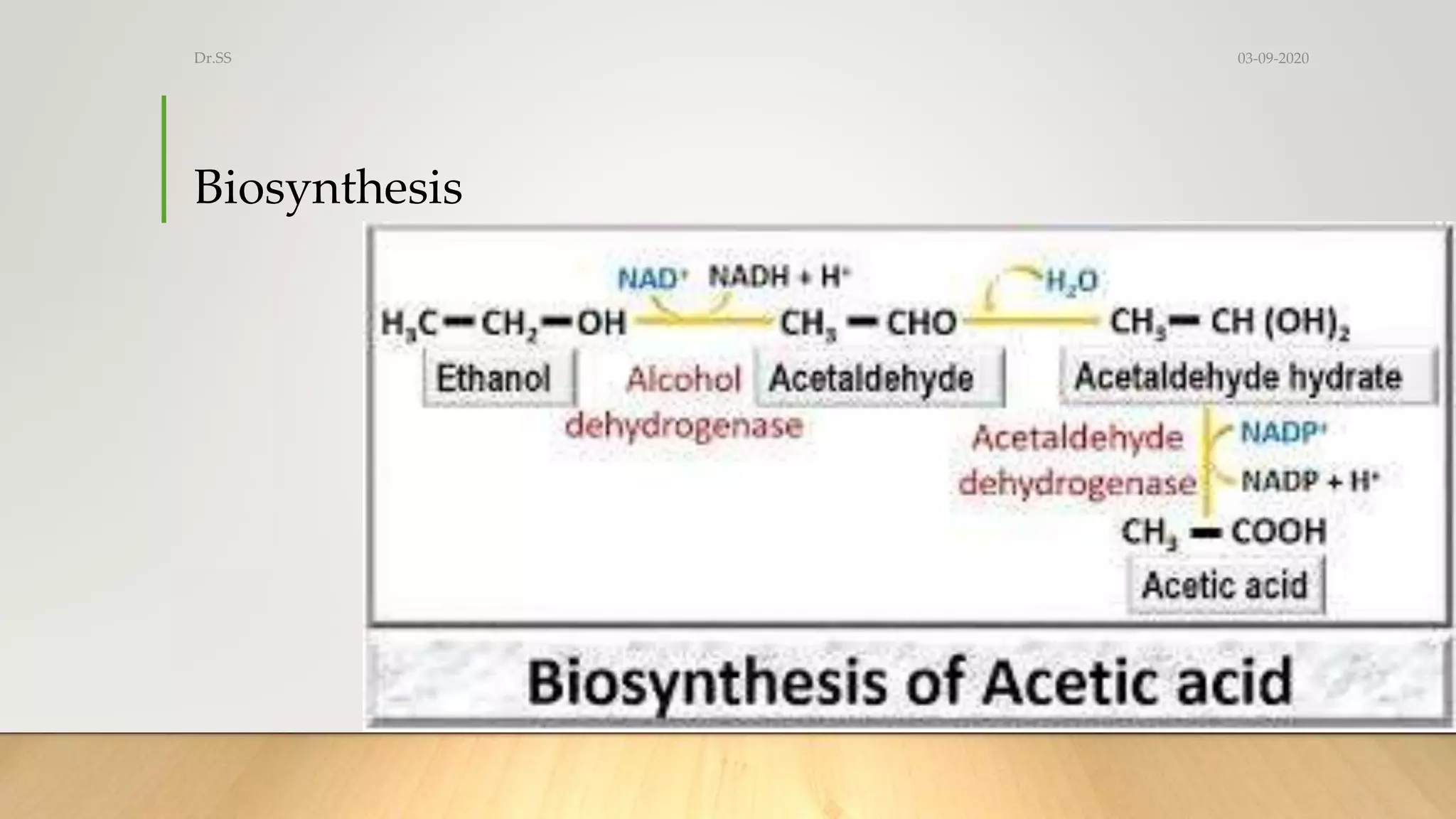
• Conversion of ethanol to hydrated acetaldehyde.
• Finally by dehydrogenation acetic acid is produced by using aldehyde
dehydrogenase enzyme
03-09-2020Dr.SS
Biosynthesis
03-09-2020Dr.SS
Types
Acetic acid is produced industrially by following three methods..
• i. Orleans
• ii. Surface fermentation(trickling generation method).
• iii. Submerged fermentation methods.
03-09-2020Dr.SS
Orleans
• Old and traditional method.
• Slow but continuous processes.
• High grade vinegar is used as starter culture.
• Fermentation is done on large containers.
• Filled to two-third of its capacity.
• Wooden containers are laid down on their sides and holes are drilled at top and end
sides of barrel.
• Then ethanol is poured in to container using long necked funnels from top.
03-09-2020Dr.SS
Cont…
• Then add starter high grade vinegar.
• Ethanol convert in to acetic acid within five weeks.(35 days).
• Netting or screens are placed over holes to prevent insects getting entry in to barrels,
• The barrel's are allowed to sit for several months.
• The temperature is kept at 21-29 degree centigrade.
• Samples are taken periodically by inserting spigot in to side holes.
• When alcohol is converted to acetic acid, it drown off through spigot.
• About 15% liquid is left to blend with next batch.
03-09-2020Dr.SS
03-09-2020Dr.SS
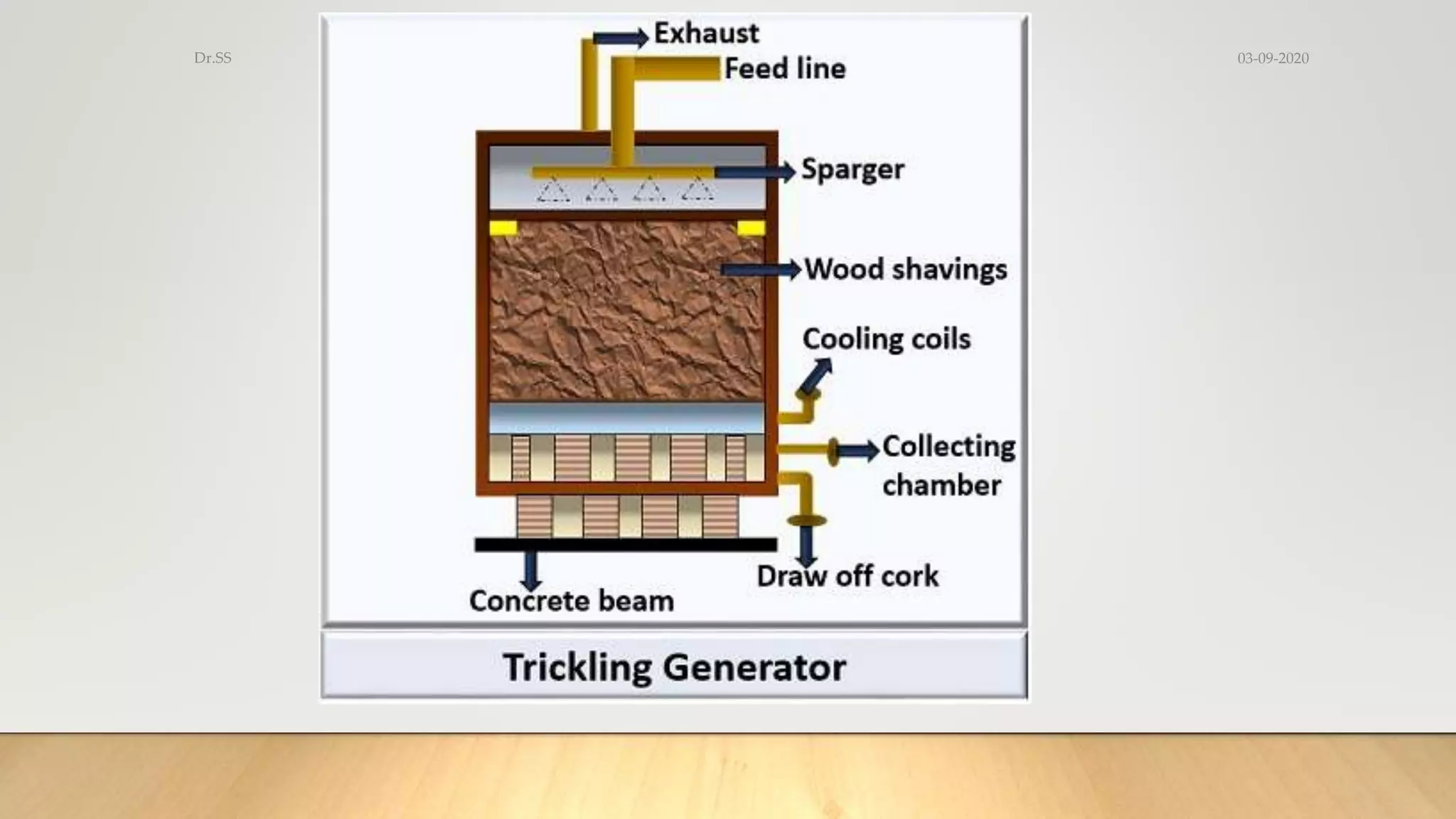
Trickling generation or Surface fermentation
• Also known as trickling system or germen processes.
• Most commonly used industrial method for production of acetic acid.
• Surface fermenter or barrel is filled with vinegar-moistened beech wood shavings.
• The substrate alcohol is poured from top of container and slowly drip down through
the shaving fillings.
• Oxygen is allowed to container through two routes.
• i. One through holes that have been punched into sides of vat.
• ii. Second through perforated bottom of vat.
03-09-2020Dr.SS
Cont…
• Air is introduced through holes by air-compressors.
• When alcohol reaches to bottom of vat , usually within a span of three days it has been
converted in to acetic acid.
• Following condition are kept under control.
• P.H range 2.5-3.2
• Temperature is kept between 20-30 degree C.
• 80-88% vinegar will be produced.
• ADVANTAGES : • Low cost • Ease of control. • High acetic acid concentration. • Less space
requirements.
03-09-2020Dr.SS
03-09-2020Dr.SS
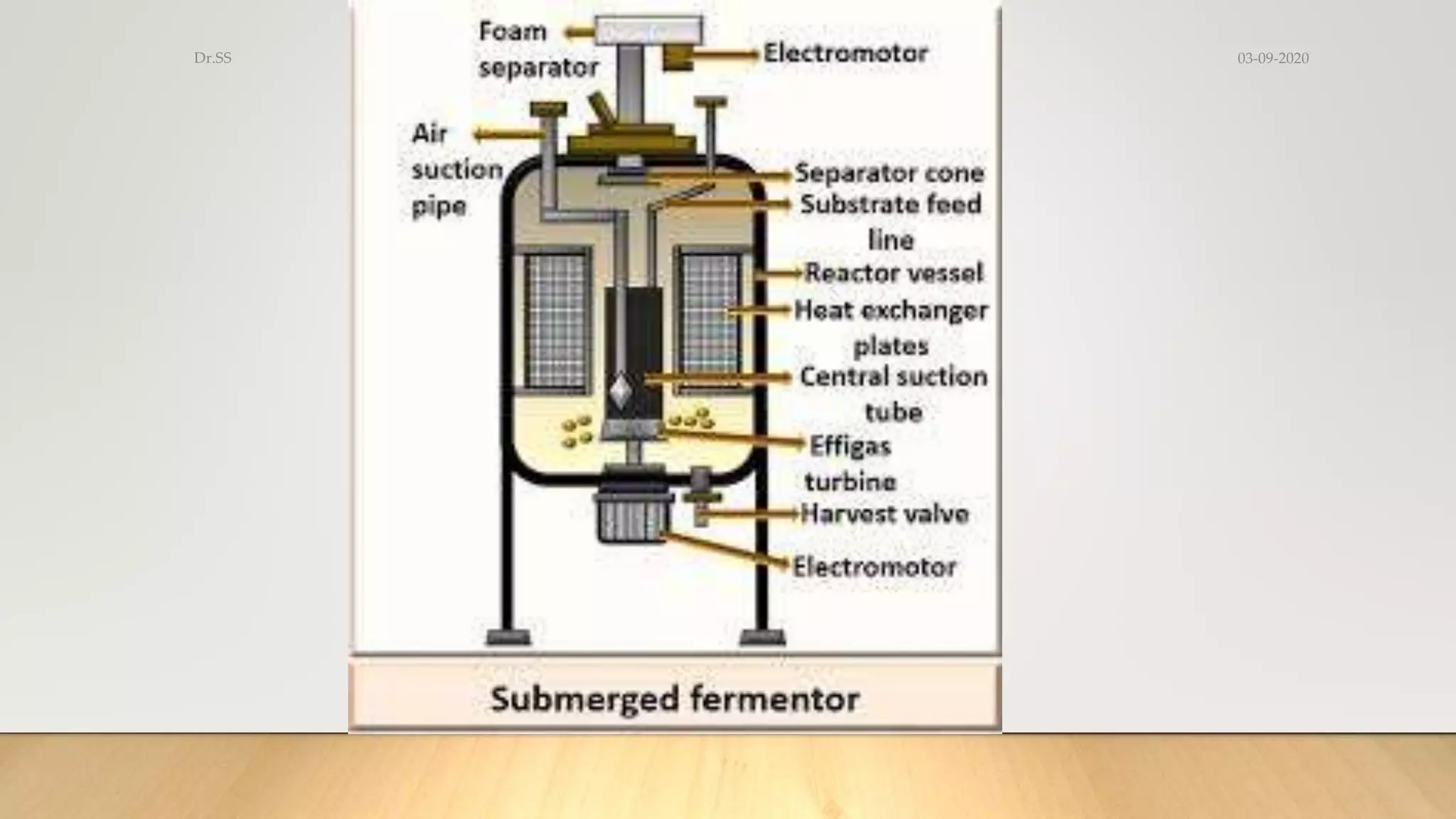
Submerged method
• This method is newer , faster and more efficient.
• For industrial processes, 10–18% ethanol and 5 times the nutrients used for submerged
fermentation are the starting conditions for fermentation.
• When the concentration of ethanol reaches 50–60% of the solution is removed and replaced
with fresh substrate containing 10–18% ethanol.
• Production plant is filled with large stainless steel containers called acetetors.
• Acetators are equipped with centrifugal pumps at bottom that will pump air bubbles in to
tank.
• As pump stirrers alcohol , the nutrients enhance the growth of acetobacter on oxygen bubbles
03-09-2020Dr.SS
Cont…
• Heat jackets keeps the temperature between 40 -42 degree centigrade.
• In 72 hours ethanol is converted to acetic acid
• The vinegar is piped from Acetator to plate and then frame to filtering machine.
• The stainless steel plates press alcohol through pipe filters to remove any sediment ,
usually about 3% of total product.
• The sediment is flushed in to drains while filtered vinegar move toward dilution
station.
• Advantages • Higher productivity. • Faster oxidation of ethanol. • Low cost due to
automation.
03-09-2020Dr.SS
03-09-2020Dr.SS
Purification
• The isolation, purification and concentration of final product determine the
feasibility of the processes.
• A. Cell separation and cell lysis:
• the first operation is cell separation and cell lysis. Which can be done by using
following techniques.
• Cross-flow microfiltration
• Nano-filtration
• Electro.diaylasis “these techniques are useful to concentrate the glacial acetic acid”
03-09-2020Dr.SS
Application
• Common use:
• Used as solvent in different industrial processes.
• Used as an active ingredient in fragrance and perfumes.
• Used in production of synthetic fibers and textiles.
• Used to make ink and indigo dyes.
• Used in manufacturing of rubber and plastics.
03-09-2020Dr.SS
Cont..
• In medicinal industry:
• Acetic acid in the form of vinegar is used for preservation of food.
• Soothe sunburnt skin and to cure from jellyfish stings. •
• Effective tool for cervical cancer screening.
• In Health and hygiene: added in to.. • Hair conditioners • Detangles and
deodorant.
03-09-2020Dr.SS
Cont..
• House Hold cleaning:
• acetic acid in the form of white vinegar is used variety of cleaning tasks. •
• Removing smears and streaks from mirrors. •
• To descaling coffee making machines. •
• Remove urine odor and pet stain.
• Food flavoring: • Used as a condiment to produce pickles. • Used as a flavor
enhancer. • To preserve vegetables • In manufacturing of mint sauce and
production of rice.
03-09-2020Dr.SS
clarification
03-09-2020Dr.SS
sivasan91@gmail.com
sivasan_sf549@anjaconline.org
Questions to think
• What are the main things needed for acetic acid production?
• Acetic acid biosynthesis
• Steps involved in the production process of acetic acid
• Methods involved in the aceticacid production
• Pointout the use of acetic acid
• submerged and surface fermentation production of acetic acid - specify
03-09-2020Dr.SS
03-09-2020Dr.SS

Acetic acid production

  • 1.
    Y5E02 BIOPROCESS TECHNOLOGY –Unit IV – Acetic acid Production Dr. S. SIVASANKARA NARAYANI ASSISTANT PROFESSOR DEPARTMENT OF MICROBIOLOGY AYYA NADAR JANAKI AMMAL COLLEGE SIVAKASI
  • 2.
    UniT -IV • Microbialproduction technology: antibiotics (penicillin) - organic acids (citric acid and acetic acid) - vitamins (b12 and riboflavin) - *enzymes (amylase) - alcoholic beverages (beer and wine). Single cell protein. 03-09-2020Dr.SS
  • 3.
    Acetic acid • AceticAcid is systematically named as ethanoic acid • It is a colorless liquid organic compound. • It has a pungent/ vinegar-like odor • Vinegar is product of Acetic acid • It has melting point 16 to 17°C; 61 to 62°F 03-09-2020Dr.SS
  • 4.
    History • Acetic acidproduction is as old as wine making(10,000 years). • In 3rd centaury Greek philosopher described how vinegar acted on metals to produce pigments useful in art. • Ancient Romans boiled sour wine in lead pots to produce highly sweet syrup called sypa. • In 8th centaury Persian chemist Jabir Ibn Hayyan concentrated Acetic acid from vinegar through distillation processes. • In 1847 German chemist Hermann Kolbe synthesized acetic acid from inorganic materials for first time. • By 1910 most of the acetic acid was obtained from the from distillation of wood. • At this time Germany is producing 10,000 tons of acetic acid. • About 30% of which is used for the manufacturing of indigo dyes. 03-09-2020Dr.SS
  • 5.
  • 6.
    Acetic acid bacteria •Acetic acid bacteria is a gram-negative bacteria which oxidize sugar or ethanol and produce acetic acid during fermentation. • Acetic acid bacteria are rod-shaped & obligate aerobes. • Pasteur in 1864 claimed that the transformation of wine into vinegar was due to the veil of Mycoderma aceti on it surface pungency of acetic acid. 03-09-2020Dr.SS
  • 7.
    Bacteria • Acetic acidbacteria are commonly used for the production of acetic acid. • The three important genera's are.. • 1 -Genus acetobacterium: • The commonly used species are. Acetobacterium aceti Acetobacterium xylinum • 2- Genus clostridium: the commonly used species is Clostridium thermoaceticum…which is an anaerobic thermophile. • 3-Acetic acid bacteria: Acetobacter and Gulocanobacter are commonly used, 03-09-2020Dr.SS
  • 8.
    Raw materials • BiomassFeedstock (beach wood, Silicon tube, sieving, wood chips) • Ethanol is used as substrate. • Microbes Acetic Acid Bacteria (Acetobacter aceti ) used as bio reactor • Following substrates are commonly used. • Ethanol • Wine and whey • Molasses • Fermented grains • malt and rice. 03-09-2020Dr.SS
  • 9.
    Production • Acetic acidis produced in following four steps. • Conversion of starch to sugar by using amylases enzymes. • Anaerobic conversion of sugars to ethanol by yeast fermentation. • Conversion of ethanol to hydrated acetaldehyde. • Finally by dehydrogenation acetic acid is produced by using aldehyde dehydrogenase enzyme 03-09-2020Dr.SS
  • 10.
  • 11.
    Types Acetic acid isproduced industrially by following three methods.. • i. Orleans • ii. Surface fermentation(trickling generation method). • iii. Submerged fermentation methods. 03-09-2020Dr.SS
  • 12.
    Orleans • Old andtraditional method. • Slow but continuous processes. • High grade vinegar is used as starter culture. • Fermentation is done on large containers. • Filled to two-third of its capacity. • Wooden containers are laid down on their sides and holes are drilled at top and end sides of barrel. • Then ethanol is poured in to container using long necked funnels from top. 03-09-2020Dr.SS
  • 13.
    Cont… • Then addstarter high grade vinegar. • Ethanol convert in to acetic acid within five weeks.(35 days). • Netting or screens are placed over holes to prevent insects getting entry in to barrels, • The barrel's are allowed to sit for several months. • The temperature is kept at 21-29 degree centigrade. • Samples are taken periodically by inserting spigot in to side holes. • When alcohol is converted to acetic acid, it drown off through spigot. • About 15% liquid is left to blend with next batch. 03-09-2020Dr.SS
  • 14.
  • 15.
    Trickling generation orSurface fermentation • Also known as trickling system or germen processes. • Most commonly used industrial method for production of acetic acid. • Surface fermenter or barrel is filled with vinegar-moistened beech wood shavings. • The substrate alcohol is poured from top of container and slowly drip down through the shaving fillings. • Oxygen is allowed to container through two routes. • i. One through holes that have been punched into sides of vat. • ii. Second through perforated bottom of vat. 03-09-2020Dr.SS
  • 16.
    Cont… • Air isintroduced through holes by air-compressors. • When alcohol reaches to bottom of vat , usually within a span of three days it has been converted in to acetic acid. • Following condition are kept under control. • P.H range 2.5-3.2 • Temperature is kept between 20-30 degree C. • 80-88% vinegar will be produced. • ADVANTAGES : • Low cost • Ease of control. • High acetic acid concentration. • Less space requirements. 03-09-2020Dr.SS
  • 17.
  • 18.
    Submerged method • Thismethod is newer , faster and more efficient. • For industrial processes, 10–18% ethanol and 5 times the nutrients used for submerged fermentation are the starting conditions for fermentation. • When the concentration of ethanol reaches 50–60% of the solution is removed and replaced with fresh substrate containing 10–18% ethanol. • Production plant is filled with large stainless steel containers called acetetors. • Acetators are equipped with centrifugal pumps at bottom that will pump air bubbles in to tank. • As pump stirrers alcohol , the nutrients enhance the growth of acetobacter on oxygen bubbles 03-09-2020Dr.SS
  • 19.
    Cont… • Heat jacketskeeps the temperature between 40 -42 degree centigrade. • In 72 hours ethanol is converted to acetic acid • The vinegar is piped from Acetator to plate and then frame to filtering machine. • The stainless steel plates press alcohol through pipe filters to remove any sediment , usually about 3% of total product. • The sediment is flushed in to drains while filtered vinegar move toward dilution station. • Advantages • Higher productivity. • Faster oxidation of ethanol. • Low cost due to automation. 03-09-2020Dr.SS
  • 20.
  • 21.
    Purification • The isolation,purification and concentration of final product determine the feasibility of the processes. • A. Cell separation and cell lysis: • the first operation is cell separation and cell lysis. Which can be done by using following techniques. • Cross-flow microfiltration • Nano-filtration • Electro.diaylasis “these techniques are useful to concentrate the glacial acetic acid” 03-09-2020Dr.SS
  • 22.
    Application • Common use: •Used as solvent in different industrial processes. • Used as an active ingredient in fragrance and perfumes. • Used in production of synthetic fibers and textiles. • Used to make ink and indigo dyes. • Used in manufacturing of rubber and plastics. 03-09-2020Dr.SS
  • 23.
    Cont.. • In medicinalindustry: • Acetic acid in the form of vinegar is used for preservation of food. • Soothe sunburnt skin and to cure from jellyfish stings. • • Effective tool for cervical cancer screening. • In Health and hygiene: added in to.. • Hair conditioners • Detangles and deodorant. 03-09-2020Dr.SS
  • 24.
    Cont.. • House Holdcleaning: • acetic acid in the form of white vinegar is used variety of cleaning tasks. • • Removing smears and streaks from mirrors. • • To descaling coffee making machines. • • Remove urine odor and pet stain. • Food flavoring: • Used as a condiment to produce pickles. • Used as a flavor enhancer. • To preserve vegetables • In manufacturing of mint sauce and production of rice. 03-09-2020Dr.SS
  • 25.
  • 26.
    Questions to think •What are the main things needed for acetic acid production? • Acetic acid biosynthesis • Steps involved in the production process of acetic acid • Methods involved in the aceticacid production • Pointout the use of acetic acid • submerged and surface fermentation production of acetic acid - specify 03-09-2020Dr.SS
  • 27.