LASERS
SAKEENA ASMI
MAHATMA GANDHI
UNIVERSITY
ight
mplification by
timulated
mission of
adiation
Term coined by Gordon Gould.
One of the most influential technological achievements of the 20th
century.
Laser is an optical device that generates intense beam of coherent
monochromatic light by Stimulated emission of radiation.
LASER SPECTRUM
Lasers operate in the ultraviolet, visible and infrared region
HISTORY OF LASER
In 1917, Albert Einstein established the basic fundamentals to built
a laser (quantum theory of light and photons & mechanism of
stimulated emission).
In 1954, the first maser was demonstrated by Charles Townes, A L
Schawlow which worked in the microwave range.
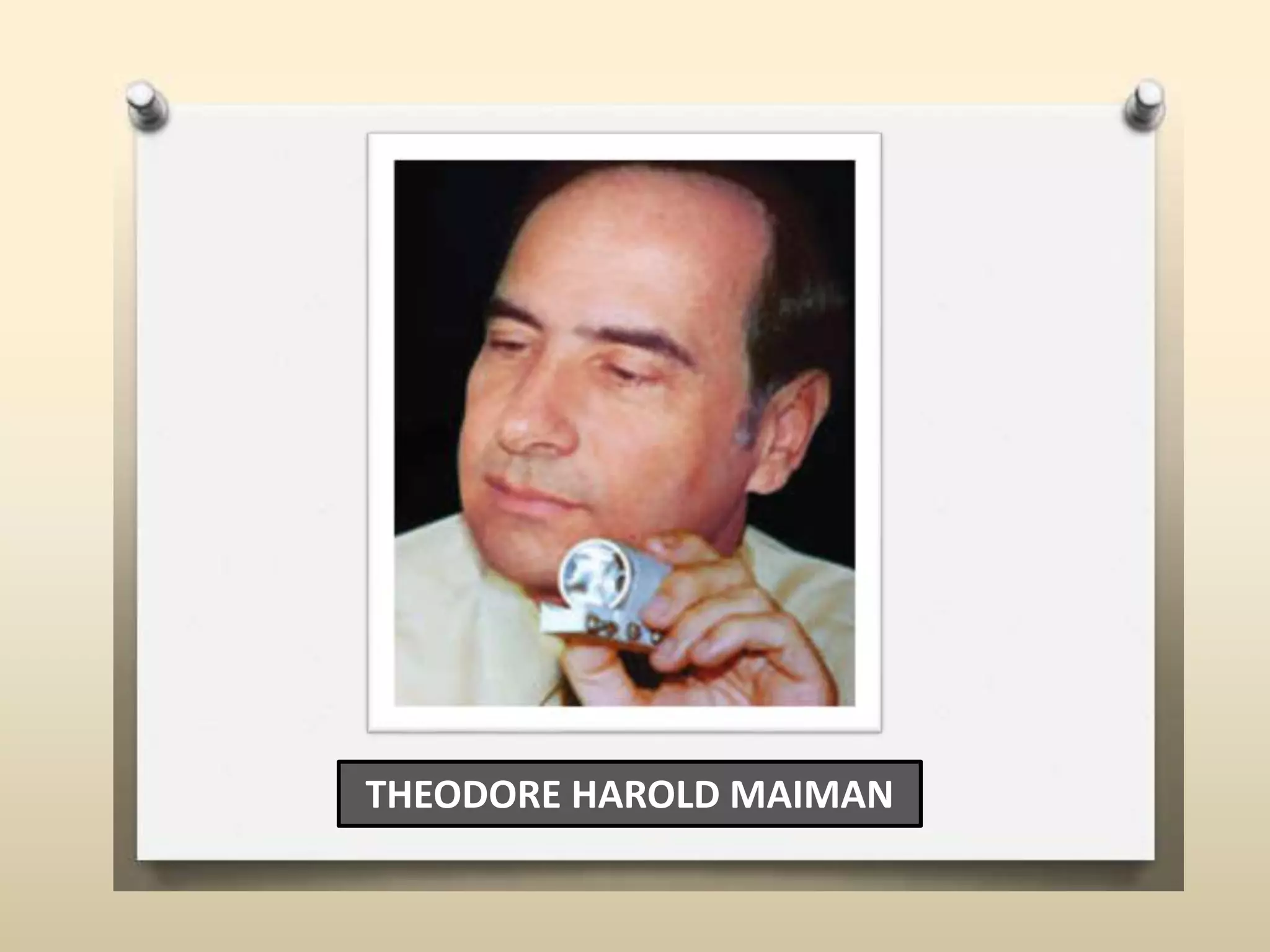
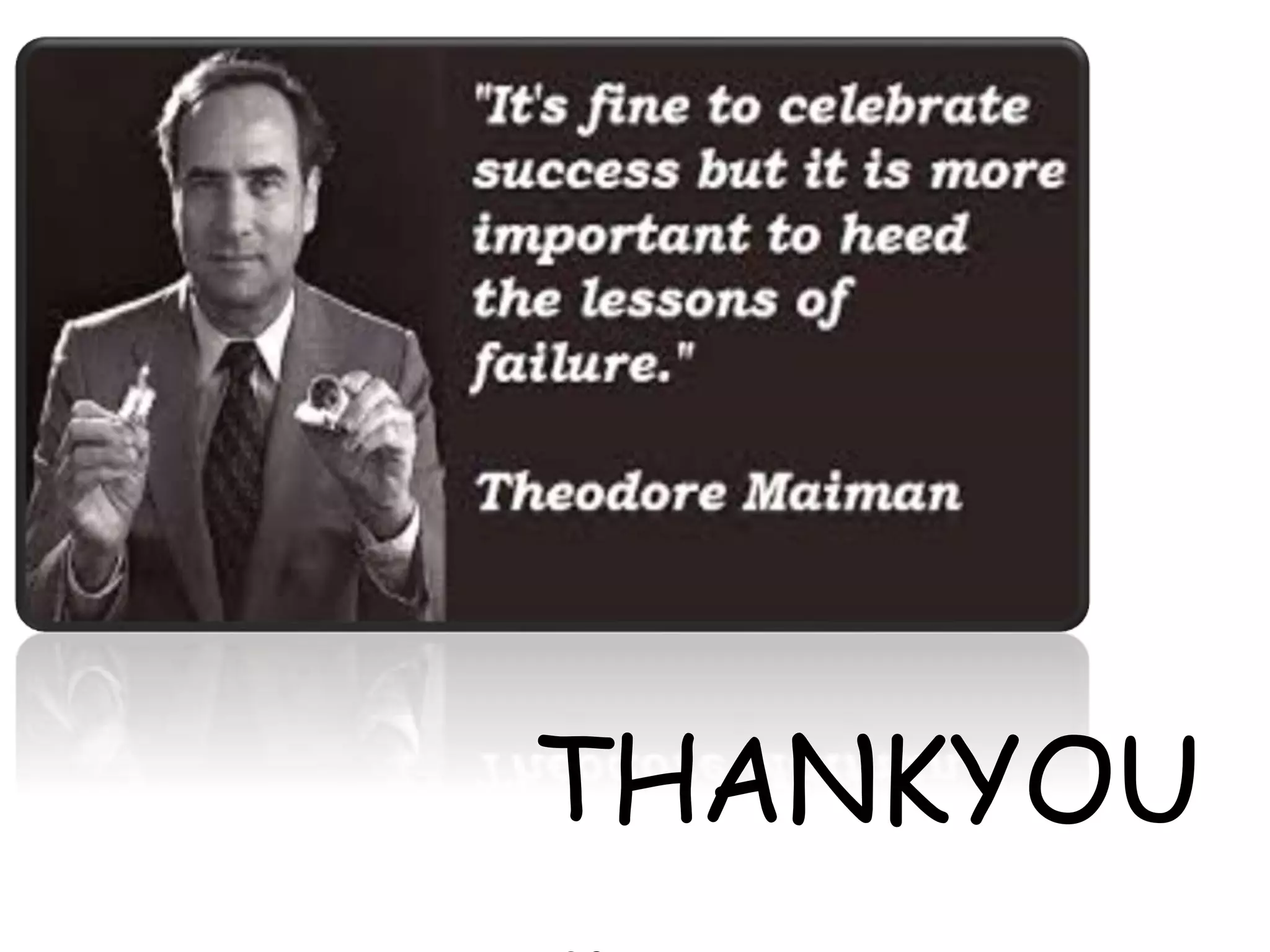
The first laser was designed by Theodore Maiman in 1960 and was
made by ruby.
THEODORE HAROLD MAIMAN
WHY ARE LASERS
USEFUL ?
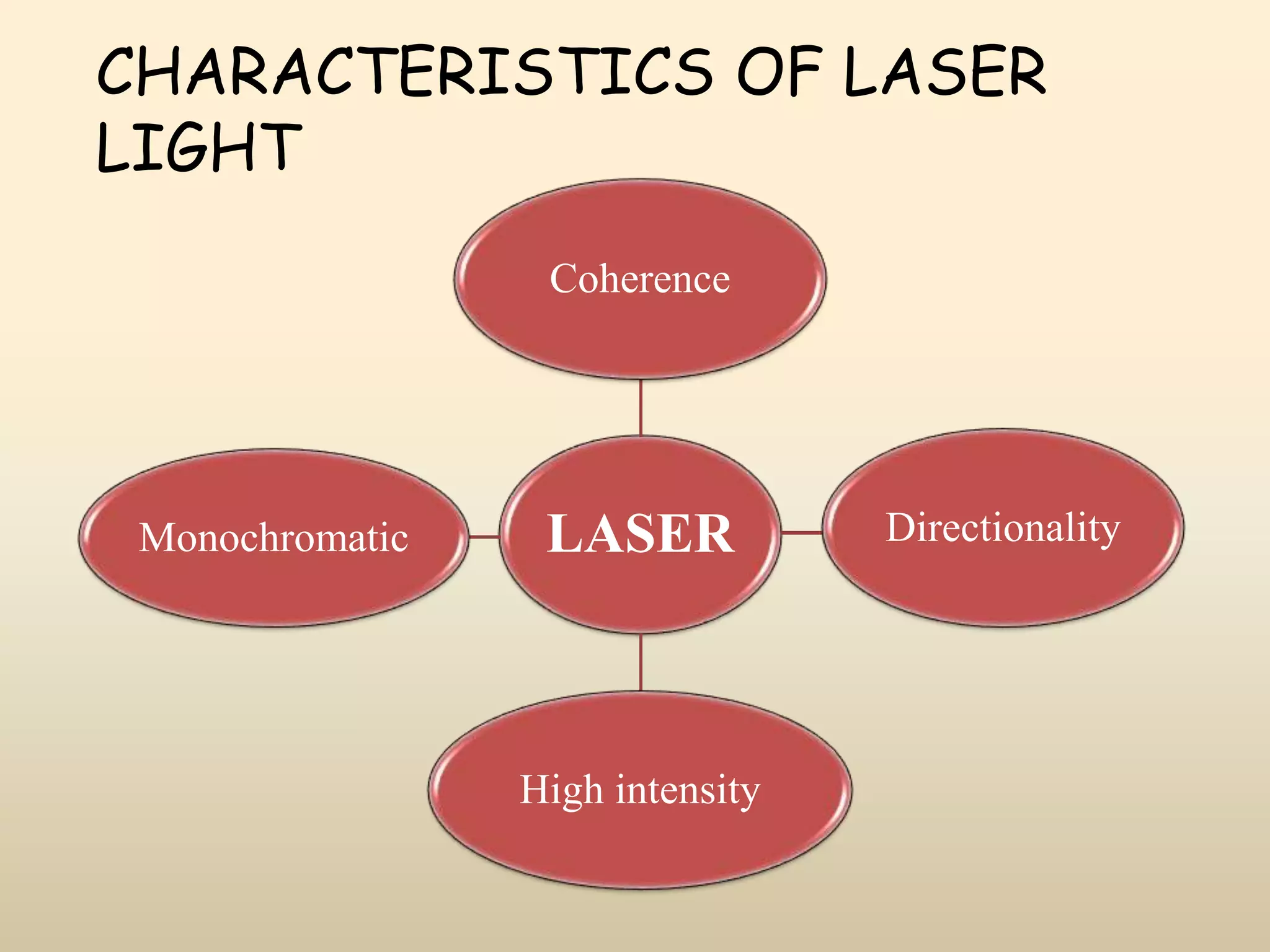
CHARACTERISTICS OF LASER
LIGHT
LASER
Coherence
Directionality
High intensity
Monochromatic
1. COHERENCE :
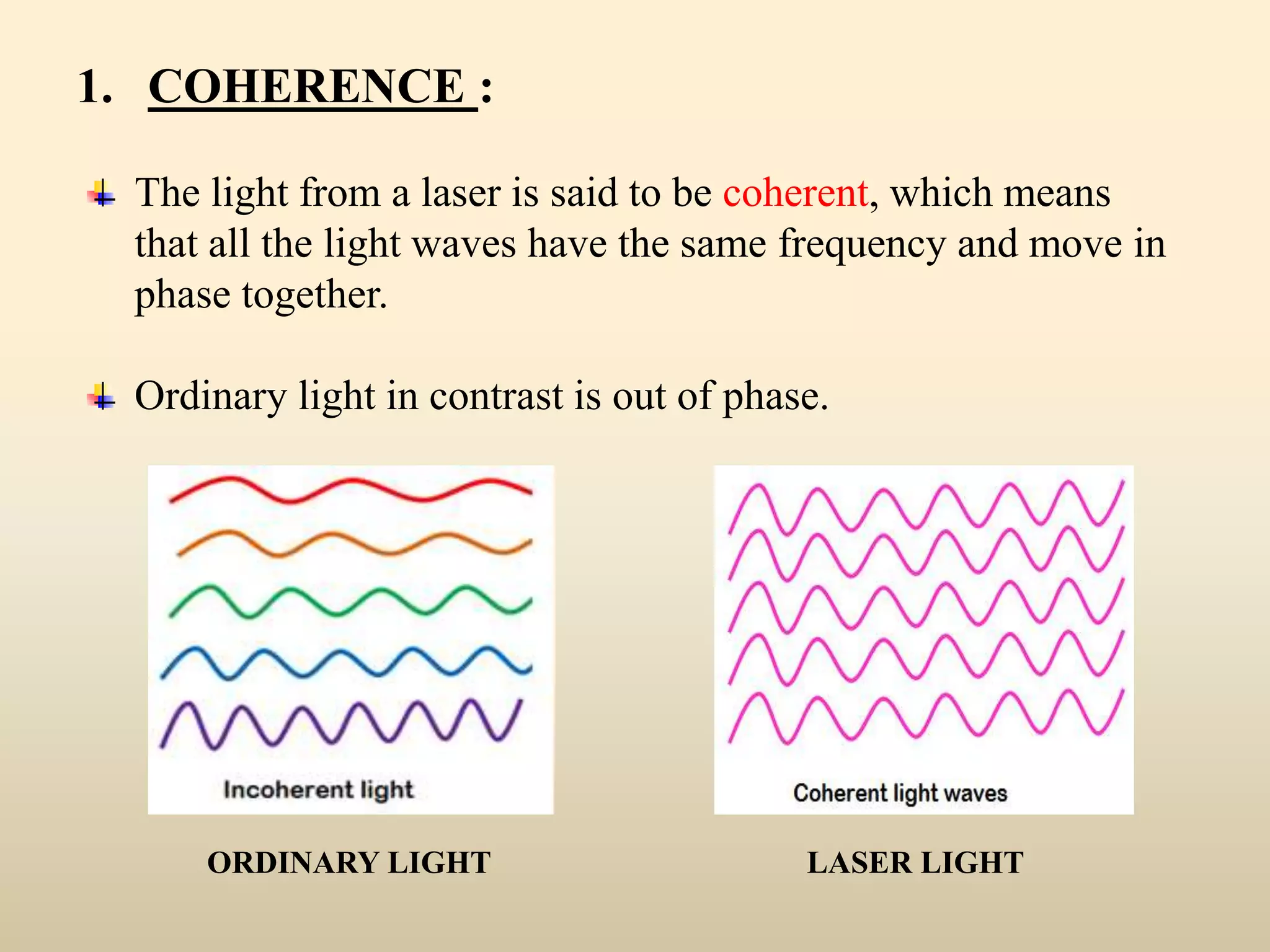
The light from a laser is said to be coherent, which means
that all the light waves have the same frequency and move in
phase together.
Ordinary light in contrast is out of phase.
ORDINARY LIGHT LASER LIGHT
2. DIRECTIONALITY :
Lasers emit light that is highly directional, that is, laser light is
emitted as a relatively narrow beam in a specific direction.
Ordinary light, such as from a light bulb, is emitted in many
directions away from the source.
ORDINARY LIGHT LASER LIGHT
3. MONOCHROMATICITY :
The light emitted from a laser is monochromatic, that is, it is
of one colour or wavelength.
In contrast, ordinary white light is a combination of many
colours or wavelengths of light.
4. HIGH INTENSITY
In laser, the light spreads in small region of space and in a small
wavelength range.
In an ordinary light source, light spreads out uniformly in all
directions.
Hence, laser light has greater intensity when compared to
ordinary light.
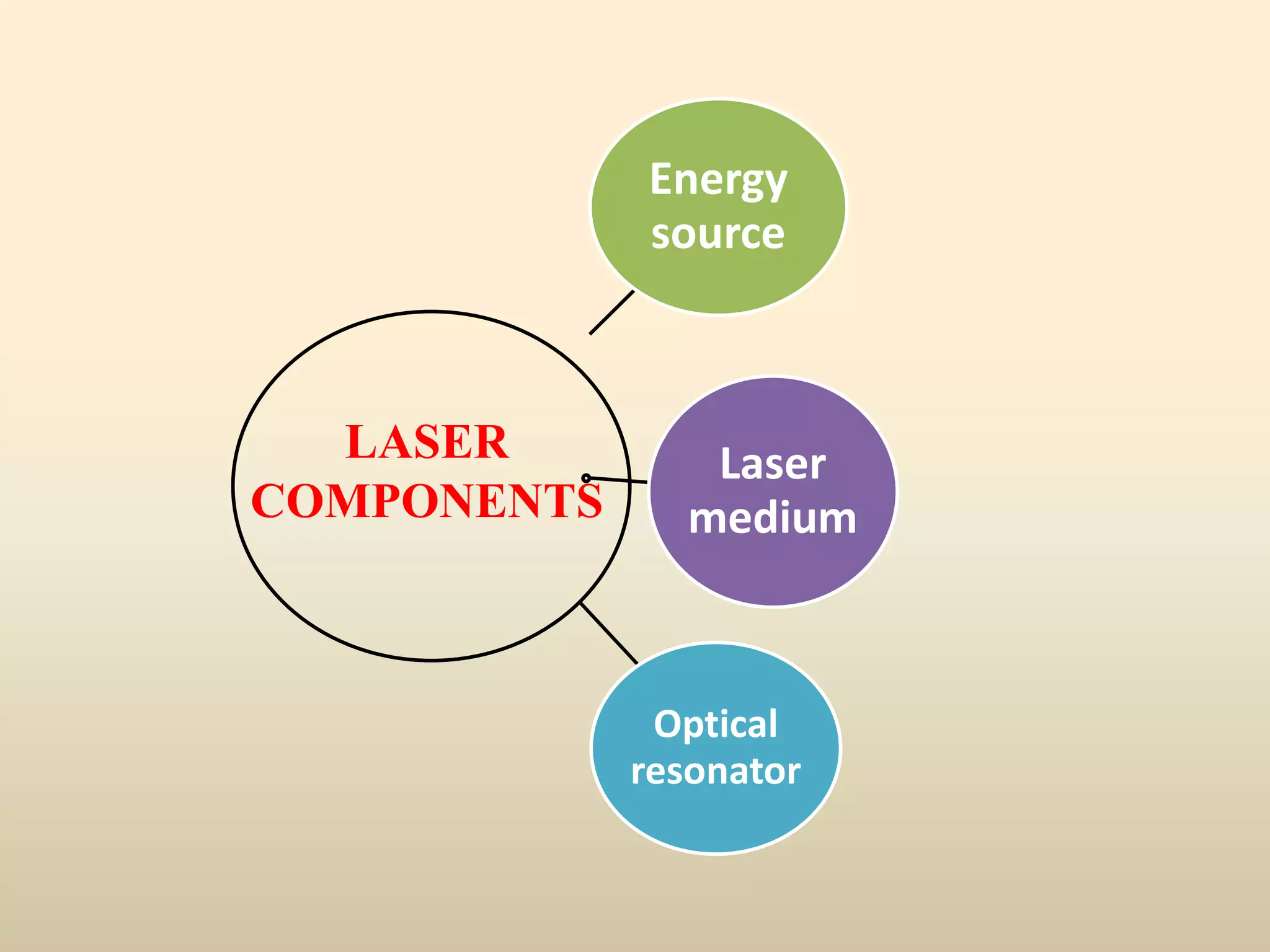
Energy
source
Laser
medium
Optical
resonator
LASER
COMPONENTS
LASER MEDIUM
ENERGY SOURCE
OPTICAL RESONATOR
HIGH
REFLECTANCE
MIRROR (HR)
OUTPUT COUPLER
MIRROR (OC)
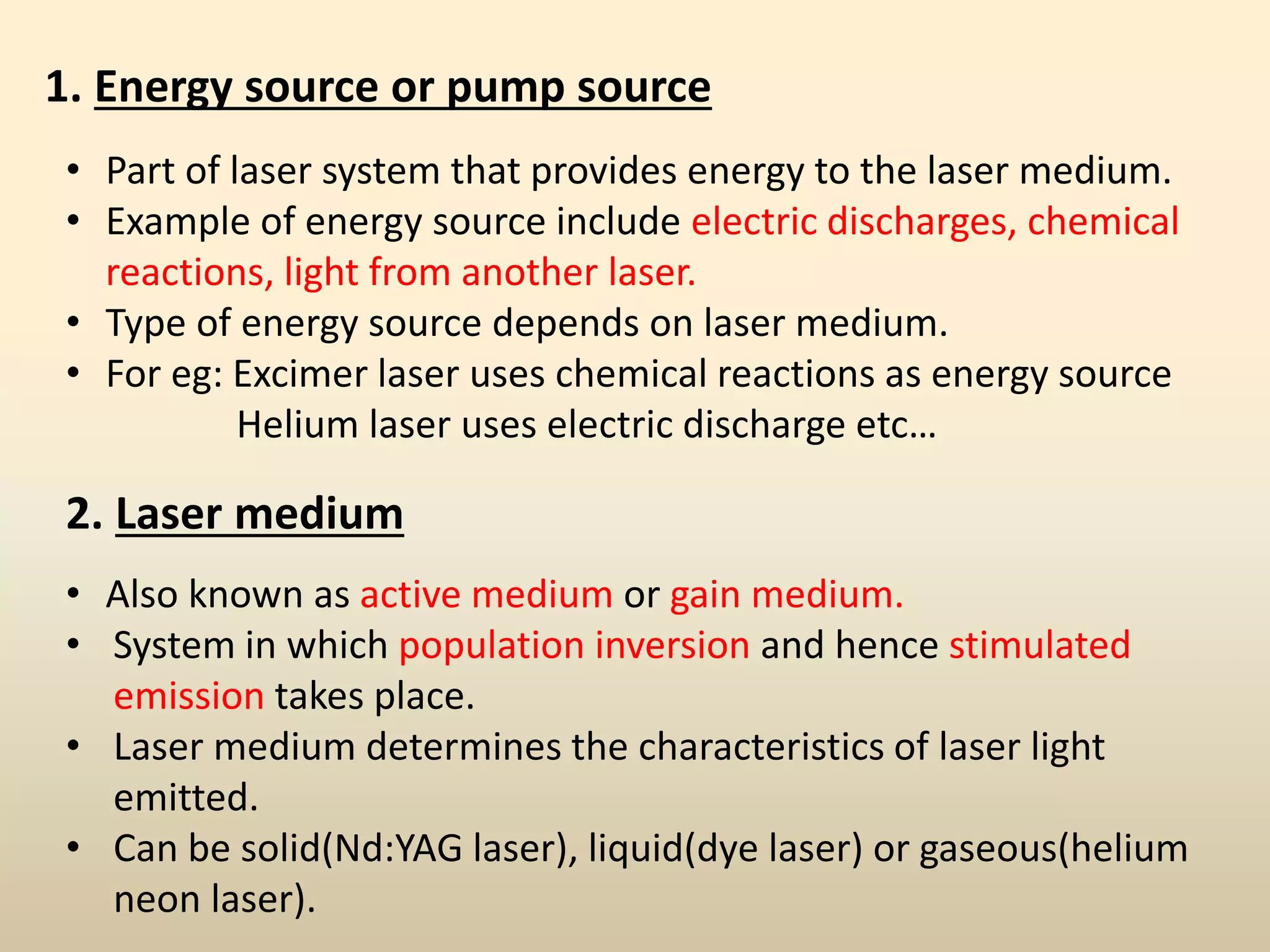
1. Energy source or pump source
• Part of laser system that provides energy to the laser medium.
• Example of energy source include electric discharges, chemical
reactions, light from another laser.
• Type of energy source depends on laser medium.
• For eg: Excimer laser uses chemical reactions as energy source
Helium laser uses electric discharge etc…
2. Laser medium
• Also known as active medium or gain medium.
• System in which population inversion and hence stimulated
emission takes place.
• Laser medium determines the characteristics of laser light
emitted.
• Can be solid(Nd:YAG laser), liquid(dye laser) or gaseous(helium
neon laser).
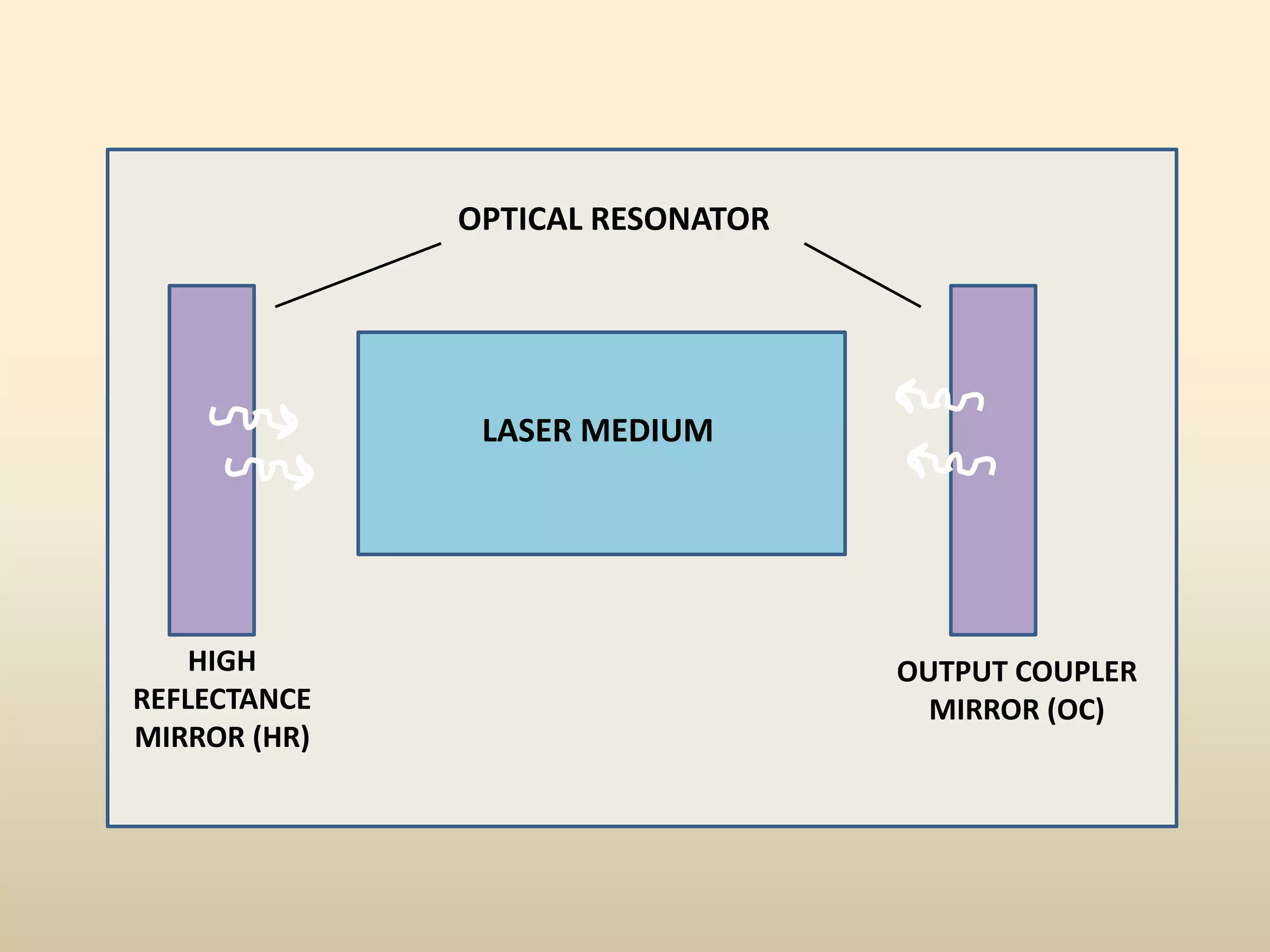
3. Optical resonator
• Laser medium is surrounded by two parallel mirrors which
provide feedback of light.
• One mirror is fully reflective (High Reflection mirror) and other
is partially reflective (Output coupler).
• Output coupler will allow some of the light to leave the optical
cavity to produce laser output beam.
• Two mirrors are whole called as OPTICAL RESONATOR.
PRINCIPLES OF WORKING OF A
LAsERIn lasers, photons are interacted in 3 ways with atoms:
1. Absorption of radiation
2. Spontaneous emission
3. Stimulated emission
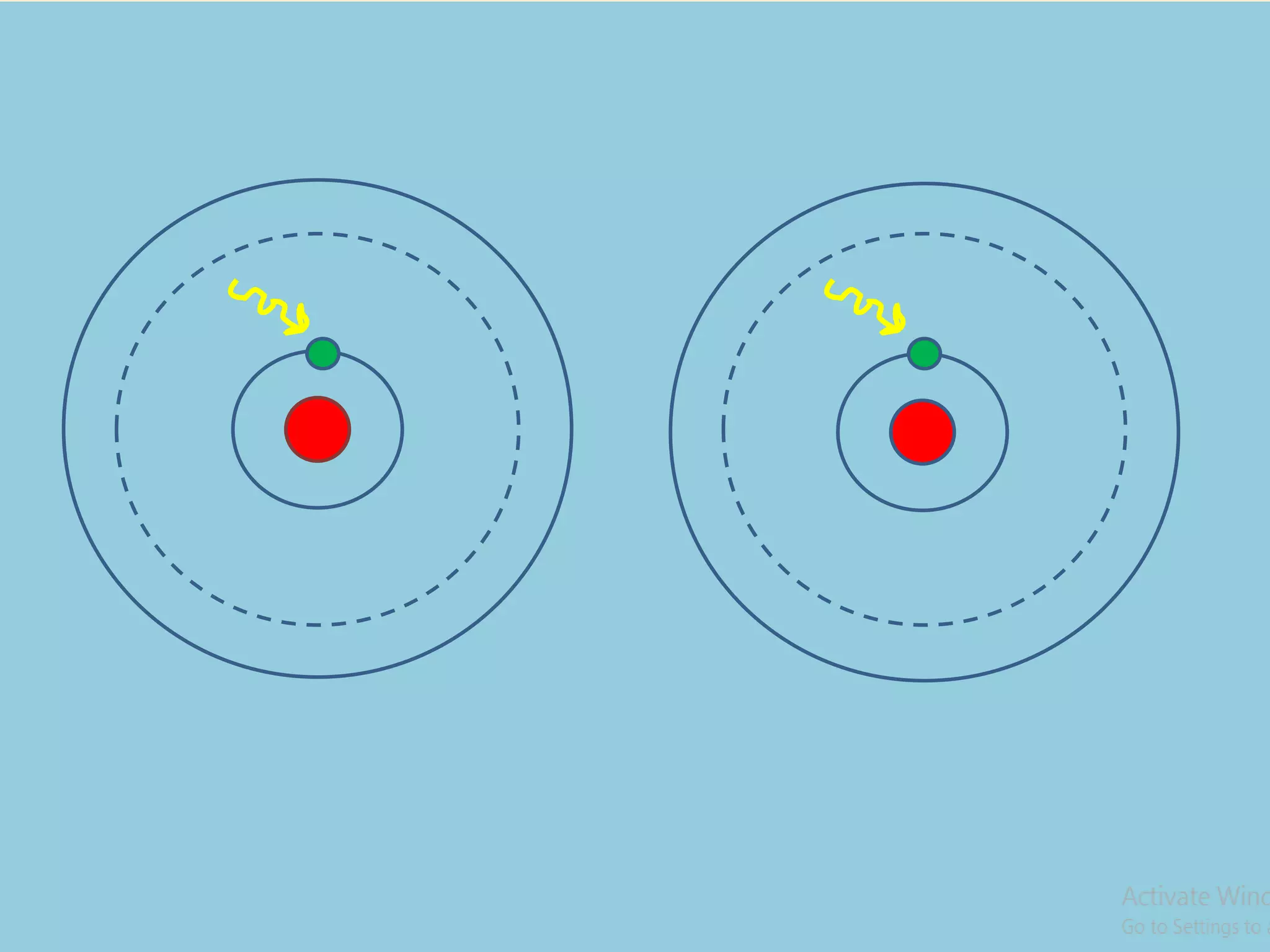
ABSORPTION OF RADIATION
• It is the process by which electrons in the lower energy state
absorbs energy from photons to jump into higher energy level.
• It occurs because these electrons in the lower energy state need
extra energy to jump into higher energy level.
• Extra energy is provided from various sources like heat, electric
field or light etc.
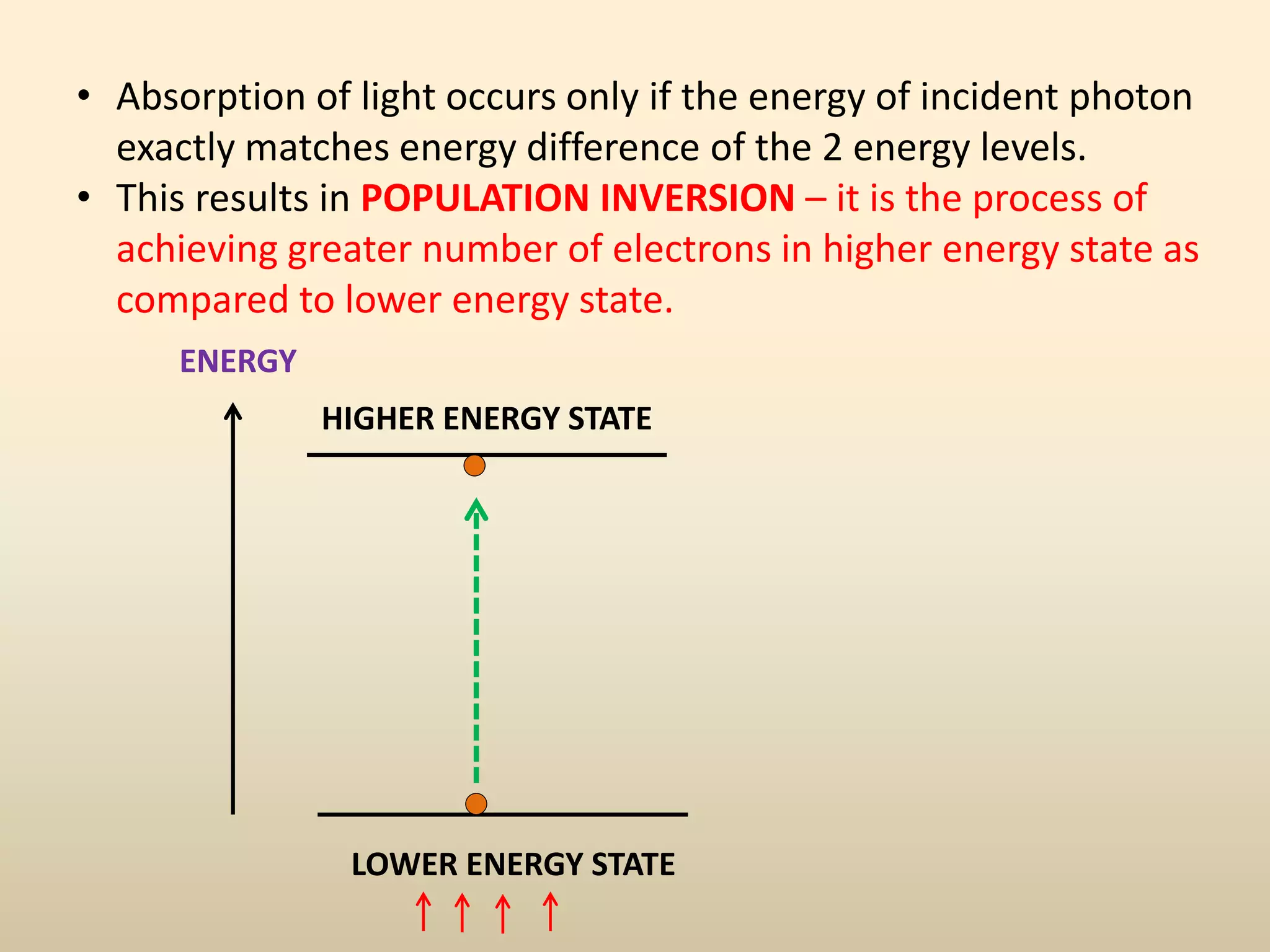
• Absorption of light occurs only if the energy of incident photon
exactly matches energy difference of the 2 energy levels.
• This results in POPULATION INVERSION – it is the process of
achieving greater number of electrons in higher energy state as
compared to lower energy state.
ENERGY
LOWER ENERGY STATE
HIGHER ENERGY STATE
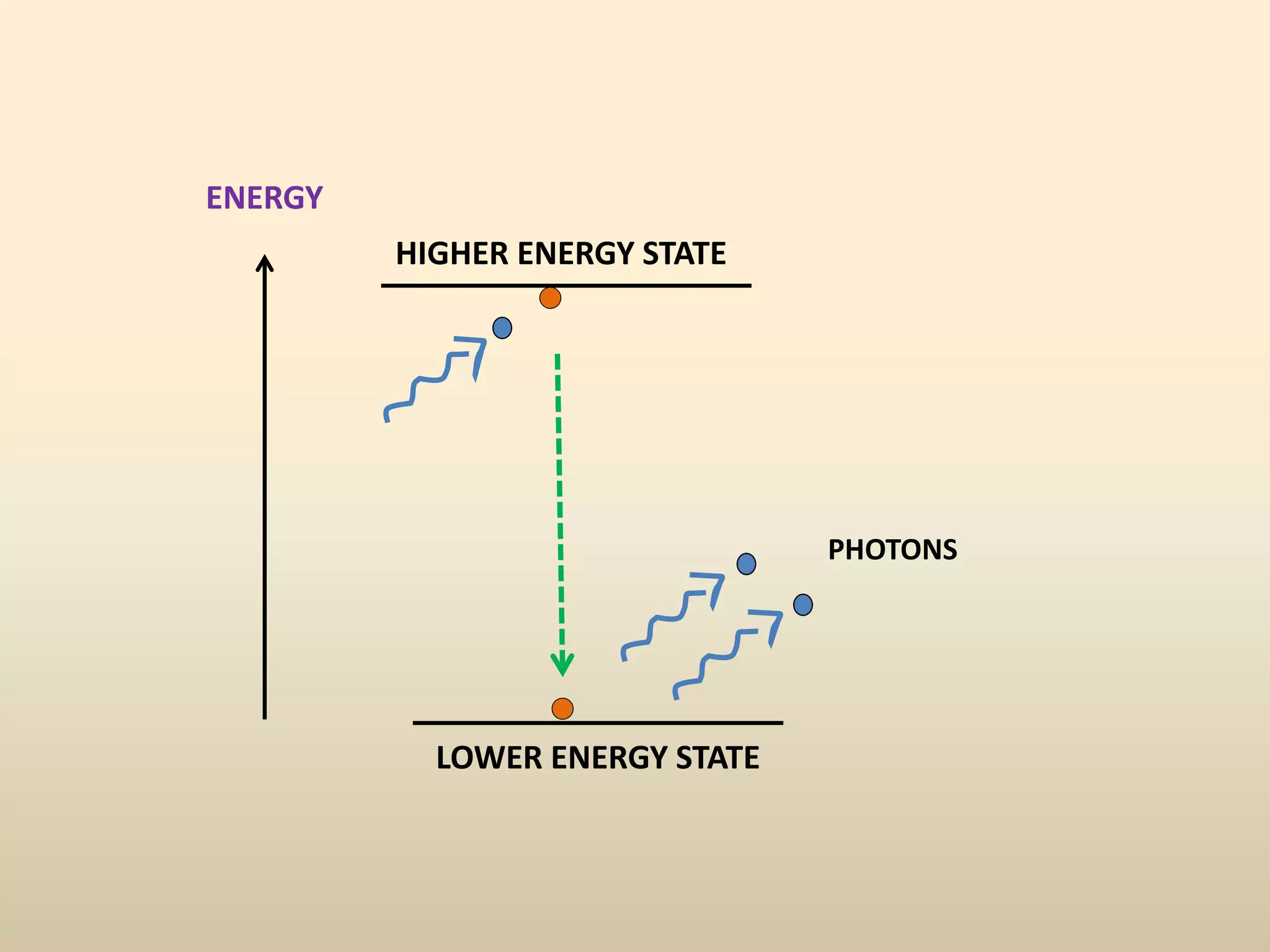
2. SPONTANEOUS EMISSION
• It is the process by which electrons in the excited state return to
the ground state by emitting photons.
• Electron in excited state can stay only for a short period called as
life time of excited electrons which is 10-8 sec.
• Here electrons move naturally from one state to another and
emission of photons also occur naturally which constitute ordinary
incoherent light.
ENERGY
LOWER ENERGY STATE
HIGHER ENERGY STATE
PHOTONS
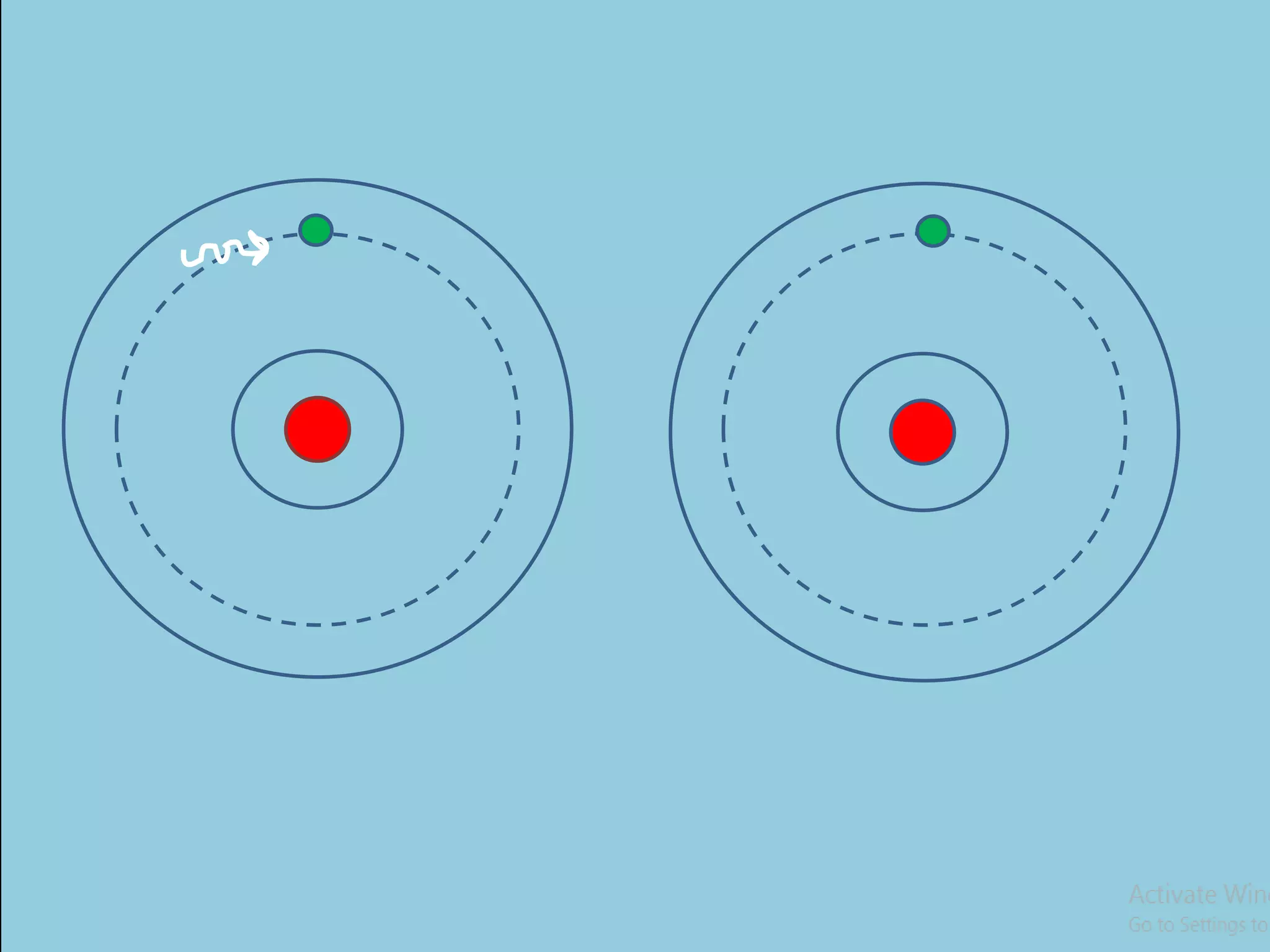
3. STIMULATED EMISSION
• It is the process by which incident photon interacts with the
excited electron and forces it to return to the ground state.
• Hence light energy is supplied directly to the excited electron, so
electrons in the excited state need not wait for completion of
their lifetime.
• Here 2 photons are emitted, one is due to incident photon and
another is due to energy release of excited electron.
• All emitted photons have the same energy same frequency and
travel in same direction.
• Number of photons emitted depends on number of electrons in
higher energy level and incident light intensity.
ENERGY
LOWER ENERGY STATE
HIGHER ENERGY STATE
PHOTONS
ENERGY SOURCE
LASER MEDIUM
ENERGY SOURCE
LASER MEDIUM
LASER MEDIUM
OPTICAL RESONATOR
HIGH
REFLECTANCE
MIRROR (HR)
OUTPUT COUPLER
MIRROR (OC)
LASER MEDIUM
OPTICAL RESONATOR
HIGH
REFLECTANCE
MIRROR (HR)
OUTPUT COUPLER
MIRROR (OC)
LASER MEDIUM
OPTICAL RESONATOR
HIGH
REFLECTANCE
MIRROR (HR)
OUTPUT COUPLER
MIRROR (OC)
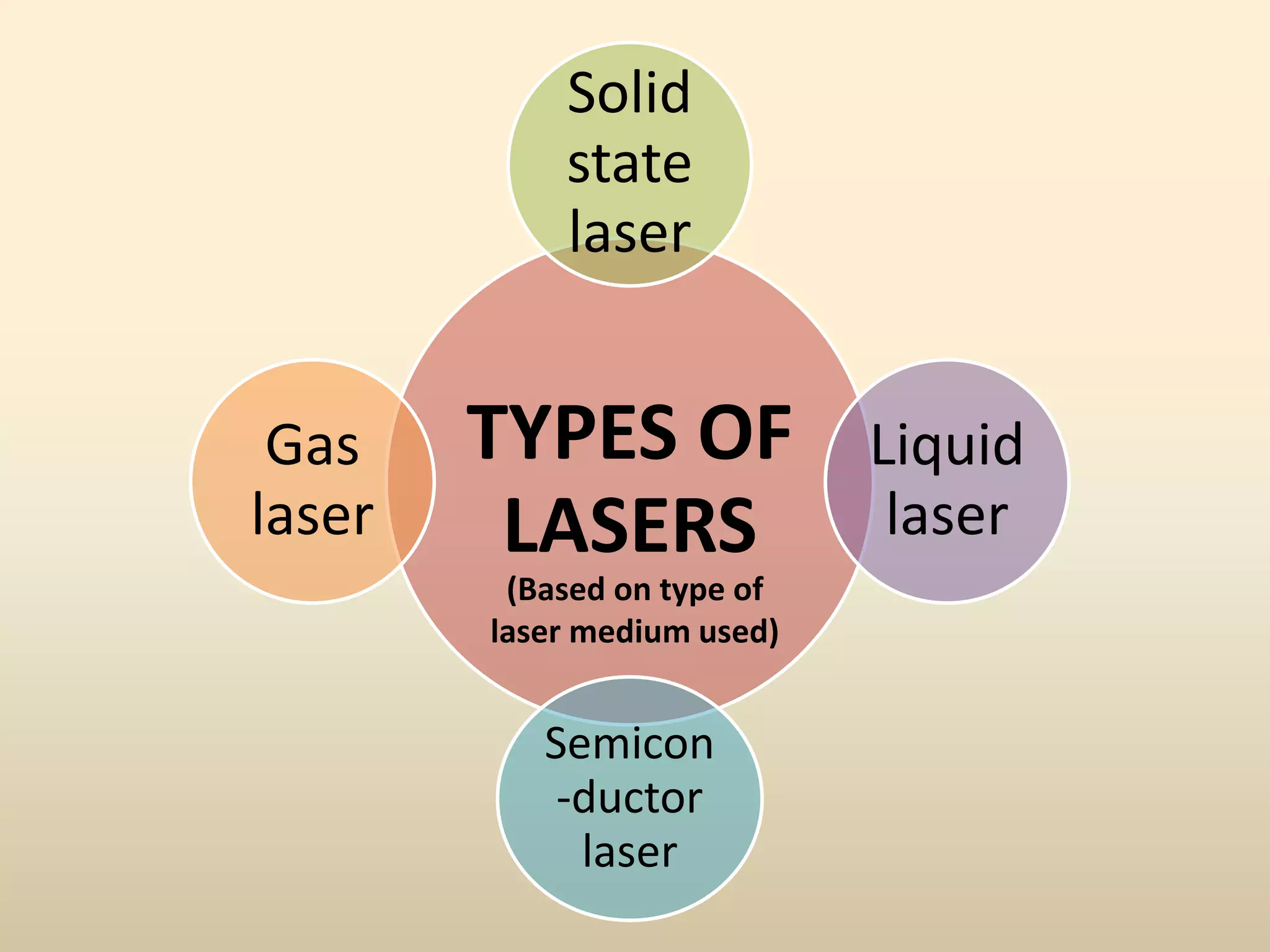
TYPES OF
LASERS
Solid
state
laser
Liquid
laser
Semicon
-ductor
laser
Gas
laser
(Based on type of
laser medium used)
1. Solid state laser
• Uses solid as a laser medium – glass or crystalline materials are
used.
• Materials such as Sapphire (Al2O3), Neodymium doped yttrium
aluminium garnet (Nd:YAG), Neodymium doped glass (Nd:Glass)
etc are used as materials for laser medium.
• Nd:YAG is the most commonly used.
• The first solid state laser was Ruby laser – here ruby crystal is the
medium.
RUBY LASER Nd:YAG LASER
2. Gas laser
• Laser medium is in the gaseous state.
• Type of gas used can determine the laser efficiency.
• Types : Helium Neon laser, Argon laser, carbon monoxide laser,
Excimer lasers etc.
Helium Neon laser CO2 laser
3. Liquid laser
• Uses liquid as laser medium.
• Most common is Dye laser – organic dye as laser medium.
DYE LASER
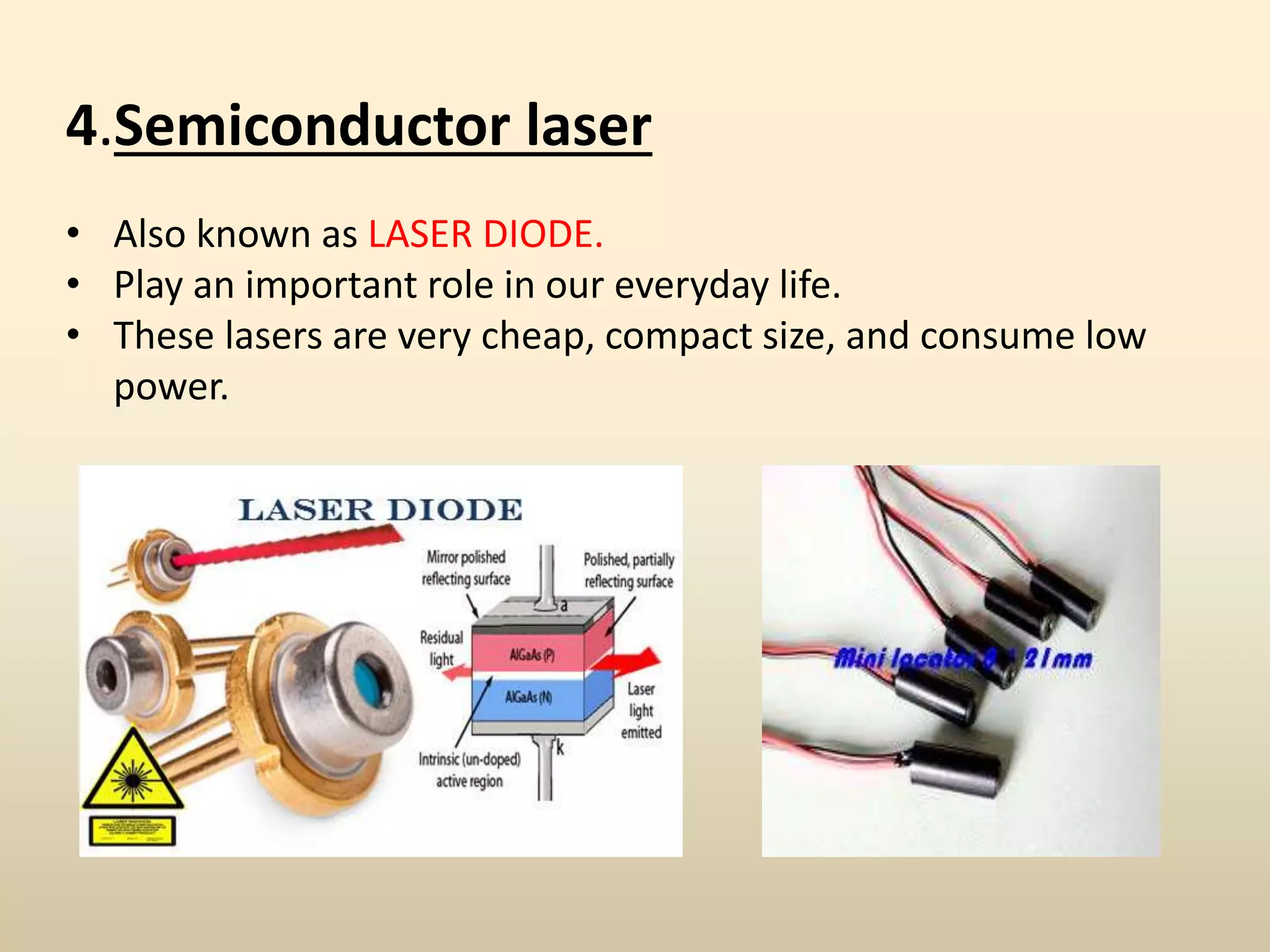
4.Semiconductor laser
• Also known as LASER DIODE.
• Play an important role in our everyday life.
• These lasers are very cheap, compact size, and consume low
power.
APPLICATIONS OF
LASERS
LASERS IN MEDICINE
Bloodless surgery
Fiber optic endoscope
to detect ulcers in the
intestine .
Lasers are used extensively in the
treatment of eye diseases particularly
to reattach a detached retina.
Used to remove caries or decayed
portion of teeth.
 Liver and lung diseases could be treated using lasers.
 To destroy cancerous and precancerous cells.
 Used to study internal structure of microorganisms and cells.
To break up gall stones and
kidney stones.
To remove plague
clogging human
arteries.
Lasers are used in
cosmetic treatments
such as acne treatment,
hair removal etc…
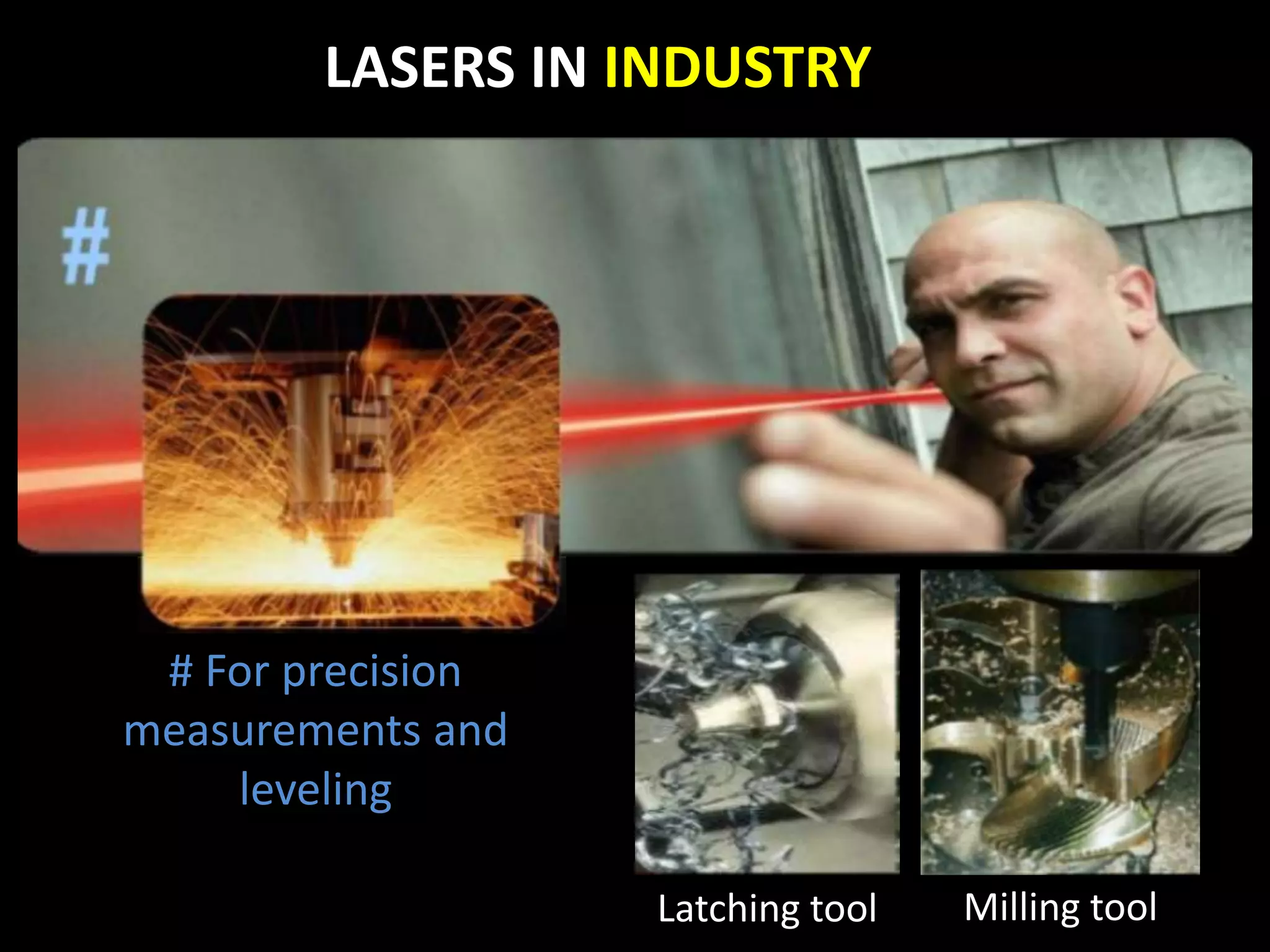
LASERS IN INDUSTRY
# For precision
measurements and
leveling
Latching tool Milling tool
Laser light is used to collect the
information about the prefixed
prizes of various products in shops
and business establishments from
the barcode printed on the
product.
Welding and cutting of metal
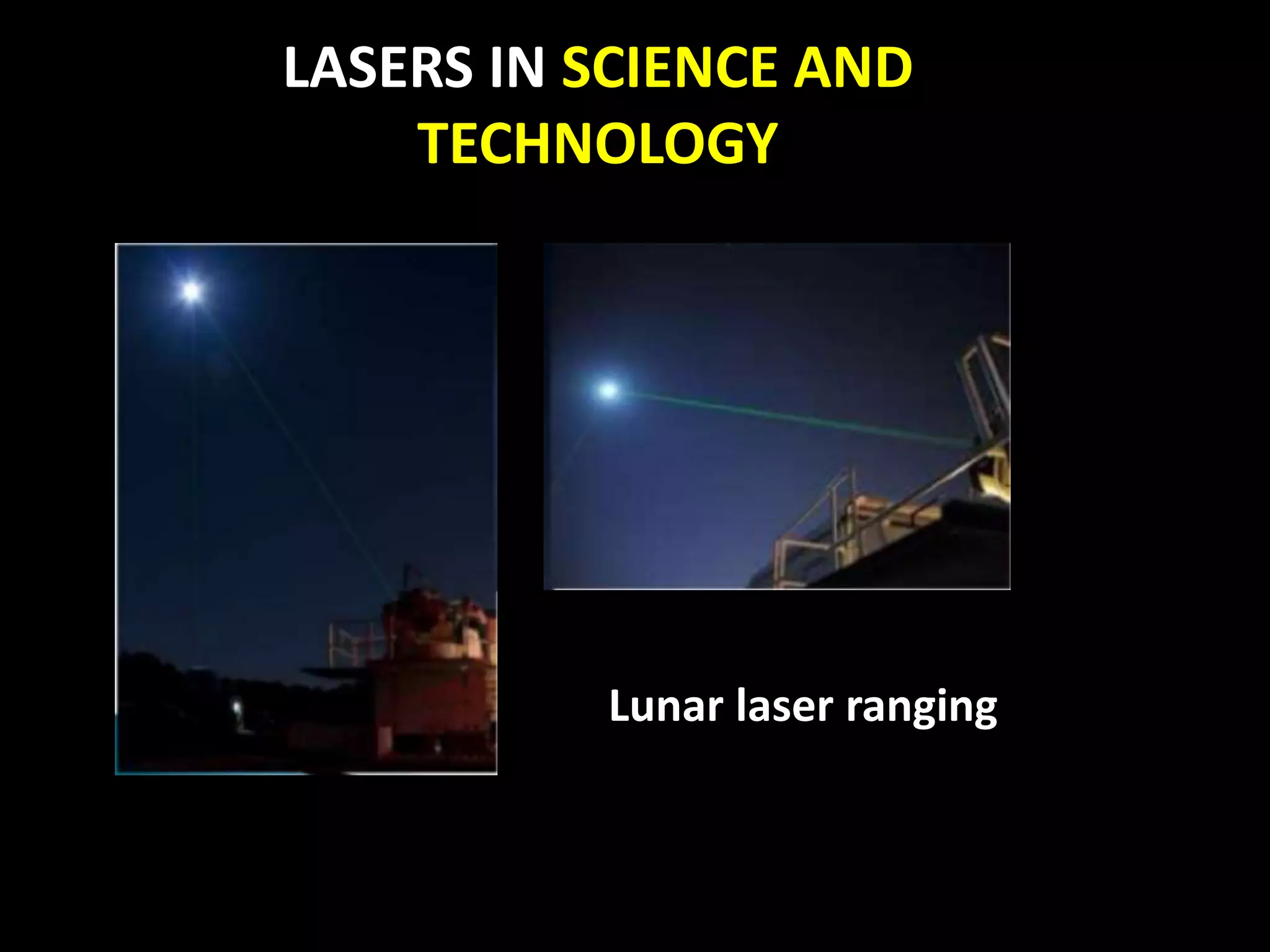
LASERS IN SCIENCE AND
TECHNOLOGY
Lunar laser ranging
LASERS IN COMMUNICATION
Laser communication systems are wireless
communications through the atmosphere.
Eg: Optical fiber communications, used particularly for long
distance optical data transmission, Free space optical
communications for inter satellite communications etc…
LASERS IN MILITARY
Thermal imaging
Night vision
Laser guns
LASERS IN HOLOGRAPHY
Holography is the production of holograms
by the use of lasers.
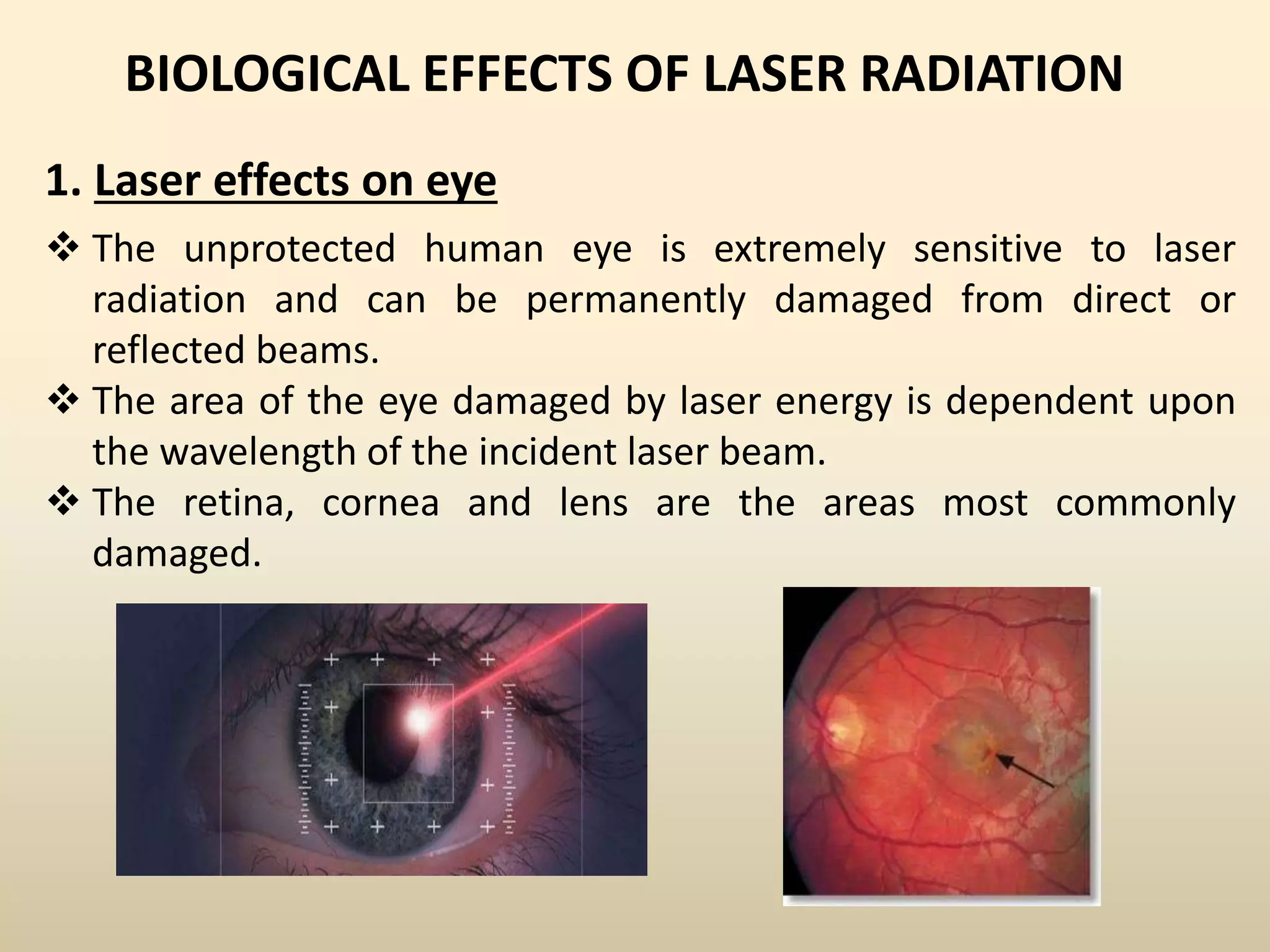
BIOLOGICAL EFFECTS OF LASER RADIATION
 The unprotected human eye is extremely sensitive to laser
radiation and can be permanently damaged from direct or
reflected beams.
 The area of the eye damaged by laser energy is dependent upon
the wavelength of the incident laser beam.
 The retina, cornea and lens are the areas most commonly
damaged.
1. Laser effects on eye
2. Laser effects on skin
 Thermal (burn) injury is the most
common cause of laser induced
skin damage.
 Thermal damage is generally
associated with laser operating at
exposure time greater than 10
microseconds and the wavelength
region near UV to infrared region.
• Retina: laser light in the visible to infrared spectrum can
cause damages to retina. These wavelengths are also known
as “retinal hazard region”
• Cornea and lens: laser light in the UV or far infrared spectrum
can cause damage to cornea and lens.
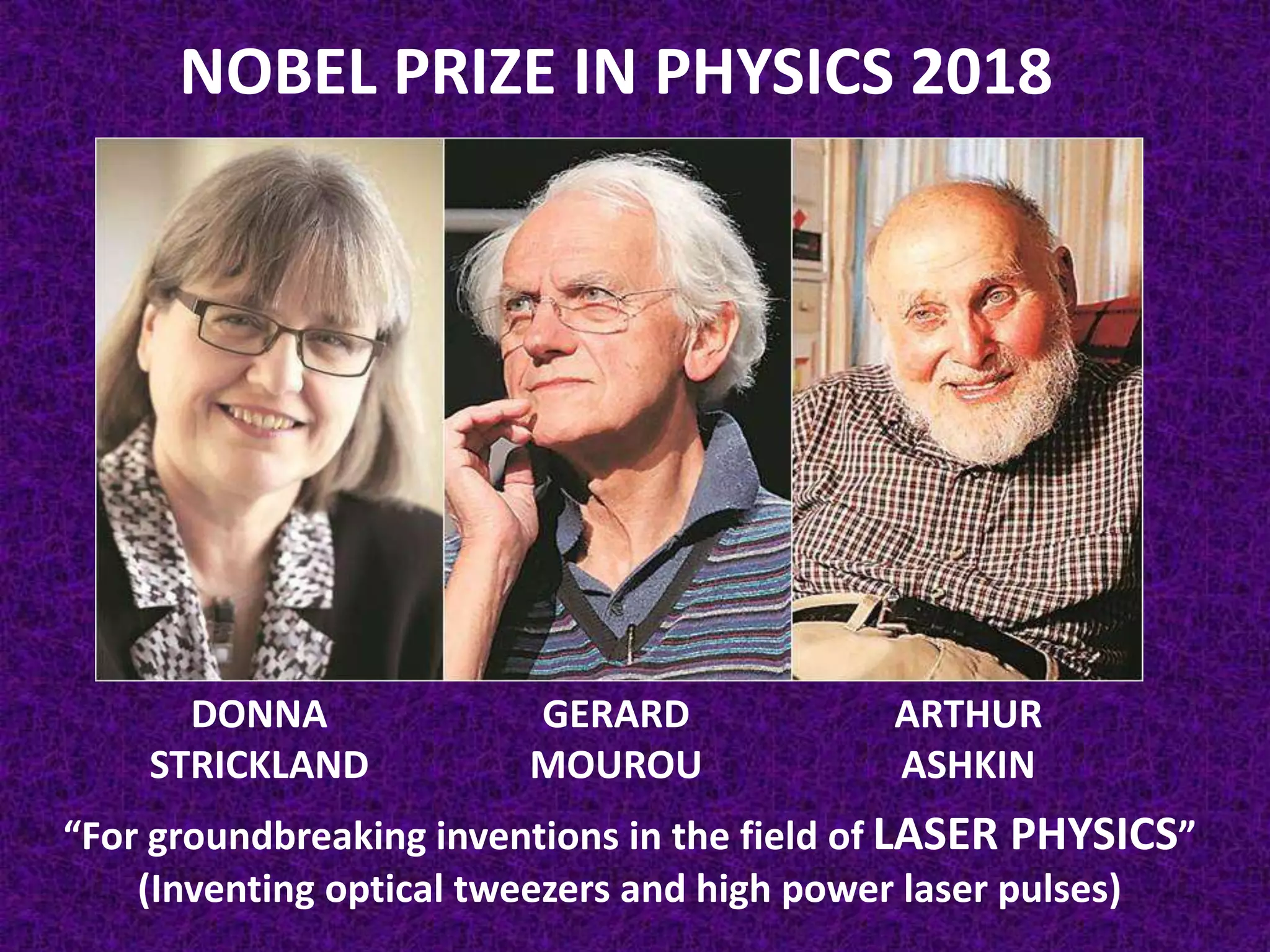
NOBEL PRIZE IN PHYSICS 2018
DONNA
STRICKLAND
GERARD
MOUROU
ARTHUR
ASHKIN
“For groundbreaking inventions in the field of LASER PHYSICS”
(Inventing optical tweezers and high power laser pulses)
THANKYOU

Lasers

  • 1.
  • 2.
    ight mplification by timulated mission of adiation Termcoined by Gordon Gould. One of the most influential technological achievements of the 20th century. Laser is an optical device that generates intense beam of coherent monochromatic light by Stimulated emission of radiation.
  • 3.
    LASER SPECTRUM Lasers operatein the ultraviolet, visible and infrared region
  • 4.
    HISTORY OF LASER In1917, Albert Einstein established the basic fundamentals to built a laser (quantum theory of light and photons & mechanism of stimulated emission). In 1954, the first maser was demonstrated by Charles Townes, A L Schawlow which worked in the microwave range. The first laser was designed by Theodore Maiman in 1960 and was made by ruby.
  • 5.
  • 6.
  • 7.
  • 8.
    1. COHERENCE : Thelight from a laser is said to be coherent, which means that all the light waves have the same frequency and move in phase together. Ordinary light in contrast is out of phase. ORDINARY LIGHT LASER LIGHT
  • 9.
    2. DIRECTIONALITY : Lasersemit light that is highly directional, that is, laser light is emitted as a relatively narrow beam in a specific direction. Ordinary light, such as from a light bulb, is emitted in many directions away from the source. ORDINARY LIGHT LASER LIGHT
  • 10.
    3. MONOCHROMATICITY : Thelight emitted from a laser is monochromatic, that is, it is of one colour or wavelength. In contrast, ordinary white light is a combination of many colours or wavelengths of light. 4. HIGH INTENSITY In laser, the light spreads in small region of space and in a small wavelength range. In an ordinary light source, light spreads out uniformly in all directions. Hence, laser light has greater intensity when compared to ordinary light.
  • 11.
  • 12.
    LASER MEDIUM ENERGY SOURCE OPTICALRESONATOR HIGH REFLECTANCE MIRROR (HR) OUTPUT COUPLER MIRROR (OC)
  • 13.
    1. Energy sourceor pump source • Part of laser system that provides energy to the laser medium. • Example of energy source include electric discharges, chemical reactions, light from another laser. • Type of energy source depends on laser medium. • For eg: Excimer laser uses chemical reactions as energy source Helium laser uses electric discharge etc… 2. Laser medium • Also known as active medium or gain medium. • System in which population inversion and hence stimulated emission takes place. • Laser medium determines the characteristics of laser light emitted. • Can be solid(Nd:YAG laser), liquid(dye laser) or gaseous(helium neon laser).
  • 14.
    3. Optical resonator •Laser medium is surrounded by two parallel mirrors which provide feedback of light. • One mirror is fully reflective (High Reflection mirror) and other is partially reflective (Output coupler). • Output coupler will allow some of the light to leave the optical cavity to produce laser output beam. • Two mirrors are whole called as OPTICAL RESONATOR.
  • 15.
    PRINCIPLES OF WORKINGOF A LAsERIn lasers, photons are interacted in 3 ways with atoms: 1. Absorption of radiation 2. Spontaneous emission 3. Stimulated emission ABSORPTION OF RADIATION • It is the process by which electrons in the lower energy state absorbs energy from photons to jump into higher energy level. • It occurs because these electrons in the lower energy state need extra energy to jump into higher energy level. • Extra energy is provided from various sources like heat, electric field or light etc.
  • 16.
    • Absorption oflight occurs only if the energy of incident photon exactly matches energy difference of the 2 energy levels. • This results in POPULATION INVERSION – it is the process of achieving greater number of electrons in higher energy state as compared to lower energy state. ENERGY LOWER ENERGY STATE HIGHER ENERGY STATE
  • 17.
    2. SPONTANEOUS EMISSION •It is the process by which electrons in the excited state return to the ground state by emitting photons. • Electron in excited state can stay only for a short period called as life time of excited electrons which is 10-8 sec. • Here electrons move naturally from one state to another and emission of photons also occur naturally which constitute ordinary incoherent light. ENERGY LOWER ENERGY STATE HIGHER ENERGY STATE PHOTONS
  • 18.
    3. STIMULATED EMISSION •It is the process by which incident photon interacts with the excited electron and forces it to return to the ground state. • Hence light energy is supplied directly to the excited electron, so electrons in the excited state need not wait for completion of their lifetime. • Here 2 photons are emitted, one is due to incident photon and another is due to energy release of excited electron. • All emitted photons have the same energy same frequency and travel in same direction. • Number of photons emitted depends on number of electrons in higher energy level and incident light intensity.
  • 19.
  • 20.
  • 21.
  • 30.
  • 31.
  • 32.
  • 33.
  • 34.
    1. Solid statelaser • Uses solid as a laser medium – glass or crystalline materials are used. • Materials such as Sapphire (Al2O3), Neodymium doped yttrium aluminium garnet (Nd:YAG), Neodymium doped glass (Nd:Glass) etc are used as materials for laser medium. • Nd:YAG is the most commonly used. • The first solid state laser was Ruby laser – here ruby crystal is the medium. RUBY LASER Nd:YAG LASER
  • 35.
    2. Gas laser •Laser medium is in the gaseous state. • Type of gas used can determine the laser efficiency. • Types : Helium Neon laser, Argon laser, carbon monoxide laser, Excimer lasers etc. Helium Neon laser CO2 laser
  • 36.
    3. Liquid laser •Uses liquid as laser medium. • Most common is Dye laser – organic dye as laser medium. DYE LASER
  • 37.
    4.Semiconductor laser • Alsoknown as LASER DIODE. • Play an important role in our everyday life. • These lasers are very cheap, compact size, and consume low power.
  • 38.
  • 39.
    LASERS IN MEDICINE Bloodlesssurgery Fiber optic endoscope to detect ulcers in the intestine . Lasers are used extensively in the treatment of eye diseases particularly to reattach a detached retina.
  • 40.
    Used to removecaries or decayed portion of teeth.  Liver and lung diseases could be treated using lasers.  To destroy cancerous and precancerous cells.  Used to study internal structure of microorganisms and cells.
  • 41.
    To break upgall stones and kidney stones. To remove plague clogging human arteries. Lasers are used in cosmetic treatments such as acne treatment, hair removal etc…
  • 42.
    LASERS IN INDUSTRY #For precision measurements and leveling Latching tool Milling tool
  • 43.
    Laser light isused to collect the information about the prefixed prizes of various products in shops and business establishments from the barcode printed on the product. Welding and cutting of metal
  • 44.
    LASERS IN SCIENCEAND TECHNOLOGY Lunar laser ranging
  • 45.
    LASERS IN COMMUNICATION Lasercommunication systems are wireless communications through the atmosphere. Eg: Optical fiber communications, used particularly for long distance optical data transmission, Free space optical communications for inter satellite communications etc…
  • 46.
    LASERS IN MILITARY Thermalimaging Night vision Laser guns
  • 47.
    LASERS IN HOLOGRAPHY Holographyis the production of holograms by the use of lasers.
  • 48.
    BIOLOGICAL EFFECTS OFLASER RADIATION  The unprotected human eye is extremely sensitive to laser radiation and can be permanently damaged from direct or reflected beams.  The area of the eye damaged by laser energy is dependent upon the wavelength of the incident laser beam.  The retina, cornea and lens are the areas most commonly damaged. 1. Laser effects on eye
  • 49.
    2. Laser effectson skin  Thermal (burn) injury is the most common cause of laser induced skin damage.  Thermal damage is generally associated with laser operating at exposure time greater than 10 microseconds and the wavelength region near UV to infrared region. • Retina: laser light in the visible to infrared spectrum can cause damages to retina. These wavelengths are also known as “retinal hazard region” • Cornea and lens: laser light in the UV or far infrared spectrum can cause damage to cornea and lens.
  • 50.
    NOBEL PRIZE INPHYSICS 2018 DONNA STRICKLAND GERARD MOUROU ARTHUR ASHKIN “For groundbreaking inventions in the field of LASER PHYSICS” (Inventing optical tweezers and high power laser pulses)
  • 51.