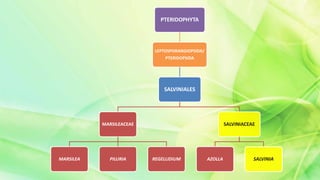
PTERIDOPHYTA
LEPTOSPORANGIOPSIDA/
PTERIDOPSIDA
SALVINIALES
MARSILEACEAE
MARSILEA PILURIA REGELLIDIUM
SALVINIACEAE
AZOLLA SALVINIA
Salvinia spp.
HABITAT:
Still and slow moving water of
lakes, ponds, reservoirs, rice
fields etc
Grow best- nutrient rich water
Can tolerate salinity, mild
temperature, frost But not
prolonged exposed.
Description:
Stems: Horizontal, dichotomously branched rhizomes, protostelic and aerenchymatous
Leaves: simple, dimorphic (fertile different from sterile), aerenchymatous, at maturity in whorls of three (2
floating, 1 submerged and root-like), blades round to oblong, entire with water repellent trichomes in upper
surface
Egg beater shaped hairs – diverge into 4 branches near the top and fuse together at the tips.
The egg beater
shaped hairs
Roots: No true roots,
submerged leaves—function as
roots, finely dissected into several
filaments, hair-like projections
along the length.
Acts as a balances, also absorbs
nourishment from water
 roots short-High nutrient
water,
 Roots long - nutrient deficient
water…
 Associated with N2 fixing BGA
T.S OF LEAF
E &F T.S OF
RHIZOME
Reproductive structure:
• Some filaments of leaves may develop
chains or clusters of tiny ovoid spore
bearing structures (sporocarp)
• Sporocarps: sporocarp which is
interpreted as modified sorus with
the indusium functioning as
protective wall is globose,
heterosporous, each bearing either
one megasporangium or several
microsporangia at maturity.
A. SPOROCARP
B.
MICROGAMETOPHYE
ANTHREDIUM
D.
SPERMATOZOID
LIFE CYCLE
1. Heterosporus
2. Keep sporangia in sporocarp covered by indusium
3. Sporocarp= 1.Megasporangia 2. Microsporangia
4. Megsporangia 8 microsporocytes---------32 megaspores only
one matures and viableenlarges,fills the whole megasporangia
5. Both types develops plasmodial tapetum—solidifies– lobed body
massulae above spore
6. No annulus.. Sporocarp wall degenerate– spores germinates
meiosis
Gametophyte:
EDOSPOROUS
1. Male gametophyte developed by microspore bear anthredia
in 2 groups
2. Female gametophyte floats to the surface and germinates.
-photosynthetic
-form several archegonia when embryos grows…
LIFE CYCLE IN SALVINIA
Economic Importance
• Use to remove excess nutrients ,other pollutants from
water. E.g S.molesta
• Dried plants  mulching, fodder
• Paper-making, biofuel, sewage treatment
• Handicrafts
• Bio-gas regeneration, bio-fertilization
• S. natans, or water moss, is used as a free floating
ornamental plant for aquariums and ponds,
• helps to purify waste or contaminated waters  remove
organic material from eutrophicated water.
• Reaserchers at Stephan F. Austin St. Nacogdoches, Texas
Extract of giant Salvinia
 inhibit growth of Human Cancer cells without destroying
nearby healthy ones.
ECOLOGICAL IMPACT
• Cut off lights to Aquatic plants, animal
• Reduce Oxygen content and degrade water quality—fish,etc
• Prevents natural exchange of gases between the air and body of
water.
– Causes waterway— stagnant,
– Kill any plant, insects trapped under its growth
• Problem to migratory birds fail to recognize the infested waterway
• Ideal conditions for breeding mosquitos —cause diseases
• Problem to Humans---
– Causes flood
– Irrigation
– Conservation of endangered species.
CONTROL
1. BIOLOGICAL CONTROL
A tiny weewil (Cyrtobagous salviniae) feeds on
it.
2. MECHANICAL CONTROL
 Machines, By hand, Harvesting equipment.
 once removed--- burnt, dried…
3. CHEMICAL CONTROL
 Fluridon- use to kill the Salvinia.
4. PREVENTION
Selling, spreading, transportation etc
REFERENCES
1. Aquatic and Riparian Weeds of West, Joseph M. Ditomaso et
al., University of California., 2003
2. Aquatic pest control, University of California, 2001
3. The families and Genera of Vascular plants, K. Kubiizki, Vol I,
2000, Springer, UK
4. Cryptogamic Botany, Vol 2, Gilbert M. Smith, New Delhi, 1955
5. Pteridophyta,Sanjay Singh , 1st Edition, 2008
THANK YOU

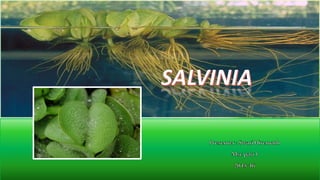
Salvinia

  • 2.
  • 3.
    Salvinia spp. HABITAT: Still andslow moving water of lakes, ponds, reservoirs, rice fields etc Grow best- nutrient rich water Can tolerate salinity, mild temperature, frost But not prolonged exposed.
  • 4.
    Description: Stems: Horizontal, dichotomouslybranched rhizomes, protostelic and aerenchymatous Leaves: simple, dimorphic (fertile different from sterile), aerenchymatous, at maturity in whorls of three (2 floating, 1 submerged and root-like), blades round to oblong, entire with water repellent trichomes in upper surface Egg beater shaped hairs – diverge into 4 branches near the top and fuse together at the tips. The egg beater shaped hairs
  • 5.
    Roots: No trueroots, submerged leaves—function as roots, finely dissected into several filaments, hair-like projections along the length. Acts as a balances, also absorbs nourishment from water  roots short-High nutrient water,  Roots long - nutrient deficient water…  Associated with N2 fixing BGA
  • 6.
    T.S OF LEAF E&F T.S OF RHIZOME
  • 7.
    Reproductive structure: • Somefilaments of leaves may develop chains or clusters of tiny ovoid spore bearing structures (sporocarp) • Sporocarps: sporocarp which is interpreted as modified sorus with the indusium functioning as protective wall is globose, heterosporous, each bearing either one megasporangium or several microsporangia at maturity.
  • 8.
  • 9.
    LIFE CYCLE 1. Heterosporus 2.Keep sporangia in sporocarp covered by indusium 3. Sporocarp= 1.Megasporangia 2. Microsporangia 4. Megsporangia 8 microsporocytes---------32 megaspores only one matures and viableenlarges,fills the whole megasporangia 5. Both types develops plasmodial tapetum—solidifies– lobed body massulae above spore 6. No annulus.. Sporocarp wall degenerate– spores germinates meiosis
  • 10.
    Gametophyte: EDOSPOROUS 1. Male gametophytedeveloped by microspore bear anthredia in 2 groups 2. Female gametophyte floats to the surface and germinates. -photosynthetic -form several archegonia when embryos grows…
  • 11.
    LIFE CYCLE INSALVINIA
  • 12.
    Economic Importance • Useto remove excess nutrients ,other pollutants from water. E.g S.molesta • Dried plants  mulching, fodder • Paper-making, biofuel, sewage treatment • Handicrafts • Bio-gas regeneration, bio-fertilization • S. natans, or water moss, is used as a free floating ornamental plant for aquariums and ponds, • helps to purify waste or contaminated waters  remove organic material from eutrophicated water.
  • 13.
    • Reaserchers atStephan F. Austin St. Nacogdoches, Texas Extract of giant Salvinia  inhibit growth of Human Cancer cells without destroying nearby healthy ones.
  • 14.
    ECOLOGICAL IMPACT • Cutoff lights to Aquatic plants, animal • Reduce Oxygen content and degrade water quality—fish,etc • Prevents natural exchange of gases between the air and body of water. – Causes waterway— stagnant, – Kill any plant, insects trapped under its growth • Problem to migratory birds fail to recognize the infested waterway • Ideal conditions for breeding mosquitos —cause diseases
  • 15.
    • Problem toHumans--- – Causes flood – Irrigation – Conservation of endangered species.
  • 16.
    CONTROL 1. BIOLOGICAL CONTROL Atiny weewil (Cyrtobagous salviniae) feeds on it. 2. MECHANICAL CONTROL  Machines, By hand, Harvesting equipment.  once removed--- burnt, dried… 3. CHEMICAL CONTROL  Fluridon- use to kill the Salvinia. 4. PREVENTION Selling, spreading, transportation etc
  • 17.
    REFERENCES 1. Aquatic andRiparian Weeds of West, Joseph M. Ditomaso et al., University of California., 2003 2. Aquatic pest control, University of California, 2001 3. The families and Genera of Vascular plants, K. Kubiizki, Vol I, 2000, Springer, UK 4. Cryptogamic Botany, Vol 2, Gilbert M. Smith, New Delhi, 1955 5. Pteridophyta,Sanjay Singh , 1st Edition, 2008
  • 18.