Transmitting & Receiving
In Communication
Systmems
Communication Concepts
• Transmission of data
• Protocols & Handshaking
• Networks
• LANs & WANs
• Topologies
• Network Access Methods
Transmission of Data
• Data Transmission is the physical
transfer of data (sending and receiving)
over a point-to-point or point-to-
multipoint communication channel.
• In order for data transmission to occur,
there must be a transmission line, also
called transmission channel or channel,
between the two machines.
Protocols & Handshaking
• Protocol- A communications protocol
defines the rules for sending blocks of
data (each known as a Protocol Data
Unit (PDU)) from one node in a
network to another node
• Handshaking- It is usually a process
that takes place when a computer is
about to communicate with a foreign
device( e.g. a modem, printer, or
network server) to establish rules for
communication.
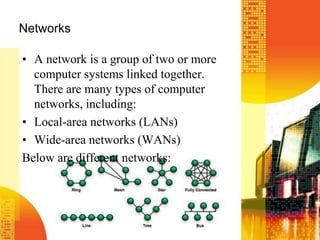
Networks
• A network is a group of two or more
computer systems linked together.
There are many types of computer
networks, including:
• Local-area networks (LANs)
• Wide-area networks (WANs)
Below are different networks:
LANs & WANs
• Local-area networks (LANs) : The
computers are geographically close
together (that is, in the same building).
• Wide-area networks (WANs) : The
computers are farther apart and are
connected by telephone lines or radio
waves.
Topologies
• Star Topology : Where a central unit
provides a link through which a group
of smaller computers and devices is
connected
• Bus Topology : Each computer in the
network is responsible for carrying out
its own communications without the aid
of a central unit.
• Ring Network : Each computer is
connected to the next two other
computers in a closed loop.
Network Access Methods
• The set of rules that defines how a
computer puts data onto the network
cable and takes data from the cable is
called an access method. Once data is
moving on the network, access methods
help to regulate the flow of network
traffic.
Network Hardware
• NICs
• Servers
• Routers & Switches
• Bridges & Gateways
• Hubs
• Transmission Media
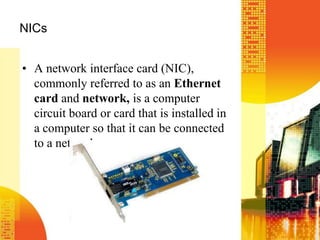
NICs
• A network interface card (NIC),
commonly referred to as an Ethernet
card and network, is a computer
circuit board or card that is installed in
a computer so that it can be connected
to a network.
Servers
• A server is a computer program that
provides services to other computer
programs (and their users) in the same
or other computers.
• For example a web server serves up
web pages.
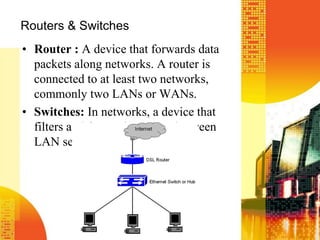
Routers & Switches
• Router : A device that forwards data
packets along networks. A router is
connected to at least two networks,
commonly two LANs or WANs.
• Switches: In networks, a device that
filters and forwards packets between
LAN segments
Bridges & Gateways
• Bridge: A connecting device which has
it’s own processor, memory and two
NIC cards, to connect two portions of a
network. Facilitates host to host
communication
• Gateway: A data communication
device that provides a remote network
with connectivity to a host network
Hubs
• A hub is a connection appliance which
allows communication to flow between
multiple segments of a LAN. A hub
connects computers so that data or
packets of information can be shared.
• A hub usually includes a switch and
sometimes a router.
Transmission Media
• Transmission media is the physical
system used to carry a communication
signal from one system to another.
• There are many different types of
transmission media, the most popular
being twisted-pair wire (normal
electrical wire), coaxial cable (the type
of cable used for cable television), and
fiber optic cable (cables made out of
glass).
Network Software
• NOSs
• Network Operating System Tasks
• Logon & Logoff Procedures
• Intranet & Extranet
NOSs
• Network Operating System, also
referred to as the Dialoguer, is the
software that runs on a server and
enables the server to manage data,
users, groups, security, applications,
and other networking functions.
Network Operating System Tasks
• Network Operating System are
designed to allow shared file and
printer access among multiple
computers in a network.
• E.g. of popular network operating
systems include Microsoft Windows
Server 2003/2008.
Intranet & Extranet
Intranets and extranets are
communication tools designed to enable
easy information sharing within
workgroups.
• Intranet: The generic term for a
collection of private computer
networks within an organization.
• Extranet: A computer network that
allows controlled access from the
outside for specific business or
educational purposes.
THE END

Communication systems

  • 1.
    Transmitting & Receiving InCommunication Systmems
  • 2.
    Communication Concepts • Transmissionof data • Protocols & Handshaking • Networks • LANs & WANs • Topologies • Network Access Methods
  • 3.
    Transmission of Data •Data Transmission is the physical transfer of data (sending and receiving) over a point-to-point or point-to- multipoint communication channel. • In order for data transmission to occur, there must be a transmission line, also called transmission channel or channel, between the two machines.
  • 4.
    Protocols & Handshaking •Protocol- A communications protocol defines the rules for sending blocks of data (each known as a Protocol Data Unit (PDU)) from one node in a network to another node • Handshaking- It is usually a process that takes place when a computer is about to communicate with a foreign device( e.g. a modem, printer, or network server) to establish rules for communication.
  • 5.
    Networks • A networkis a group of two or more computer systems linked together. There are many types of computer networks, including: • Local-area networks (LANs) • Wide-area networks (WANs) Below are different networks:
  • 6.
    LANs & WANs •Local-area networks (LANs) : The computers are geographically close together (that is, in the same building). • Wide-area networks (WANs) : The computers are farther apart and are connected by telephone lines or radio waves.
  • 7.
    Topologies • Star Topology: Where a central unit provides a link through which a group of smaller computers and devices is connected • Bus Topology : Each computer in the network is responsible for carrying out its own communications without the aid of a central unit. • Ring Network : Each computer is connected to the next two other computers in a closed loop.
  • 8.
    Network Access Methods •The set of rules that defines how a computer puts data onto the network cable and takes data from the cable is called an access method. Once data is moving on the network, access methods help to regulate the flow of network traffic.
  • 9.
    Network Hardware • NICs •Servers • Routers & Switches • Bridges & Gateways • Hubs • Transmission Media
  • 10.
    NICs • A networkinterface card (NIC), commonly referred to as an Ethernet card and network, is a computer circuit board or card that is installed in a computer so that it can be connected to a network.
  • 11.
    Servers • A serveris a computer program that provides services to other computer programs (and their users) in the same or other computers. • For example a web server serves up web pages.
  • 12.
    Routers & Switches •Router : A device that forwards data packets along networks. A router is connected to at least two networks, commonly two LANs or WANs. • Switches: In networks, a device that filters and forwards packets between LAN segments
  • 13.
    Bridges & Gateways •Bridge: A connecting device which has it’s own processor, memory and two NIC cards, to connect two portions of a network. Facilitates host to host communication • Gateway: A data communication device that provides a remote network with connectivity to a host network
  • 14.
    Hubs • A hubis a connection appliance which allows communication to flow between multiple segments of a LAN. A hub connects computers so that data or packets of information can be shared. • A hub usually includes a switch and sometimes a router.
  • 15.
    Transmission Media • Transmissionmedia is the physical system used to carry a communication signal from one system to another. • There are many different types of transmission media, the most popular being twisted-pair wire (normal electrical wire), coaxial cable (the type of cable used for cable television), and fiber optic cable (cables made out of glass).
  • 16.
    Network Software • NOSs •Network Operating System Tasks • Logon & Logoff Procedures • Intranet & Extranet
  • 17.
    NOSs • Network OperatingSystem, also referred to as the Dialoguer, is the software that runs on a server and enables the server to manage data, users, groups, security, applications, and other networking functions.
  • 18.
    Network Operating SystemTasks • Network Operating System are designed to allow shared file and printer access among multiple computers in a network. • E.g. of popular network operating systems include Microsoft Windows Server 2003/2008.
  • 19.
    Intranet & Extranet Intranetsand extranets are communication tools designed to enable easy information sharing within workgroups. • Intranet: The generic term for a collection of private computer networks within an organization. • Extranet: A computer network that allows controlled access from the outside for specific business or educational purposes.
  • 20.