Lecture-1
Introductory Concepts of Data
Communication
Basic Communication Model
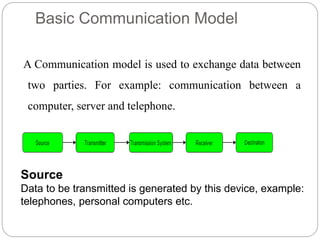
A Communication model is used to exchange data between
two parties. For example: communication between a
computer, server and telephone.
Source
Data to be transmitted is generated by this device, example:
telephones, personal computers etc.
Basic Communication Model
 Transmitter
The data generated by the source system is not directly
transmitted in the form its generated. The transmitter
transforms and encodes the data in such a form to
produce electromagnetic waves or signals.
 Transmission System
A transmission system can be a single transmission line
or a complex network connecting source and destination.
 Receiver
Receiver accepts the signal from the transmission system
and converts it into a form which is easily managed by the
destination device.
 Destination
Destination receives the incoming data from the receiver
Components of Data Communication
1. Message: It is the information to be delivered.
2. Sender: Sender is the person who is sending the message.
3. Receiver: Receiver is the person to whom the message is
being sent to.
4. Medium: It is the medium through which the message is
sent. For example: A Modem.
5. Protocol: These are some set of rules which govern data
communication.
What is a Computer Network?
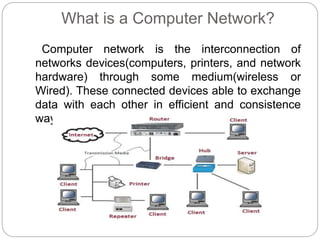
Computer network is the interconnection of
networks devices(computers, printers, and network
hardware) through some medium(wireless or
Wired). These connected devices able to exchange
data with each other in efficient and consistence
way.
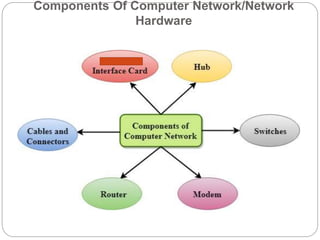
Components Of Computer Network/Network
Hardware
Network Interface Card
NIC is a device that helps the computer to
communicate with another device. The network
interface card contains the hardware addresses, the
data-link layer protocol use this address to identify the
system on the network so that it transfers the data to
the correct destination. NIC performs some activates
such as sending and receiving data as well as
controlling data flow between linked all terminals over
the network. NIC is capable to send and receive data
on (10,100 to 1000 Mb/s) transfer rate. All NIC contain
unique id (MAC address) that is programmed on chip,
and it is embedded on the network interface card.
There are two types of NIC:
•Wireless NIC: All the modern laptops use the wireless NIC. In Wireless
NIC, a connection is made using the antenna that employs the radio
wave technology.
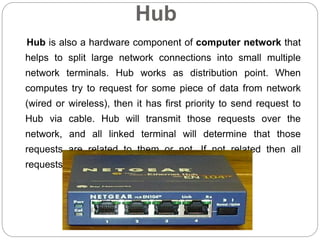
Hub
Hub is also a hardware component of computer network that
helps to split large network connections into small multiple
network terminals. Hub works as distribution point. When
computes try to request for some piece of data from network
(wired or wireless), then it has first priority to send request to
Hub via cable. Hub will transmit those requests over the
network, and all linked terminal will determine that those
requests are related to them or not. If not related then all
requests will be trashed.
Modem
Modem stands for “Modulator–Demodulator“. Main
objective of using of Modem in computer network is
to move data from one computer terminal to another
computer terminal via telephone line system.
Types of modem are:
 Ethernet modem – It is connected into NIC in the
computer system.
 Wireless modem – Wireless modem contains small
antenna, and it is connected with computer terminal
through wireless network.
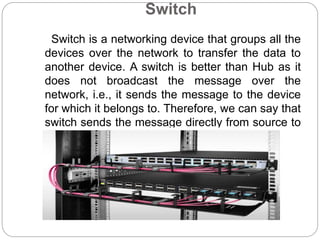
Switch
Switch is a networking device that groups all the
devices over the network to transfer the data to
another device. A switch is better than Hub as it
does not broadcast the message over the
network, i.e., it sends the message to the device
for which it belongs to. Therefore, we can say that
switch sends the message directly from source to
the destination.
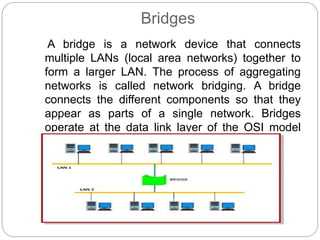
Bridges
A bridge is a network device that connects
multiple LANs (local area networks) together to
form a larger LAN. The process of aggregating
networks is called network bridging. A bridge
connects the different components so that they
appear as parts of a single network. Bridges
operate at the data link layer of the OSI model
and hence also referred as Layer 2 switches.
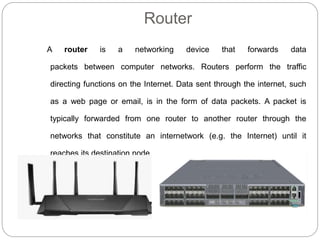
Router
A router is a networking device that forwards data
packets between computer networks. Routers perform the traffic
directing functions on the Internet. Data sent through the internet, such
as a web page or email, is in the form of data packets. A packet is
typically forwarded from one router to another router through the
networks that constitute an internetwork (e.g. the Internet) until it
reaches its destination node.
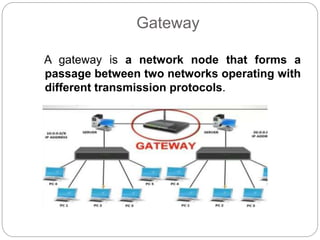
Gateway
A gateway is a network node that forms a
passage between two networks operating with
different transmission protocols.
Repeater
 Repeater performs all activates on the physical
layer of the OSI model. It is very helpful to
regain or replicate analog or digital signals, which
are distorted by transmission loss. So it is known
as “Signal Booster”.
Network Software
Network software is defined as a wide range of
software that streamlines the operations,
design, monitoring, and implementation of
computer networks.
Functions of network software
 User management allows administrators to add
or remove users from the network. This is
particularly useful when hiring or relieving
 File management lets administrators decide the
location of data storage and control user access
to that data.
 Access enables users to enjoy uninterrupted
access to network resources.
 Network security systems assist administrators
in looking after security and preventing data
breaches.

Introductory Concepts of Data Communication-Lecture-1.pptx

  • 1.
  • 2.
    Basic Communication Model ACommunication model is used to exchange data between two parties. For example: communication between a computer, server and telephone. Source Data to be transmitted is generated by this device, example: telephones, personal computers etc.
  • 3.
    Basic Communication Model Transmitter The data generated by the source system is not directly transmitted in the form its generated. The transmitter transforms and encodes the data in such a form to produce electromagnetic waves or signals.  Transmission System A transmission system can be a single transmission line or a complex network connecting source and destination.  Receiver Receiver accepts the signal from the transmission system and converts it into a form which is easily managed by the destination device.  Destination Destination receives the incoming data from the receiver
  • 4.
    Components of DataCommunication 1. Message: It is the information to be delivered. 2. Sender: Sender is the person who is sending the message. 3. Receiver: Receiver is the person to whom the message is being sent to. 4. Medium: It is the medium through which the message is sent. For example: A Modem. 5. Protocol: These are some set of rules which govern data communication.
  • 5.
    What is aComputer Network? Computer network is the interconnection of networks devices(computers, printers, and network hardware) through some medium(wireless or Wired). These connected devices able to exchange data with each other in efficient and consistence way.
  • 6.
    Components Of ComputerNetwork/Network Hardware
  • 7.
    Network Interface Card NICis a device that helps the computer to communicate with another device. The network interface card contains the hardware addresses, the data-link layer protocol use this address to identify the system on the network so that it transfers the data to the correct destination. NIC performs some activates such as sending and receiving data as well as controlling data flow between linked all terminals over the network. NIC is capable to send and receive data on (10,100 to 1000 Mb/s) transfer rate. All NIC contain unique id (MAC address) that is programmed on chip, and it is embedded on the network interface card. There are two types of NIC: •Wireless NIC: All the modern laptops use the wireless NIC. In Wireless NIC, a connection is made using the antenna that employs the radio wave technology.
  • 8.
    Hub Hub is alsoa hardware component of computer network that helps to split large network connections into small multiple network terminals. Hub works as distribution point. When computes try to request for some piece of data from network (wired or wireless), then it has first priority to send request to Hub via cable. Hub will transmit those requests over the network, and all linked terminal will determine that those requests are related to them or not. If not related then all requests will be trashed.
  • 9.
    Modem Modem stands for“Modulator–Demodulator“. Main objective of using of Modem in computer network is to move data from one computer terminal to another computer terminal via telephone line system. Types of modem are:  Ethernet modem – It is connected into NIC in the computer system.  Wireless modem – Wireless modem contains small antenna, and it is connected with computer terminal through wireless network.
  • 10.
    Switch Switch is anetworking device that groups all the devices over the network to transfer the data to another device. A switch is better than Hub as it does not broadcast the message over the network, i.e., it sends the message to the device for which it belongs to. Therefore, we can say that switch sends the message directly from source to the destination.
  • 11.
    Bridges A bridge isa network device that connects multiple LANs (local area networks) together to form a larger LAN. The process of aggregating networks is called network bridging. A bridge connects the different components so that they appear as parts of a single network. Bridges operate at the data link layer of the OSI model and hence also referred as Layer 2 switches.
  • 12.
    Router A router isa networking device that forwards data packets between computer networks. Routers perform the traffic directing functions on the Internet. Data sent through the internet, such as a web page or email, is in the form of data packets. A packet is typically forwarded from one router to another router through the networks that constitute an internetwork (e.g. the Internet) until it reaches its destination node.
  • 13.
    Gateway A gateway isa network node that forms a passage between two networks operating with different transmission protocols.
  • 14.
    Repeater  Repeater performsall activates on the physical layer of the OSI model. It is very helpful to regain or replicate analog or digital signals, which are distorted by transmission loss. So it is known as “Signal Booster”.
  • 15.
    Network Software Network softwareis defined as a wide range of software that streamlines the operations, design, monitoring, and implementation of computer networks.
  • 16.
    Functions of networksoftware  User management allows administrators to add or remove users from the network. This is particularly useful when hiring or relieving  File management lets administrators decide the location of data storage and control user access to that data.  Access enables users to enjoy uninterrupted access to network resources.  Network security systems assist administrators in looking after security and preventing data breaches.