Communication Skills Training Presented by: Ghazala Butt Human Resources Manager
Objectives You would be able to: Know the difference between verbal and non-verbal communication Understand Seven Essential Communication Skills Careful and active listening Express feelings and thoughts clearly and completely Know your verbal communication strengths Improve your verbal communication skills
Definition What is Communication  ????? Communication is the management of messages for the purpose of creating meaning to interact with each other, with clarity & ease The act of meaning something, of conveying an attitude (belief, desire, intention, regret, etc.) to others, by  linguistic  or  other means The exchange of thoughts, messages, or information, as by  speech, signals, writing , or  behavior
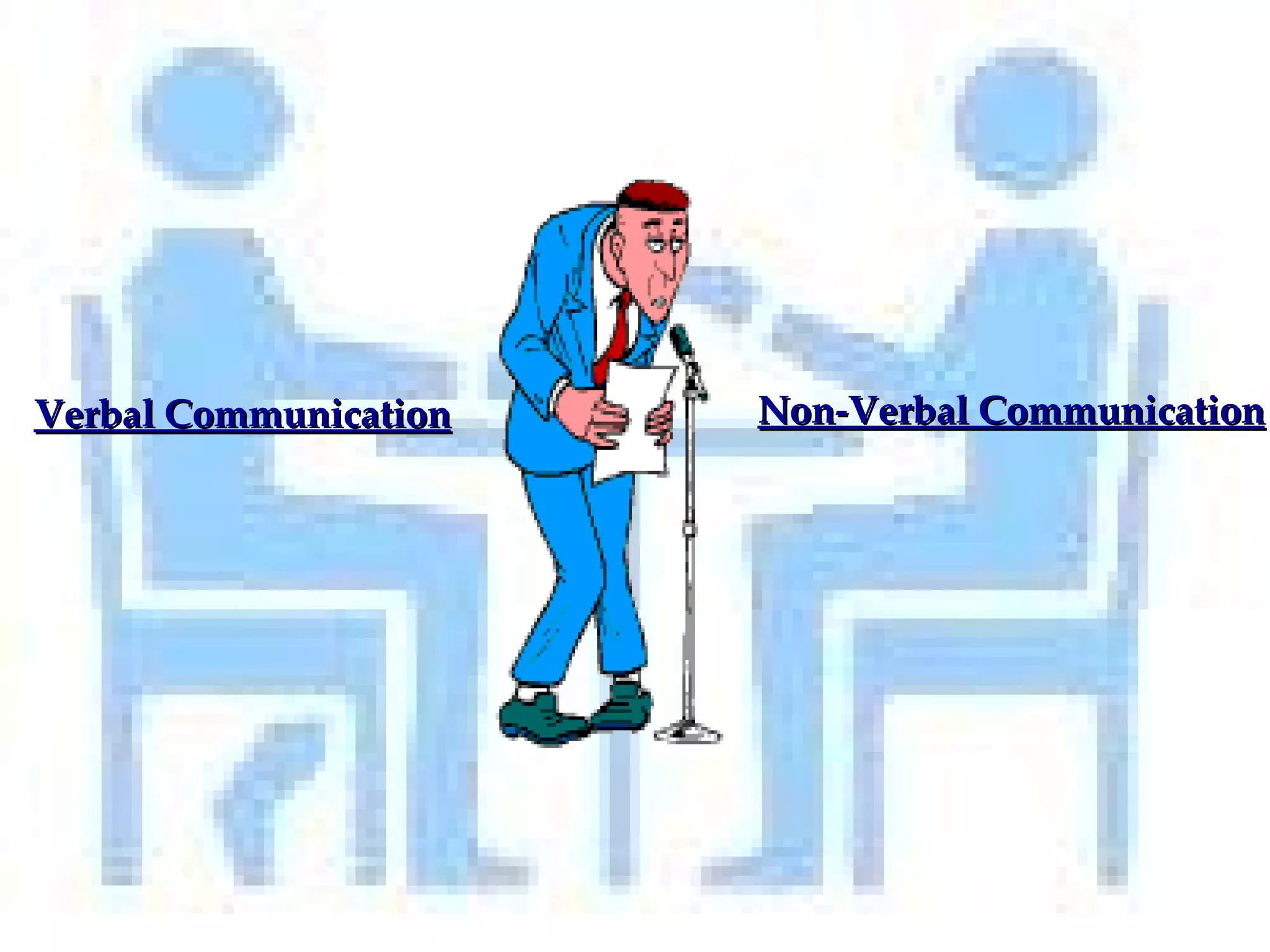
Verbal Communication Non-Verbal Communication
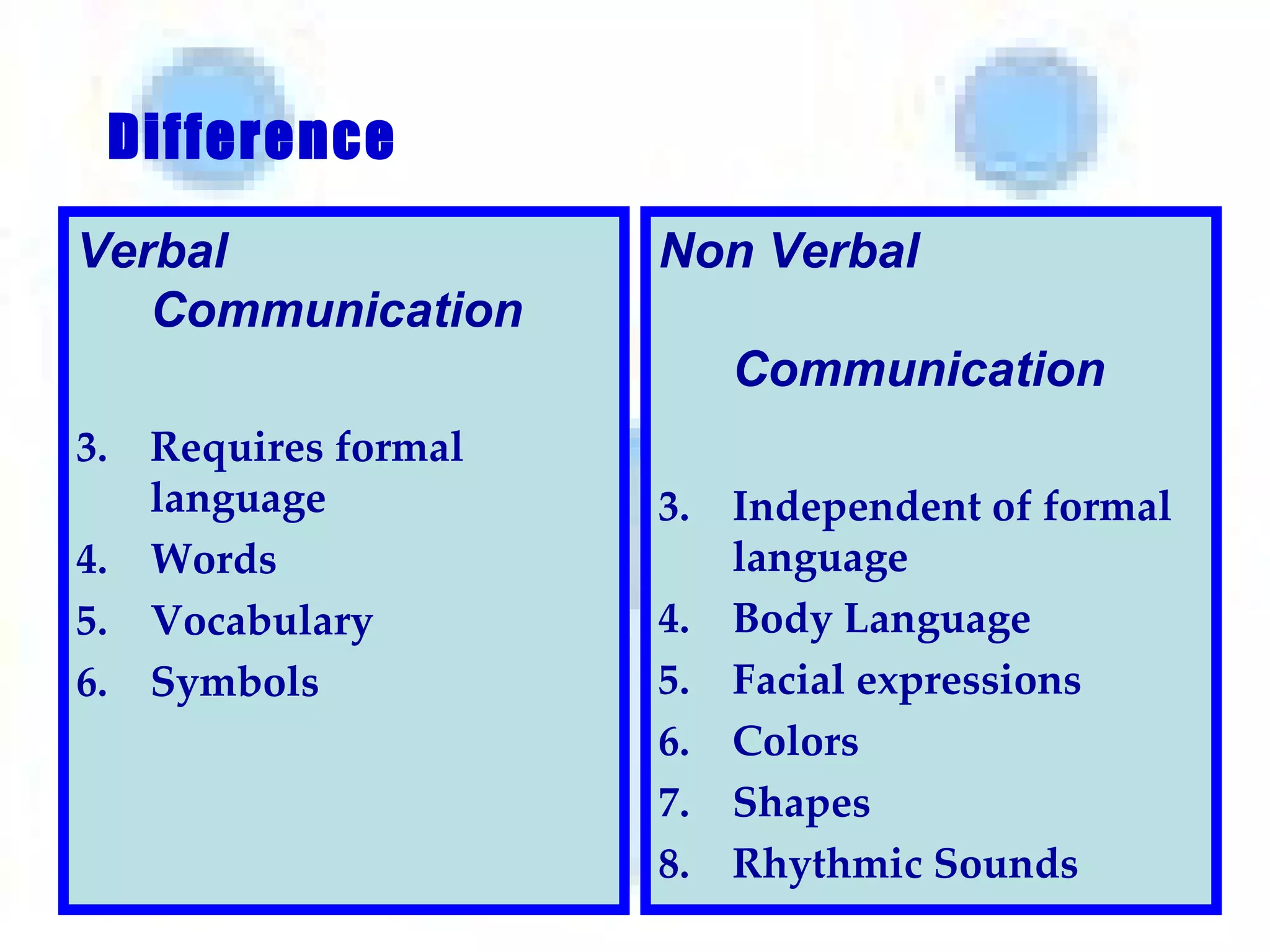
Verbal Communication Requires formal language Words Vocabulary Symbols Non Verbal  Communication Independent of formal language Body Language Facial expressions Colors Shapes Rhythmic Sounds Difference
Verbal Communication Training Focus
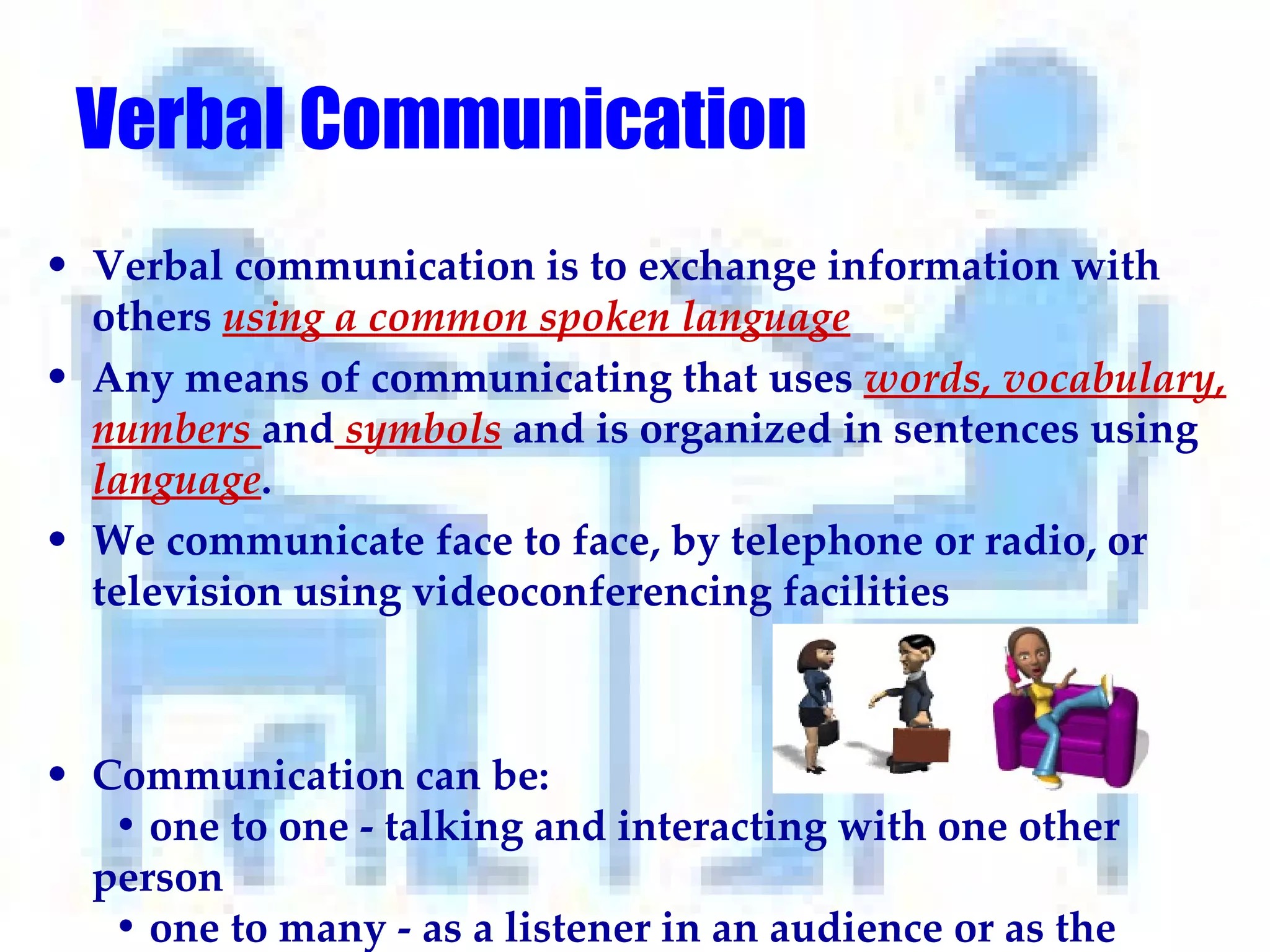
Verbal Communication   Verbal communication is to exchange information with others  using a common spoken language Any means of communicating that uses  words, vocabulary, numbers  and  symbols  and is organized in sentences using  language .   We communicate face to face, by telephone or radio, or television using videoconferencing facilities Communication can be:   • one to one - talking and interacting with one other person   • one to many - as a listener in an audience or as the speaker   • in groups - talking together to share ideas or find solutions.
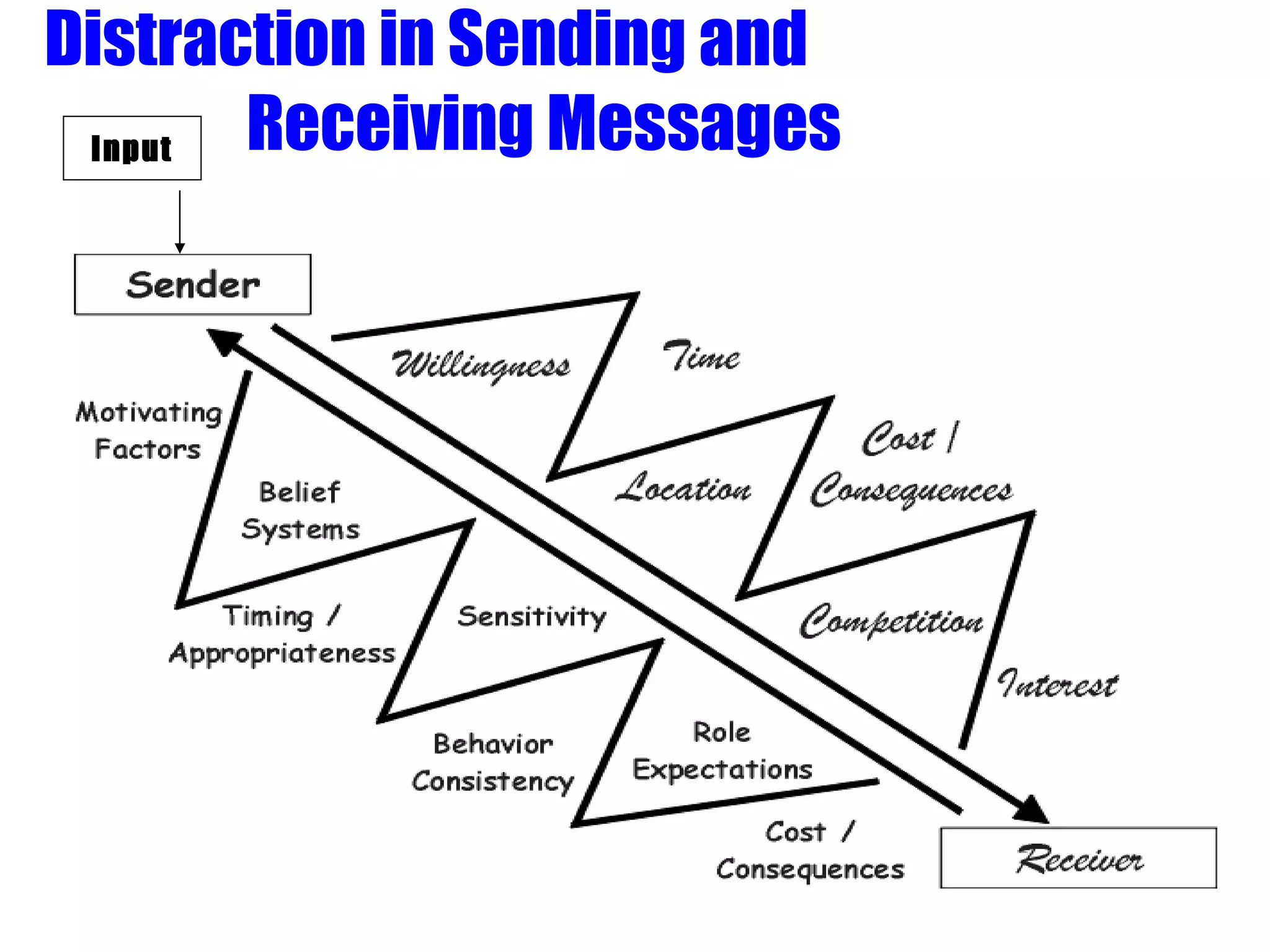
Process of  Verbal Communication Input  (The sender has an  intention  to communicate with another person) Sender  (The sender  sends  the message ) Channel  (The message is sent via channel, which can be made of a variety of materials) Noise  (The channel is subjected to various sources of noise)   Receiver  (The receiver  translates  the incoming message, or expression) Output  ( This is the  content  translated by the receiver )
Distraction in Sending and    Receiving Messages Input
Activity …  Chinese Whisper “ It is good to eat caterpillars for breakfast”
  Challenges of    Verbal Communication
These challenges include your learning to see   each  conversation  as an opportunity to grow in skill and awareness each encounter as an opportunity to express more appreciation each argument as an opportunity to translate your complaints into requests
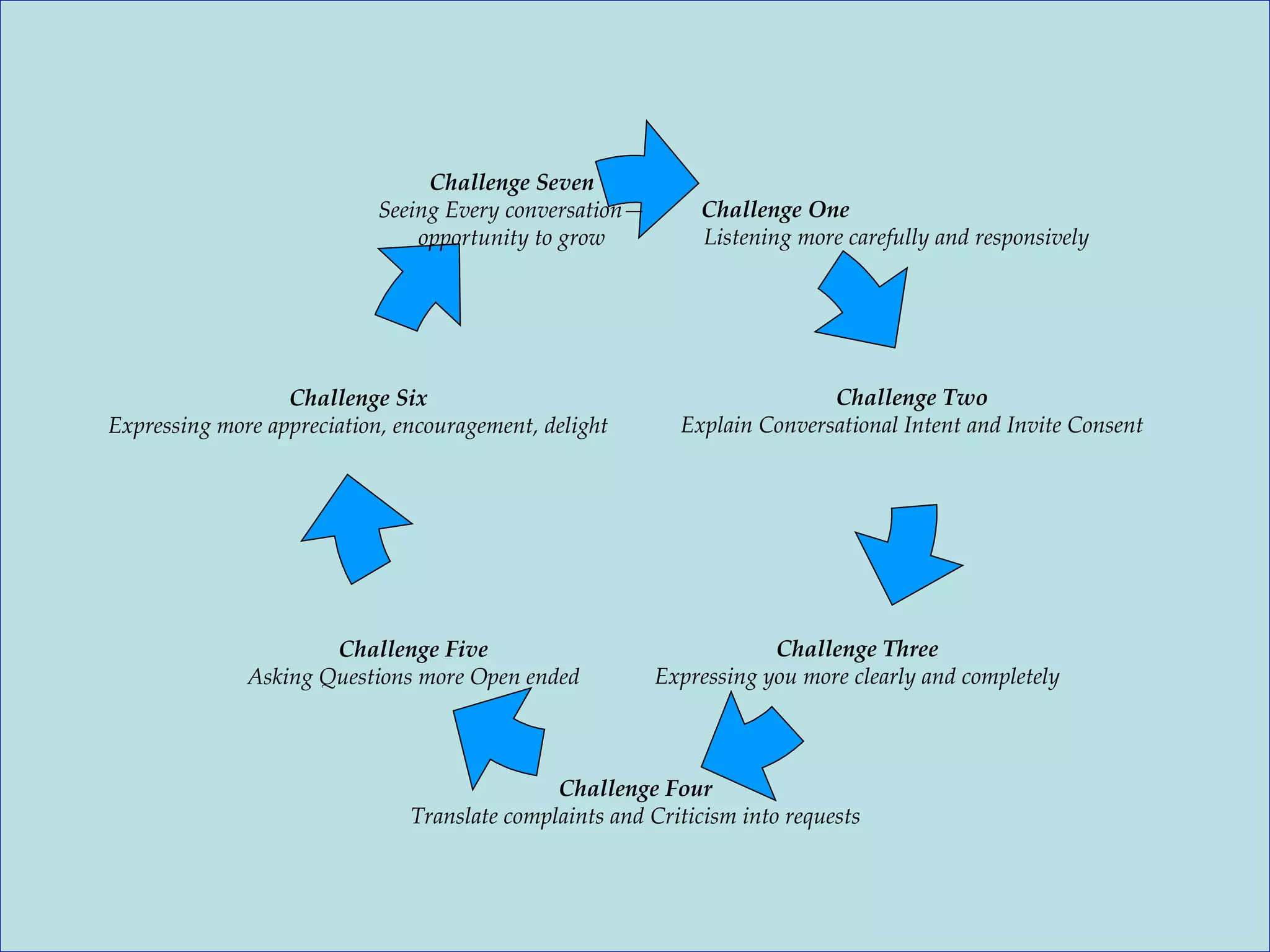
Challenge Five Asking Questions more Open ended Challenge Six Expressing more appreciation, encouragement, delight Challenge One   Listening more carefully and responsively Challenge Seven Seeing Every conversation— opportunity to grow Challenge Two Explain Conversational Intent and Invite Consent Challenge Three Expressing you more clearly and completely Challenge Four Translate complaints and Criticism into requests
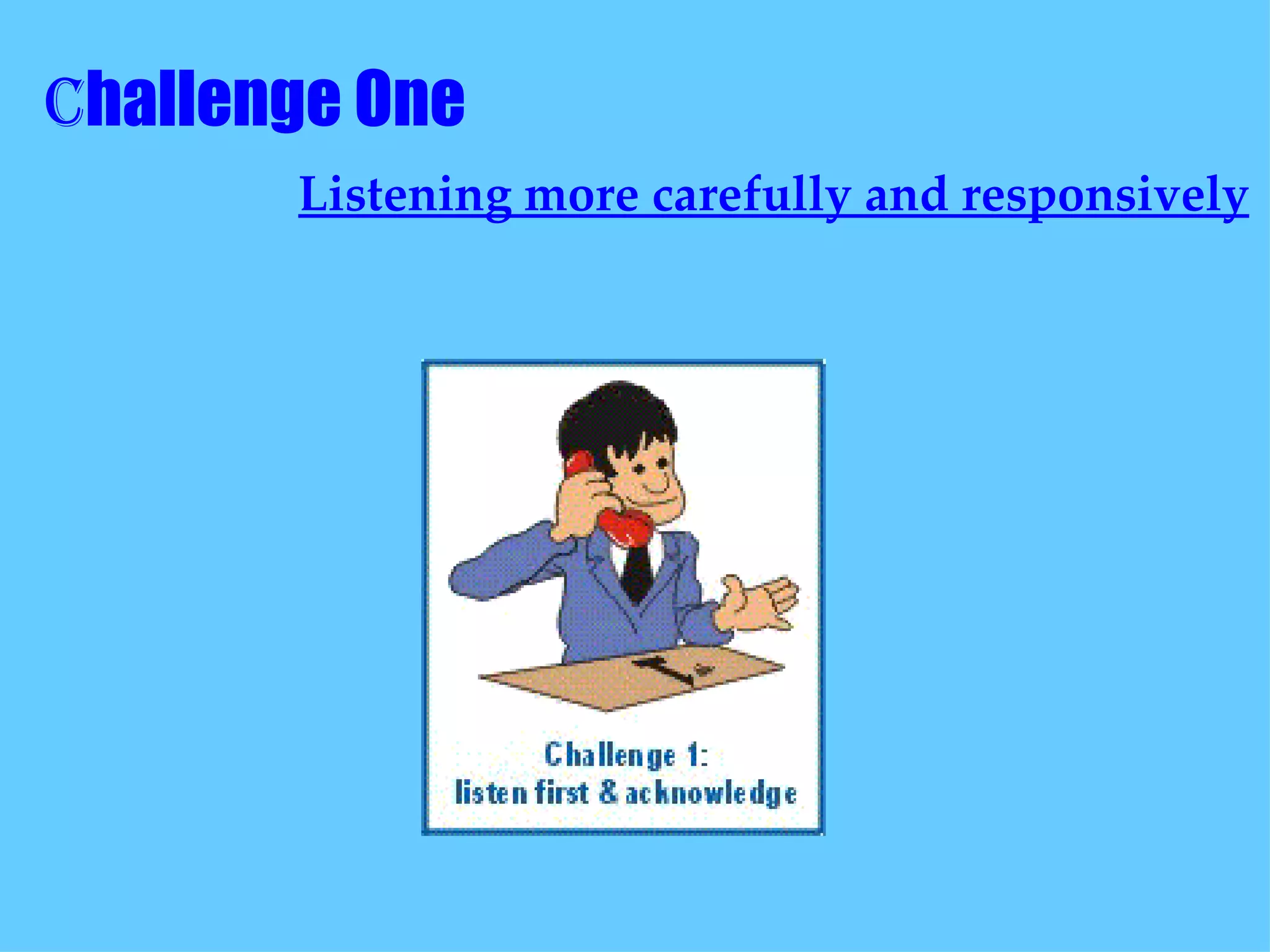
C hallenge One  Listening more carefully and responsively
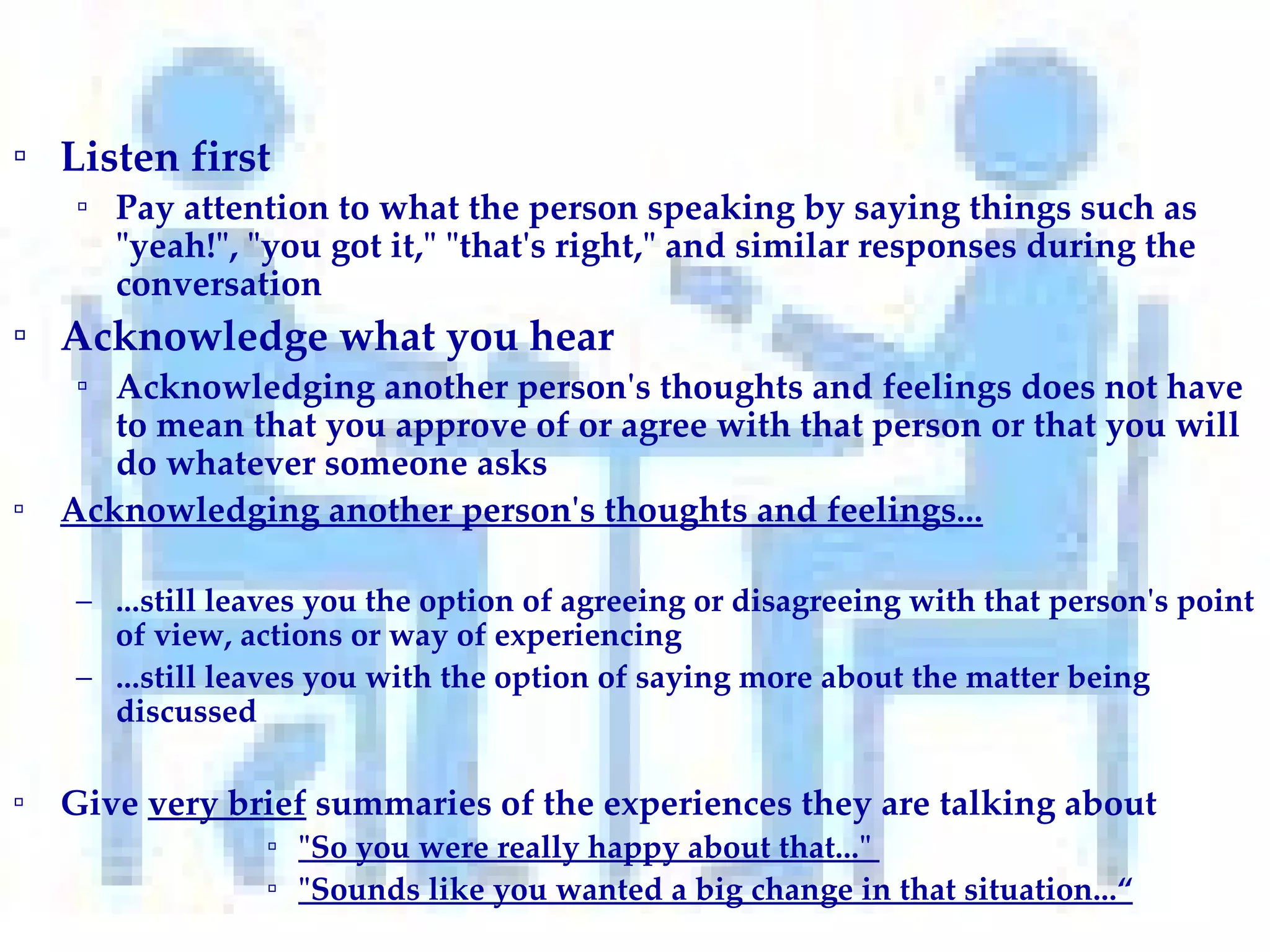
Listen first  Pay attention to what the person speaking by saying things such as "yeah!", "you got it," "that's right," and similar responses during the conversation Acknowledge what you hear Acknowledging another person's thoughts and feelings does not have to mean that you approve of or agree with that person or that you will do whatever someone asks Acknowledging another person's thoughts and feelings... ...still leaves you the option of agreeing or disagreeing with that person's point of view, actions or way of experiencing ...still leaves you with the option of saying more about the matter being discussed Give  very brief  summaries of the experiences they are talking about "So you were really happy about that..."  "Sounds like you wanted a big change in that situation...“
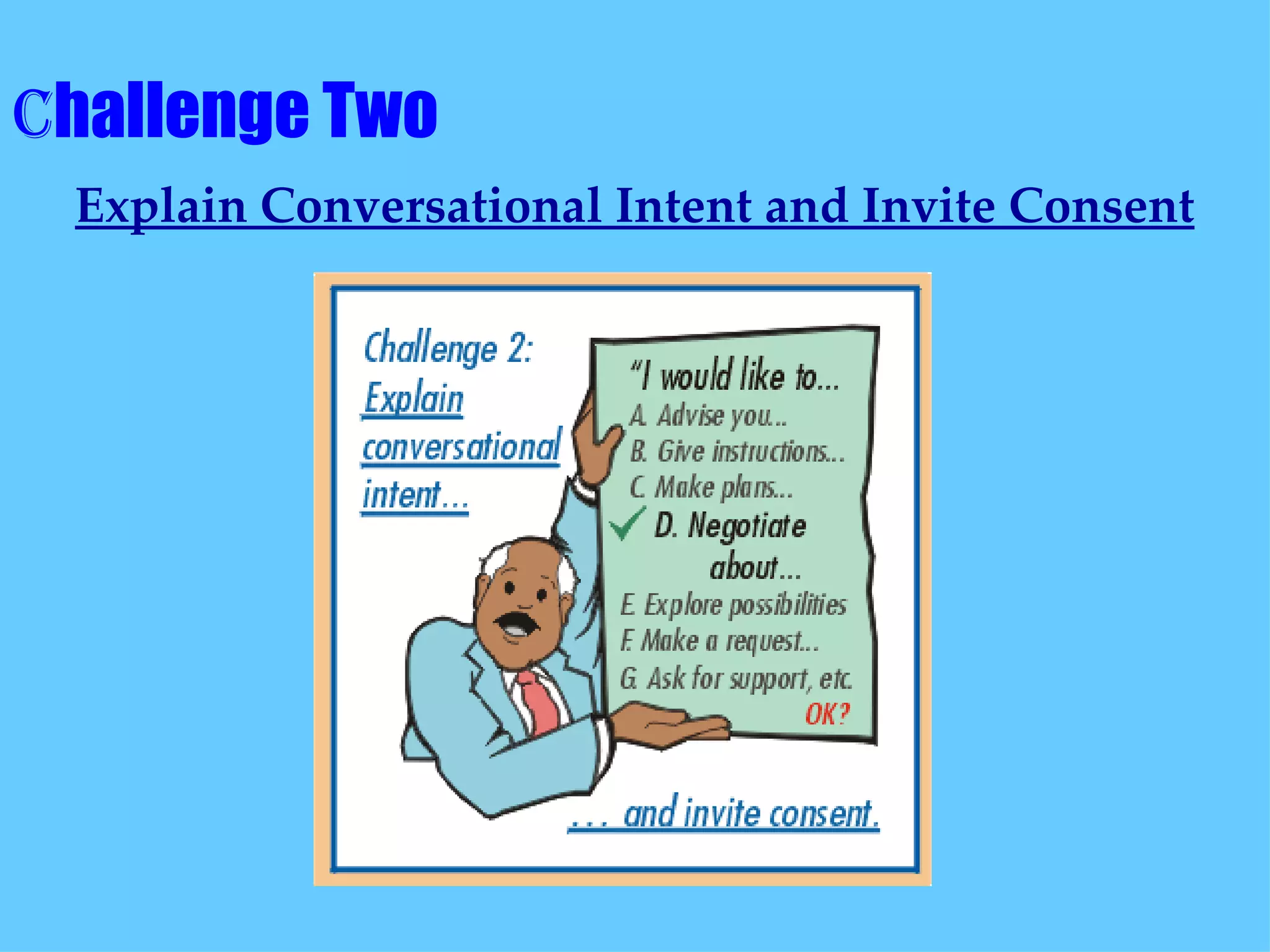
C hallenge Two    Explain Conversational Intent and Invite Consent
Some conversations require a lot more time, effort and involvement than others. If you want to have a conversation that will require a significant amount of effort from the other person, it will go better if that person understands what he or she is getting into and permission to participate “ Do you have a minute?    Right now I'd like to talk to you about... Is that OK?”   Importance of this Challenge: First, we give our listeners a chance to consent to or decline the offer of a specific conversation  Second, we help our listeners to understand the "big picture," the overall goal of the conversation-to-come.  Third, we allow our listeners to get ready for what is coming  And fourth, we help our listeners understand the role that we want them to play in the conversation: fellow problem solver, employee receiving instructions, giver of emotional support, and so on.
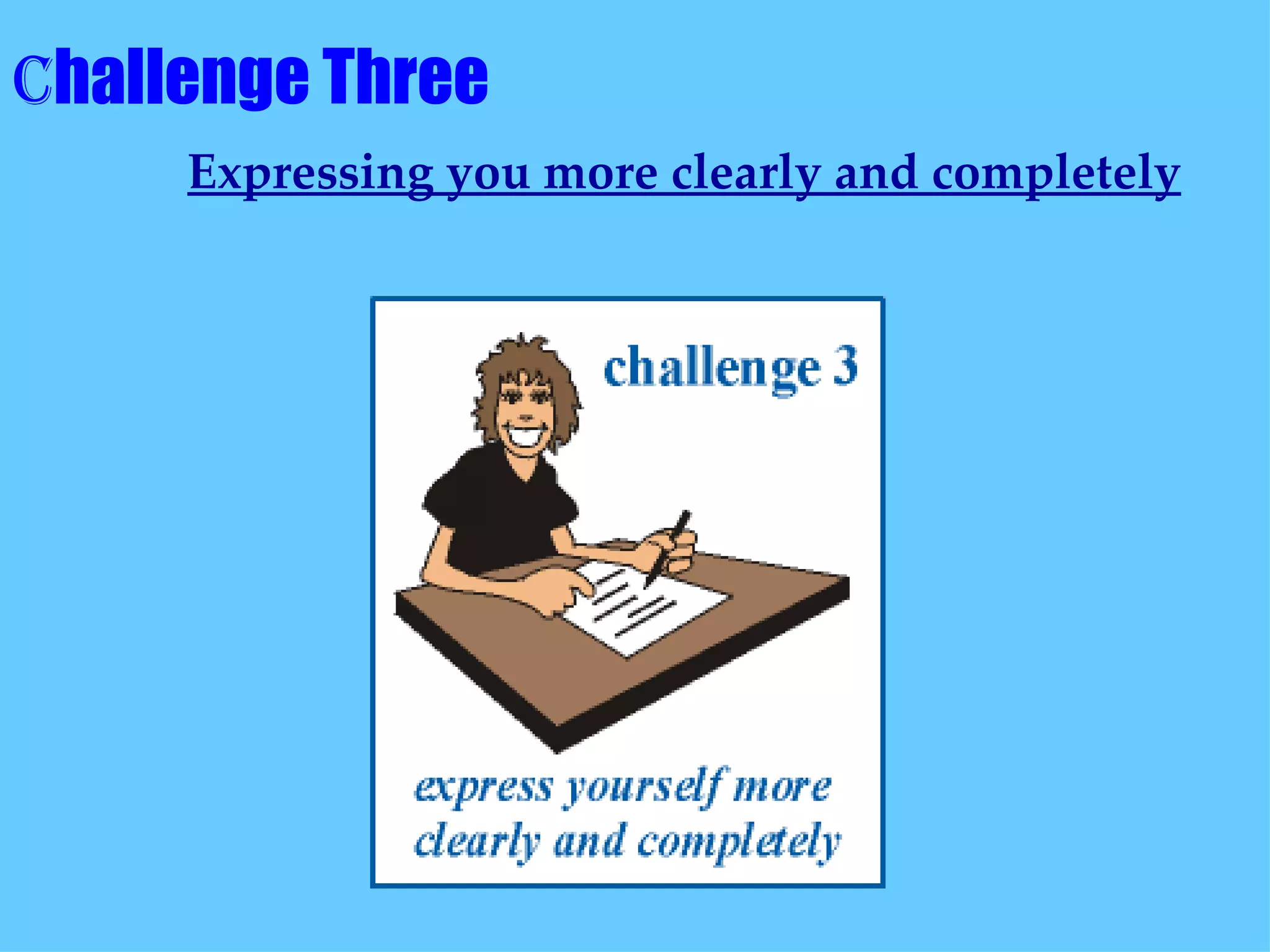
C hallenge Three    Expressing you more clearly and completely
Give your listeners more information about  what  you  are saying When one person sincerely listens to another, a very  creative process  is going on in which the listener mentally reconstructs the speaker's experience. The more dimensions of your experience you share with the other person, it would be easy-to-grasp, and a very accurate and clear picture would be reconstructed in his / her mind.  Filling in the missing information  Your two o'clock is here,"  ---- "Your client who made an appointment for two o'clock has arrived in the waiting room,"  In situations of change, ambiguity, conflict, or great emotional need, our "shorthand" way of speaking may not work at all for two possible reasons: First, our listeners may fill in a completely different set of details than the one we intended Second, our listeners may not understand the significance of what we are saying
Have you ever met such ambiguous situation (due to missing information) that caused conflict / frustration???
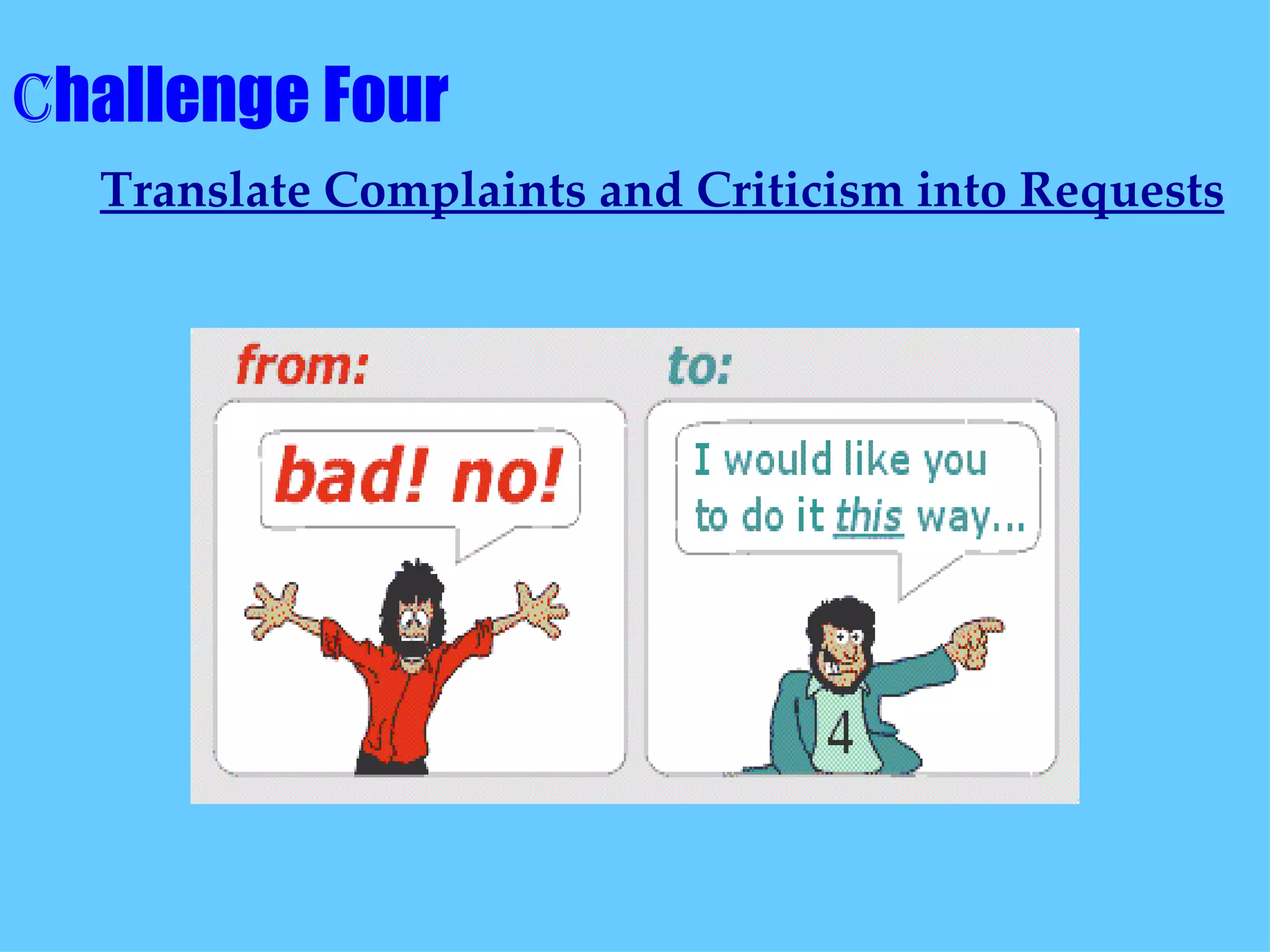
C hallenge Four    Translate Complaints and Criticism into Requests
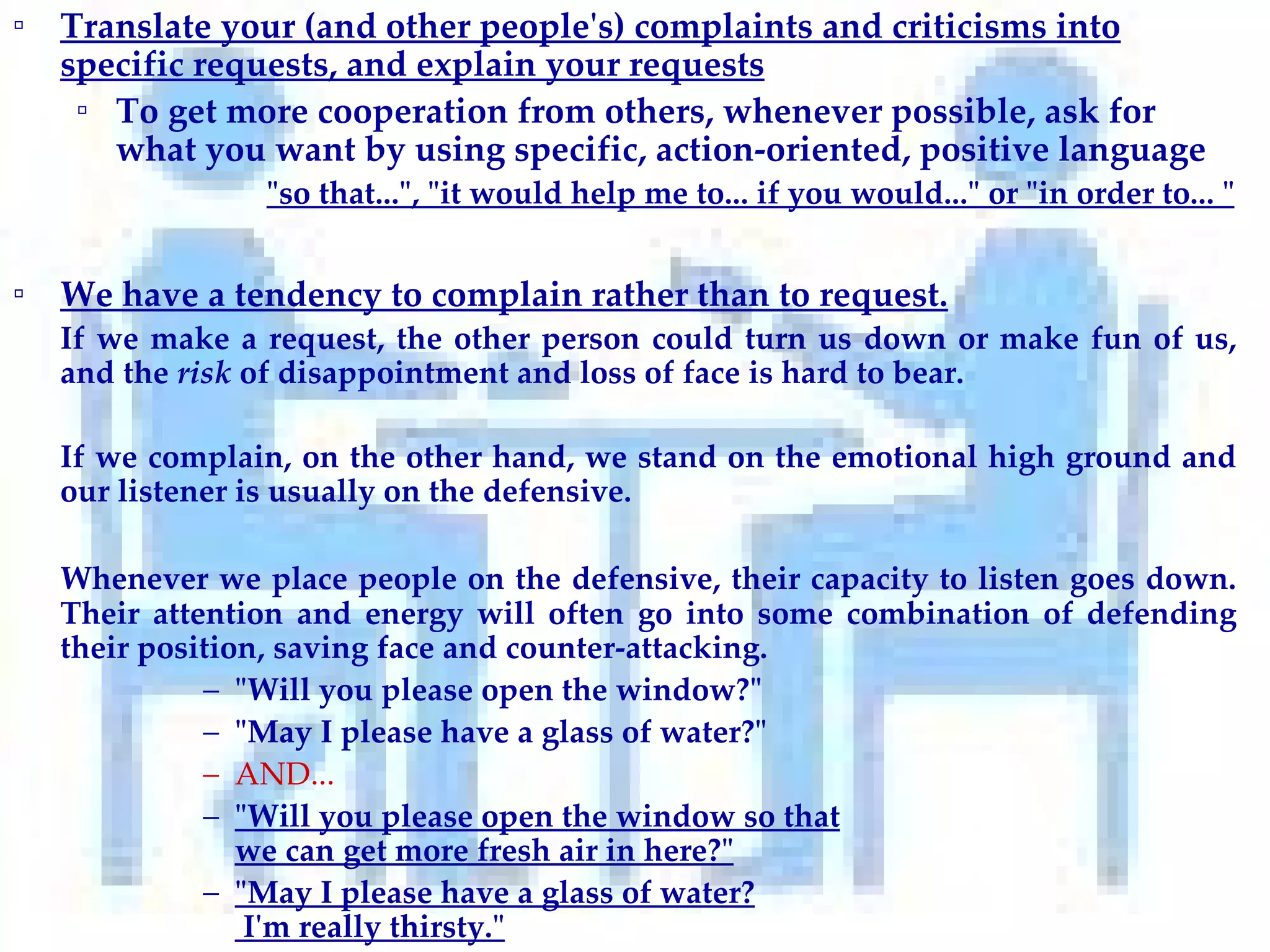
Translate your (and other people's) complaints and criticisms into specific requests, and explain your requests To get more cooperation from others, whenever possible, ask for what you want by using specific, action-oriented, positive language  "so that...", "it would help me to... if you would..." or "in order to... "  We have a tendency to complain rather than to request.   If we make a request, the other person could turn us down or make fun of us, and the  risk  of disappointment and loss of face is hard to bear.  If we complain, on the other hand, we stand on the emotional high ground and our listener is usually on the defensive.   Whenever we place people on the defensive, their capacity to listen goes down. Their attention and energy will often go into some combination of defending their position, saving face and counter-attacking. "Will you please open the window?" "May I please have a glass of water?" AND... "Will you please open the window so that we can get more fresh air in here?" "May I please have a glass of water?  I'm really thirsty."
What is your experience ????
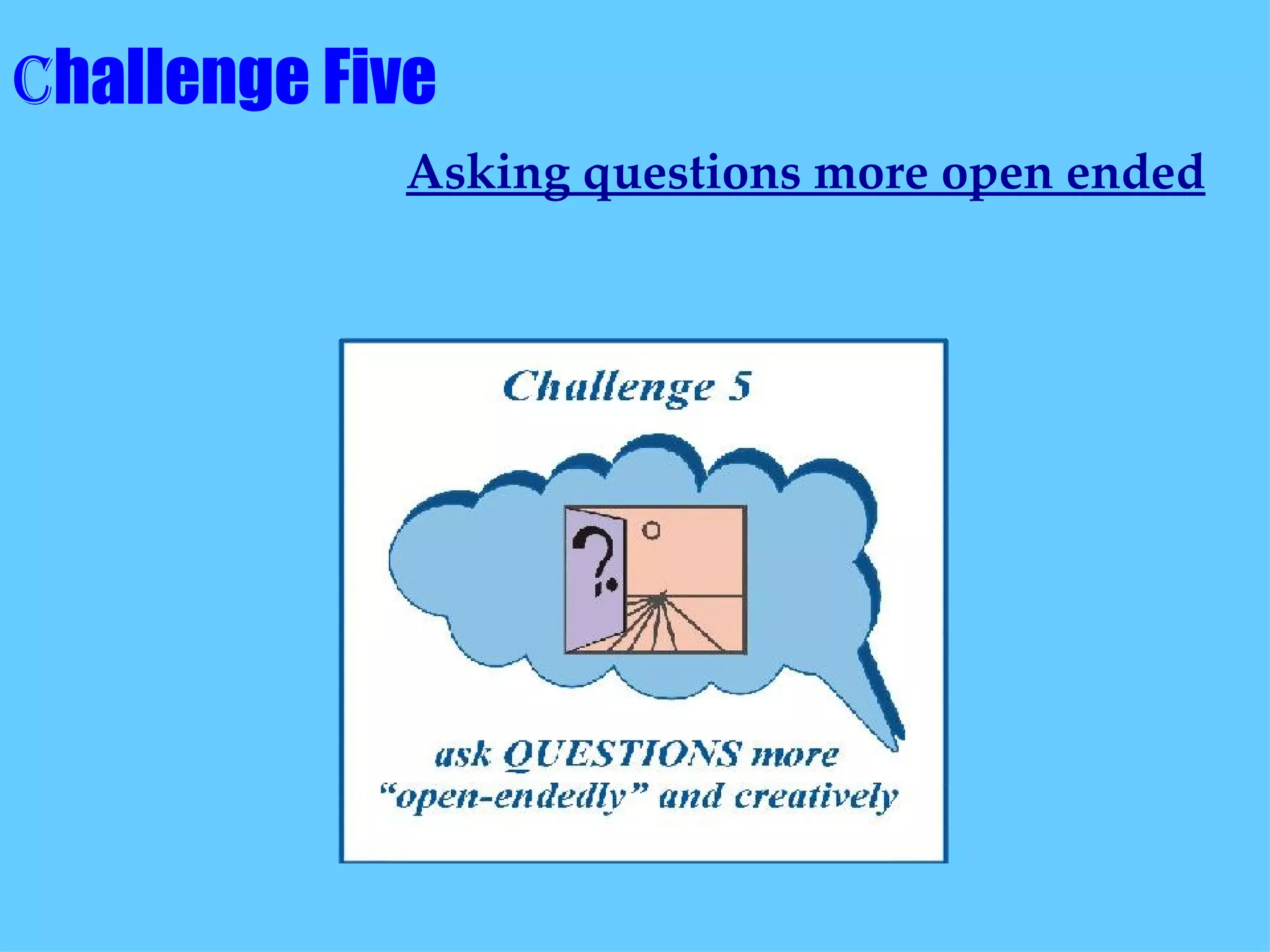
C hallenge Five      Asking questions more open ended
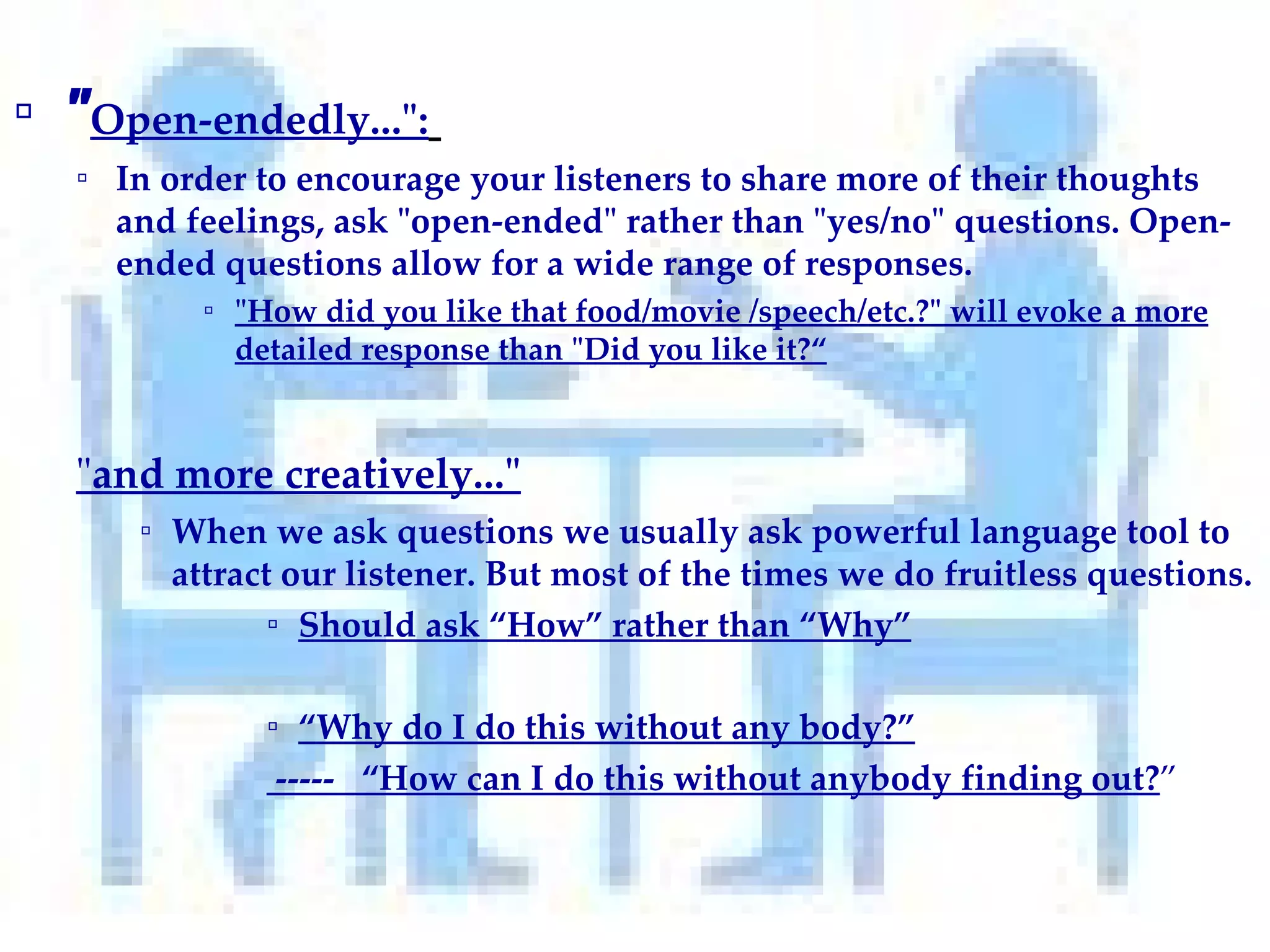
" Open-endedly...":   In order to encourage your listeners to share more of their thoughts and feelings, ask "open-ended" rather than "yes/no" questions. Open-ended questions allow for a wide range of responses. "How did you like that food/movie /speech/etc.?" will evoke a more detailed response than "Did you like it?“ " and more creatively..."   When we ask questions we usually ask powerful language tool to attract our listener. But most of the times we do fruitless questions.  Should ask “How” rather than “Why” “ Why do I do this without any body?” -----  “How can I do this without anybody finding out? ”
“ Your question is the quest you're on.  No questions -- no journey. Timid questions -- timid trips. Radical questions  -- an expedition to the root of your being”   Bon Voyage
-  Are you comfortable with my plan?? -  Can you provide me some more information to go forward?? -  Are you ready to meet this deadline??
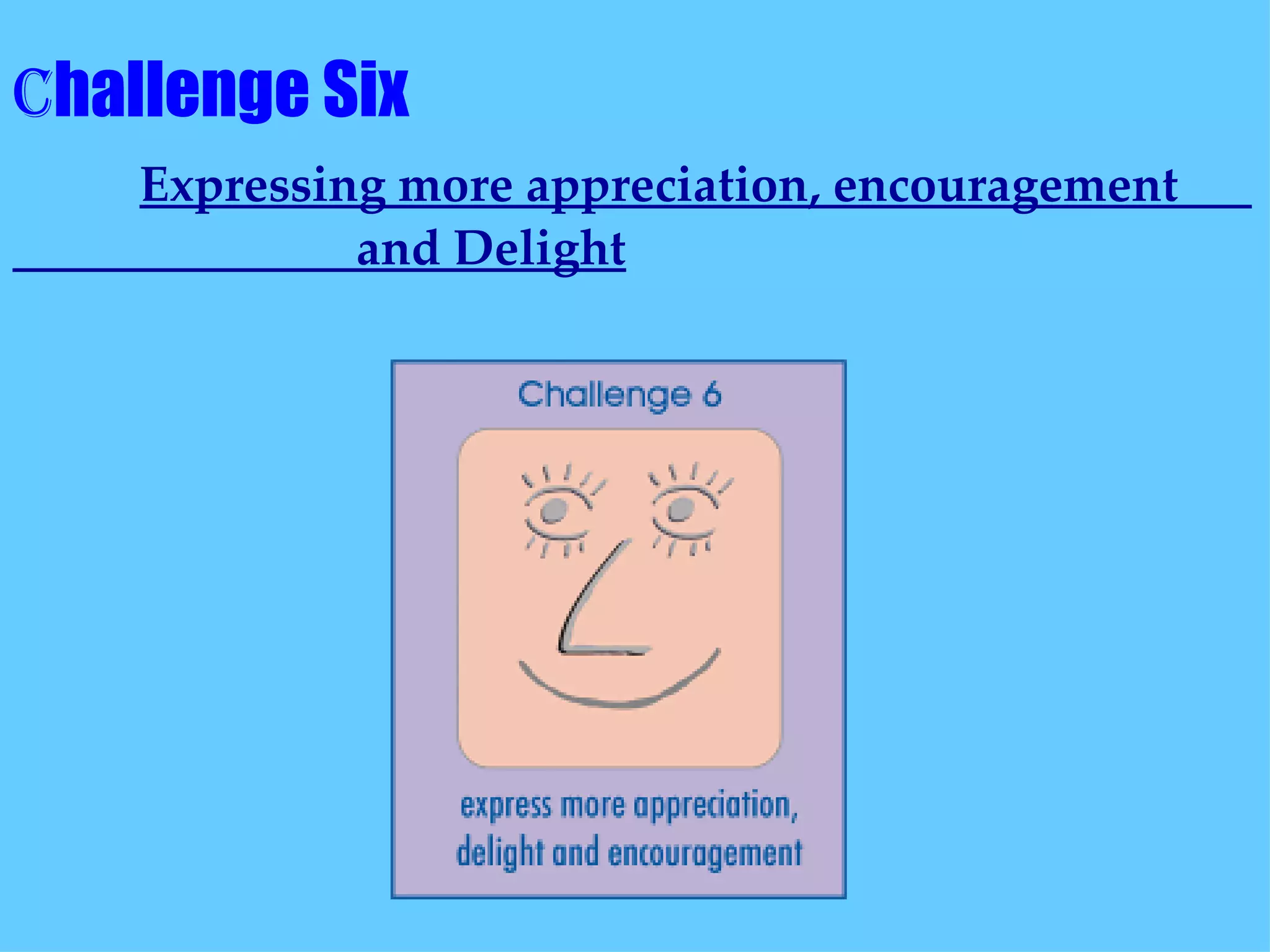
C hallenge Six  Expressing more appreciation, encouragement  and Delight
“ Our gratefulness is our deepest prayer, prayed not with words but with our hearts”
To build more satisfying relationships with the people around you, make a conscious effort to express more gratitude, appreciation, delight, affirmation, and encouragement To express gratitude in a meaningful way, a person needs to actually feel grateful, and that often involves looking at a person or situation from a new angle. Expressing appreciation thus involves both an  expressive action  and an  inner attitud e Living more gratefully   To be grateful for the goodness of simplest things Good job done by your Team member Tea prepared by your office boy Turning of seasons Beautiful flowers Exploring a new theme: Receiving each day as a gift Thank you = yes to life   Expressing gratitude in the middle of a difficult life
Event to be grateful for
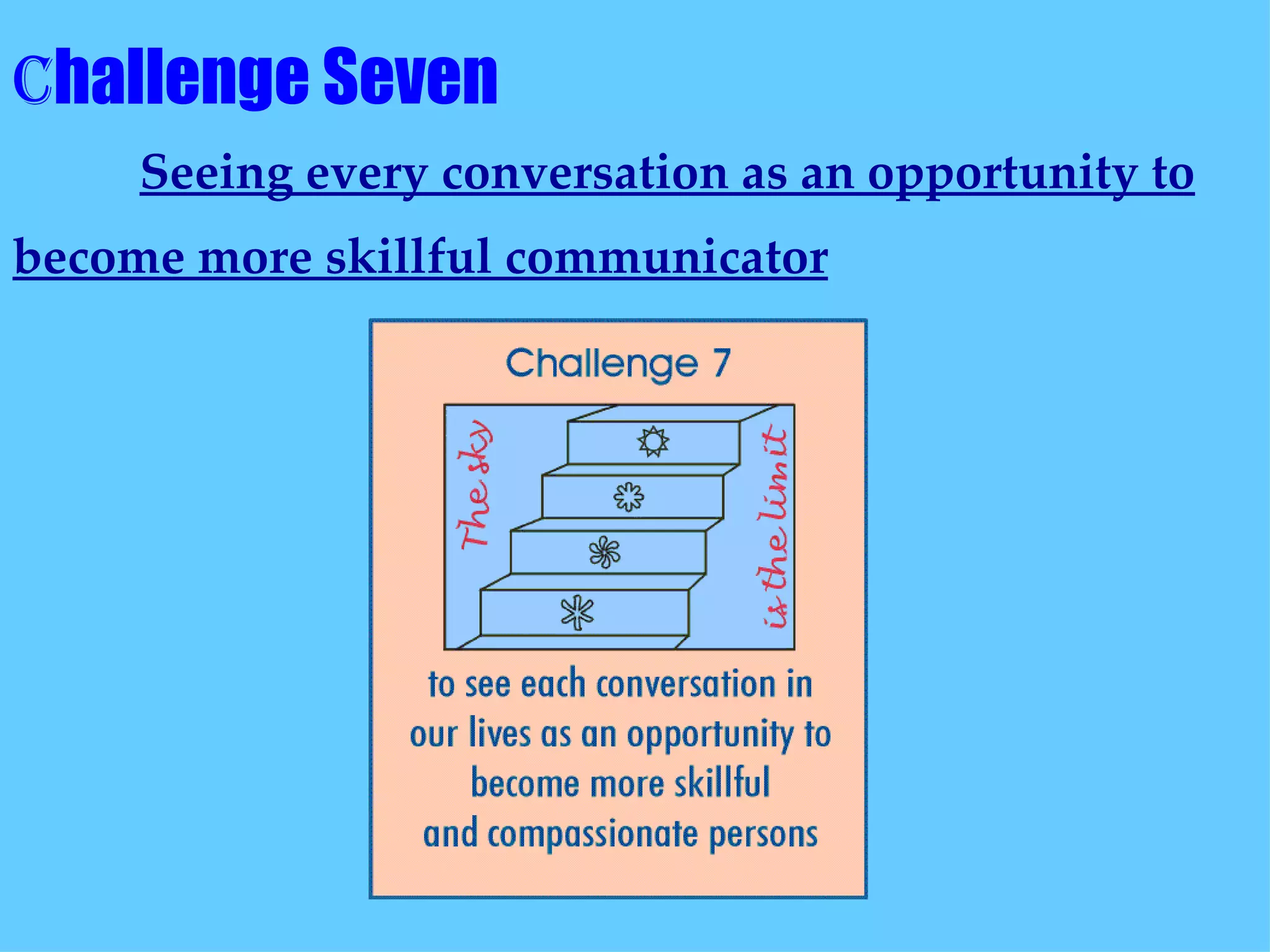
C hallenge Seven  Seeing every conversation as an opportunity to become more skillful communicator
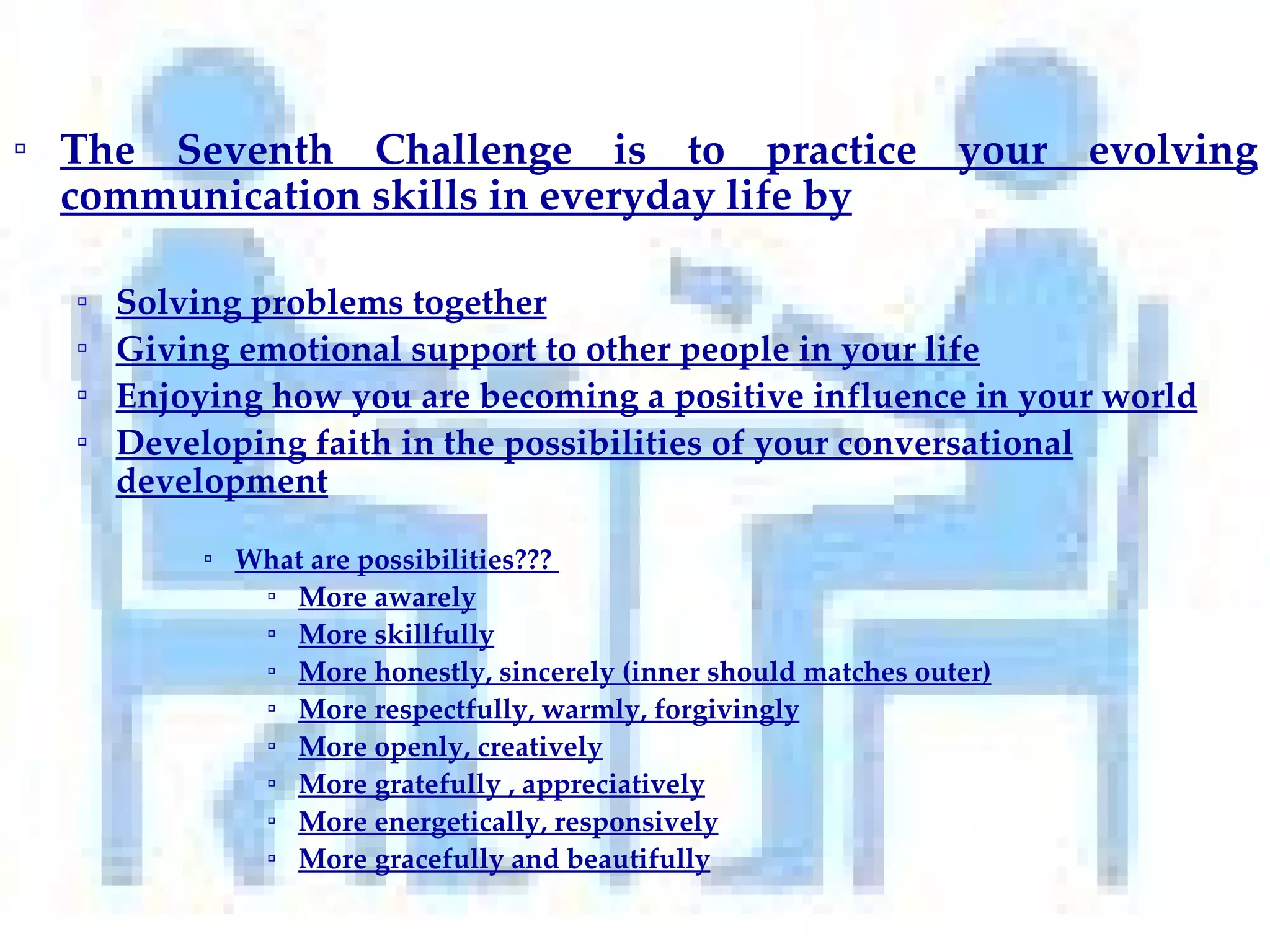
The Seventh Challenge is to practice your evolving communication skills in everyday life by Solving problems together Giving emotional support to other people in your life Enjoying how you are becoming a positive influence in your world Developing faith in the possibilities of your conversational development What are possibilities???  More awarely More skillfully More honestly, sincerely (inner should matches outer) More respectfully, warmly, forgivingly More openly, creatively More gratefully , appreciatively More energetically, responsively More gracefully and beautifully
Barriers to Effective Verbal Communication at Work
Language Barriers Ambiguity Vocabulary Rambling Unusual words Psychological Barriers Pressures Mood Shyness Aggression Know-it-all Mind not on work Environmental Barriers Interruptions Noise/heat/cold/space available Speech Barriers Accent Stereotyped attitude Lack of knowledge
How to Improve Verbal Communication
Improve your listening skill. Most people think they listen well, but the truth is that most of people don't listen at all -- they just speak and then think about what they're going to say next Don't take another person's reaction or anger personally You don't have to have all the answers. It's OK to say, “I don't know.” Respond (facts and feelings); don't react (feelings)  Remember that what someone says and what we hear can be amazingly different! Our personal filters, assumptions, judgments, and beliefs can distort what we hear Acknowledge inconvenience or frustration and offer a timeline, particularly if you need someone else's cooperation or your activities will affect them
Look for common ground instead of focusing solely on differences Work to keep a positive mental focus  Whether you are going to speak in public, talk to your boss, you have to think before you utter those words Reduce your usage of verbal pauses Avoid careless language. Talk and write in ways that allow for accurate description of your experience, thoughts or ideas. Don't expect people to assume and guess what you are trying to say
Know your Communication Strengths
-  Strengths of your Group -  Major weaknesses of your Group -  How can you change your weakness into your strengths ????
 
Thank You

Communication Skills Training

  • 1.
    Communication Skills TrainingPresented by: Ghazala Butt Human Resources Manager
  • 2.
    Objectives You wouldbe able to: Know the difference between verbal and non-verbal communication Understand Seven Essential Communication Skills Careful and active listening Express feelings and thoughts clearly and completely Know your verbal communication strengths Improve your verbal communication skills
  • 3.
    Definition What isCommunication ????? Communication is the management of messages for the purpose of creating meaning to interact with each other, with clarity & ease The act of meaning something, of conveying an attitude (belief, desire, intention, regret, etc.) to others, by linguistic or other means The exchange of thoughts, messages, or information, as by speech, signals, writing , or behavior
  • 4.
  • 5.
    Verbal Communication Requiresformal language Words Vocabulary Symbols Non Verbal Communication Independent of formal language Body Language Facial expressions Colors Shapes Rhythmic Sounds Difference
  • 6.
  • 7.
    Verbal Communication Verbal communication is to exchange information with others using a common spoken language Any means of communicating that uses words, vocabulary, numbers and symbols and is organized in sentences using language . We communicate face to face, by telephone or radio, or television using videoconferencing facilities Communication can be:   • one to one - talking and interacting with one other person   • one to many - as a listener in an audience or as the speaker   • in groups - talking together to share ideas or find solutions.
  • 8.
    Process of Verbal Communication Input (The sender has an intention to communicate with another person) Sender (The sender sends the message ) Channel (The message is sent via channel, which can be made of a variety of materials) Noise (The channel is subjected to various sources of noise) Receiver (The receiver translates the incoming message, or expression) Output ( This is the content translated by the receiver )
  • 9.
    Distraction in Sendingand Receiving Messages Input
  • 10.
    Activity … Chinese Whisper “ It is good to eat caterpillars for breakfast”
  • 11.
    Challengesof Verbal Communication
  • 12.
    These challenges includeyour learning to see each conversation as an opportunity to grow in skill and awareness each encounter as an opportunity to express more appreciation each argument as an opportunity to translate your complaints into requests
  • 13.
    Challenge Five AskingQuestions more Open ended Challenge Six Expressing more appreciation, encouragement, delight Challenge One Listening more carefully and responsively Challenge Seven Seeing Every conversation— opportunity to grow Challenge Two Explain Conversational Intent and Invite Consent Challenge Three Expressing you more clearly and completely Challenge Four Translate complaints and Criticism into requests
  • 14.
    C hallenge One Listening more carefully and responsively
  • 15.
    Listen first Pay attention to what the person speaking by saying things such as "yeah!", "you got it," "that's right," and similar responses during the conversation Acknowledge what you hear Acknowledging another person's thoughts and feelings does not have to mean that you approve of or agree with that person or that you will do whatever someone asks Acknowledging another person's thoughts and feelings... ...still leaves you the option of agreeing or disagreeing with that person's point of view, actions or way of experiencing ...still leaves you with the option of saying more about the matter being discussed Give very brief summaries of the experiences they are talking about "So you were really happy about that..." "Sounds like you wanted a big change in that situation...“
  • 16.
    C hallenge Two Explain Conversational Intent and Invite Consent
  • 17.
    Some conversations requirea lot more time, effort and involvement than others. If you want to have a conversation that will require a significant amount of effort from the other person, it will go better if that person understands what he or she is getting into and permission to participate “ Do you have a minute?   Right now I'd like to talk to you about... Is that OK?” Importance of this Challenge: First, we give our listeners a chance to consent to or decline the offer of a specific conversation Second, we help our listeners to understand the "big picture," the overall goal of the conversation-to-come. Third, we allow our listeners to get ready for what is coming And fourth, we help our listeners understand the role that we want them to play in the conversation: fellow problem solver, employee receiving instructions, giver of emotional support, and so on.
  • 18.
    C hallenge Three Expressing you more clearly and completely
  • 19.
    Give your listenersmore information about  what  you  are saying When one person sincerely listens to another, a very creative process is going on in which the listener mentally reconstructs the speaker's experience. The more dimensions of your experience you share with the other person, it would be easy-to-grasp, and a very accurate and clear picture would be reconstructed in his / her mind. Filling in the missing information Your two o'clock is here," ---- "Your client who made an appointment for two o'clock has arrived in the waiting room," In situations of change, ambiguity, conflict, or great emotional need, our "shorthand" way of speaking may not work at all for two possible reasons: First, our listeners may fill in a completely different set of details than the one we intended Second, our listeners may not understand the significance of what we are saying
  • 20.
    Have you evermet such ambiguous situation (due to missing information) that caused conflict / frustration???
  • 21.
    C hallenge Four Translate Complaints and Criticism into Requests
  • 22.
    Translate your (andother people's) complaints and criticisms into specific requests, and explain your requests To get more cooperation from others, whenever possible, ask for what you want by using specific, action-oriented, positive language "so that...", "it would help me to... if you would..." or "in order to... " We have a tendency to complain rather than to request. If we make a request, the other person could turn us down or make fun of us, and the risk of disappointment and loss of face is hard to bear. If we complain, on the other hand, we stand on the emotional high ground and our listener is usually on the defensive. Whenever we place people on the defensive, their capacity to listen goes down. Their attention and energy will often go into some combination of defending their position, saving face and counter-attacking. "Will you please open the window?" "May I please have a glass of water?" AND... "Will you please open the window so that we can get more fresh air in here?" "May I please have a glass of water? I'm really thirsty."
  • 23.
    What is yourexperience ????
  • 24.
    C hallenge Five Asking questions more open ended
  • 25.
    " Open-endedly...": In order to encourage your listeners to share more of their thoughts and feelings, ask "open-ended" rather than "yes/no" questions. Open-ended questions allow for a wide range of responses. "How did you like that food/movie /speech/etc.?" will evoke a more detailed response than "Did you like it?“ " and more creatively..." When we ask questions we usually ask powerful language tool to attract our listener. But most of the times we do fruitless questions. Should ask “How” rather than “Why” “ Why do I do this without any body?” ----- “How can I do this without anybody finding out? ”
  • 26.
    “ Your questionis the quest you're on. No questions -- no journey. Timid questions -- timid trips. Radical questions -- an expedition to the root of your being” Bon Voyage
  • 27.
    - Areyou comfortable with my plan?? - Can you provide me some more information to go forward?? - Are you ready to meet this deadline??
  • 28.
    C hallenge Six Expressing more appreciation, encouragement and Delight
  • 29.
    “ Our gratefulnessis our deepest prayer, prayed not with words but with our hearts”
  • 30.
    To build moresatisfying relationships with the people around you, make a conscious effort to express more gratitude, appreciation, delight, affirmation, and encouragement To express gratitude in a meaningful way, a person needs to actually feel grateful, and that often involves looking at a person or situation from a new angle. Expressing appreciation thus involves both an expressive action and an inner attitud e Living more gratefully To be grateful for the goodness of simplest things Good job done by your Team member Tea prepared by your office boy Turning of seasons Beautiful flowers Exploring a new theme: Receiving each day as a gift Thank you = yes to life Expressing gratitude in the middle of a difficult life
  • 31.
    Event to begrateful for
  • 32.
    C hallenge Seven Seeing every conversation as an opportunity to become more skillful communicator
  • 33.
    The Seventh Challengeis to practice your evolving communication skills in everyday life by Solving problems together Giving emotional support to other people in your life Enjoying how you are becoming a positive influence in your world Developing faith in the possibilities of your conversational development What are possibilities??? More awarely More skillfully More honestly, sincerely (inner should matches outer) More respectfully, warmly, forgivingly More openly, creatively More gratefully , appreciatively More energetically, responsively More gracefully and beautifully
  • 34.
    Barriers to EffectiveVerbal Communication at Work
  • 35.
    Language Barriers AmbiguityVocabulary Rambling Unusual words Psychological Barriers Pressures Mood Shyness Aggression Know-it-all Mind not on work Environmental Barriers Interruptions Noise/heat/cold/space available Speech Barriers Accent Stereotyped attitude Lack of knowledge
  • 36.
    How to ImproveVerbal Communication
  • 37.
    Improve your listeningskill. Most people think they listen well, but the truth is that most of people don't listen at all -- they just speak and then think about what they're going to say next Don't take another person's reaction or anger personally You don't have to have all the answers. It's OK to say, “I don't know.” Respond (facts and feelings); don't react (feelings) Remember that what someone says and what we hear can be amazingly different! Our personal filters, assumptions, judgments, and beliefs can distort what we hear Acknowledge inconvenience or frustration and offer a timeline, particularly if you need someone else's cooperation or your activities will affect them
  • 38.
    Look for commonground instead of focusing solely on differences Work to keep a positive mental focus Whether you are going to speak in public, talk to your boss, you have to think before you utter those words Reduce your usage of verbal pauses Avoid careless language. Talk and write in ways that allow for accurate description of your experience, thoughts or ideas. Don't expect people to assume and guess what you are trying to say
  • 39.
  • 40.
    - Strengthsof your Group - Major weaknesses of your Group - How can you change your weakness into your strengths ????
  • 41.
  • 42.