
Food for thought
When I have talked in anger,
And my cheeks were flaming red,
I have always uttered something,
Which I wish I had not said.
What we aim to learn
• To understand and appreciate the process of communication as
an important constituent of the professional effectiveness
• To understand oneself and improve interpersonal skills
• Exposure to communication concepts
• Diagnose and circumvent barriers to communication
• To gain confidence and honing presentation skills
What is Communication
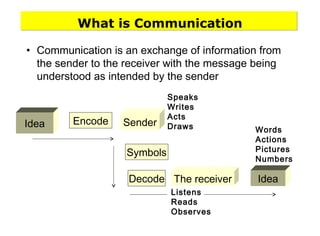
• Communication is an exchange of information from
the sender to the receiver with the message being
understood as intended by the sender
Idea
Decode Idea
Listens
Reads
Observes
Speaks
Writes
Acts
Draws Words
Actions
Pictures
Numbers
Encode
Symbols
The receiver
Sender
Three ways to think about
communication
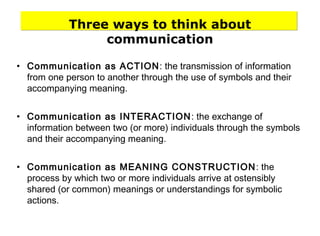
• Communication as ACTION: the transmission of information
from one person to another through the use of symbols and their
accompanying meaning.
• Communication as INTERACTION: the exchange of
information between two (or more) individuals through the symbols
and their accompanying meaning.
• Communication as MEANING CONSTRUCTION: the
process by which two or more individuals arrive at ostensibly
shared (or common) meanings or understandings for symbolic
actions.
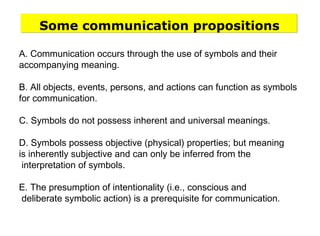
A. Communication occurs through the use of symbols and their
accompanying meaning.
B. All objects, events, persons, and actions can function as symbols
for communication.
C. Symbols do not possess inherent and universal meanings.
D. Symbols possess objective (physical) properties; but meaning
is inherently subjective and can only be inferred from the
interpretation of symbols.
E. The presumption of intentionality (i.e., conscious and
deliberate symbolic action) is a prerequisite for communication.
Some communication propositions
Importance Of Communication
• Organizational / Functional:
greater information access and awareness
• Improves coordination:
reduces logical gaps
• Encourages cooperation:
helps bring everyone in the mainstream
• Gives a direction:
to tasks and activities
• Morale and empowerment
• Decision making aid
• Speeds up the organizational processes
• Better focus on customer requirements
• Generates a greater sense of organizational commitment
and involvement
• A problem solving tool:
by clarity, preciseness and feedback
….. Importance Of Communication
Barriers to Communication
• A barrier reduces or changes the quality of
the message being transmitted
• Types :
1. Physical 2. Psychological
Poor health Lack of Concentration
Sound / noise Attitude and bias
Unsuitable temperature Lack of self discipline
Distractions Low emotional state
How to overcome the barriers
For the sender
• Be clear about the message to be
sent
• Be precise and to the point
• Do not be verbose
• Use a language understandable
to the receiver
• Write the message if required
• Request a feedback to ensure
receipt of message
For the receiver
• Be attentive
• Concentrate on the message
• Ask for clarifications wherever
required
• Listen objectively
• ‘Listen’ for body
language
• Make notes if required
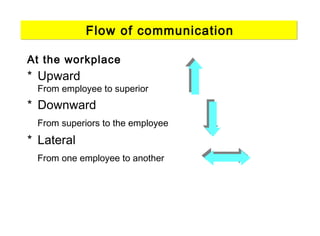
Flow of communication
At the workplace
* Upward
From employee to superior
* Downward
From superiors to the employee
* Lateral
From one employee to another
Communication types
Verbal
• Oral - the spoken language
Non verbal
• Written
• Body language
• Expressions - facial, gestures, signs
Medium of Communication
• Memos
• E-mails
• Notices
• Company circulars
• In-house magazines
• Oral instructions
Gateways to Communication
• A barrier removed is a gateway created.
• We need to eradicate the ‘neps’ from the ‘fabric’ of
our communication by practicing certain things.
1. Creating within one self the need and willingness to
understand
2. Making the message appropriate to the receivers
frame of reference
( speak the “language” of the listener)
3. Ability to describe others behavior without evaluating
or interpreting.
4. Ask for feedback from the receiver
5. Reinforce communication by using more than one
channel to convey the message
(Verbal, written, nonverbal)
….. Gateways to Communication
EFFECTIVE COMMUNICATION
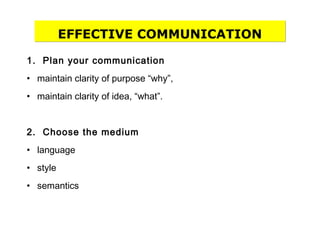
1. Plan your communication
• maintain clarity of purpose “why”,
• maintain clarity of idea, “what”.
2. Choose the medium
• language
• style
• semantics
…. Effective Communication
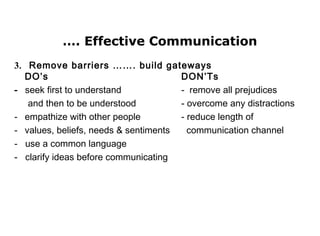
3. Remove barriers ……. build gateways
DO’s DON’Ts
- seek first to understand - remove all prejudices
and then to be understood - overcome any distractions
- empathize with other people - reduce length of
- values, beliefs, needs & sentiments communication channel
- use a common language
- clarify ideas before communicating
….. Effective Communication
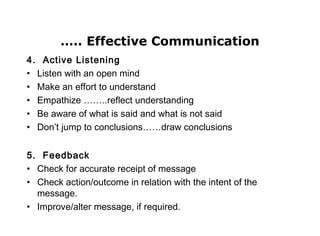
4. Active Listening
• Listen with an open mind
• Make an effort to understand
• Empathize ……..reflect understanding
• Be aware of what is said and what is not said
• Don’t jump to conclusions……draw conclusions
5. Feedback
• Check for accurate receipt of message
• Check action/outcome in relation with the intent of the
message.
• Improve/alter message, if required.
Listening : A lost art
Why do we not listen?
• actions speak louder than words
• Seeing is easier than listening
• Visual medium is powerful
We hear but don’t listen
look but don’t see
Listening-
Interpretation
• What the receiver receives may be different
from what the sender sends.
• What receiver receives depends on
– His behavior
– Past experiences
– His values, motivation, need or his attitude
– His world
What it takes to be a good listener
• Ability to concentrate
• genuine desire to understand the other persons point
of view
• Sensitivity to needs, emotions and body language
• Humility: “You might have a point of view and I
respect you”
• A belief that other people are important and worth
listening to.
How to be a good listener
• Know your power as a listener
• Ask questions
• Reflect feelings
• Let your body give reassuring messages
• Know your prejudices
• Avoid making snap judgements
• Avoid anger
The Art of Listening
Listening : an important human skill
• indispensable for superiors
• gets you respect, love and fame
• shows that you care for and respect others
• not listening could be psychologically upsetting for
the other person
• you can’t fake listening
• the higher you go, the more you have to listen
• it is a rare skill
The Art of Listening
Listening needs an
• ability to concentrate
• a genuine desire to understand the other persons point of
view
• sensitivity to needs, emotions and body language
• humility - “I am not right alone, you might have a point and I
respect you”
• a belief that other people are important and worth listening to
The Art of Listening
Poor Listeners
• The fidget : “Why are you telling me ?”
• The aggressive listener : tries too hard and as a result scares
people.
• The pseudo - intellectual : hears only ideas and not the
emotions behind them
• The passive listener : :I agree with whatever you say”
• The inaccurate listener :”I can’t concentrate”
The Art of Listening
How to be a good listener,
Know your power as a listener
• Ask questions
• Reflect feelings
• Let your body give reassuring messages. Nodding, arms
apart, legs not crossed, erect forward posture. All these give
non-verbal messages that you are listening.
• Know your prejudices. You must discount from all those
matters towards which you are biased or passionate.
• Avoid making snap judgments
• Avoid anger. It always gets the better of you.
Importance Of Feedback
• Feedback is necessary to check the effectiveness of the
communication.
• Feedback helps reflect upon how well the message has been
encoded, transmitted and understood.
• Feedback helps make mid-course correction if found required.
- in terms of action : changing strategy
- in terms of communication : changing message
How to take Feedback
- ask for it you are the sender or offer it if you
are the receiver
- observe
- evaluate the results achieved as against the
objectives set
- be objective while giving or receiving it
- focus on the task and performance aspects not
the individual’s personality
Official Communication
1. Flow : vertical/horizontal/cross
2. Content : top-down are in the form of orders or directives
bottom-up are in the form of feedback or
complaints
3. Through a proper channel : Who is the end audience? Who
should know first ? What should the network be ?
4. “Information is power”. One who has the authority to
communicate is considered powerful.
How to write memos that work
• Begin with planning.
- what are the facts ?
- what do they mean ?
- what do I do now ?
Write short and to the point sentences
• Write in the second person
• Use memos to summarize group decisions, to list individual
assignments and deadlines
• Adopt a conversational style
• Use the B - E - T method to help strengthen your memos content
i.e.
- B = Bottom line - E = Evidence - T = tasks
Always keep your memos brief and precise
Communication Ethics
If intimation is power, and if we have information, then we must
respect and handle our communication with restraint.
Key Points:
• maintain confidentiality -
confidential information is trust reposed
Confidential information is trust betrayed
• certain information is `need to know’ - the job demands it,
certain information is `desire to know’ - it may help in my job,
and certain information is `desirable to know’, it may increase
my power, fame and status.
• Gossiping or bitching - is like `stabbing in the back’
…. Communication Ethics
• Ownership of information - Permission of the owner is a must before
using it.
• Knowledge of information vs. use of information - having
information does not mean you can use it.
• Communication must flow through a proper channel - cutting across
a channels causes heartburns, hurt and misunderstandings
• Timing and place - be careful and sensitive to it.
Written Communication
Written communication as compared to oral communication is at
a disadvantage because of the absence of non-verbal gestures,
voice variation and physical expressions. This as a result
increases the importance of clarity and accuracy of the content
of our written message. To have effective written
communication, certain steps and guidelines may help.
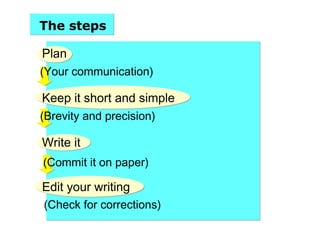
Plan
Keep it short and simple
Write it
Edit your writing
The steps
(Your communication)
(Brevity and precision)
(Commit it on paper)
(Check for corrections)
Steps
Step 1. Plan
Like nearly any activity, written communication too requires
a plan and a structure. Certain thins must be clearly ascertained, like,
Sender : From whom is the communication starting ?
Receiver : Who is the end receiver/audience of the written
communication?
Purpose : Why are we making the communication ?
What is the expected outcome I.e What do expect the receiver to do ?
These questions when answered and related will help us understand
and design the path, requirements and the construction of the message.
Step 2. Keep it Short & Simple (K.I.S.S.)
The Structure of the content of the message must be,
• Brief: Brevity and simplicity avoids any confusion in
understanding the message.
• Specific : Only the issue or matter in question must be
addressed. Other unrelated matters must not be included as it
might decrease the significance of the main topic.
• Sequence:The flow of or written communication must follow a
logical and stepwise format.
Step 2. Keep it Short & Simple (K.I.S.S.)
The Structure of the content of the message must be,
• Short Sentences : They facilitate easy and correct understanding
of the message.
• Simple usable words : Everyday used words maintain the
harmony and expression of our communication.
• Facts and Figures ; They help to give our communication
objectivity. Relying on unclear, subjective assumptions and
expectations blurs the message.
• Meaning of the facts
Supporting data and clarification of the facts would help in the
clarity of our communication.
• Suit it to the audience
One message may need different degrees of explanations.
This depends on the context, frame of reference and
understanding capability of the receiver in question. We must
explain and elaborate our message depending on the
receiver.
• Call for action
Our written communication should look for expected action to
be taken based on it.
• Request feedback
Our written communication must call for acknowledgment of
receipt of information.Supporting the acknowledgment must
be specific feedback on how the communication has been
understood.
Step 3. Write It
Once we have done the above, we could proceed to actually
writing our communication on paper, bearing a few things in
mind.
• Double spacing to improve readability,as used on this page.
• Use of paragraph to make the communication more logical
and understandable.
• Neat, uniform handwriting, in case it is not typed or printed.
Step 4. Edit your writing
Effective editing is another step towards good writing. The key
points to remember during editing are,
• Edit your draft as brutally as if it was someone else’s copy.
• Edit your draft from the readers point of view
• Be specially critical of the first few paragraphs
Step 4. Edit your writing (cont.)
• Look out for problems in any section you wrote when you were
bored or tired.
• Carefully study the content of your draft details, flow, forgotten
points, unrelated issues etc.
• Edit for brevity and clarity
• Read aloud for style and tone
• Edit again
Body Language
• Interpreting body language is vital in any communication process
• Observe the body movements and postures
• Match the other person’s language
Some interesting interpretations of Rabbits
Sniffing: May be annoyed or just talking to you
Grunts: Usually angry, watch out or you could get bit!
Shrill scream: Hurt or dying
Circling your feet: Usually indicates sexual behavior.
He/She's in love.
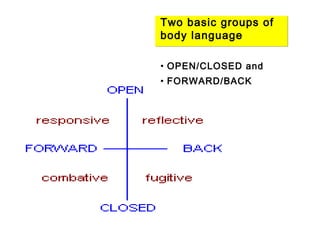
Two basic groups of
body language
• OPEN/CLOSED and
• FORWARD/BACK
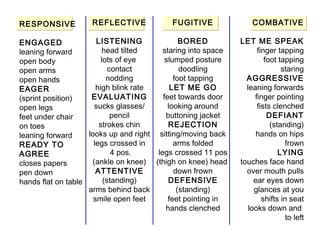
RESPONSIVE
ENGAGED
leaning forward
open body
open arms
open hands
EAGER
(sprint position)
open legs
feet under chair
on toes
leaning forward
READY TO
AGREE
closes papers
pen down
hands flat on table
REFLECTIVE
LISTENING
head tilted
lots of eye
contact
nodding
high blink rate
EVALUATING
sucks glasses/
pencil
strokes chin
looks up and right
legs crossed in
4 pos.
(ankle on knee)
ATTENTIVE
(standing)
arms behind back
smile open feet
FUGITIVE
BORED
staring into space
slumped posture
doodling
foot tapping
LET ME GO
feet towards door
looking around
buttoning jacket
REJECTION
sitting/moving back
arms folded
legs crossed 11 pos
(thigh on knee) head
down frown
DEFENSIVE
(standing)
feet pointing in
hands clenched
COMBATIVE
LET ME SPEAK
finger tapping
foot tapping
staring
AGGRESSIVE
leaning forwards
finger pointing
fists clenched
DEFIANT
(standing)
hands on hips
frown
LYING
touches face hand
over mouth pulls
ear eyes down
glances at you
shifts in seat
looks down and
to left
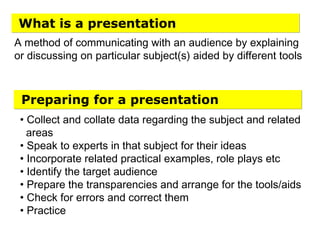
What is a presentation
A method of communicating with an audience by explaining
or discussing on particular subject(s) aided by different tools
Preparing for a presentation
• Collect and collate data regarding the subject and related
areas
• Speak to experts in that subject for their ideas
• Incorporate related practical examples, role plays etc
• Identify the target audience
• Prepare the transparencies and arrange for the tools/aids
• Check for errors and correct them
• Practice
Making effective presentations
Points to be kept in mind
• Be clear about the subject and the purpose of the same
• Collect accurate data and information on the subject
• Collect data on related topics and areas
• Use language understood by the audience
• Frame your presentation around the target audience
• Involve the audience by asking questions or games
• Do not remain fixed at one position, move while speaking
• Use gestures and expressions to drive the point home
• Use presentation aids to generate interest and present data
• Note critical points on a small note pad for ready reference
• Provide a list of reference books, articles etc and handouts
• Take a feedback at the end
Tools for effective presentations
Transparencies Overhead projector
Audio Visual facilities Handouts
Computer aided presentation - Power Point, CD ROM
Role plays, case studies, quizzes
Uses
An effective method of putting ideas across in a
comprehensive manner
- Proposals
- Training of employees
- Assignments to be submitted
Managerial requirements for
communication
A. Managerial communication skills are used for:
• Work facilitation
• To inform, instruct and guide
• Interpreting employee non verbal communication
• Motivating subordinates
• Breaking employee barriers and mindsets
• Developing better interpersonal relations
• As a ‘bridge’ between subordinates and superiors
Superior Manager Subordinate
Peers
B. What needs to be communicated
Information/ Attitudes
Data + Values
Moods
Emotions
C. The communication linkages
• Practice active listening, listen for facts and feelings, content and
intent.
• Identify barriers to good listening - and knock them down.
• Guide conversations with "open" and "closed" questions.
• Defuse difficult situations; encourage participation;
• Build empathy and check understanding.
• Read and use body language effectively.
• Speak effectively and persuasively.
Some final guidelines
Summarizing……Summarizing……
• Concepts, importance, barriers and ways to
overcome them
• Types, medium, gateways to communication
• Effective Communication – how to achieve
• Listening – importance, effective listening
• Feedback – importance, how to receive
• Organizational communication, memos
• Communication Ethics
• Written Communication – steps
• Body Language - Types
• Presentation Skills – how to deliver effective
presentations
Communication skills _1_634

Communication skills _1_634

  • 2.
    Food for thought WhenI have talked in anger, And my cheeks were flaming red, I have always uttered something, Which I wish I had not said.
  • 3.
    What we aimto learn • To understand and appreciate the process of communication as an important constituent of the professional effectiveness • To understand oneself and improve interpersonal skills • Exposure to communication concepts • Diagnose and circumvent barriers to communication • To gain confidence and honing presentation skills
  • 5.
    What is Communication •Communication is an exchange of information from the sender to the receiver with the message being understood as intended by the sender Idea Decode Idea Listens Reads Observes Speaks Writes Acts Draws Words Actions Pictures Numbers Encode Symbols The receiver Sender
  • 6.
    Three ways tothink about communication • Communication as ACTION: the transmission of information from one person to another through the use of symbols and their accompanying meaning. • Communication as INTERACTION: the exchange of information between two (or more) individuals through the symbols and their accompanying meaning. • Communication as MEANING CONSTRUCTION: the process by which two or more individuals arrive at ostensibly shared (or common) meanings or understandings for symbolic actions.
  • 7.
    A. Communication occursthrough the use of symbols and their accompanying meaning. B. All objects, events, persons, and actions can function as symbols for communication. C. Symbols do not possess inherent and universal meanings. D. Symbols possess objective (physical) properties; but meaning is inherently subjective and can only be inferred from the interpretation of symbols. E. The presumption of intentionality (i.e., conscious and deliberate symbolic action) is a prerequisite for communication. Some communication propositions
  • 8.
    Importance Of Communication •Organizational / Functional: greater information access and awareness • Improves coordination: reduces logical gaps • Encourages cooperation: helps bring everyone in the mainstream • Gives a direction: to tasks and activities • Morale and empowerment
  • 9.
    • Decision makingaid • Speeds up the organizational processes • Better focus on customer requirements • Generates a greater sense of organizational commitment and involvement • A problem solving tool: by clarity, preciseness and feedback ….. Importance Of Communication
  • 10.
    Barriers to Communication •A barrier reduces or changes the quality of the message being transmitted • Types : 1. Physical 2. Psychological Poor health Lack of Concentration Sound / noise Attitude and bias Unsuitable temperature Lack of self discipline Distractions Low emotional state
  • 11.
    How to overcomethe barriers For the sender • Be clear about the message to be sent • Be precise and to the point • Do not be verbose • Use a language understandable to the receiver • Write the message if required • Request a feedback to ensure receipt of message For the receiver • Be attentive • Concentrate on the message • Ask for clarifications wherever required • Listen objectively • ‘Listen’ for body language • Make notes if required
  • 12.
    Flow of communication Atthe workplace * Upward From employee to superior * Downward From superiors to the employee * Lateral From one employee to another
  • 13.
    Communication types Verbal • Oral- the spoken language Non verbal • Written • Body language • Expressions - facial, gestures, signs
  • 14.
    Medium of Communication •Memos • E-mails • Notices • Company circulars • In-house magazines • Oral instructions
  • 15.
    Gateways to Communication •A barrier removed is a gateway created. • We need to eradicate the ‘neps’ from the ‘fabric’ of our communication by practicing certain things. 1. Creating within one self the need and willingness to understand 2. Making the message appropriate to the receivers frame of reference ( speak the “language” of the listener)
  • 16.
    3. Ability todescribe others behavior without evaluating or interpreting. 4. Ask for feedback from the receiver 5. Reinforce communication by using more than one channel to convey the message (Verbal, written, nonverbal) ….. Gateways to Communication
  • 17.
    EFFECTIVE COMMUNICATION 1. Planyour communication • maintain clarity of purpose “why”, • maintain clarity of idea, “what”. 2. Choose the medium • language • style • semantics
  • 18.
    …. Effective Communication 3.Remove barriers ……. build gateways DO’s DON’Ts - seek first to understand - remove all prejudices and then to be understood - overcome any distractions - empathize with other people - reduce length of - values, beliefs, needs & sentiments communication channel - use a common language - clarify ideas before communicating
  • 19.
    ….. Effective Communication 4.Active Listening • Listen with an open mind • Make an effort to understand • Empathize ……..reflect understanding • Be aware of what is said and what is not said • Don’t jump to conclusions……draw conclusions 5. Feedback • Check for accurate receipt of message • Check action/outcome in relation with the intent of the message. • Improve/alter message, if required.
  • 21.
    Listening : Alost art Why do we not listen? • actions speak louder than words • Seeing is easier than listening • Visual medium is powerful We hear but don’t listen look but don’t see
  • 22.
    Listening- Interpretation • What thereceiver receives may be different from what the sender sends. • What receiver receives depends on – His behavior – Past experiences – His values, motivation, need or his attitude – His world
  • 23.
    What it takesto be a good listener • Ability to concentrate • genuine desire to understand the other persons point of view • Sensitivity to needs, emotions and body language • Humility: “You might have a point of view and I respect you” • A belief that other people are important and worth listening to.
  • 24.
    How to bea good listener • Know your power as a listener • Ask questions • Reflect feelings • Let your body give reassuring messages • Know your prejudices • Avoid making snap judgements • Avoid anger
  • 25.
    The Art ofListening Listening : an important human skill • indispensable for superiors • gets you respect, love and fame • shows that you care for and respect others • not listening could be psychologically upsetting for the other person • you can’t fake listening • the higher you go, the more you have to listen • it is a rare skill
  • 26.
    The Art ofListening Listening needs an • ability to concentrate • a genuine desire to understand the other persons point of view • sensitivity to needs, emotions and body language • humility - “I am not right alone, you might have a point and I respect you” • a belief that other people are important and worth listening to
  • 27.
    The Art ofListening Poor Listeners • The fidget : “Why are you telling me ?” • The aggressive listener : tries too hard and as a result scares people. • The pseudo - intellectual : hears only ideas and not the emotions behind them • The passive listener : :I agree with whatever you say” • The inaccurate listener :”I can’t concentrate”
  • 28.
    The Art ofListening How to be a good listener, Know your power as a listener • Ask questions • Reflect feelings • Let your body give reassuring messages. Nodding, arms apart, legs not crossed, erect forward posture. All these give non-verbal messages that you are listening. • Know your prejudices. You must discount from all those matters towards which you are biased or passionate. • Avoid making snap judgments • Avoid anger. It always gets the better of you.
  • 29.
    Importance Of Feedback •Feedback is necessary to check the effectiveness of the communication. • Feedback helps reflect upon how well the message has been encoded, transmitted and understood. • Feedback helps make mid-course correction if found required. - in terms of action : changing strategy - in terms of communication : changing message
  • 30.
    How to takeFeedback - ask for it you are the sender or offer it if you are the receiver - observe - evaluate the results achieved as against the objectives set - be objective while giving or receiving it - focus on the task and performance aspects not the individual’s personality
  • 32.
    Official Communication 1. Flow: vertical/horizontal/cross 2. Content : top-down are in the form of orders or directives bottom-up are in the form of feedback or complaints 3. Through a proper channel : Who is the end audience? Who should know first ? What should the network be ? 4. “Information is power”. One who has the authority to communicate is considered powerful.
  • 33.
    How to writememos that work • Begin with planning. - what are the facts ? - what do they mean ? - what do I do now ? Write short and to the point sentences • Write in the second person • Use memos to summarize group decisions, to list individual assignments and deadlines • Adopt a conversational style • Use the B - E - T method to help strengthen your memos content i.e. - B = Bottom line - E = Evidence - T = tasks Always keep your memos brief and precise
  • 34.
    Communication Ethics If intimationis power, and if we have information, then we must respect and handle our communication with restraint. Key Points: • maintain confidentiality - confidential information is trust reposed Confidential information is trust betrayed • certain information is `need to know’ - the job demands it, certain information is `desire to know’ - it may help in my job, and certain information is `desirable to know’, it may increase my power, fame and status. • Gossiping or bitching - is like `stabbing in the back’
  • 35.
    …. Communication Ethics •Ownership of information - Permission of the owner is a must before using it. • Knowledge of information vs. use of information - having information does not mean you can use it. • Communication must flow through a proper channel - cutting across a channels causes heartburns, hurt and misunderstandings • Timing and place - be careful and sensitive to it.
  • 36.
    Written Communication Written communicationas compared to oral communication is at a disadvantage because of the absence of non-verbal gestures, voice variation and physical expressions. This as a result increases the importance of clarity and accuracy of the content of our written message. To have effective written communication, certain steps and guidelines may help.
  • 37.
    Plan Keep it shortand simple Write it Edit your writing The steps (Your communication) (Brevity and precision) (Commit it on paper) (Check for corrections)
  • 38.
    Steps Step 1. Plan Likenearly any activity, written communication too requires a plan and a structure. Certain thins must be clearly ascertained, like, Sender : From whom is the communication starting ? Receiver : Who is the end receiver/audience of the written communication? Purpose : Why are we making the communication ? What is the expected outcome I.e What do expect the receiver to do ? These questions when answered and related will help us understand and design the path, requirements and the construction of the message.
  • 39.
    Step 2. Keepit Short & Simple (K.I.S.S.) The Structure of the content of the message must be, • Brief: Brevity and simplicity avoids any confusion in understanding the message. • Specific : Only the issue or matter in question must be addressed. Other unrelated matters must not be included as it might decrease the significance of the main topic. • Sequence:The flow of or written communication must follow a logical and stepwise format.
  • 40.
    Step 2. Keepit Short & Simple (K.I.S.S.) The Structure of the content of the message must be, • Short Sentences : They facilitate easy and correct understanding of the message. • Simple usable words : Everyday used words maintain the harmony and expression of our communication. • Facts and Figures ; They help to give our communication objectivity. Relying on unclear, subjective assumptions and expectations blurs the message.
  • 41.
    • Meaning ofthe facts Supporting data and clarification of the facts would help in the clarity of our communication. • Suit it to the audience One message may need different degrees of explanations. This depends on the context, frame of reference and understanding capability of the receiver in question. We must explain and elaborate our message depending on the receiver.
  • 42.
    • Call foraction Our written communication should look for expected action to be taken based on it. • Request feedback Our written communication must call for acknowledgment of receipt of information.Supporting the acknowledgment must be specific feedback on how the communication has been understood.
  • 43.
    Step 3. WriteIt Once we have done the above, we could proceed to actually writing our communication on paper, bearing a few things in mind. • Double spacing to improve readability,as used on this page. • Use of paragraph to make the communication more logical and understandable. • Neat, uniform handwriting, in case it is not typed or printed.
  • 44.
    Step 4. Edityour writing Effective editing is another step towards good writing. The key points to remember during editing are, • Edit your draft as brutally as if it was someone else’s copy. • Edit your draft from the readers point of view • Be specially critical of the first few paragraphs
  • 45.
    Step 4. Edityour writing (cont.) • Look out for problems in any section you wrote when you were bored or tired. • Carefully study the content of your draft details, flow, forgotten points, unrelated issues etc. • Edit for brevity and clarity • Read aloud for style and tone • Edit again
  • 46.
    Body Language • Interpretingbody language is vital in any communication process • Observe the body movements and postures • Match the other person’s language Some interesting interpretations of Rabbits Sniffing: May be annoyed or just talking to you Grunts: Usually angry, watch out or you could get bit! Shrill scream: Hurt or dying Circling your feet: Usually indicates sexual behavior. He/She's in love.
  • 47.
    Two basic groupsof body language • OPEN/CLOSED and • FORWARD/BACK
  • 48.
    RESPONSIVE ENGAGED leaning forward open body openarms open hands EAGER (sprint position) open legs feet under chair on toes leaning forward READY TO AGREE closes papers pen down hands flat on table REFLECTIVE LISTENING head tilted lots of eye contact nodding high blink rate EVALUATING sucks glasses/ pencil strokes chin looks up and right legs crossed in 4 pos. (ankle on knee) ATTENTIVE (standing) arms behind back smile open feet FUGITIVE BORED staring into space slumped posture doodling foot tapping LET ME GO feet towards door looking around buttoning jacket REJECTION sitting/moving back arms folded legs crossed 11 pos (thigh on knee) head down frown DEFENSIVE (standing) feet pointing in hands clenched COMBATIVE LET ME SPEAK finger tapping foot tapping staring AGGRESSIVE leaning forwards finger pointing fists clenched DEFIANT (standing) hands on hips frown LYING touches face hand over mouth pulls ear eyes down glances at you shifts in seat looks down and to left
  • 50.
    What is apresentation A method of communicating with an audience by explaining or discussing on particular subject(s) aided by different tools Preparing for a presentation • Collect and collate data regarding the subject and related areas • Speak to experts in that subject for their ideas • Incorporate related practical examples, role plays etc • Identify the target audience • Prepare the transparencies and arrange for the tools/aids • Check for errors and correct them • Practice
  • 51.
    Making effective presentations Pointsto be kept in mind • Be clear about the subject and the purpose of the same • Collect accurate data and information on the subject • Collect data on related topics and areas • Use language understood by the audience • Frame your presentation around the target audience • Involve the audience by asking questions or games • Do not remain fixed at one position, move while speaking • Use gestures and expressions to drive the point home • Use presentation aids to generate interest and present data • Note critical points on a small note pad for ready reference • Provide a list of reference books, articles etc and handouts • Take a feedback at the end
  • 52.
    Tools for effectivepresentations Transparencies Overhead projector Audio Visual facilities Handouts Computer aided presentation - Power Point, CD ROM Role plays, case studies, quizzes Uses An effective method of putting ideas across in a comprehensive manner - Proposals - Training of employees - Assignments to be submitted
  • 53.
    Managerial requirements for communication A.Managerial communication skills are used for: • Work facilitation • To inform, instruct and guide • Interpreting employee non verbal communication • Motivating subordinates • Breaking employee barriers and mindsets • Developing better interpersonal relations • As a ‘bridge’ between subordinates and superiors
  • 54.
    Superior Manager Subordinate Peers B.What needs to be communicated Information/ Attitudes Data + Values Moods Emotions C. The communication linkages
  • 55.
    • Practice activelistening, listen for facts and feelings, content and intent. • Identify barriers to good listening - and knock them down. • Guide conversations with "open" and "closed" questions. • Defuse difficult situations; encourage participation; • Build empathy and check understanding. • Read and use body language effectively. • Speak effectively and persuasively. Some final guidelines
  • 56.
    Summarizing……Summarizing…… • Concepts, importance,barriers and ways to overcome them • Types, medium, gateways to communication • Effective Communication – how to achieve • Listening – importance, effective listening • Feedback – importance, how to receive • Organizational communication, memos • Communication Ethics • Written Communication – steps • Body Language - Types • Presentation Skills – how to deliver effective presentations