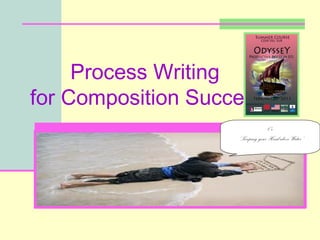
Process Writing
for Composition Success
                                  Or
                    “Keeping your Head above Water”
About us and the topic we
      chose:
 Susan Joyce, American, published author-book
  writer, publisher for Peel Productions, Inc.

  “ Information
+ Imagination
_______________________
GREAT CREATION”

 Gabriela Gaione, Uruguayan, EFL teacher, amateur
  writer

 “Writing comes from the soul”
Why improve writing in EFL?


 Evidence indicates that Ss are not getting good results
  in the writing skill- hence INSPECCIÓN de INGLÉS
  suggested this topic was critical this year

 It is a requirement in all EFL syllabi

 It is an academic and social need

 It is a market labor need

 It is an integral part of a whole education
Writing
 Identifies
Writing
 identifies,
 communicates
 and
 reminds


            http://www.flickr.com/photos/henrybloomfield/5695330591/sizes/o/in/photostream/
Writing
 Communicates and reminds
Writing
 Satisfies a requirement
Writing
 Promotes introspection
Writing
 Communicates, recombines and allows
 introspection
Writing
 May exemplify what is known as aesthetic
  creativity
Non linguistic knowledge
that we use for writing - Grabe and

Kaplan
   reference
   world background knowledge
   memory
   emotion
   perception
   intention
   logical arrangement
   situation
A model of text structure -Grabe and
Kaplan 1996
    Fig 3.1 text structure
                  SURFACE    L DEEP
    Sentential    syntax     E semantic
                             X
                             I
    textual       cohesion   C coherence
                             O
                             N
Analysis of Writing by
Grabe and Kaplan 1996
P92 4.1 Flower and Hayes- - - - writing process model

                        T ask envir onment
    T he rhetor ical problem       T ext pr oduced so far
G   T opic
E   Audience
N
    exigency
E
R
A   Planning                   translation Reviewing
T   Or ganizing                            Evaluating
I   Goal setting                           Editing
N
G
 http://faculty.uoit.ca/hughes/Writing/TheWriting
  Process.gif


     http:// faculty .uoit.ca/ hughes/ Wr iting/T heWritingProces
     s.gif
RSVP- How to respond to SS’ writing

TESOL tips
 Comments on the margin on content
 Questions in the margin on content
 Sum-up comments at the end of the composition
       Include good news
       Be short
       Focus on one or two- taught aspects
   Conference
   Include peer advice
   Use correction codes
   Share criteria and if possible create rubrics with your
    students before the writing takes place-
Some TESOL strategies for successful
writing-
 Copying
 Dictation
 Dictocomp
 Note- taking
 Speed writing
 In – class essays
 Form filling
ABC brainstorm- link – list -combine
Order, edit and proof-read
P 38 Grabe and Kaplan
Some questions to reflect upon:
 What is a text?
 How may texts be examined as product?
 How may texts be analyzed as process?
 How may product and process be viewed as
  reflecting an Interactive model?
 How do process and product issues embed
  themselves within a coherent interpretation of wider
  social contexts for writing?
 What types of texts do we want learners to produce?
 What do these issues suggest for writing instruction
  in the classroom?
Bibliography & LINKS
  Grabe, W. & Kaplan, R.B. Theory and Practice of Writing- An Applied
     Linguistics Perspective -1996 -Longman
     Scarpa, S. Cursos de Sensibilización para Docentes del Plan 1996
     Febrero Marzo 2001- Cuadernos de la ANEP
    Snow, D. More than a Native Speaker- Teaching English to Speakers
     of Other Languages, Inc-2006
    Tribble, C. Writing 1996 Oxford University Press –
    Ur, P.A Course in Language Teaching 1999 Cambridge University
     Press
 http://www.flickr.com/
 http://faculty.uoit.ca/hughes/Writing/TheWritingProcess.g

http://www.flickr.com/photos/henrybloomfield/5695330591/sizes/o/in/photostream
Thank you!

Susan and Gabriela

Process writing for composition success saturday

  • 1.
    Process Writing for CompositionSuccess Or “Keeping your Head above Water”
  • 2.
    About us andthe topic we chose:  Susan Joyce, American, published author-book writer, publisher for Peel Productions, Inc. “ Information + Imagination _______________________ GREAT CREATION”  Gabriela Gaione, Uruguayan, EFL teacher, amateur writer  “Writing comes from the soul”
  • 4.
    Why improve writingin EFL?  Evidence indicates that Ss are not getting good results in the writing skill- hence INSPECCIÓN de INGLÉS suggested this topic was critical this year  It is a requirement in all EFL syllabi  It is an academic and social need  It is a market labor need  It is an integral part of a whole education
  • 5.
  • 6.
    Writing  identifies,  communicates and  reminds http://www.flickr.com/photos/henrybloomfield/5695330591/sizes/o/in/photostream/
  • 7.
  • 8.
  • 9.
  • 10.
    Writing  Communicates, recombinesand allows introspection
  • 11.
    Writing  May exemplifywhat is known as aesthetic creativity
  • 12.
    Non linguistic knowledge thatwe use for writing - Grabe and Kaplan  reference  world background knowledge  memory  emotion  perception  intention  logical arrangement  situation
  • 13.
    A model oftext structure -Grabe and Kaplan 1996 Fig 3.1 text structure SURFACE L DEEP Sentential syntax E semantic X I textual cohesion C coherence O N
  • 14.
    Analysis of Writingby Grabe and Kaplan 1996
  • 15.
    P92 4.1 Flowerand Hayes- - - - writing process model T ask envir onment T he rhetor ical problem T ext pr oduced so far G T opic E Audience N exigency E R A Planning translation Reviewing T Or ganizing Evaluating I Goal setting Editing N G
  • 16.
     http://faculty.uoit.ca/hughes/Writing/TheWriting Process.gif http:// faculty .uoit.ca/ hughes/ Wr iting/T heWritingProces s.gif
  • 19.
    RSVP- How torespond to SS’ writing TESOL tips  Comments on the margin on content  Questions in the margin on content  Sum-up comments at the end of the composition  Include good news  Be short  Focus on one or two- taught aspects  Conference  Include peer advice  Use correction codes  Share criteria and if possible create rubrics with your students before the writing takes place-
  • 20.
    Some TESOL strategiesfor successful writing-  Copying  Dictation  Dictocomp  Note- taking  Speed writing  In – class essays  Form filling
  • 22.
    ABC brainstorm- link– list -combine
  • 23.
    Order, edit andproof-read
  • 25.
    P 38 Grabeand Kaplan Some questions to reflect upon:  What is a text?  How may texts be examined as product?  How may texts be analyzed as process?  How may product and process be viewed as reflecting an Interactive model?  How do process and product issues embed themselves within a coherent interpretation of wider social contexts for writing?  What types of texts do we want learners to produce?  What do these issues suggest for writing instruction in the classroom?
  • 27.
    Bibliography & LINKS  Grabe, W. & Kaplan, R.B. Theory and Practice of Writing- An Applied Linguistics Perspective -1996 -Longman  Scarpa, S. Cursos de Sensibilización para Docentes del Plan 1996 Febrero Marzo 2001- Cuadernos de la ANEP  Snow, D. More than a Native Speaker- Teaching English to Speakers of Other Languages, Inc-2006  Tribble, C. Writing 1996 Oxford University Press –  Ur, P.A Course in Language Teaching 1999 Cambridge University Press http://www.flickr.com/ http://faculty.uoit.ca/hughes/Writing/TheWritingProcess.g http://www.flickr.com/photos/henrybloomfield/5695330591/sizes/o/in/photostream
  • 28.