Communication Skills for Teachers
Dilip Barad
Dept. of English
M.K. Bhavnagar University
27 June 2014
Faculty Development Programme
Morgan, Algiro L. in his paper
‘Communication Skills for Teachers’
• “One of the most neglected aspects of teacher
training is thorough preparation in the diverse
communication skills that are needed by good
teachers in today's schools.”
Six Important Points: CS 4 T
• Positive Motivation: create interest, enthusiasm, remove
fear and inhibition.
• Effective Body Language: Gestures, body movement with
verbal skills – never sit and teach - Moving in aisles.
• Sense of Humor: do not confuse dirty jokes with humour.
• Understanding the Students: prefer dialogue over
monologue – listen students’ opinion- saint on the stage vs
guide by the side
• Team Formation: helps in mutual
understanding students as well as teachers.
• Technical skills: Up-to-date with latest
techno-tools for teaching.
Be precise: Brevity is the Soul
• A Brief History of Communication . . (Video)
• The journey from pre-historic to techno-era in
a few seconds.
• Save time! Time is the most precious.
• (To view this video visit:
https://www.youtube.com/watch?v=c9KGt3OS4uM&index=2&list=PLSmZQVxjN9_j0Ln3e5i6L
-NDzEpHGNP7W)
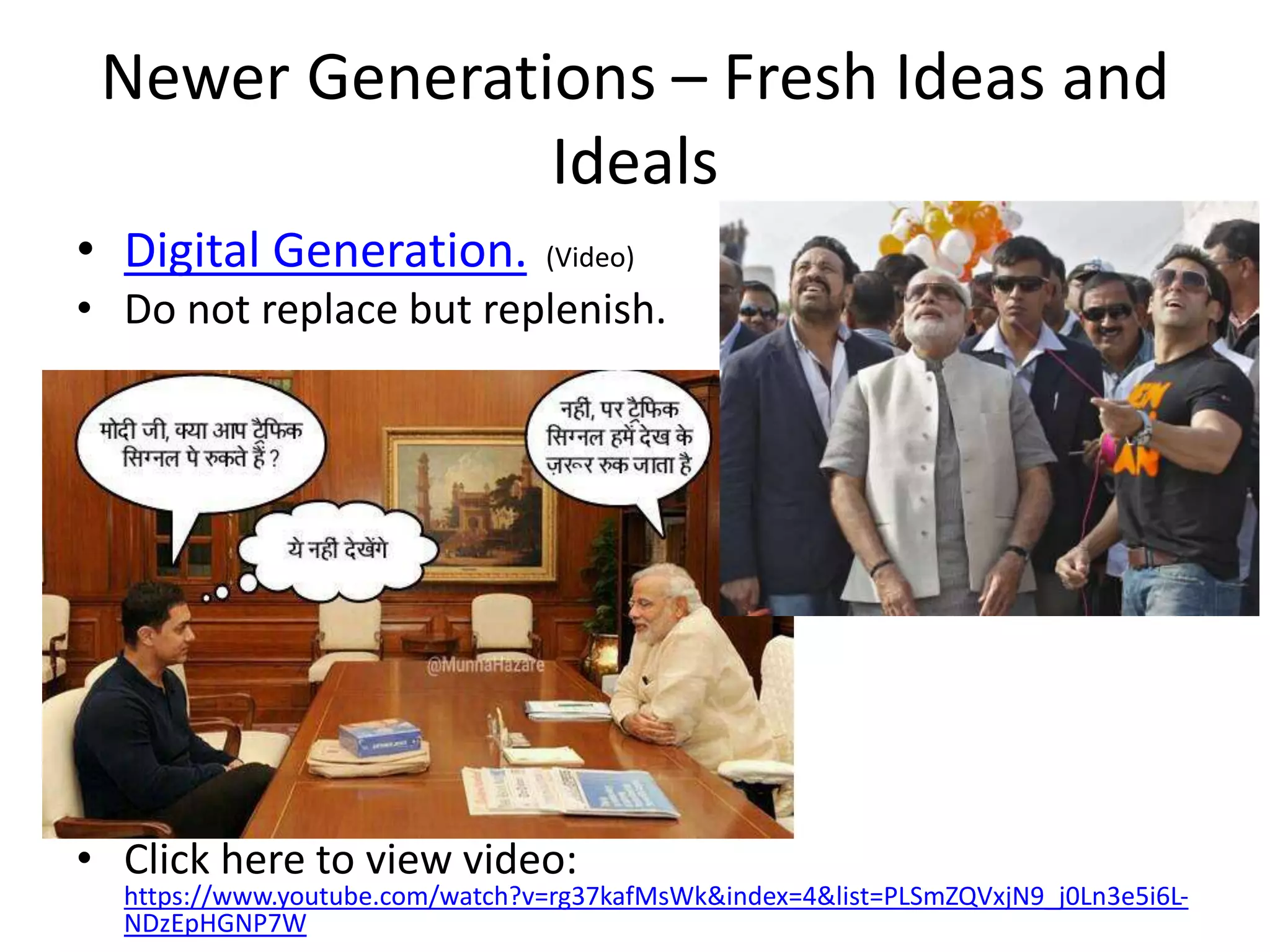
Newer Generations – Fresh Ideas and
Ideals
• Digital Generation. (Video)
• Do not replace but replenish.
• Click here to view video:
https://www.youtube.com/watch?v=rg37kafMsWk&index=4&list=PLSmZQVxjN9_j0Ln3e5i6L-
NDzEpHGNP7W
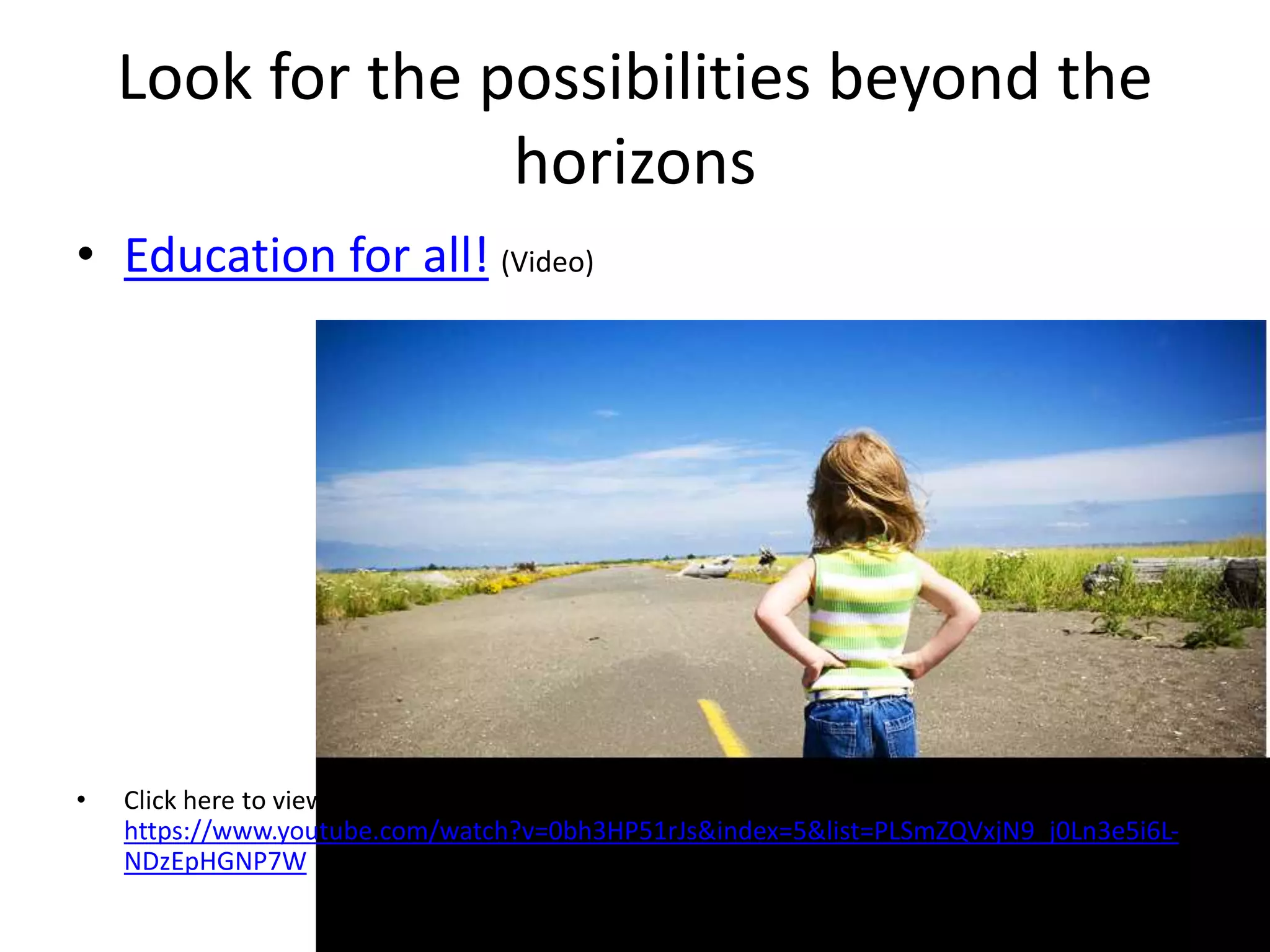
Look for the possibilities beyond the
horizons
• Education for all! (Video)
• Click here to view video:
https://www.youtube.com/watch?v=0bh3HP51rJs&index=5&list=PLSmZQVxjN9_j0Ln3e5i6L-
NDzEpHGNP7W
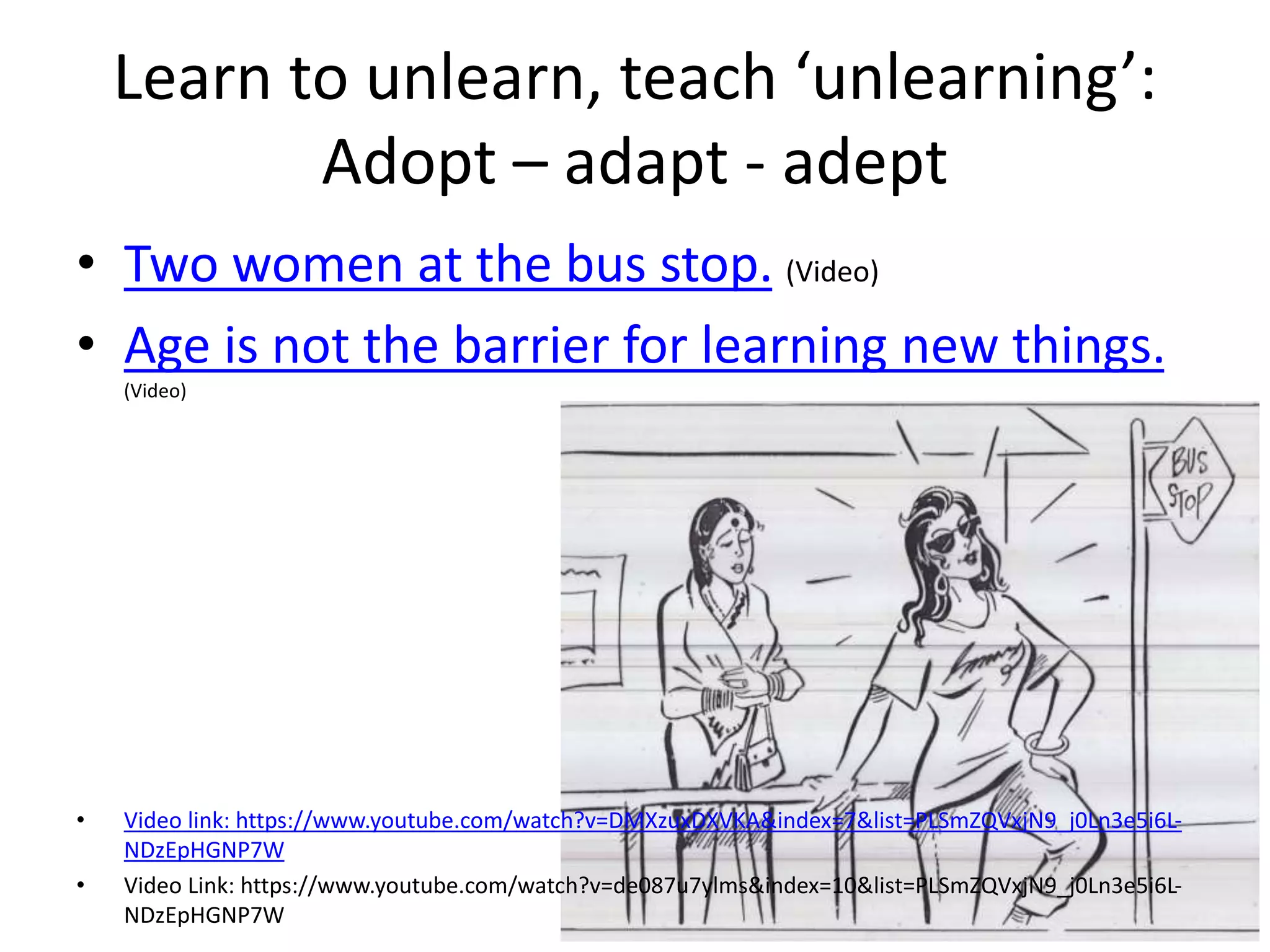
Learn to unlearn, teach ‘unlearning’:
Adopt – adapt - adept
• Two women at the bus stop. (Video)
• Age is not the barrier for learning new things.
(Video)
• Video link: https://www.youtube.com/watch?v=DMXzuxDXVKA&index=7&list=PLSmZQVxjN9_j0Ln3e5i6L-
NDzEpHGNP7W
• Video Link: https://www.youtube.com/watch?v=de087u7ylms&index=10&list=PLSmZQVxjN9_j0Ln3e5i6L-
NDzEpHGNP7W
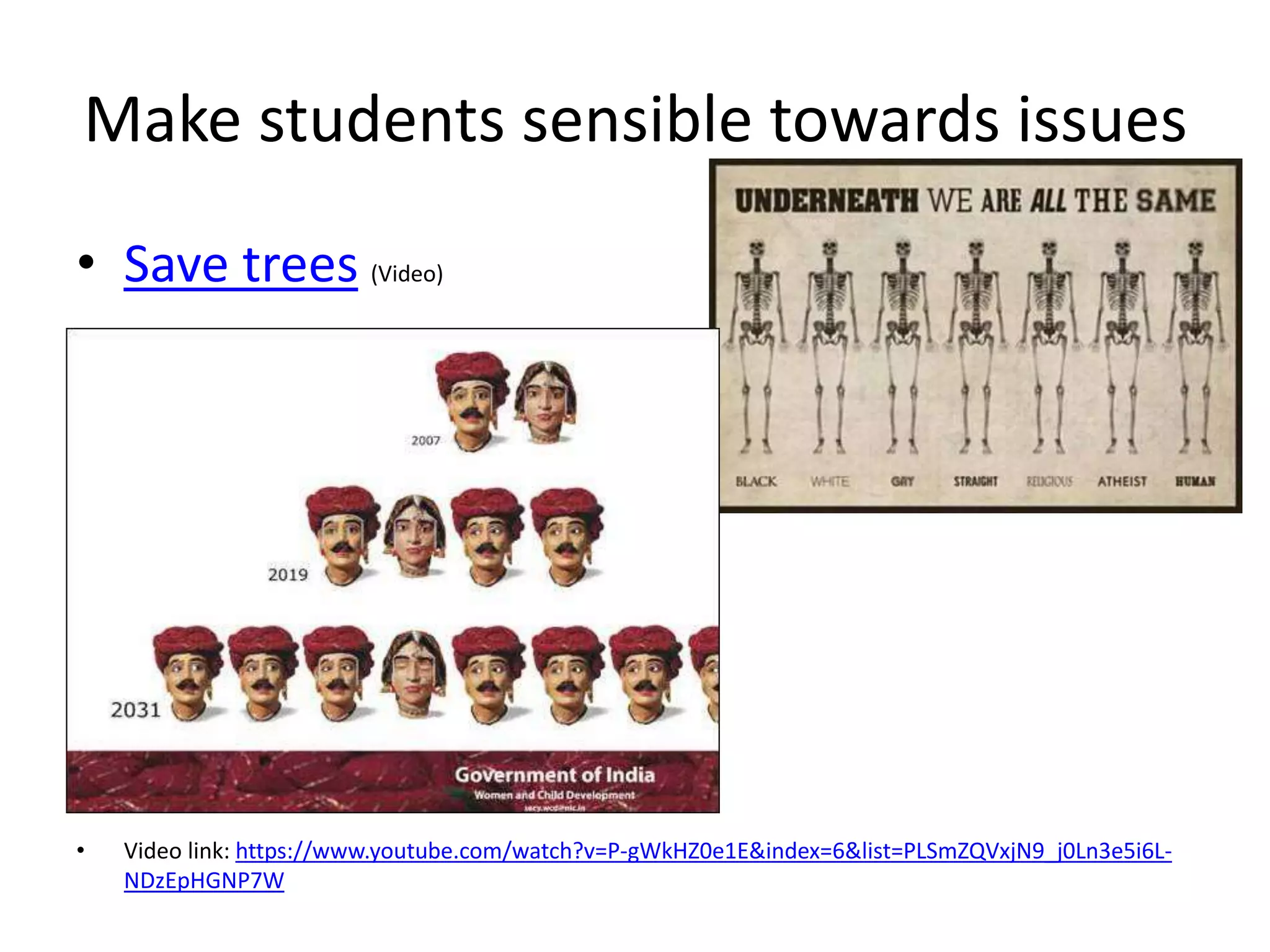
Make students sensible towards issues
• Save trees (Video)
• Video link: https://www.youtube.com/watch?v=P-gWkHZ0e1E&index=6&list=PLSmZQVxjN9_j0Ln3e5i6L-
NDzEpHGNP7W
Demonstrate! Do not teach, let them
learn!
• Watch this video from movie 3 Idiots.
• (The scene is that of Virus demonstrating nest of crow with eggs of Koyel)
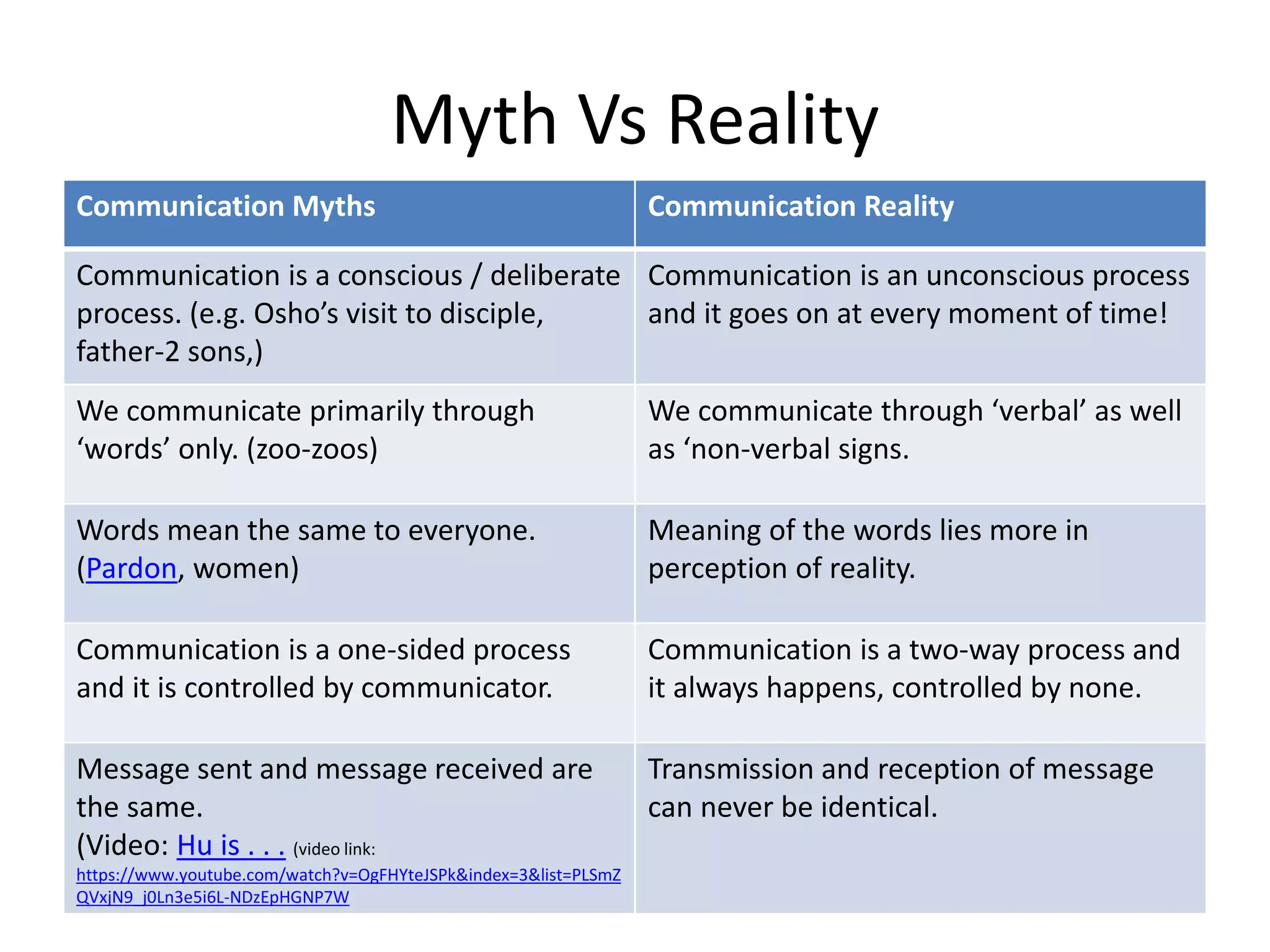
Myth Vs Reality
Communication Myths Communication Reality
Communication is a conscious / deliberate
process. (e.g. Osho’s visit to disciple,
father-2 sons,)
Communication is an unconscious process
and it goes on at every moment of time!
We communicate primarily through
‘words’ only. (zoo-zoos)
We communicate through ‘verbal’ as well
as ‘non-verbal signs.
Words mean the same to everyone.
(Pardon, women)
Meaning of the words lies more in
perception of reality.
Communication is a one-sided process
and it is controlled by communicator.
Communication is a two-way process and
it always happens, controlled by none.
Message sent and message received are
the same.
(Video: Hu is . . . (video link:
https://www.youtube.com/watch?v=OgFHYteJSPk&index=3&list=PLSmZ
QVxjN9_j0Ln3e5i6L-NDzEpHGNP7W
Transmission and reception of message
can never be identical.
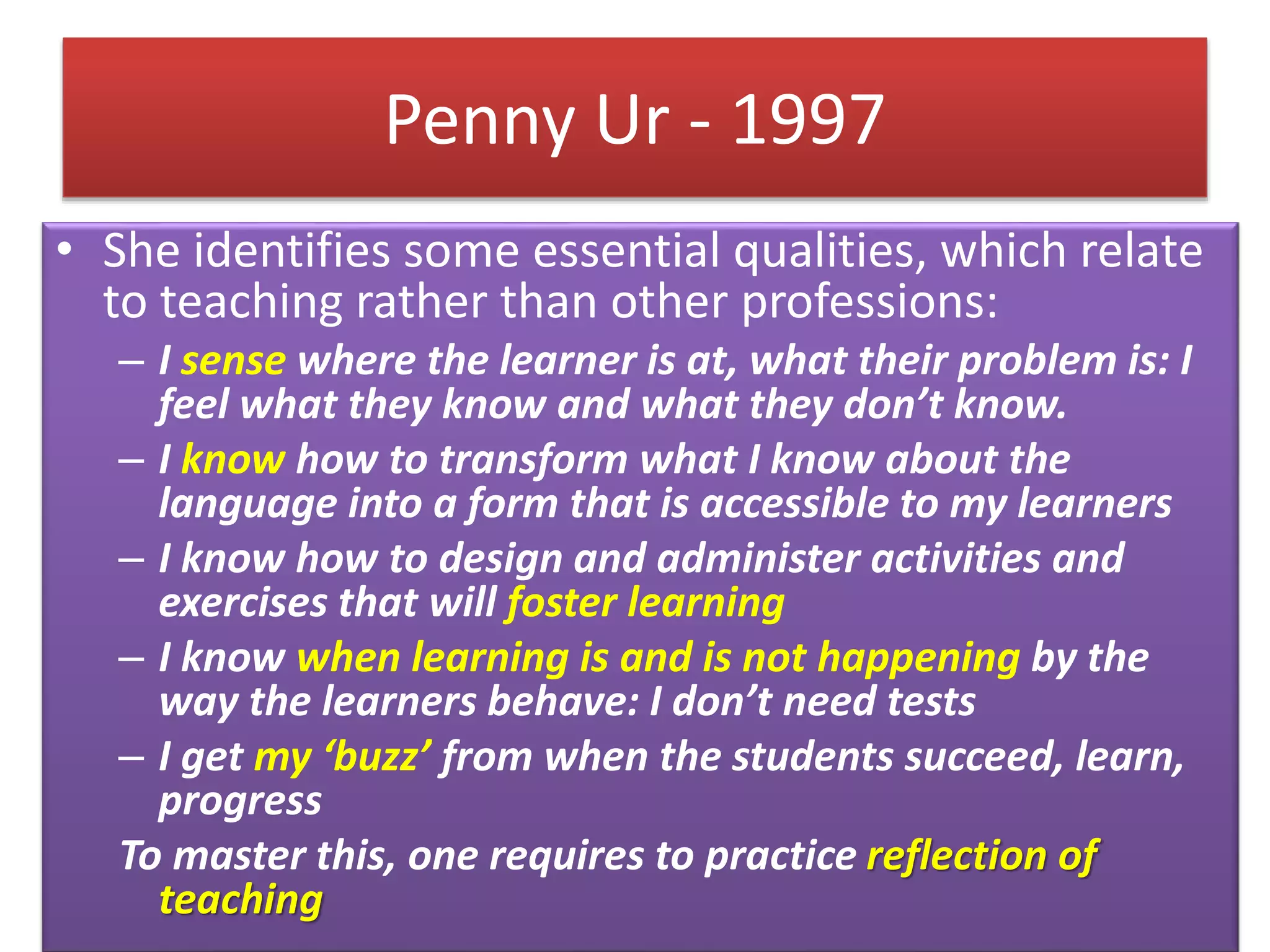
Penny Ur - 1997
• She identifies some essential qualities, which relate
to teaching rather than other professions:
– I sense where the learner is at, what their problem is: I
feel what they know and what they don’t know.
– I know how to transform what I know about the
language into a form that is accessible to my learners
– I know how to design and administer activities and
exercises that will foster learning
– I know when learning is and is not happening by the
way the learners behave: I don’t need tests
– I get my ‘buzz’ from when the students succeed, learn,
progress
To master this, one requires to practice reflection of
teaching
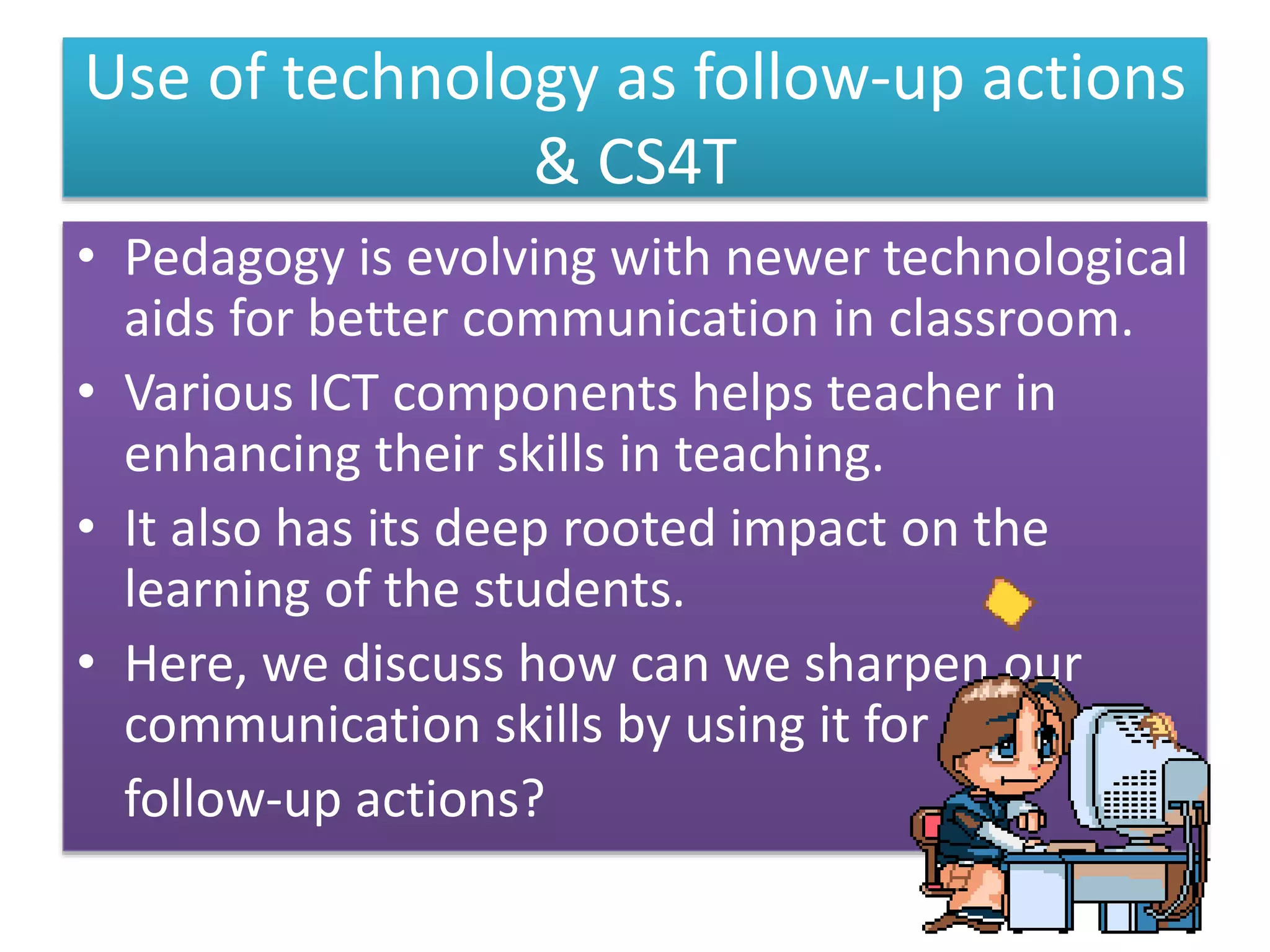
Use of technology as follow-up actions
& CS4T
• Pedagogy is evolving with newer technological
aids for better communication in classroom.
• Various ICT components helps teacher in
enhancing their skills in teaching.
• It also has its deep rooted impact on the
learning of the students.
• Here, we discuss how can we sharpen our
communication skills by using it for
follow-up actions?
• SMS, email, scrap, tweet, chat, web spaces, SIG,
etc can be used effectively for:
– Replying questions of the students
– Solving their doubts/queries etc
– Giving some task for next class in advance
– Having group discussion out of the class
– Uploading lesson/presentation to web
spaces
– Running web sites with LMS to check
students progress
– Managing e-groups (SIGs) – file
upload, poll, discussion, photos etc.
Social Constructivism
• Social constructivism extends constructivism
into social settings, wherein groups construct
knowledge for one another, collaboratively
creating a small culture of shared artifacts
with shared meanings.
• When one is immersed within a culture like
this, one is learning all the time about how to
be a part of that culture, on many levels.
• Eg. Cup.
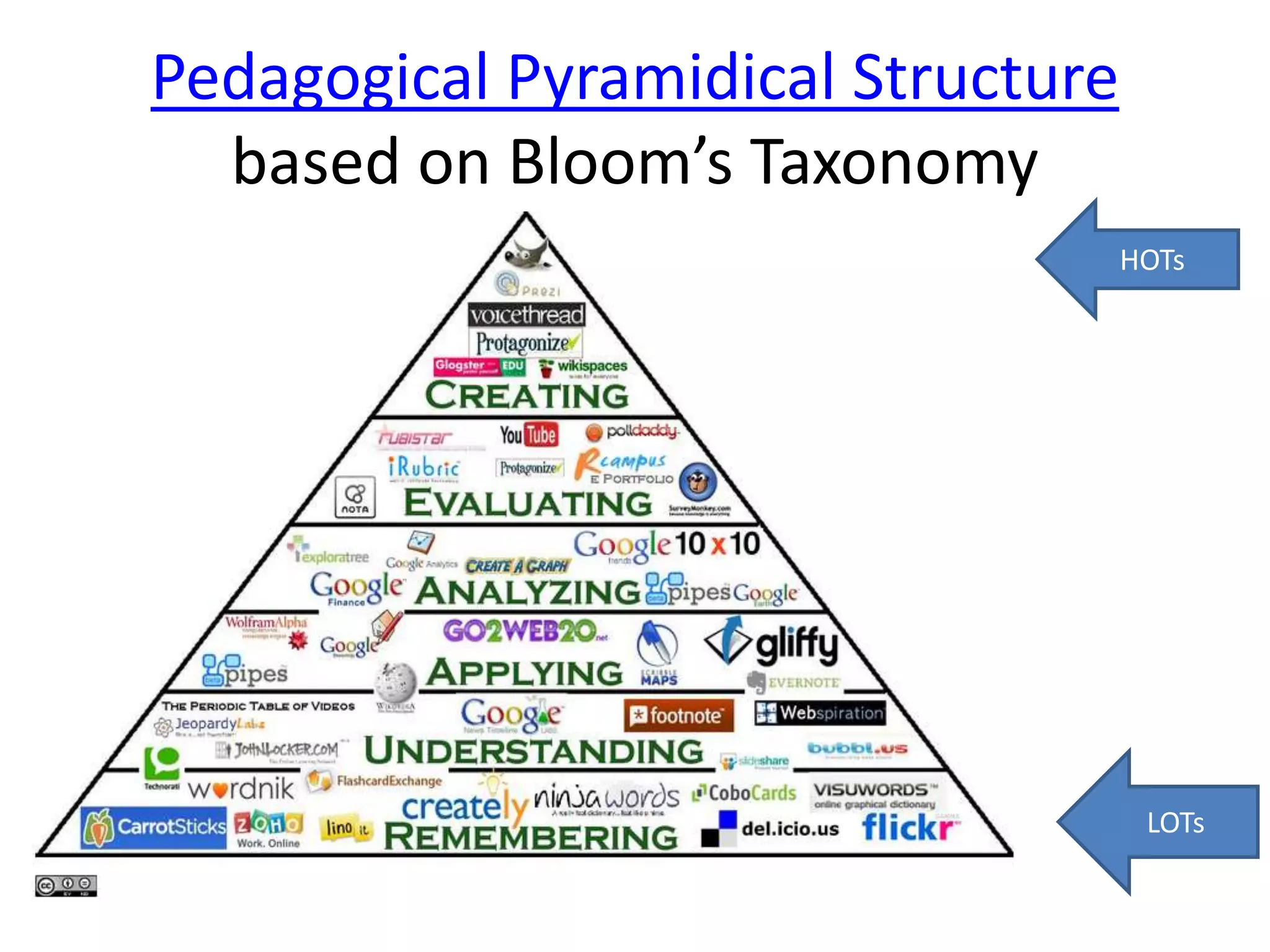
Pedagogical Pyramidical Structure
based on Bloom’s Taxonomy
LOTs
HOTs
Observation is the master key!
• To be the master of effective Communication
Skills, OBSERVE, OBSERVE, OBSERVE; minutely,
meticulously, marvelously.
Let’s view this advertisement. We are supposed to identify the product -
Fire crackers - Courier service – anti-roach spray - Gas Cylinder – Save
Fuel - Save Environment – match box –– old age woes
Click or copy / paste to view video:
https://www.youtube.com/watch?v=97650bEF434&index=9&list=PLSmZQVxjN9_j0Ln3e5i6L-NDzEpHGNP7W
29/06/2014 17
An Advanced National Workshop in General
Semantics: 28-30 Jan. 2013
How observant are we?
Video link: https://www.youtube.com/watch?v=ubNF9QNEQLA&index=8&list=PLSmZQVxjN9_j0Ln3e5i6L-NDzEpHGNP7W
29/06/2014 18
An Advanced National Workshop in General
Semantics: 28-30 Jan. 2013
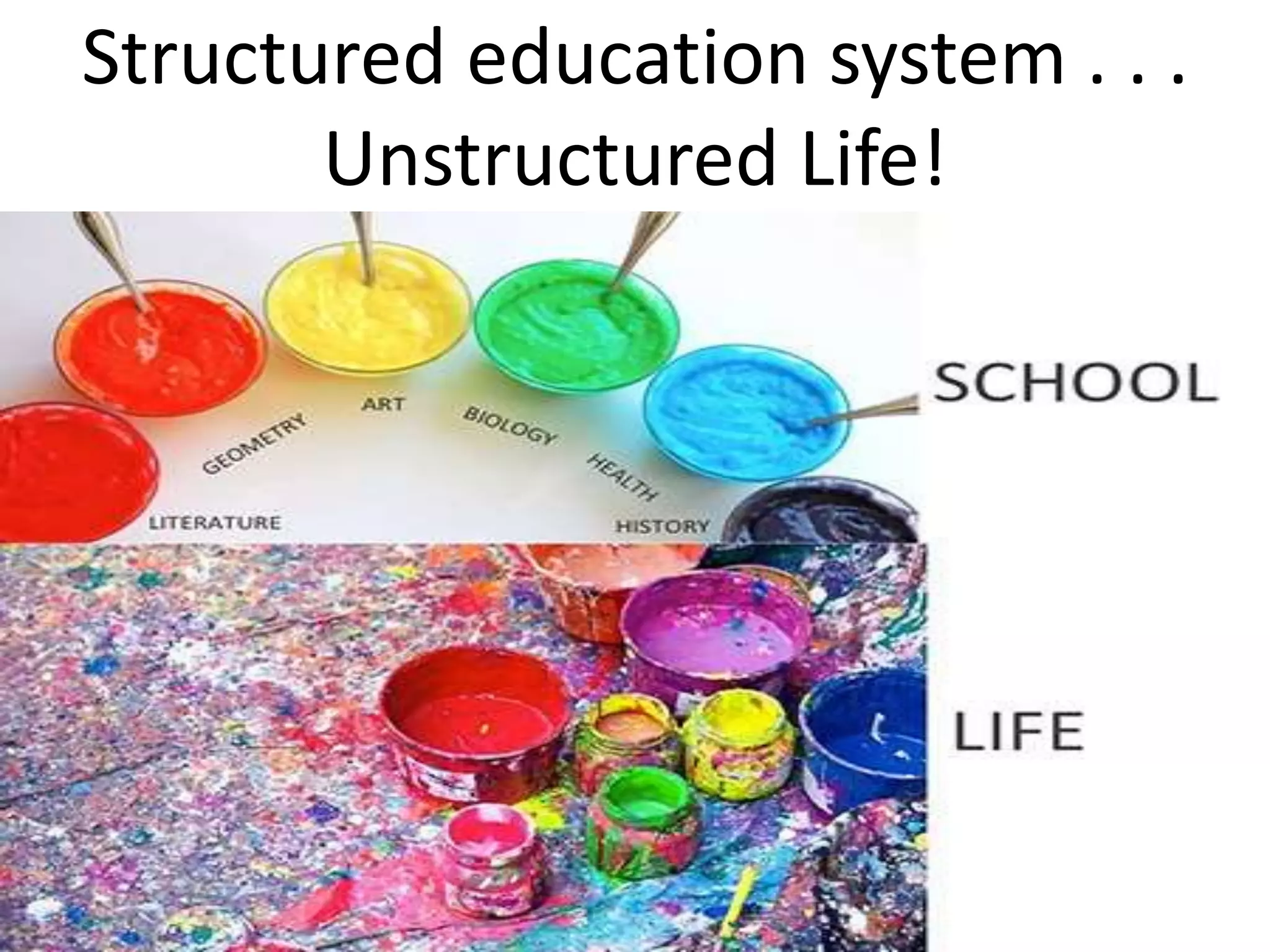
Structured education system . . .
Unstructured Life!
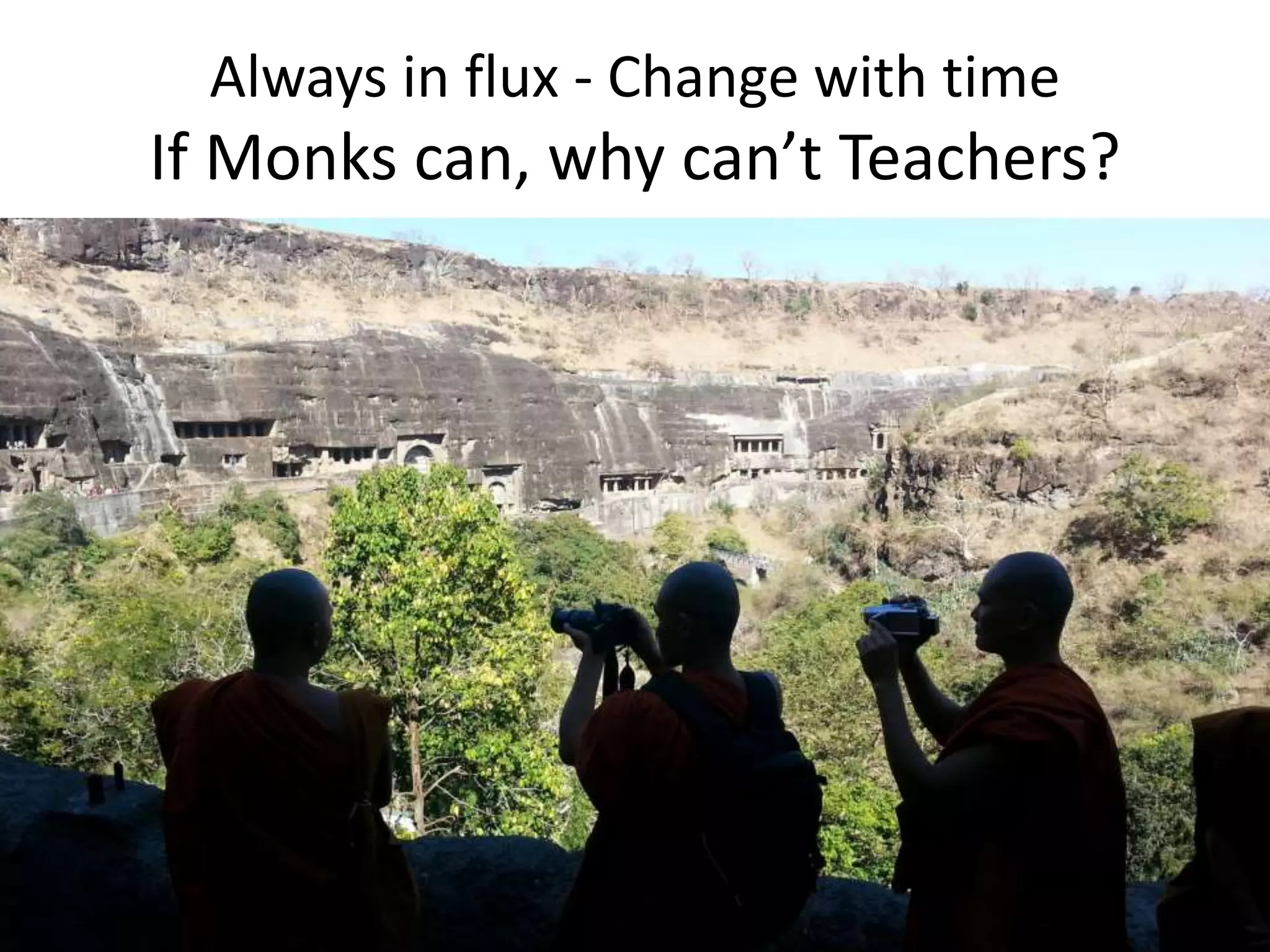
Always in flux - Change with time
If Monks can, why can’t Teachers?
Let us review highly effective skills of
teachers
• Be precise: Brevity is the Soul
• Be contemporary: Newer Generations – Fresh Ideas
and Ideals
• Look for the possibilities beyond the horizons
• Learn to unlearn, teach ‘unlearning’: Adopt – adapt –
adept
• Make students sensible towards issues
• Demonstrate! Do not teach, let them learn!
• Be observant! Avoid jundgmentalism
• Always be in flux - Change with time
• Practice Reflective Teaching
Lets conclude - teachers in action
• Video 1: An imaginary picture of a teacher
• Video 2: The reality!
• Video1 link: https://www.youtube.com/watch?v=TlEP5uAhr3Y&index=11&list=PLSmZQVxjN9_j0Ln3e5i6L-NDzEpHGNP7W
• Video2 link: https://www.youtube.com/watch?v=amBhZP1b4x4&index=12&list=PLSmZQVxjN9_j0Ln3e5i6L-NDzEpHGNP7W
What is the message?
• To get to the core of message, do not ask ‘WHAT’.
• Do not ask ‘What is said or shown?’
• Ask, ‘HOW’ – The ‘How’ of the presentation has
the message for teachers to be effective and
efficient in classroom performance as well as in
professional development.
• In this 90 minutes presentation:
– 12 videos
– 17 images
– #900 words – are used in 24 slides.
Thank You…
•Questions????
•Before you ask, ponder this:
PM of I, school visit, questions by students, Nawaz Sharif,
Dawood, Iraq !@?
• www.dilipbarad.com
• dilipbarad@gmail.com

Communication Skills for Teachers - II

  • 1.
    Communication Skills forTeachers Dilip Barad Dept. of English M.K. Bhavnagar University 27 June 2014 Faculty Development Programme
  • 2.
    Morgan, Algiro L.in his paper ‘Communication Skills for Teachers’ • “One of the most neglected aspects of teacher training is thorough preparation in the diverse communication skills that are needed by good teachers in today's schools.”
  • 3.
    Six Important Points:CS 4 T • Positive Motivation: create interest, enthusiasm, remove fear and inhibition. • Effective Body Language: Gestures, body movement with verbal skills – never sit and teach - Moving in aisles. • Sense of Humor: do not confuse dirty jokes with humour. • Understanding the Students: prefer dialogue over monologue – listen students’ opinion- saint on the stage vs guide by the side • Team Formation: helps in mutual understanding students as well as teachers. • Technical skills: Up-to-date with latest techno-tools for teaching.
  • 4.
    Be precise: Brevityis the Soul • A Brief History of Communication . . (Video) • The journey from pre-historic to techno-era in a few seconds. • Save time! Time is the most precious. • (To view this video visit: https://www.youtube.com/watch?v=c9KGt3OS4uM&index=2&list=PLSmZQVxjN9_j0Ln3e5i6L -NDzEpHGNP7W)
  • 5.
    Newer Generations –Fresh Ideas and Ideals • Digital Generation. (Video) • Do not replace but replenish. • Click here to view video: https://www.youtube.com/watch?v=rg37kafMsWk&index=4&list=PLSmZQVxjN9_j0Ln3e5i6L- NDzEpHGNP7W
  • 6.
    Look for thepossibilities beyond the horizons • Education for all! (Video) • Click here to view video: https://www.youtube.com/watch?v=0bh3HP51rJs&index=5&list=PLSmZQVxjN9_j0Ln3e5i6L- NDzEpHGNP7W
  • 7.
    Learn to unlearn,teach ‘unlearning’: Adopt – adapt - adept • Two women at the bus stop. (Video) • Age is not the barrier for learning new things. (Video) • Video link: https://www.youtube.com/watch?v=DMXzuxDXVKA&index=7&list=PLSmZQVxjN9_j0Ln3e5i6L- NDzEpHGNP7W • Video Link: https://www.youtube.com/watch?v=de087u7ylms&index=10&list=PLSmZQVxjN9_j0Ln3e5i6L- NDzEpHGNP7W
  • 8.
    Make students sensibletowards issues • Save trees (Video) • Video link: https://www.youtube.com/watch?v=P-gWkHZ0e1E&index=6&list=PLSmZQVxjN9_j0Ln3e5i6L- NDzEpHGNP7W
  • 9.
    Demonstrate! Do notteach, let them learn! • Watch this video from movie 3 Idiots. • (The scene is that of Virus demonstrating nest of crow with eggs of Koyel)
  • 10.
    Myth Vs Reality CommunicationMyths Communication Reality Communication is a conscious / deliberate process. (e.g. Osho’s visit to disciple, father-2 sons,) Communication is an unconscious process and it goes on at every moment of time! We communicate primarily through ‘words’ only. (zoo-zoos) We communicate through ‘verbal’ as well as ‘non-verbal signs. Words mean the same to everyone. (Pardon, women) Meaning of the words lies more in perception of reality. Communication is a one-sided process and it is controlled by communicator. Communication is a two-way process and it always happens, controlled by none. Message sent and message received are the same. (Video: Hu is . . . (video link: https://www.youtube.com/watch?v=OgFHYteJSPk&index=3&list=PLSmZ QVxjN9_j0Ln3e5i6L-NDzEpHGNP7W Transmission and reception of message can never be identical.
  • 11.
    Penny Ur -1997 • She identifies some essential qualities, which relate to teaching rather than other professions: – I sense where the learner is at, what their problem is: I feel what they know and what they don’t know. – I know how to transform what I know about the language into a form that is accessible to my learners – I know how to design and administer activities and exercises that will foster learning – I know when learning is and is not happening by the way the learners behave: I don’t need tests – I get my ‘buzz’ from when the students succeed, learn, progress To master this, one requires to practice reflection of teaching
  • 12.
    Use of technologyas follow-up actions & CS4T • Pedagogy is evolving with newer technological aids for better communication in classroom. • Various ICT components helps teacher in enhancing their skills in teaching. • It also has its deep rooted impact on the learning of the students. • Here, we discuss how can we sharpen our communication skills by using it for follow-up actions?
  • 13.
    • SMS, email,scrap, tweet, chat, web spaces, SIG, etc can be used effectively for: – Replying questions of the students – Solving their doubts/queries etc – Giving some task for next class in advance – Having group discussion out of the class – Uploading lesson/presentation to web spaces – Running web sites with LMS to check students progress – Managing e-groups (SIGs) – file upload, poll, discussion, photos etc.
  • 14.
    Social Constructivism • Socialconstructivism extends constructivism into social settings, wherein groups construct knowledge for one another, collaboratively creating a small culture of shared artifacts with shared meanings. • When one is immersed within a culture like this, one is learning all the time about how to be a part of that culture, on many levels. • Eg. Cup.
  • 15.
    Pedagogical Pyramidical Structure basedon Bloom’s Taxonomy LOTs HOTs
  • 16.
    Observation is themaster key! • To be the master of effective Communication Skills, OBSERVE, OBSERVE, OBSERVE; minutely, meticulously, marvelously.
  • 17.
    Let’s view thisadvertisement. We are supposed to identify the product - Fire crackers - Courier service – anti-roach spray - Gas Cylinder – Save Fuel - Save Environment – match box –– old age woes Click or copy / paste to view video: https://www.youtube.com/watch?v=97650bEF434&index=9&list=PLSmZQVxjN9_j0Ln3e5i6L-NDzEpHGNP7W 29/06/2014 17 An Advanced National Workshop in General Semantics: 28-30 Jan. 2013
  • 18.
    How observant arewe? Video link: https://www.youtube.com/watch?v=ubNF9QNEQLA&index=8&list=PLSmZQVxjN9_j0Ln3e5i6L-NDzEpHGNP7W 29/06/2014 18 An Advanced National Workshop in General Semantics: 28-30 Jan. 2013
  • 19.
    Structured education system. . . Unstructured Life!
  • 20.
    Always in flux- Change with time If Monks can, why can’t Teachers?
  • 21.
    Let us reviewhighly effective skills of teachers • Be precise: Brevity is the Soul • Be contemporary: Newer Generations – Fresh Ideas and Ideals • Look for the possibilities beyond the horizons • Learn to unlearn, teach ‘unlearning’: Adopt – adapt – adept • Make students sensible towards issues • Demonstrate! Do not teach, let them learn! • Be observant! Avoid jundgmentalism • Always be in flux - Change with time • Practice Reflective Teaching
  • 22.
    Lets conclude -teachers in action • Video 1: An imaginary picture of a teacher • Video 2: The reality! • Video1 link: https://www.youtube.com/watch?v=TlEP5uAhr3Y&index=11&list=PLSmZQVxjN9_j0Ln3e5i6L-NDzEpHGNP7W • Video2 link: https://www.youtube.com/watch?v=amBhZP1b4x4&index=12&list=PLSmZQVxjN9_j0Ln3e5i6L-NDzEpHGNP7W
  • 23.
    What is themessage? • To get to the core of message, do not ask ‘WHAT’. • Do not ask ‘What is said or shown?’ • Ask, ‘HOW’ – The ‘How’ of the presentation has the message for teachers to be effective and efficient in classroom performance as well as in professional development. • In this 90 minutes presentation: – 12 videos – 17 images – #900 words – are used in 24 slides.
  • 24.
    Thank You… •Questions???? •Before youask, ponder this: PM of I, school visit, questions by students, Nawaz Sharif, Dawood, Iraq !@? • www.dilipbarad.com • dilipbarad@gmail.com