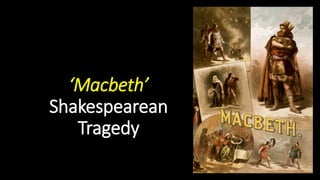
‘Macbeth’
Shakespearean
Tragedy
What is a tragedy? Aristotle’s ‘Poetics’
• Tragedy, then, is an imitation of an action that is
serious, complete, and of a certain magnitude; in the
language embellished with each kind of artistic
ornament, the several kinds being found in separate
parts of the play; in the form of action, not of
narrative; through pity and fear effecting the proper
purgation-catharsis of these and similar emotions.”
Six Parts of a Tragedy
• Plot (Fable), or mythos - Plot is the Soul of a Tragedy.
• Character(ethos) – Tragic Hero (neither good not bad
but a rather good being) – Hamartia (tragic flaw)
• Thought (Central Theme) (Moral / ethical center)
• Diction (Language)
• Melody / Song
• Spectacle
Classical Tragedy
• Law of Probability and Possibility
• Deus ex Machina
• Peripeteia and Anagnorisis
• Complex plots have both ‘reversal of intention (situation)’ (peripeteia) and
‘recognition’ (anagnorisis) connected with the catastrophe. (pg. 20 Aristotle’s Poetics
by S.H. Butcher)
• Both peripeteia and anagnorisis turn upon surprise. Aristotle explains that a
peripeteia occurs when a character produces an effect opposite to that which he
intended to produce or reversal of fortune, while an anagnorisis “is a change from
ignorance to knowledge, producing love or hate between the persons destined for
good or bad fortune.”
• He argues that the best plots combine these two as part of their cause-and-effect
chain (i.e., the peripeteia leads directly to the anagnorisis); this in turns creates the
catastrophe, leading to the final “scene of suffering”
Shakespeare’s Concept of Tragedy
Illustrate from your reading of the play ‘Macbeth’
1. The Conflict between the Good and the Evil
a. The Conflict: Inner as well as with others
2. True to Life (Nature)
3. The Tragic Hero
4. The Tragic Flaw
5. Peripeteia and Anagnorisis
6. Law of Probability & possibility – Cause &
Effect
7. The Tragic Waste
8. Character and Destiny: the extremes and
the golden mean: the threshold: the
twilight: the grey rather than the black and
the white
9. Complicating Factors:
a. Some abnormal condition of mind
b.The supernatural, ghost and witches
c. The role of chance
d.F
10.Catharsis
11. The Melodramatic Element
12. No Poetic Justice
1. Macbeth has PJ but Lady M…
13.Serenity at the End

Shakespearean Tragedy | Macbeth

  • 1.
  • 2.
    What is atragedy? Aristotle’s ‘Poetics’ • Tragedy, then, is an imitation of an action that is serious, complete, and of a certain magnitude; in the language embellished with each kind of artistic ornament, the several kinds being found in separate parts of the play; in the form of action, not of narrative; through pity and fear effecting the proper purgation-catharsis of these and similar emotions.”
  • 3.
    Six Parts ofa Tragedy • Plot (Fable), or mythos - Plot is the Soul of a Tragedy. • Character(ethos) – Tragic Hero (neither good not bad but a rather good being) – Hamartia (tragic flaw) • Thought (Central Theme) (Moral / ethical center) • Diction (Language) • Melody / Song • Spectacle
  • 4.
    Classical Tragedy • Lawof Probability and Possibility • Deus ex Machina • Peripeteia and Anagnorisis • Complex plots have both ‘reversal of intention (situation)’ (peripeteia) and ‘recognition’ (anagnorisis) connected with the catastrophe. (pg. 20 Aristotle’s Poetics by S.H. Butcher) • Both peripeteia and anagnorisis turn upon surprise. Aristotle explains that a peripeteia occurs when a character produces an effect opposite to that which he intended to produce or reversal of fortune, while an anagnorisis “is a change from ignorance to knowledge, producing love or hate between the persons destined for good or bad fortune.” • He argues that the best plots combine these two as part of their cause-and-effect chain (i.e., the peripeteia leads directly to the anagnorisis); this in turns creates the catastrophe, leading to the final “scene of suffering”
  • 5.
    Shakespeare’s Concept ofTragedy Illustrate from your reading of the play ‘Macbeth’ 1. The Conflict between the Good and the Evil a. The Conflict: Inner as well as with others 2. True to Life (Nature) 3. The Tragic Hero 4. The Tragic Flaw 5. Peripeteia and Anagnorisis 6. Law of Probability & possibility – Cause & Effect 7. The Tragic Waste 8. Character and Destiny: the extremes and the golden mean: the threshold: the twilight: the grey rather than the black and the white 9. Complicating Factors: a. Some abnormal condition of mind b.The supernatural, ghost and witches c. The role of chance d.F 10.Catharsis 11. The Melodramatic Element 12. No Poetic Justice 1. Macbeth has PJ but Lady M… 13.Serenity at the End