EFFECTIVE COMMUNICATION IN THE CLASSROOM Fi McGarry
SITE 2.1.1 Communicate effectively ,  using a variety of media, to stimulate pupils and achieve the object of lessons.
 
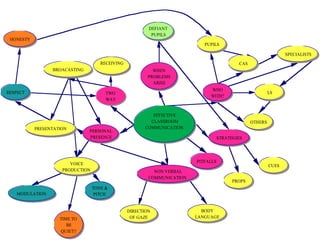
What are communication skills? Transmission Reception
With whom? Pupils Colleagues – managers, classroom assistants, visiting specialists, L.S. etc. Parents Others
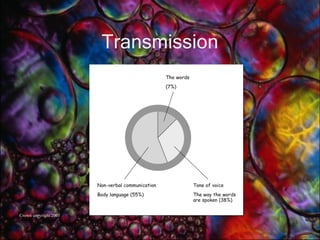
Transmission Crown copyright   2005
REFLECT What types of communication do you use? What do you hear yourself saying/see yourself doing? Describe this to a partner Identify any “scripts” (consistently used phrases) or non-verbal routines you use
Barriers  Emotional aspects Threats to teacher’s self-esteem Skills/experience
Communication that creates or reinforces negative behaviour Sarcasm Anger Belittling Negative expectations Insensitive physical contact Overt use of physical size
Communication that promotes positive behaviour Praise Affirmations Positively stated expectations Language of belonging Language of choice Eye contact Safe physical contact Body language
Body Language It’s not (only) what you say, it’s the way that you say it! Awareness of nonverbal behaviour allows you to become a better receiver You will become a better sender of signals that reinforce learning Increases the degree of perceived psychological closeness between teacher and pupil
Nonverbal behaviours Eye contact Facial expression Gestures Posture and body orientation Proximity Paralinguistics Humour
Negative verbal behaviours Inconsistent, or hidden messages Rudeness Raised voices Incoherent diction Too much talk! Inappropriate language/style
Positive verbal behaviours Clear messages Respectful Encouraging Appropriate use of praise Pauses Clear diction Modulated tones
Developing your role Honesty Openness Respect
Developing your role Be professional! Look professional! Set professional expectations!
Strategies Props Cues
When problems arise Stay calm Speak to the pupil privately and in a quiet voice Establish eye contact and call the pupil by name State any command as a positive (do) rather than a negative (don’t) Use clear and descriptive terms so that the pupil knows exactly what is expected.
Pitfalls Mismatch between words and nonverbal signals Pause to think before reacting to provocative behaviour Do not become entangled in a protracted discussion Do not try to coerce or force a pupil to comply
Proactive steps to avoid conflict Offer face-saving exit strategies Act in positive ways  Agree fair behavioural consequences in advance Avoid making demands of pupils when they are upset
Bibliography DOES, 2005  Primary National Strategy, Classroom Communication, Irmsher, Karen. Communication Skills, ERIC Digest 102 January 1996  http://eric.uoregon.edu Fisher, R., Ury, W.,& Patton, B (1991) Getting to yes:  Negotiating agreement without giving in (2 nd  ed) Penguin, N.Y. Prendivill, Patricia. Developing Facilition Skills, 1995 Combat Poverty Agency, Dublin Ritts, Vicki and Stein, James R. Six Ways to Improve Your Nonverbal Communications 29/08/2006 http://honolulu.hawaii.edu Working With Defiant Kids 29/08/2006  www.interventioncentral.org

Effective Communication In The Classroom

  • 1.
    EFFECTIVE COMMUNICATION INTHE CLASSROOM Fi McGarry
  • 2.
    SITE 2.1.1 Communicateeffectively , using a variety of media, to stimulate pupils and achieve the object of lessons.
  • 3.
  • 4.
    What are communicationskills? Transmission Reception
  • 5.
    With whom? PupilsColleagues – managers, classroom assistants, visiting specialists, L.S. etc. Parents Others
  • 6.
  • 7.
    REFLECT What typesof communication do you use? What do you hear yourself saying/see yourself doing? Describe this to a partner Identify any “scripts” (consistently used phrases) or non-verbal routines you use
  • 8.
    Barriers Emotionalaspects Threats to teacher’s self-esteem Skills/experience
  • 9.
    Communication that createsor reinforces negative behaviour Sarcasm Anger Belittling Negative expectations Insensitive physical contact Overt use of physical size
  • 10.
    Communication that promotespositive behaviour Praise Affirmations Positively stated expectations Language of belonging Language of choice Eye contact Safe physical contact Body language
  • 11.
    Body Language It’snot (only) what you say, it’s the way that you say it! Awareness of nonverbal behaviour allows you to become a better receiver You will become a better sender of signals that reinforce learning Increases the degree of perceived psychological closeness between teacher and pupil
  • 12.
    Nonverbal behaviours Eyecontact Facial expression Gestures Posture and body orientation Proximity Paralinguistics Humour
  • 13.
    Negative verbal behavioursInconsistent, or hidden messages Rudeness Raised voices Incoherent diction Too much talk! Inappropriate language/style
  • 14.
    Positive verbal behavioursClear messages Respectful Encouraging Appropriate use of praise Pauses Clear diction Modulated tones
  • 15.
    Developing your roleHonesty Openness Respect
  • 16.
    Developing your roleBe professional! Look professional! Set professional expectations!
  • 17.
  • 18.
    When problems ariseStay calm Speak to the pupil privately and in a quiet voice Establish eye contact and call the pupil by name State any command as a positive (do) rather than a negative (don’t) Use clear and descriptive terms so that the pupil knows exactly what is expected.
  • 19.
    Pitfalls Mismatch betweenwords and nonverbal signals Pause to think before reacting to provocative behaviour Do not become entangled in a protracted discussion Do not try to coerce or force a pupil to comply
  • 20.
    Proactive steps toavoid conflict Offer face-saving exit strategies Act in positive ways Agree fair behavioural consequences in advance Avoid making demands of pupils when they are upset
  • 21.
    Bibliography DOES, 2005 Primary National Strategy, Classroom Communication, Irmsher, Karen. Communication Skills, ERIC Digest 102 January 1996 http://eric.uoregon.edu Fisher, R., Ury, W.,& Patton, B (1991) Getting to yes: Negotiating agreement without giving in (2 nd ed) Penguin, N.Y. Prendivill, Patricia. Developing Facilition Skills, 1995 Combat Poverty Agency, Dublin Ritts, Vicki and Stein, James R. Six Ways to Improve Your Nonverbal Communications 29/08/2006 http://honolulu.hawaii.edu Working With Defiant Kids 29/08/2006 www.interventioncentral.org