EFFECTIVE COMUNICATION SKILLS
FOR TEACHERS IN CLASSROOM
BEIGN A CAPACITY BUILDING PROGRAM
FOR
DOUBLE SUCCESS NURSERY AND PRIMARY SCHOOL
TEACHING STAFF
HELD @ 7, CHURCH CLOSE OFF AGBARO STREET, IDI IROKO
BUS-STOP, IKORODU, LAGOS STATE, NIGERIA
Meet the Facilitator
RASHEED, Oluwasegun Kazeem Ph.D
(+234)-8051700164, (+234)-7066867887
kazeemrasheed1440@gmail.com
MNAEAP, EMPM, MNIM, MTRCN, MACSN, CT,
Dip. Digital Mkt., CEAF, CME, W10FE, CMIE,
FMIE, MAPROCON, AMIBRN, MCIEMA (USA)
Lead Principal Facilitator at HEED – A - DINK CONSULT
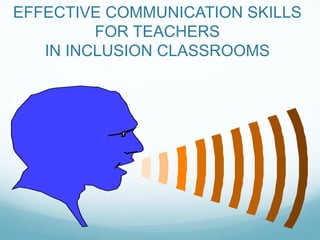
EFFECTIVE COMMUNICATION SKILLS
FOR TEACHERS
IN INCLUSION CLASSROOMS
Why Effective Communication in
Classroom?
First 5 min.
____
____
____
Conclusion
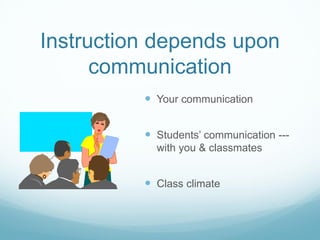
Instruction depends upon
communication
 Your communication
 Students’ communication ---
with you & classmates
 Class climate
Kinds of classroom
communication
 Presentations
 Teaching
 lectures
 Group work
 Interpersonal
 Intercultural
Tips for Effective
Communication
 Know your audience
 Express ideas clearly & explicitly
 Check audience’s listening skills
 Gain & keep attention
 Be well organized & prepared
 Use visual aids effectively
 Remember messages are verbal, visual and vocal
Effective Visual
Communication in Classroom
 Can be understood in 6 seconds
 Anchor listeners to the key concepts
 Do not put your students in reading mode
 Enhance (aid) your verbal & vocal messages
 Use soft and understandable terms
 Don’t use strange words
 Use words according to the students age
Benefits of visual
Communication
 Improves memory
 Speeds comprehension
 Decreases odd time
 Adds to teacher’s credibility
 Decreases nervousness
 Adds interest in teaching
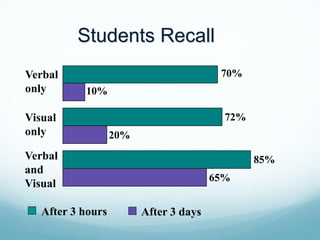
Students Recall
70%
10%
72%
20%
85%
65%
After 3 hours After 3 days
Verbal
only
Visual
only
Verbal
and
Visual
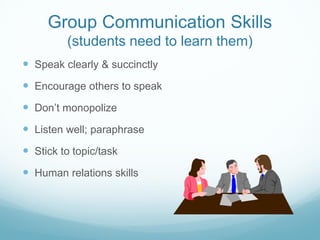
Group Communication Skills
(students need to learn them)
 Speak clearly & succinctly
 Encourage others to speak
 Don’t monopolize
 Listen well; paraphrase
 Stick to topic/task
 Human relations skills
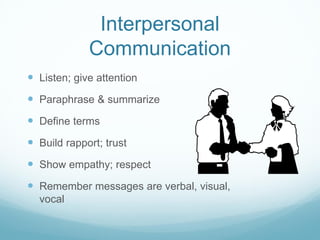
Interpersonal
Communication
 Listen; give attention
 Paraphrase & summarize
 Define terms
 Build rapport; trust
 Show empathy; respect
 Remember messages are verbal, visual,
vocal
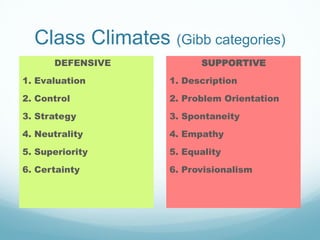
Class Climates (Gibb categories)
DEFENSIVE
1. Evaluation
2. Control
3. Strategy
4. Neutrality
5. Superiority
6. Certainty
SUPPORTIVE
1. Description
2. Problem Orientation
3. Spontaneity
4. Empathy
5. Equality
6. Provisionalism
Intercultural Principles
 Successful comm. depends upon shared meanings.
 Cultural patterns: the group’s collective beliefs, values,
norms
 One’s culture & language affects one’s cognition & learning
 Native language affects one’s world view, beliefs, etc.
 Different cultural practices in education and classroom
 Differences continuum: minor to major.
Modern Challenge:
Most Schools have
good infrastructure but
lack good
communicationist in
the classrooms.
THANKS FOR LISTENING
GOD BLESS YOU ALL

COMMUNICATION IN CLASSROOM for effective

  • 1.
    EFFECTIVE COMUNICATION SKILLS FORTEACHERS IN CLASSROOM BEIGN A CAPACITY BUILDING PROGRAM FOR DOUBLE SUCCESS NURSERY AND PRIMARY SCHOOL TEACHING STAFF HELD @ 7, CHURCH CLOSE OFF AGBARO STREET, IDI IROKO BUS-STOP, IKORODU, LAGOS STATE, NIGERIA
  • 2.
    Meet the Facilitator RASHEED,Oluwasegun Kazeem Ph.D (+234)-8051700164, (+234)-7066867887 kazeemrasheed1440@gmail.com MNAEAP, EMPM, MNIM, MTRCN, MACSN, CT, Dip. Digital Mkt., CEAF, CME, W10FE, CMIE, FMIE, MAPROCON, AMIBRN, MCIEMA (USA) Lead Principal Facilitator at HEED – A - DINK CONSULT
  • 3.
    EFFECTIVE COMMUNICATION SKILLS FORTEACHERS IN INCLUSION CLASSROOMS
  • 4.
    Why Effective Communicationin Classroom? First 5 min. ____ ____ ____ Conclusion
  • 5.
    Instruction depends upon communication Your communication  Students’ communication --- with you & classmates  Class climate
  • 6.
    Kinds of classroom communication Presentations  Teaching  lectures  Group work  Interpersonal  Intercultural
  • 7.
    Tips for Effective Communication Know your audience  Express ideas clearly & explicitly  Check audience’s listening skills  Gain & keep attention  Be well organized & prepared  Use visual aids effectively  Remember messages are verbal, visual and vocal
  • 8.
    Effective Visual Communication inClassroom  Can be understood in 6 seconds  Anchor listeners to the key concepts  Do not put your students in reading mode  Enhance (aid) your verbal & vocal messages  Use soft and understandable terms  Don’t use strange words  Use words according to the students age
  • 9.
    Benefits of visual Communication Improves memory  Speeds comprehension  Decreases odd time  Adds to teacher’s credibility  Decreases nervousness  Adds interest in teaching
  • 10.
    Students Recall 70% 10% 72% 20% 85% 65% After 3hours After 3 days Verbal only Visual only Verbal and Visual
  • 11.
    Group Communication Skills (studentsneed to learn them)  Speak clearly & succinctly  Encourage others to speak  Don’t monopolize  Listen well; paraphrase  Stick to topic/task  Human relations skills
  • 12.
    Interpersonal Communication  Listen; giveattention  Paraphrase & summarize  Define terms  Build rapport; trust  Show empathy; respect  Remember messages are verbal, visual, vocal
  • 13.
    Class Climates (Gibbcategories) DEFENSIVE 1. Evaluation 2. Control 3. Strategy 4. Neutrality 5. Superiority 6. Certainty SUPPORTIVE 1. Description 2. Problem Orientation 3. Spontaneity 4. Empathy 5. Equality 6. Provisionalism
  • 14.
    Intercultural Principles  Successfulcomm. depends upon shared meanings.  Cultural patterns: the group’s collective beliefs, values, norms  One’s culture & language affects one’s cognition & learning  Native language affects one’s world view, beliefs, etc.  Different cultural practices in education and classroom  Differences continuum: minor to major.
  • 15.
    Modern Challenge: Most Schoolshave good infrastructure but lack good communicationist in the classrooms.
  • 16.