Voice & Accent Neutralization
Consonant   Sounds Vowel   Sounds Intonation What we will learn
Some   startling facts: There are 26 letters in the English Alphabets However there   are 44   sounds 24 Consonant Sounds 20 Vowel Sounds (12 vowels & 8 Diphthongs) Introduction to Consonant and Vowel Sounds
Factors that affect Pronunciation and intonation are: Regional Influence/Mother Tongue Influence Speech Pattern Personality Family & Friends factor Introduction to Consonant and Vowel Sounds
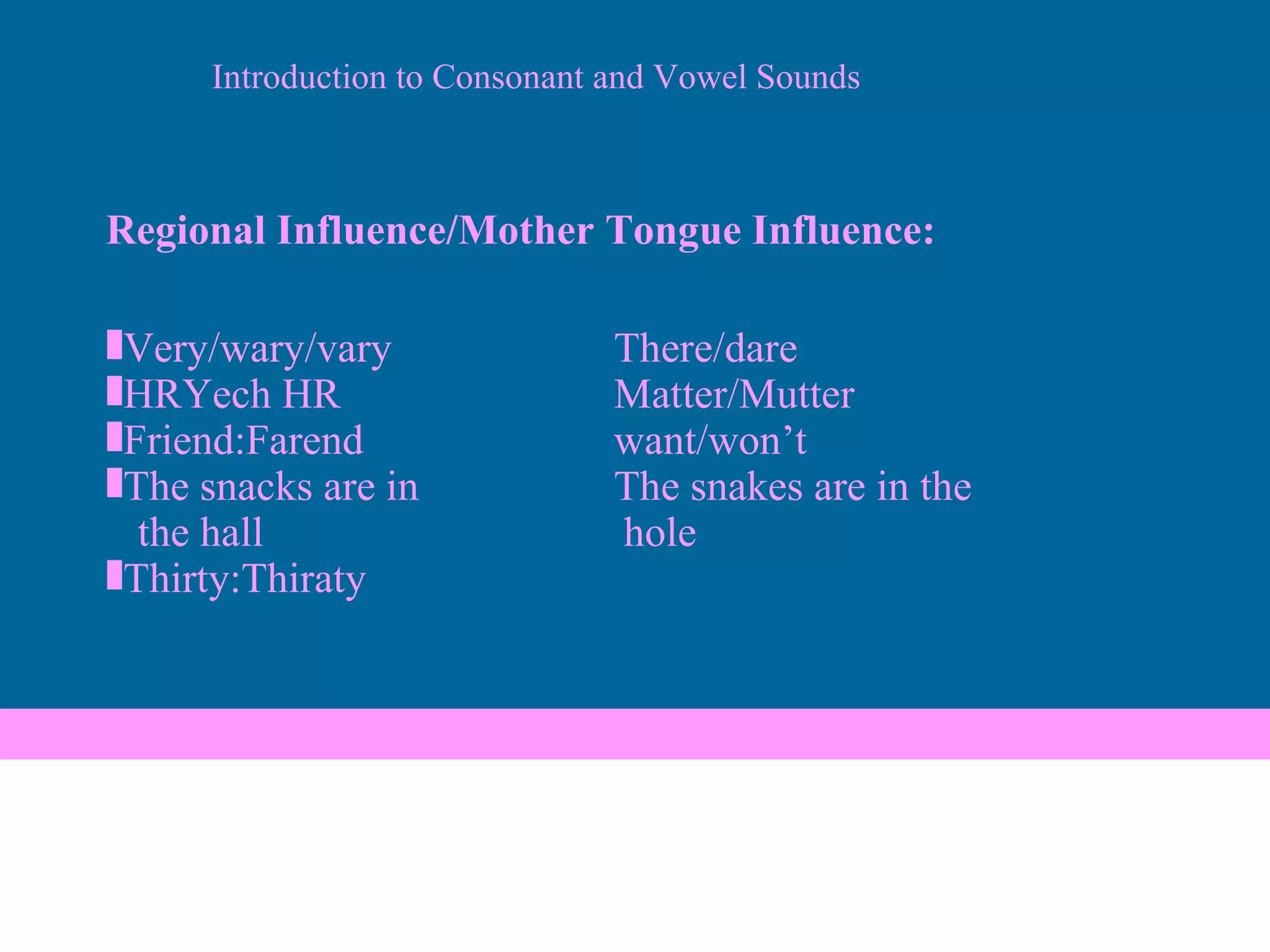
Regional Influence/Mother Tongue Influence: Very/wary/vary There/dare HRYech HR Matter/Mutter Friend:Farend want/won’t The snacks are in  The snakes are in the the hall  hole Thirty:Thiraty Introduction to Consonant and Vowel Sounds
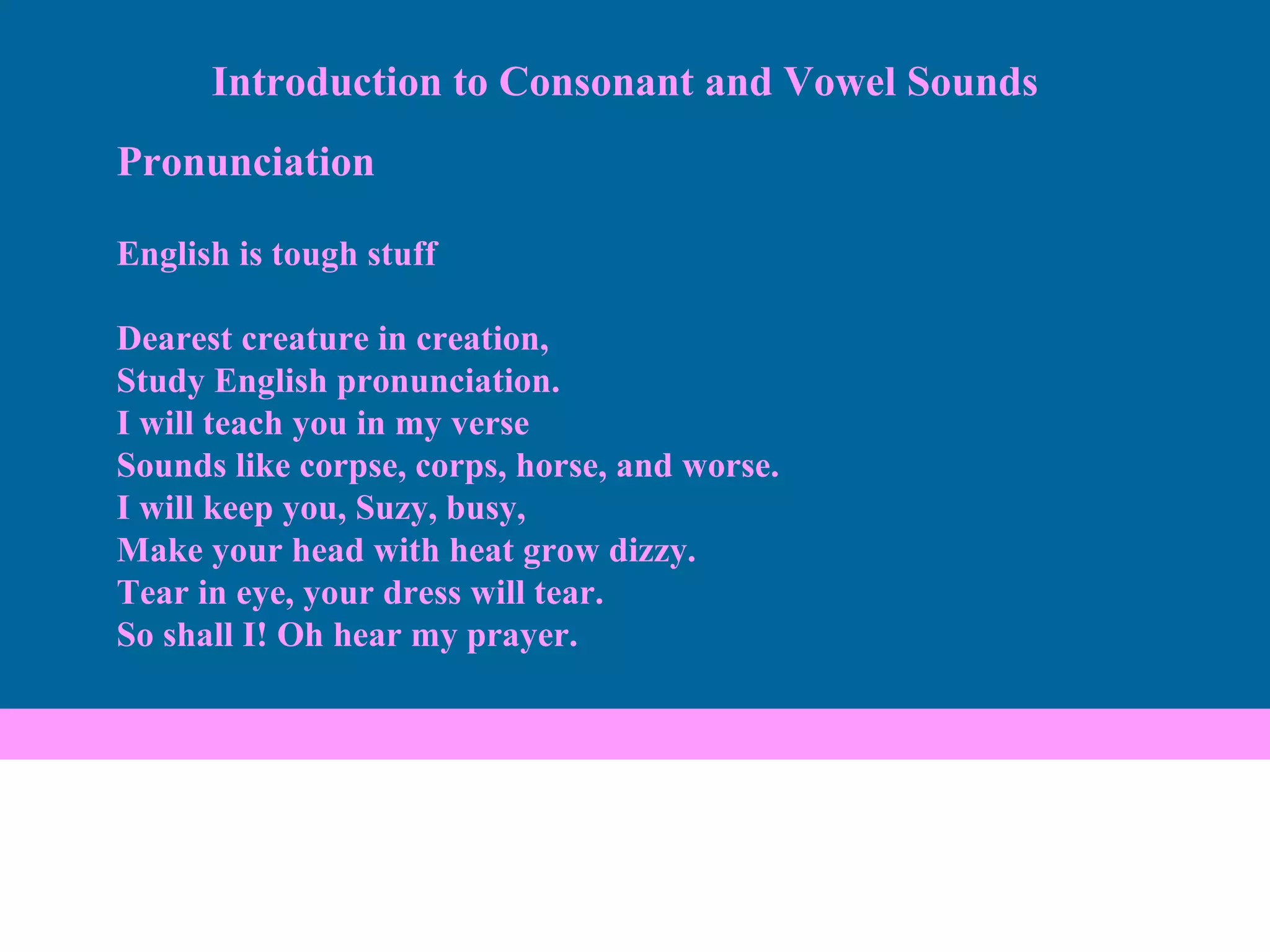
Pronunciation English is tough stuff Dearest creature in creation, Study English pronunciation. I will teach you in my verse Sounds like corpse, corps, horse, and worse. I will keep you, Suzy, busy, Make your head with heat grow dizzy. Tear in eye, your dress will tear. So shall I! Oh hear my prayer. Introduction to Consonant and Vowel Sounds
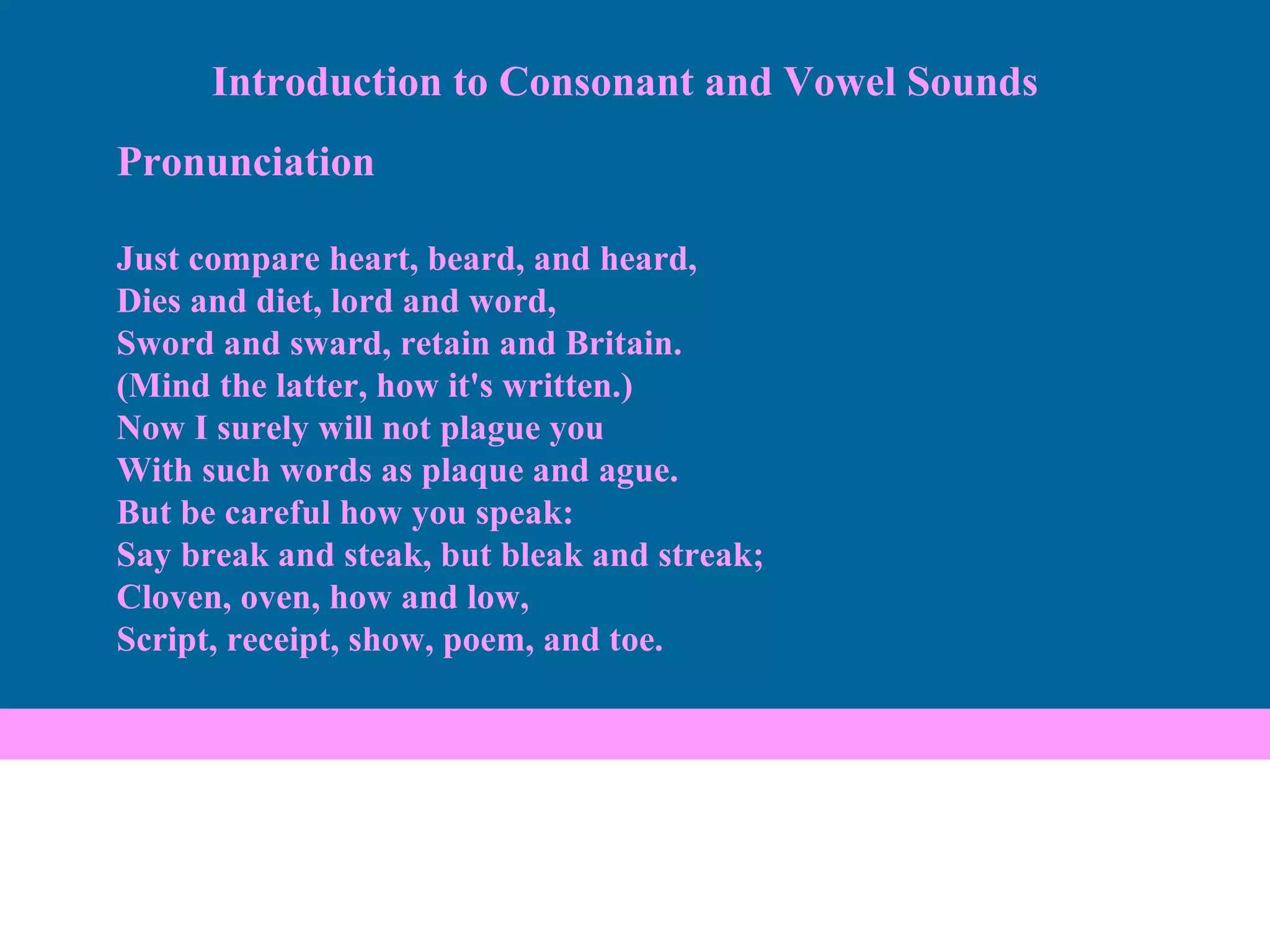
Pronunciation Just compare heart, beard, and heard, Dies and diet, lord and word, Sword and sward, retain and Britain. (Mind the latter, how it's written.) Now I surely will not plague you With such words as plaque and ague. But be careful how you speak: Say break and steak, but bleak and streak; Cloven, oven, how and low, Script, receipt, show, poem, and toe. Introduction to Consonant and Vowel Sounds
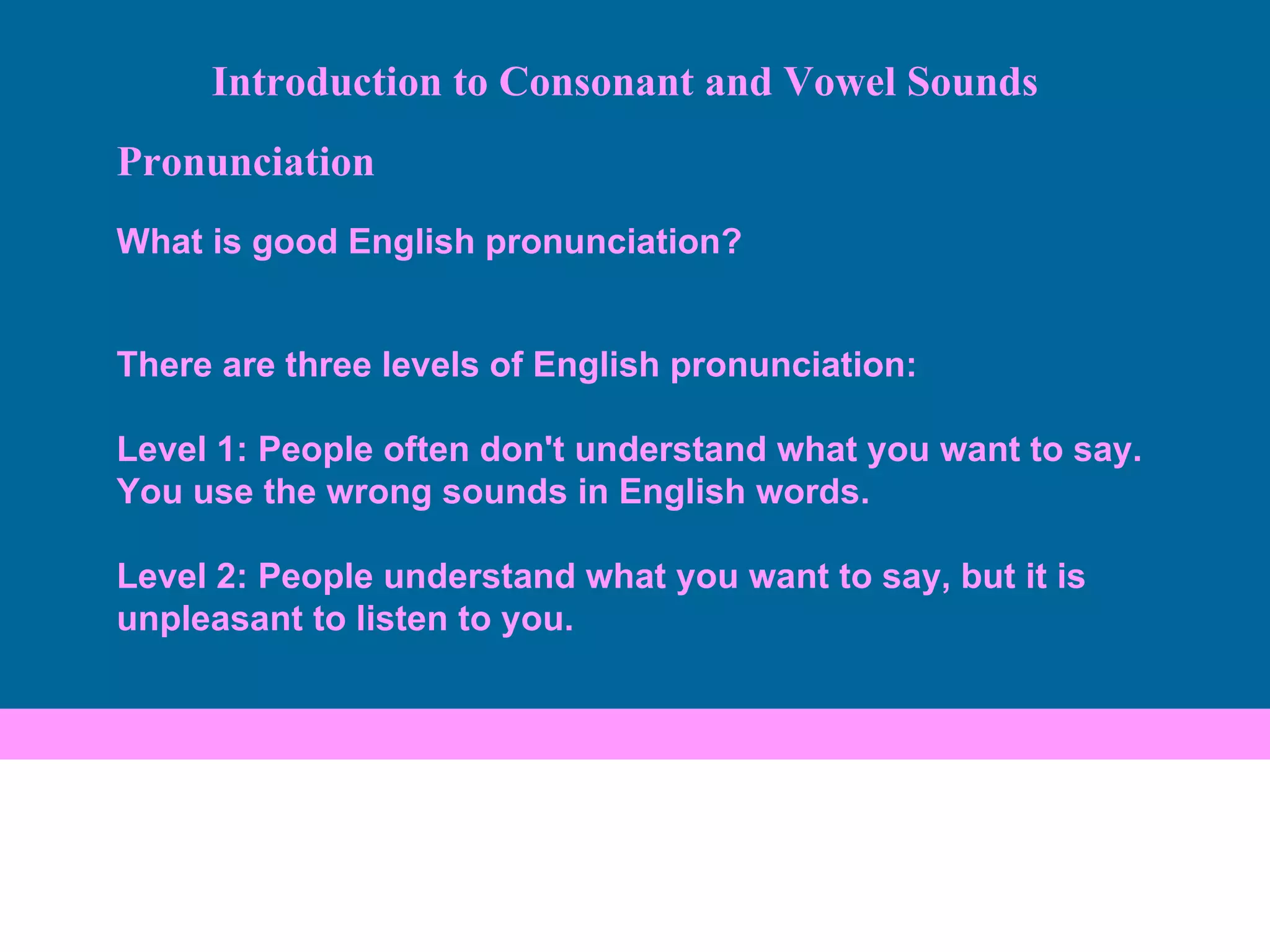
Pronunciation What is good English pronunciation? There are three levels of English pronunciation:  Level 1: People often don't understand what you want to say. You use the wrong sounds in English words. Level 2: People understand what you want to say, but it is unpleasant to listen to you.  Introduction to Consonant and Vowel Sounds
Pronunciation Level 3: People understand you, and your English is pleasant to listen to. Level 3 will be called good pronunciation.  Notice that good pronunciation is not "perfect American or British accent". You don't have to sound like the Queen of England or the President of the United States of America.  Introduction to Consonant and Vowel Sounds
Pronunciation Why not? Because there are many regional kinds of English. In England, people from Newcastle speak English differently from people in London. In America, people from New York City, California, and Texas each have their own pronunciation. So it is no problem if you have your own accent.  But our accent must be close to the standards (British English). What does it mean? Turn on your TV and watch channels like BBC. You will hear many different people (news anchors, reporters, etc.)   Introduction to Consonant and Vowel Sounds
Pronunciation  Tips These English pronunciation tips will help you : Tip 1 Do not confuse pronunciation of words with their spelling! For example, "threw" and "through", although spelled differently, are pronounced the same. Also, identical letters or letter clusters in words do not always produce the same sound. For example, the "ough" in "though" and "through" represents a different sound in each word. Learn to practice what you hear, not what you see. Introduction to Consonant and Vowel Sounds
Pronunciation  Tips Tip 2 Imagine a sound in your mind before you say it. Try to visualize the positioning of your mouth and face. Think about how you are going to make the sound. Tip 3 The English language has many different dialects, and words can be pronounced differently. It is important, however, that you pronounce words clearly to ensure effective communication. Introduction to Consonant and Vowel Sounds
Pronunciation Glossary These are some of the words used to talk about pronunciation.  Air flow Aspiration Auditory Clusters (blended sounds) Curl Introduction to Consonant and Vowel Sounds
Pronunciation Glossary Flatten Glide / Slide Hard palate Intonation Lengthen sound Introduction to Consonant and Vowel Sounds
Pronunciation Glossary Lips spread Lower Pitch Pressed lips Protruded lips Introduction to Consonant and Vowel Sounds
Pronunciation Glossary Protruded lips Roof Round lips Shorten sound Soft palate Tap Introduction to Consonant and Vowel Sounds
Pronunciation Glossary Tooth ridge Top of mouth / Roof of mouth Unvoiced (voiceless) Upper Visual Voiced Introduction to Consonant and Vowel Sounds
Pronunciation The mechanism of speech involves production and articulation of the sounds produced. Consonant and vowel sounds are an integral part of English speech Consonant sounds are produced by a blockage or obstruction to the exhaled air. Vowel sounds are produced without any obstruction to the exhaled air. Introduction to Consonant and Vowel Sounds
Consonant Sounds Created by blocking the outgoing breath.  Grouped in families classified according to the obstruction. Clarity in speech depends on the way consonants are pronounced. To pronounce consonants clearly, you need to identify the obstruction. Consonant sounds in different languages differ in quality. Introduction to Consonant and Vowel Sounds
Consonant sounds are divided into Voiced and Unvoiced sounds. Voiced sounds create a resonant sound in the throat. Unvoiced sounds are aspirated sounds. Introduction to Consonant and Vowel Sounds
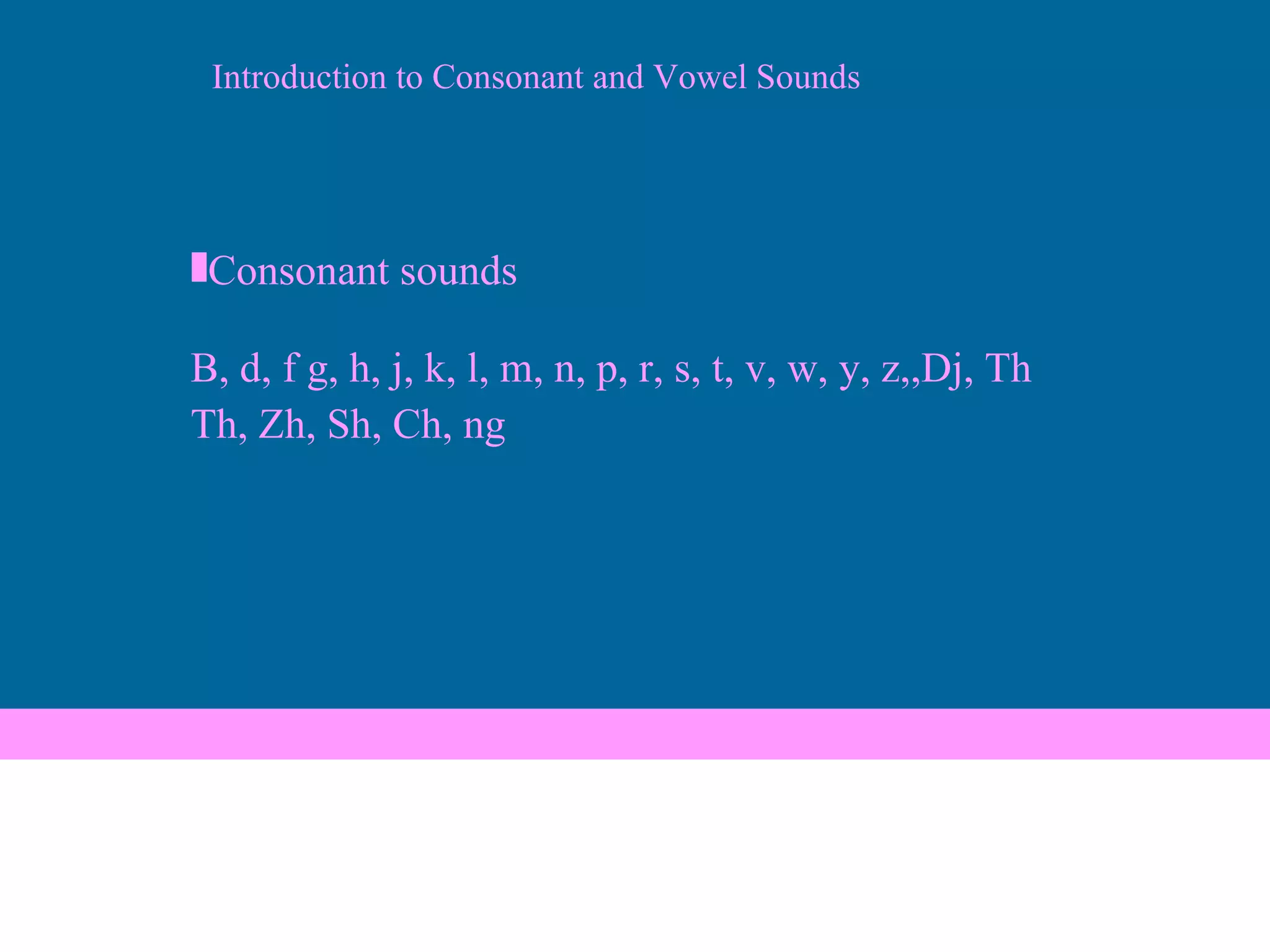
Consonant sounds B, d, f g, h, j, k, l, m, n, p, r, s, t, v, w, y, z,,Dj, Th Th, Zh, Sh, Ch, ng Introduction to Consonant and Vowel Sounds
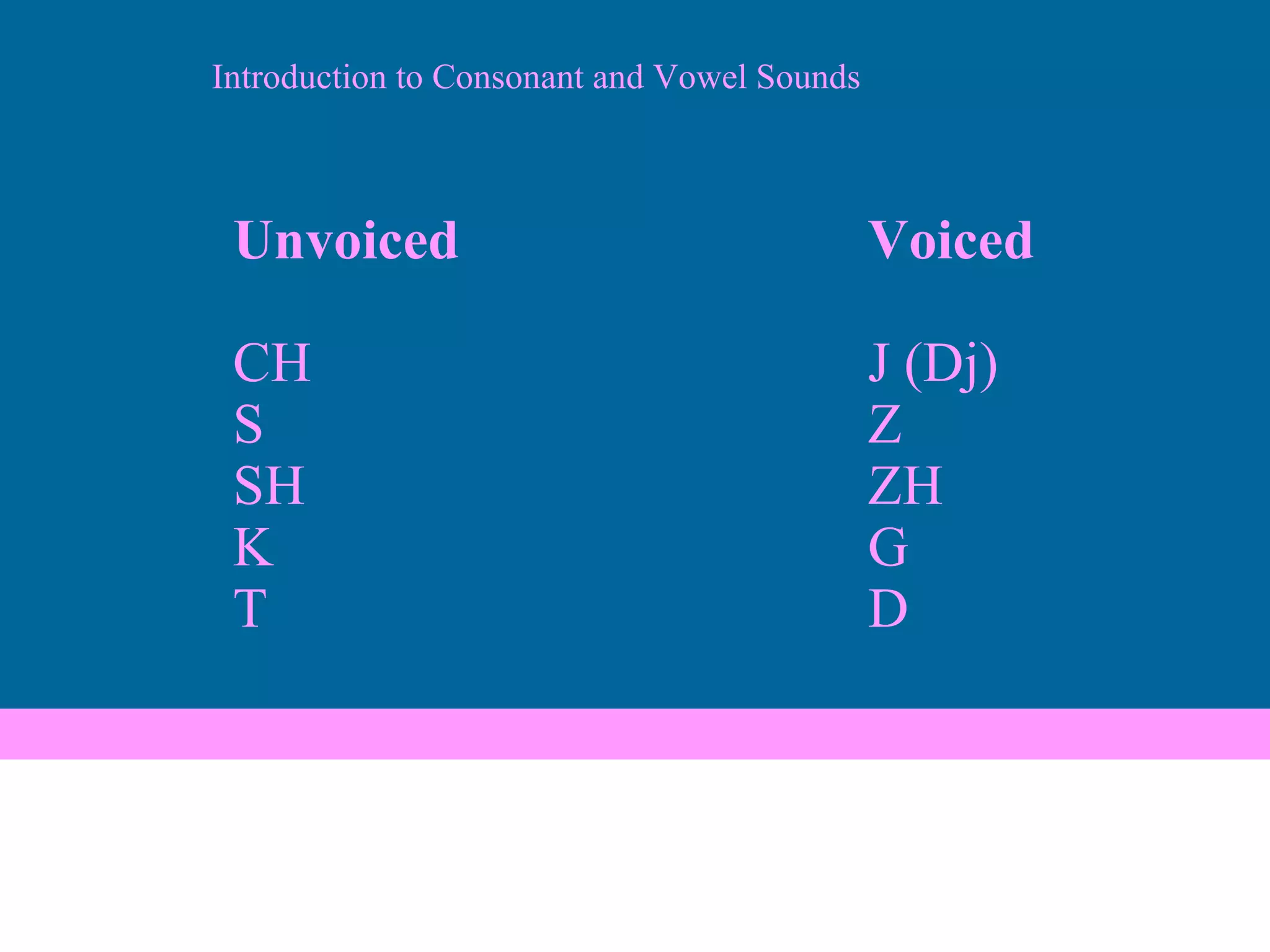
Unvoiced Voiced CH J (Dj) S Z SH ZH K G T D Introduction to Consonant and Vowel Sounds
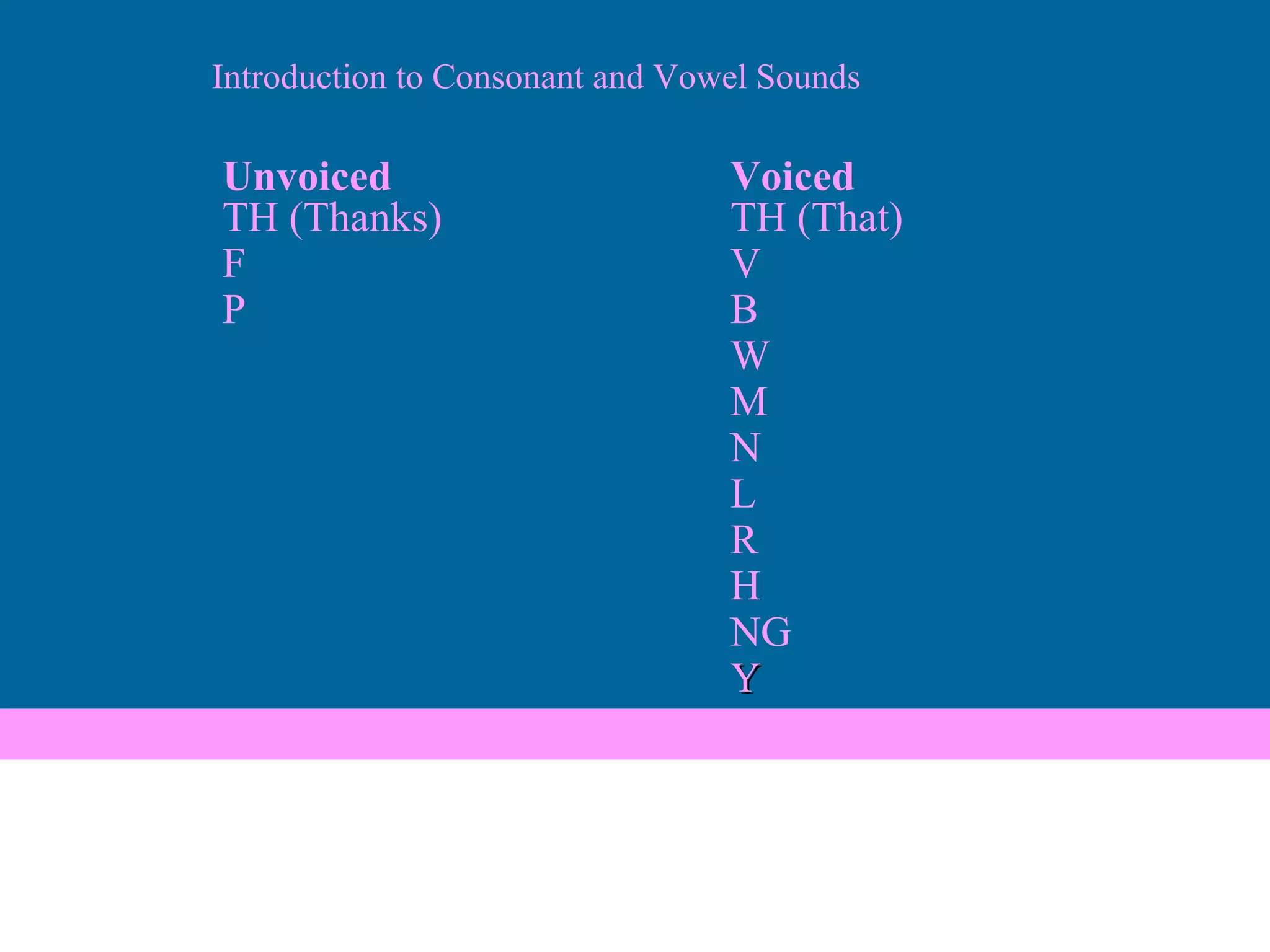
Unvoiced Voiced TH (Thanks) TH (That) F V P B W M N L R H NG  Y Introduction to Consonant and Vowel Sounds
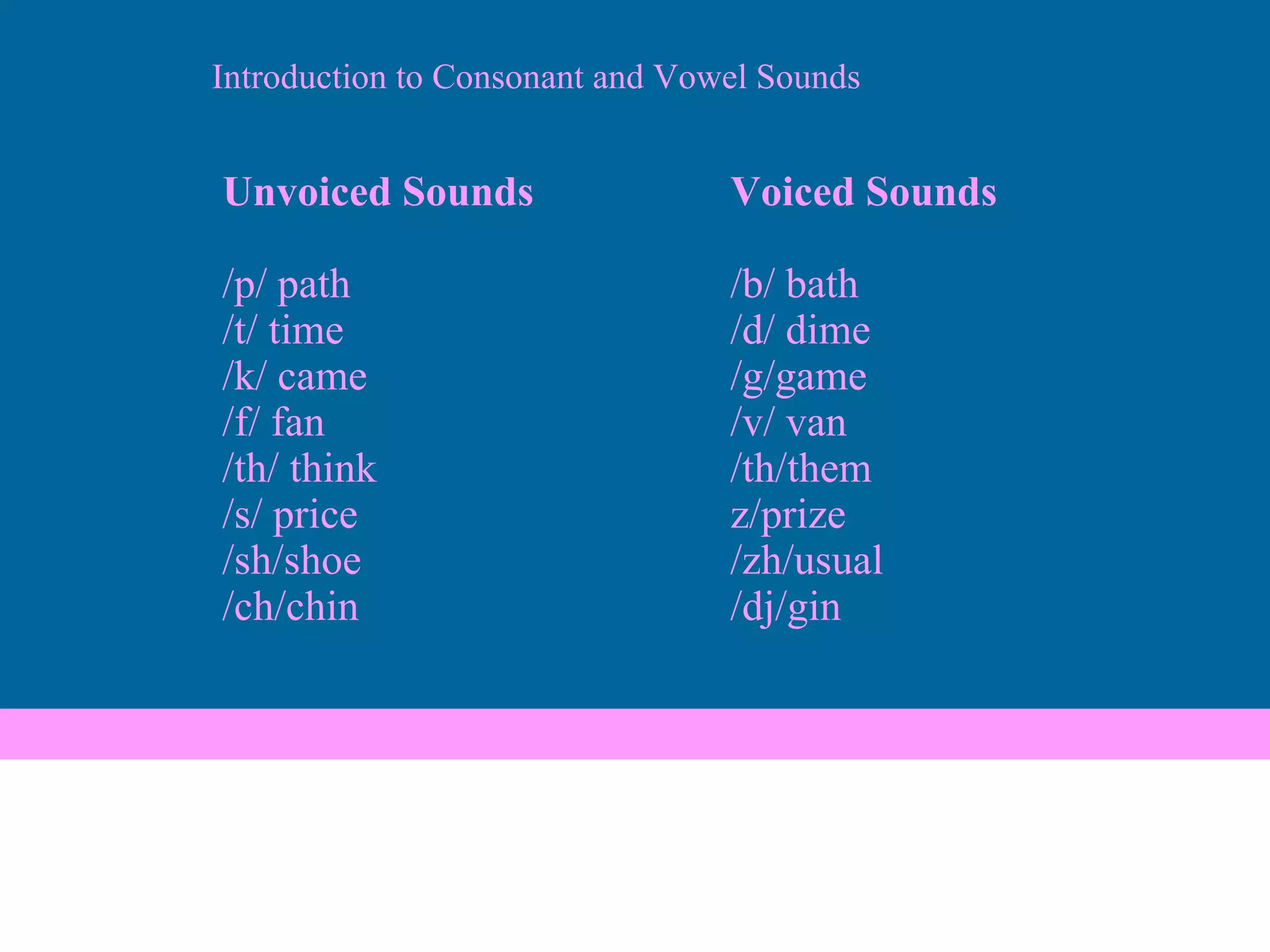
Unvoiced Sounds Voiced Sounds /p/ path /b/ bath /t/ time /d/ dime /k/ came /g/game /f/ fan /v/ van /th/ think /th/them /s/ price z/prize /sh/shoe /zh/usual /ch/chin /dj/gin Introduction to Consonant and Vowel Sounds
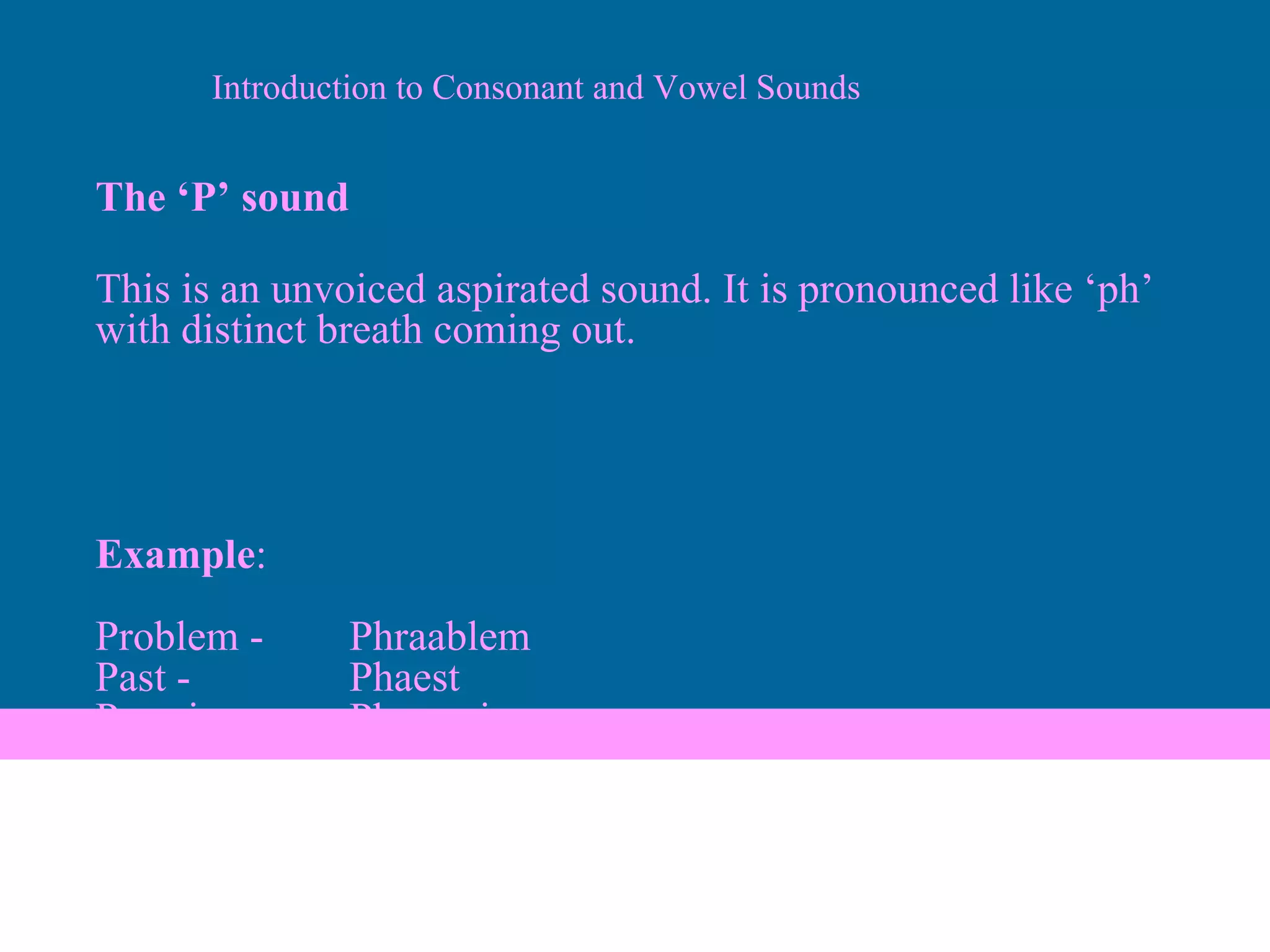
The ‘P’ sound This is an unvoiced aspirated sound. It is pronounced like ‘ph’ with distinct breath coming out. Example : Problem - Phraablem Past - Phaest Promise- Phraamis Introduction to Consonant and Vowel Sounds
The ‘P’ sound (Practice Exercise)  Peter had a problem with his project Pickles are more expensive than peas. My parents made the payment for Patricia’s picnic. Politicians are publicizing the polished policemen’s work. The patient ran in panic for no particular reason Introduction to Consonant and Vowel Sounds
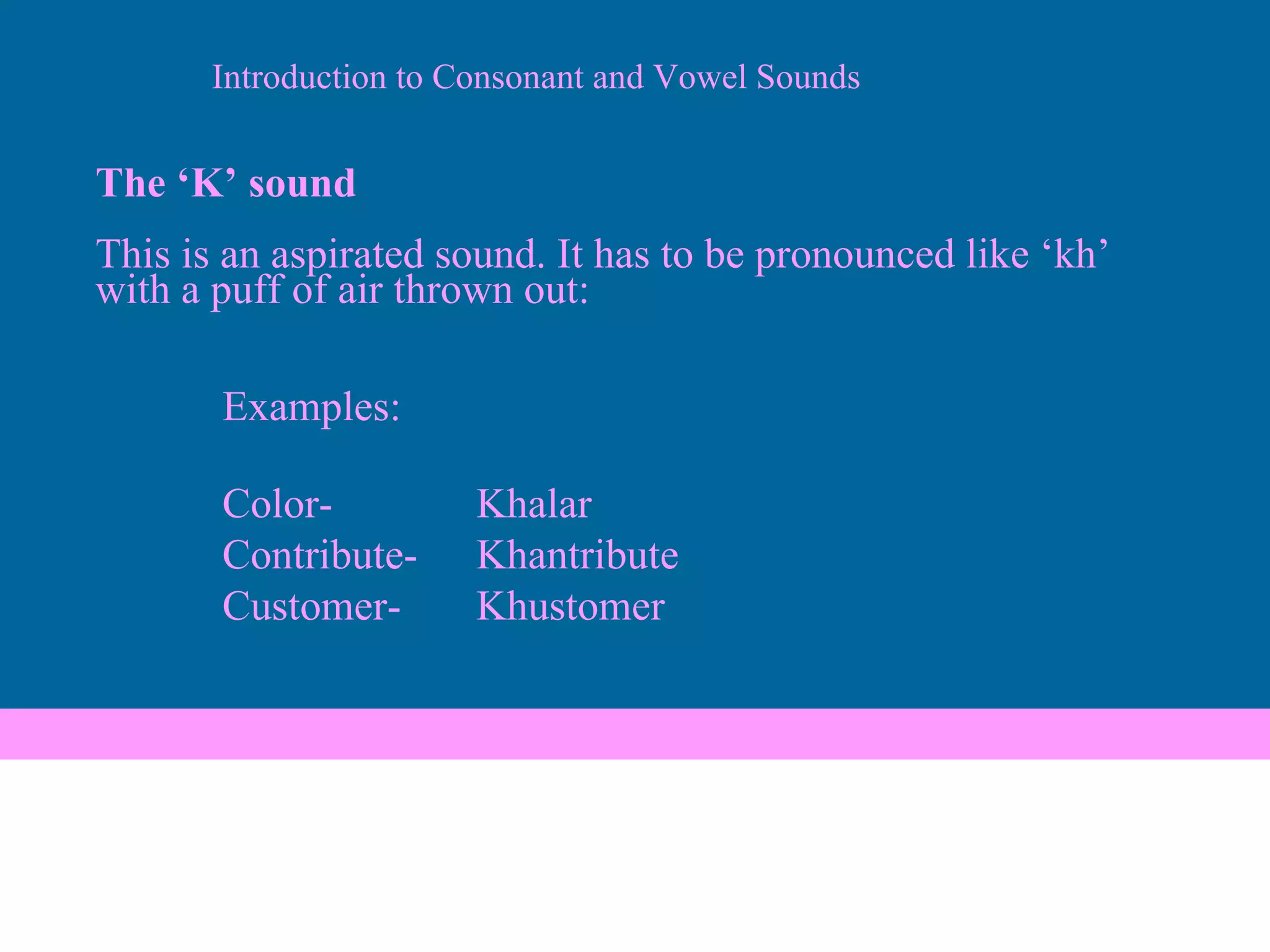
The ‘K’ sound This is an aspirated sound. It has to be pronounced like ‘kh’ with a puff of air thrown out: Examples: Color- Khalar Contribute- Khantribute Customer- Khustomer Introduction to Consonant and Vowel Sounds
Practice Exercise (emphasize on ‘k’ sound’) I was coming back home after my coaching classes. On my way I saw a cute girl clinging and cringing on the branch of a tree. She was crying at the top of her voice. I called out for her and asked her to calm down. She requested me to help her come down the tree. I feared that my clothes will get soiled. But I somehow gathered the courage to climb the tree. Just when I was a little short of clutching her arm, my leg slipped and I came crashing down the road. The cream color of my collar became black and I got a cut on my right knee. I quickly contained my anxiety and made quick steps towards the cocoon of my home. Introduction to Consonant and Vowel Sounds
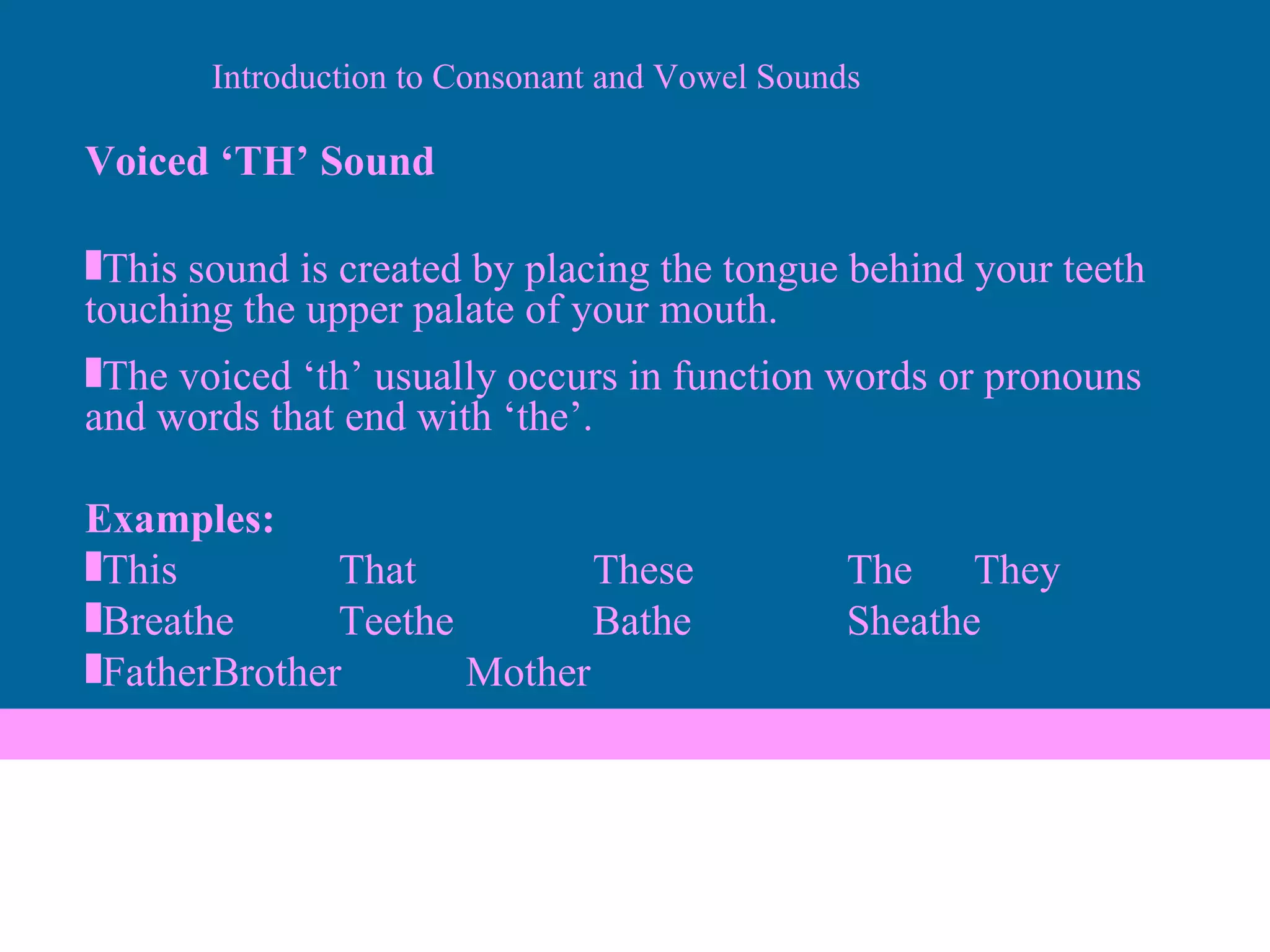
Voiced ‘TH’ Sound This sound is created by placing the tongue behind your teeth touching the upper palate of your mouth. The voiced ‘th’ usually occurs in function words or pronouns and words that end with ‘the’. Examples: This That These The They Breathe Teethe Bathe Sheathe Father Brother Mother Introduction to Consonant and Vowel Sounds
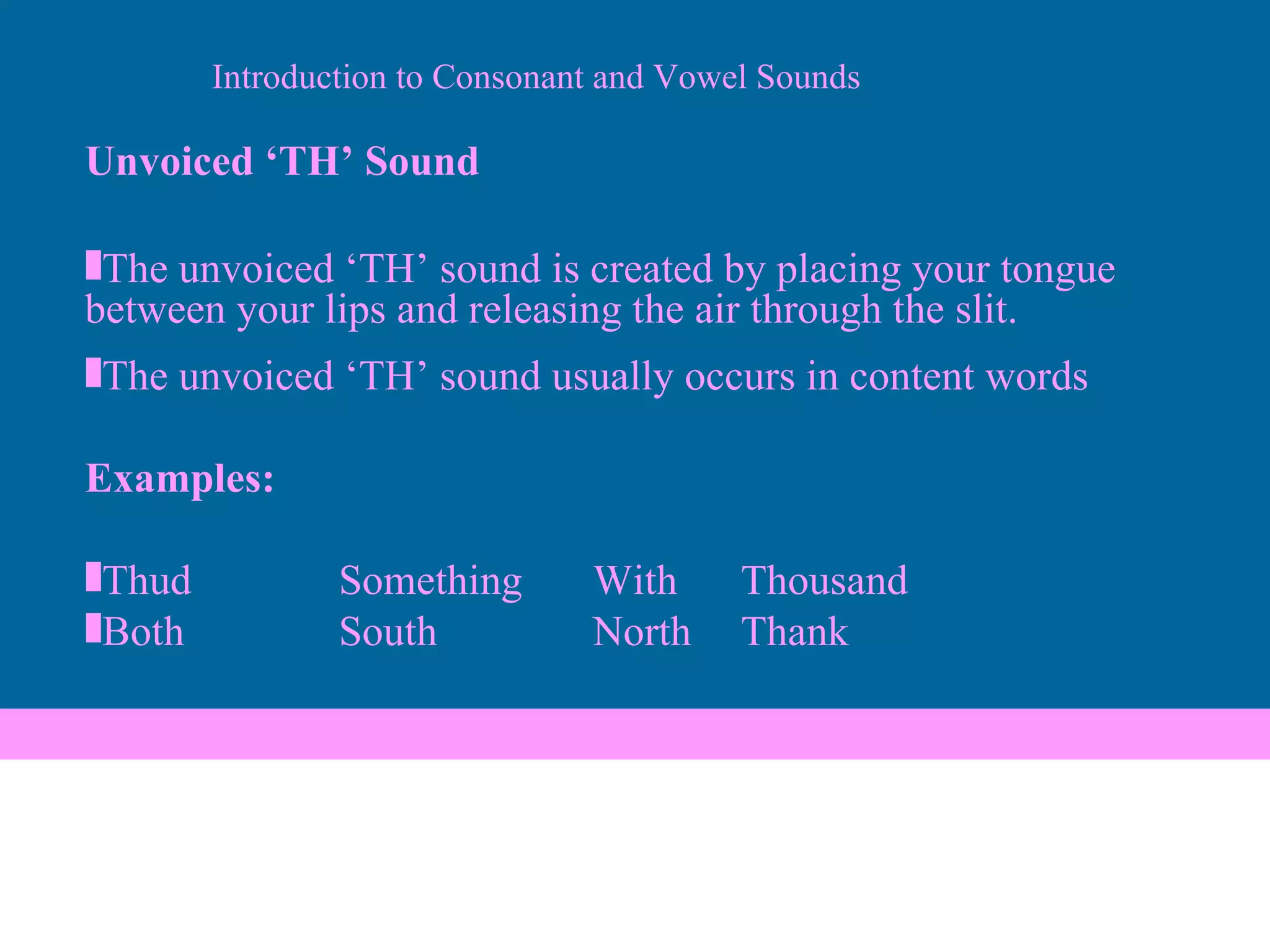
Unvoiced ‘TH’ Sound The unvoiced ‘TH’ sound is created by placing your tongue between your lips and releasing the air through the slit. The unvoiced ‘TH’ sound usually occurs in content words Examples: Thud Something With   Thousand Both South North    Thank Introduction to Consonant and Vowel Sounds
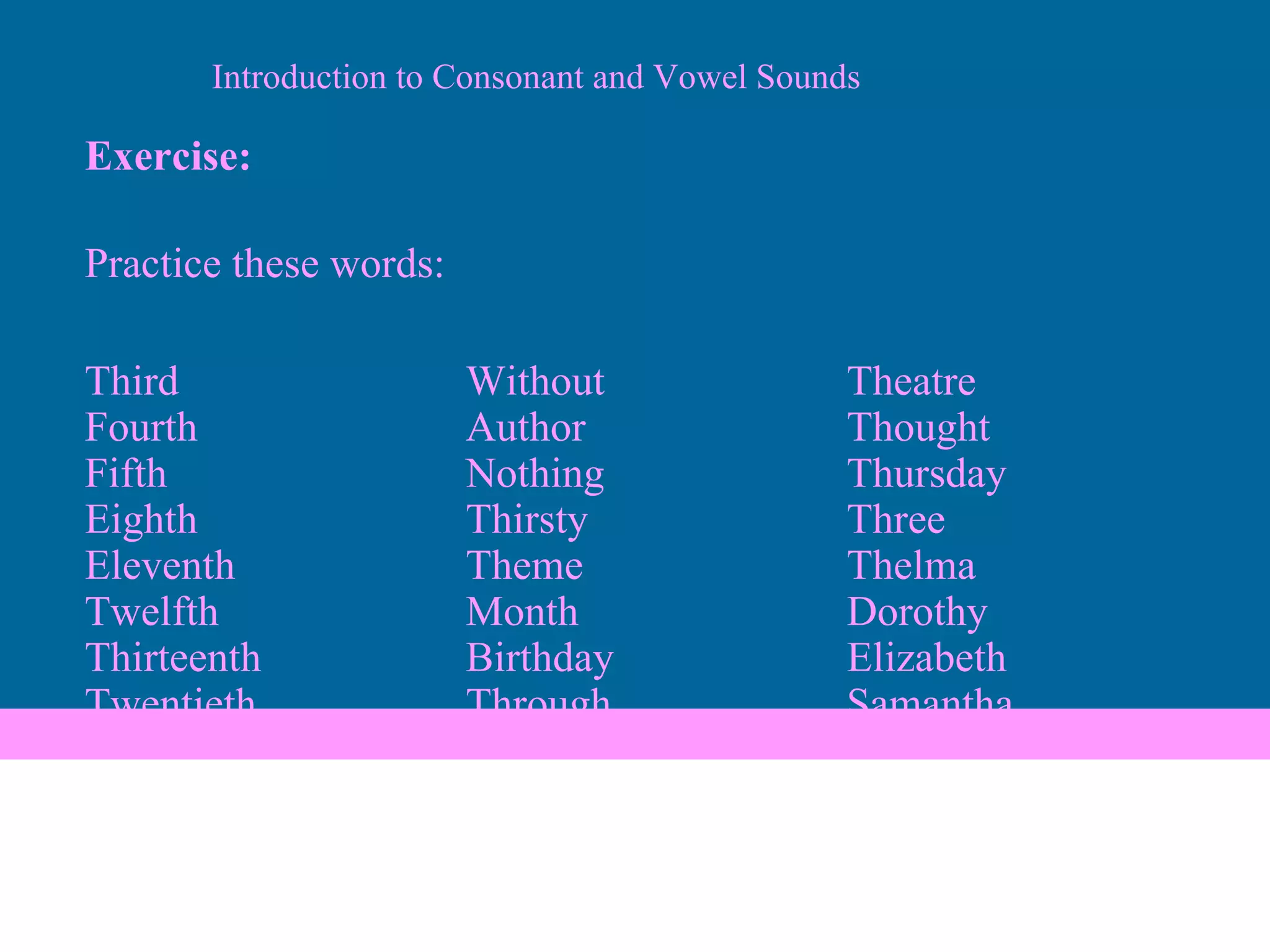
Exercise: Practice these words: Third Without Theatre Fourth Author Thought Fifth Nothing Thursday Eighth Thirsty Three Eleventh Theme Thelma Twelfth Month Dorothy Thirteenth Birthday Elizabeth Twentieth Through Samantha Introduction to Consonant and Vowel Sounds
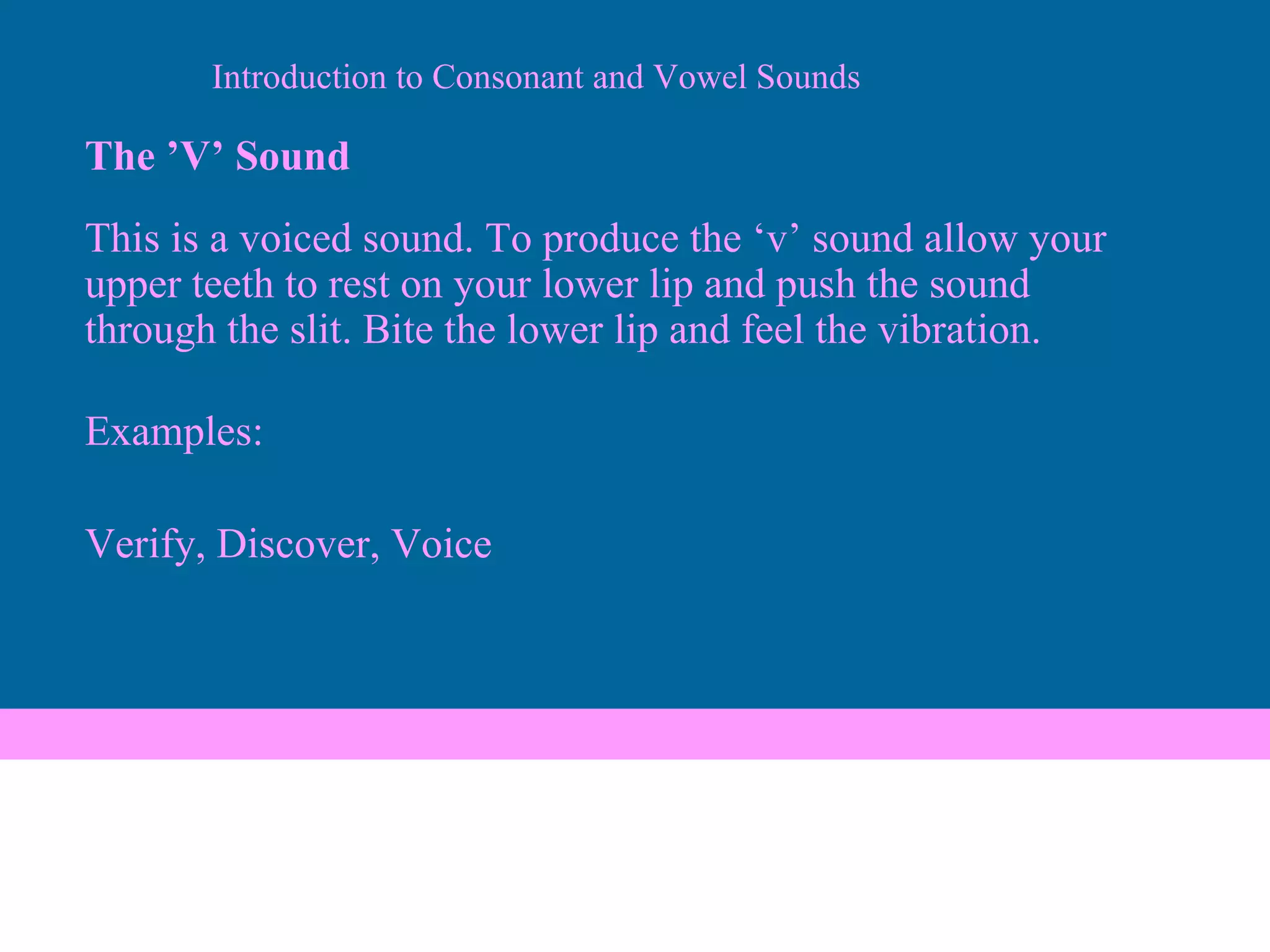
The ’V’ Sound This is a voiced sound. To produce the ‘v’ sound allow your upper teeth to rest on your lower lip and push the sound through the slit. Bite the lower lip and feel the vibration. Examples: Verify, Discover, Voice Introduction to Consonant and Vowel Sounds
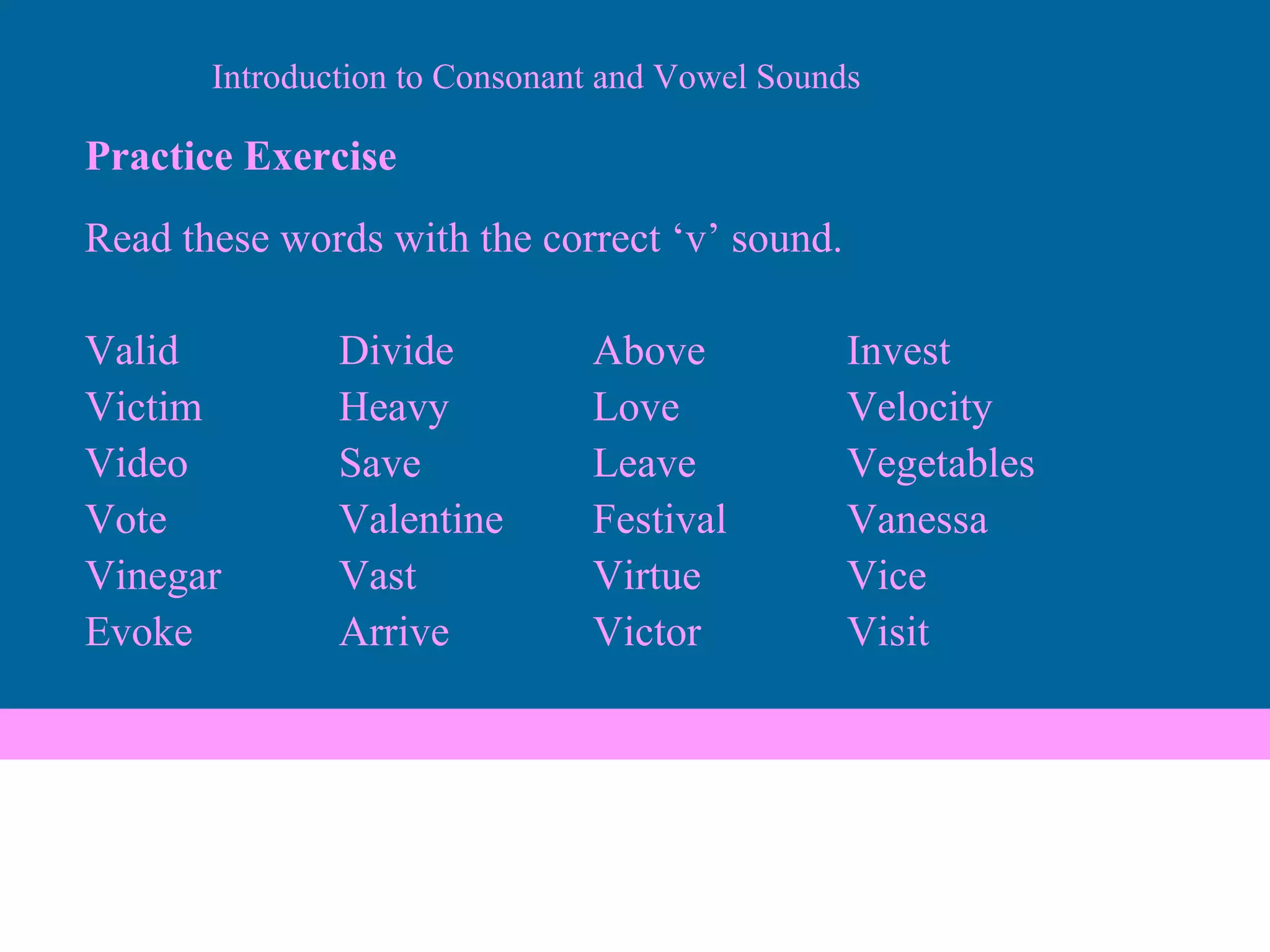
Practice Exercise Read these words with the correct ‘v’ sound. Valid Divide Above Invest Victim Heavy Love Velocity Video Save Leave Vegetables Vote Valentine Festival Vanessa Vinegar Vast Virtue Vice  Evoke Arrive Victor Visit Introduction to Consonant and Vowel Sounds
The ‘W’ sound This is a voiced sound. To produce the ‘w’ sound, make your lips rounded and the tongue drawn back as in the position of ‘u’. Your lips should form a soft circle. Examples: Work Wedding Wednesday Introduction to Consonant and Vowel Sounds
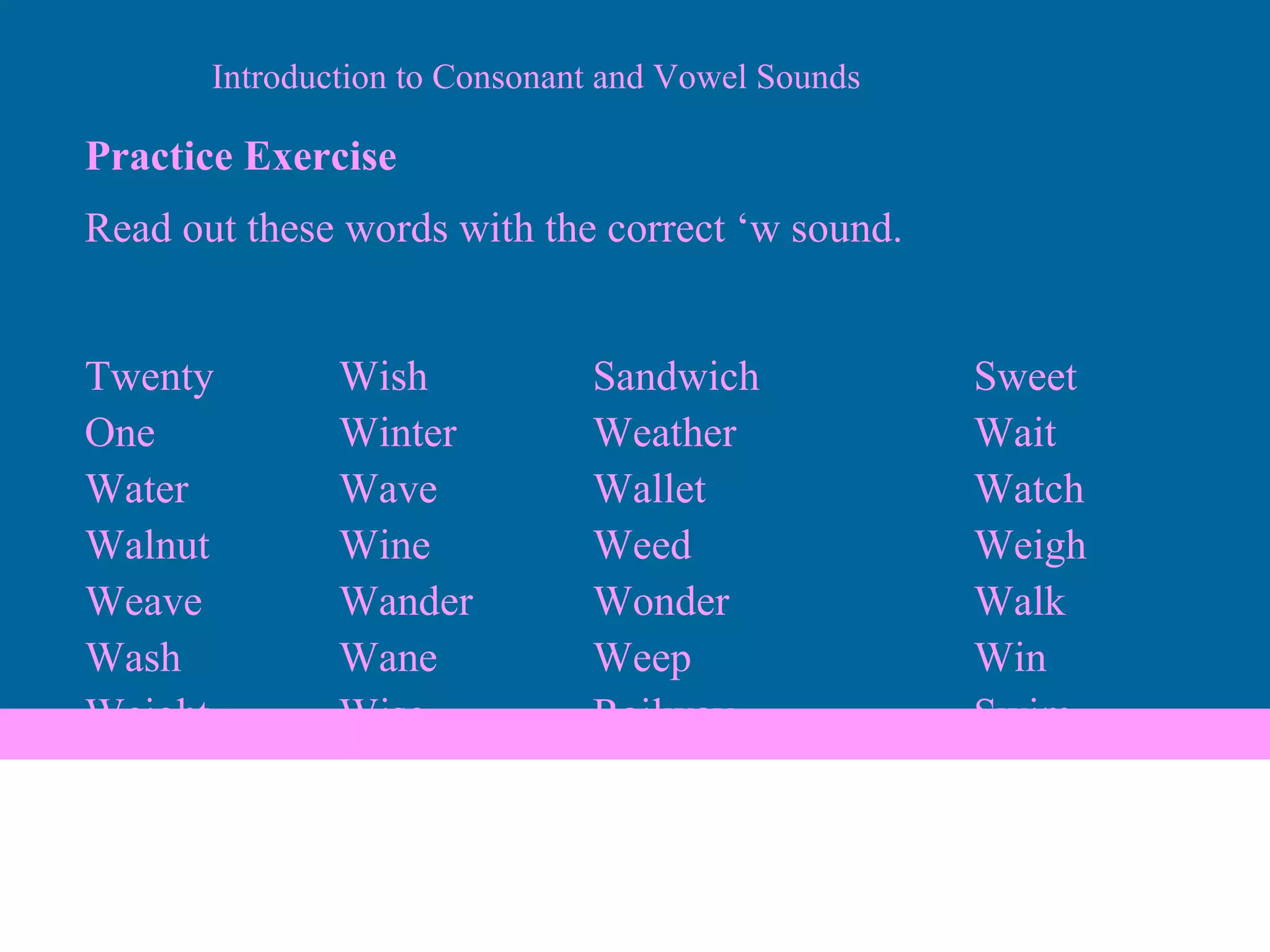
Practice Exercise Read out these words with the correct ‘w sound. Twenty Wish Sandwich Sweet One Winter Weather Wait Water Wave Wallet Watch Walnut   Wine Weed Weigh Weave Wander Wonder Walk Wash Wane Weep Win Weight Wise Railway Swim Introduction to Consonant and Vowel Sounds
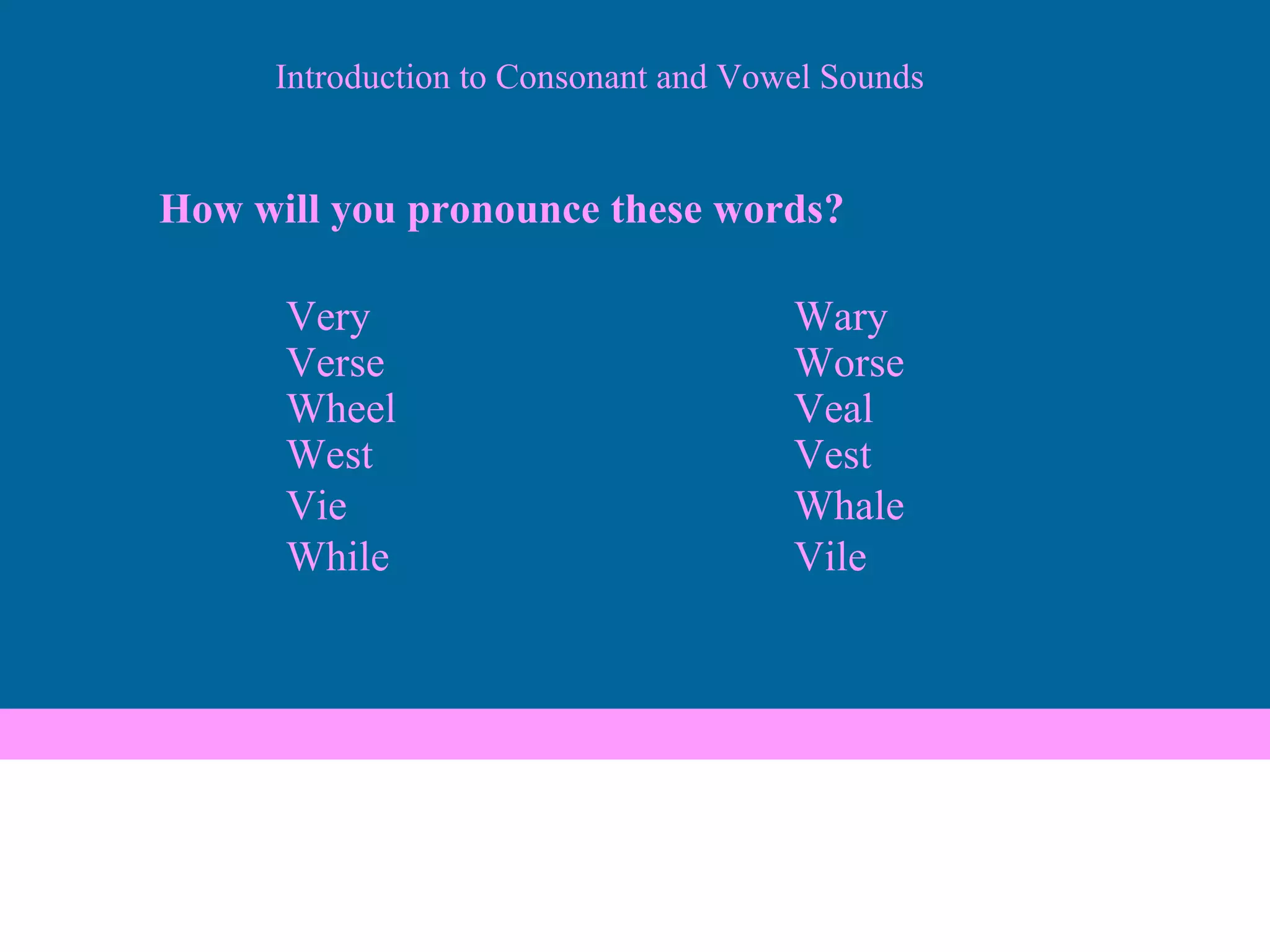
How will you pronounce these words? Very Wary Verse Worse Wheel Veal West Vest Vie Whale While Vile Introduction to Consonant and Vowel Sounds
The Ch sound This is an unvoiced aspirated sound: Church Cherish Chant Chamber Introduction to Consonant and Vowel Sounds
The Ch sound Practice Exercise Charlie chose the chilly chicken Chitra chanced to sit on the Chiming chair. Cherry cheered the charming champion. Check the cheese before you eat. Channel of the chimney was charred. Introduction to Consonant and Vowel Sounds
Introduction to Consonant and Vowel Sounds The dj Sound This is a voiced sound Gin Ginger Practice Exercise: Gin and tonic water is the gist for success for gigantic parties. Gillette is the brand of a shaving gadget Gauge the height of the hill gingerly. Fit the gauge gently.
Introduction to Consonant and Vowel Sounds The sh sound This is a voiced sound. Produce the ‘sh’ sound by pursing your lips in an oval shape resting your upper teeth straight on your lower teeth and blowing the air through the slit between the teeth.
Introduction to Consonant and Vowel Sounds The sh sound Shell She Shoot English
Introduction to Consonant and Vowel Sounds The sh sound Practice Exercise: Chef, Champagne Musician ,Ancient Tension, Pension Russia, Expression Sanction, Section
Introduction to Consonant and Vowel Sounds The S Sound The S sound is a voiced sound produced by placing the tongue towards the upper ridge of your teeth and passing the air through the slit Swim State Start
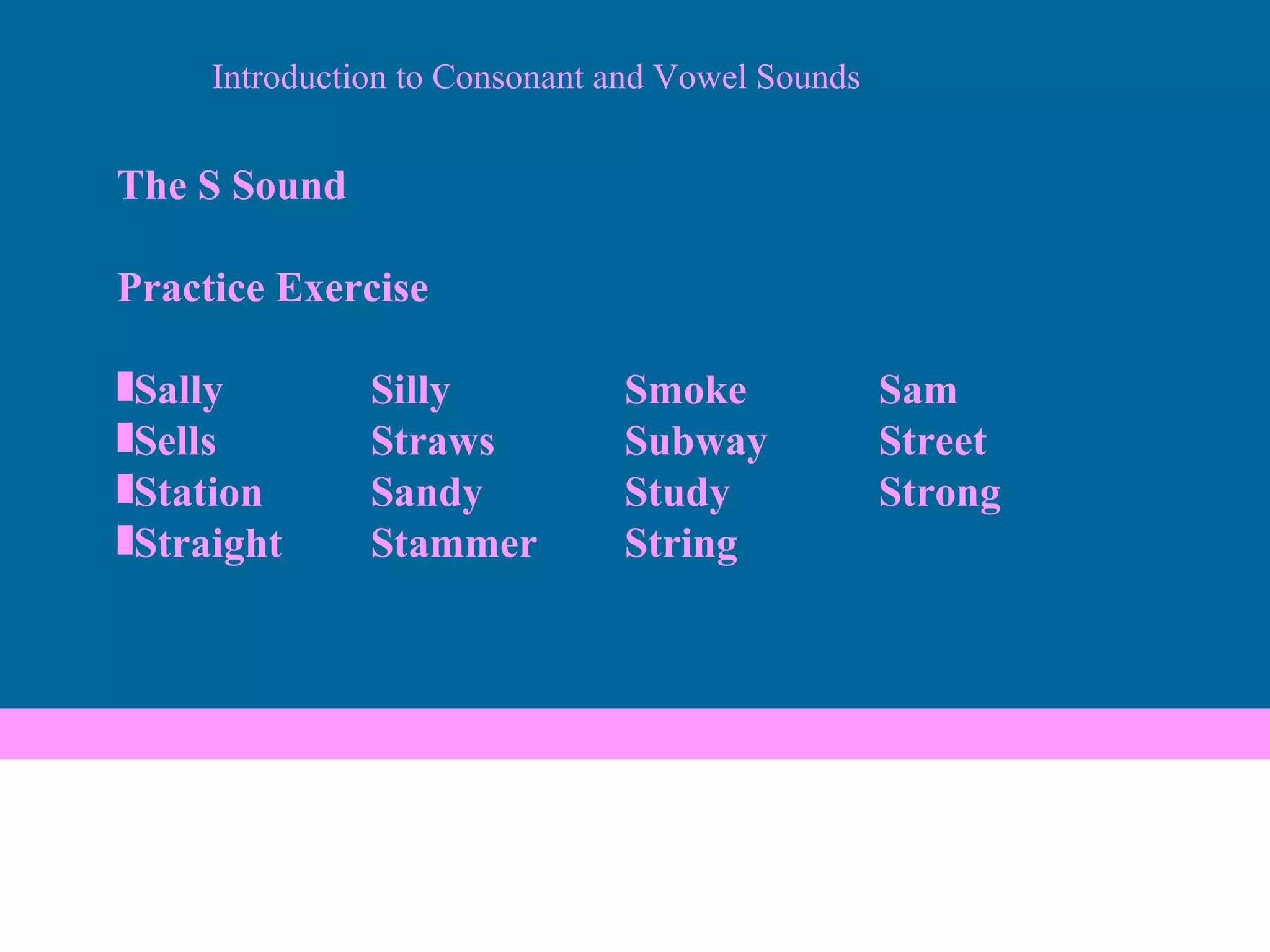
Introduction to Consonant and Vowel Sounds The S Sound Practice Exercise Sally Silly Smoke Sam Sells Straws Subway Street Station Sandy Study Strong Straight Stammer String
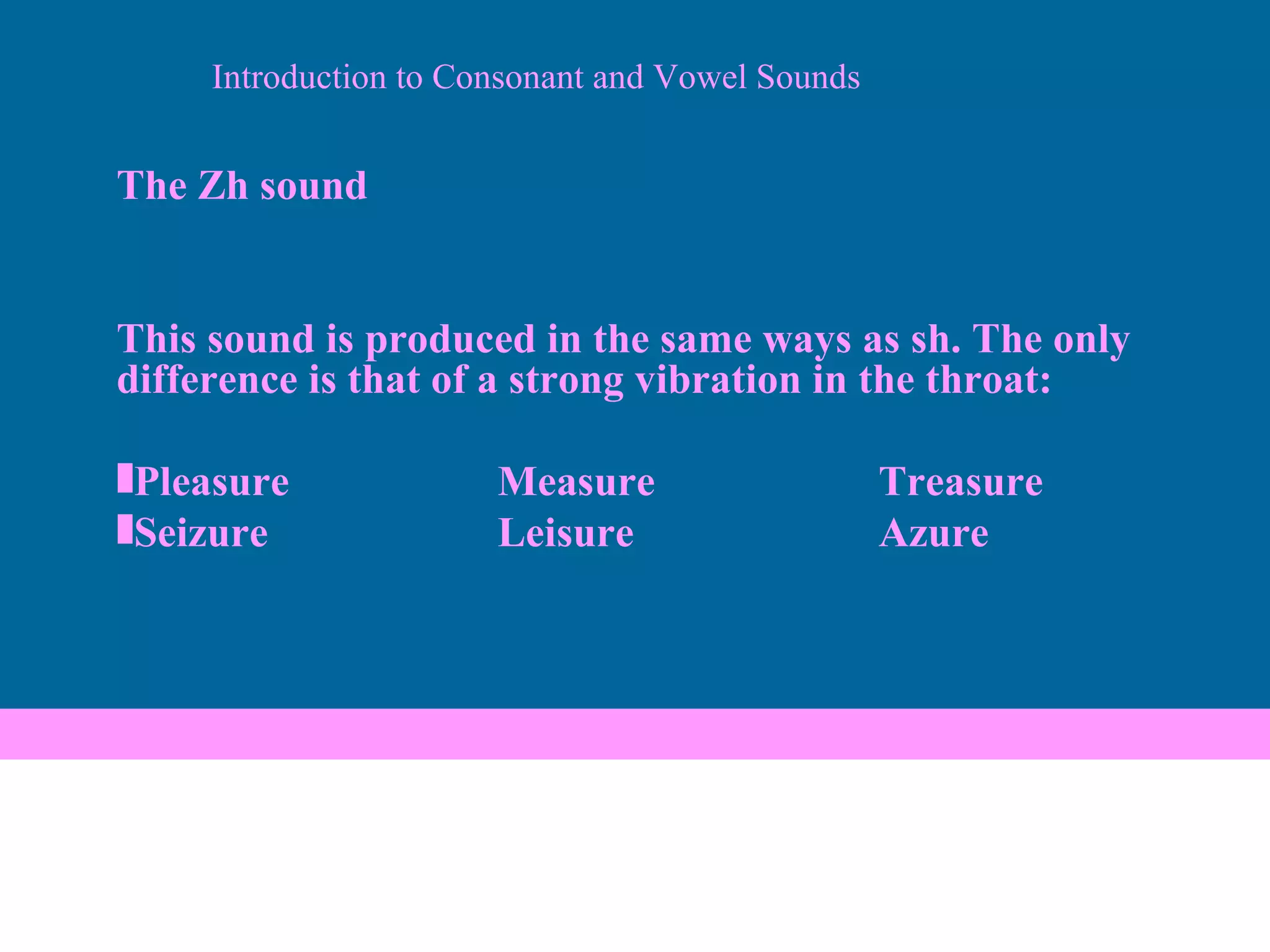
Introduction to Consonant and Vowel Sounds The Zh sound This sound is produced in the same ways as sh. The only difference is that of a strong vibration in the throat: Pleasure Measure Treasure Seizure Leisure Azure
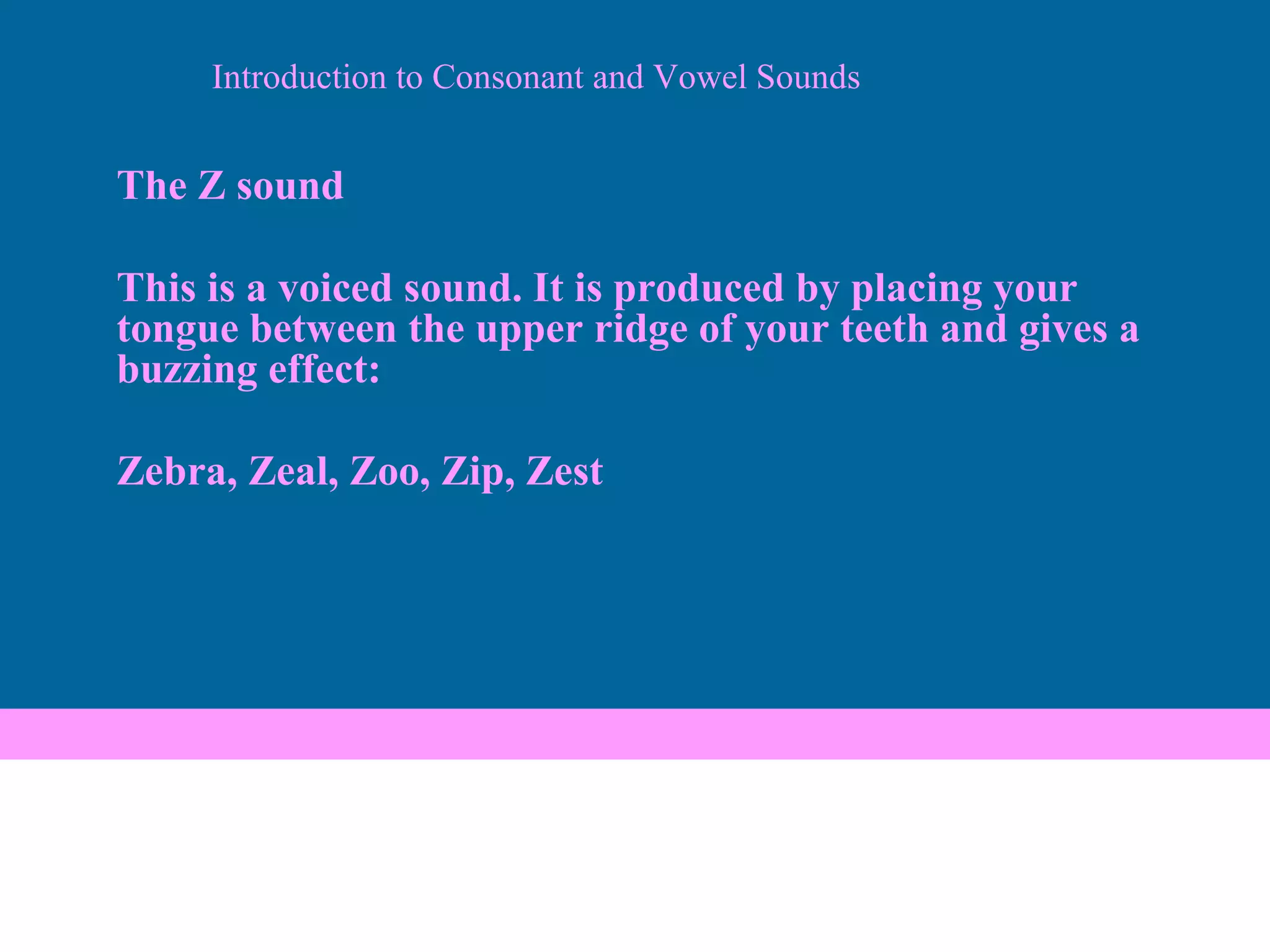
Introduction to Consonant and Vowel Sounds The Z sound This is a voiced sound. It is produced by placing your tongue between the upper ridge of your teeth and gives a buzzing effect: Zebra, Zeal, Zoo, Zip, Zest
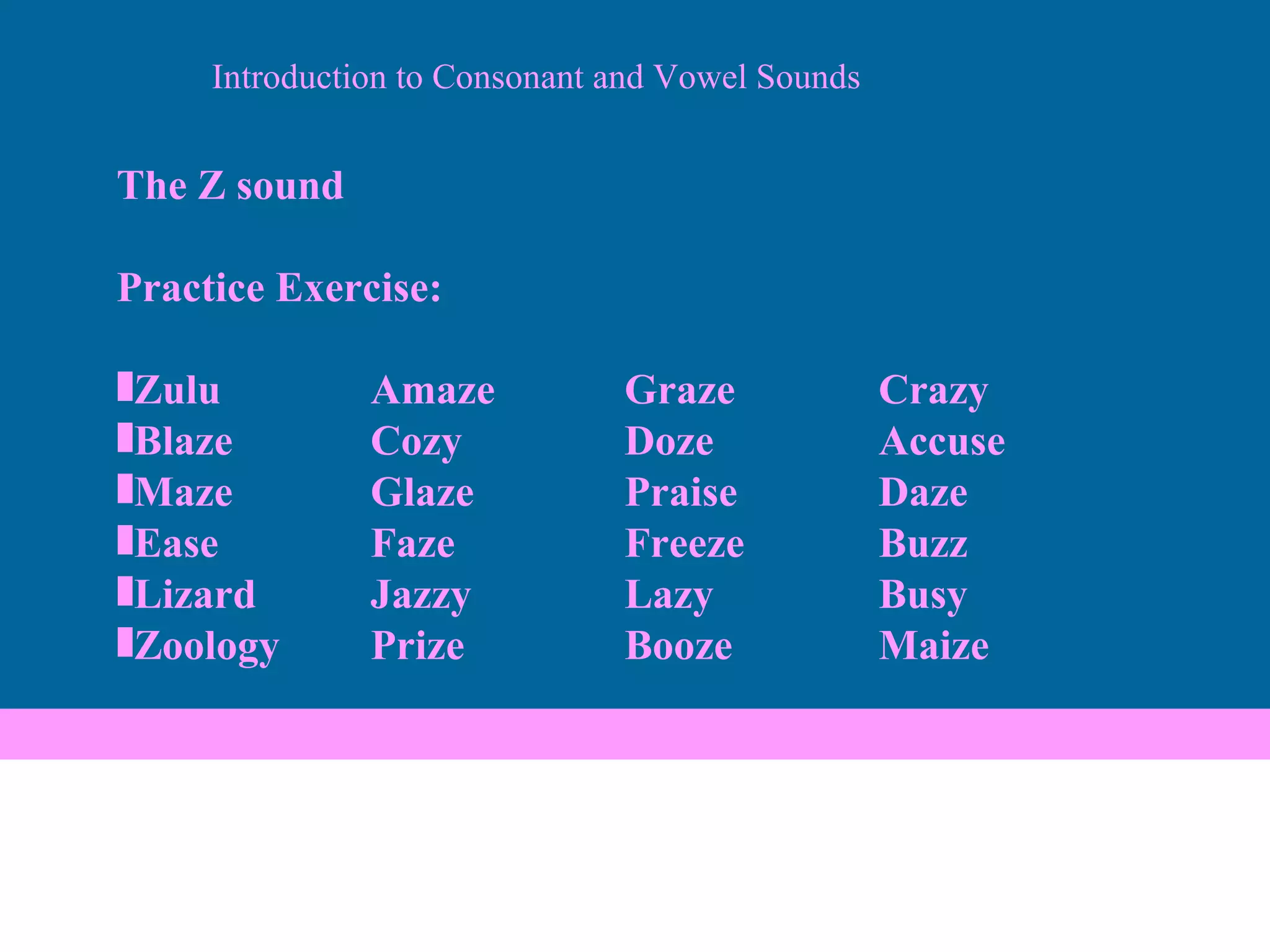
Introduction to Consonant and Vowel Sounds The Z sound Practice Exercise: Zulu Amaze Graze Crazy Blaze Cozy Doze Accuse Maze Glaze Praise Daze Ease Faze Freeze Buzz Lizard Jazzy Lazy Busy Zoology Prize Booze Maize
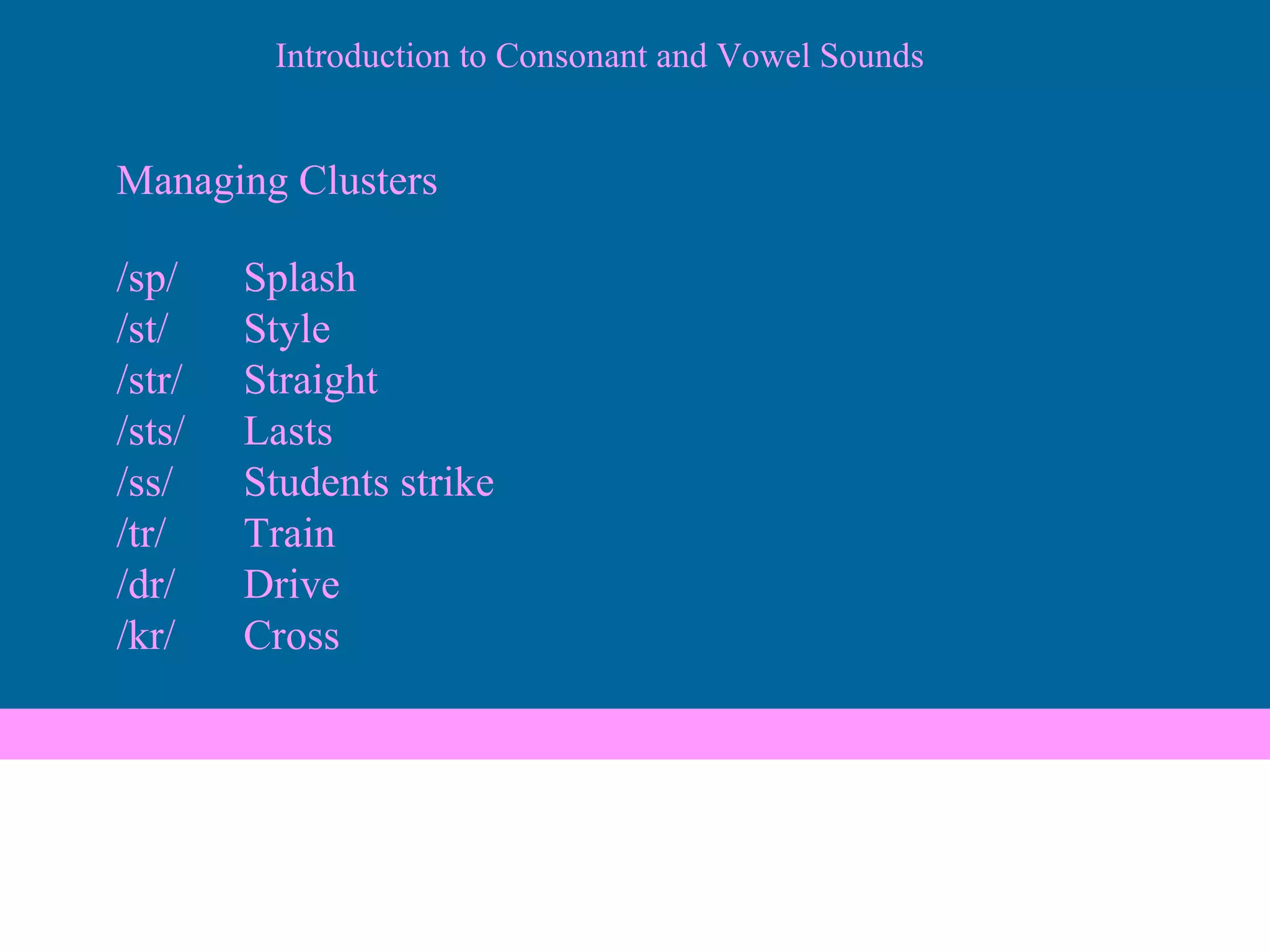
Introduction to Consonant and Vowel Sounds Managing Clusters /sp/ Splash /st/ Style /str/ Straight /sts/ Lasts /ss/ Students strike /tr/ Train /dr/ Drive /kr/ Cross
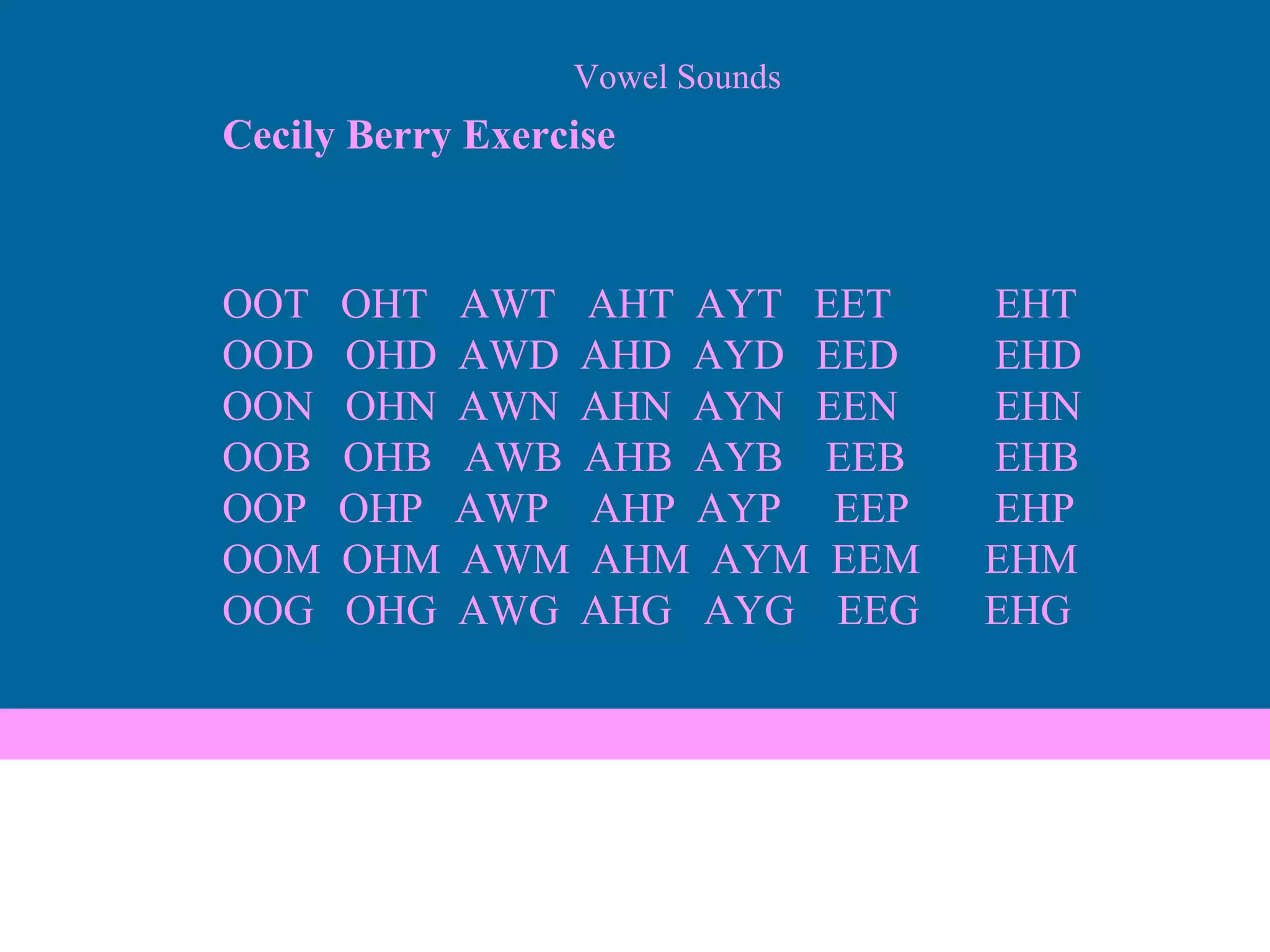
Vowel Sounds Cecily Berry Exercise OOT  OHT  AWT  AHT  AYT  EET  EHT OOD  OHD  AWD  AHD  AYD  EED  EHD OON  OHN  AWN  AHN  AYN  EEN   EHN OOB  OHB  AWB  AHB  AYB  EEB   EHB OOP  OHP  AWP  AHP  AYP  EEP  EHP OOM  OHM  AWM  AHM  AYM  EEM  EHM OOG  OHG  AWG  AHG  AYG  EEG  EHG
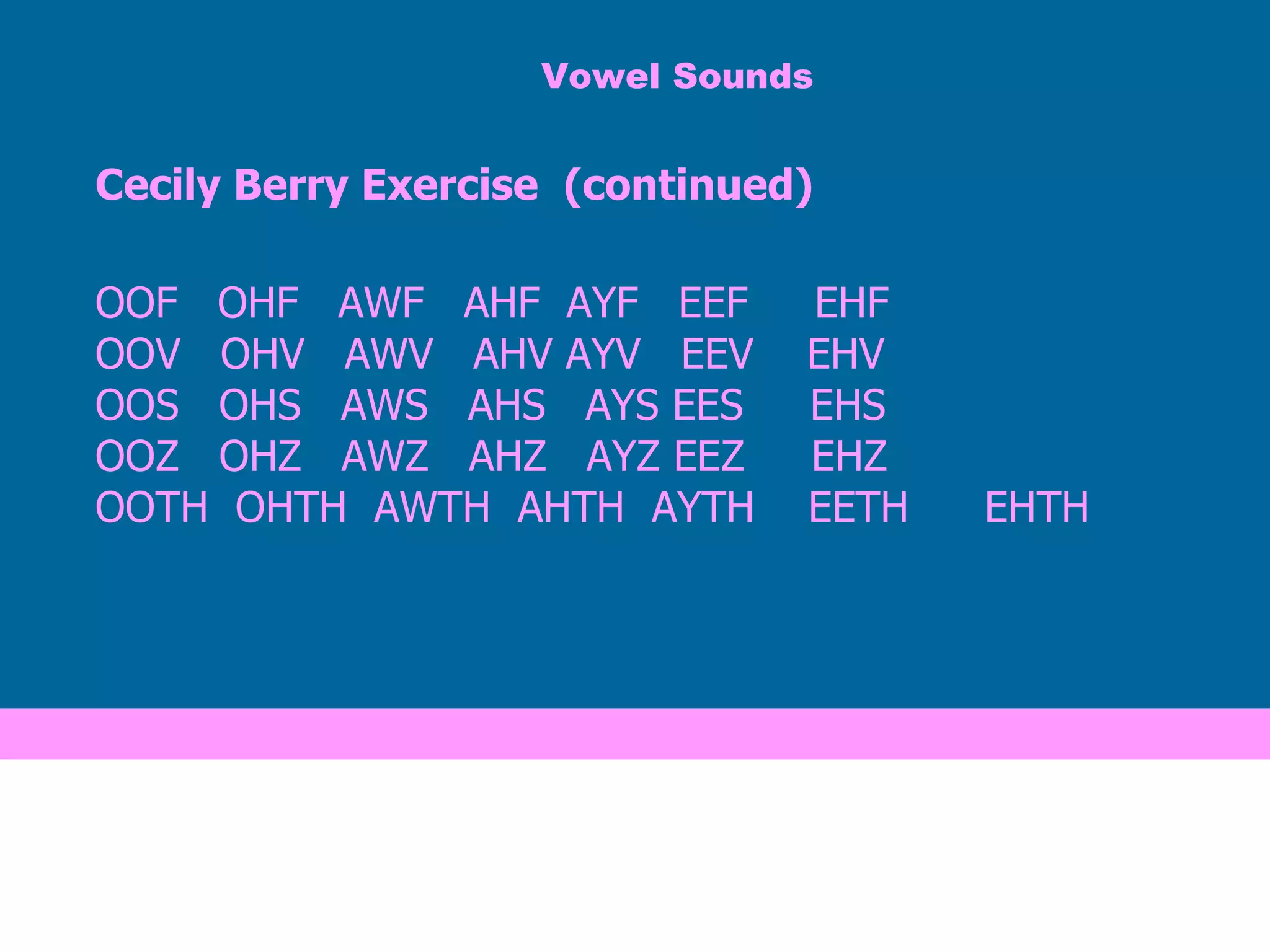
Vowel Sounds Cecily Berry Exercise  (continued) OOF  OHF  AWF  AHF  AYF  EEF  EHF OOV  OHV  AWV  AHV AYV  EEV  EHV OOS  OHS  AWS  AHS  AYS EES  EHS OOZ  OHZ  AWZ  AHZ  AYZ EEZ  EHZ OOTH  OHTH  AWTH  AHTH  AYTH  EETH  EHTH
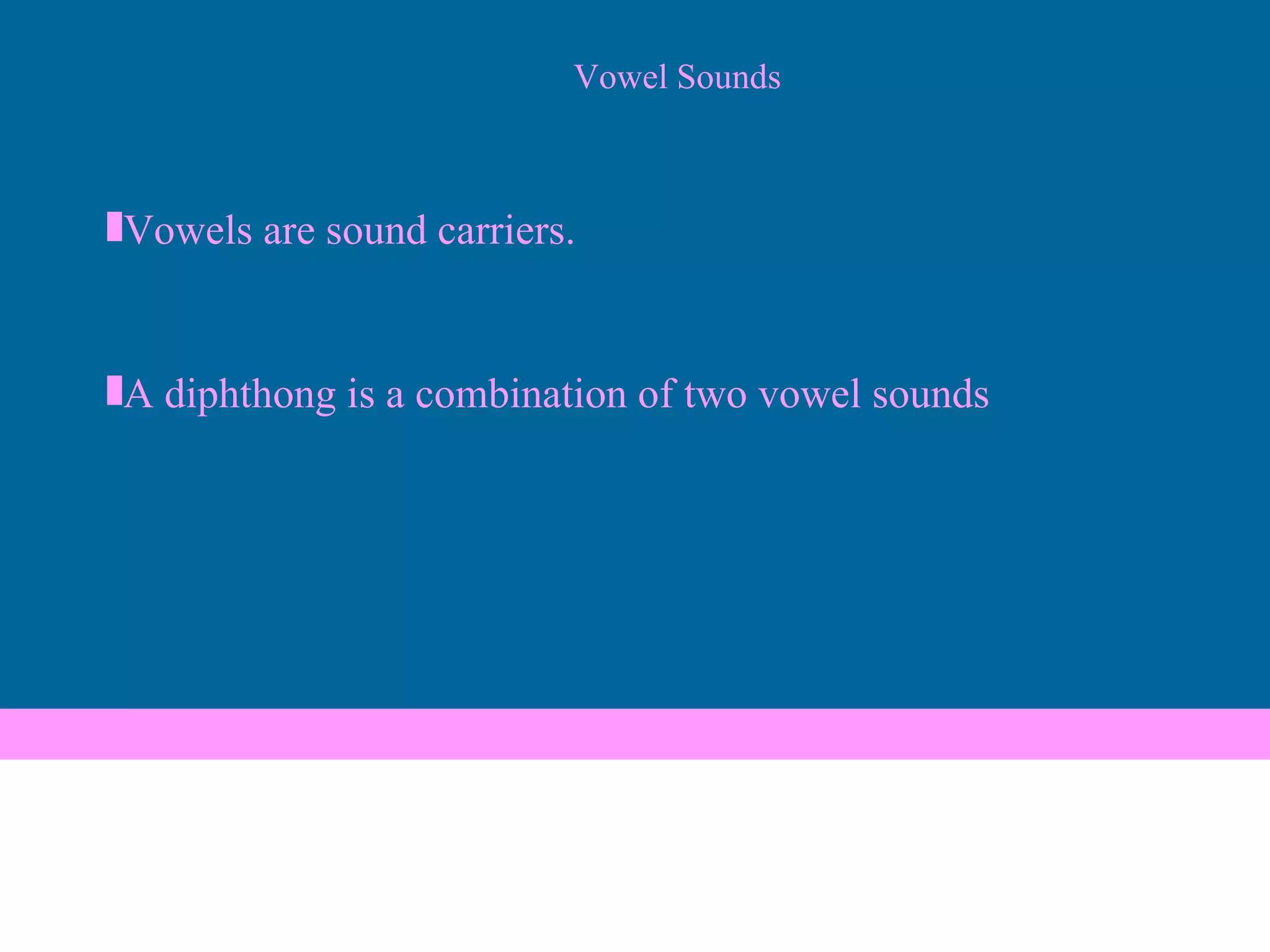
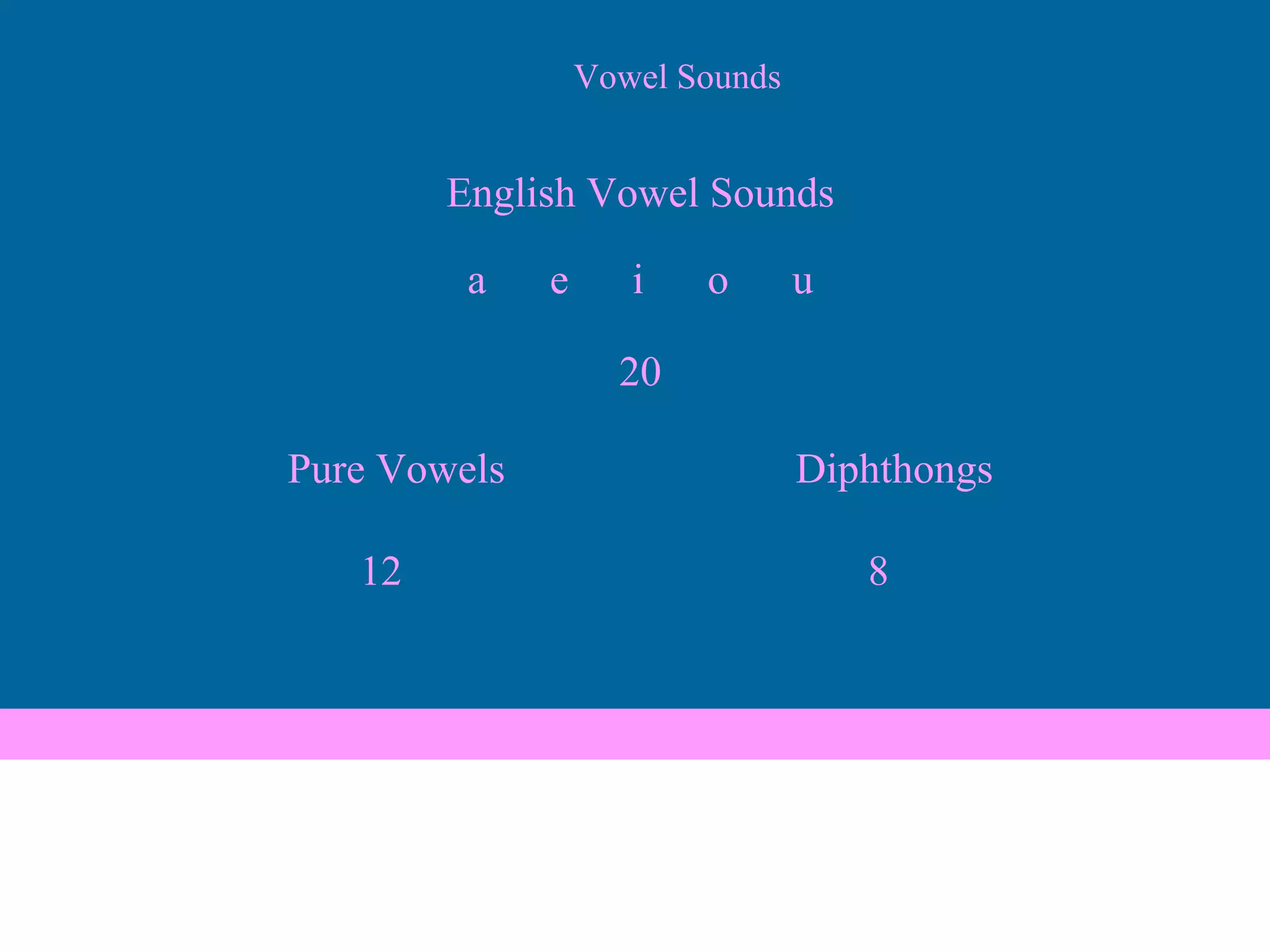
Vowel Sounds Vowels are sound carriers. A diphthong is a combination of two vowel sounds
Vowel Sounds English Vowel Sounds a  e  i  o  u 20 Pure Vowels Diphthongs 12  8
Vowel Sounds Vowel Sounds Vowel sounds can be broadly categorized  into: Long Vowels Short Vowels Diphthongs
Vowel Sounds Diphthongs: [aʊ] as in  house   [aɪ] as in  kite   [eɪ] as in  same   [juː] as in  few [ɔɪ] as in  join   [ɪə] as in  fear   [ɛə] as in  hair [ʊə] as in  poor
Vowel Sounds Some Commonly Mispronounced Words Hotel Component Petrol Industry Engineer Cassette Decade Chaos Development
Intonation What is intonation “ Rise and fall in pitch is intonation” It can also be defined as “Speech Music”
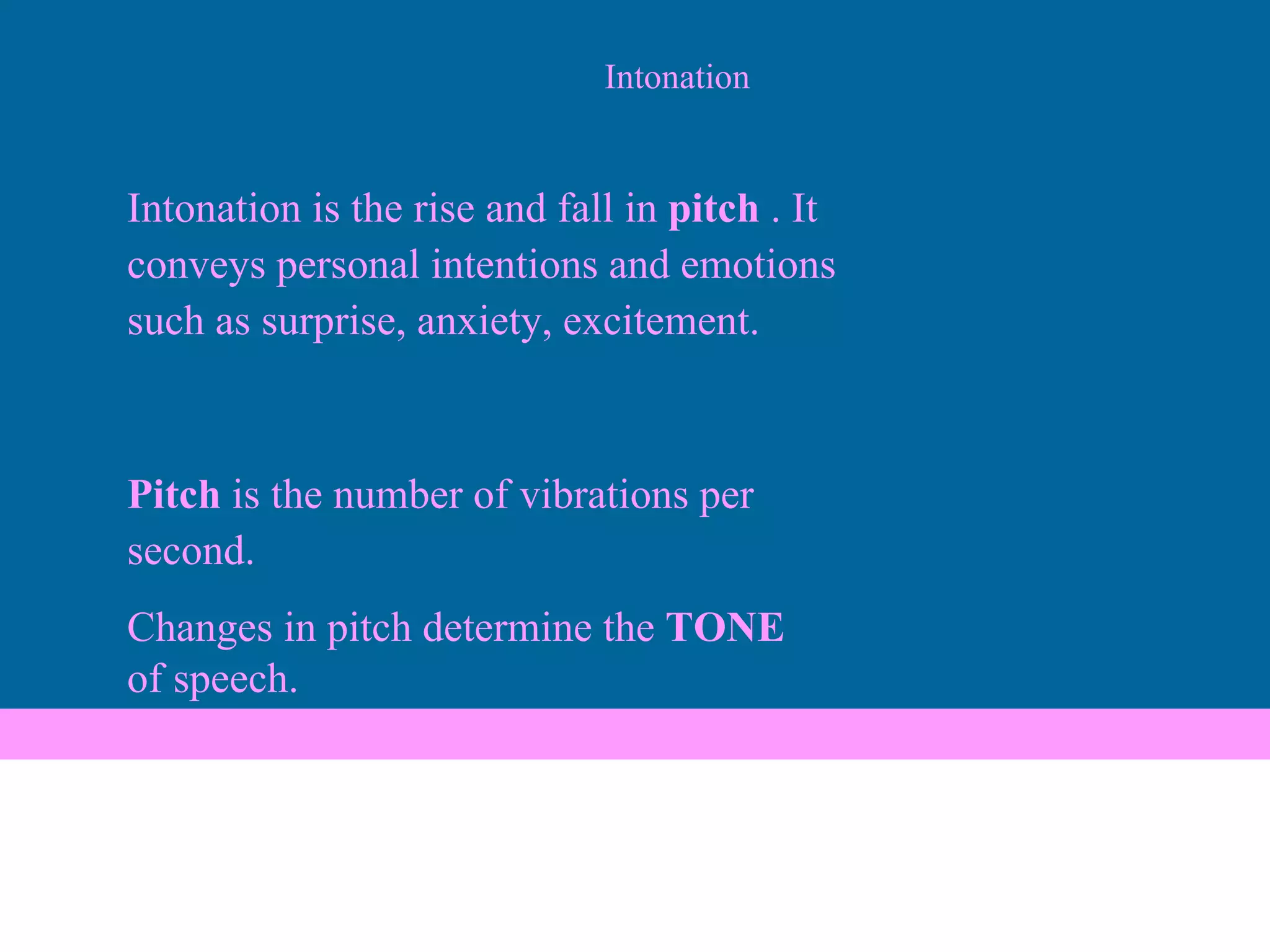
Intonation Intonation is the rise and fall in  pitch  . It conveys personal intentions and emotions such as surprise, anxiety, excitement. Pitch  is the number of vibrations per second. Changes in pitch determine the  TONE of speech.
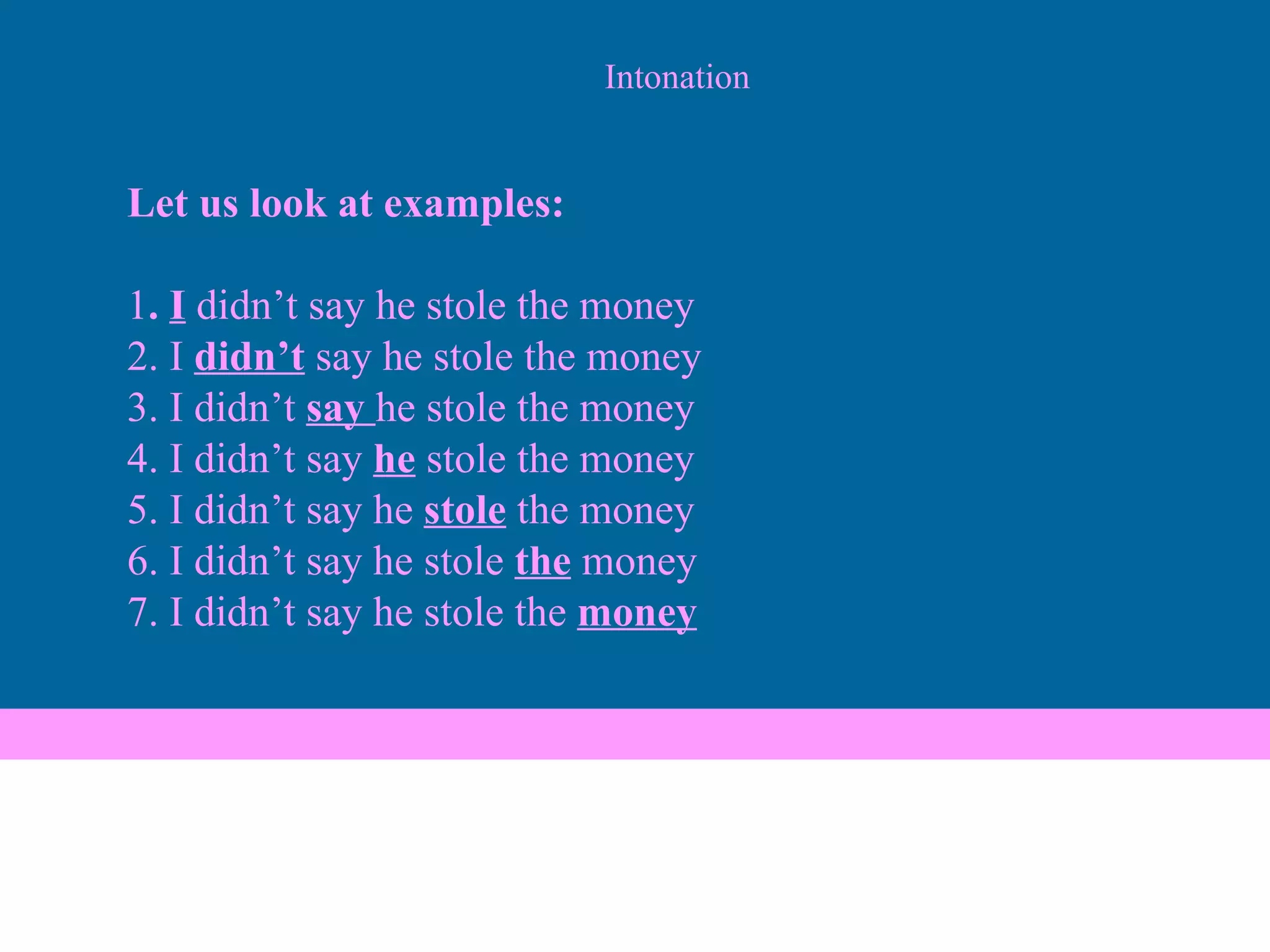
Intonation Let us look at examples: 1 .  I   didn’t say he stole the money 2. I  didn’t  say he stole the money 3. I didn’t  say  he stole the money 4. I didn’t say  he  stole the money 5. I didn’t say he  stole  the money 6. I didn’t say he stole  the  money 7. I didn’t say he stole the  money
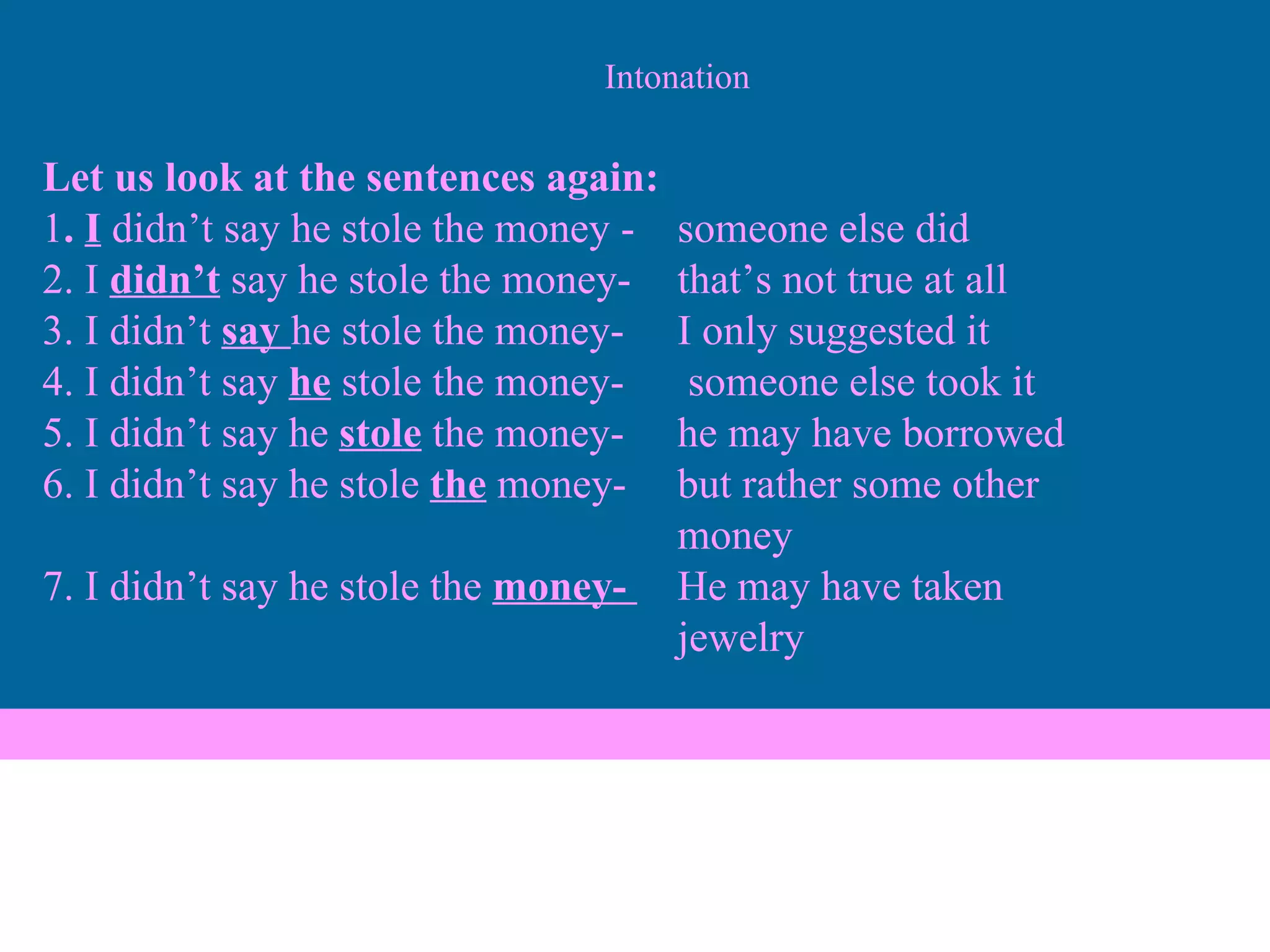
Intonation Let us look at the sentences again: 1 .  I   didn’t say he stole the money -  someone else did 2. I  didn’t  say he stole the money-  that’s not true at all 3. I didn’t  say  he stole the money-  I only suggested it 4. I didn’t say  he  stole the money-  someone else took it 5. I didn’t say he  stole  the money- he may have borrowed  6. I didn’t say he stole  the  money-  but rather some other money 7. I didn’t say he stole the  money-  He may have taken jewelry
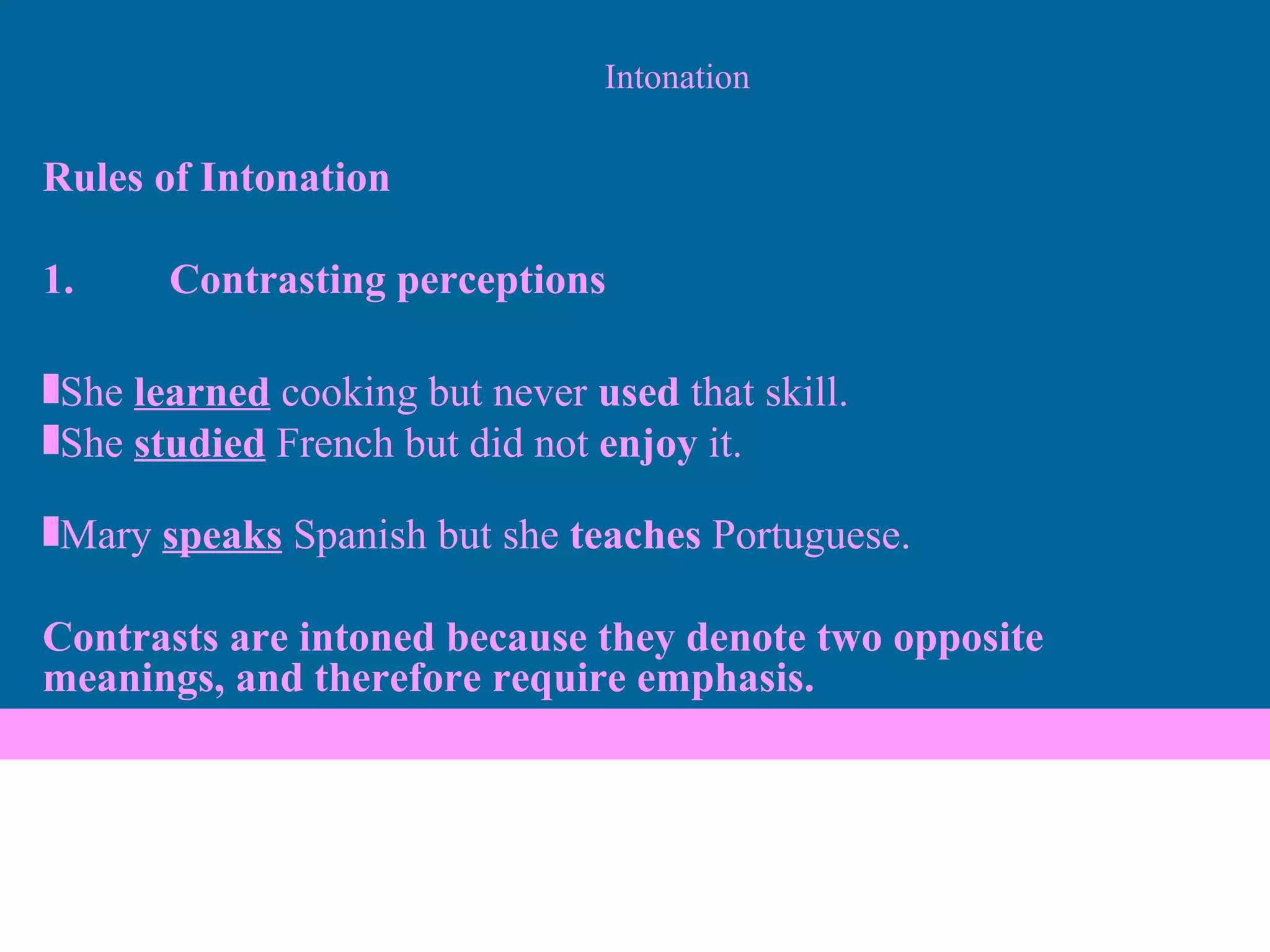
Intonation Rules of Intonation 1. Contrasting perceptions She  learned  cooking but never  used  that skill. She  studied  French but did not  enjoy  it. Mary  speaks  Spanish but she  teaches  Portuguese.  Contrasts are intoned because they denote two opposite meanings, and therefore require emphasis.
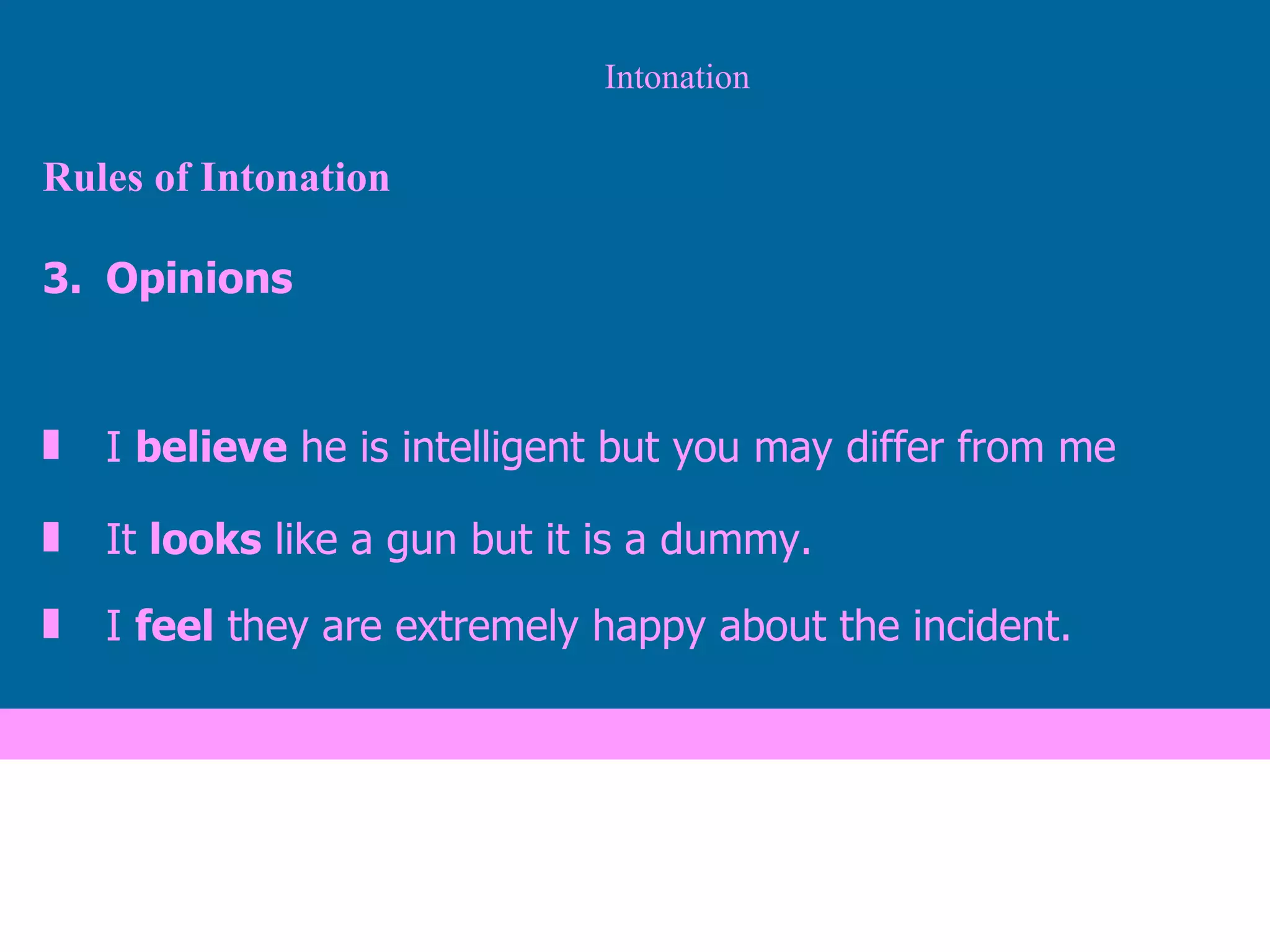
Intonation Rules of Intonation Opinions I  believe  he is intelligent but you may differ from me It  looks  like a gun but it is a dummy. I  feel  they are extremely happy about the incident.
Intonation Rules of Intonation 2. Opinions Opinions are stressed since they denote strong perceptions. However, if there are nouns in the sentence, the nouns get more emphasis than the verbs. Example: Harry  believes he is intelligent but you may differ from him.
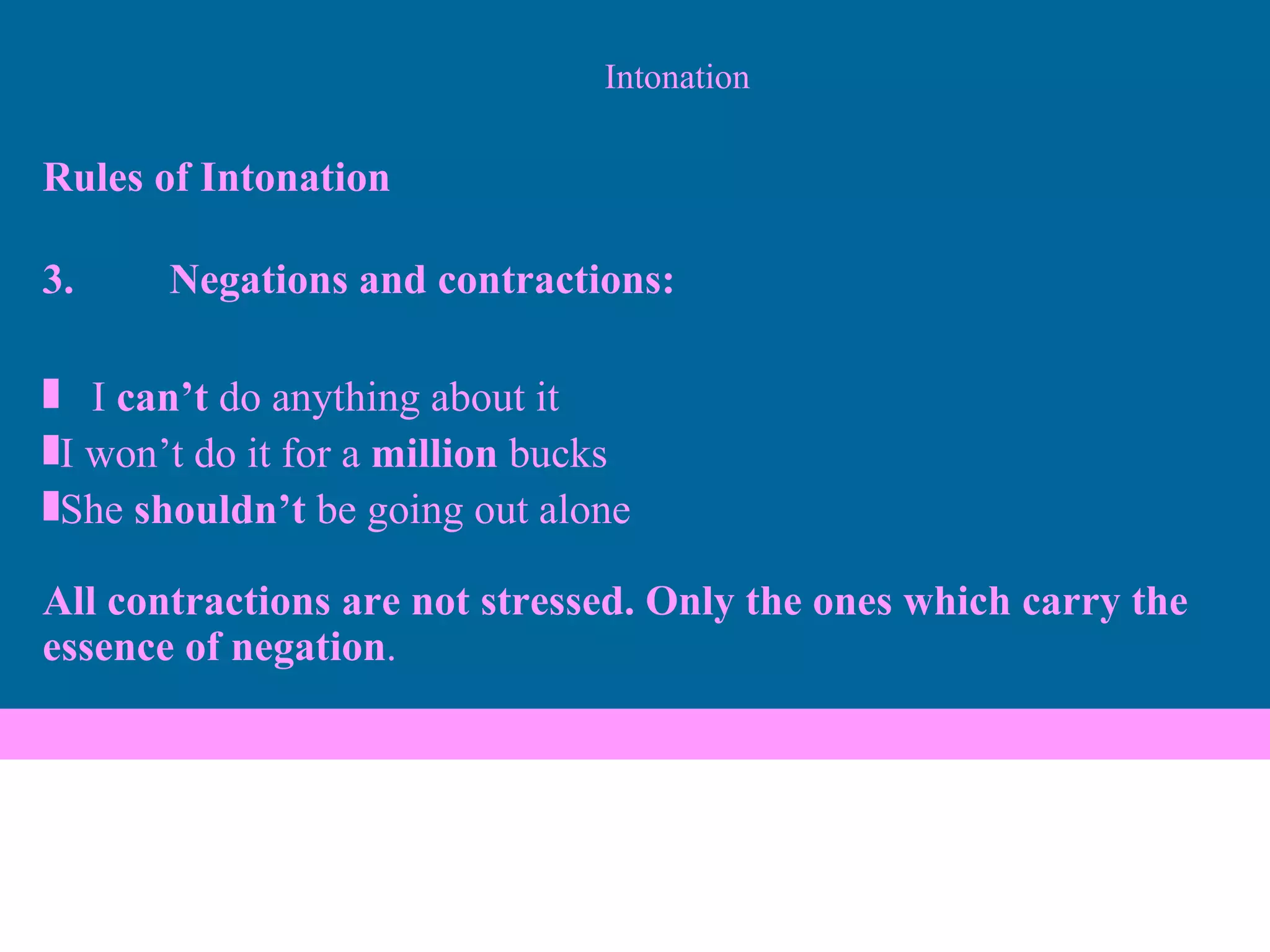
Intonation Rules of Intonation 3. Negations and contractions: I  can’t  do anything about it I won’t do it for a  million  bucks She  shouldn’t  be going out alone All contractions are not stressed. Only the ones which carry the essence of negation .
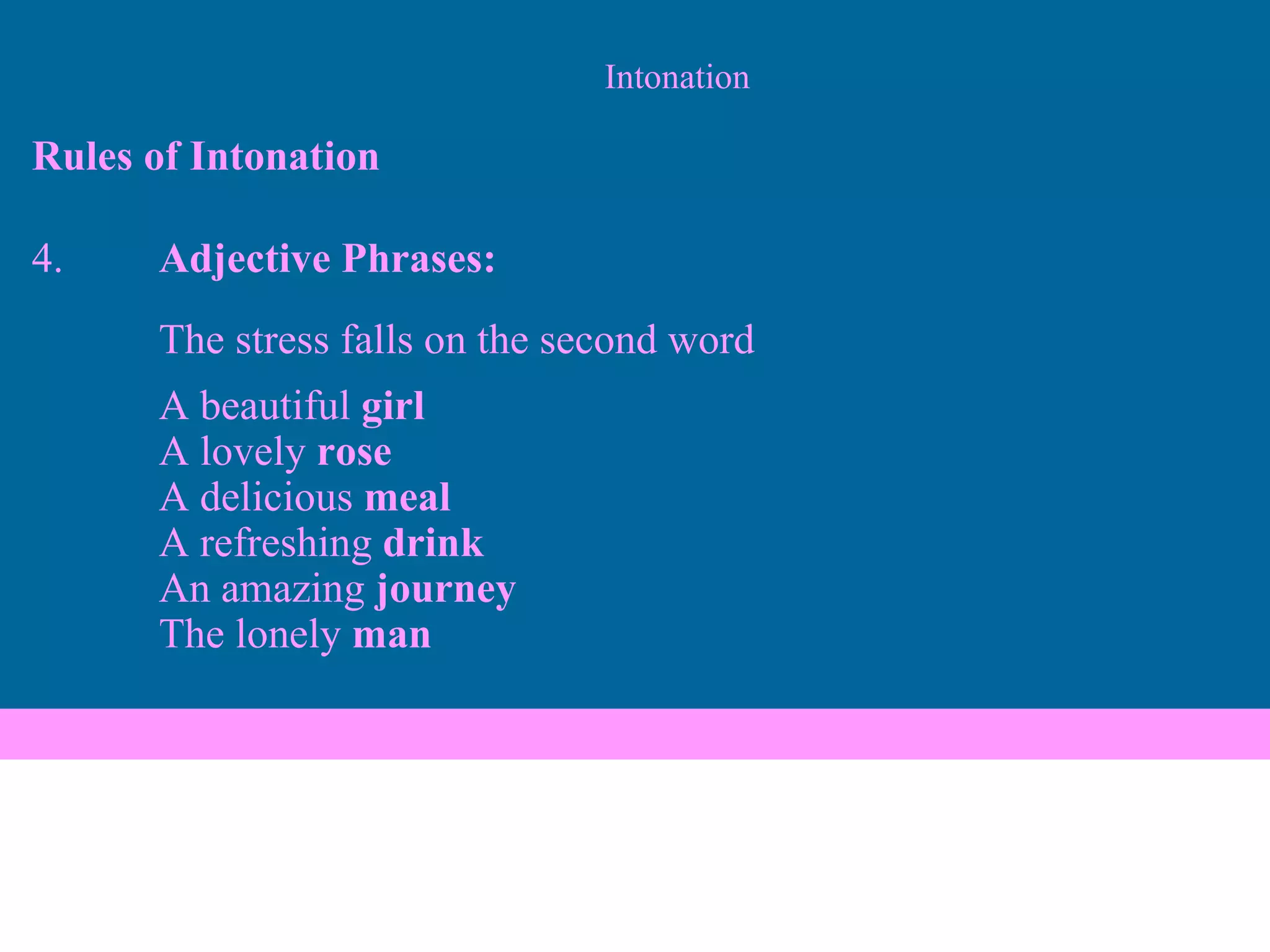
Intonation Rules of Intonation 4.  Adjective Phrases: The stress falls on the second word A beautiful  girl A lovely  rose A delicious  meal A refreshing  drink An amazing  journey The lonely  man
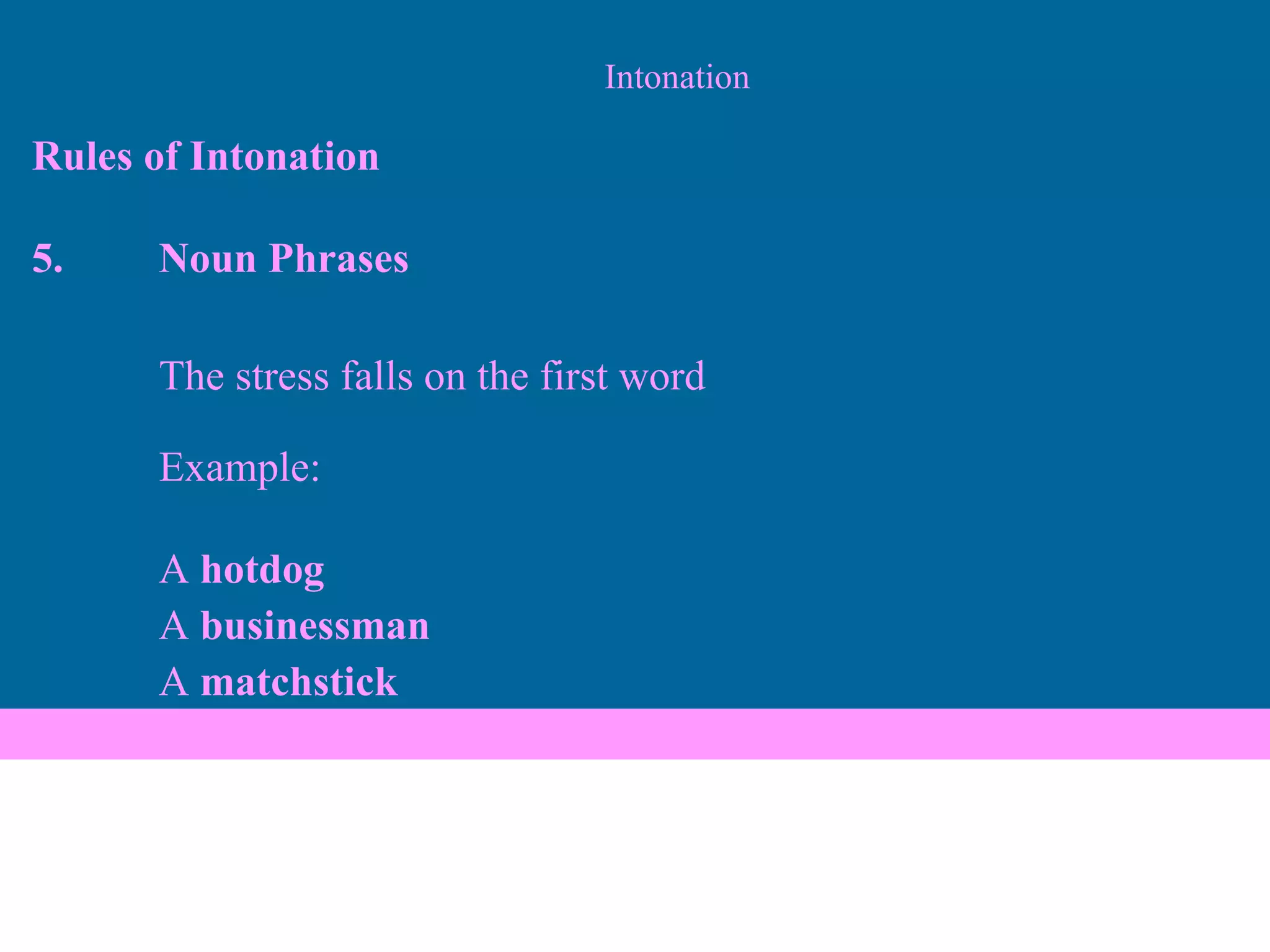
Intonation Rules of Intonation 5. Noun Phrases The stress falls on the first word Example: A  hotdog A  businessman A  matchstick
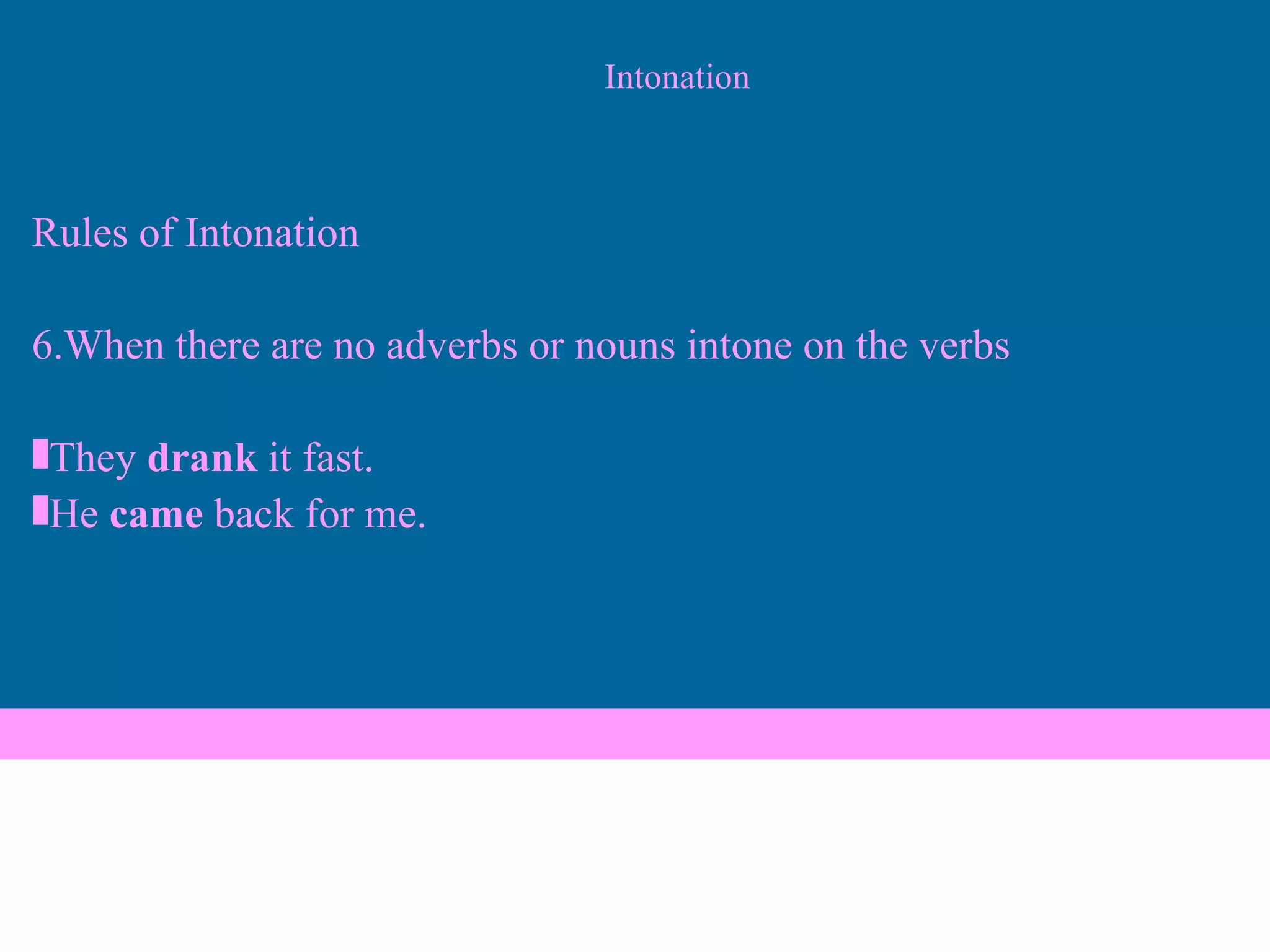
Intonation Rules of Intonation 6.When there are no adverbs or nouns intone on the verbs They  drank  it fast.  He  came  back for me.
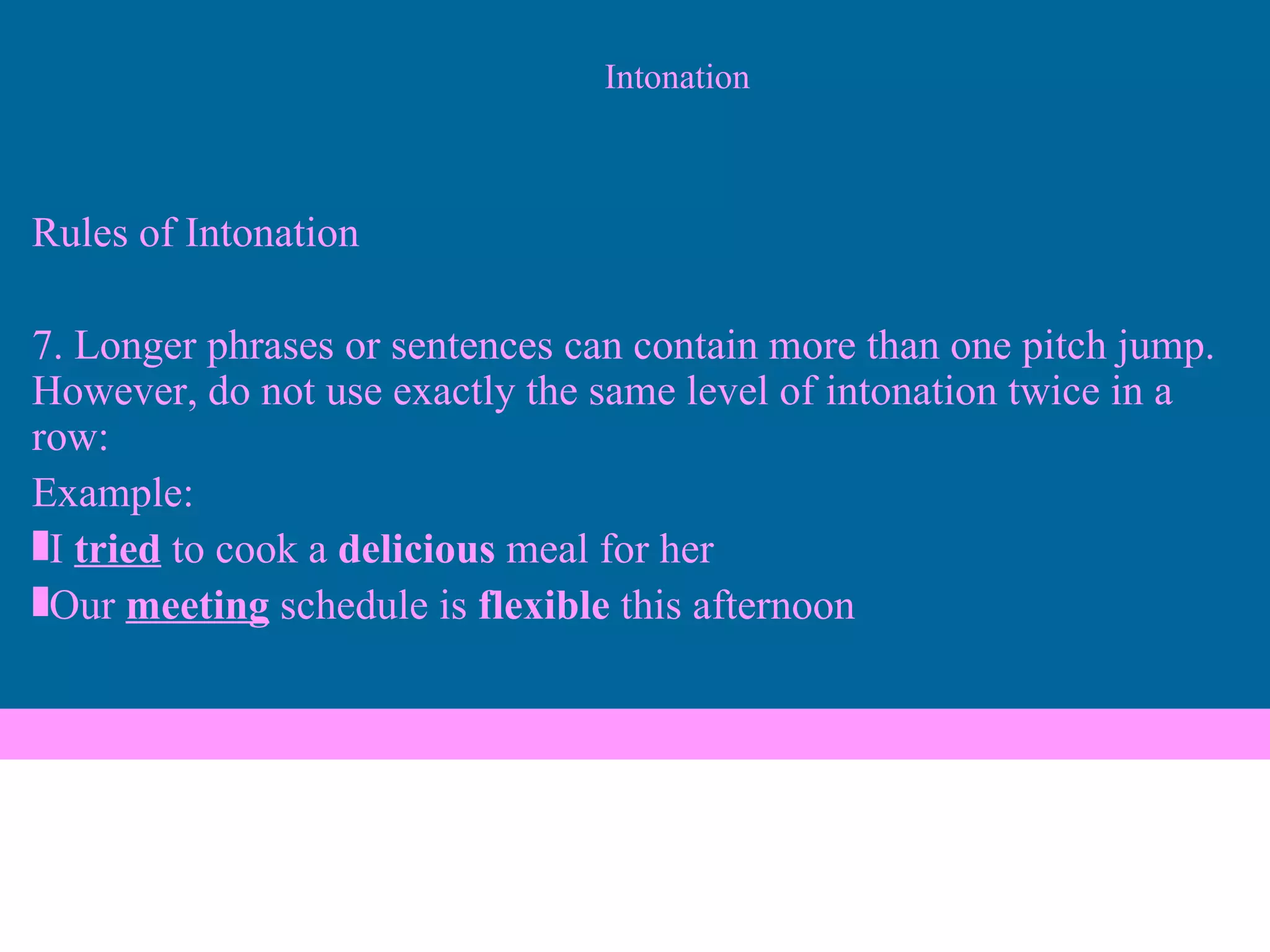
Intonation Rules of Intonation 7. Longer phrases or sentences can contain more than one pitch jump. However, do not use exactly the same level of intonation twice in a row: Example: I  tried  to cook a  delicious  meal for her Our  meeting  schedule is  flexible  this afternoon
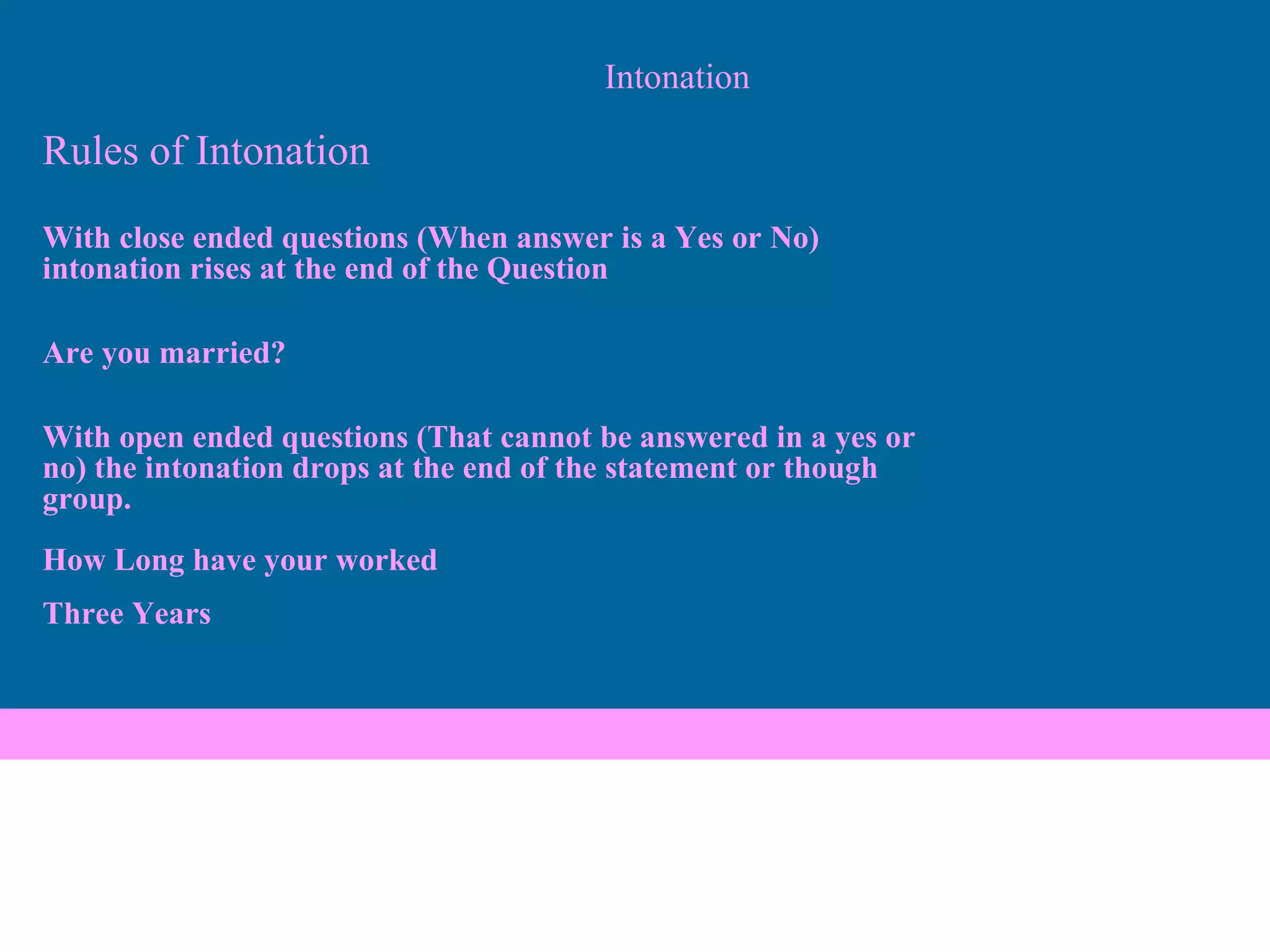
Intonation Rules of Intonation With close ended questions (When answer is a Yes or No)  intonation rises at the end of the Question Are you married? With open ended questions (That cannot be answered in a yes or  no) the intonation drops at the end of the statement or though  group.   How Long have your worked Three Years  
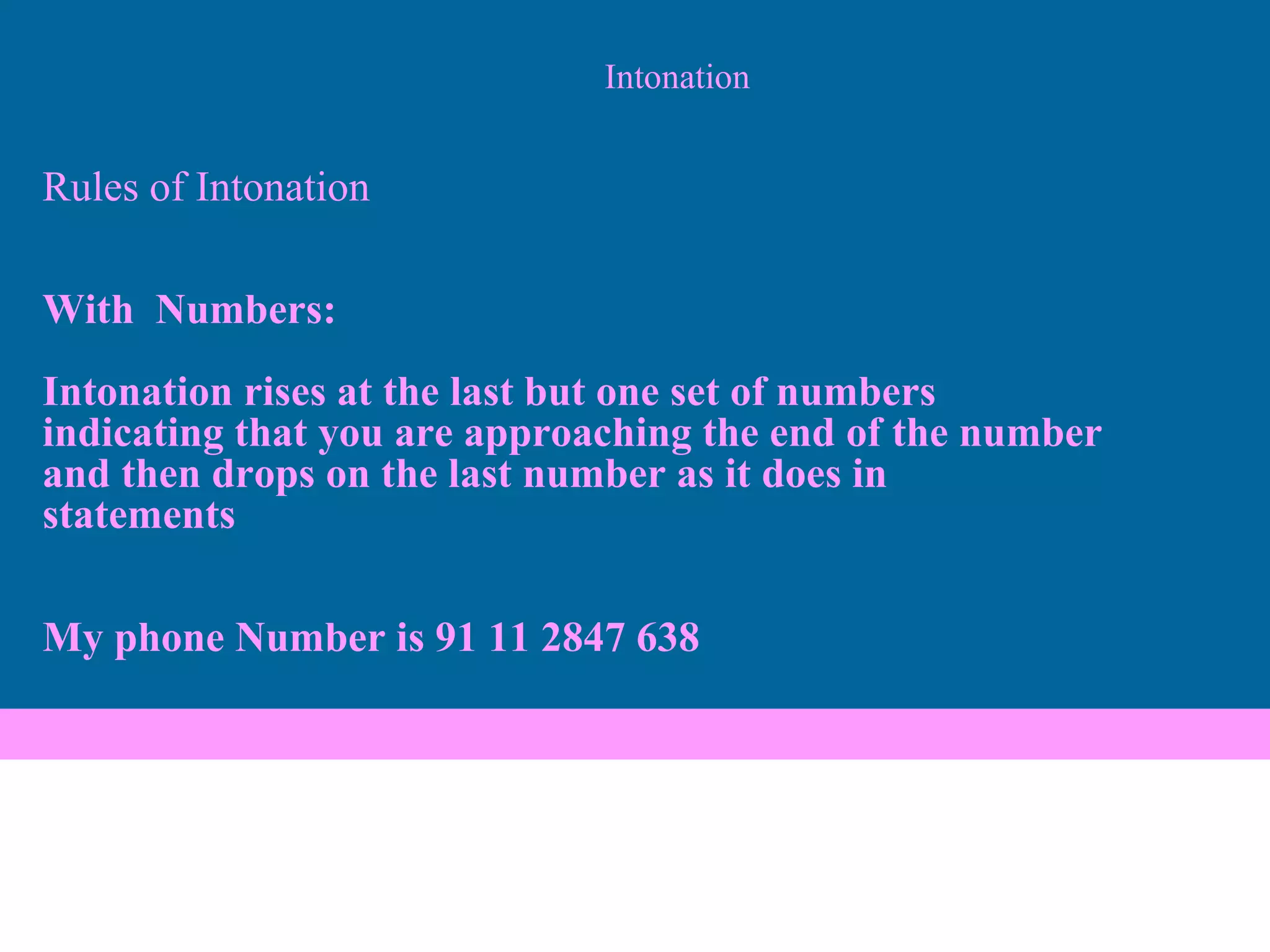
Intonation Rules of Intonation   With  Numbers:   Intonation rises at the last but one set of numbers  indicating that you are approaching the end of the number and then drops on the last number as it does in  statements   My phone Number is 91 11 2847 638
Intonation Rules of Intonation Intonation when giving choices:   Intonation will rise on the first choice or all the choices before the  last one and down for the final option to indicate end of the choices Do you want red, black or yellow?   Other rules of intonation:   When new information is conveyed, nouns which are the  carriers of new information are stressed   People  enjoy  parties Cats  drink  milk Men  drive  cars
Intonation What happens when we lack  intonation while conversing? Negates the essence of information Makes us sound mechanical causes miscommunication

Voice & accent neutralization

  • 1.
    Voice & AccentNeutralization
  • 2.
    Consonant Sounds Vowel Sounds Intonation What we will learn
  • 3.
    Some startling facts: There are 26 letters in the English Alphabets However there are 44 sounds 24 Consonant Sounds 20 Vowel Sounds (12 vowels & 8 Diphthongs) Introduction to Consonant and Vowel Sounds
  • 4.
    Factors that affectPronunciation and intonation are: Regional Influence/Mother Tongue Influence Speech Pattern Personality Family & Friends factor Introduction to Consonant and Vowel Sounds
  • 5.
    Regional Influence/Mother TongueInfluence: Very/wary/vary There/dare HRYech HR Matter/Mutter Friend:Farend want/won’t The snacks are in The snakes are in the the hall hole Thirty:Thiraty Introduction to Consonant and Vowel Sounds
  • 6.
    Pronunciation English istough stuff Dearest creature in creation, Study English pronunciation. I will teach you in my verse Sounds like corpse, corps, horse, and worse. I will keep you, Suzy, busy, Make your head with heat grow dizzy. Tear in eye, your dress will tear. So shall I! Oh hear my prayer. Introduction to Consonant and Vowel Sounds
  • 7.
    Pronunciation Just compareheart, beard, and heard, Dies and diet, lord and word, Sword and sward, retain and Britain. (Mind the latter, how it's written.) Now I surely will not plague you With such words as plaque and ague. But be careful how you speak: Say break and steak, but bleak and streak; Cloven, oven, how and low, Script, receipt, show, poem, and toe. Introduction to Consonant and Vowel Sounds
  • 8.
    Pronunciation What isgood English pronunciation? There are three levels of English pronunciation: Level 1: People often don't understand what you want to say. You use the wrong sounds in English words. Level 2: People understand what you want to say, but it is unpleasant to listen to you. Introduction to Consonant and Vowel Sounds
  • 9.
    Pronunciation Level 3:People understand you, and your English is pleasant to listen to. Level 3 will be called good pronunciation. Notice that good pronunciation is not "perfect American or British accent". You don't have to sound like the Queen of England or the President of the United States of America. Introduction to Consonant and Vowel Sounds
  • 10.
    Pronunciation Why not?Because there are many regional kinds of English. In England, people from Newcastle speak English differently from people in London. In America, people from New York City, California, and Texas each have their own pronunciation. So it is no problem if you have your own accent. But our accent must be close to the standards (British English). What does it mean? Turn on your TV and watch channels like BBC. You will hear many different people (news anchors, reporters, etc.) Introduction to Consonant and Vowel Sounds
  • 11.
    Pronunciation TipsThese English pronunciation tips will help you : Tip 1 Do not confuse pronunciation of words with their spelling! For example, "threw" and "through", although spelled differently, are pronounced the same. Also, identical letters or letter clusters in words do not always produce the same sound. For example, the "ough" in "though" and "through" represents a different sound in each word. Learn to practice what you hear, not what you see. Introduction to Consonant and Vowel Sounds
  • 12.
    Pronunciation TipsTip 2 Imagine a sound in your mind before you say it. Try to visualize the positioning of your mouth and face. Think about how you are going to make the sound. Tip 3 The English language has many different dialects, and words can be pronounced differently. It is important, however, that you pronounce words clearly to ensure effective communication. Introduction to Consonant and Vowel Sounds
  • 13.
    Pronunciation Glossary Theseare some of the words used to talk about pronunciation. Air flow Aspiration Auditory Clusters (blended sounds) Curl Introduction to Consonant and Vowel Sounds
  • 14.
    Pronunciation Glossary FlattenGlide / Slide Hard palate Intonation Lengthen sound Introduction to Consonant and Vowel Sounds
  • 15.
    Pronunciation Glossary Lipsspread Lower Pitch Pressed lips Protruded lips Introduction to Consonant and Vowel Sounds
  • 16.
    Pronunciation Glossary Protrudedlips Roof Round lips Shorten sound Soft palate Tap Introduction to Consonant and Vowel Sounds
  • 17.
    Pronunciation Glossary Toothridge Top of mouth / Roof of mouth Unvoiced (voiceless) Upper Visual Voiced Introduction to Consonant and Vowel Sounds
  • 18.
    Pronunciation The mechanismof speech involves production and articulation of the sounds produced. Consonant and vowel sounds are an integral part of English speech Consonant sounds are produced by a blockage or obstruction to the exhaled air. Vowel sounds are produced without any obstruction to the exhaled air. Introduction to Consonant and Vowel Sounds
  • 19.
    Consonant Sounds Createdby blocking the outgoing breath. Grouped in families classified according to the obstruction. Clarity in speech depends on the way consonants are pronounced. To pronounce consonants clearly, you need to identify the obstruction. Consonant sounds in different languages differ in quality. Introduction to Consonant and Vowel Sounds
  • 20.
    Consonant sounds aredivided into Voiced and Unvoiced sounds. Voiced sounds create a resonant sound in the throat. Unvoiced sounds are aspirated sounds. Introduction to Consonant and Vowel Sounds
  • 21.
    Consonant sounds B,d, f g, h, j, k, l, m, n, p, r, s, t, v, w, y, z,,Dj, Th Th, Zh, Sh, Ch, ng Introduction to Consonant and Vowel Sounds
  • 22.
    Unvoiced Voiced CHJ (Dj) S Z SH ZH K G T D Introduction to Consonant and Vowel Sounds
  • 23.
    Unvoiced Voiced TH(Thanks) TH (That) F V P B W M N L R H NG Y Introduction to Consonant and Vowel Sounds
  • 24.
    Unvoiced Sounds VoicedSounds /p/ path /b/ bath /t/ time /d/ dime /k/ came /g/game /f/ fan /v/ van /th/ think /th/them /s/ price z/prize /sh/shoe /zh/usual /ch/chin /dj/gin Introduction to Consonant and Vowel Sounds
  • 25.
    The ‘P’ soundThis is an unvoiced aspirated sound. It is pronounced like ‘ph’ with distinct breath coming out. Example : Problem - Phraablem Past - Phaest Promise- Phraamis Introduction to Consonant and Vowel Sounds
  • 26.
    The ‘P’ sound(Practice Exercise) Peter had a problem with his project Pickles are more expensive than peas. My parents made the payment for Patricia’s picnic. Politicians are publicizing the polished policemen’s work. The patient ran in panic for no particular reason Introduction to Consonant and Vowel Sounds
  • 27.
    The ‘K’ soundThis is an aspirated sound. It has to be pronounced like ‘kh’ with a puff of air thrown out: Examples: Color- Khalar Contribute- Khantribute Customer- Khustomer Introduction to Consonant and Vowel Sounds
  • 28.
    Practice Exercise (emphasizeon ‘k’ sound’) I was coming back home after my coaching classes. On my way I saw a cute girl clinging and cringing on the branch of a tree. She was crying at the top of her voice. I called out for her and asked her to calm down. She requested me to help her come down the tree. I feared that my clothes will get soiled. But I somehow gathered the courage to climb the tree. Just when I was a little short of clutching her arm, my leg slipped and I came crashing down the road. The cream color of my collar became black and I got a cut on my right knee. I quickly contained my anxiety and made quick steps towards the cocoon of my home. Introduction to Consonant and Vowel Sounds
  • 29.
    Voiced ‘TH’ SoundThis sound is created by placing the tongue behind your teeth touching the upper palate of your mouth. The voiced ‘th’ usually occurs in function words or pronouns and words that end with ‘the’. Examples: This That These The They Breathe Teethe Bathe Sheathe Father Brother Mother Introduction to Consonant and Vowel Sounds
  • 30.
    Unvoiced ‘TH’ SoundThe unvoiced ‘TH’ sound is created by placing your tongue between your lips and releasing the air through the slit. The unvoiced ‘TH’ sound usually occurs in content words Examples: Thud Something With Thousand Both South North Thank Introduction to Consonant and Vowel Sounds
  • 31.
    Exercise: Practice thesewords: Third Without Theatre Fourth Author Thought Fifth Nothing Thursday Eighth Thirsty Three Eleventh Theme Thelma Twelfth Month Dorothy Thirteenth Birthday Elizabeth Twentieth Through Samantha Introduction to Consonant and Vowel Sounds
  • 32.
    The ’V’ SoundThis is a voiced sound. To produce the ‘v’ sound allow your upper teeth to rest on your lower lip and push the sound through the slit. Bite the lower lip and feel the vibration. Examples: Verify, Discover, Voice Introduction to Consonant and Vowel Sounds
  • 33.
    Practice Exercise Readthese words with the correct ‘v’ sound. Valid Divide Above Invest Victim Heavy Love Velocity Video Save Leave Vegetables Vote Valentine Festival Vanessa Vinegar Vast Virtue Vice Evoke Arrive Victor Visit Introduction to Consonant and Vowel Sounds
  • 34.
    The ‘W’ soundThis is a voiced sound. To produce the ‘w’ sound, make your lips rounded and the tongue drawn back as in the position of ‘u’. Your lips should form a soft circle. Examples: Work Wedding Wednesday Introduction to Consonant and Vowel Sounds
  • 35.
    Practice Exercise Readout these words with the correct ‘w sound. Twenty Wish Sandwich Sweet One Winter Weather Wait Water Wave Wallet Watch Walnut Wine Weed Weigh Weave Wander Wonder Walk Wash Wane Weep Win Weight Wise Railway Swim Introduction to Consonant and Vowel Sounds
  • 36.
    How will youpronounce these words? Very Wary Verse Worse Wheel Veal West Vest Vie Whale While Vile Introduction to Consonant and Vowel Sounds
  • 37.
    The Ch soundThis is an unvoiced aspirated sound: Church Cherish Chant Chamber Introduction to Consonant and Vowel Sounds
  • 38.
    The Ch soundPractice Exercise Charlie chose the chilly chicken Chitra chanced to sit on the Chiming chair. Cherry cheered the charming champion. Check the cheese before you eat. Channel of the chimney was charred. Introduction to Consonant and Vowel Sounds
  • 39.
    Introduction to Consonantand Vowel Sounds The dj Sound This is a voiced sound Gin Ginger Practice Exercise: Gin and tonic water is the gist for success for gigantic parties. Gillette is the brand of a shaving gadget Gauge the height of the hill gingerly. Fit the gauge gently.
  • 40.
    Introduction to Consonantand Vowel Sounds The sh sound This is a voiced sound. Produce the ‘sh’ sound by pursing your lips in an oval shape resting your upper teeth straight on your lower teeth and blowing the air through the slit between the teeth.
  • 41.
    Introduction to Consonantand Vowel Sounds The sh sound Shell She Shoot English
  • 42.
    Introduction to Consonantand Vowel Sounds The sh sound Practice Exercise: Chef, Champagne Musician ,Ancient Tension, Pension Russia, Expression Sanction, Section
  • 43.
    Introduction to Consonantand Vowel Sounds The S Sound The S sound is a voiced sound produced by placing the tongue towards the upper ridge of your teeth and passing the air through the slit Swim State Start
  • 44.
    Introduction to Consonantand Vowel Sounds The S Sound Practice Exercise Sally Silly Smoke Sam Sells Straws Subway Street Station Sandy Study Strong Straight Stammer String
  • 45.
    Introduction to Consonantand Vowel Sounds The Zh sound This sound is produced in the same ways as sh. The only difference is that of a strong vibration in the throat: Pleasure Measure Treasure Seizure Leisure Azure
  • 46.
    Introduction to Consonantand Vowel Sounds The Z sound This is a voiced sound. It is produced by placing your tongue between the upper ridge of your teeth and gives a buzzing effect: Zebra, Zeal, Zoo, Zip, Zest
  • 47.
    Introduction to Consonantand Vowel Sounds The Z sound Practice Exercise: Zulu Amaze Graze Crazy Blaze Cozy Doze Accuse Maze Glaze Praise Daze Ease Faze Freeze Buzz Lizard Jazzy Lazy Busy Zoology Prize Booze Maize
  • 48.
    Introduction to Consonantand Vowel Sounds Managing Clusters /sp/ Splash /st/ Style /str/ Straight /sts/ Lasts /ss/ Students strike /tr/ Train /dr/ Drive /kr/ Cross
  • 49.
    Vowel Sounds CecilyBerry Exercise OOT OHT AWT AHT AYT EET EHT OOD OHD AWD AHD AYD EED EHD OON OHN AWN AHN AYN EEN EHN OOB OHB AWB AHB AYB EEB EHB OOP OHP AWP AHP AYP EEP EHP OOM OHM AWM AHM AYM EEM EHM OOG OHG AWG AHG AYG EEG EHG
  • 50.
    Vowel Sounds CecilyBerry Exercise (continued) OOF OHF AWF AHF AYF EEF EHF OOV OHV AWV AHV AYV EEV EHV OOS OHS AWS AHS AYS EES EHS OOZ OHZ AWZ AHZ AYZ EEZ EHZ OOTH OHTH AWTH AHTH AYTH EETH EHTH
  • 51.
    Vowel Sounds Vowelsare sound carriers. A diphthong is a combination of two vowel sounds
  • 52.
    Vowel Sounds EnglishVowel Sounds a e i o u 20 Pure Vowels Diphthongs 12 8
  • 53.
    Vowel Sounds VowelSounds Vowel sounds can be broadly categorized into: Long Vowels Short Vowels Diphthongs
  • 54.
    Vowel Sounds Diphthongs:[aʊ] as in house [aɪ] as in kite [eɪ] as in same [juː] as in few [ɔɪ] as in join [ɪə] as in fear [ɛə] as in hair [ʊə] as in poor
  • 55.
    Vowel Sounds SomeCommonly Mispronounced Words Hotel Component Petrol Industry Engineer Cassette Decade Chaos Development
  • 56.
    Intonation What isintonation “ Rise and fall in pitch is intonation” It can also be defined as “Speech Music”
  • 57.
    Intonation Intonation isthe rise and fall in pitch . It conveys personal intentions and emotions such as surprise, anxiety, excitement. Pitch is the number of vibrations per second. Changes in pitch determine the TONE of speech.
  • 58.
    Intonation Let uslook at examples: 1 . I didn’t say he stole the money 2. I didn’t say he stole the money 3. I didn’t say he stole the money 4. I didn’t say he stole the money 5. I didn’t say he stole the money 6. I didn’t say he stole the money 7. I didn’t say he stole the money
  • 59.
    Intonation Let uslook at the sentences again: 1 . I didn’t say he stole the money - someone else did 2. I didn’t say he stole the money- that’s not true at all 3. I didn’t say he stole the money- I only suggested it 4. I didn’t say he stole the money- someone else took it 5. I didn’t say he stole the money- he may have borrowed 6. I didn’t say he stole the money- but rather some other money 7. I didn’t say he stole the money- He may have taken jewelry
  • 60.
    Intonation Rules ofIntonation 1. Contrasting perceptions She learned cooking but never used that skill. She studied French but did not enjoy it. Mary speaks Spanish but she teaches Portuguese. Contrasts are intoned because they denote two opposite meanings, and therefore require emphasis.
  • 61.
    Intonation Rules ofIntonation Opinions I believe he is intelligent but you may differ from me It looks like a gun but it is a dummy. I feel they are extremely happy about the incident.
  • 62.
    Intonation Rules ofIntonation 2. Opinions Opinions are stressed since they denote strong perceptions. However, if there are nouns in the sentence, the nouns get more emphasis than the verbs. Example: Harry believes he is intelligent but you may differ from him.
  • 63.
    Intonation Rules ofIntonation 3. Negations and contractions: I can’t do anything about it I won’t do it for a million bucks She shouldn’t be going out alone All contractions are not stressed. Only the ones which carry the essence of negation .
  • 64.
    Intonation Rules ofIntonation 4. Adjective Phrases: The stress falls on the second word A beautiful girl A lovely rose A delicious meal A refreshing drink An amazing journey The lonely man
  • 65.
    Intonation Rules ofIntonation 5. Noun Phrases The stress falls on the first word Example: A hotdog A businessman A matchstick
  • 66.
    Intonation Rules ofIntonation 6.When there are no adverbs or nouns intone on the verbs They drank it fast. He came back for me.
  • 67.
    Intonation Rules ofIntonation 7. Longer phrases or sentences can contain more than one pitch jump. However, do not use exactly the same level of intonation twice in a row: Example: I tried to cook a delicious meal for her Our meeting schedule is flexible this afternoon
  • 68.
    Intonation Rules ofIntonation With close ended questions (When answer is a Yes or No) intonation rises at the end of the Question Are you married? With open ended questions (That cannot be answered in a yes or no) the intonation drops at the end of the statement or though group.   How Long have your worked Three Years  
  • 69.
    Intonation Rules ofIntonation   With Numbers:   Intonation rises at the last but one set of numbers indicating that you are approaching the end of the number and then drops on the last number as it does in statements   My phone Number is 91 11 2847 638
  • 70.
    Intonation Rules ofIntonation Intonation when giving choices:   Intonation will rise on the first choice or all the choices before the last one and down for the final option to indicate end of the choices Do you want red, black or yellow?   Other rules of intonation:   When new information is conveyed, nouns which are the carriers of new information are stressed   People enjoy parties Cats drink milk Men drive cars
  • 71.
    Intonation What happenswhen we lack intonation while conversing? Negates the essence of information Makes us sound mechanical causes miscommunication