The Conceptual Basis of Second Language
Teaching and Learning
• The Humanistic Tradition and Experiential
Learning
• Communicative Language Teaching
• Learner-Centered Education
• Negotiated Curricula
• Task-Based Language Teaching
• “Education is an admirable thing, but it is
well to remember from time to time that
nothing that is worth knowing can be
taught.” Oscar Wilde.
The Humanistic Tradition and
Experiential Learning
Learning is a process of self-discovery,
grew experiential learning.
Meaningful learning has to be self-initiated
Driven by basic human desire for self-
realization, well being and growth.
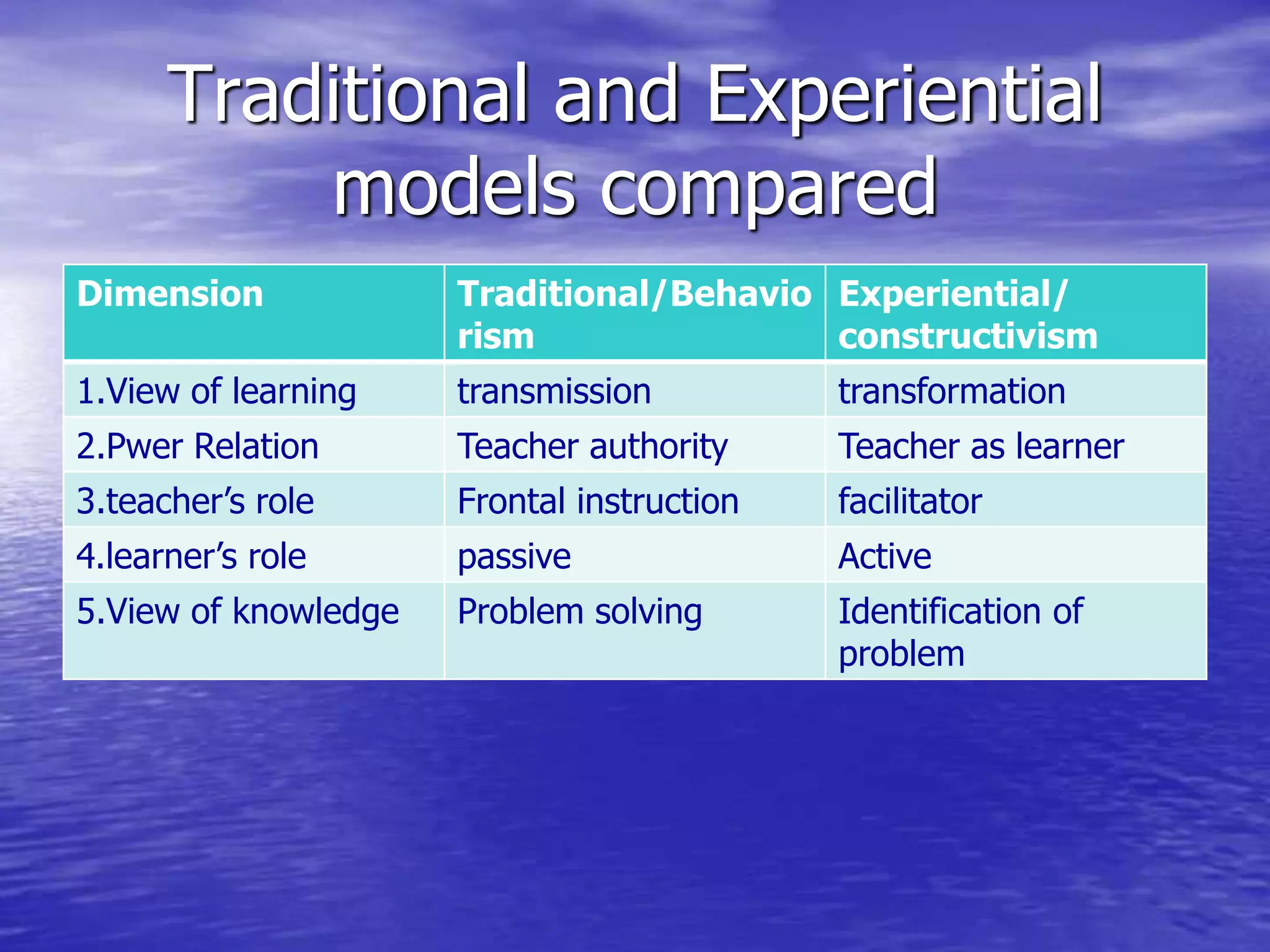
Traditional and Experiential
models compared
Dimension Traditional/Behavio
rism
Experiential/
constructivism
1.View of learning transmission transformation
2.Pwer Relation Teacher authority Teacher as learner
3.teacher’s role Frontal instruction facilitator
4.learner’s role passive Active
5.View of knowledge Problem solving Identification of
problem
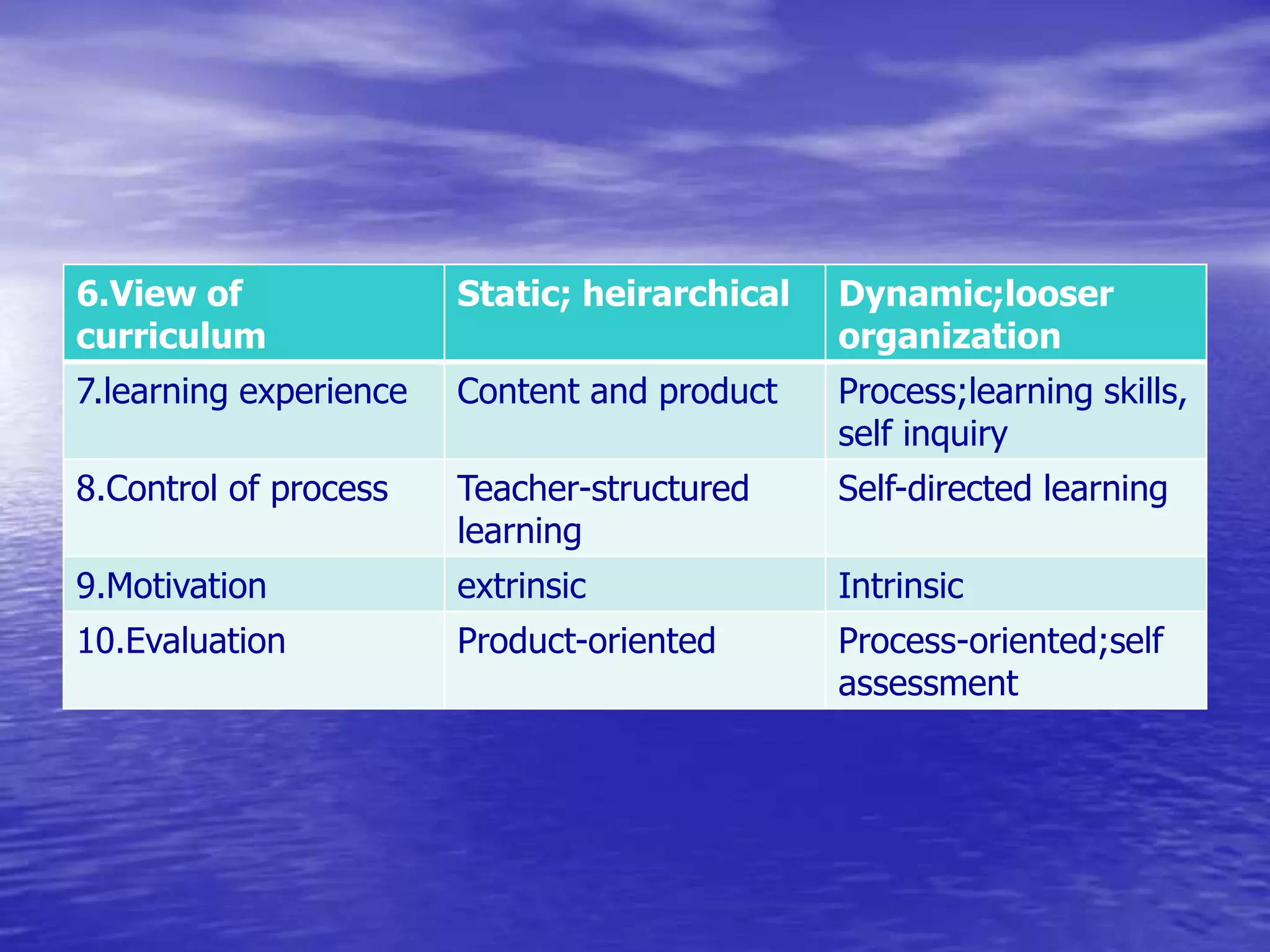
6.View of
curriculum
Static; heirarchical Dynamic;looser
organization
7.learning experience Content and product Process;learning skills,
self inquiry
8.Control of process Teacher-structured
learning
Self-directed learning
9.Motivation extrinsic Intrinsic
10.Evaluation Product-oriented Process-oriented;self
assessment
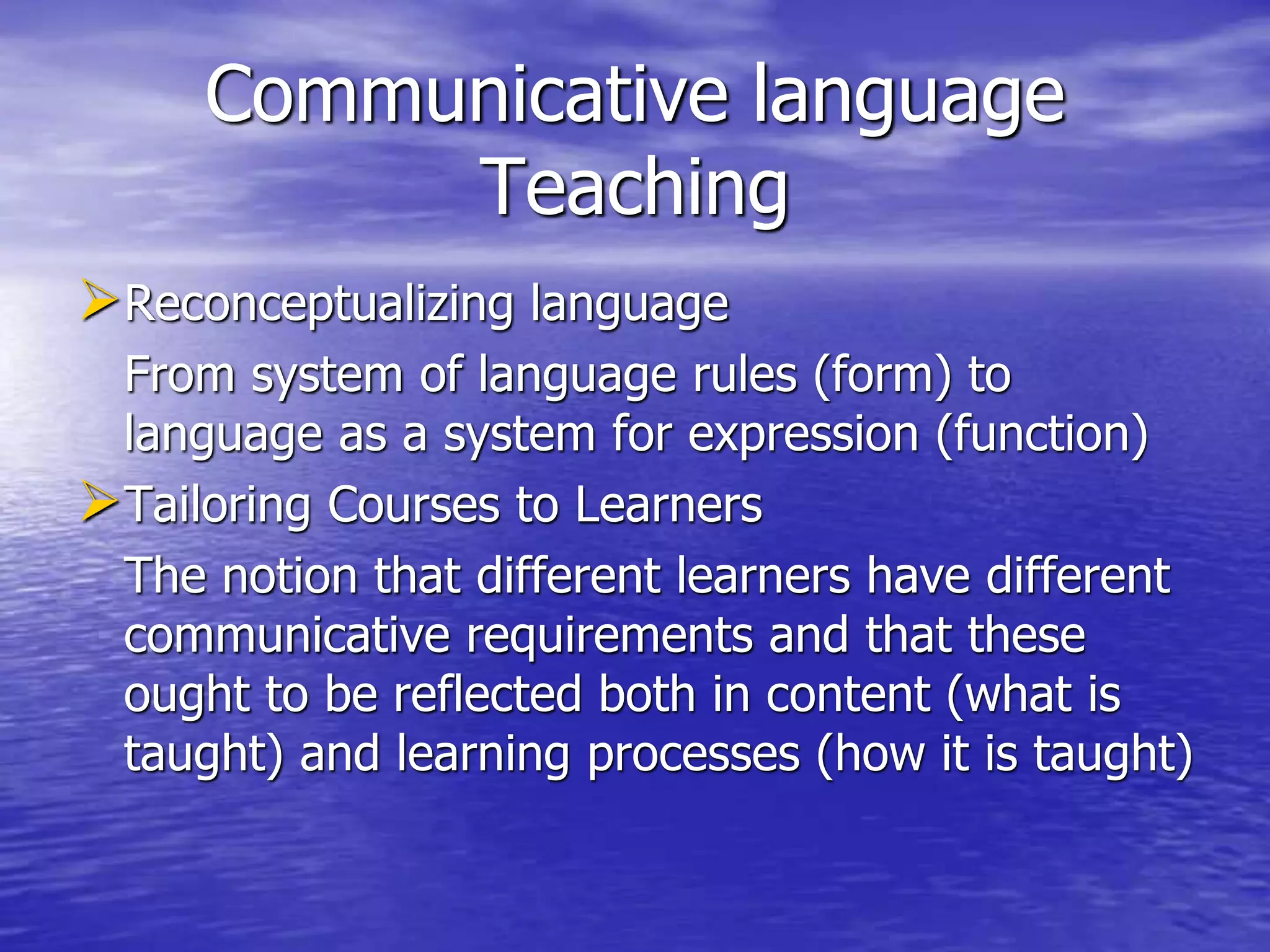
Communicative language
Teaching
Reconceptualizing language
From system of language rules (form) to
language as a system for expression (function)
Tailoring Courses to Learners
The notion that different learners have different
communicative requirements and that these
ought to be reflected both in content (what is
taught) and learning processes (how it is taught)
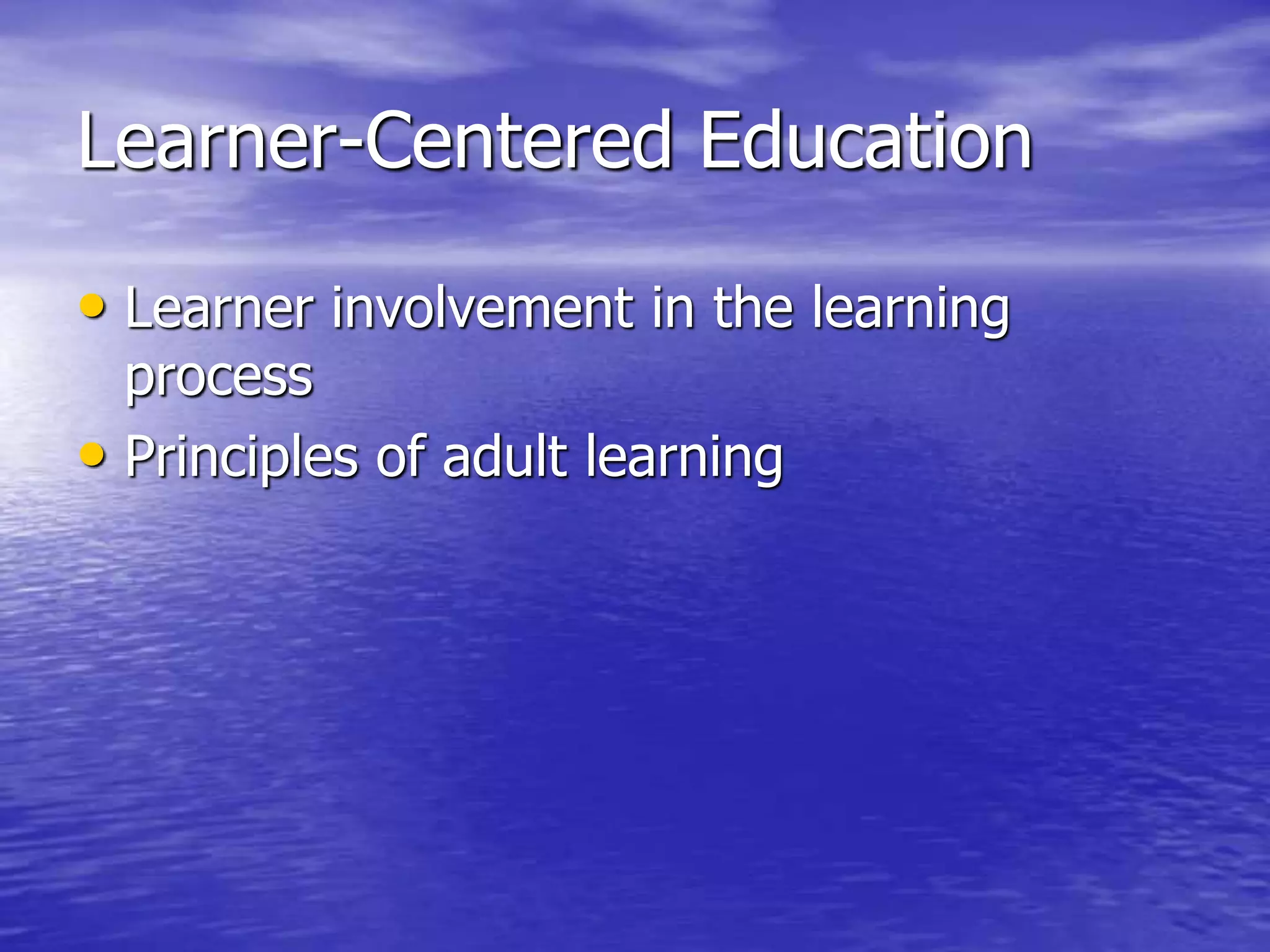
Learner-Centered Education
• Learner involvement in the learning
process
• Principles of adult learning
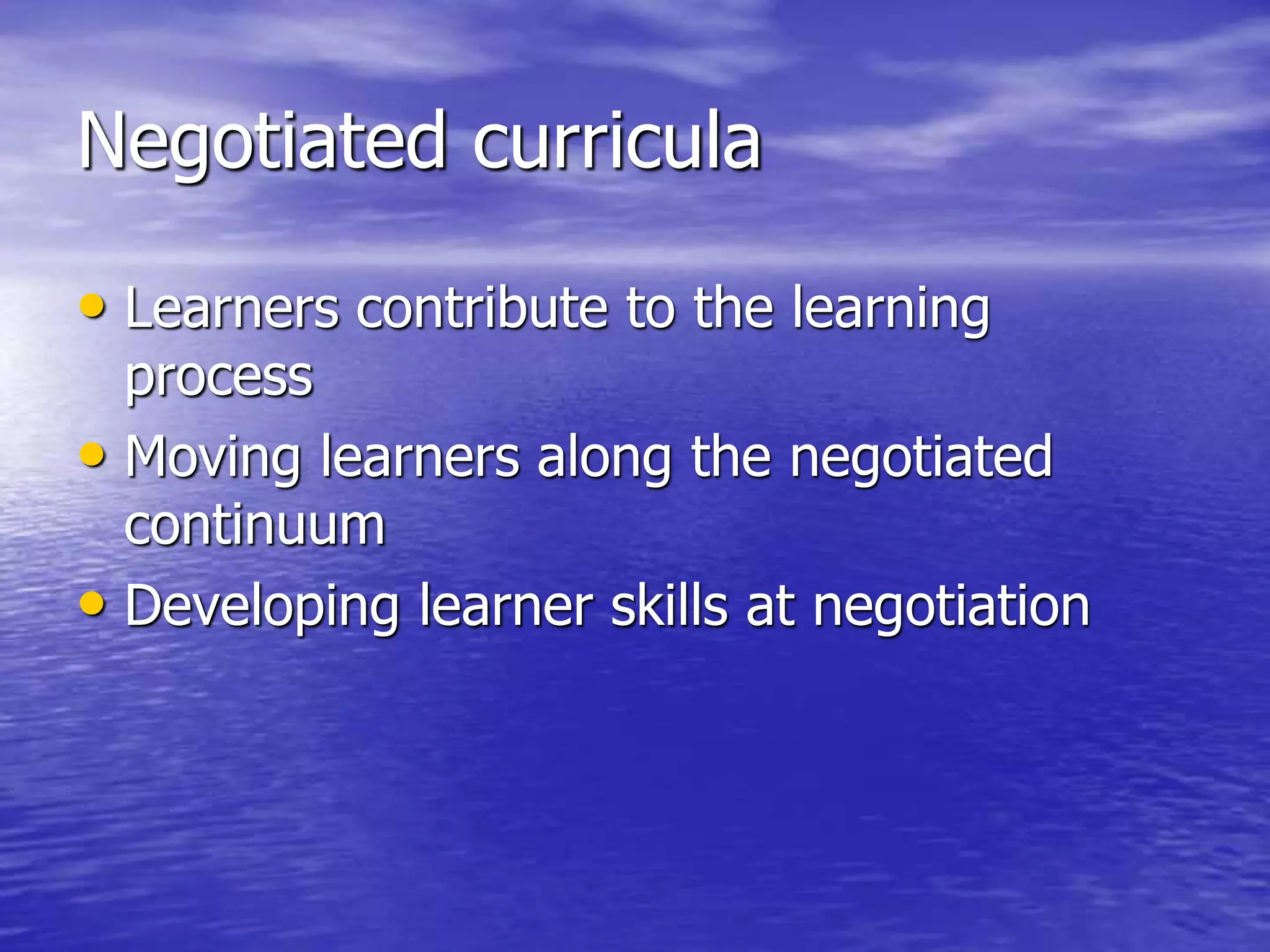
Negotiated curricula
• Learners contribute to the learning
process
• Moving learners along the negotiated
continuum
• Developing learner skills at negotiation
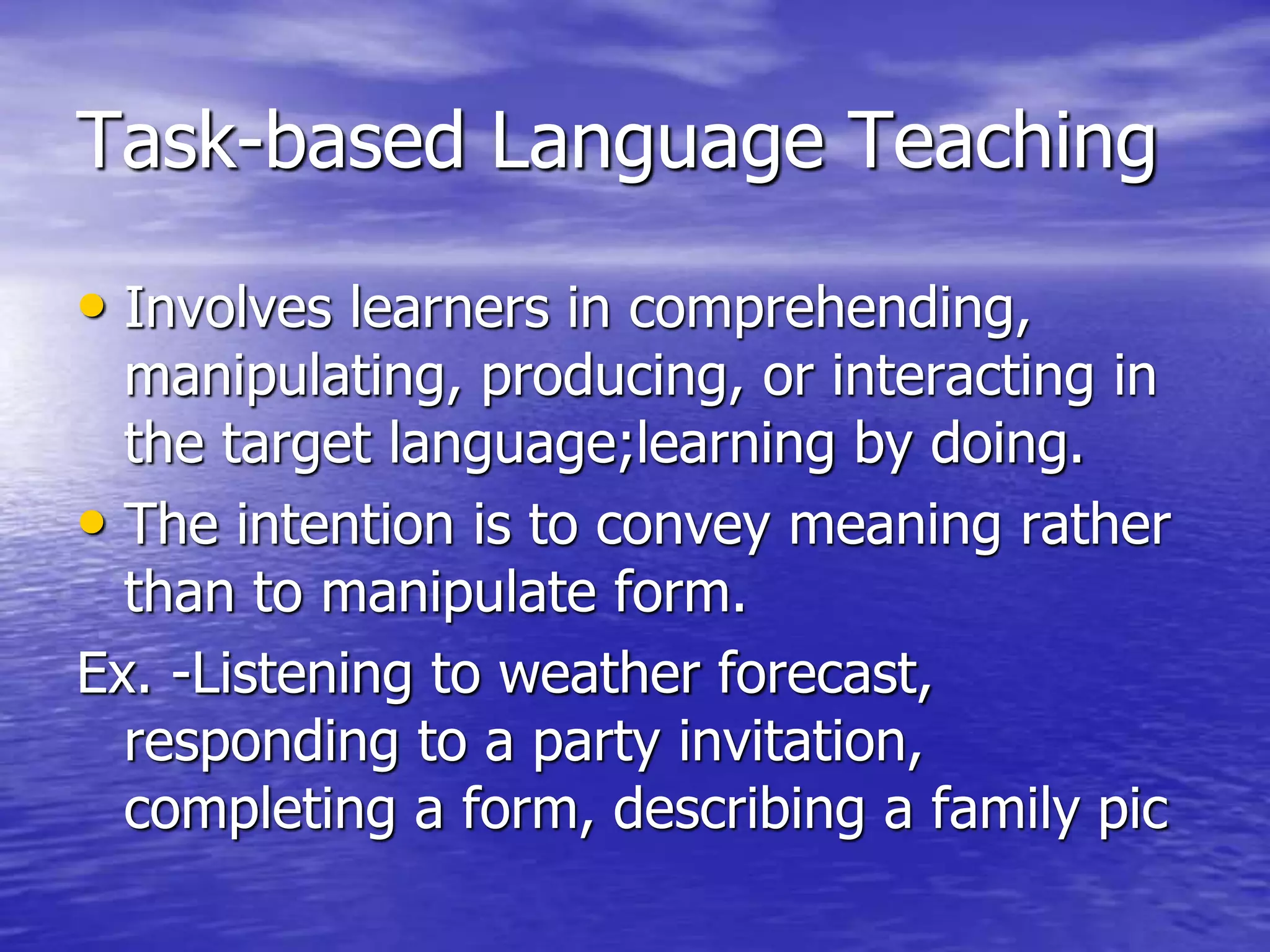
Task-based Language Teaching
• Involves learners in comprehending,
manipulating, producing, or interacting in
the target language;learning by doing.
• The intention is to convey meaning rather
than to manipulate form.
Ex. -Listening to weather forecast,
responding to a party invitation,
completing a form, describing a family pic
The Communicative Language
Teaching
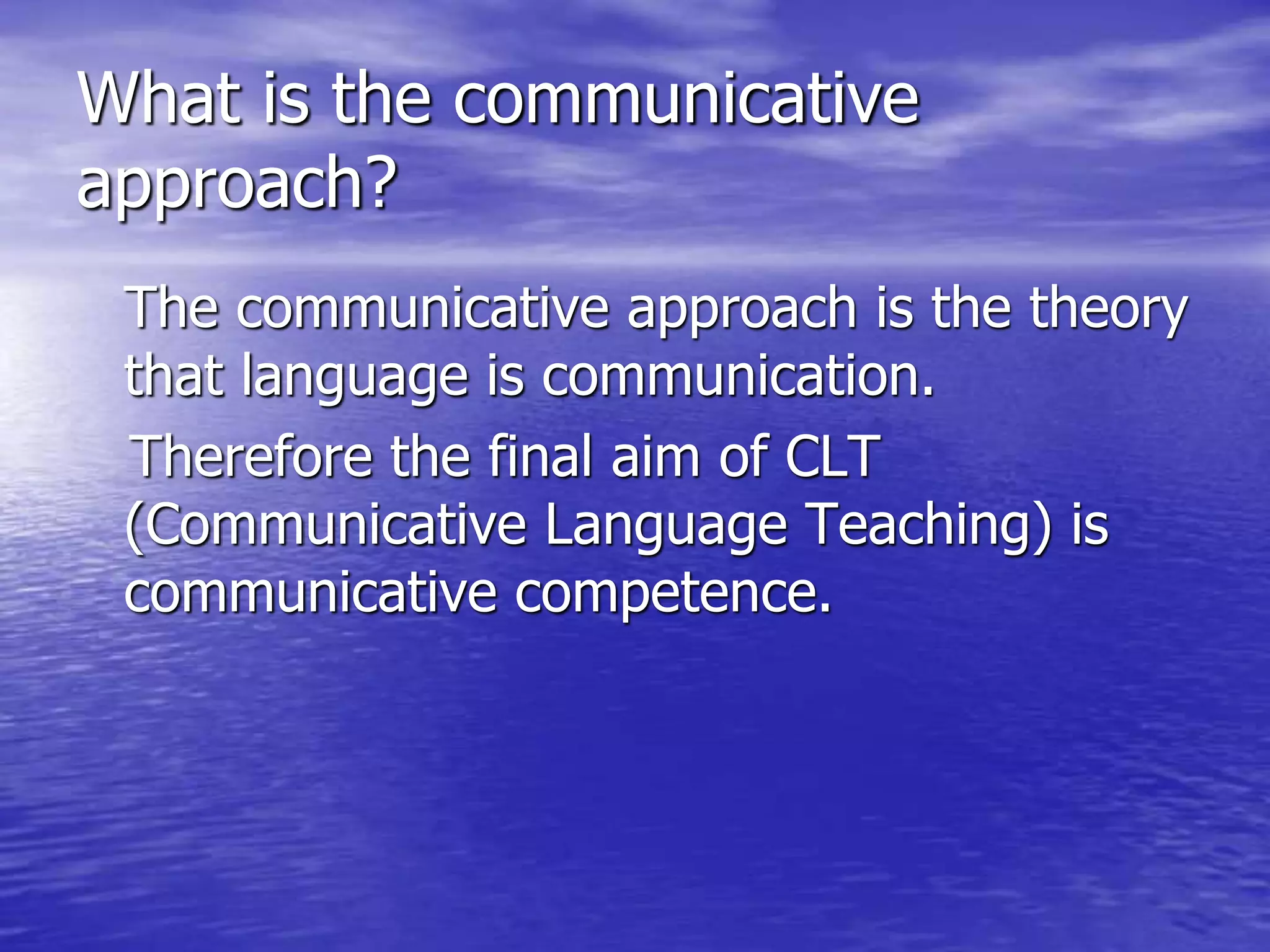
What is the communicative
approach?
The communicative approach is the theory
that language is communication.
Therefore the final aim of CLT
(Communicative Language Teaching) is
communicative competence.
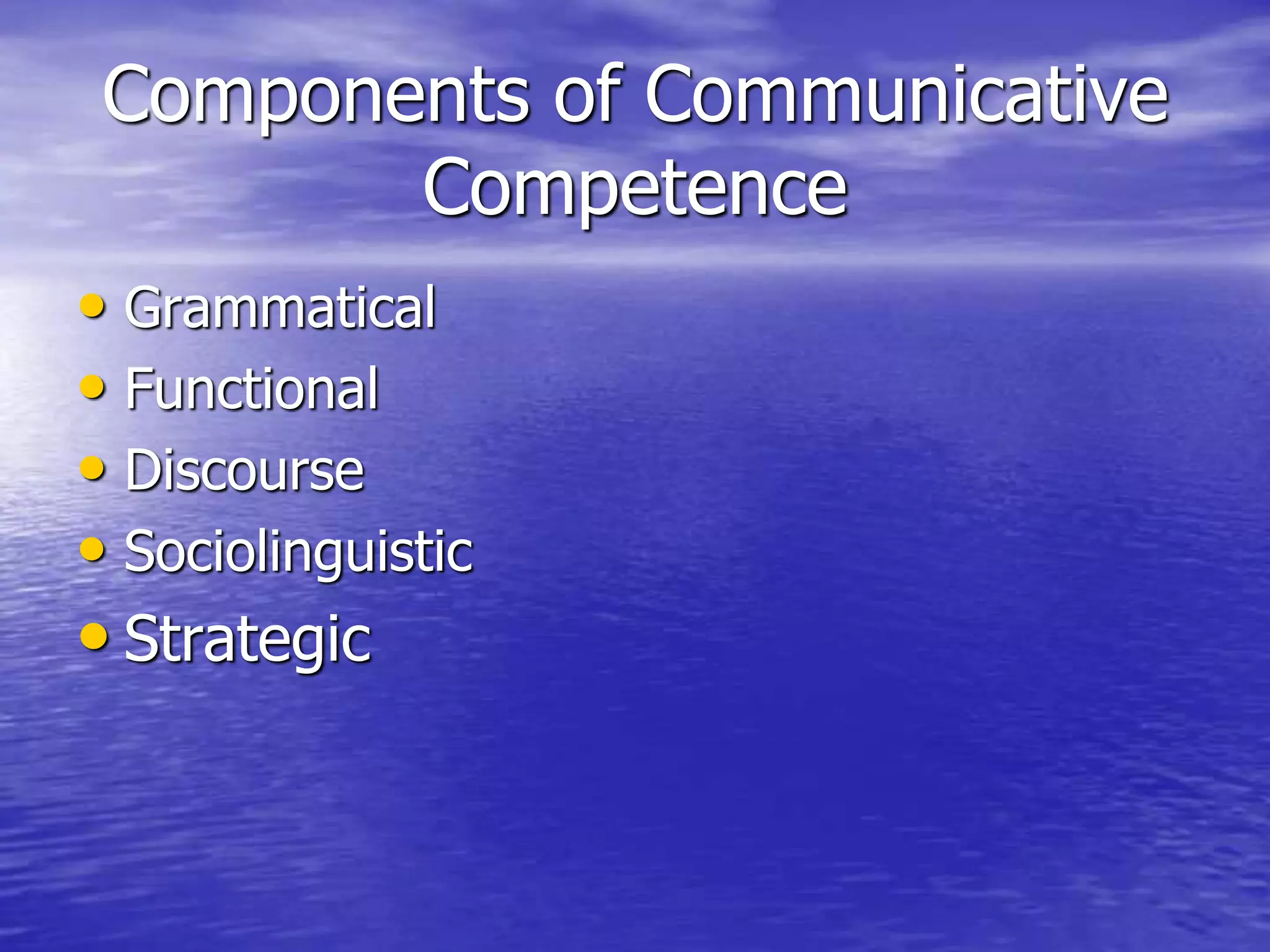
Components of Communicative
Competence
• Grammatical
• Functional
• Discourse
• Sociolinguistic
• Strategic
The Principles of the
Communicative Approach:
Learners learn through using it to communicate
Authentic and meaningful communication should
be the goal of classroom activities
Fluency is an important dimension of
communication
Communication involves the integration of
different language skills
Learning is a process of creative construction
and involves trial and error
So what is the teacher’s role in
this?
The teacher has two main roles:
• To facilitate the communication process in the
classroom
• To act as an independent participant within the
learning-teaching group
The teacher is also expected to act as a resource, an organiser of
resources, a motivator, a counsellor, a guide, an analyst and a
researcher.
There are many other minor roles of a teacher, some of these would
include being an actor and an entertainer. After all, a good lesson
must be interesting or the students will ‘switch off’ and learn
nothing.
In practical terms, what does that
mean?
It means that we need to concentrate on
the following:
Teacher – Student activities
Activities
Materials
Teacher-Student Interaction
Since communicative competence is our aim, it is
essential that students be given every opportunity to
practise communicating. In the communicative
classroom teacher talking time (TTT) must be kept to a
minimum. This is not to say that the teacher shouldn’t
speak at all, but TTT should be controlled and
appropriate.
The classroom should be learner centred.
The teacher’s role is to facilitate student communication
which is done through careful selection of materials and
activities relevant to the aims of the lesson in which they
are used.
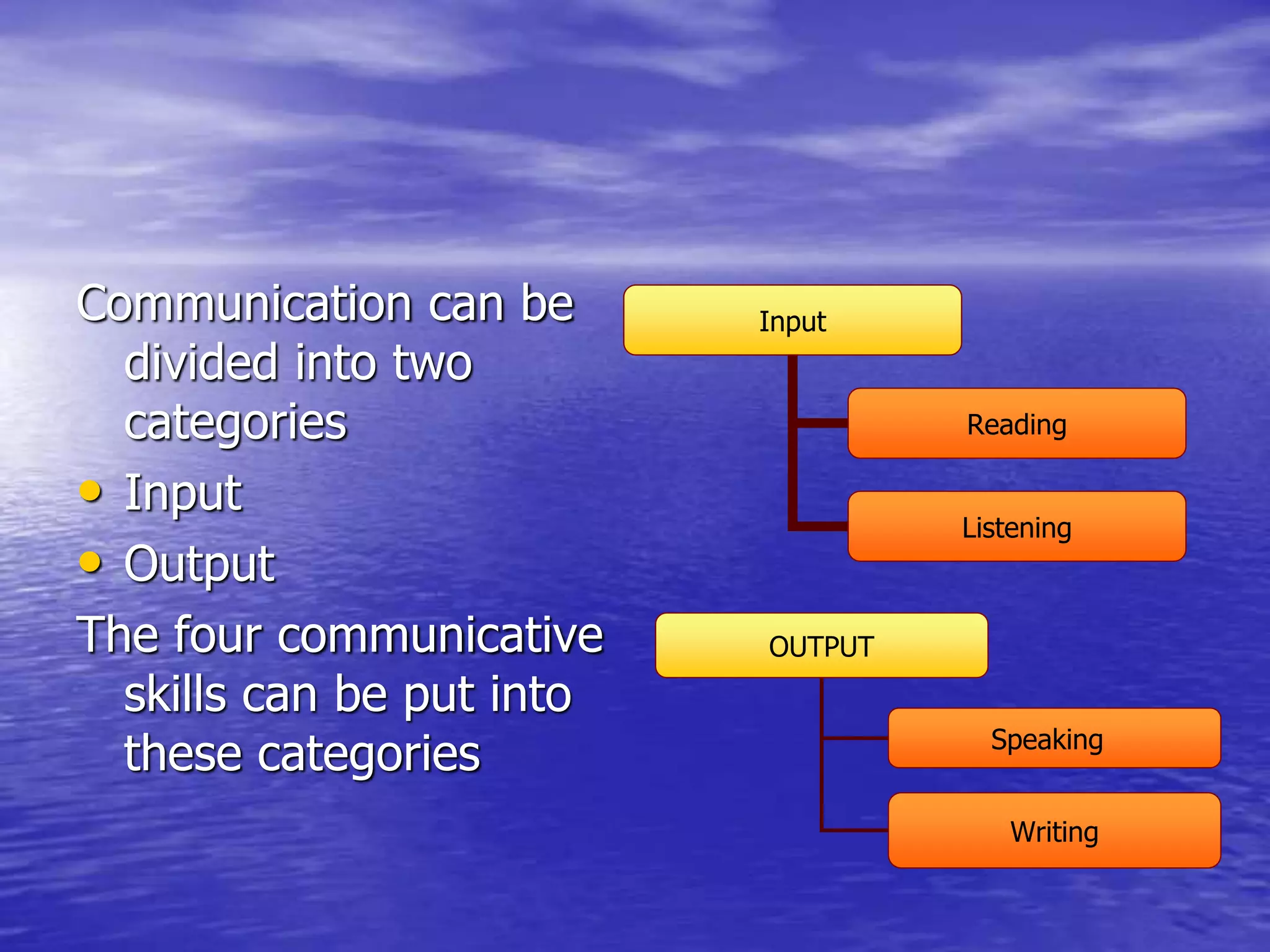
Communication can be
divided into two
categories
• Input
• Output
The four communicative
skills can be put into
these categories
OUTPUT
Speaking
Writing
Input
Reading
Listening
Whichever of these skills is being taught
the main focus must be on the student
and not on the teacher. The interaction
should usually be the student to student
and should include the teacher only
where necessary. During most classroom
activities the teacher will monitor and
intervene only where necessary.
The lesson extract follows a method
called Presentation-Practice-
Production or PPP for short.
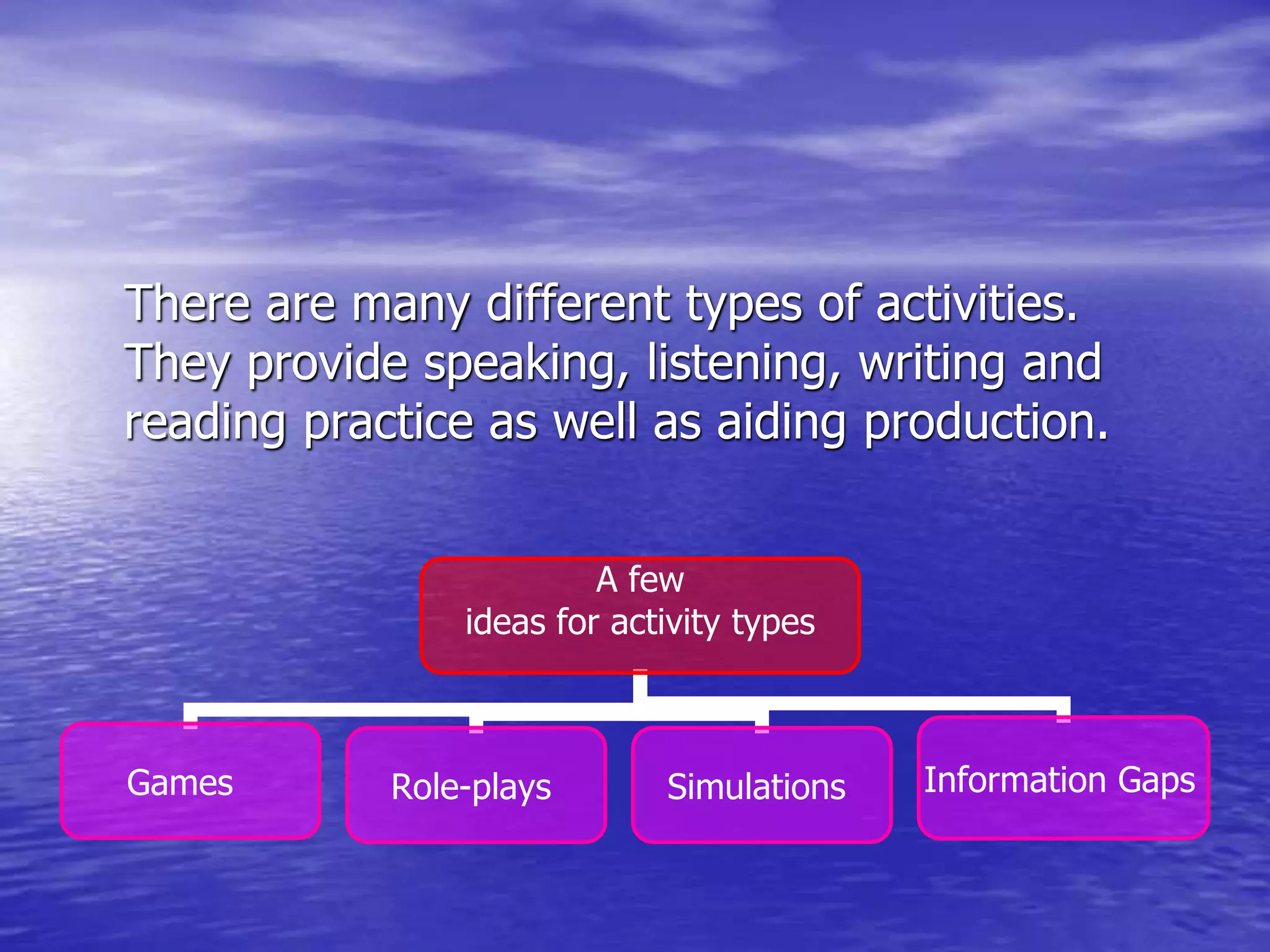
There are many different types of activities.
They provide speaking, listening, writing and
reading practice as well as aiding production.
A few
ideas for activity types
Games Role-plays Simulations Information Gaps
Where do I find activities?
They can be found in books containing supplementary
material such as the Reward Resource Packs.
Many teachers enjoy creating their own activities, which
can be tailored specifically to their classes needs.
Activities used in the classroom must be selected
carefully as if they are above the level of the students
they can destroy self-confidence and if below they can
bore the students.
Activities usually involve the students working together
either in pairs or in small groups.
Activities are often used to practise real-
life situations involving social interaction
and so a high level of social and functional
language should be expected.
Materials
Materials fall into three broad categories:
text-based,
task-based
realia.
They can be used as the basis for classroom
activities. Once again not only must the activity
be appropriate to the level of the students but
the materials used must be appropriate too.
Text-based materials
For example practice exercises, reading
passages, gap fills, recordings, etc. can be
found in almost any course book as well
as in books containing supplementary
materials. They form an essential part of
most lessons.
Task-based materials
These include game boards, roleplay
cards, materials for drilling, pairwork
tasks, etc.
They might be used to support 'real life'
tasks such as role playing booking into a
hotel, or a job interview.
Realia
This includes such things as magazines,
newspapers, fruit and vegetables, axes, maps -
things from the real world outside the
classroom.
They can be used in many activities.
For example, fruit and vegetables could be used
in a shopping activity, an axe could be used to
show the effect of using the present perfect
continuous on a short action verb.
So what does the
communicative approach
mean in practical terms?
We should now understand that the
teacher's job is to get their students to
communicate using real language by
providing them with instruction, practice,
and above all opportunities to produce
English in activities which encourage
acquisition and fluency.
In conclusion
CLT should be fun for both teacher and
students.
Enabling students to communicate
successfully is also very rewarding.

The Communicative language Teaching Approach.ppt

  • 1.
    The Conceptual Basisof Second Language Teaching and Learning • The Humanistic Tradition and Experiential Learning • Communicative Language Teaching • Learner-Centered Education • Negotiated Curricula • Task-Based Language Teaching
  • 2.
    • “Education isan admirable thing, but it is well to remember from time to time that nothing that is worth knowing can be taught.” Oscar Wilde.
  • 3.
    The Humanistic Traditionand Experiential Learning Learning is a process of self-discovery, grew experiential learning. Meaningful learning has to be self-initiated Driven by basic human desire for self- realization, well being and growth.
  • 4.
    Traditional and Experiential modelscompared Dimension Traditional/Behavio rism Experiential/ constructivism 1.View of learning transmission transformation 2.Pwer Relation Teacher authority Teacher as learner 3.teacher’s role Frontal instruction facilitator 4.learner’s role passive Active 5.View of knowledge Problem solving Identification of problem
  • 5.
    6.View of curriculum Static; heirarchicalDynamic;looser organization 7.learning experience Content and product Process;learning skills, self inquiry 8.Control of process Teacher-structured learning Self-directed learning 9.Motivation extrinsic Intrinsic 10.Evaluation Product-oriented Process-oriented;self assessment
  • 6.
    Communicative language Teaching Reconceptualizing language Fromsystem of language rules (form) to language as a system for expression (function) Tailoring Courses to Learners The notion that different learners have different communicative requirements and that these ought to be reflected both in content (what is taught) and learning processes (how it is taught)
  • 7.
    Learner-Centered Education • Learnerinvolvement in the learning process • Principles of adult learning
  • 8.
    Negotiated curricula • Learnerscontribute to the learning process • Moving learners along the negotiated continuum • Developing learner skills at negotiation
  • 9.
    Task-based Language Teaching •Involves learners in comprehending, manipulating, producing, or interacting in the target language;learning by doing. • The intention is to convey meaning rather than to manipulate form. Ex. -Listening to weather forecast, responding to a party invitation, completing a form, describing a family pic
  • 10.
  • 11.
    What is thecommunicative approach? The communicative approach is the theory that language is communication. Therefore the final aim of CLT (Communicative Language Teaching) is communicative competence.
  • 12.
    Components of Communicative Competence •Grammatical • Functional • Discourse • Sociolinguistic • Strategic
  • 13.
    The Principles ofthe Communicative Approach: Learners learn through using it to communicate Authentic and meaningful communication should be the goal of classroom activities Fluency is an important dimension of communication Communication involves the integration of different language skills Learning is a process of creative construction and involves trial and error
  • 14.
    So what isthe teacher’s role in this? The teacher has two main roles: • To facilitate the communication process in the classroom • To act as an independent participant within the learning-teaching group The teacher is also expected to act as a resource, an organiser of resources, a motivator, a counsellor, a guide, an analyst and a researcher. There are many other minor roles of a teacher, some of these would include being an actor and an entertainer. After all, a good lesson must be interesting or the students will ‘switch off’ and learn nothing.
  • 15.
    In practical terms,what does that mean? It means that we need to concentrate on the following: Teacher – Student activities Activities Materials
  • 16.
    Teacher-Student Interaction Since communicativecompetence is our aim, it is essential that students be given every opportunity to practise communicating. In the communicative classroom teacher talking time (TTT) must be kept to a minimum. This is not to say that the teacher shouldn’t speak at all, but TTT should be controlled and appropriate. The classroom should be learner centred. The teacher’s role is to facilitate student communication which is done through careful selection of materials and activities relevant to the aims of the lesson in which they are used.
  • 17.
    Communication can be dividedinto two categories • Input • Output The four communicative skills can be put into these categories OUTPUT Speaking Writing Input Reading Listening
  • 18.
    Whichever of theseskills is being taught the main focus must be on the student and not on the teacher. The interaction should usually be the student to student and should include the teacher only where necessary. During most classroom activities the teacher will monitor and intervene only where necessary.
  • 19.
    The lesson extractfollows a method called Presentation-Practice- Production or PPP for short.
  • 20.
    There are manydifferent types of activities. They provide speaking, listening, writing and reading practice as well as aiding production. A few ideas for activity types Games Role-plays Simulations Information Gaps
  • 21.
    Where do Ifind activities? They can be found in books containing supplementary material such as the Reward Resource Packs. Many teachers enjoy creating their own activities, which can be tailored specifically to their classes needs. Activities used in the classroom must be selected carefully as if they are above the level of the students they can destroy self-confidence and if below they can bore the students. Activities usually involve the students working together either in pairs or in small groups.
  • 22.
    Activities are oftenused to practise real- life situations involving social interaction and so a high level of social and functional language should be expected.
  • 23.
    Materials Materials fall intothree broad categories: text-based, task-based realia. They can be used as the basis for classroom activities. Once again not only must the activity be appropriate to the level of the students but the materials used must be appropriate too.
  • 24.
    Text-based materials For examplepractice exercises, reading passages, gap fills, recordings, etc. can be found in almost any course book as well as in books containing supplementary materials. They form an essential part of most lessons.
  • 25.
    Task-based materials These includegame boards, roleplay cards, materials for drilling, pairwork tasks, etc. They might be used to support 'real life' tasks such as role playing booking into a hotel, or a job interview.
  • 26.
    Realia This includes suchthings as magazines, newspapers, fruit and vegetables, axes, maps - things from the real world outside the classroom. They can be used in many activities. For example, fruit and vegetables could be used in a shopping activity, an axe could be used to show the effect of using the present perfect continuous on a short action verb.
  • 27.
    So what doesthe communicative approach mean in practical terms? We should now understand that the teacher's job is to get their students to communicate using real language by providing them with instruction, practice, and above all opportunities to produce English in activities which encourage acquisition and fluency.
  • 28.
    In conclusion CLT shouldbe fun for both teacher and students. Enabling students to communicate successfully is also very rewarding.