 Communication – ‘To makeCommunication – ‘To make known,known, toto impartimpart,, declaredeclare andand correspondcorrespond toto
bring about a change in another person’sbring about a change in another person’s knowledge, attitude andknowledge, attitude and
behaviour.’behaviour.’
 Writing; speaking; facial & vocabulary expressions; body posture;Writing; speaking; facial & vocabulary expressions; body posture;
appearance and clothingappearance and clothing we wear.we wear.
 Communication plays an important role in the p’cist’s life in dealing with theCommunication plays an important role in the p’cist’s life in dealing with the
patients, health care professionals and in the business aspects of thepatients, health care professionals and in the business aspects of the
profession.profession.
Factors influencing Communication (‘Drives’)Factors influencing Communication (‘Drives’)
• AffiliationAffiliation – warm, friendly responses, social acceptance by others.– warm, friendly responses, social acceptance by others.
• AggressionAggression – harm people physically, verbally or in other ways.– harm people physically, verbally or in other ways.
• Biological needsBiological needs – eating, drinking, feeling healthy or ill.– eating, drinking, feeling healthy or ill.
• DependencyDependency – help, support and guidance from people in position of power.– help, support and guidance from people in position of power.
• DominanceDominance – acceptance by others as a leader.– acceptance by others as a leader.
• GenderGender – physical proximity; bodily contact.– physical proximity; bodily contact.
• Self esteemSelf esteem && egoego identity.identity.
Verbal vs Non-verbal communicationVerbal vs Non-verbal communication
 Verbal communicationVerbal communication : Actual words or speaking; convey about: Actual words or speaking; convey about 10%10% of theof the
message.message.
 Non-verbal communicationNon-verbal communication : Body language; conveys: Body language; conveys 90%90% of the message;of the message;
body language consists of –body language consists of –
• Gestures; facial expressions; eye contact; physical contact; body posture;Gestures; facial expressions; eye contact; physical contact; body posture;
body space; proximity.body space; proximity.
 P’cist communicates with –P’cist communicates with –
• Patients; nurses; doctors; administrator; visitors; medical representatives.Patients; nurses; doctors; administrator; visitors; medical representatives.
• Fellow P’cists; clinical lab in-charge; drug suppliers; drugs’ controlFellow P’cists; clinical lab in-charge; drug suppliers; drugs’ control
administrator.administrator.
• Ideal to create a friendly area so that the patient feels comfortable whileIdeal to create a friendly area so that the patient feels comfortable while
communicating with the pharmacist.communicating with the pharmacist.
Factors affecting non-verbal communicationFactors affecting non-verbal communication
Kinesis (movements)Kinesis (movements)
 Body movementBody movement plays a vital part in conveying the message.plays a vital part in conveying the message.
 Manner in which we use the arms, hands, legs, head, face etc. to have aManner in which we use the arms, hands, legs, head, face etc. to have a
dramatic effect on the listener. [shaking hands – friendly non-verbal].dramatic effect on the listener. [shaking hands – friendly non-verbal].
 Generate a feeling of empathy and commitment to help others.Generate a feeling of empathy and commitment to help others.
 ‘‘Open’ postureOpen’ posture – standing / sitting w/ full frontal appearance to the person w/– standing / sitting w/ full frontal appearance to the person w/
whom we interact.whom we interact.
 ‘‘Closed’ postureClosed’ posture – arms folded in front of your chest; legs crossed in front of– arms folded in front of your chest; legs crossed in front of
knees; head facing downwards; eyes looking down at the floor; tends to stopknees; head facing downwards; eyes looking down at the floor; tends to stop
communication.communication.
 Always prefer aAlways prefer a shorter communicationshorter communication (long conversations are boring).(long conversations are boring).
 Sometimes,Sometimes, long conversations w/ sincere intent leaves the patient boredlong conversations w/ sincere intent leaves the patient bored;;
he / she no longer listens; the patient retracts from the situation.he / she no longer listens; the patient retracts from the situation.
 Open posture communication includesOpen posture communication includes
• Varied eye contact.Varied eye contact.
• Relaxed postureRelaxed posture
• Appropriate comfortable gestures.Appropriate comfortable gestures.
• Frontal appearance (shoulder square to the other person).Frontal appearance (shoulder square to the other person).
• Slight lean towards the other personSlight lean towards the other person..
• Head up; shoulders back.Head up; shoulders back.
 Proximity (nearness)Proximity (nearness)
• Distance b/n 2 persons plays an important role in what is beingDistance b/n 2 persons plays an important role in what is being
communicated.communicated.
• Different distances b/n persons results in different communications.Different distances b/n persons results in different communications.
-- 18”18” from each other (intimate relationship)from each other (intimate relationship)
-- 18 – 48”18 – 48” (feel comfortable; casual, personal conversation in our society)(feel comfortable; casual, personal conversation in our society)
-- 4 ft. – 12 ft.4 ft. – 12 ft. (2 people engaged in social / consultative interactions).(2 people engaged in social / consultative interactions).
-- > 12> 12 ft.ft. (one person speaks; the other is the audience).(one person speaks; the other is the audience).
• P’cist mustP’cist must consider the subject and distance factorconsider the subject and distance factor wheneverwhenever
interacting w/ patients.interacting w/ patients.
• Eg. : While discussing the use of rectal / vaginal medications, it’s bestEg. : While discussing the use of rectal / vaginal medications, it’s best
to stand very near to the patient (in order to avoid embarassing theto stand very near to the patient (in order to avoid embarassing the
patient).patient).
 EnvironmentalEnvironmental
• ColourColour used in the pharmacy decoration;used in the pharmacy decoration; lighting; use of spacelighting; use of space..
• Typical pharmacy designTypical pharmacy design at the counter.at the counter.
• Dirt, clutter & general untidinessDirt, clutter & general untidiness carry a negative non-verbalcarry a negative non-verbal
message to the patient.message to the patient.
• ‘‘A picture (image) is worth more than a 1000 words.’ The patient mayA picture (image) is worth more than a 1000 words.’ The patient may
not entirely remember what you say but, they willnot entirely remember what you say but, they will DEFINITELYDEFINITELY
remember the image of the pharmacy, pharmacist etc..remember the image of the pharmacy, pharmacist etc..
• P’cist’s appearance canP’cist’s appearance can complement or destroycomplement or destroy all other non-verbalall other non-verbal
efforts to communicate professionalism and competence.efforts to communicate professionalism and competence.
Barriers in CommunicationBarriers in Communication
 EnvironmentalEnvironmental
 The patientThe patient
 The pharmacistThe pharmacist
 TimeTime
 Geographical factorsGeographical factors
EnvironmentalEnvironmental
 P’cist must communicate with others in places like community /P’cist must communicate with others in places like community /
hospital pharmacies; hospital wards etc..hospital pharmacies; hospital wards etc..
 Environmental factors –Environmental factors –
a)a) lack of privacylack of privacy b)b) busy pharmacybusy pharmacy
c)c) noisenoise d)d) physical barriers (eg. Counter distance)physical barriers (eg. Counter distance)
Patient factorsPatient factors
 Busy & hectic life styleBusy & hectic life style – prefer p’cy where drugs are dispensed– prefer p’cy where drugs are dispensed
quickly – don’t want to spend time in understanding the medication orquickly – don’t want to spend time in understanding the medication or
other health-related issues.other health-related issues.
 Purpose of communication should be explained in a nice manner toPurpose of communication should be explained in a nice manner to
the patients, so that they understand the benefits of it.the patients, so that they understand the benefits of it.
 Patient’s physical disability is also an important issue.Patient’s physical disability is also an important issue.
PharmacistPharmacist
 Barriers to effective communication :Barriers to effective communication :
• Lack of confidence, interest, knowledge, privacyLack of confidence, interest, knowledge, privacy
• Laziness.Laziness.
• Poor communication skills.Poor communication skills.
• Economic barriers.Economic barriers.
TimeTime
 Timing of interaction is critical for good / ineffective communication.Timing of interaction is critical for good / ineffective communication.
 After waiting a long time in the pharmacy, the patient only thinks ofAfter waiting a long time in the pharmacy, the patient only thinks of
going home ASAP. It is ineffective to be counselling the patient atgoing home ASAP. It is ineffective to be counselling the patient at
that time, as they won’t be listening at all.that time, as they won’t be listening at all.
 Better to useBetter to use ‘Patient information leaflets’‘Patient information leaflets’ at that time.at that time.
Geographical factorsGeographical factors
 Language and literacy are two very important factors which could beLanguage and literacy are two very important factors which could be
either a boon or a bane for the communication process.either a boon or a bane for the communication process.
Questioning skillsQuestioning skills
 Questioning w/ reinforcement is important for proper interaction.Questioning w/ reinforcement is important for proper interaction.
 Type and way the question is askedType and way the question is asked elicits the respective response.elicits the respective response.
 2 types of questioning –2 types of questioning – Open type; Closed typeOpen type; Closed type..
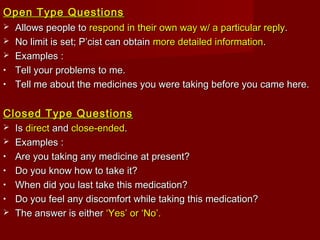
Open Type QuestionsOpen Type Questions
 Allows people toAllows people to respond in their own wayrespond in their own way w/ a particular replyw/ a particular reply..
 No limit is set; P’cist can obtainNo limit is set; P’cist can obtain more detailed informationmore detailed information..
 Examples :Examples :
• Tell your problems to me.Tell your problems to me.
• Tell me about the medicines you were taking before you came here.Tell me about the medicines you were taking before you came here.
Closed Type QuestionsClosed Type Questions
 IsIs directdirect andand close-endedclose-ended..
 Examples :Examples :
• Are you taking any medicine at present?Are you taking any medicine at present?
• Do you know how to take it?Do you know how to take it?
• When did you last take this medication?When did you last take this medication?
• Do you feel any discomfort while taking this medication?Do you feel any discomfort while taking this medication?
 The answer is eitherThe answer is either ‘Yes’ or ‘No’.‘Yes’ or ‘No’.
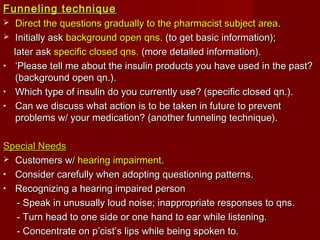
Funneling techniqueFunneling technique
 Direct the questions gradually to the pharmacist subject areaDirect the questions gradually to the pharmacist subject area..
 Initially askInitially ask background open qnsbackground open qns. (to get basic information);. (to get basic information);
later asklater ask specific closed qns.specific closed qns. (more detailed information).(more detailed information).
• ‘‘Please tell me about the insulin products you have used in the past?Please tell me about the insulin products you have used in the past?
(background open qn.).(background open qn.).
• Which type of insulin do you currently use? (specific closed qn.).Which type of insulin do you currently use? (specific closed qn.).
• Can we discuss what action is to be taken in future to preventCan we discuss what action is to be taken in future to prevent
problems w/ your medication? (another funneling technique).problems w/ your medication? (another funneling technique).
Special NeedsSpecial Needs
 Customers w/Customers w/ hearing impairmenthearing impairment..
• Consider carefully when adopting questioning patterns.Consider carefully when adopting questioning patterns.
• Recognizing a hearing impaired personRecognizing a hearing impaired person
- Speak in unusually loud noise; inappropriate responses to qns.- Speak in unusually loud noise; inappropriate responses to qns.
- Turn head to one side or one hand to ear while listening.- Turn head to one side or one hand to ear while listening.
- Concentrate on p’cist’s lips while being spoken to.- Concentrate on p’cist’s lips while being spoken to.
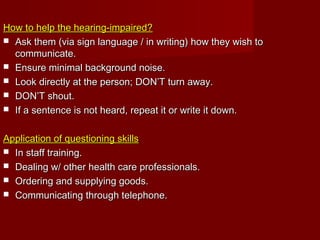
How to help the hearing-impaired?How to help the hearing-impaired?
 Ask them (via sign language / in writing) how they wish toAsk them (via sign language / in writing) how they wish to
communicate.communicate.
 Ensure minimal background noise.Ensure minimal background noise.
 Look directly at the person; DON’T turn away.Look directly at the person; DON’T turn away.
 DON’T shout.DON’T shout.
 If a sentence is not heard, repeat it or write it down.If a sentence is not heard, repeat it or write it down.
Application of questioning skillsApplication of questioning skills
 In staff training.In staff training.
 Dealing w/ other health care professionals.Dealing w/ other health care professionals.
 Ordering and supplying goods.Ordering and supplying goods.
 Communicating through telephone.Communicating through telephone.
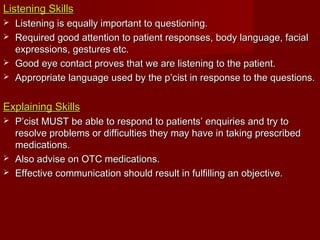
Listening SkillsListening Skills
 Listening is equally important to questioning.Listening is equally important to questioning.
 Required good attention to patient responses, body language, facialRequired good attention to patient responses, body language, facial
expressions, gestures etc.expressions, gestures etc.
 Good eye contact proves that we are listening to the patient.Good eye contact proves that we are listening to the patient.
 Appropriate language used by the p’cist in response to the questions.Appropriate language used by the p’cist in response to the questions.
Explaining SkillsExplaining Skills
 P’cist MUST be able to respond to patients’ enquiries and try toP’cist MUST be able to respond to patients’ enquiries and try to
resolve problems or difficulties they may have in taking prescribedresolve problems or difficulties they may have in taking prescribed
medications.medications.
 Also advise on OTC medications.Also advise on OTC medications.
 Effective communication should result in fulfilling an objective.Effective communication should result in fulfilling an objective.
Ethics in CommunicationEthics in Communication
 P’cist must be professional (give out accurate advice and offerP’cist must be professional (give out accurate advice and offer
reassurance, if necessary).reassurance, if necessary).
 Maximise the communication strengths and minimize theMaximise the communication strengths and minimize the
weaknesses.weaknesses.
 Avoid ego states within the communication process; Respect theAvoid ego states within the communication process; Respect the
practitioners for having a unique set of knowledge.practitioners for having a unique set of knowledge.
 Information exchange is a must.Information exchange is a must.
Benefits of CommunicationBenefits of Communication
 Increased understanding and recall by the patients.Increased understanding and recall by the patients.
 Patients are more satisfied.Patients are more satisfied.
 Less ill-informed consent.Less ill-informed consent.
 Increased compliance.Increased compliance.
 Faster recovery from illness.Faster recovery from illness.
THANK YOU!!!THANK YOU!!!

Communication skills

  • 2.
     Communication –‘To makeCommunication – ‘To make known,known, toto impartimpart,, declaredeclare andand correspondcorrespond toto bring about a change in another person’sbring about a change in another person’s knowledge, attitude andknowledge, attitude and behaviour.’behaviour.’  Writing; speaking; facial & vocabulary expressions; body posture;Writing; speaking; facial & vocabulary expressions; body posture; appearance and clothingappearance and clothing we wear.we wear.  Communication plays an important role in the p’cist’s life in dealing with theCommunication plays an important role in the p’cist’s life in dealing with the patients, health care professionals and in the business aspects of thepatients, health care professionals and in the business aspects of the profession.profession. Factors influencing Communication (‘Drives’)Factors influencing Communication (‘Drives’) • AffiliationAffiliation – warm, friendly responses, social acceptance by others.– warm, friendly responses, social acceptance by others. • AggressionAggression – harm people physically, verbally or in other ways.– harm people physically, verbally or in other ways. • Biological needsBiological needs – eating, drinking, feeling healthy or ill.– eating, drinking, feeling healthy or ill. • DependencyDependency – help, support and guidance from people in position of power.– help, support and guidance from people in position of power. • DominanceDominance – acceptance by others as a leader.– acceptance by others as a leader. • GenderGender – physical proximity; bodily contact.– physical proximity; bodily contact. • Self esteemSelf esteem && egoego identity.identity.
  • 3.
    Verbal vs Non-verbalcommunicationVerbal vs Non-verbal communication  Verbal communicationVerbal communication : Actual words or speaking; convey about: Actual words or speaking; convey about 10%10% of theof the message.message.  Non-verbal communicationNon-verbal communication : Body language; conveys: Body language; conveys 90%90% of the message;of the message; body language consists of –body language consists of – • Gestures; facial expressions; eye contact; physical contact; body posture;Gestures; facial expressions; eye contact; physical contact; body posture; body space; proximity.body space; proximity.  P’cist communicates with –P’cist communicates with – • Patients; nurses; doctors; administrator; visitors; medical representatives.Patients; nurses; doctors; administrator; visitors; medical representatives. • Fellow P’cists; clinical lab in-charge; drug suppliers; drugs’ controlFellow P’cists; clinical lab in-charge; drug suppliers; drugs’ control administrator.administrator. • Ideal to create a friendly area so that the patient feels comfortable whileIdeal to create a friendly area so that the patient feels comfortable while communicating with the pharmacist.communicating with the pharmacist.
  • 4.
    Factors affecting non-verbalcommunicationFactors affecting non-verbal communication Kinesis (movements)Kinesis (movements)  Body movementBody movement plays a vital part in conveying the message.plays a vital part in conveying the message.  Manner in which we use the arms, hands, legs, head, face etc. to have aManner in which we use the arms, hands, legs, head, face etc. to have a dramatic effect on the listener. [shaking hands – friendly non-verbal].dramatic effect on the listener. [shaking hands – friendly non-verbal].  Generate a feeling of empathy and commitment to help others.Generate a feeling of empathy and commitment to help others.  ‘‘Open’ postureOpen’ posture – standing / sitting w/ full frontal appearance to the person w/– standing / sitting w/ full frontal appearance to the person w/ whom we interact.whom we interact.  ‘‘Closed’ postureClosed’ posture – arms folded in front of your chest; legs crossed in front of– arms folded in front of your chest; legs crossed in front of knees; head facing downwards; eyes looking down at the floor; tends to stopknees; head facing downwards; eyes looking down at the floor; tends to stop communication.communication.  Always prefer aAlways prefer a shorter communicationshorter communication (long conversations are boring).(long conversations are boring).  Sometimes,Sometimes, long conversations w/ sincere intent leaves the patient boredlong conversations w/ sincere intent leaves the patient bored;; he / she no longer listens; the patient retracts from the situation.he / she no longer listens; the patient retracts from the situation.
  • 5.
     Open posturecommunication includesOpen posture communication includes • Varied eye contact.Varied eye contact. • Relaxed postureRelaxed posture • Appropriate comfortable gestures.Appropriate comfortable gestures. • Frontal appearance (shoulder square to the other person).Frontal appearance (shoulder square to the other person). • Slight lean towards the other personSlight lean towards the other person.. • Head up; shoulders back.Head up; shoulders back.  Proximity (nearness)Proximity (nearness) • Distance b/n 2 persons plays an important role in what is beingDistance b/n 2 persons plays an important role in what is being communicated.communicated. • Different distances b/n persons results in different communications.Different distances b/n persons results in different communications. -- 18”18” from each other (intimate relationship)from each other (intimate relationship) -- 18 – 48”18 – 48” (feel comfortable; casual, personal conversation in our society)(feel comfortable; casual, personal conversation in our society) -- 4 ft. – 12 ft.4 ft. – 12 ft. (2 people engaged in social / consultative interactions).(2 people engaged in social / consultative interactions). -- > 12> 12 ft.ft. (one person speaks; the other is the audience).(one person speaks; the other is the audience).
  • 6.
    • P’cist mustP’cistmust consider the subject and distance factorconsider the subject and distance factor wheneverwhenever interacting w/ patients.interacting w/ patients. • Eg. : While discussing the use of rectal / vaginal medications, it’s bestEg. : While discussing the use of rectal / vaginal medications, it’s best to stand very near to the patient (in order to avoid embarassing theto stand very near to the patient (in order to avoid embarassing the patient).patient).  EnvironmentalEnvironmental • ColourColour used in the pharmacy decoration;used in the pharmacy decoration; lighting; use of spacelighting; use of space.. • Typical pharmacy designTypical pharmacy design at the counter.at the counter. • Dirt, clutter & general untidinessDirt, clutter & general untidiness carry a negative non-verbalcarry a negative non-verbal message to the patient.message to the patient. • ‘‘A picture (image) is worth more than a 1000 words.’ The patient mayA picture (image) is worth more than a 1000 words.’ The patient may not entirely remember what you say but, they willnot entirely remember what you say but, they will DEFINITELYDEFINITELY remember the image of the pharmacy, pharmacist etc..remember the image of the pharmacy, pharmacist etc.. • P’cist’s appearance canP’cist’s appearance can complement or destroycomplement or destroy all other non-verbalall other non-verbal efforts to communicate professionalism and competence.efforts to communicate professionalism and competence.
  • 7.
    Barriers in CommunicationBarriersin Communication  EnvironmentalEnvironmental  The patientThe patient  The pharmacistThe pharmacist  TimeTime  Geographical factorsGeographical factors EnvironmentalEnvironmental  P’cist must communicate with others in places like community /P’cist must communicate with others in places like community / hospital pharmacies; hospital wards etc..hospital pharmacies; hospital wards etc..  Environmental factors –Environmental factors – a)a) lack of privacylack of privacy b)b) busy pharmacybusy pharmacy c)c) noisenoise d)d) physical barriers (eg. Counter distance)physical barriers (eg. Counter distance)
  • 8.
    Patient factorsPatient factors Busy & hectic life styleBusy & hectic life style – prefer p’cy where drugs are dispensed– prefer p’cy where drugs are dispensed quickly – don’t want to spend time in understanding the medication orquickly – don’t want to spend time in understanding the medication or other health-related issues.other health-related issues.  Purpose of communication should be explained in a nice manner toPurpose of communication should be explained in a nice manner to the patients, so that they understand the benefits of it.the patients, so that they understand the benefits of it.  Patient’s physical disability is also an important issue.Patient’s physical disability is also an important issue. PharmacistPharmacist  Barriers to effective communication :Barriers to effective communication : • Lack of confidence, interest, knowledge, privacyLack of confidence, interest, knowledge, privacy • Laziness.Laziness. • Poor communication skills.Poor communication skills. • Economic barriers.Economic barriers.
  • 9.
    TimeTime  Timing ofinteraction is critical for good / ineffective communication.Timing of interaction is critical for good / ineffective communication.  After waiting a long time in the pharmacy, the patient only thinks ofAfter waiting a long time in the pharmacy, the patient only thinks of going home ASAP. It is ineffective to be counselling the patient atgoing home ASAP. It is ineffective to be counselling the patient at that time, as they won’t be listening at all.that time, as they won’t be listening at all.  Better to useBetter to use ‘Patient information leaflets’‘Patient information leaflets’ at that time.at that time. Geographical factorsGeographical factors  Language and literacy are two very important factors which could beLanguage and literacy are two very important factors which could be either a boon or a bane for the communication process.either a boon or a bane for the communication process. Questioning skillsQuestioning skills  Questioning w/ reinforcement is important for proper interaction.Questioning w/ reinforcement is important for proper interaction.  Type and way the question is askedType and way the question is asked elicits the respective response.elicits the respective response.  2 types of questioning –2 types of questioning – Open type; Closed typeOpen type; Closed type..
  • 10.
    Open Type QuestionsOpenType Questions  Allows people toAllows people to respond in their own wayrespond in their own way w/ a particular replyw/ a particular reply..  No limit is set; P’cist can obtainNo limit is set; P’cist can obtain more detailed informationmore detailed information..  Examples :Examples : • Tell your problems to me.Tell your problems to me. • Tell me about the medicines you were taking before you came here.Tell me about the medicines you were taking before you came here. Closed Type QuestionsClosed Type Questions  IsIs directdirect andand close-endedclose-ended..  Examples :Examples : • Are you taking any medicine at present?Are you taking any medicine at present? • Do you know how to take it?Do you know how to take it? • When did you last take this medication?When did you last take this medication? • Do you feel any discomfort while taking this medication?Do you feel any discomfort while taking this medication?  The answer is eitherThe answer is either ‘Yes’ or ‘No’.‘Yes’ or ‘No’.
  • 11.
    Funneling techniqueFunneling technique Direct the questions gradually to the pharmacist subject areaDirect the questions gradually to the pharmacist subject area..  Initially askInitially ask background open qnsbackground open qns. (to get basic information);. (to get basic information); later asklater ask specific closed qns.specific closed qns. (more detailed information).(more detailed information). • ‘‘Please tell me about the insulin products you have used in the past?Please tell me about the insulin products you have used in the past? (background open qn.).(background open qn.). • Which type of insulin do you currently use? (specific closed qn.).Which type of insulin do you currently use? (specific closed qn.). • Can we discuss what action is to be taken in future to preventCan we discuss what action is to be taken in future to prevent problems w/ your medication? (another funneling technique).problems w/ your medication? (another funneling technique). Special NeedsSpecial Needs  Customers w/Customers w/ hearing impairmenthearing impairment.. • Consider carefully when adopting questioning patterns.Consider carefully when adopting questioning patterns. • Recognizing a hearing impaired personRecognizing a hearing impaired person - Speak in unusually loud noise; inappropriate responses to qns.- Speak in unusually loud noise; inappropriate responses to qns. - Turn head to one side or one hand to ear while listening.- Turn head to one side or one hand to ear while listening. - Concentrate on p’cist’s lips while being spoken to.- Concentrate on p’cist’s lips while being spoken to.
  • 12.
    How to helpthe hearing-impaired?How to help the hearing-impaired?  Ask them (via sign language / in writing) how they wish toAsk them (via sign language / in writing) how they wish to communicate.communicate.  Ensure minimal background noise.Ensure minimal background noise.  Look directly at the person; DON’T turn away.Look directly at the person; DON’T turn away.  DON’T shout.DON’T shout.  If a sentence is not heard, repeat it or write it down.If a sentence is not heard, repeat it or write it down. Application of questioning skillsApplication of questioning skills  In staff training.In staff training.  Dealing w/ other health care professionals.Dealing w/ other health care professionals.  Ordering and supplying goods.Ordering and supplying goods.  Communicating through telephone.Communicating through telephone.
  • 13.
    Listening SkillsListening Skills Listening is equally important to questioning.Listening is equally important to questioning.  Required good attention to patient responses, body language, facialRequired good attention to patient responses, body language, facial expressions, gestures etc.expressions, gestures etc.  Good eye contact proves that we are listening to the patient.Good eye contact proves that we are listening to the patient.  Appropriate language used by the p’cist in response to the questions.Appropriate language used by the p’cist in response to the questions. Explaining SkillsExplaining Skills  P’cist MUST be able to respond to patients’ enquiries and try toP’cist MUST be able to respond to patients’ enquiries and try to resolve problems or difficulties they may have in taking prescribedresolve problems or difficulties they may have in taking prescribed medications.medications.  Also advise on OTC medications.Also advise on OTC medications.  Effective communication should result in fulfilling an objective.Effective communication should result in fulfilling an objective.
  • 14.
    Ethics in CommunicationEthicsin Communication  P’cist must be professional (give out accurate advice and offerP’cist must be professional (give out accurate advice and offer reassurance, if necessary).reassurance, if necessary).  Maximise the communication strengths and minimize theMaximise the communication strengths and minimize the weaknesses.weaknesses.  Avoid ego states within the communication process; Respect theAvoid ego states within the communication process; Respect the practitioners for having a unique set of knowledge.practitioners for having a unique set of knowledge.  Information exchange is a must.Information exchange is a must. Benefits of CommunicationBenefits of Communication  Increased understanding and recall by the patients.Increased understanding and recall by the patients.  Patients are more satisfied.Patients are more satisfied.  Less ill-informed consent.Less ill-informed consent.  Increased compliance.Increased compliance.  Faster recovery from illness.Faster recovery from illness.
  • 15.