PHARMACY COMMUNICATIONS
MIFTAH REDWAN…. 0232…. 5MARKS
1
Outlines
• Definitions & introduction
• How to communicate
• Elements of communication
• The pharmacy care process
• Common communication mistakes
health practitioners make
• Basic communication skills
2
What is communication?
Definitions
• Communication
–is the act of exchanging information
–It can be used to inform, command,
instruct, assess, influence, and persuade
other people
• Interpersonal Communication
–is an interactive process between
individuals that involves sending and
receiving verbal and nonverbal messages
3
Definitions (2)
• Non Verbal Communication
–is non verbal behaviors – actions,
body language and active listening
•Are vitally important
communication skills
4
Introduction
• Effective patient communication is
central to being able to provide
pharmaceutical care:
–Identifying patient issues and needs,
–Developing and communicating
solutions, and
–Ensuring patient agreement and
understanding . . . . . . . . . . are
essential skills for pharmacists today
5
• Effective communication skills are
necessary to
–Receive accurate and
comprehensive information from
the patient . . . . . for
practitioners
–Successfully educate the patient
6
Introduction (2)
• Additionally, strong communications
skills will enable a pharmacist to:
–Establish the necessary rapport to
building a trusting relationship; and
–Ensure an effective exchange of
information necessary for the
•Pharmacist to appreciate patient
needs
•Patient to understand and accept
pharmacist recommendations 7
Introduction (3)
• Some of the more tangible benefits patients
experience when pharmacists use effective
communication strategies:
–Improved adherence with medication use
–Increased satisfaction with their
relationship with the pharmacist
–Greater likelihood that patients will ask for
help when it is needed, resulting in fewer
unaddressed side effects and adverse
effects
–Improve patient trust in pharmacist advice
and education 8
How we communicate?
• We communicate
–Verbally (through words),
–Visually (through the use of pictures or
printed materials),
–Kinesthetically (through body language),
–Interpersonally (through social
interaction), and
–Intrapersonally (within our self)
• The structure of communication can be
described as a system made up of
several elements 9
How we communicate (2)
• The intended message is put into
words by the sender,
–who transmits it (through speech or
writing) to the receiver,
–who must then decode the message to
understand the intended message
• Along the way, there are several
opportunities for communication to
fail, and so the pharmacist’s task is
two-fold 10
How we communicate (3)
• When communicating with patients
and other health-care providers,
–Pharmacists can manage how they
convey the intended message through
verbal and non-verbal communication
• There is a need to also be aware of the
verbal and non-verbal responses of
the receiver of our communication
–So that the pharmacist can identify when
confusion or misunderstanding has
occurred and take steps to clarify 11
Verbal and Non-Verbal Communication
• Pharmacists need to take
responsibility for their behavior,
particularly in choosing the
content provided to patients and
the manner in which it is provided
• To help pharmacists ensure
effective communication, consider
the five “Ss”:
–Be sincere, keep communication
simple, short and specific, and lastly,
summarize 12
Verbal and Non-Verbal Communication (2)
• Be sincere
–A pharmacist’s attitude will
affect both patient adherence as
well as therapeutic outcome
–Genuineness, warmth and
openness on the part of the
pharmacist will have a powerful
influence on the patient and the
quality of their relationship with
the pharmacist 13
Verbal and Non-Verbal Communication (3)
• Keep communication simple, short and
specific
–Avoid unnecessary complexity
–Shorter words and sentences told will be
recalled more by patients
–The number of messages should ideally be
kept to a maximum of three items
• Being specific when giving information or
advice to patients will help them recall what
they are told
• The more specific the message or instructions,
the more likely it will be adhered to 14
Verbal and Non-Verbal Communication (4)
• Lastly, summarize
–Repeating important messages as a
summary, with emphasis on critical
aspects of the communication will
help the patient “take home” the
vital aspects of their care
instructions
•Dosing instructions
•When to take, or
•How to take 15
Elements of Communication
• Before managers can master oral or
written communication they must be
able to:
–Identify their audience
–Develop active listening skills
–Learn to ask questions effectively
–Give and receive feedback
–Understand the importance of
nonverbal communication 16
Identifying the Audience
• Managers communicate daily with
a variety of individuals and/or
groups
–To communicate effectively,
managers should tailor
communications to their unique
audience
–Each audience possesses a different
need for information which
contributes toward achieving
organizational objectives 17
Active Listening
• Is the conscious process of securing
information (including feelings or
emotions) through attention and
observation
–Don’t assume anything
–Don’t interrupt
–Don’t guess about intentions
–Don’t react too quickly
–Don’t exhibit bad behavior 18
Asking Effective Questions
• Specific types of questions, when
used at the appropriate time, can lead
to more effective communications
–Open-ended questions: are questions
that require a sentence or more to
answer, and are useful for starting
dialogue
–Close-ended questions: are questions
that require only simple, short answers
19
Essential Ingredients for Effective
Feedback
1.Determine if feedback is desired
2.Focus on few items
3.State it objectively; be specific and
job-related
4.Make sure feedback is timely and
understood
5. Establish clear priorities for future action
6. Include positive factors that you can praise
7.Give the recipient a chance to
respond 20
Basic skills: Effective use of
questioning
• Competent questioning ensures the
pharmacist will obtain the necessary
information to identify patient needs and
drug related problems
• Early in the conversation,
– Keep questions general and less personal
• This approach will relax the patient and help
you develop rapport
– Keep questions open-ended
• This encourages the patient to share
information or discuss experiences in their
own way 21
Effective use of questioning (2)
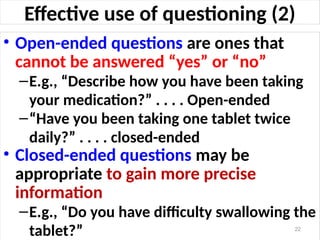
• Open-ended questions are ones that
cannot be answered “yes” or “no”
–E.g., “Describe how you have been taking
your medication?” . . . . Open-ended
–“Have you been taking one tablet twice
daily?” . . . . closed-ended
• Closed-ended questions may be
appropriate to gain more precise
information
–E.g., “Do you have difficulty swallowing the
tablet?” 22
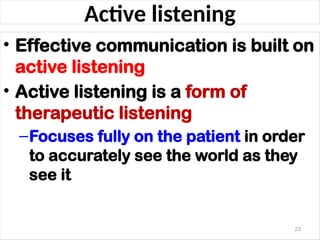
Active listening
• Effective communication is built on
active listening
• Active listening is a form of
therapeutic listening
–Focuses fully on the patient in order
to accurately see the world as they
see it
23
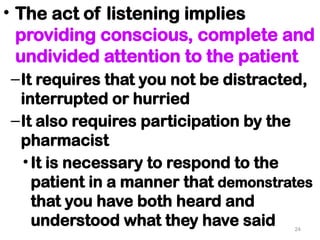
• The act of listening implies
providing conscious, complete and
undivided attention to the patient
–It requires that you not be distracted,
interrupted or hurried
–It also requires participation by the
pharmacist
•It is necessary to respond to the
patient in a manner that demonstrates
that you have both heard and
understood what they have said 24
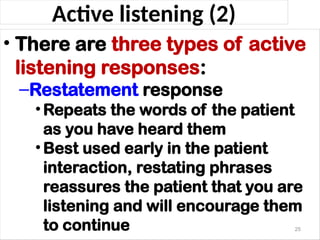
Active listening (2)
• There are three types of active
listening responses:
–Restatement response
•Repeats the words of the patient
as you have heard them
•Best used early in the patient
interaction, restating phrases
reassures the patient that you are
listening and will encourage them
to continue 25
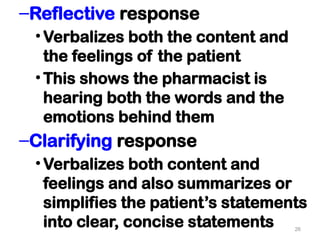
–Reflective response
•Verbalizes both the content and
the feelings of the patient
•This shows the pharmacist is
hearing both the words and the
emotions behind them
–Clarifying response
•Verbalizes both content and
feelings and also summarizes or
simplifies the patient’s statements
into clear, concise statements 26
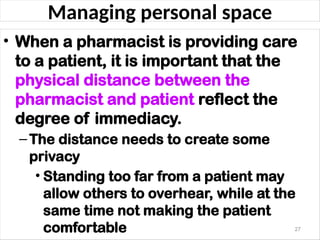
Managing personal space
• When a pharmacist is providing care
to a patient, it is important that the
physical distance between the
pharmacist and patient reflect the
degree of immediacy.
–The distance needs to create some
privacy
• Standing too far from a patient may
allow others to overhear, while at the
same time not making the patient
comfortable 27
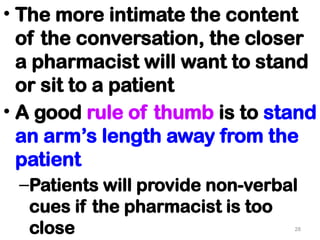
• The more intimate the content
of the conversation, the closer
a pharmacist will want to stand
or sit to a patient
• A good rule of thumb is to stand
an arm’s length away from the
patient
–Patients will provide non-verbal
cues if the pharmacist is too
close 28
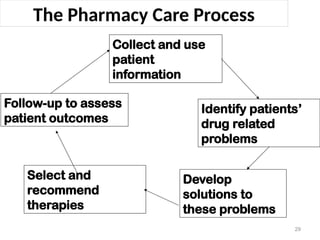
The Pharmacy Care Process
29
Collect and use
patient
information
Identify patients’
drug related
problems
Develop
solutions to
these problems
Select and
recommend
therapies
Follow-up to assess
patient outcomes
Pharmacy care (2)
• Three parts:
–Patient Information
–Prospective Drug Utilization
Review
–Patient Counseling
30
Patient Information
• Full name
• Address and phone
• Date of birth (DOB) / age
• Gender
• Drug list (profile) including all OTC, Rx,
herbal supplements, etc.
• Pharmacist comments
• Chronic medical conditions (diagnoses)
• Keep for 2 years 31
Prospective DUR
• Over / underutilization
• Therapeutic duplications
• Drug-disease interactions
• Drug-drug interactions
• Incorrect dosage or duration of
treatment
• Drug allergy interactions
• Clinical abuse - misuse
32
Patient Counseling
• Name (generic)
• Intended use and expected action
• Route, dosage form, dosage and
administration schedule
• Special directions for preparation,
storage or administration
• Precautions to be observed while
taking
• Common side effects, how to avoid
or action required if they occur 33
Patient Counseling (2)
• Techniques for self monitoring of
drug therapy
• Potential interactions or therapeutic
contraindications
• Refills
• What to do if you miss a dose
• Any other information THIS patient
may need to ensure safe use
34
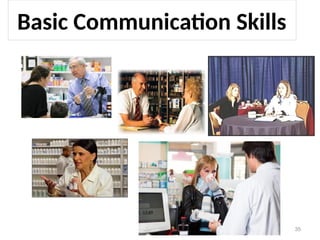
Basic Communication Skills
35
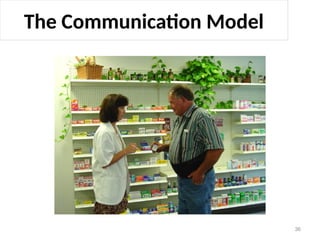
The Communication Model
36
The communication model (2)
• Communication takes two
–Sender and receiver
• To optimize communication, we
must consider the “channel”
• Two way flow of information
• Potential for a breakdown to occur
at any time
• Barriers will exist – minimize these
when you can
37
Basic Counseling and Communication
Skills
• Courtesy and rapport:
–Quite possibly the most critical skills
you will need to develop, and includes:
•How to address patients
•Introducing yourself
•Learning patient names
•Being aware of your appearance &
attitude issues
•Respecting patient privacy issues
•Avoiding stereotypes
•Using appropriate body language
38
Basic Counseling and Communication
Skills (2)
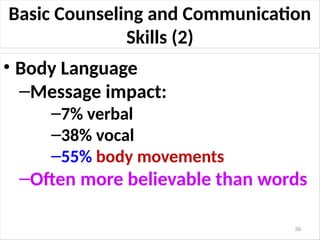
• Body Language
–Message impact:
–7% verbal
–38% vocal
–55% body movements
–Often more believable than words
39
–Composed of
–Body movements
–Facial expression
–Gestures
–Posture and breathing
–Space
40
Basic Counseling and Communication
Skills (3)
• Body language
–Facial expression – smile
–Eye contact
–Open posture
–Distance
–Tone of voice
–Get “CLOSER”
–Control distractions, lean in, open
posture, smile, make good eye
contact, relax 41
Body language
• Most of what we communicate happens
through our body language
• For communication to be perceived as
genuine
–There needs to be congruency between
our words and our body language
• There are a number of ways a pharmacist can
use body language
–To increase the effectiveness of their
communication and display interest and
concern 42
Body language (2)
• Ways pharmacists can encourage patients to
listen and respond to what we are saying
–Establishing eye contact while talking to
patients,
–Leaning toward patients,
–Having a relaxed posture,
• Uncrossing arms and removing hands from
pockets, facing the patient directly with feet
facing forward
–Removing any physical barriers, such as a
desk, to create a more personal space with
the patient
–Head nods and smiling 43
Body language (3)
• Facial expressions in general can convey
emotions such as worry, confusion, sadness or
excitement
– Simply through movements in eyebrows, smiles
or frowns, or angle of the head
• Body language has cultural implications
• Some body movements mean one thing in one
culture, and may convey a totally different
message in another culture
– When a pharmacist uses body language to identify a
patient’s feelings or understanding, they need to use
words to clarify whether their assumptions are
correct 44
Basic Skills: Information
• When communicating important
information to patients, be sure to:
• State the purpose of your
communication
• Inquire about what the patient needs
• Use markers for critical information
–“Now, Ms. Smith, this is really
important…..I need you to…”
• Talk in lay terms, but don’t oversimplify
–Avoid technical jargon
–Avoid information overload
–Keep it short and simple, to the point 45
Basic Skills: Gathering Information
• When gathering information
–Ask open-ended questions
•Much more information can be gained
•Saves time
•Provides opportunities for patients to
reveal information we might not be
thinking about
–“How are you supposed to be taking
this…?
–“Tell me more about this…” 46
Basic Skills: Assessment
• The question is, did your patient learn
anything from you?
• In other words, did the other person
understand what you said, and meant?
• To assess:
–Summarize your teaching
–Verify what your patients know
• “Ms. Smith, can you tell me how you will take
your medication?
–Reinforce patient understanding when you
can
• “That’s right, this medication will make you
sleepy…” 47
Basic Skills: Empathy
• Seek to understand what your
patients feel
•Empathy is not sympathy
•Realistically, may not be attainable
because you are not the other
person
•Empathy will help you shape your
communication so that others
better understand you!
• Listening and Responding Test 48
Basic Skills: Assertiveness and
Persuasion
•Assertive versus aggressive
•Persuasive versus pushy
–What is the difference?
49

2. Basic Communication Skills for Pharmacists.pptx

  • 1.
  • 2.
    Outlines • Definitions &introduction • How to communicate • Elements of communication • The pharmacy care process • Common communication mistakes health practitioners make • Basic communication skills 2
  • 3.
    What is communication? Definitions •Communication –is the act of exchanging information –It can be used to inform, command, instruct, assess, influence, and persuade other people • Interpersonal Communication –is an interactive process between individuals that involves sending and receiving verbal and nonverbal messages 3
  • 4.
    Definitions (2) • NonVerbal Communication –is non verbal behaviors – actions, body language and active listening •Are vitally important communication skills 4
  • 5.
    Introduction • Effective patientcommunication is central to being able to provide pharmaceutical care: –Identifying patient issues and needs, –Developing and communicating solutions, and –Ensuring patient agreement and understanding . . . . . . . . . . are essential skills for pharmacists today 5
  • 6.
    • Effective communicationskills are necessary to –Receive accurate and comprehensive information from the patient . . . . . for practitioners –Successfully educate the patient 6
  • 7.
    Introduction (2) • Additionally,strong communications skills will enable a pharmacist to: –Establish the necessary rapport to building a trusting relationship; and –Ensure an effective exchange of information necessary for the •Pharmacist to appreciate patient needs •Patient to understand and accept pharmacist recommendations 7
  • 8.
    Introduction (3) • Someof the more tangible benefits patients experience when pharmacists use effective communication strategies: –Improved adherence with medication use –Increased satisfaction with their relationship with the pharmacist –Greater likelihood that patients will ask for help when it is needed, resulting in fewer unaddressed side effects and adverse effects –Improve patient trust in pharmacist advice and education 8
  • 9.
    How we communicate? •We communicate –Verbally (through words), –Visually (through the use of pictures or printed materials), –Kinesthetically (through body language), –Interpersonally (through social interaction), and –Intrapersonally (within our self) • The structure of communication can be described as a system made up of several elements 9
  • 10.
    How we communicate(2) • The intended message is put into words by the sender, –who transmits it (through speech or writing) to the receiver, –who must then decode the message to understand the intended message • Along the way, there are several opportunities for communication to fail, and so the pharmacist’s task is two-fold 10
  • 11.
    How we communicate(3) • When communicating with patients and other health-care providers, –Pharmacists can manage how they convey the intended message through verbal and non-verbal communication • There is a need to also be aware of the verbal and non-verbal responses of the receiver of our communication –So that the pharmacist can identify when confusion or misunderstanding has occurred and take steps to clarify 11
  • 12.
    Verbal and Non-VerbalCommunication • Pharmacists need to take responsibility for their behavior, particularly in choosing the content provided to patients and the manner in which it is provided • To help pharmacists ensure effective communication, consider the five “Ss”: –Be sincere, keep communication simple, short and specific, and lastly, summarize 12
  • 13.
    Verbal and Non-VerbalCommunication (2) • Be sincere –A pharmacist’s attitude will affect both patient adherence as well as therapeutic outcome –Genuineness, warmth and openness on the part of the pharmacist will have a powerful influence on the patient and the quality of their relationship with the pharmacist 13
  • 14.
    Verbal and Non-VerbalCommunication (3) • Keep communication simple, short and specific –Avoid unnecessary complexity –Shorter words and sentences told will be recalled more by patients –The number of messages should ideally be kept to a maximum of three items • Being specific when giving information or advice to patients will help them recall what they are told • The more specific the message or instructions, the more likely it will be adhered to 14
  • 15.
    Verbal and Non-VerbalCommunication (4) • Lastly, summarize –Repeating important messages as a summary, with emphasis on critical aspects of the communication will help the patient “take home” the vital aspects of their care instructions •Dosing instructions •When to take, or •How to take 15
  • 16.
    Elements of Communication •Before managers can master oral or written communication they must be able to: –Identify their audience –Develop active listening skills –Learn to ask questions effectively –Give and receive feedback –Understand the importance of nonverbal communication 16
  • 17.
    Identifying the Audience •Managers communicate daily with a variety of individuals and/or groups –To communicate effectively, managers should tailor communications to their unique audience –Each audience possesses a different need for information which contributes toward achieving organizational objectives 17
  • 18.
    Active Listening • Isthe conscious process of securing information (including feelings or emotions) through attention and observation –Don’t assume anything –Don’t interrupt –Don’t guess about intentions –Don’t react too quickly –Don’t exhibit bad behavior 18
  • 19.
    Asking Effective Questions •Specific types of questions, when used at the appropriate time, can lead to more effective communications –Open-ended questions: are questions that require a sentence or more to answer, and are useful for starting dialogue –Close-ended questions: are questions that require only simple, short answers 19
  • 20.
    Essential Ingredients forEffective Feedback 1.Determine if feedback is desired 2.Focus on few items 3.State it objectively; be specific and job-related 4.Make sure feedback is timely and understood 5. Establish clear priorities for future action 6. Include positive factors that you can praise 7.Give the recipient a chance to respond 20
  • 21.
    Basic skills: Effectiveuse of questioning • Competent questioning ensures the pharmacist will obtain the necessary information to identify patient needs and drug related problems • Early in the conversation, – Keep questions general and less personal • This approach will relax the patient and help you develop rapport – Keep questions open-ended • This encourages the patient to share information or discuss experiences in their own way 21
  • 22.
    Effective use ofquestioning (2) • Open-ended questions are ones that cannot be answered “yes” or “no” –E.g., “Describe how you have been taking your medication?” . . . . Open-ended –“Have you been taking one tablet twice daily?” . . . . closed-ended • Closed-ended questions may be appropriate to gain more precise information –E.g., “Do you have difficulty swallowing the tablet?” 22
  • 23.
    Active listening • Effectivecommunication is built on active listening • Active listening is a form of therapeutic listening –Focuses fully on the patient in order to accurately see the world as they see it 23
  • 24.
    • The actof listening implies providing conscious, complete and undivided attention to the patient –It requires that you not be distracted, interrupted or hurried –It also requires participation by the pharmacist •It is necessary to respond to the patient in a manner that demonstrates that you have both heard and understood what they have said 24
  • 25.
    Active listening (2) •There are three types of active listening responses: –Restatement response •Repeats the words of the patient as you have heard them •Best used early in the patient interaction, restating phrases reassures the patient that you are listening and will encourage them to continue 25
  • 26.
    –Reflective response •Verbalizes boththe content and the feelings of the patient •This shows the pharmacist is hearing both the words and the emotions behind them –Clarifying response •Verbalizes both content and feelings and also summarizes or simplifies the patient’s statements into clear, concise statements 26
  • 27.
    Managing personal space •When a pharmacist is providing care to a patient, it is important that the physical distance between the pharmacist and patient reflect the degree of immediacy. –The distance needs to create some privacy • Standing too far from a patient may allow others to overhear, while at the same time not making the patient comfortable 27
  • 28.
    • The moreintimate the content of the conversation, the closer a pharmacist will want to stand or sit to a patient • A good rule of thumb is to stand an arm’s length away from the patient –Patients will provide non-verbal cues if the pharmacist is too close 28
  • 29.
    The Pharmacy CareProcess 29 Collect and use patient information Identify patients’ drug related problems Develop solutions to these problems Select and recommend therapies Follow-up to assess patient outcomes
  • 30.
    Pharmacy care (2) •Three parts: –Patient Information –Prospective Drug Utilization Review –Patient Counseling 30
  • 31.
    Patient Information • Fullname • Address and phone • Date of birth (DOB) / age • Gender • Drug list (profile) including all OTC, Rx, herbal supplements, etc. • Pharmacist comments • Chronic medical conditions (diagnoses) • Keep for 2 years 31
  • 32.
    Prospective DUR • Over/ underutilization • Therapeutic duplications • Drug-disease interactions • Drug-drug interactions • Incorrect dosage or duration of treatment • Drug allergy interactions • Clinical abuse - misuse 32
  • 33.
    Patient Counseling • Name(generic) • Intended use and expected action • Route, dosage form, dosage and administration schedule • Special directions for preparation, storage or administration • Precautions to be observed while taking • Common side effects, how to avoid or action required if they occur 33
  • 34.
    Patient Counseling (2) •Techniques for self monitoring of drug therapy • Potential interactions or therapeutic contraindications • Refills • What to do if you miss a dose • Any other information THIS patient may need to ensure safe use 34
  • 35.
  • 36.
  • 37.
    The communication model(2) • Communication takes two –Sender and receiver • To optimize communication, we must consider the “channel” • Two way flow of information • Potential for a breakdown to occur at any time • Barriers will exist – minimize these when you can 37
  • 38.
    Basic Counseling andCommunication Skills • Courtesy and rapport: –Quite possibly the most critical skills you will need to develop, and includes: •How to address patients •Introducing yourself •Learning patient names •Being aware of your appearance & attitude issues •Respecting patient privacy issues •Avoiding stereotypes •Using appropriate body language 38
  • 39.
    Basic Counseling andCommunication Skills (2) • Body Language –Message impact: –7% verbal –38% vocal –55% body movements –Often more believable than words 39
  • 40.
    –Composed of –Body movements –Facialexpression –Gestures –Posture and breathing –Space 40
  • 41.
    Basic Counseling andCommunication Skills (3) • Body language –Facial expression – smile –Eye contact –Open posture –Distance –Tone of voice –Get “CLOSER” –Control distractions, lean in, open posture, smile, make good eye contact, relax 41
  • 42.
    Body language • Mostof what we communicate happens through our body language • For communication to be perceived as genuine –There needs to be congruency between our words and our body language • There are a number of ways a pharmacist can use body language –To increase the effectiveness of their communication and display interest and concern 42
  • 43.
    Body language (2) •Ways pharmacists can encourage patients to listen and respond to what we are saying –Establishing eye contact while talking to patients, –Leaning toward patients, –Having a relaxed posture, • Uncrossing arms and removing hands from pockets, facing the patient directly with feet facing forward –Removing any physical barriers, such as a desk, to create a more personal space with the patient –Head nods and smiling 43
  • 44.
    Body language (3) •Facial expressions in general can convey emotions such as worry, confusion, sadness or excitement – Simply through movements in eyebrows, smiles or frowns, or angle of the head • Body language has cultural implications • Some body movements mean one thing in one culture, and may convey a totally different message in another culture – When a pharmacist uses body language to identify a patient’s feelings or understanding, they need to use words to clarify whether their assumptions are correct 44
  • 45.
    Basic Skills: Information •When communicating important information to patients, be sure to: • State the purpose of your communication • Inquire about what the patient needs • Use markers for critical information –“Now, Ms. Smith, this is really important…..I need you to…” • Talk in lay terms, but don’t oversimplify –Avoid technical jargon –Avoid information overload –Keep it short and simple, to the point 45
  • 46.
    Basic Skills: GatheringInformation • When gathering information –Ask open-ended questions •Much more information can be gained •Saves time •Provides opportunities for patients to reveal information we might not be thinking about –“How are you supposed to be taking this…? –“Tell me more about this…” 46
  • 47.
    Basic Skills: Assessment •The question is, did your patient learn anything from you? • In other words, did the other person understand what you said, and meant? • To assess: –Summarize your teaching –Verify what your patients know • “Ms. Smith, can you tell me how you will take your medication? –Reinforce patient understanding when you can • “That’s right, this medication will make you sleepy…” 47
  • 48.
    Basic Skills: Empathy •Seek to understand what your patients feel •Empathy is not sympathy •Realistically, may not be attainable because you are not the other person •Empathy will help you shape your communication so that others better understand you! • Listening and Responding Test 48
  • 49.
    Basic Skills: Assertivenessand Persuasion •Assertive versus aggressive •Persuasive versus pushy –What is the difference? 49
Editor's Notes

  • #38 courtesy = good manner