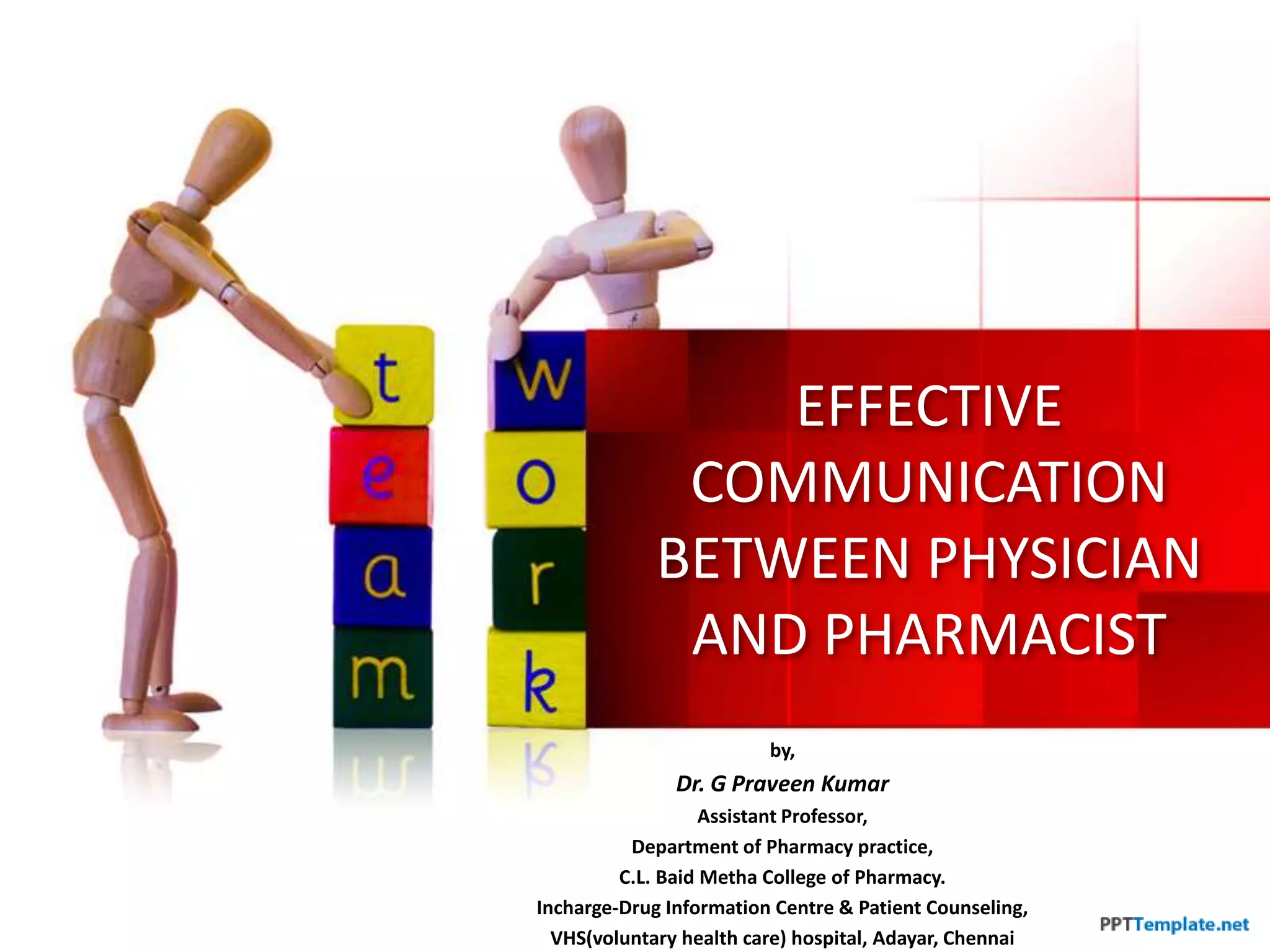
EFFECTIVE
COMMUNICATION
BETWEEN PHYSICIAN
AND PHARMACIST
by,

Dr. G Praveen Kumar
Assistant Professor,
Department of Pharmacy practice,
C.L. Baid Metha College of Pharmacy.
Incharge-Drug Information Centre & Patient Counseling,
VHS(voluntary health care) hospital, Adayar, Chennai
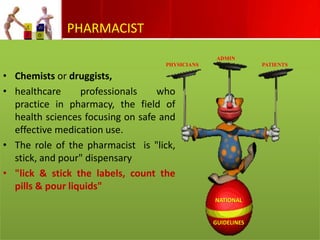
PHARMACIST
ADMIN
PHYSICIANS

PATIENTS

• Chemists or druggists,
• healthcare
professionals
who
practice in pharmacy, the field of
health sciences focusing on safe and
effective medication use.
• The role of the pharmacist is "lick,
stick, and pour" dispensary
• "lick & stick the labels, count the
pills & pour liquids"
NATIONAL

GUIDELINES
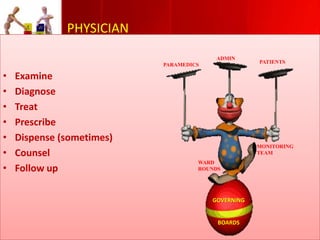
PHYSICIAN
ADMIN
PARAMEDICS

•
•
•
•
•
•
•

Examine
Diagnose
Treat
Prescribe
Dispense (sometimes)
Counsel
Follow up

PATIENTS

MONITORING
TEAM
WARD
ROUNDS

GOVERNING

BOARDS
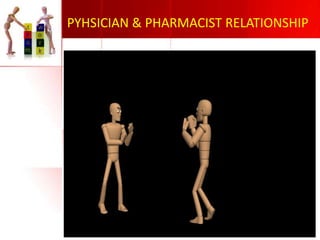
PYHSICIAN & PHARMACIST RELATIONSHIP
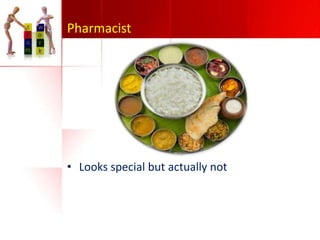
Pharmacist

• Looks special but actually not
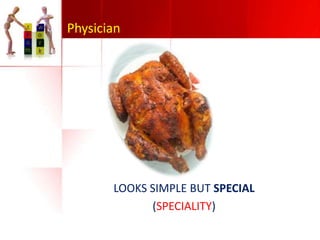
Physician

LOOKS SIMPLE BUT SPECIAL
(SPECIALITY)
DEVELOPMENT OF PROFESSION

Physicians
• MBBS
• MD
• DM

Pharmacist
• D.Pharm
• B.Pharm/M.Pharm
• Pharm.D
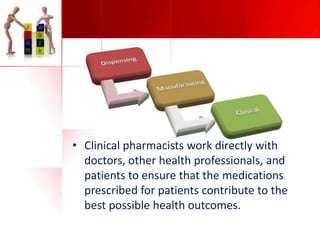
• Clinical pharmacists work directly with
doctors, other health professionals, and
patients to ensure that the medications
prescribed for patients contribute to the
best possible health outcomes.
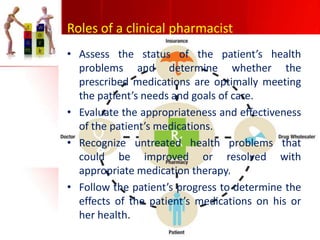
Roles of a clinical pharmacist
• Assess the status of the patient’s health
problems and determine whether the
prescribed medications are optimally meeting
the patient’s needs and goals of care.
• Evaluate the appropriateness and effectiveness
of the patient’s medications.
• Recognize untreated health problems that
could be improved or resolved with
appropriate medication therapy.
• Follow the patient’s progress to determine the
effects of the patient’s medications on his or
her health.
• Consult with the patient’s doctors and
other health care providers in selecting the
medication therapy that best meets the
patient’s needs and contributes effectively
to the overall therapy goals.
• Advise the patient on how to best take his
or her medications.
• Support the health care team’s efforts to
educate the patient on other important
steps to improve or maintain health, such
as exercise, diet, and preventive steps like
immunization.
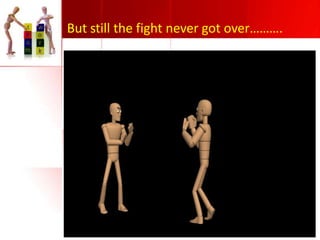
But still the fight never got over……….
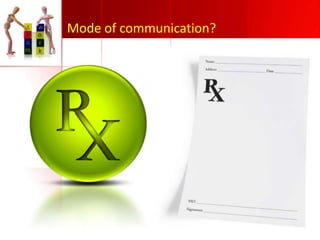
Mode of communication?
Prescribing Guidelines
• Part 1: The process of rational treatment
• Part 2: Selecting your P-drugs
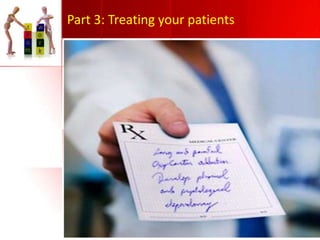
• Part 3: Treating your patients
• Part 4: Keeping up-to-date
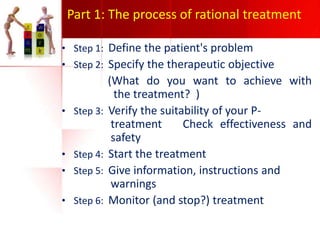
Part 1: The process of rational treatment
• Step 1: Define the patient's problem
• Step 2: Specify the therapeutic objective

• Step 3:

• Step 4:
• Step 5:
• Step 6:

(What do you want to achieve with
the treatment? )
Verify the suitability of your Ptreatment
Check effectiveness and
safety
Start the treatment
Give information, instructions and
warnings
Monitor (and stop?) treatment
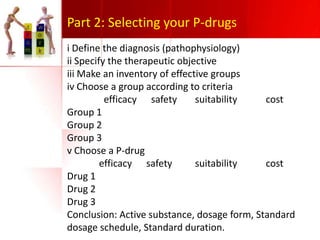
Part 2: Selecting your P-drugs
i Define the diagnosis (pathophysiology)
ii Specify the therapeutic objective
iii Make an inventory of effective groups
iv Choose a group according to criteria
efficacy safety
suitability
cost
Group 1
Group 2
Group 3
v Choose a P-drug
efficacy safety
suitability
cost
Drug 1
Drug 2
Drug 3
Conclusion: Active substance, dosage form, Standard
dosage schedule, Standard duration.
Part 3: Treating your patients
Part 4: Keeping up-to-date

“Knowledge is of two kinds. We know a
subject ourselves, or we know where we
can find information upon it.”
-Samuel Johnson (1709-1784)
Martindale’s The Extra Pharmacopoeia is an excellent reference book
with detailed drug information on most active substances and chemicals.
Avery’s Drug Treatment is a more specialized book, appropriate for
prescribers with a special interest in clinical pharmacology.
Pharmacist contribution?

• Prescription audit/monitoring
• Drug information
• Patient counselling
Prescription audit….
• Medication errors
• Almost everyone in the modern world takes
medication at one time or another
• Most of the time medications are beneficial
• But some occasion they do harmful effects (side
effects) which is adverse drug events
• But sometimes the harm is caused by an error in
prescribing or dispensing or administration of
medication
Types - Responsibilities
• PRISCRIBING ERRORS - physicians

• TRANSCRIBING ERRORS – pharmacist/nurses
• DISPENSING ERRORS – pharmacist/ physicians
• ADMINISTRATION ERRORS – nurses/patients
Parts of prescription
•
•
•
•
•

Name, address, telephone of prescriber
Date
Drugs
Name/I.D no., age & gender of patient
Signature or initials of prescriber
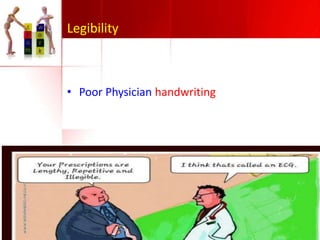
Legibility

• Poor Physician handwriting
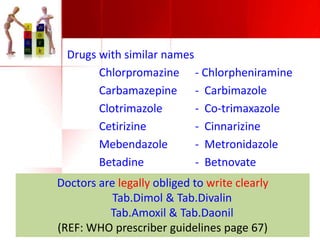
Drugs with similar names
Chlorpromazine - Chlorpheniramine
Carbamazepine - Carbimazole
Clotrimazole
- Co-trimaxazole
Cetirizine
- Cinnarizine
Mebendazole
- Metronidazole
Betadine
- Betnovate
Doctors are legally obliged to write clearly
Tab.Dimol & Tab.Divalin
Tab.Amoxil & Tab.Daonil
(REF: WHO prescriber guidelines page 67)
Drug name and dosage form
• Brands differ as same as the sarees brands
– Especially in India
• Use only generic names in the Prescription
• Use brands only if needed…
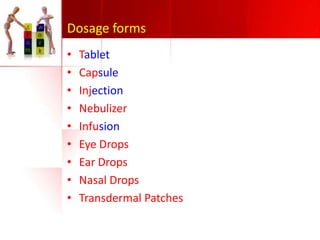
Dosage forms
•
•
•
•
•
•
•
•
•

Tablet
Capsule
Injection
Nebulizer
Infusion
Eye Drops
Ear Drops
Nasal Drops
Transdermal Patches
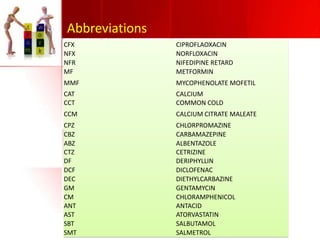
Abbreviations
CFX
NFX
NFR
MF

CIPROFLAOXACIN
NORFLOXACIN
NIFEDIPINE RETARD
METFORMIN

MMF

MYCOPHENOLATE MOFETIL

CAT
CCT

CALCIUM
COMMON COLD

CCM

CALCIUM CITRATE MALEATE

CPZ
CBZ
ABZ
CTZ
DF
DCF
DEC
GM
CM
ANT
AST
SBT
SMT

CHLORPROMAZINE
CARBAMAZEPINE
ALBENTAZOLE
CETRIZINE
DERIPHYLLIN
DICLOFENAC
DIETHYLCARBAZINE
GENTAMYCIN
CHLORAMPHENICOL
ANTACID
ATORVASTATIN
SALBUTAMOL
SALMETROL
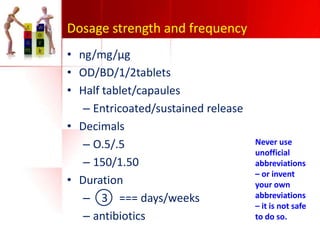
Dosage strength and frequency
• ng/mg/µg
• OD/BD/1/2tablets
• Half tablet/capaules
– Entricoated/sustained release
• Decimals
– O.5/.5
– 150/1.50
• Duration
– 3 === days/weeks
– antibiotics

Never use
unofficial
abbreviations
– or invent
your own
abbreviations
– it is not safe
to do so.
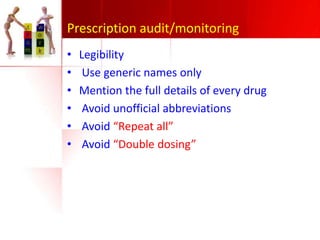
Prescription audit/monitoring
•
•
•
•
•
•

Legibility
Use generic names only
Mention the full details of every drug
Avoid unofficial abbreviations
Avoid “Repeat all”
Avoid “Double dosing”
Drug information
services
• “The Drug Information Centre is a service
offered through Pharmacy department
which provides advice and act as a referral
service by directing the best available
resource to respond to query or concern.”
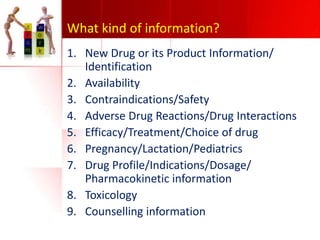
What kind of information?
1. New Drug or its Product Information/
Identification
2. Availability
3. Contraindications/Safety
4. Adverse Drug Reactions/Drug Interactions
5. Efficacy/Treatment/Choice of drug
6. Pregnancy/Lactation/Pediatrics
7. Drug Profile/Indications/Dosage/
Pharmacokinetic information
8. Toxicology
9. Counselling information
Resources….
• Primary resources: Research papers/Journal
•
•
•
•
•

Micromedex
FDA website
Medscape •
webMD
Drugs.com(d
rug
interaction
checker)
• Who
guidelines
•
• EBSCO
journal
services

articles/Case reports.
Secondary resource: abstracts, review
articles, indexing services such as DRUGDEX,

Drug Information Database and abstracting
MEDLINE, MICROMEDIX, etc…
Tertiary resources: Text books on various
aspects of drug use & practical guidelines.
Patient counselling
“It is the physicians or pharmacist’s
responsibility to ensure the patient receives
the required information for the quality use of
medicine.
Counselling implies the communication of
information that would encourage
therapeutic outcome”
You can organize a patient counseling Event – to
develop professional practice skills.
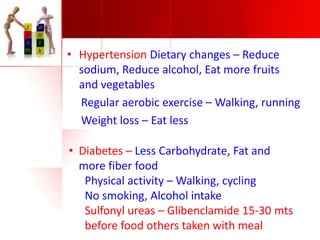
• Hypertension Dietary changes – Reduce
sodium, Reduce alcohol, Eat more fruits
and vegetables
Regular aerobic exercise – Walking, running
Weight loss – Eat less
• Diabetes – Less Carbohydrate, Fat and
more fiber food
Physical activity – Walking, cycling
No smoking, Alcohol intake
Sulfonyl ureas – Glibenclamide 15-30 mts
before food others taken with meal
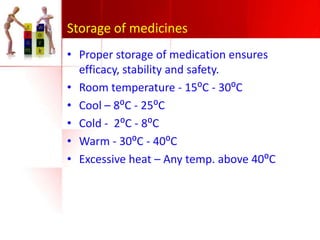
Storage of medicines
• Proper storage of medication ensures
efficacy, stability and safety.
• Room temperature - 15⁰C - 30⁰C
• Cool – 8⁰C - 25⁰C
• Cold - 2⁰C - 8⁰C
• Warm - 30⁰C - 40⁰C
• Excessive heat – Any temp. above 40⁰C
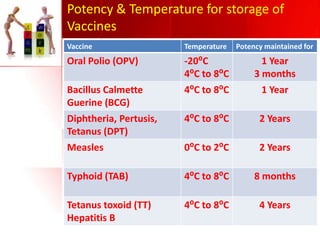
Potency & Temperature for storage of
Vaccines
Vaccine

Temperature

Potency maintained for

Oral Polio (OPV)

-20⁰C
4⁰C to 8⁰C

1 Year
3 months

Bacillus Calmette
Guerine (BCG)
Diphtheria, Pertusis,
Tetanus (DPT)

4⁰C to 8⁰C

1 Year

4⁰C to 8⁰C

2 Years

Measles

0⁰C to 2⁰C

2 Years

Typhoid (TAB)

4⁰C to 8⁰C

8 months

Tetanus toxoid (TT)
Hepatitis B

4⁰C to 8⁰C

4 Years
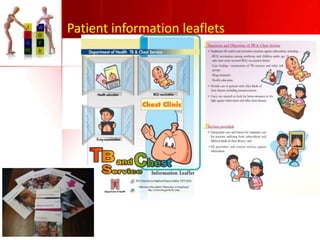
Patient information leaflets
How to overcome
the barrier?
PHARMACY AND THERAPEUTIC COMMITEE

THE PHARMACY AND THERAPEUTICS
COMMITTEE IS A POLICY FAMING AND
RECOMMENDING BODY TO THE MEDICAL
STAFF AND THE ADMINSTRATION OF
HOSPITAL ON MATTERS RELATED TO
THERAPEUTIC USE OF DRUGS.
HOSPITAL FORMULARY

• Hospital Formulary is a continually revised
compilation of pharmaceuticals including
important ancillary information that reflects
the current clinical judgment of the medical
staff.
Contents…
• Introductory information- Acknowledgement, List
of abbreviations, Intended usage of the formulary
manual
• Basic information of the drug
– Generic name,
– dosage form,
– strength
– Indications
– Pharmacological action
– Precautions
– Side effects
– Dosage – form,
– frequency Instructions
– Drug interactions
• Supplementary information on each drug
– Price
– Regulatory category
– Storage guidelines
– Patient counselling information
– Brand names
• Formulas for various diagnostic stains,
diagnostic aids
• Table of common Lab-values
Size of the formulary
• It is sufficiently small in size so that it could
be easily carried by clinicians, nurses etc, in
the pockets of their uniform or lab coats.
• The hospitals may determine their own size
of the formulary.
• Join together to create a better therapeutic
outcome.
• For queries contact:
DRUG & POISON INFORMATION CENTRE
Department of Pharmacy Practice
C.L. Baid Metha College of Pharmacy
• www.clbaidmethacollege.com
Go-to “DIC Request Form”
Aware….
Stay Tuned
to the
Developing
Technology.
We TREAT
And Let
“GOD”

Heals...
For details mail to :
praveen.pharmd@gmail.com.

Thanks To the Almighty GOD
(Jesus Christ)
&
to all….

Effective communication between physician and pharmacist.

  • 1.
    EFFECTIVE COMMUNICATION BETWEEN PHYSICIAN AND PHARMACIST by, Dr.G Praveen Kumar Assistant Professor, Department of Pharmacy practice, C.L. Baid Metha College of Pharmacy. Incharge-Drug Information Centre & Patient Counseling, VHS(voluntary health care) hospital, Adayar, Chennai
  • 2.
    PHARMACIST ADMIN PHYSICIANS PATIENTS • Chemists ordruggists, • healthcare professionals who practice in pharmacy, the field of health sciences focusing on safe and effective medication use. • The role of the pharmacist is "lick, stick, and pour" dispensary • "lick & stick the labels, count the pills & pour liquids" NATIONAL GUIDELINES
  • 3.
  • 4.
  • 5.
  • 6.
    Physician LOOKS SIMPLE BUTSPECIAL (SPECIALITY)
  • 7.
    DEVELOPMENT OF PROFESSION Physicians •MBBS • MD • DM Pharmacist • D.Pharm • B.Pharm/M.Pharm • Pharm.D
  • 8.
    • Clinical pharmacistswork directly with doctors, other health professionals, and patients to ensure that the medications prescribed for patients contribute to the best possible health outcomes.
  • 9.
    Roles of aclinical pharmacist • Assess the status of the patient’s health problems and determine whether the prescribed medications are optimally meeting the patient’s needs and goals of care. • Evaluate the appropriateness and effectiveness of the patient’s medications. • Recognize untreated health problems that could be improved or resolved with appropriate medication therapy. • Follow the patient’s progress to determine the effects of the patient’s medications on his or her health.
  • 10.
    • Consult withthe patient’s doctors and other health care providers in selecting the medication therapy that best meets the patient’s needs and contributes effectively to the overall therapy goals. • Advise the patient on how to best take his or her medications. • Support the health care team’s efforts to educate the patient on other important steps to improve or maintain health, such as exercise, diet, and preventive steps like immunization.
  • 11.
    But still thefight never got over……….
  • 12.
  • 13.
    Prescribing Guidelines • Part1: The process of rational treatment • Part 2: Selecting your P-drugs • Part 3: Treating your patients • Part 4: Keeping up-to-date
  • 14.
    Part 1: Theprocess of rational treatment • Step 1: Define the patient's problem • Step 2: Specify the therapeutic objective • Step 3: • Step 4: • Step 5: • Step 6: (What do you want to achieve with the treatment? ) Verify the suitability of your Ptreatment Check effectiveness and safety Start the treatment Give information, instructions and warnings Monitor (and stop?) treatment
  • 15.
    Part 2: Selectingyour P-drugs i Define the diagnosis (pathophysiology) ii Specify the therapeutic objective iii Make an inventory of effective groups iv Choose a group according to criteria efficacy safety suitability cost Group 1 Group 2 Group 3 v Choose a P-drug efficacy safety suitability cost Drug 1 Drug 2 Drug 3 Conclusion: Active substance, dosage form, Standard dosage schedule, Standard duration.
  • 16.
    Part 3: Treatingyour patients
  • 17.
    Part 4: Keepingup-to-date “Knowledge is of two kinds. We know a subject ourselves, or we know where we can find information upon it.” -Samuel Johnson (1709-1784) Martindale’s The Extra Pharmacopoeia is an excellent reference book with detailed drug information on most active substances and chemicals. Avery’s Drug Treatment is a more specialized book, appropriate for prescribers with a special interest in clinical pharmacology.
  • 18.
    Pharmacist contribution? • Prescriptionaudit/monitoring • Drug information • Patient counselling
  • 19.
    Prescription audit…. • Medicationerrors • Almost everyone in the modern world takes medication at one time or another • Most of the time medications are beneficial • But some occasion they do harmful effects (side effects) which is adverse drug events • But sometimes the harm is caused by an error in prescribing or dispensing or administration of medication
  • 20.
    Types - Responsibilities •PRISCRIBING ERRORS - physicians • TRANSCRIBING ERRORS – pharmacist/nurses • DISPENSING ERRORS – pharmacist/ physicians • ADMINISTRATION ERRORS – nurses/patients
  • 21.
    Parts of prescription • • • • • Name,address, telephone of prescriber Date Drugs Name/I.D no., age & gender of patient Signature or initials of prescriber
  • 22.
  • 23.
    Drugs with similarnames Chlorpromazine - Chlorpheniramine Carbamazepine - Carbimazole Clotrimazole - Co-trimaxazole Cetirizine - Cinnarizine Mebendazole - Metronidazole Betadine - Betnovate Doctors are legally obliged to write clearly Tab.Dimol & Tab.Divalin Tab.Amoxil & Tab.Daonil (REF: WHO prescriber guidelines page 67)
  • 24.
    Drug name anddosage form • Brands differ as same as the sarees brands – Especially in India • Use only generic names in the Prescription • Use brands only if needed…
  • 25.
  • 26.
    Abbreviations CFX NFX NFR MF CIPROFLAOXACIN NORFLOXACIN NIFEDIPINE RETARD METFORMIN MMF MYCOPHENOLATE MOFETIL CAT CCT CALCIUM COMMONCOLD CCM CALCIUM CITRATE MALEATE CPZ CBZ ABZ CTZ DF DCF DEC GM CM ANT AST SBT SMT CHLORPROMAZINE CARBAMAZEPINE ALBENTAZOLE CETRIZINE DERIPHYLLIN DICLOFENAC DIETHYLCARBAZINE GENTAMYCIN CHLORAMPHENICOL ANTACID ATORVASTATIN SALBUTAMOL SALMETROL
  • 27.
    Dosage strength andfrequency • ng/mg/µg • OD/BD/1/2tablets • Half tablet/capaules – Entricoated/sustained release • Decimals – O.5/.5 – 150/1.50 • Duration – 3 === days/weeks – antibiotics Never use unofficial abbreviations – or invent your own abbreviations – it is not safe to do so.
  • 28.
    Prescription audit/monitoring • • • • • • Legibility Use genericnames only Mention the full details of every drug Avoid unofficial abbreviations Avoid “Repeat all” Avoid “Double dosing”
  • 29.
  • 30.
    • “The DrugInformation Centre is a service offered through Pharmacy department which provides advice and act as a referral service by directing the best available resource to respond to query or concern.”
  • 31.
    What kind ofinformation? 1. New Drug or its Product Information/ Identification 2. Availability 3. Contraindications/Safety 4. Adverse Drug Reactions/Drug Interactions 5. Efficacy/Treatment/Choice of drug 6. Pregnancy/Lactation/Pediatrics 7. Drug Profile/Indications/Dosage/ Pharmacokinetic information 8. Toxicology 9. Counselling information
  • 32.
    Resources…. • Primary resources:Research papers/Journal • • • • • Micromedex FDA website Medscape • webMD Drugs.com(d rug interaction checker) • Who guidelines • • EBSCO journal services articles/Case reports. Secondary resource: abstracts, review articles, indexing services such as DRUGDEX, Drug Information Database and abstracting MEDLINE, MICROMEDIX, etc… Tertiary resources: Text books on various aspects of drug use & practical guidelines.
  • 33.
  • 34.
    “It is thephysicians or pharmacist’s responsibility to ensure the patient receives the required information for the quality use of medicine. Counselling implies the communication of information that would encourage therapeutic outcome” You can organize a patient counseling Event – to develop professional practice skills.
  • 35.
    • Hypertension Dietarychanges – Reduce sodium, Reduce alcohol, Eat more fruits and vegetables Regular aerobic exercise – Walking, running Weight loss – Eat less • Diabetes – Less Carbohydrate, Fat and more fiber food Physical activity – Walking, cycling No smoking, Alcohol intake Sulfonyl ureas – Glibenclamide 15-30 mts before food others taken with meal
  • 36.
    Storage of medicines •Proper storage of medication ensures efficacy, stability and safety. • Room temperature - 15⁰C - 30⁰C • Cool – 8⁰C - 25⁰C • Cold - 2⁰C - 8⁰C • Warm - 30⁰C - 40⁰C • Excessive heat – Any temp. above 40⁰C
  • 37.
    Potency & Temperaturefor storage of Vaccines Vaccine Temperature Potency maintained for Oral Polio (OPV) -20⁰C 4⁰C to 8⁰C 1 Year 3 months Bacillus Calmette Guerine (BCG) Diphtheria, Pertusis, Tetanus (DPT) 4⁰C to 8⁰C 1 Year 4⁰C to 8⁰C 2 Years Measles 0⁰C to 2⁰C 2 Years Typhoid (TAB) 4⁰C to 8⁰C 8 months Tetanus toxoid (TT) Hepatitis B 4⁰C to 8⁰C 4 Years
  • 38.
  • 39.
  • 40.
    PHARMACY AND THERAPEUTICCOMMITEE THE PHARMACY AND THERAPEUTICS COMMITTEE IS A POLICY FAMING AND RECOMMENDING BODY TO THE MEDICAL STAFF AND THE ADMINSTRATION OF HOSPITAL ON MATTERS RELATED TO THERAPEUTIC USE OF DRUGS.
  • 42.
    HOSPITAL FORMULARY • HospitalFormulary is a continually revised compilation of pharmaceuticals including important ancillary information that reflects the current clinical judgment of the medical staff.
  • 43.
    Contents… • Introductory information-Acknowledgement, List of abbreviations, Intended usage of the formulary manual • Basic information of the drug – Generic name, – dosage form, – strength – Indications – Pharmacological action – Precautions – Side effects – Dosage – form, – frequency Instructions – Drug interactions
  • 44.
    • Supplementary informationon each drug – Price – Regulatory category – Storage guidelines – Patient counselling information – Brand names • Formulas for various diagnostic stains, diagnostic aids • Table of common Lab-values
  • 45.
    Size of theformulary • It is sufficiently small in size so that it could be easily carried by clinicians, nurses etc, in the pockets of their uniform or lab coats. • The hospitals may determine their own size of the formulary.
  • 46.
    • Join togetherto create a better therapeutic outcome.
  • 47.
    • For queriescontact: DRUG & POISON INFORMATION CENTRE Department of Pharmacy Practice C.L. Baid Metha College of Pharmacy • www.clbaidmethacollege.com Go-to “DIC Request Form”
  • 48.
  • 49.
  • 50.
    For details mailto : praveen.pharmd@gmail.com. Thanks To the Almighty GOD (Jesus Christ) & to all….