PHARMACOTHERAPY POINTERS FOR
ISCHEMIC STROKE
[MALAYSIAN CPGs]
 Stroke is a global health problem and is the 2nd commonest
cause of death and a leading cause of adult disability
worldwide.
 Stroke is a clinical syndrome characterized by rapidly developing
clinical symptoms (and/or signs) of focal, and at times global,
loss of cerebral function, with symptoms lasting more than 24
hours or leading to death, with no apparent cause other than
that of vascular origin.
Three main causes of ischaemic stroke:
1. Atherothromboembolism (50%; mainly atheroma);
2. Intracranial small vessel disease (penetrating artery disease)
(25%);
3. Cardiogenic embolism (20%);
 Other causes: arterial dissection, trauma, vasculitis
(primary/secondary), metabolic disorders, congenital disorders,
and
 Other less common causes: migraine, pregnancy, oral
contraceptives, etc.
Signs/symptoms of a stroke (for pts. with AF, CVA, post-MI, or
valve replacements)
 Facial droop
 Arm drift
 Slurred speech
 Weakness or numbness in extremities (usually unilateral, but
may be bilateral)
 Abnormal or loss of vision or hearing (usually unilateral, but
may be bilateral)
 Difficulty walking (unsteady gait)
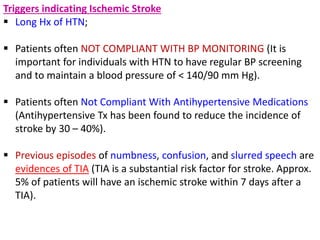
Triggers indicating Ischemic Stroke
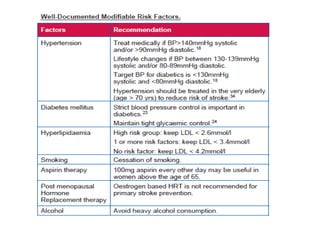
 Long Hx of HTN;
 Patients often NOT COMPLIANT WITH BP MONITORING (It is
important for individuals with HTN to have regular BP screening
and to maintain a blood pressure of < 140/90 mm Hg).
 Patients often Not Compliant With Antihypertensive Medications
(Antihypertensive Tx has been found to reduce the incidence of
stroke by 30 – 40%).
 Previous episodes of numbness, confusion, and slurred speech are
evidences of TIA (TIA is a substantial risk factor for stroke. Approx.
5% of patients will have an ischemic stroke within 7 days after a
TIA).
Trig.indic.Isch.Stroke (contd’.)
 Not seeking treatment for TIA episodes as the clinical symptoms
resolve quickly (The risk of stroke within 7 days is doubled for
patients with TIAs who did not seek treatment).
 Urgent treatment should be provided for TIAs (early treatment for
TIA and minor stroke can reduce the risk of early recurrent stroke
by 80%).
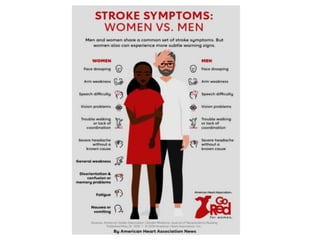
 Non-traditional symptoms of stroke: LOC, SOB, pain, and
headache; (Studies have demonstrated that non-traditional
symptoms are more prevalent among women, often leading to a
delay in the evaluation for stroke).
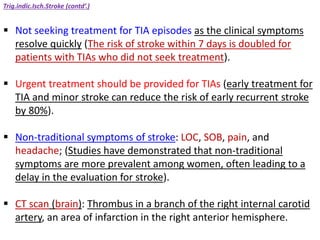
 CT scan (brain): Thrombus in a branch of the right internal carotid
artery, an area of infarction in the right anterior hemisphere.
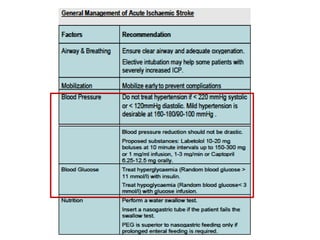
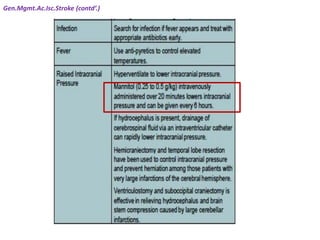
Gen.Mgmt.Ac.Isc.Stroke (contd’.)
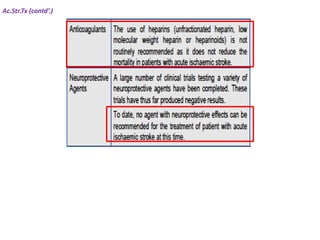
Ac.Str.Tx (contd’.)
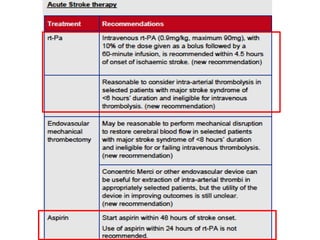
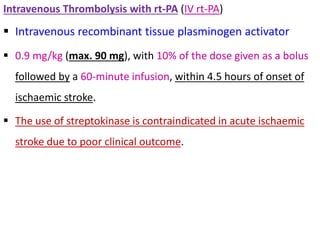
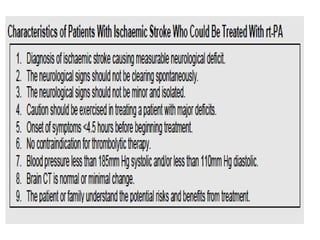
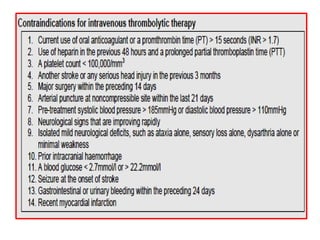
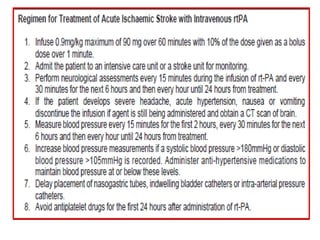
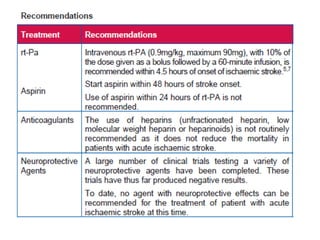
Intravenous Thrombolysis with rt-PA (IV rt-PA)
 Intravenous recombinant tissue plasminogen activator
 0.9 mg/kg (max. 90 mg), with 10% of the dose given as a bolus
followed by a 60-minute infusion, within 4.5 hours of onset of
ischaemic stroke.
 The use of streptokinase is contraindicated in acute ischaemic
stroke due to poor clinical outcome.
IV rt-PA (contd’.)
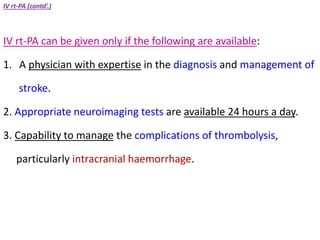
IV rt-PA can be given only if the following are available:
1. A physician with expertise in the diagnosis and management of
stroke.
2. Appropriate neuroimaging tests are available 24 hours a day.
3. Capability to manage the complications of thrombolysis,
particularly intracranial haemorrhage.
IV rt-PA (contd’.)
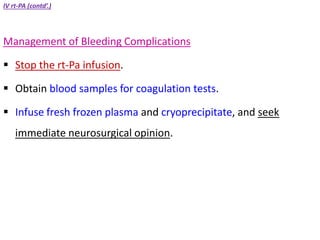
Management of Bleeding Complications
 Stop the rt-Pa infusion.
 Obtain blood samples for coagulation tests.
 Infuse fresh frozen plasma and cryoprecipitate, and seek
immediate neurosurgical opinion.
IV rt-PA (contd’.)
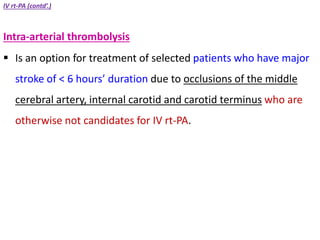
Intra-arterial thrombolysis
 Is an option for treatment of selected patients who have major
stroke of < 6 hours’ duration due to occlusions of the middle
cerebral artery, internal carotid and carotid terminus who are
otherwise not candidates for IV rt-PA.
Intra-arterial thrombolysis should be considered only if the following
are available:
1. A physician with expertise in the diagnosis and management of
stroke.
2. A physician with expertise and experience managing IV rt-PA cases.
3. Appropriate neuroimaging tests including perfusion and
angiography are available 24 hours a day.
4. Interventional neuroradiologist or qualified physician with
experience of endovascular intracranial work.
5. Capability to manage the complications of thrombolysis (mainly
intracranial haemorrhage);
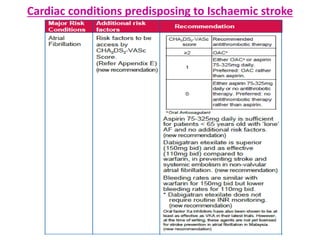
The CHA2DS2-VASc score
 Is a widely adopted validated tool to predict the risk of stroke and
systemic emboli in patients with non-valvular atrial fibrillation.
 Is a risk stratification tool for strokes in patients with atrial
fibrillation;
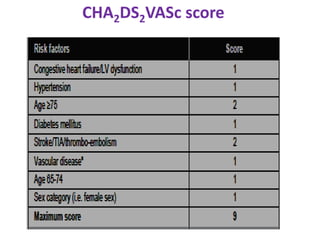
 CHF, HTN, age ≥ 75 years, DM, Stroke (or) TIA, Vascular disease,
Age 65 – 74 years, Sex category
 To aid in deciding when anticoagulation therapy for stroke
prophylaxis may be beneficial.
 Advantage: its ease of use (allows HCP to quickly estimate risk
based on a short set of criteria);
CHA2DS2VASc score
CHA2DS2-VASc score (contd’.)
 It is recommended for assessment of systemic emboli risk in
patients with non-valvular atrial fibrillation.
 Oral anticoagulation is recommended for those patients with a
score of 2 or greater.
 The score as a whole has been well validated and has been
included in the current major practice guidelines.
 Max. possible score is 9 (each parameter max. of 1 score; age and
prior stroke/TIA max. of 2 score each)
CHA 2DS 2-VASc score (contd’.)
 The components of the CHA2DS2-VASc score have been shown
separately to represent significant risk factors for embolism,
with certain elements such as prior stroke or TIA and age being
relatively significant.
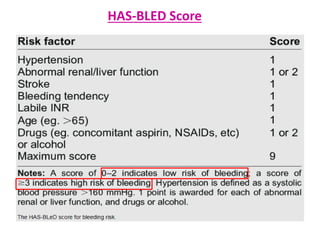
HAS-BLED Score
 HTN, Abnormal renal/liver function, Stroke, Bleeding history or
predisposition, Labile INR, Elderly (age > 65), and Drugs/alcohol
concomitantly;
 To estimate the 1-year risk for major bleeding in patients with
atrial fibrillation;
 Max. possible score is 9 [1 point for each of the components
(abnormal renal/liver function and drugs/alcohol possibly scoring
2 points each if both are present)].
 ‘Drugs’ refer to any medications that increase bleeding risk during
anticoagulation (aspirin, NSAIDs, steroids);
 ‘Alcohol’ refers to alcohol abuse.
HAS-BLED Score
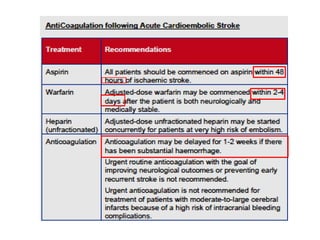
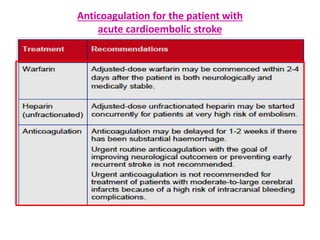
Anticoagulation for the patient with
acute cardioembolic stroke
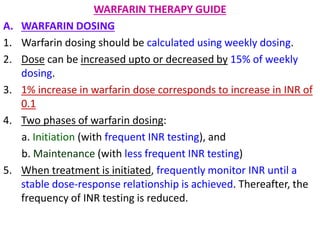
WARFARIN THERAPY GUIDE
A. WARFARIN DOSING
1. Warfarin dosing should be calculated using weekly dosing.
2. Dose can be increased upto or decreased by 15% of weekly
dosing.
3. 1% increase in warfarin dose corresponds to increase in INR of
0.1
4. Two phases of warfarin dosing:
a. Initiation (with frequent INR testing), and
b. Maintenance (with less frequent INR testing)
5. When treatment is initiated, frequently monitor INR until a
stable dose-response relationship is achieved. Thereafter, the
frequency of INR testing is reduced.
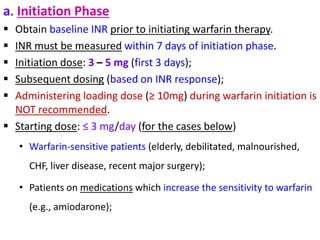
a. Initiation Phase
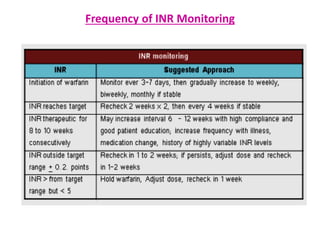
 Obtain baseline INR prior to initiating warfarin therapy.
 INR must be measured within 7 days of initiation phase.
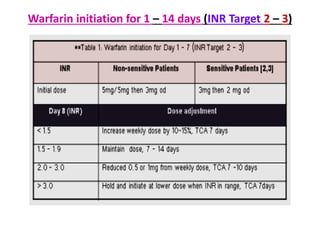
 Initiation dose: 3 – 5 mg (first 3 days);
 Subsequent dosing (based on INR response);
 Administering loading dose (≥ 10mg) during warfarin initiation is
NOT recommended.
 Starting dose: ≤ 3 mg/day (for the cases below)
• Warfarin-sensitive patients (elderly, debilitated, malnourished,
CHF, liver disease, recent major surgery);
• Patients on medications which increase the sensitivity to warfarin
(e.g., amiodarone);
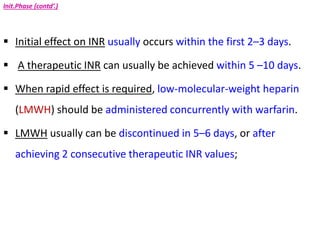
Init.Phase (contd’.)
 Initial effect on INR usually occurs within the first 2–3 days.
 A therapeutic INR can usually be achieved within 5 –10 days.
 When rapid effect is required, low-molecular-weight heparin
(LMWH) should be administered concurrently with warfarin.
 LMWH usually can be discontinued in 5–6 days, or after
achieving 2 consecutive therapeutic INR values;
Warfarin initiation for 1 – 14 days (INR Target 2 – 3)
Frequency of INR Monitoring
b. Maintenance Phase
 This can only be considered when targeted range INR is
achieved.
 Patients w/ stable INR (INR in range > 6 months) can be under
longer duration of INR monitoring (up to 12 weeks).
 However dose adjustment must be done accordingly when INR
is not in target range.
International Normalized Ratio (INR)
 INR reading shows the rate of blood clotting in the body.
 Warfarin dose depends on the targeted INR which should be
within the recommended range.
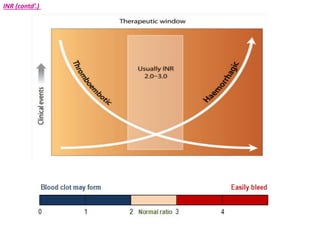
 Normally, the desired INR range is between 2.0 to 3.0.
 Blood tests should be done regularly throughout the treatment
period to monitor the INR readings.
 If INR < target range, there is an increased risk of clotting.
 If INR > target range, there is an increased risk of bleeding.
INR (contd’.)
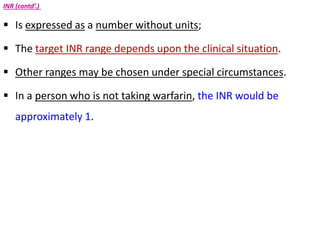
 Is expressed as a number without units;
 The target INR range depends upon the clinical situation.
 Other ranges may be chosen under special circumstances.
 In a person who is not taking warfarin, the INR would be
approximately 1.
INR (contd’.)
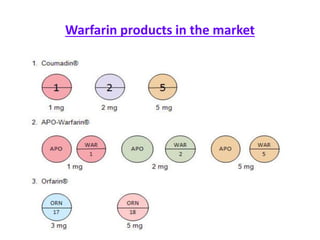
Warfarin products in the market
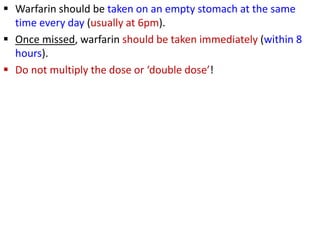
 Warfarin should be taken on an empty stomach at the same
time every day (usually at 6pm).
 Once missed, warfarin should be taken immediately (within 8
hours).
 Do not multiply the dose or ‘double dose’!
Food consumption
 Major changes in dietary patterns: Intake of foods high in Vit.K –
Green leafy vegetables (sawi, spinach, broccoli, cabbage etc.), soy
products, liver, green tea, cranberry juice.
 Intake of foods containing Vitamin K should be consistent to avoid
significant changes in the body.
Medicines/Supplements
 Pain killers (Aspirin, Mefenamic Acid, Ibuprofen);
 Antibiotics (Erythromycin, Chloramphenicol, Ciprofloxacin);
 Antiepileptics (Carbamazepine, Phenytoin)
 Vitamin/Supplement (Vits. C, E & K, Coenzyme Q10);
 Traditional/herbs (St. John’s Wort, Gingko, Ginseng, Green tea,
Garlic).
Why should warfarin be taken preferably in the evenings?
 In order to shorten the response time for making a dosing
change;
 Patients are usually advised to have their INR test in the
morning and to take their warfarin in the evening (so that the
INR test result will be back in time to change that day’s warfarin
dose if needed).
THE END
RECAP &
FOR YOUR INFO…..
Transient Ischaemic Attack (TIA)
A clinical syndrome characterized by an acute loss of focal cerebral
or monocular function with symptoms lasting < 24 hours and
which is thought to be due to inadequate cerebral or ocular blood
supply as a result of arterial thrombosis or embolism.
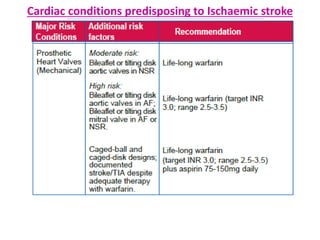
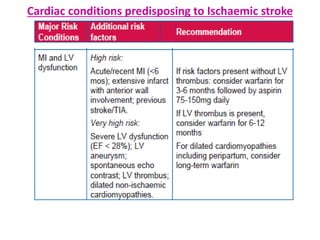
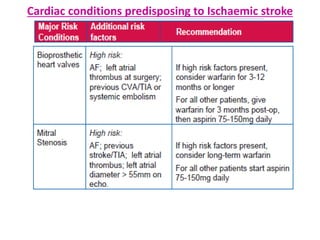
Cardiac conditions predisposing to Ischaemic stroke
Few General Pointers
 Recommended warfarin dose INR target 2.5 [range 2.0 to 3.0]
unless stated otherwise
 Increase BP measurements if a systolic BP >180mmHg or
diastolic BP >105mmHg is recorded. Administer anti-
hypertensive medications to maintain BP at or below these
levels.
 ICSI guideline - Increase of 15% weekly dose of warfarin
would correspond to increase in INR of 1.0.
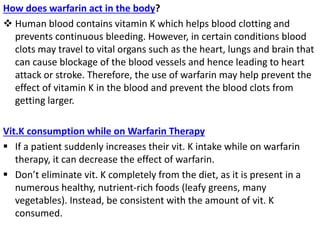
How does warfarin act in the body?
 Human blood contains vitamin K which helps blood clotting and
prevents continuous bleeding. However, in certain conditions blood
clots may travel to vital organs such as the heart, lungs and brain that
can cause blockage of the blood vessels and hence leading to heart
attack or stroke. Therefore, the use of warfarin may help prevent the
effect of vitamin K in the blood and prevent the blood clots from
getting larger.
Vit.K consumption while on Warfarin Therapy
 If a patient suddenly increases their vit. K intake while on warfarin
therapy, it can decrease the effect of warfarin.
 Don’t eliminate vit. K completely from the diet, as it is present in a
numerous healthy, nutrient-rich foods (leafy greens, many
vegetables). Instead, be consistent with the amount of vit. K
consumed.
REFERENCES:
 Malaysian Clinical Practice Guidelines for Management of
Ischemic Stroke. 3rd edition (2020). Publishers: Malaysian
Society of Neurosciences. eISBN 978-967-11469-2-7.
 Anticoagulation MTAC (AC-MTAC) Protocol 2nd edition
(2020)Pharmaceutical Service Program, Ministry of Health
Malaysia. ISBN: 978-967-5570-85-8

PHARMACOTHERAPY POINTERS FOR ISCHEMIC STROKE [MALAYSIAN CPGs].pdf

  • 1.
  • 2.
     Stroke isa global health problem and is the 2nd commonest cause of death and a leading cause of adult disability worldwide.  Stroke is a clinical syndrome characterized by rapidly developing clinical symptoms (and/or signs) of focal, and at times global, loss of cerebral function, with symptoms lasting more than 24 hours or leading to death, with no apparent cause other than that of vascular origin.
  • 3.
    Three main causesof ischaemic stroke: 1. Atherothromboembolism (50%; mainly atheroma); 2. Intracranial small vessel disease (penetrating artery disease) (25%); 3. Cardiogenic embolism (20%);  Other causes: arterial dissection, trauma, vasculitis (primary/secondary), metabolic disorders, congenital disorders, and  Other less common causes: migraine, pregnancy, oral contraceptives, etc.
  • 4.
    Signs/symptoms of astroke (for pts. with AF, CVA, post-MI, or valve replacements)  Facial droop  Arm drift  Slurred speech  Weakness or numbness in extremities (usually unilateral, but may be bilateral)  Abnormal or loss of vision or hearing (usually unilateral, but may be bilateral)  Difficulty walking (unsteady gait)
  • 6.
    Triggers indicating IschemicStroke  Long Hx of HTN;  Patients often NOT COMPLIANT WITH BP MONITORING (It is important for individuals with HTN to have regular BP screening and to maintain a blood pressure of < 140/90 mm Hg).  Patients often Not Compliant With Antihypertensive Medications (Antihypertensive Tx has been found to reduce the incidence of stroke by 30 – 40%).  Previous episodes of numbness, confusion, and slurred speech are evidences of TIA (TIA is a substantial risk factor for stroke. Approx. 5% of patients will have an ischemic stroke within 7 days after a TIA).
  • 7.
    Trig.indic.Isch.Stroke (contd’.)  Notseeking treatment for TIA episodes as the clinical symptoms resolve quickly (The risk of stroke within 7 days is doubled for patients with TIAs who did not seek treatment).  Urgent treatment should be provided for TIAs (early treatment for TIA and minor stroke can reduce the risk of early recurrent stroke by 80%).  Non-traditional symptoms of stroke: LOC, SOB, pain, and headache; (Studies have demonstrated that non-traditional symptoms are more prevalent among women, often leading to a delay in the evaluation for stroke).  CT scan (brain): Thrombus in a branch of the right internal carotid artery, an area of infarction in the right anterior hemisphere.
  • 11.
  • 13.
  • 15.
    Intravenous Thrombolysis withrt-PA (IV rt-PA)  Intravenous recombinant tissue plasminogen activator  0.9 mg/kg (max. 90 mg), with 10% of the dose given as a bolus followed by a 60-minute infusion, within 4.5 hours of onset of ischaemic stroke.  The use of streptokinase is contraindicated in acute ischaemic stroke due to poor clinical outcome.
  • 16.
    IV rt-PA (contd’.) IVrt-PA can be given only if the following are available: 1. A physician with expertise in the diagnosis and management of stroke. 2. Appropriate neuroimaging tests are available 24 hours a day. 3. Capability to manage the complications of thrombolysis, particularly intracranial haemorrhage.
  • 20.
    IV rt-PA (contd’.) Managementof Bleeding Complications  Stop the rt-Pa infusion.  Obtain blood samples for coagulation tests.  Infuse fresh frozen plasma and cryoprecipitate, and seek immediate neurosurgical opinion.
  • 21.
    IV rt-PA (contd’.) Intra-arterialthrombolysis  Is an option for treatment of selected patients who have major stroke of < 6 hours’ duration due to occlusions of the middle cerebral artery, internal carotid and carotid terminus who are otherwise not candidates for IV rt-PA.
  • 22.
    Intra-arterial thrombolysis shouldbe considered only if the following are available: 1. A physician with expertise in the diagnosis and management of stroke. 2. A physician with expertise and experience managing IV rt-PA cases. 3. Appropriate neuroimaging tests including perfusion and angiography are available 24 hours a day. 4. Interventional neuroradiologist or qualified physician with experience of endovascular intracranial work. 5. Capability to manage the complications of thrombolysis (mainly intracranial haemorrhage);
  • 23.
    The CHA2DS2-VASc score Is a widely adopted validated tool to predict the risk of stroke and systemic emboli in patients with non-valvular atrial fibrillation.  Is a risk stratification tool for strokes in patients with atrial fibrillation;  CHF, HTN, age ≥ 75 years, DM, Stroke (or) TIA, Vascular disease, Age 65 – 74 years, Sex category  To aid in deciding when anticoagulation therapy for stroke prophylaxis may be beneficial.  Advantage: its ease of use (allows HCP to quickly estimate risk based on a short set of criteria);
  • 24.
  • 25.
    CHA2DS2-VASc score (contd’.) It is recommended for assessment of systemic emboli risk in patients with non-valvular atrial fibrillation.  Oral anticoagulation is recommended for those patients with a score of 2 or greater.  The score as a whole has been well validated and has been included in the current major practice guidelines.  Max. possible score is 9 (each parameter max. of 1 score; age and prior stroke/TIA max. of 2 score each)
  • 26.
    CHA 2DS 2-VAScscore (contd’.)  The components of the CHA2DS2-VASc score have been shown separately to represent significant risk factors for embolism, with certain elements such as prior stroke or TIA and age being relatively significant.
  • 27.
    HAS-BLED Score  HTN,Abnormal renal/liver function, Stroke, Bleeding history or predisposition, Labile INR, Elderly (age > 65), and Drugs/alcohol concomitantly;  To estimate the 1-year risk for major bleeding in patients with atrial fibrillation;  Max. possible score is 9 [1 point for each of the components (abnormal renal/liver function and drugs/alcohol possibly scoring 2 points each if both are present)].  ‘Drugs’ refer to any medications that increase bleeding risk during anticoagulation (aspirin, NSAIDs, steroids);  ‘Alcohol’ refers to alcohol abuse.
  • 28.
  • 31.
    Anticoagulation for thepatient with acute cardioembolic stroke
  • 32.
    WARFARIN THERAPY GUIDE A.WARFARIN DOSING 1. Warfarin dosing should be calculated using weekly dosing. 2. Dose can be increased upto or decreased by 15% of weekly dosing. 3. 1% increase in warfarin dose corresponds to increase in INR of 0.1 4. Two phases of warfarin dosing: a. Initiation (with frequent INR testing), and b. Maintenance (with less frequent INR testing) 5. When treatment is initiated, frequently monitor INR until a stable dose-response relationship is achieved. Thereafter, the frequency of INR testing is reduced.
  • 33.
    a. Initiation Phase Obtain baseline INR prior to initiating warfarin therapy.  INR must be measured within 7 days of initiation phase.  Initiation dose: 3 – 5 mg (first 3 days);  Subsequent dosing (based on INR response);  Administering loading dose (≥ 10mg) during warfarin initiation is NOT recommended.  Starting dose: ≤ 3 mg/day (for the cases below) • Warfarin-sensitive patients (elderly, debilitated, malnourished, CHF, liver disease, recent major surgery); • Patients on medications which increase the sensitivity to warfarin (e.g., amiodarone);
  • 34.
    Init.Phase (contd’.)  Initialeffect on INR usually occurs within the first 2–3 days.  A therapeutic INR can usually be achieved within 5 –10 days.  When rapid effect is required, low-molecular-weight heparin (LMWH) should be administered concurrently with warfarin.  LMWH usually can be discontinued in 5–6 days, or after achieving 2 consecutive therapeutic INR values;
  • 35.
    Warfarin initiation for1 – 14 days (INR Target 2 – 3)
  • 36.
    Frequency of INRMonitoring
  • 37.
    b. Maintenance Phase This can only be considered when targeted range INR is achieved.  Patients w/ stable INR (INR in range > 6 months) can be under longer duration of INR monitoring (up to 12 weeks).  However dose adjustment must be done accordingly when INR is not in target range.
  • 38.
    International Normalized Ratio(INR)  INR reading shows the rate of blood clotting in the body.  Warfarin dose depends on the targeted INR which should be within the recommended range.  Normally, the desired INR range is between 2.0 to 3.0.  Blood tests should be done regularly throughout the treatment period to monitor the INR readings.  If INR < target range, there is an increased risk of clotting.  If INR > target range, there is an increased risk of bleeding.
  • 39.
    INR (contd’.)  Isexpressed as a number without units;  The target INR range depends upon the clinical situation.  Other ranges may be chosen under special circumstances.  In a person who is not taking warfarin, the INR would be approximately 1.
  • 40.
  • 41.
  • 42.
     Warfarin shouldbe taken on an empty stomach at the same time every day (usually at 6pm).  Once missed, warfarin should be taken immediately (within 8 hours).  Do not multiply the dose or ‘double dose’!
  • 43.
    Food consumption  Majorchanges in dietary patterns: Intake of foods high in Vit.K – Green leafy vegetables (sawi, spinach, broccoli, cabbage etc.), soy products, liver, green tea, cranberry juice.  Intake of foods containing Vitamin K should be consistent to avoid significant changes in the body. Medicines/Supplements  Pain killers (Aspirin, Mefenamic Acid, Ibuprofen);  Antibiotics (Erythromycin, Chloramphenicol, Ciprofloxacin);  Antiepileptics (Carbamazepine, Phenytoin)  Vitamin/Supplement (Vits. C, E & K, Coenzyme Q10);  Traditional/herbs (St. John’s Wort, Gingko, Ginseng, Green tea, Garlic).
  • 44.
    Why should warfarinbe taken preferably in the evenings?  In order to shorten the response time for making a dosing change;  Patients are usually advised to have their INR test in the morning and to take their warfarin in the evening (so that the INR test result will be back in time to change that day’s warfarin dose if needed).
  • 46.
  • 47.
  • 48.
    Transient Ischaemic Attack(TIA) A clinical syndrome characterized by an acute loss of focal cerebral or monocular function with symptoms lasting < 24 hours and which is thought to be due to inadequate cerebral or ocular blood supply as a result of arterial thrombosis or embolism.
  • 51.
  • 52.
  • 53.
  • 54.
  • 55.
    Few General Pointers Recommended warfarin dose INR target 2.5 [range 2.0 to 3.0] unless stated otherwise  Increase BP measurements if a systolic BP >180mmHg or diastolic BP >105mmHg is recorded. Administer anti- hypertensive medications to maintain BP at or below these levels.  ICSI guideline - Increase of 15% weekly dose of warfarin would correspond to increase in INR of 1.0.
  • 56.
    How does warfarinact in the body?  Human blood contains vitamin K which helps blood clotting and prevents continuous bleeding. However, in certain conditions blood clots may travel to vital organs such as the heart, lungs and brain that can cause blockage of the blood vessels and hence leading to heart attack or stroke. Therefore, the use of warfarin may help prevent the effect of vitamin K in the blood and prevent the blood clots from getting larger. Vit.K consumption while on Warfarin Therapy  If a patient suddenly increases their vit. K intake while on warfarin therapy, it can decrease the effect of warfarin.  Don’t eliminate vit. K completely from the diet, as it is present in a numerous healthy, nutrient-rich foods (leafy greens, many vegetables). Instead, be consistent with the amount of vit. K consumed.
  • 57.
    REFERENCES:  Malaysian ClinicalPractice Guidelines for Management of Ischemic Stroke. 3rd edition (2020). Publishers: Malaysian Society of Neurosciences. eISBN 978-967-11469-2-7.  Anticoagulation MTAC (AC-MTAC) Protocol 2nd edition (2020)Pharmaceutical Service Program, Ministry of Health Malaysia. ISBN: 978-967-5570-85-8