1
Ethics in Pharmacy
Profession
Part 1: Ethics in Clinical
Research
Dr. Bhaswat S. Chakraborty
Former Sr.VP, & Chair, R&D Core Committee, Cadila
Pharma
Former Director, Biopharmaceutics, Biovail, Canada
Former Senior Reviewer, TPD, Canada
1
Presented at the Institute of Pharmacy,
Nirma University, March 3, 2018
2
Contents
 Ethics in general
 Ethics in Pharmacy
 History of Clinical Research
 Ethics in Clinical Research
 Ethics of RCTs and randomization
 Ethics of data integrity
 Concluding remarks
2
3
Ethics
 Ethics or moral philosophy
 Moral values
 The term ethics derives from Ancient Greek
θικόςἠ (ethikos), from θοςἦ (ethos), meaning
'habit, custom'
 Philosophy of axiology comprises the sub-
branches of ethics and aesthetics, each
concerned with values
 Systematizing, defending, and recommending
concepts of right and wrong conduct
4
Ethics..
 Ethics seeks to resolve questions of human
morality
by defining concepts such as
good and evil, right and wrong
virtue and vice, justice and crime
 As a field of intellectual enquiry, moral
philosophy also is related to
moral psychology
descriptive ethics, and
value theory
5
Bioethics
 Bioethics is the study of ethics brought
about by advances in biology and medicine
 Concerned with the ethical questions that
arise in the relationships among life
sciences, biotechnology, medicine, politics,
law, and philosophy
 Includes more commonplace questions of
values ("the ethics of the ordinary") that
arise in primary care, medical research,
clinical research etc.
6
Ethics in Pharmacy
Profession
 Ethical Principles for Pharmacists
 Guidance for decision-making and maintain
ethical integrity varies according to the
country and professional body that creates
the guidelines
 However, the ethical principles are similar
and can be separated into five main
categories:
the responsibility for the consumer
the community
the profession
the business and
7
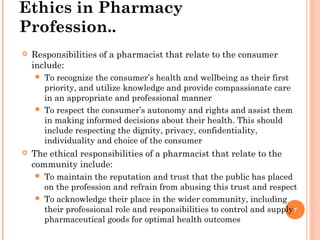
Ethics in Pharmacy
Profession..
 Responsibilities of a pharmacist that relate to the consumer
include:
 To recognize the consumer’s health and wellbeing as their first
priority, and utilize knowledge and provide compassionate care
in an appropriate and professional manner
 To respect the consumer’s autonomy and rights and assist them
in making informed decisions about their health. This should
include respecting the dignity, privacy, confidentiality,
individuality and choice of the consumer
 The ethical responsibilities of a pharmacist that relate to the
community include:
 To maintain the reputation and trust that the public has placed
on the profession and refrain from abusing this trust and respect
 To acknowledge their place in the wider community, including
their professional role and responsibilities to control and supply
pharmaceutical goods for optimal health outcomes
8
Ethics in Pharmacy Profession…
 Relating to the profession include:
 To commit to the development and enhancement of the
profession by becoming involved in activities such as training
staff, teaching, being a preceptor or mentor for students, interns
or colleagues, participating in initiatives to develop the
profession and demonstrate positive leadership.
 To keep up-to-date with knowledge of pharmacy practice with
lifelong learning and self-development to maintain professional
competence and personal health to continue practicing.
 To practice only when their professional independence,
judgment and integrity remains upheld, and manage situations
with a conflict of interest appropriately.
 Relating to business practices include:
 To conduct the business practices of pharmacy in an ethical and
professional manner with the consumer’s best interest in mind
and due respect to colleagues and the reputation of the
profession.
 Relating to other health professionals include:
 To work in cooperation and collaboration with other healthcare
professionals to achieve the optimal health outcomes for
consumers.
9
10
11
12
13
14
15
16
17
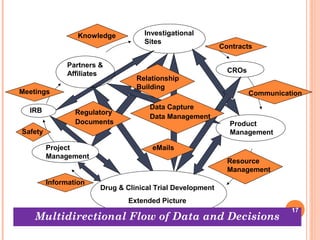
Investigational
Sites
Product
Management
Project
Management
Drug & Clinical Trial Development
Extended Picture
IRB Regulatory
Documents
Relationship
Building
eMails
Partners &
Affiliates
Meetings
CROs
Contracts
Knowledge
Information
Safety
Communication
Resource
Management
Data Capture
Data Management
Multidirectional Flow of Data and Decisions
17
18
19
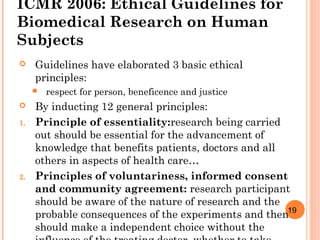
ICMR 2006: Ethical Guidelines for
Biomedical Research on Human
Subjects
 Guidelines have elaborated 3 basic ethical
principles:
 respect for person, beneficence and justice
 By inducting 12 general principles:
1. Principle of essentiality:research being carried
out should be essential for the advancement of
knowledge that benefits patients, doctors and all
others in aspects of health care…
2. Principles of voluntariness, informed consent
and community agreement: research participant
should be aware of the nature of research and the
probable consequences of the experiments and then
should make a independent choice without the
20
ICMR 2006: Ethical Guidelines for
Biomedical Research on Human
Subjects..
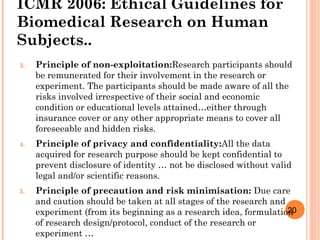
3. Principle of non-exploitation:Research participants should
be remunerated for their involvement in the research or
experiment. The participants should be made aware of all the
risks involved irrespective of their social and economic
condition or educational levels attained…either through
insurance cover or any other appropriate means to cover all
foreseeable and hidden risks.
4. Principle of privacy and confidentiality:All the data
acquired for research purpose should be kept confidential to
prevent disclosure of identity … not be disclosed without valid
legal and/or scientific reasons.
5. Principle of precaution and risk minimisation: Due care
and caution should be taken at all stages of the research and
experiment (from its beginning as a research idea, formulation
of research design/protocol, conduct of the research or
experiment …
21
ICMR 2006: Ethical Guidelines for
Biomedical Research on Human
Subjects…
6. Principle of professional competence:Clinical research
should be carried out only bycompetent and qualified persons
in their respective fields.
7. Principle of accountability and transparency: The
researcher should conduct experiments in fair, honest,
impartial and transparent manner after full disclosure of
his/her interests in research. They should balso retain the
research data, …
8. Principle of the maximisation of the public interest and
of distributive justice: The results of the research should be
used for benefit of all humans, especially the research
participants themselves and/or the community…
9. Principle of institutional arrangements: It is required
that all institutional arrangements required to be made in
respect of the research and its subsequent use or applications
should be duly made in transparent manner.
22
ICMR 2006: Ethical Guidelines for
Biomedical Research on Human
Subjects….
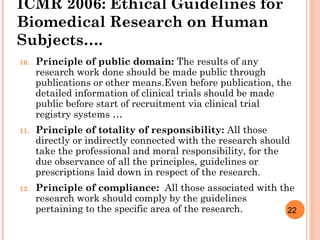
10. Principle of public domain: The results of any
research work done should be made public through
publications or other means.Even before publication, the
detailed information of clinical trials should be made
public before start of recruitment via clinical trial
registry systems …
11. Principle of totality of responsibility: All those
directly or indirectly connected with the research should
take the professional and moral responsibility, for the
due observance of all the principles, guidelines or
prescriptions laid down in respect of the research.
12. Principle of compliance: All those associated with the
research work should comply by the guidelines
pertaining to the specific area of the research.
23
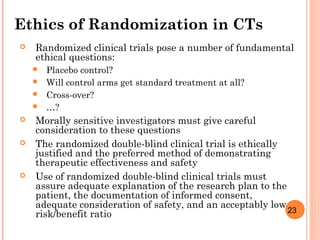
Ethics of Randomization in CTs
 Randomized clinical trials pose a number of fundamental
ethical questions:
 Placebo control?
 Will control arms get standard treatment at all?
 Cross-over?
 …?
 Morally sensitive investigators must give careful
consideration to these questions
 The randomized double-blind clinical trial is ethically
justified and the preferred method of demonstrating
therapeutic effectiveness and safety
 Use of randomized double-blind clinical trials must
assure adequate explanation of the research plan to the
patient, the documentation of informed consent,
adequate consideration of safety, and an acceptably low
risk/benefit ratio
24
25
26
27
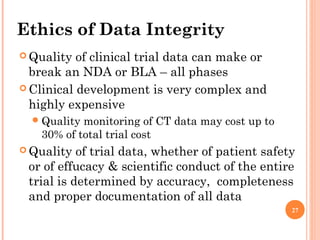
Ethics of Data Integrity
 Quality of clinical trial data can make or
break an NDA or BLA – all phases
 Clinical development is very complex and
highly expensive
Quality monitoring of CT data may cost up to
30% of total trial cost
 Quality of trial data, whether of patient safety
or of effucacy & scientific conduct of the entire
trial is determined by accuracy, completeness
and proper documentation of all data
28
Data Integrity in Clinical
Research
 “Data integrity is the degree to whicha
collection of data is complete, consistent and
accurate through the data lifecycle.” – WHO
 Research integrity depends on data integrity
 Includes all aspects of collection, use, storage and sharing
of data.
 Data integrity is a shared responsibility
 Although the main responsibility belongs to the PI asnd
the sponsor, there is a broader role and responsibility for
the institute and scientific community.
 Transparency of the research data is its
CREDIBILTY 28
Free and accurate information
exchange is fundamental to scientific
progressVan Eyk J., JHU NHLBI Innovative Proteomics Center on Heart Failure
29
Sources of Data Integrity & Its
Lack
 Data integrity is based on accurate and
traceable:
Collection
Recording
Storage
Reporting.
 Data integrity can be compromised numerous
ways:
Malicious proprietors
Human mistakes and naivety
Technical error 29
Van Eyk J., JHU NHLBI Innovative Proteomics Center on Heart Failure
Fraud & cooked data are the highest risk of
intefrity but errors can also give misleading
results
30
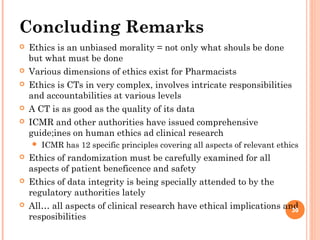
Concluding Remarks
 Ethics is an unbiased morality = not only what shouls be done
but what must be done
 Various dimensions of ethics exist for Pharmacists
 Ethics is CTs in very complex, involves intricate responsibilities
and accountabilities at various levels
 A CT is as good as the quality of its data
 ICMR and other authorities have issued comprehensive
guide;ines on human ethics ad clinical research
 ICMR has 12 specific principles covering all aspects of relevant ethics
 Ethics of randomization must be carefully examined for all
aspects of patient beneficence and safety
 Ethics of data integrity is being specially attended to by the
regulatory authorities lately
 All… all aspects of clinical research have ethical implications and
resposibilities
30
31
Thank You Very Much
32
QUESTIONS?

Ethics in Pharmacy

  • 1.
    1 Ethics in Pharmacy Profession Part1: Ethics in Clinical Research Dr. Bhaswat S. Chakraborty Former Sr.VP, & Chair, R&D Core Committee, Cadila Pharma Former Director, Biopharmaceutics, Biovail, Canada Former Senior Reviewer, TPD, Canada 1 Presented at the Institute of Pharmacy, Nirma University, March 3, 2018
  • 2.
    2 Contents  Ethics ingeneral  Ethics in Pharmacy  History of Clinical Research  Ethics in Clinical Research  Ethics of RCTs and randomization  Ethics of data integrity  Concluding remarks 2
  • 3.
    3 Ethics  Ethics ormoral philosophy  Moral values  The term ethics derives from Ancient Greek θικόςἠ (ethikos), from θοςἦ (ethos), meaning 'habit, custom'  Philosophy of axiology comprises the sub- branches of ethics and aesthetics, each concerned with values  Systematizing, defending, and recommending concepts of right and wrong conduct
  • 4.
    4 Ethics..  Ethics seeksto resolve questions of human morality by defining concepts such as good and evil, right and wrong virtue and vice, justice and crime  As a field of intellectual enquiry, moral philosophy also is related to moral psychology descriptive ethics, and value theory
  • 5.
    5 Bioethics  Bioethics isthe study of ethics brought about by advances in biology and medicine  Concerned with the ethical questions that arise in the relationships among life sciences, biotechnology, medicine, politics, law, and philosophy  Includes more commonplace questions of values ("the ethics of the ordinary") that arise in primary care, medical research, clinical research etc.
  • 6.
    6 Ethics in Pharmacy Profession Ethical Principles for Pharmacists  Guidance for decision-making and maintain ethical integrity varies according to the country and professional body that creates the guidelines  However, the ethical principles are similar and can be separated into five main categories: the responsibility for the consumer the community the profession the business and
  • 7.
    7 Ethics in Pharmacy Profession.. Responsibilities of a pharmacist that relate to the consumer include:  To recognize the consumer’s health and wellbeing as their first priority, and utilize knowledge and provide compassionate care in an appropriate and professional manner  To respect the consumer’s autonomy and rights and assist them in making informed decisions about their health. This should include respecting the dignity, privacy, confidentiality, individuality and choice of the consumer  The ethical responsibilities of a pharmacist that relate to the community include:  To maintain the reputation and trust that the public has placed on the profession and refrain from abusing this trust and respect  To acknowledge their place in the wider community, including their professional role and responsibilities to control and supply pharmaceutical goods for optimal health outcomes
  • 8.
    8 Ethics in PharmacyProfession…  Relating to the profession include:  To commit to the development and enhancement of the profession by becoming involved in activities such as training staff, teaching, being a preceptor or mentor for students, interns or colleagues, participating in initiatives to develop the profession and demonstrate positive leadership.  To keep up-to-date with knowledge of pharmacy practice with lifelong learning and self-development to maintain professional competence and personal health to continue practicing.  To practice only when their professional independence, judgment and integrity remains upheld, and manage situations with a conflict of interest appropriately.  Relating to business practices include:  To conduct the business practices of pharmacy in an ethical and professional manner with the consumer’s best interest in mind and due respect to colleagues and the reputation of the profession.  Relating to other health professionals include:  To work in cooperation and collaboration with other healthcare professionals to achieve the optimal health outcomes for consumers.
  • 9.
  • 10.
  • 11.
  • 12.
  • 13.
  • 14.
  • 15.
  • 16.
  • 17.
    17 Investigational Sites Product Management Project Management Drug & ClinicalTrial Development Extended Picture IRB Regulatory Documents Relationship Building eMails Partners & Affiliates Meetings CROs Contracts Knowledge Information Safety Communication Resource Management Data Capture Data Management Multidirectional Flow of Data and Decisions 17
  • 18.
  • 19.
    19 ICMR 2006: EthicalGuidelines for Biomedical Research on Human Subjects  Guidelines have elaborated 3 basic ethical principles:  respect for person, beneficence and justice  By inducting 12 general principles: 1. Principle of essentiality:research being carried out should be essential for the advancement of knowledge that benefits patients, doctors and all others in aspects of health care… 2. Principles of voluntariness, informed consent and community agreement: research participant should be aware of the nature of research and the probable consequences of the experiments and then should make a independent choice without the
  • 20.
    20 ICMR 2006: EthicalGuidelines for Biomedical Research on Human Subjects.. 3. Principle of non-exploitation:Research participants should be remunerated for their involvement in the research or experiment. The participants should be made aware of all the risks involved irrespective of their social and economic condition or educational levels attained…either through insurance cover or any other appropriate means to cover all foreseeable and hidden risks. 4. Principle of privacy and confidentiality:All the data acquired for research purpose should be kept confidential to prevent disclosure of identity … not be disclosed without valid legal and/or scientific reasons. 5. Principle of precaution and risk minimisation: Due care and caution should be taken at all stages of the research and experiment (from its beginning as a research idea, formulation of research design/protocol, conduct of the research or experiment …
  • 21.
    21 ICMR 2006: EthicalGuidelines for Biomedical Research on Human Subjects… 6. Principle of professional competence:Clinical research should be carried out only bycompetent and qualified persons in their respective fields. 7. Principle of accountability and transparency: The researcher should conduct experiments in fair, honest, impartial and transparent manner after full disclosure of his/her interests in research. They should balso retain the research data, … 8. Principle of the maximisation of the public interest and of distributive justice: The results of the research should be used for benefit of all humans, especially the research participants themselves and/or the community… 9. Principle of institutional arrangements: It is required that all institutional arrangements required to be made in respect of the research and its subsequent use or applications should be duly made in transparent manner.
  • 22.
    22 ICMR 2006: EthicalGuidelines for Biomedical Research on Human Subjects…. 10. Principle of public domain: The results of any research work done should be made public through publications or other means.Even before publication, the detailed information of clinical trials should be made public before start of recruitment via clinical trial registry systems … 11. Principle of totality of responsibility: All those directly or indirectly connected with the research should take the professional and moral responsibility, for the due observance of all the principles, guidelines or prescriptions laid down in respect of the research. 12. Principle of compliance: All those associated with the research work should comply by the guidelines pertaining to the specific area of the research.
  • 23.
    23 Ethics of Randomizationin CTs  Randomized clinical trials pose a number of fundamental ethical questions:  Placebo control?  Will control arms get standard treatment at all?  Cross-over?  …?  Morally sensitive investigators must give careful consideration to these questions  The randomized double-blind clinical trial is ethically justified and the preferred method of demonstrating therapeutic effectiveness and safety  Use of randomized double-blind clinical trials must assure adequate explanation of the research plan to the patient, the documentation of informed consent, adequate consideration of safety, and an acceptably low risk/benefit ratio
  • 24.
  • 25.
  • 26.
  • 27.
    27 Ethics of DataIntegrity  Quality of clinical trial data can make or break an NDA or BLA – all phases  Clinical development is very complex and highly expensive Quality monitoring of CT data may cost up to 30% of total trial cost  Quality of trial data, whether of patient safety or of effucacy & scientific conduct of the entire trial is determined by accuracy, completeness and proper documentation of all data
  • 28.
    28 Data Integrity inClinical Research  “Data integrity is the degree to whicha collection of data is complete, consistent and accurate through the data lifecycle.” – WHO  Research integrity depends on data integrity  Includes all aspects of collection, use, storage and sharing of data.  Data integrity is a shared responsibility  Although the main responsibility belongs to the PI asnd the sponsor, there is a broader role and responsibility for the institute and scientific community.  Transparency of the research data is its CREDIBILTY 28 Free and accurate information exchange is fundamental to scientific progressVan Eyk J., JHU NHLBI Innovative Proteomics Center on Heart Failure
  • 29.
    29 Sources of DataIntegrity & Its Lack  Data integrity is based on accurate and traceable: Collection Recording Storage Reporting.  Data integrity can be compromised numerous ways: Malicious proprietors Human mistakes and naivety Technical error 29 Van Eyk J., JHU NHLBI Innovative Proteomics Center on Heart Failure Fraud & cooked data are the highest risk of intefrity but errors can also give misleading results
  • 30.
    30 Concluding Remarks  Ethicsis an unbiased morality = not only what shouls be done but what must be done  Various dimensions of ethics exist for Pharmacists  Ethics is CTs in very complex, involves intricate responsibilities and accountabilities at various levels  A CT is as good as the quality of its data  ICMR and other authorities have issued comprehensive guide;ines on human ethics ad clinical research  ICMR has 12 specific principles covering all aspects of relevant ethics  Ethics of randomization must be carefully examined for all aspects of patient beneficence and safety  Ethics of data integrity is being specially attended to by the regulatory authorities lately  All… all aspects of clinical research have ethical implications and resposibilities 30
  • 31.
  • 32.