
SEMINAR-I
DRUG UTIIZATION REVIEW
• Drug Utilization Reviews (DUR), also referred to as Drug
Utilization Evaluations (DUE) or Medication Utilization
Evaluations (MUE), are defined as an authorized,
structured, ongoing review of healthcare provider
prescribing, pharmacist dispensing, and patient use of
medication.
• DURs involve a comprehensive review of patient’s
prescription and medication data before, during, and
after dispensing to ensure appropriate medication
decision making and positive patient outcomes.
• DURs are classified into three categories:
 Prospective - Evaluation of a patient's
therapy before medication is dispensed
 Concurrent - Ongoing monitoring of drug
therapy during the course of treatment
 Retrospective - Review of therapy after
the patient has received the medication
Significance
DUR programs play a key role in helping managed
health care systems understand, interpret, and
improve the prescribing, administration, and use
of medications.
Employers and health planners find DUR
programs valuable because the results are used
to foster more efficient use of scarce health care
resources. Pharmacists play a key role in this
process because of their expertise in the area of
pharmaceutical care.
• DURs afford the managed care pharmacist the
opportunity to identify trends in prescribing within
groups of patients such as those with asthma, diabetes,
or high blood pressure.
• Pharmacists can then, in collaboration with other
members of the health care team, initiate action to
improve drugtherapy for both individual patients and
covered populations.
• DURs serve as a means of improving the quality of
patient care, enhancing therapeutic outcomes, and
reducing inappropriate pharmaceutical expenditures,
thus reducing overall health care costs.
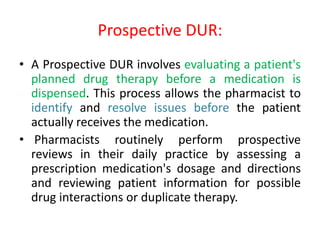
Prospective DUR:
• A Prospective DUR involves evaluating a patient's
planned drug therapy before a medication is
dispensed. This process allows the pharmacist to
identify and resolve issues before the patient
actually receives the medication.
• Pharmacists routinely perform prospective
reviews in their daily practice by assessing a
prescription medication's dosage and directions
and reviewing patient information for possible
drug interactions or duplicate therapy.
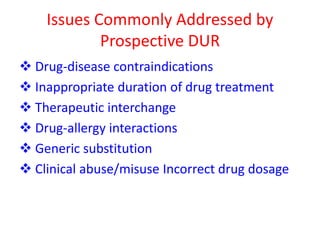
Issues Commonly Addressed by
Prospective DUR
 Drug-disease contraindications
 Inappropriate duration of drug treatment
 Therapeutic interchange
 Drug-allergy interactions
 Generic substitution
 Clinical abuse/misuse Incorrect drug dosage
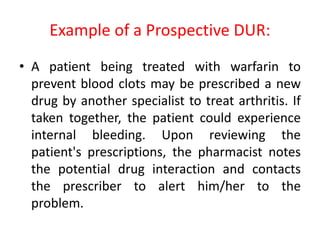
Example of a Prospective DUR:
• A patient being treated with warfarin to
prevent blood clots may be prescribed a new
drug by another specialist to treat arthritis. If
taken together, the patient could experience
internal bleeding. Upon reviewing the
patient's prescriptions, the pharmacist notes
the potential drug interaction and contacts
the prescriber to alert him/her to the
problem.
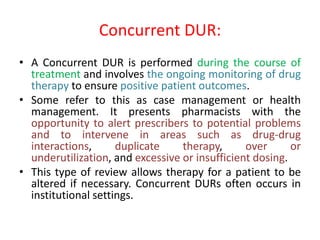
Concurrent DUR:
• A Concurrent DUR is performed during the course of
treatment and involves the ongoing monitoring of drug
therapy to ensure positive patient outcomes.
• Some refer to this as case management or health
management. It presents pharmacists with the
opportunity to alert prescribers to potential problems
and to intervene in areas such as drug-drug
interactions, duplicate therapy, over or
underutilization, and excessive or insufficient dosing.
• This type of review allows therapy for a patient to be
altered if necessary. Concurrent DURs often occurs in
institutional settings.
Issues Commonly Addressed by
Concurrent DUR:
Over and underutilization
 Drug-drug interactions
 Drug-age precautions
 Excessive doses
 Drug-gender precautions
 High or low dosages
 Drug-pregnancy precautions
 Duplicate therapy
 Drug-disease interactions
Example of a Concurrent DUR:
• Patients in institutional settings often receive
multiple medications. Periodic review of patient
records can detect actual or potential drug-drug
interactions or duplicate therapy. This type of
review can also alert the pharmacist to the need
for changes in medications such as antibiotics or
the need for dosage adjustments based on
laboratory test results. The key physician(s) must
then be alerted to the situation so that corrective
action can be taken.
Retrospective DUR:
• A retrospective DUR is the simplest to perform since
drug therapy is reviewed after the patient has received
the medication. A retrospective review may detect
patterns in prescribing, dispensing, or administering
drugs to prevent recurrence of inappropriate use or
abuse and serves as a means for developing
prospective standards and target interventions.
• In retrospective DUR, patient medical charts or
computerized records are screened to determine
whether the drug therapy met approved criteria and
aids prescribers in improving care for their patients,
individually and within groups of patients, such as
those with diabetes, asthma, or high blood pressure.
Issues Commonly Addressed by
Retrospective DUR:
 Therapeutic appropriateness
 Over and underutilization
 Appropriate generic use
 Therapeutic duplication
 Drug-disease contraindications
 Drug-drug interactions
 Incorrect drug dosage
 Inappropriate duration of treatment
Clinical abuse/misuse
Example of a Retrospective DUR:
• An analysis of member prescription utilization
may identify of a group of patients whose
therapy does not meet approved guidelines.
• Upon retrospective review the pharmacist may
identify a group of patients with asthma who,
according to their medical and pharmacy history,
should be using orally inhaled steroids. Using this
information, the pharmacist can then encourage
physicians to prescribe the indicated drugs.
Drug Utilization review

Drug Utilization review

  • 1.
  • 2.
    • Drug UtilizationReviews (DUR), also referred to as Drug Utilization Evaluations (DUE) or Medication Utilization Evaluations (MUE), are defined as an authorized, structured, ongoing review of healthcare provider prescribing, pharmacist dispensing, and patient use of medication. • DURs involve a comprehensive review of patient’s prescription and medication data before, during, and after dispensing to ensure appropriate medication decision making and positive patient outcomes.
  • 3.
    • DURs areclassified into three categories:  Prospective - Evaluation of a patient's therapy before medication is dispensed  Concurrent - Ongoing monitoring of drug therapy during the course of treatment  Retrospective - Review of therapy after the patient has received the medication
  • 4.
    Significance DUR programs playa key role in helping managed health care systems understand, interpret, and improve the prescribing, administration, and use of medications. Employers and health planners find DUR programs valuable because the results are used to foster more efficient use of scarce health care resources. Pharmacists play a key role in this process because of their expertise in the area of pharmaceutical care.
  • 5.
    • DURs affordthe managed care pharmacist the opportunity to identify trends in prescribing within groups of patients such as those with asthma, diabetes, or high blood pressure. • Pharmacists can then, in collaboration with other members of the health care team, initiate action to improve drugtherapy for both individual patients and covered populations. • DURs serve as a means of improving the quality of patient care, enhancing therapeutic outcomes, and reducing inappropriate pharmaceutical expenditures, thus reducing overall health care costs.
  • 6.
    Prospective DUR: • AProspective DUR involves evaluating a patient's planned drug therapy before a medication is dispensed. This process allows the pharmacist to identify and resolve issues before the patient actually receives the medication. • Pharmacists routinely perform prospective reviews in their daily practice by assessing a prescription medication's dosage and directions and reviewing patient information for possible drug interactions or duplicate therapy.
  • 7.
    Issues Commonly Addressedby Prospective DUR  Drug-disease contraindications  Inappropriate duration of drug treatment  Therapeutic interchange  Drug-allergy interactions  Generic substitution  Clinical abuse/misuse Incorrect drug dosage
  • 8.
    Example of aProspective DUR: • A patient being treated with warfarin to prevent blood clots may be prescribed a new drug by another specialist to treat arthritis. If taken together, the patient could experience internal bleeding. Upon reviewing the patient's prescriptions, the pharmacist notes the potential drug interaction and contacts the prescriber to alert him/her to the problem.
  • 9.
    Concurrent DUR: • AConcurrent DUR is performed during the course of treatment and involves the ongoing monitoring of drug therapy to ensure positive patient outcomes. • Some refer to this as case management or health management. It presents pharmacists with the opportunity to alert prescribers to potential problems and to intervene in areas such as drug-drug interactions, duplicate therapy, over or underutilization, and excessive or insufficient dosing. • This type of review allows therapy for a patient to be altered if necessary. Concurrent DURs often occurs in institutional settings.
  • 10.
    Issues Commonly Addressedby Concurrent DUR: Over and underutilization  Drug-drug interactions  Drug-age precautions  Excessive doses  Drug-gender precautions  High or low dosages  Drug-pregnancy precautions  Duplicate therapy  Drug-disease interactions
  • 11.
    Example of aConcurrent DUR: • Patients in institutional settings often receive multiple medications. Periodic review of patient records can detect actual or potential drug-drug interactions or duplicate therapy. This type of review can also alert the pharmacist to the need for changes in medications such as antibiotics or the need for dosage adjustments based on laboratory test results. The key physician(s) must then be alerted to the situation so that corrective action can be taken.
  • 12.
    Retrospective DUR: • Aretrospective DUR is the simplest to perform since drug therapy is reviewed after the patient has received the medication. A retrospective review may detect patterns in prescribing, dispensing, or administering drugs to prevent recurrence of inappropriate use or abuse and serves as a means for developing prospective standards and target interventions. • In retrospective DUR, patient medical charts or computerized records are screened to determine whether the drug therapy met approved criteria and aids prescribers in improving care for their patients, individually and within groups of patients, such as those with diabetes, asthma, or high blood pressure.
  • 13.
    Issues Commonly Addressedby Retrospective DUR:  Therapeutic appropriateness  Over and underutilization  Appropriate generic use  Therapeutic duplication  Drug-disease contraindications  Drug-drug interactions  Incorrect drug dosage  Inappropriate duration of treatment Clinical abuse/misuse
  • 14.
    Example of aRetrospective DUR: • An analysis of member prescription utilization may identify of a group of patients whose therapy does not meet approved guidelines. • Upon retrospective review the pharmacist may identify a group of patients with asthma who, according to their medical and pharmacy history, should be using orally inhaled steroids. Using this information, the pharmacist can then encourage physicians to prescribe the indicated drugs.