Topic 1: Language & Communication
Learning Outcomes:
• Demonstrate understanding of the key ideas in
language and communication.
• Relate your personal experience with input
presented.
What is Language?
• Linguists agree that a language can only be called
a language if it has system of rules (known as
grammar), a sound system (phonology), and a
vocabulary (lexicon).
• A system of conventional signals for
communication by a whole community. -AC
Gimson
What is Language?
• Language as instrument of communication.
• Without language, there will be no society
(binding force).
• Language serves as identity of the people
inhabiting a society.
• Backbone of society
Features of Language
• Vocal-auditory channel- vocalization and sound
perception
• Broadcasting transmission- everyone can hear
what has been said
• Interchangeability- role changes
• Total feedback- speakers can hear everything
what they say
Features of Language
• Semanticity- linguistic units have specific
meanings
• Arbitrariness- when naming things or events,
there is no connection/relationship between the
signified (object) and signifier (symbol)
• Discreteness- each utterance differ from all other
discretely
Features of Language
• Productivity/openness- new utterances can be
readily coined and understood
• Duality of patterning- meaningless phonemes
combined together to form meaningful and larger
sentences
• Traditional (cultural) transmission- language are
learned, not genetically encoded
Features of Language
• Prevarication- possibility of lying
• Learnability- speaker can learn other languages
Key Takeaways
• When people use language, they can understand
each other because they belong to the same
speech community. They can understand each
other because their speech community, people
share the same set of rules in the language
system.
Key Takeaways
• While growing up, people acquire the languages
used by those in the community. This is the
process of language acquisition. The languages
acquired while growing up are known as mother
tongues or referred to as first language.
Key Takeaways
• People later on that other languages are needed
for various reasons. These other languages may
be referred to as second languages. People learn
these languages by studying formally in school or
informally on their own. This process is called
language learning.
Key Takeaways
• As people broaden and explore, they come in
contact with several groups outside their speech
community, like a Filipino communicating
Chinese, Americans among others. This is process
is called language contact. It is the results into
phenomena such as code switching, language
shift, language loss and language death.
Key Takeaways
• Language is indeed a complex human capacity. It
is therefore important to be aware of its features
and behavior to be able to use language more
effectively and productively in communicating
with others.
Warming Up!
Activity 1:
• Group the class into ______.
• Each group needs to think of any communication
situation to re-enact or role play for 3-5 minutes
• Practice for 10 minutes.
Warming Up!
• Based on Activity 1, process the following.
• What is communication?
• What are the elements of communication?
• Describe/Explain the process of communication.
LEARNING OUTCOMES:
• Define communication;
• Discuss the following components of
communication:
a. Nature
b. Elements
c. Cycle and processes
d. Types
e. Functions
What is
Communication?
Comes from the Latin word
communis, meaning
commonness. It is a process
wherein knowledge, ideas,
information, attitudes,
feelings and the like are
transmitted.
Communication is a two-way
process by which
information is exchanged
between or among
individuals through a
common system of symbols,
signs and behavior.
“Any act by which one person
gives to or receives from
another person information
about that person’s needs,
desires, perceptions,
knowledge, or affective states.”
Julia Scherba de Valenzuela
“the exchange of thoughts,
messages, or information, as
by speech, signals, writing,”
free dictionary.com
“the act of conveying
information for the purpose of
creating a shared
understanding”
communication.com
NATURE OF COMUNICATION
1.Communication is
a process.
NATURE OF COMUNICATION
2. Communication
occurs between two or
more people (the
speaker and the
receiver).
NATURE OF COMUNICATION
3. Communication can be
expressed through written or
spoken words, actions
(nonverbal), or both spoken
words and nonverbal actions
at the same time.
ELEMENTS OF
COMUNICATION
The person
who intends
to convey or
send the
message.
It is the idea being
transmitted in the
communication process.
This can be opinion,
attitude, feelings, views,
orders, or suggestions.
It is the person
who receives
the message or
for whom the
message is
meant for.
It is the
receiver’s reply
to the sender.
Feedback
CONTEXT
It is the environment
where communication
takes place.
BARRIER
The factors that affect
the flow of communication
such as NOISE.
NOISE means
distractions that
interfere with accurate
transmission and
reception of a message.
External
Sights, sounds and any
other distractions in
the environment
Internal
Distractions within
the communicator like
physiological or
biological
Semantic
Unintentional meanings
caused by certain
symbols, ethnic slurs,
profanity and vulgar
speech
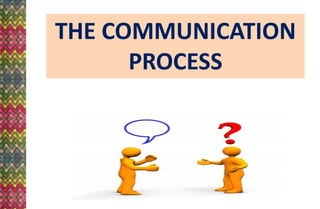
THE COMMUNICATION
PROCESS
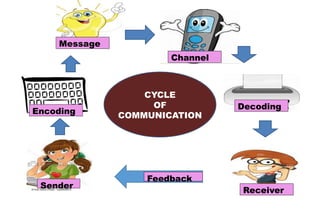
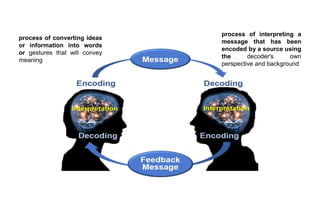
CYCLE
OF
COMMUNICATION
Sender
Encoding
Message
Channel
Decoding
Receiver
Feedback
process of converting ideas
or information into words
or gestures that will convey
meaning
process of interpreting a
message that has been
encoded by a source using
the decoder's own
perspective and background
TYPES OF
COMMUNICATION
VERBAL
It is the process of
transmitting a message
from a sender to the
receiver with the use of
words.
VERBAL
Consider
appropriateness, brevity,
clarity, ethics, and
vividness when engaging
in this type of
communication
NON-VERBAL
It is process of
sending message from
a sender to the receiver
with the use of signs or
symbols other than
words.
NON-VERBAL
Examples: stares, smiles, tone
of voice, movements, manners
of walking, standing and sitting,
appearance, style of attire,
attitude towards time and
space, personality, gestures,
and others
AURAL & VISUAL
A. Voice-Paralanguage
volume-loudness
rate- frequency
pitch- highness and lowness
tone- the way a person speaks to
someone
variety-being different or diverse
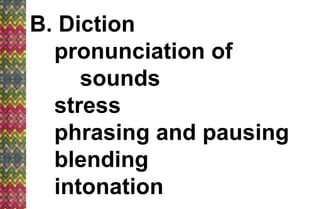
B. Diction
pronunciation of
sounds
stress
phrasing and pausing
blending
intonation
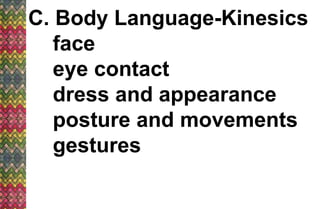
C. Body Language-Kinesics
face
eye contact
dress and appearance
posture and movements
gestures
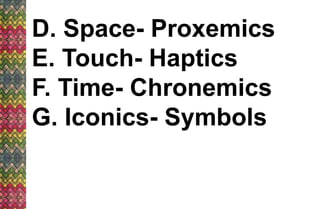
D. Space- Proxemics
E. Touch- Haptics
F. Time- Chronemics
G. Iconics- Symbols
Mastery of nonverbal communication is
important for several reasons:
1. It enhances and
emphasizes the message
of your speech, thus
making it more
meaningful, truthful, and
relevant.
Mastery of nonverbal communication is
important for several reasons:
2. It communicates
feelings, attitudes, and
perceptions without you
saying a word.
Mastery of nonverbal communication is
important for several reasons:
3. It can sustain the
attention of listeners
and keep them engaged
in the speech.
Mastery of nonverbal communication is
important for several reasons:
4. It gives the audience a
preview to the type of
speaker you are.
Mastery of nonverbal communication is
important for several reasons:
5. It makes you appear
more dynamic and
animated in your
delivery.
Mastery of nonverbal communication is
important for several reasons:
6. It serves as a channel
to release tension and
nervousness.
Mastery of nonverbal communication is
important for several reasons:
7. It makes you a credible
speaker.
8. It helps you vary your
speaking style and avoid a
monotonous delivery.
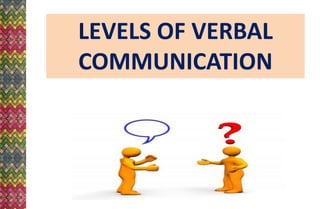
LEVELS OF VERBAL
COMMUNICATION
INTRAPERSONAL
This refers to
communication that centers
on one person where the
speaker acts both as the
sender and the receiver of
message.
INTERPERSONAL
This refers to communication
between and among people and
establishes personal
relationship between and among
them.
1. Dyad Communication
2. Small Group Discussion (3-12
persons)
PUBLIC
This type refers to
communication that
requires you to deliver or
send the message before or
in front of a group.
PUBLIC
The message can be driven
by informational or persuasive
purposes.
The voice is louder and the
gestures are more expansive
because the audience is bigger.
MASS
This refers to
communication that takes
place through television, radio,
newspapers, magazines,
books, billboards, internet,
and other types of media.
FUNCTIONS OF COMMUNICATION
1. Control – Communication
functions to control
behavior.
FUNCTIONS OF COMMUNICATION
2. Social Interaction –
Communication allows
individuals to interact with
others.
FUNCTIONS OF COMMUNICATION
3. Motivation –
Communication motivates
or encourages people to
live better.
FUNCTIONS OF COMMUNICATION
4. Emotional expression –
Communication facilitates
people’s expression of their
feelings and emotions.
FUNCTIONS OF COMMUNICATION
4. Emotional expression –
Communication facilitates
people’s expression of their
feelings and emotions.
FUNCTIONS OF COMMUNICATION
5. Information
dissemination –
Communication
functions to convey
information.
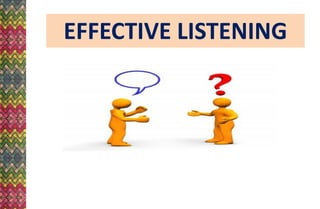
EFFECTIVE LISTENING
ADVANTAGES OF LISTENING WELL
1. Faster and more efficient
way of gathering information
than reading.
2. If you don’t understand the
speaker’s discourse, you can
clarify immediately.
ADVANTAGES OF LISTENING WELL
3. Sometimes writing may
seem dull and difficult to
understand can often be
understood and
appreciated if you listen to
it.
ADVANTAGES OF LISTENING WELL
4. Good listening is one of the
best known ways for
improving language facility.
ADVANTAGES OF LISTENING WELL
5. Good and critical listening
gives you a chance to understand
a speaker’s message, clarify his
motives, and evaluate the whole
purpose of the communication
BARRIERS TO EFFECTIVE LISTENING
1. Supersensitive Listening
3. Premature Dismissal of a
Subject as Uninteresting
2. Avoiding Difficult Explanations
4. Finding Fault with a Speaker’s
Delivery or Appearance
IDENTIFY 3
POSSIBLE WAYS
TO DEVELOP
YOUR LISTENING
SKILLS
BUILDING A GOOD LISTENING HABIT
1. Think of the other person.
3. Show interest. Do not do other
things at the same time.
2. Listen not only with your ears,
but with your mind.
BUILDING A GOOD LISTENING HABIT
4. Take down notes.
6. Summarize mentally what the
speaker is saying.
5. Note facial expressions and the
speaker’s tone of voice.

1Lesson-1-Introduction_Communication.pdf

  • 1.
    Topic 1: Language& Communication Learning Outcomes: • Demonstrate understanding of the key ideas in language and communication. • Relate your personal experience with input presented.
  • 2.
    What is Language? •Linguists agree that a language can only be called a language if it has system of rules (known as grammar), a sound system (phonology), and a vocabulary (lexicon). • A system of conventional signals for communication by a whole community. -AC Gimson
  • 3.
    What is Language? •Language as instrument of communication. • Without language, there will be no society (binding force). • Language serves as identity of the people inhabiting a society. • Backbone of society
  • 4.
    Features of Language •Vocal-auditory channel- vocalization and sound perception • Broadcasting transmission- everyone can hear what has been said • Interchangeability- role changes • Total feedback- speakers can hear everything what they say
  • 5.
    Features of Language •Semanticity- linguistic units have specific meanings • Arbitrariness- when naming things or events, there is no connection/relationship between the signified (object) and signifier (symbol) • Discreteness- each utterance differ from all other discretely
  • 6.
    Features of Language •Productivity/openness- new utterances can be readily coined and understood • Duality of patterning- meaningless phonemes combined together to form meaningful and larger sentences • Traditional (cultural) transmission- language are learned, not genetically encoded
  • 7.
    Features of Language •Prevarication- possibility of lying • Learnability- speaker can learn other languages
  • 8.
    Key Takeaways • Whenpeople use language, they can understand each other because they belong to the same speech community. They can understand each other because their speech community, people share the same set of rules in the language system.
  • 9.
    Key Takeaways • Whilegrowing up, people acquire the languages used by those in the community. This is the process of language acquisition. The languages acquired while growing up are known as mother tongues or referred to as first language.
  • 10.
    Key Takeaways • Peoplelater on that other languages are needed for various reasons. These other languages may be referred to as second languages. People learn these languages by studying formally in school or informally on their own. This process is called language learning.
  • 11.
    Key Takeaways • Aspeople broaden and explore, they come in contact with several groups outside their speech community, like a Filipino communicating Chinese, Americans among others. This is process is called language contact. It is the results into phenomena such as code switching, language shift, language loss and language death.
  • 12.
    Key Takeaways • Languageis indeed a complex human capacity. It is therefore important to be aware of its features and behavior to be able to use language more effectively and productively in communicating with others.
  • 13.
    Warming Up! Activity 1: •Group the class into ______. • Each group needs to think of any communication situation to re-enact or role play for 3-5 minutes • Practice for 10 minutes.
  • 14.
    Warming Up! • Basedon Activity 1, process the following. • What is communication? • What are the elements of communication? • Describe/Explain the process of communication.
  • 15.
    LEARNING OUTCOMES: • Definecommunication; • Discuss the following components of communication: a. Nature b. Elements c. Cycle and processes d. Types e. Functions
  • 16.
  • 17.
    Comes from theLatin word communis, meaning commonness. It is a process wherein knowledge, ideas, information, attitudes, feelings and the like are transmitted.
  • 18.
    Communication is atwo-way process by which information is exchanged between or among individuals through a common system of symbols, signs and behavior.
  • 19.
    “Any act bywhich one person gives to or receives from another person information about that person’s needs, desires, perceptions, knowledge, or affective states.” Julia Scherba de Valenzuela
  • 20.
    “the exchange ofthoughts, messages, or information, as by speech, signals, writing,” free dictionary.com
  • 21.
    “the act ofconveying information for the purpose of creating a shared understanding” communication.com
  • 22.
  • 23.
    NATURE OF COMUNICATION 2.Communication occurs between two or more people (the speaker and the receiver).
  • 24.
    NATURE OF COMUNICATION 3.Communication can be expressed through written or spoken words, actions (nonverbal), or both spoken words and nonverbal actions at the same time.
  • 25.
  • 26.
    The person who intends toconvey or send the message.
  • 27.
    It is theidea being transmitted in the communication process. This can be opinion, attitude, feelings, views, orders, or suggestions.
  • 28.
    It is theperson who receives the message or for whom the message is meant for.
  • 29.
    It is the receiver’sreply to the sender. Feedback
  • 30.
    CONTEXT It is theenvironment where communication takes place.
  • 31.
    BARRIER The factors thataffect the flow of communication such as NOISE.
  • 32.
    NOISE means distractions that interferewith accurate transmission and reception of a message.
  • 33.
    External Sights, sounds andany other distractions in the environment
  • 34.
    Internal Distractions within the communicatorlike physiological or biological
  • 35.
    Semantic Unintentional meanings caused bycertain symbols, ethnic slurs, profanity and vulgar speech
  • 36.
  • 37.
  • 38.
    process of convertingideas or information into words or gestures that will convey meaning process of interpreting a message that has been encoded by a source using the decoder's own perspective and background
  • 39.
  • 40.
    VERBAL It is theprocess of transmitting a message from a sender to the receiver with the use of words.
  • 41.
    VERBAL Consider appropriateness, brevity, clarity, ethics,and vividness when engaging in this type of communication
  • 42.
    NON-VERBAL It is processof sending message from a sender to the receiver with the use of signs or symbols other than words.
  • 43.
    NON-VERBAL Examples: stares, smiles,tone of voice, movements, manners of walking, standing and sitting, appearance, style of attire, attitude towards time and space, personality, gestures, and others
  • 44.
    AURAL & VISUAL A.Voice-Paralanguage volume-loudness rate- frequency pitch- highness and lowness tone- the way a person speaks to someone variety-being different or diverse
  • 45.
  • 46.
    C. Body Language-Kinesics face eyecontact dress and appearance posture and movements gestures
  • 47.
    D. Space- Proxemics E.Touch- Haptics F. Time- Chronemics G. Iconics- Symbols
  • 48.
    Mastery of nonverbalcommunication is important for several reasons: 1. It enhances and emphasizes the message of your speech, thus making it more meaningful, truthful, and relevant.
  • 49.
    Mastery of nonverbalcommunication is important for several reasons: 2. It communicates feelings, attitudes, and perceptions without you saying a word.
  • 50.
    Mastery of nonverbalcommunication is important for several reasons: 3. It can sustain the attention of listeners and keep them engaged in the speech.
  • 51.
    Mastery of nonverbalcommunication is important for several reasons: 4. It gives the audience a preview to the type of speaker you are.
  • 52.
    Mastery of nonverbalcommunication is important for several reasons: 5. It makes you appear more dynamic and animated in your delivery.
  • 53.
    Mastery of nonverbalcommunication is important for several reasons: 6. It serves as a channel to release tension and nervousness.
  • 54.
    Mastery of nonverbalcommunication is important for several reasons: 7. It makes you a credible speaker. 8. It helps you vary your speaking style and avoid a monotonous delivery.
  • 55.
  • 56.
    INTRAPERSONAL This refers to communicationthat centers on one person where the speaker acts both as the sender and the receiver of message.
  • 57.
    INTERPERSONAL This refers tocommunication between and among people and establishes personal relationship between and among them. 1. Dyad Communication 2. Small Group Discussion (3-12 persons)
  • 58.
    PUBLIC This type refersto communication that requires you to deliver or send the message before or in front of a group.
  • 59.
    PUBLIC The message canbe driven by informational or persuasive purposes. The voice is louder and the gestures are more expansive because the audience is bigger.
  • 60.
    MASS This refers to communicationthat takes place through television, radio, newspapers, magazines, books, billboards, internet, and other types of media.
  • 61.
    FUNCTIONS OF COMMUNICATION 1.Control – Communication functions to control behavior.
  • 62.
    FUNCTIONS OF COMMUNICATION 2.Social Interaction – Communication allows individuals to interact with others.
  • 63.
    FUNCTIONS OF COMMUNICATION 3.Motivation – Communication motivates or encourages people to live better.
  • 64.
    FUNCTIONS OF COMMUNICATION 4.Emotional expression – Communication facilitates people’s expression of their feelings and emotions.
  • 65.
    FUNCTIONS OF COMMUNICATION 4.Emotional expression – Communication facilitates people’s expression of their feelings and emotions.
  • 66.
    FUNCTIONS OF COMMUNICATION 5.Information dissemination – Communication functions to convey information.
  • 67.
  • 68.
    ADVANTAGES OF LISTENINGWELL 1. Faster and more efficient way of gathering information than reading. 2. If you don’t understand the speaker’s discourse, you can clarify immediately.
  • 69.
    ADVANTAGES OF LISTENINGWELL 3. Sometimes writing may seem dull and difficult to understand can often be understood and appreciated if you listen to it.
  • 70.
    ADVANTAGES OF LISTENINGWELL 4. Good listening is one of the best known ways for improving language facility.
  • 71.
    ADVANTAGES OF LISTENINGWELL 5. Good and critical listening gives you a chance to understand a speaker’s message, clarify his motives, and evaluate the whole purpose of the communication
  • 72.
    BARRIERS TO EFFECTIVELISTENING 1. Supersensitive Listening 3. Premature Dismissal of a Subject as Uninteresting 2. Avoiding Difficult Explanations 4. Finding Fault with a Speaker’s Delivery or Appearance
  • 73.
    IDENTIFY 3 POSSIBLE WAYS TODEVELOP YOUR LISTENING SKILLS
  • 74.
    BUILDING A GOODLISTENING HABIT 1. Think of the other person. 3. Show interest. Do not do other things at the same time. 2. Listen not only with your ears, but with your mind.
  • 75.
    BUILDING A GOODLISTENING HABIT 4. Take down notes. 6. Summarize mentally what the speaker is saying. 5. Note facial expressions and the speaker’s tone of voice.