Unit 4.communicationUnit 4.communication
Radha paudel
MMIHS, Nursing faculty
Wednesday, January 31, 20181
Unit 4.communicationUnit 4.communication
• Meaning/definition, purpose and types
of communication
• Communication process
• Barriers and measure of overcoming
them
• Principles of effective communication
• Interview- aims, kinds and technique
Wednesday, January 31, 20182
What is communication?What is communication?
• The word communication is
derived from Latin word
“communis” which means
common or commonness.
• It is a act of developing and
gaining understanding between
two or more people.
Wednesday, January 31, 20183
• It is the process of exchanging
information and feelings between
people.
• It is the transfer of information and
understanding from one person to
another.
Wednesday, January 31, 20184
CommunicationCommunication
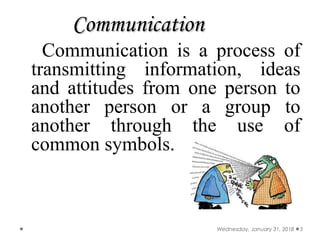
Communication is a process of
transmitting information, ideas
and attitudes from one person to
another person or a group to
another through the use of
common symbols.
Wednesday, January 31, 2018 5
Cont…Cont…
• Communication is a process by
which information, decision and
direction passed through a social
system and the ways in which
knowledge, opinion and attitude are
formed or modified.
Wednesday, January 31, 20186
Communication is the art of
transmitting information, ideas and
attitude from one person to another.
communication is the process of
meaningful interaction among human
beings.
Wednesday, January 31, 20187
Cont…Cont…
• Communication, a part of normal
relationship with other people, is a
process of exchanging the ideas,
information, knowledge and message
to bring the desired change in the
behavior of people.
Wednesday, January 31, 20188
Cont….Cont….
• Communication is a two-way
process of reaching mutual
understanding , in which
participants not only exchange
information but also create and
share meaning.
Wednesday, January 31, 2018 9
Cont…Cont…
• summary of communication
• The exchange of message convening
information ideas attitudes emotions
opinions or instructions between
individuals or groups with the objectives
of creating understanding or coordinating
activities is known as communication.
Communication may be verbal or non-
verbal and include spoken , written and
visual elements. Wednesday, January 31, 201810
Health CommunicationsHealth Communications
• It is a process of exchanging and
shaping the health ideas,
information, knowledge and
massage to bring desired change in
the health behavior and practice so
that the health of the person can be
promoted well.
Wednesday, January 31, 201811
What are the most common ways
we communicate?
Spoken Word
Written Word
Visual Images
Body Language
Wednesday, January 31, 201812
Purpose ofPurpose of
communicationcommunication
• The purpose of communication is to allow the
exchange of information, ideas, concepts,
emotions, thoughts and opinions.
• It is done with aim of socialization as well as
development. Communication is part of life.
• To inform
• To influence
• To express feelings
Wednesday, January 31, 201813
Types/methods of CommunicationTypes/methods of Communication
• One Way communication
• Two way communication
• Written Communication
• Verbal Communication
• Non Verbal Communication (symbolic)
• Formal and informal communication
• Tele communication and internet
Wednesday, January 31, 201814
1.One way communication1.One way communication..
The flow of communication is ‘one way’ from
the communicator to the audience. eg the
lecture method in class rooms, lecture in mass
gathering by political leader. The drawbacks
of the one way communication.
• Knowledge is imposed
• Little audience participation.
• No feedback.
• Learning is authoritative, rapid
• Message transmission – sender to receiver
Wednesday, January 31, 201815
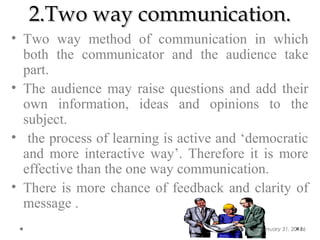
2.Two way communication.2.Two way communication.
• Two way method of communication in which
both the communicator and the audience take
part.
• The audience may raise questions and add their
own information, ideas and opinions to the
subject.
• the process of learning is active and ‘democratic
and more interactive way’. Therefore it is more
effective than the one way communication.
• There is more chance of feedback and clarity of
message .
Wednesday, January 31, 201816
3.Verbal communication.3.Verbal communication.
The verbal means of
communication includes the use
of language whether spoken or
written.
The encoding of messages into
words, either written or spoken.
Wednesday, January 31, 201817
Cont…Cont…
Written communication may not
be as persuasive (influential) or
personal as the spoken word.
It is effective methods of
communication there is clarity,
accuracy and certainty.
Wednesday, January 31, 201818
4.Non –verbal communication4.Non –verbal communication
Nonverbal communication is the
exchange of information without the
use of words. There are various ways
in which information is exchanged
through nonverbal communication.
The encoding of messages by means
of facial expressions, body language,
and styles of dress, Hand gesture,
Touch. Raising eye brows, Silence.etc
Wednesday, January 31, 2018 19
Examples ofExamples of
Decoding Nonverbal CuesDecoding Nonverbal Cues
Boss fails to acknowledge
employee’s greeting
No eye contact
while
communicating
Manager sighs deeply
Boss breathes
heavily &
waves arms
He’s
unapproachable!
My opinion
doesn’t count
I wonder what
he’s hiding?
He’s angry! I’ll
stay out of
his way!
SOURCE: Adapted from “Steps to Better Listening” by C. Hamilton and B. H. Kleiner. Copyright © February 1987. Reprinted with permission, Personnel Journal, all rights reserved.
Wednesday, January 31, 201820
5.Written communication.5.Written communication.
The written and printed
matter also used in
communication eg memo,
reports, books, letter etc.
Wednesday, January 31, 2018 21
6.Formal and informal communication6.Formal and informal communication
Communication has been classified into
two group formal and informal. Formal
(follows lines of authority) and informal
(grape-vine) .The informal channels may
be more active than formal channel.
Wednesday, January 31, 201822
7.Tele communication and7.Tele communication and
internetinternet
Communication is the process of
communicating over distance
using electromagnetic
instruments eg Radio. TV,
internet etc.
Wednesday, January 31, 201823
Why is communicationWhy is communication
necessary for nurses?necessary for nurses?
• Communication skills help generate trust
between the nurse and clients.
• To provide job satisfaction.
• To give and receive instructions.
• To provide means of co-ordination.
Wednesday, January 31, 201824
Result of poorResult of poor
communication:communication:
• Reduced productivity.
• Duplication of work.
• Neglect of some task.
• Poor group feelings, frustration.
• Insecurity and undisciplined patients,
clients and staff.
Wednesday, January 31, 201825
Elements ofElements of
Communication/Component ofCommunication/Component of
communicationcommunication..
1. Sender (Source)
2. Message ( Content)
3. Channel ( Medium)
4. Receiver ( Audience)
5. Feed back (Effect)
Wednesday, January 31, 201826
Elements of Communication
Communicator
Perception &
Interpretation
Perception &
InterpretationEncoding
Channel Nonverbal
Communications
Communication ProcessCommunication Process
Sender EncodesEncodes Medium DecodesDecodes Receiver
NoiseNoise
Feedback
NoiseNoise
Social ContextSocial Context
Basic Element in Communication Process
Fig: Process of CommunicationFig: Process of Communication
•
SenderSender MassageMassage ChannelChannel ReceiverReceiver
FeedbackFeedback
Wednesday, January 31, 201829
The Communication Process
SENDER
(encodes)
RECEIVER
(decodes)
Barrier
Barrier
Medium
Feedback/Response
Wednesday, January 31, 201830
Wednesday, January 31, 2018 31
Communication NetworksCommunication Networks
Chain Wheel
All Channels
Wednesday, January 31, 201832
Flow of communicationFlow of communication
At the workplace
* Upward
From subordinates to superior
* Downward
From superiors to the subordinates
* Lateral
From one employee to another
1.Sender1.Sender
• The sender (communicator) is the
originator of the message.
• The sender initiates a message exactly
what the receiver wants.
Wednesday, January 31, 201834
Wednesday, January 31, 2018
35
EncodingEncoding
• The transmitter which converts the message
into signals.
• signals may be verbal, written, pictorial and so
on.
• It is the sender’s perception of the message
/ideas.
Wednesday, January 31, 201836
2.Message2.Message
• Message is the information or
(‘technical know-how’) which the
communicator transmits to his
audience to receive, understand,
accept and act upon. It may be in the
word, pictures or signs.
Wednesday, January 31, 201837
A good message must be:
With the objectives.
Meaning full/purposeful.
Based on the felt /
community needs.
Clear and understandable.
Wednesday, January 31, 201838
Specific , scientifically sound
accurate and current.
Timely and adequate
Covering only one point at a
time.
Understandable by audience.
Interesting and value of the
audience.
Culturally and socially Wednesday, January 31, 201839
3.Channels of communication.3.Channels of communication.
Channel is implied the ‘ physical bridge’
or the media of communication between
the sender and the receiver. These are:
1. Interpersonal:
• Face to face communication.
• Corresponding.
• E-mail, internet
2.Mass media:
T.V, Radio, Wall printed, Poster, Books,
Pump let, Drama, Singing, Film hall etc.
Wednesday, January 31, 2018 40
4.Receiver4.Receiver
All communications must have
an audience, this may be a
single person or a group of
people. without the audience
communication is nothing.
Wednesday, January 31, 201841
DecodingDecoding
• The process of translating
message to be understandable
by the receiver is known as
decoding. The decoding
process my be differ in each
individual.
Wednesday, January 31, 201842
5.Feed back:5.Feed back:
It is the flow of information from the audience
to the sender. It is the reaction of the audience
to the message. If the message is not clear or
not acceptable to the audience may reject it.
The feedback thus provides an opportunity to
the sender to modify his/ her message and
render it acceptable. In interpersonal
communication the feedback is immediate. In
mass communication it takes some times to get
feedback.
Wednesday, January 31, 2018 43
Barriers toBarriers to
communication.communication.
There are many barriers in
communication. These barriers make
it hard for us to understand the
message. The barriers should be
identified and removed as much as
possible to achieve effective
communication:
. Wednesday, January 31, 201844
These barriers are:
Physiological,
psychological,
environmental,
cultural and others
Wednesday, January 31, 2018 45
Barriers to communication
• Noise
• Inappropriate medium
• Assumptions/Misconceptions
• Emotions
• Language differences
• Poor listening skills
• Distractions
Wednesday, January 31, 201846
Hearing Vs Listening
Hearing – Physical
process, natural,
passive
Listening – Physical as
well as mental
process, active,
learned process, a skill
Listening is hard.
You must choose to participate in the process of
listening. Wednesday, January 31, 201847
1.Physiological barriers:1.Physiological barriers:
Hearing.
Vision problem and speaking
problem.
Smelling and testing problem.
Wednesday, January 31, 201848
2.Psychological barriers2.Psychological barriers
These are mental condition,
• Emotional disturbance,
nervousness.
• Level of intelligence.
Wednesday, January 31, 201849
3.Environmental barriers3.Environmental barriers
It also play a important role in
communication. If environment is
pleasant then things become
clear to understand. If the
environment is noise, the person
feels bored because of cannot
hear properly.
Wednesday, January 31, 201850
Noise.
Invisibility.
Too much cold and hot.
Seating arrangement.
Congestion etc.
Wednesday, January 31, 201851
4.Cultural barriers:4.Cultural barriers:
It is also one of the important factors in barrier of
communication. One person can understand
quickly, another may not.
Language problem.
Illiteracy.
Level of understanding.
Custom.
Belief, religion.
Economic and social class differences.
Language. Wednesday, January 31, 2018 52
5.Channels barriers of5.Channels barriers of
communication:communication:
Defective channel with
mechanical disturbance, electric
disturbance in
• Cassette player.
• Radio.
• television etc. Wednesday, January 31, 201853
Other barriers of communication:Other barriers of communication:
• Filtering: The information may be filtered
by the sender eg. Sender holds
communication as they think receiver do
not need it.
• Selective perception: they selectively
perceive the message based on the needs,
organizational requirement and
background of the employees. cont.
Wednesday, January 31, 201854
Cont….Cont….
• Information overload: Managers are
flooded with information from various
sources. Many of these message are
either overlooked or misinterpreted.
• Time pressure: Manager is often
subjected to time pressure, because
decisions must be made within specified
deadlines. Such time pressure creates
communication problems.
Wednesday, January 31, 201855
Importance of nurse relationships withImportance of nurse relationships with
individual, family, group and community:individual, family, group and community:
1.It helps to work together with the person
to fulfill the objectives of the institution,
self or programme in the community.
2. Importance to exchange their views,
ideas and experiences with other without
hesitation and helps to make decision on
existing problems.
Wednesday, January 31, 201856
3.To make the programme more
effective by getting co-operation
as well as co-ordination of ideas.
4.To motivate the people to bring
change in their health behaviour
or makes positive towards health.
Wednesday, January 31, 201857
Maintenance of effectiveMaintenance of effective
communication:communication:
1.We should use the right word in right place
to the right person at the right time with the
right manner.
2.Use simple, clear concise, exact and
familiar words avoid using technical words.
3.Use a combination of talk demonstration
and return demonstration.
Wednesday, January 31, 201858
Effective communicationEffective communication
• Speaking through eyes
• Voice level
• Audience awareness
• Facial expression
• Posture
• Dress sense
Wednesday, January 31, 2018 59
Effective communication 7 csEffective communication 7 cs
They are also called the seven Cs of
communication.
1.Completeness
2.Conciseness
3.Clarity
4.Correctness
5.Consideration
6.Courtesy
7.Concreteness
Wednesday, January 31, 2018
60
• Completeness
Every communication must be
complete and adequate.
Incomplete messages keep the
receiver guessing, create
misunderstanding and delay actions.
Every person should, therefore, be
provided with all the required facts
and figures.
Wednesday, January 31, 201861
• Conciseness
1. A concise message saves time and
expense for both sender and
receiver.
2.Conciseness contributes to emphasis;
by eliminating unnecessary words,
you let important ideas stand out.
3. When combined with a “you-view”,
concise messages are inherently
more interesting to recipients as they
avoid unnecessary information.
Wednesday, January 31, 201862
• Clarity ity means getting your message
across so the receiver will understand what
you are trying to convey.
2. You want that person to interpret your
words with the same meaning you have in
mind.
3. Accomplishing that goal is difficult
because, as you know, individual
experiences are never identical, and words
have different meanings to different persons.
.
Wednesday, January 31, 201863
Cont..Cont..
• Here are some specific ways to help
make your messages clear:
1. Choose short, familiar,
conversational words.
2. Construct effective sentences and
paragraphs.
3. Achieve appropriate readability
(and listenability).
4. Include examples, illustrations, and
other visual aids, when desirable
Wednesday, January 31, 201864
• Correctness
• 1. The term correctness as applied to business
messages means right level of language and
accuracy of facts, figures and words.
2. If the information is not correctly conveyed,
the sender will lose credibility
3. Transmission of incorrect information to
superiors will vitiate decision making process.
Wednesday, January 31, 201865
Cont…Cont…
4. Transmission of incorrect information
to outsiders will spoil the public image of
the firm.
5. To convey correct messages,
grammatical errors should also be
avoided.
6. You should not transmit any message
unless you are absolutely sure of its
correctness.
Wednesday, January 31, 201866
• Consideration
1. Consideration means that you
prepare every message with the
recipient in mind and try to put
yourself in his or her place.
2. Try to visualize your readers (or
listeners)—with their desires,
problems, circumstances, emotions,
and probable reactions to your
request.
Wednesday, January 31, 201867
Cont..Cont..
• 3. Then handle the matter from their
point of view.
4. This thoughtful consideration is also
called "you-attitude," empathy, the
human touch, and understanding of
human nature. (It does not mean,
however, that you should overlook the
needs of your organization.)
Wednesday, January 31, 201868
• Consideration
1. Consideration underlies the other six C's of
good business communication
2. You adapt your language and message
content to your receiver's needs when you
make your message complete, concise,
concrete, clear, courteous, and correct.
However, in four specific ways you can
indicate you are considerate:
• Focus on "you" instead of "I" and "we."
• Show reader benefit or interest in reader.
• Emphasize positive, pleasant facts.
• Apply integrity and ethic
Wednesday, January 31, 201869
• Courtesy
•Courteous messages help to
strengthen present business
friendships, as well as make new
friends.
•Courtesy stems from sincere you-
attitude.
•It is not merely politeness with
mechanical insertions of "please's" and
"thank-you'd.“
Wednesday, January 31, 201870
• To be courteous, considerate communicators
should follow these suggestions regarding
tone of the communications.
•Be sincerely tactful, thoughtful, and
appreciative.
• Omit expressions that irritate, hurt, or
belittle.
• Grant and apologize good-naturedly.
Wednesday, January 31, 201871
• Concreteness
• Communicating concretely means
being specific, definite, and vivid
rather than vague and general.
• The following guidelines should help
you compose concrete, convincing
messages:
• Use specific facts and figures.
• Put action in your verbs.
• Choose vivid, image-building words.
Wednesday, January 31, 201872
Interpersonal CommunicationInterpersonal Communication
Simply, It is a process between two
persons having communication to
exchange and shape the ideas,
information, knowledge and massage
to have a desired change .
Wednesday, January 31, 201873
Interpersonal CommunicationInterpersonal Communication(Contd(Contd
 Interpersonal communication can mean the ability to
relate to people in written as well as verbal
communication.
 This type of communication can occur in both a one-
on-one and sometimes in group setting.
 This also means being able to handle different people
in different situations, and making people feel at
ease.
Wednesday, January 31, 201874
Interpersonal CommunicationInterpersonal Communication(Contd.)(Contd.)
• Gestures such as eye contact, body
movement, and hand gestures are
also part of IPC
• Interpersonal communication
involves face-to-face communication
in a way that accomplishes the
purpose and is appropriate.
Wednesday, January 31, 201875
Interpersonal relationshipsInterpersonal relationships
• Definition of IPR:
• A multitude (great number of things or
people) of practices and activities
designed to win the goodwill (establish
popularities of a business, friendly) and
co operational relationship.
• The link, contact or dealing between two
people is called interpersonal
relationship.
Wednesday, January 31, 201876
Methods of InterpersonalMethods of Interpersonal
CommunicationCommunication
Interpersonal Communication
PersonalPersonal ContactContact HomeHome VisitVisit PersonalPersonal LetterLetter
InterviewInterview
TelephoneTelephone
ConversationConversation
ChattingChatting
ObservationObservation
DialogueDialogue
Email/FaxEmail/Fax
LatterLatter
Wednesday, January 31, 201877
Importance of I.P.R.Importance of I.P.R.
1. I.P.R is one of the important ways of
establishing public relation.
2. It helps to work together with the person
to fulfill the objectives of the institution,
self or programme in the community.
3. If there is good IPR personnel can
exchange their views, ideas and
experiences with other without
hesitation, it helps to make decision or a
existing problem.
Wednesday, January 31, 201878
Cont..Cont..
4. It makes the programme more effective
by getting co-operation as well as co-
ordination of ideas.
5. Good IPR motivates the people to bring
change in their health behaviour or
makes positive towards health.
Therefore IPR is very much
important in every sector of country to
run an organization smoothly and
achieve goal.
Wednesday, January 31, 201879
Ten Ways to Improve Your Interpersonal SkillsTen Ways to Improve Your Interpersonal Skills
1. Smile.
2. Be appreciative.
3. Pay attention to others.
4. Practice active listening.
5. Bring people together.
6. Resolve conflicts.
7. Communicate clearly.
8. Humor them.
9. See it from their side.
10.Don't always complain
Key to effectiveKey to effective
communication:communication:
1.Ideas should be accurate, systematic, and
clear.
2. We should use the right word in the right
place to the right person at the right time
with the right manner.
3.Use simple, clear, concise, exact and
familiar words avoid using technical
words.
Wednesday, January 31, 201881
4.Use a combination of talk, demonstration
and return demonstration.
5. Communicate according to the need and
interest of the audience.
6. Do not discuss their cases or other
inappropriate topics in front of them.
Wednesday, January 31, 201882
7. Listen to others with an open mind and
not just hear.
8. Repeat the information especially main
points and always appreciate the audience
for positive change.
9. Do not try to give too much information
at one time.
Wednesday, January 31, 201883
Interview,- aims, kinds
and technique
Wednesday, January 31, 201884
InterviewInterview
• Interview is a purposeful face to face
interaction between interviewer and
interviewee for getting knowledge, attitude
and practice in particular issues.
• Interview is a piece of social interaction with
one person asking a number of questions and
the other person giving answers.
Wednesday, January 31, 201885
Aims of interviewAims of interview
• To obtain details information by face to
face contact.
• To obtain answer with details
clarification
• To obtain personal view regarding certain
issues
• To find out various view related to topic
and solve the problem.
Wednesday, January 31, 201886
Types of interviewTypes of interview
• Structured interview- when the
interview is structured with a format
• Semi structured interview
• Unstructured interview
Wednesday, January 31, 201887
Technique for a successfulTechnique for a successful
interviewinterview
1. Establishing contact.
2. Starting an interview.
3. Securing rapport.
4. Recall.
5. Probe question.
Wednesday, January 31, 2018 88
Cont..Cont..
6. Encouragement
7. Guiding the interview.
8. Recording.
9. Closing the interview.
10.Report.
Wednesday, January 31, 201889
1.Establishing contact:1.Establishing contact:
Before conducting an interview is to
establish contact with the interviewee. It
is important to inform about date, time
and place for interview to interviewee for
better understanding so that interviewee
can have a sense of satisfaction and
feeling of importance.
Wednesday, January 31, 201890
2. Starting an interview:2. Starting an interview:
While having interview, it should be started with
general discussion at the beginning of the
period. The interviewer should create a pleasant
atmosphere while interviewing. So that the
interviewee can give answer freely. The
interviewer should let her/him talk without
interruption in between .He should be a listener
but he has to direct or help from time to time
when there is necessary.
Wednesday, January 31, 201891
3.3. Securing Rapport (harmoniousSecuring Rapport (harmonious
understanding relationshipunderstanding relationship
While interviewing a good rapport
should be established between the
interviewee and interviewer. Good
rapport requires a friendly environment
and has to gain confidence of
interviewee. The interviewer should
have good attitude or manner so that
interviewee can respond to him
properly. Wednesday, January 31, 201892
4. Recall4. Recall
During the time of interview the
interviewee may get upset and he/ she
may be silent and may be away from the
main subject. So in that case the
interviewer should give enough time to
the interviewee to recollect and start
again. It may be necessary to refresh his/
her memory by pointing out what they
had been saying last.
Wednesday, January 31, 2018 93
5.Probe question:5.Probe question:
The interviewer has to be
careful side tracts in between
conversation. Great care
should be taken inputting
probe question.
Wednesday, January 31, 201894
6.Encouragement :6.Encouragement :
Interviewer should give
encouragement to the
interviewee to make him/ her
fully confident to tell more
information to the interviewer.
Wednesday, January 31, 201895
7.Guiding the interview:7.Guiding the interview:
During interview the interviewee may be
more defensive due to misunderstanding
the conversation. So in that case
interviewer should guide him/ her in
proper channel. So that he can understand
the actual subject matter.
Wednesday, January 31, 201896
8.Recording:8.Recording:
Recording is one of the important
points while conducting an interview.
Minimal recording should be done
between conversation using key
points.
Wednesday, January 31, 201897
9.Closing the interview:9.Closing the interview:
The interview should be closed in
a pleasant manner by giving
thanks and greetings so that the
interviewee feel relaxed and
comfortable.
Wednesday, January 31, 201898
10.Report:10.Report:
Report should be compiled when
the mind is still fresh. Report it to
concern personnel.
Wednesday, January 31, 201899
I.P.R for nurses with client/I.P.R for nurses with client/
patient:patient:
The patient is the most important person
in the hospital. The patient in the hospital
experiences a new and unfamiliar
surrounding due to hospitalization. In that
time the patient faces many physical and
psychological problems.
Wednesday, January 31, 2018100
cont,..cont,..
Same as the client also most important person
in clinic and community. So nurse response
them in a positive manner, they can understand
each other and they can solved their problems
by dealing with each other.
Knowing their health problems the community
health nurse can do physical checkup, give
health education according to need, cure for
simple diseases, refers to hospital etc.
Wednesday, January 31, 2018101
Cont..Cont..
if they show their poverty condition we can
give advice to kept domestic animals like
hen, pig, duck etc according to their
culture and capacity.
To maintain good interpersonal relationship
the nurse should never show their
arrogance should understand their
problems, should regard them as your
family have all things which they provide
you without hesitation.
Wednesday, January 31, 2018102
I PR with health personal:I PR with health personal:
Interpersonal Relationship play a vital
role to improve the community
people’s health. Therefore every
health personal and nurse should
maintain good relationship among
each other.
Wednesday, January 31, 2018103
There are various types of health
personnel eg doctors, nurses,
supporting staff, administrative staff as
well as other technical staff working
and each of them have different works
to be performed. So to carry out the
work in an authentic and good way
there should be good interpersonal
relationship between health personal
and nurses.
Wednesday, January 31, 2018104
By good IPR with health person we can
gain various knowledge, information,
good use of power and authority and
prevent misunderstanding. So that we can
perform our activities in a successful
way.
So good IPR is very essential in the field
of nursing.
Wednesday, January 31, 2018105
IPR with community:IPR with community:
The nurse should establish a good
interpersonal relationship with the
community in the field of health. It is
necessary to exchange views, ideas and
experiences with the community people.
Establish good IPR we can easily find out
feelings culture, custom, beliefs and their
health problem, discussion about
solution..
Wednesday, January 31, 2018106
Cont..Cont..
and proper action it. For example when the
nurse has to give health education to the
community about family planning and if
there is good IPR with people they listen
her carefully and implement the actions
told by the nurse.
So, without IPR with the community
people may not trust us and…
Wednesday, January 31, 2018107
Cont…Cont…
we may fail in fulfilling our objectives and may
be unable to achieve our goal.
The concept of people towards the health
programme and health workers may be
negative. Good appearance, behavior,
capability to adapt new environment are the
main keys to establish good IPR for a nurse
with the community…..
Wednesday, January 31, 2018108
The community nurse can create a
pleasant working environment,
understand the community, their socio-
economical level and promote the health
of the community.
Therefore good IPR is quite important in
between nurse, clients, health person, and
the community.
Wednesday, January 31, 2018109
Improving Body Language -
Tips
• Keep appropriate distance
• Touch only when appropriate
• Take care of your appearance
• Be aware - people may give false
cues
• Maintain eye contact
• Smile genuinely
Wednesday, January 31, 2018 110
…in the new global and diverse
workplace requires
excellent communication skills!
Success for YOU…
Wednesday, January 31, 2018111
QuestionsQuestions
Wednesday, January 31, 2018112
Wednesday, January 31, 2018113

Communication- Learning ppt

  • 1.
    Unit 4.communicationUnit 4.communication Radhapaudel MMIHS, Nursing faculty Wednesday, January 31, 20181
  • 2.
    Unit 4.communicationUnit 4.communication •Meaning/definition, purpose and types of communication • Communication process • Barriers and measure of overcoming them • Principles of effective communication • Interview- aims, kinds and technique Wednesday, January 31, 20182
  • 3.
    What is communication?Whatis communication? • The word communication is derived from Latin word “communis” which means common or commonness. • It is a act of developing and gaining understanding between two or more people. Wednesday, January 31, 20183
  • 4.
    • It isthe process of exchanging information and feelings between people. • It is the transfer of information and understanding from one person to another. Wednesday, January 31, 20184
  • 5.
    CommunicationCommunication Communication is aprocess of transmitting information, ideas and attitudes from one person to another person or a group to another through the use of common symbols. Wednesday, January 31, 2018 5
  • 6.
    Cont…Cont… • Communication isa process by which information, decision and direction passed through a social system and the ways in which knowledge, opinion and attitude are formed or modified. Wednesday, January 31, 20186
  • 7.
    Communication is theart of transmitting information, ideas and attitude from one person to another. communication is the process of meaningful interaction among human beings. Wednesday, January 31, 20187
  • 8.
    Cont…Cont… • Communication, apart of normal relationship with other people, is a process of exchanging the ideas, information, knowledge and message to bring the desired change in the behavior of people. Wednesday, January 31, 20188
  • 9.
    Cont….Cont…. • Communication isa two-way process of reaching mutual understanding , in which participants not only exchange information but also create and share meaning. Wednesday, January 31, 2018 9
  • 10.
    Cont…Cont… • summary ofcommunication • The exchange of message convening information ideas attitudes emotions opinions or instructions between individuals or groups with the objectives of creating understanding or coordinating activities is known as communication. Communication may be verbal or non- verbal and include spoken , written and visual elements. Wednesday, January 31, 201810
  • 11.
    Health CommunicationsHealth Communications •It is a process of exchanging and shaping the health ideas, information, knowledge and massage to bring desired change in the health behavior and practice so that the health of the person can be promoted well. Wednesday, January 31, 201811
  • 12.
    What are themost common ways we communicate? Spoken Word Written Word Visual Images Body Language Wednesday, January 31, 201812
  • 13.
    Purpose ofPurpose of communicationcommunication •The purpose of communication is to allow the exchange of information, ideas, concepts, emotions, thoughts and opinions. • It is done with aim of socialization as well as development. Communication is part of life. • To inform • To influence • To express feelings Wednesday, January 31, 201813
  • 14.
    Types/methods of CommunicationTypes/methodsof Communication • One Way communication • Two way communication • Written Communication • Verbal Communication • Non Verbal Communication (symbolic) • Formal and informal communication • Tele communication and internet Wednesday, January 31, 201814
  • 15.
    1.One way communication1.Oneway communication.. The flow of communication is ‘one way’ from the communicator to the audience. eg the lecture method in class rooms, lecture in mass gathering by political leader. The drawbacks of the one way communication. • Knowledge is imposed • Little audience participation. • No feedback. • Learning is authoritative, rapid • Message transmission – sender to receiver Wednesday, January 31, 201815
  • 16.
    2.Two way communication.2.Twoway communication. • Two way method of communication in which both the communicator and the audience take part. • The audience may raise questions and add their own information, ideas and opinions to the subject. • the process of learning is active and ‘democratic and more interactive way’. Therefore it is more effective than the one way communication. • There is more chance of feedback and clarity of message . Wednesday, January 31, 201816
  • 17.
    3.Verbal communication.3.Verbal communication. Theverbal means of communication includes the use of language whether spoken or written. The encoding of messages into words, either written or spoken. Wednesday, January 31, 201817
  • 18.
    Cont…Cont… Written communication maynot be as persuasive (influential) or personal as the spoken word. It is effective methods of communication there is clarity, accuracy and certainty. Wednesday, January 31, 201818
  • 19.
    4.Non –verbal communication4.Non–verbal communication Nonverbal communication is the exchange of information without the use of words. There are various ways in which information is exchanged through nonverbal communication. The encoding of messages by means of facial expressions, body language, and styles of dress, Hand gesture, Touch. Raising eye brows, Silence.etc Wednesday, January 31, 2018 19
  • 20.
    Examples ofExamples of DecodingNonverbal CuesDecoding Nonverbal Cues Boss fails to acknowledge employee’s greeting No eye contact while communicating Manager sighs deeply Boss breathes heavily & waves arms He’s unapproachable! My opinion doesn’t count I wonder what he’s hiding? He’s angry! I’ll stay out of his way! SOURCE: Adapted from “Steps to Better Listening” by C. Hamilton and B. H. Kleiner. Copyright © February 1987. Reprinted with permission, Personnel Journal, all rights reserved. Wednesday, January 31, 201820
  • 21.
    5.Written communication.5.Written communication. Thewritten and printed matter also used in communication eg memo, reports, books, letter etc. Wednesday, January 31, 2018 21
  • 22.
    6.Formal and informalcommunication6.Formal and informal communication Communication has been classified into two group formal and informal. Formal (follows lines of authority) and informal (grape-vine) .The informal channels may be more active than formal channel. Wednesday, January 31, 201822
  • 23.
    7.Tele communication and7.Telecommunication and internetinternet Communication is the process of communicating over distance using electromagnetic instruments eg Radio. TV, internet etc. Wednesday, January 31, 201823
  • 24.
    Why is communicationWhyis communication necessary for nurses?necessary for nurses? • Communication skills help generate trust between the nurse and clients. • To provide job satisfaction. • To give and receive instructions. • To provide means of co-ordination. Wednesday, January 31, 201824
  • 25.
    Result of poorResultof poor communication:communication: • Reduced productivity. • Duplication of work. • Neglect of some task. • Poor group feelings, frustration. • Insecurity and undisciplined patients, clients and staff. Wednesday, January 31, 201825
  • 26.
    Elements ofElements of Communication/ComponentofCommunication/Component of communicationcommunication.. 1. Sender (Source) 2. Message ( Content) 3. Channel ( Medium) 4. Receiver ( Audience) 5. Feed back (Effect) Wednesday, January 31, 201826
  • 27.
    Elements of Communication Communicator Perception& Interpretation Perception & InterpretationEncoding Channel Nonverbal Communications
  • 28.
    Communication ProcessCommunication Process SenderEncodesEncodes Medium DecodesDecodes Receiver NoiseNoise Feedback NoiseNoise Social ContextSocial Context Basic Element in Communication Process
  • 29.
    Fig: Process ofCommunicationFig: Process of Communication • SenderSender MassageMassage ChannelChannel ReceiverReceiver FeedbackFeedback Wednesday, January 31, 201829
  • 30.
  • 31.
  • 32.
    Communication NetworksCommunication Networks ChainWheel All Channels Wednesday, January 31, 201832
  • 33.
    Flow of communicationFlowof communication At the workplace * Upward From subordinates to superior * Downward From superiors to the subordinates * Lateral From one employee to another
  • 34.
    1.Sender1.Sender • The sender(communicator) is the originator of the message. • The sender initiates a message exactly what the receiver wants. Wednesday, January 31, 201834
  • 35.
  • 36.
    EncodingEncoding • The transmitterwhich converts the message into signals. • signals may be verbal, written, pictorial and so on. • It is the sender’s perception of the message /ideas. Wednesday, January 31, 201836
  • 37.
    2.Message2.Message • Message isthe information or (‘technical know-how’) which the communicator transmits to his audience to receive, understand, accept and act upon. It may be in the word, pictures or signs. Wednesday, January 31, 201837
  • 38.
    A good messagemust be: With the objectives. Meaning full/purposeful. Based on the felt / community needs. Clear and understandable. Wednesday, January 31, 201838
  • 39.
    Specific , scientificallysound accurate and current. Timely and adequate Covering only one point at a time. Understandable by audience. Interesting and value of the audience. Culturally and socially Wednesday, January 31, 201839
  • 40.
    3.Channels of communication.3.Channelsof communication. Channel is implied the ‘ physical bridge’ or the media of communication between the sender and the receiver. These are: 1. Interpersonal: • Face to face communication. • Corresponding. • E-mail, internet 2.Mass media: T.V, Radio, Wall printed, Poster, Books, Pump let, Drama, Singing, Film hall etc. Wednesday, January 31, 2018 40
  • 41.
    4.Receiver4.Receiver All communications musthave an audience, this may be a single person or a group of people. without the audience communication is nothing. Wednesday, January 31, 201841
  • 42.
    DecodingDecoding • The processof translating message to be understandable by the receiver is known as decoding. The decoding process my be differ in each individual. Wednesday, January 31, 201842
  • 43.
    5.Feed back:5.Feed back: Itis the flow of information from the audience to the sender. It is the reaction of the audience to the message. If the message is not clear or not acceptable to the audience may reject it. The feedback thus provides an opportunity to the sender to modify his/ her message and render it acceptable. In interpersonal communication the feedback is immediate. In mass communication it takes some times to get feedback. Wednesday, January 31, 2018 43
  • 44.
    Barriers toBarriers to communication.communication. Thereare many barriers in communication. These barriers make it hard for us to understand the message. The barriers should be identified and removed as much as possible to achieve effective communication: . Wednesday, January 31, 201844
  • 45.
  • 46.
    Barriers to communication •Noise • Inappropriate medium • Assumptions/Misconceptions • Emotions • Language differences • Poor listening skills • Distractions Wednesday, January 31, 201846
  • 47.
    Hearing Vs Listening Hearing– Physical process, natural, passive Listening – Physical as well as mental process, active, learned process, a skill Listening is hard. You must choose to participate in the process of listening. Wednesday, January 31, 201847
  • 48.
    1.Physiological barriers:1.Physiological barriers: Hearing. Visionproblem and speaking problem. Smelling and testing problem. Wednesday, January 31, 201848
  • 49.
    2.Psychological barriers2.Psychological barriers Theseare mental condition, • Emotional disturbance, nervousness. • Level of intelligence. Wednesday, January 31, 201849
  • 50.
    3.Environmental barriers3.Environmental barriers Italso play a important role in communication. If environment is pleasant then things become clear to understand. If the environment is noise, the person feels bored because of cannot hear properly. Wednesday, January 31, 201850
  • 51.
    Noise. Invisibility. Too much coldand hot. Seating arrangement. Congestion etc. Wednesday, January 31, 201851
  • 52.
    4.Cultural barriers:4.Cultural barriers: Itis also one of the important factors in barrier of communication. One person can understand quickly, another may not. Language problem. Illiteracy. Level of understanding. Custom. Belief, religion. Economic and social class differences. Language. Wednesday, January 31, 2018 52
  • 53.
    5.Channels barriers of5.Channelsbarriers of communication:communication: Defective channel with mechanical disturbance, electric disturbance in • Cassette player. • Radio. • television etc. Wednesday, January 31, 201853
  • 54.
    Other barriers ofcommunication:Other barriers of communication: • Filtering: The information may be filtered by the sender eg. Sender holds communication as they think receiver do not need it. • Selective perception: they selectively perceive the message based on the needs, organizational requirement and background of the employees. cont. Wednesday, January 31, 201854
  • 55.
    Cont….Cont…. • Information overload:Managers are flooded with information from various sources. Many of these message are either overlooked or misinterpreted. • Time pressure: Manager is often subjected to time pressure, because decisions must be made within specified deadlines. Such time pressure creates communication problems. Wednesday, January 31, 201855
  • 56.
    Importance of nurserelationships withImportance of nurse relationships with individual, family, group and community:individual, family, group and community: 1.It helps to work together with the person to fulfill the objectives of the institution, self or programme in the community. 2. Importance to exchange their views, ideas and experiences with other without hesitation and helps to make decision on existing problems. Wednesday, January 31, 201856
  • 57.
    3.To make theprogramme more effective by getting co-operation as well as co-ordination of ideas. 4.To motivate the people to bring change in their health behaviour or makes positive towards health. Wednesday, January 31, 201857
  • 58.
    Maintenance of effectiveMaintenanceof effective communication:communication: 1.We should use the right word in right place to the right person at the right time with the right manner. 2.Use simple, clear concise, exact and familiar words avoid using technical words. 3.Use a combination of talk demonstration and return demonstration. Wednesday, January 31, 201858
  • 59.
    Effective communicationEffective communication •Speaking through eyes • Voice level • Audience awareness • Facial expression • Posture • Dress sense Wednesday, January 31, 2018 59
  • 60.
    Effective communication 7csEffective communication 7 cs They are also called the seven Cs of communication. 1.Completeness 2.Conciseness 3.Clarity 4.Correctness 5.Consideration 6.Courtesy 7.Concreteness Wednesday, January 31, 2018 60
  • 61.
    • Completeness Every communicationmust be complete and adequate. Incomplete messages keep the receiver guessing, create misunderstanding and delay actions. Every person should, therefore, be provided with all the required facts and figures. Wednesday, January 31, 201861
  • 62.
    • Conciseness 1. Aconcise message saves time and expense for both sender and receiver. 2.Conciseness contributes to emphasis; by eliminating unnecessary words, you let important ideas stand out. 3. When combined with a “you-view”, concise messages are inherently more interesting to recipients as they avoid unnecessary information. Wednesday, January 31, 201862
  • 63.
    • Clarity itymeans getting your message across so the receiver will understand what you are trying to convey. 2. You want that person to interpret your words with the same meaning you have in mind. 3. Accomplishing that goal is difficult because, as you know, individual experiences are never identical, and words have different meanings to different persons. . Wednesday, January 31, 201863
  • 64.
    Cont..Cont.. • Here aresome specific ways to help make your messages clear: 1. Choose short, familiar, conversational words. 2. Construct effective sentences and paragraphs. 3. Achieve appropriate readability (and listenability). 4. Include examples, illustrations, and other visual aids, when desirable Wednesday, January 31, 201864
  • 65.
    • Correctness • 1.The term correctness as applied to business messages means right level of language and accuracy of facts, figures and words. 2. If the information is not correctly conveyed, the sender will lose credibility 3. Transmission of incorrect information to superiors will vitiate decision making process. Wednesday, January 31, 201865
  • 66.
    Cont…Cont… 4. Transmission ofincorrect information to outsiders will spoil the public image of the firm. 5. To convey correct messages, grammatical errors should also be avoided. 6. You should not transmit any message unless you are absolutely sure of its correctness. Wednesday, January 31, 201866
  • 67.
    • Consideration 1. Considerationmeans that you prepare every message with the recipient in mind and try to put yourself in his or her place. 2. Try to visualize your readers (or listeners)—with their desires, problems, circumstances, emotions, and probable reactions to your request. Wednesday, January 31, 201867
  • 68.
    Cont..Cont.. • 3. Thenhandle the matter from their point of view. 4. This thoughtful consideration is also called "you-attitude," empathy, the human touch, and understanding of human nature. (It does not mean, however, that you should overlook the needs of your organization.) Wednesday, January 31, 201868
  • 69.
    • Consideration 1. Considerationunderlies the other six C's of good business communication 2. You adapt your language and message content to your receiver's needs when you make your message complete, concise, concrete, clear, courteous, and correct. However, in four specific ways you can indicate you are considerate: • Focus on "you" instead of "I" and "we." • Show reader benefit or interest in reader. • Emphasize positive, pleasant facts. • Apply integrity and ethic Wednesday, January 31, 201869
  • 70.
    • Courtesy •Courteous messageshelp to strengthen present business friendships, as well as make new friends. •Courtesy stems from sincere you- attitude. •It is not merely politeness with mechanical insertions of "please's" and "thank-you'd.“ Wednesday, January 31, 201870
  • 71.
    • To becourteous, considerate communicators should follow these suggestions regarding tone of the communications. •Be sincerely tactful, thoughtful, and appreciative. • Omit expressions that irritate, hurt, or belittle. • Grant and apologize good-naturedly. Wednesday, January 31, 201871
  • 72.
    • Concreteness • Communicatingconcretely means being specific, definite, and vivid rather than vague and general. • The following guidelines should help you compose concrete, convincing messages: • Use specific facts and figures. • Put action in your verbs. • Choose vivid, image-building words. Wednesday, January 31, 201872
  • 73.
    Interpersonal CommunicationInterpersonal Communication Simply,It is a process between two persons having communication to exchange and shape the ideas, information, knowledge and massage to have a desired change . Wednesday, January 31, 201873
  • 74.
    Interpersonal CommunicationInterpersonal Communication(Contd(Contd Interpersonal communication can mean the ability to relate to people in written as well as verbal communication.  This type of communication can occur in both a one- on-one and sometimes in group setting.  This also means being able to handle different people in different situations, and making people feel at ease. Wednesday, January 31, 201874
  • 75.
    Interpersonal CommunicationInterpersonal Communication(Contd.)(Contd.) •Gestures such as eye contact, body movement, and hand gestures are also part of IPC • Interpersonal communication involves face-to-face communication in a way that accomplishes the purpose and is appropriate. Wednesday, January 31, 201875
  • 76.
    Interpersonal relationshipsInterpersonal relationships •Definition of IPR: • A multitude (great number of things or people) of practices and activities designed to win the goodwill (establish popularities of a business, friendly) and co operational relationship. • The link, contact or dealing between two people is called interpersonal relationship. Wednesday, January 31, 201876
  • 77.
    Methods of InterpersonalMethodsof Interpersonal CommunicationCommunication Interpersonal Communication PersonalPersonal ContactContact HomeHome VisitVisit PersonalPersonal LetterLetter InterviewInterview TelephoneTelephone ConversationConversation ChattingChatting ObservationObservation DialogueDialogue Email/FaxEmail/Fax LatterLatter Wednesday, January 31, 201877
  • 78.
    Importance of I.P.R.Importanceof I.P.R. 1. I.P.R is one of the important ways of establishing public relation. 2. It helps to work together with the person to fulfill the objectives of the institution, self or programme in the community. 3. If there is good IPR personnel can exchange their views, ideas and experiences with other without hesitation, it helps to make decision or a existing problem. Wednesday, January 31, 201878
  • 79.
    Cont..Cont.. 4. It makesthe programme more effective by getting co-operation as well as co- ordination of ideas. 5. Good IPR motivates the people to bring change in their health behaviour or makes positive towards health. Therefore IPR is very much important in every sector of country to run an organization smoothly and achieve goal. Wednesday, January 31, 201879
  • 80.
    Ten Ways toImprove Your Interpersonal SkillsTen Ways to Improve Your Interpersonal Skills 1. Smile. 2. Be appreciative. 3. Pay attention to others. 4. Practice active listening. 5. Bring people together. 6. Resolve conflicts. 7. Communicate clearly. 8. Humor them. 9. See it from their side. 10.Don't always complain
  • 81.
    Key to effectiveKeyto effective communication:communication: 1.Ideas should be accurate, systematic, and clear. 2. We should use the right word in the right place to the right person at the right time with the right manner. 3.Use simple, clear, concise, exact and familiar words avoid using technical words. Wednesday, January 31, 201881
  • 82.
    4.Use a combinationof talk, demonstration and return demonstration. 5. Communicate according to the need and interest of the audience. 6. Do not discuss their cases or other inappropriate topics in front of them. Wednesday, January 31, 201882
  • 83.
    7. Listen toothers with an open mind and not just hear. 8. Repeat the information especially main points and always appreciate the audience for positive change. 9. Do not try to give too much information at one time. Wednesday, January 31, 201883
  • 84.
    Interview,- aims, kinds andtechnique Wednesday, January 31, 201884
  • 85.
    InterviewInterview • Interview isa purposeful face to face interaction between interviewer and interviewee for getting knowledge, attitude and practice in particular issues. • Interview is a piece of social interaction with one person asking a number of questions and the other person giving answers. Wednesday, January 31, 201885
  • 86.
    Aims of interviewAimsof interview • To obtain details information by face to face contact. • To obtain answer with details clarification • To obtain personal view regarding certain issues • To find out various view related to topic and solve the problem. Wednesday, January 31, 201886
  • 87.
    Types of interviewTypesof interview • Structured interview- when the interview is structured with a format • Semi structured interview • Unstructured interview Wednesday, January 31, 201887
  • 88.
    Technique for asuccessfulTechnique for a successful interviewinterview 1. Establishing contact. 2. Starting an interview. 3. Securing rapport. 4. Recall. 5. Probe question. Wednesday, January 31, 2018 88
  • 89.
    Cont..Cont.. 6. Encouragement 7. Guidingthe interview. 8. Recording. 9. Closing the interview. 10.Report. Wednesday, January 31, 201889
  • 90.
    1.Establishing contact:1.Establishing contact: Beforeconducting an interview is to establish contact with the interviewee. It is important to inform about date, time and place for interview to interviewee for better understanding so that interviewee can have a sense of satisfaction and feeling of importance. Wednesday, January 31, 201890
  • 91.
    2. Starting aninterview:2. Starting an interview: While having interview, it should be started with general discussion at the beginning of the period. The interviewer should create a pleasant atmosphere while interviewing. So that the interviewee can give answer freely. The interviewer should let her/him talk without interruption in between .He should be a listener but he has to direct or help from time to time when there is necessary. Wednesday, January 31, 201891
  • 92.
    3.3. Securing Rapport(harmoniousSecuring Rapport (harmonious understanding relationshipunderstanding relationship While interviewing a good rapport should be established between the interviewee and interviewer. Good rapport requires a friendly environment and has to gain confidence of interviewee. The interviewer should have good attitude or manner so that interviewee can respond to him properly. Wednesday, January 31, 201892
  • 93.
    4. Recall4. Recall Duringthe time of interview the interviewee may get upset and he/ she may be silent and may be away from the main subject. So in that case the interviewer should give enough time to the interviewee to recollect and start again. It may be necessary to refresh his/ her memory by pointing out what they had been saying last. Wednesday, January 31, 2018 93
  • 94.
    5.Probe question:5.Probe question: Theinterviewer has to be careful side tracts in between conversation. Great care should be taken inputting probe question. Wednesday, January 31, 201894
  • 95.
    6.Encouragement :6.Encouragement : Interviewershould give encouragement to the interviewee to make him/ her fully confident to tell more information to the interviewer. Wednesday, January 31, 201895
  • 96.
    7.Guiding the interview:7.Guidingthe interview: During interview the interviewee may be more defensive due to misunderstanding the conversation. So in that case interviewer should guide him/ her in proper channel. So that he can understand the actual subject matter. Wednesday, January 31, 201896
  • 97.
    8.Recording:8.Recording: Recording is oneof the important points while conducting an interview. Minimal recording should be done between conversation using key points. Wednesday, January 31, 201897
  • 98.
    9.Closing the interview:9.Closingthe interview: The interview should be closed in a pleasant manner by giving thanks and greetings so that the interviewee feel relaxed and comfortable. Wednesday, January 31, 201898
  • 99.
    10.Report:10.Report: Report should becompiled when the mind is still fresh. Report it to concern personnel. Wednesday, January 31, 201899
  • 100.
    I.P.R for nurseswith client/I.P.R for nurses with client/ patient:patient: The patient is the most important person in the hospital. The patient in the hospital experiences a new and unfamiliar surrounding due to hospitalization. In that time the patient faces many physical and psychological problems. Wednesday, January 31, 2018100
  • 101.
    cont,..cont,.. Same as theclient also most important person in clinic and community. So nurse response them in a positive manner, they can understand each other and they can solved their problems by dealing with each other. Knowing their health problems the community health nurse can do physical checkup, give health education according to need, cure for simple diseases, refers to hospital etc. Wednesday, January 31, 2018101
  • 102.
    Cont..Cont.. if they showtheir poverty condition we can give advice to kept domestic animals like hen, pig, duck etc according to their culture and capacity. To maintain good interpersonal relationship the nurse should never show their arrogance should understand their problems, should regard them as your family have all things which they provide you without hesitation. Wednesday, January 31, 2018102
  • 103.
    I PR withhealth personal:I PR with health personal: Interpersonal Relationship play a vital role to improve the community people’s health. Therefore every health personal and nurse should maintain good relationship among each other. Wednesday, January 31, 2018103
  • 104.
    There are varioustypes of health personnel eg doctors, nurses, supporting staff, administrative staff as well as other technical staff working and each of them have different works to be performed. So to carry out the work in an authentic and good way there should be good interpersonal relationship between health personal and nurses. Wednesday, January 31, 2018104
  • 105.
    By good IPRwith health person we can gain various knowledge, information, good use of power and authority and prevent misunderstanding. So that we can perform our activities in a successful way. So good IPR is very essential in the field of nursing. Wednesday, January 31, 2018105
  • 106.
    IPR with community:IPRwith community: The nurse should establish a good interpersonal relationship with the community in the field of health. It is necessary to exchange views, ideas and experiences with the community people. Establish good IPR we can easily find out feelings culture, custom, beliefs and their health problem, discussion about solution.. Wednesday, January 31, 2018106
  • 107.
    Cont..Cont.. and proper actionit. For example when the nurse has to give health education to the community about family planning and if there is good IPR with people they listen her carefully and implement the actions told by the nurse. So, without IPR with the community people may not trust us and… Wednesday, January 31, 2018107
  • 108.
    Cont…Cont… we may failin fulfilling our objectives and may be unable to achieve our goal. The concept of people towards the health programme and health workers may be negative. Good appearance, behavior, capability to adapt new environment are the main keys to establish good IPR for a nurse with the community….. Wednesday, January 31, 2018108
  • 109.
    The community nursecan create a pleasant working environment, understand the community, their socio- economical level and promote the health of the community. Therefore good IPR is quite important in between nurse, clients, health person, and the community. Wednesday, January 31, 2018109
  • 110.
    Improving Body Language- Tips • Keep appropriate distance • Touch only when appropriate • Take care of your appearance • Be aware - people may give false cues • Maintain eye contact • Smile genuinely Wednesday, January 31, 2018 110
  • 111.
    …in the newglobal and diverse workplace requires excellent communication skills! Success for YOU… Wednesday, January 31, 2018111
  • 112.
  • 113.