Communication  Diploma in Quality Serivce Delivery
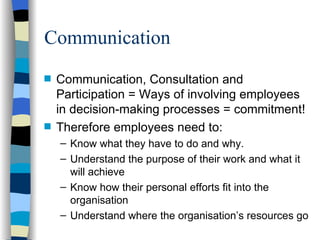
Communication Communication, Consultation and Participation = Ways of involving employees in decision-making processes = commitment! Therefore employees need to: Know what they have to do and why. Understand the purpose of their work and what it will achieve Know how their personal efforts fit into the organisation Understand where the organisation’s resources go
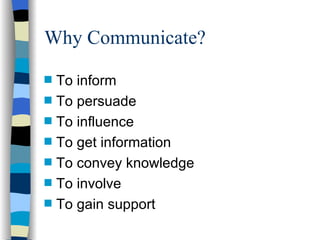
Why Communicate? To inform To persuade To influence To get information   To convey knowledge To involve To gain support
Why is Communication So Important? Changing nature of workplace Increasing use of teamwork Emphasis on creativity, innovation, problem-solving Increasingly mobile work-force Flatter, more flexible organisation structures
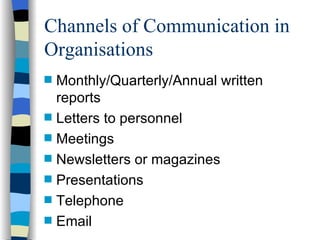
Channels of Communication in Organisations Monthly/Quarterly/Annual written reports Letters to personnel Meetings Newsletters or magazines Presentations Telephone Email
Channels of Communication in Organisations We often think first of channels which are one-way Two-way channels include: management walkabouts data from staff surveys regular briefing sessions lunches with personnel suggestion schemes feedback from employee representatives
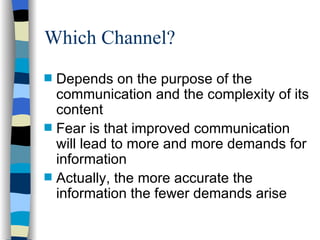
Which Channel? Depends on the purpose of the communication and the complexity of its content Fear is that improved communication will lead to more and more demands for information Actually, the more accurate the information the  fewer  demands arise
Which Channel? Writing - Advantages Good for reaching large numbers of people Large amounts of information Provides reference for future Writing-Disadvantages No exchange of views Only works if people actually read and understand the material May not be suited to the audience No interaction - almost always one way No opportunity for clarification Talking - Advantages Can be tailored to the specific   audience Allows interaction and exchange of information Allows clarification Allows communication of emotions/feelings Talking - Disadvantages No very effective for large numbers of people amounts of information Time-consuming May be difficult to get everyone together at the same time May be no reference about what was said or not said - memory!
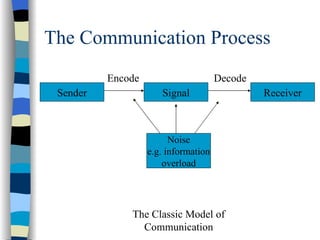
The Communication Process Sender Signal Receiver Encode Decode Noise e.g. information overload The Classic Model of Communication
The Communication Process We don’t just encode and decode messages but actively select, filter and interpret them and try to make sense of them For example, if a message is not very interesting or important you may ignore it especially if you have to many to deal with
The Communication Process Serial Distortion, for example the general who sent the following message: “ Send reinforcements, we’re going to advance” became “Send three and fourpence, we’re going to a dance”
Serial Distortion Particular points in the message may be given more importance New information may be added Certain details may be modified to suit either the receiver or the sender The sequence of events may be altered Gaps may be filled to make sense of the message Distortion may be deliberate but often it is simply that we decode and interpret and re-code any message that we send. The more stages the message passes through the more likelihood there is of distortion
Good Communication Depends on: the sender knowing clearly what is intended to be communicated Using words which allow the receiver to receive the intended message Conducting the communication in an open way so that the receiver has the opportunity to clarify or ask for more information
5 Key Factors in Communication Perception of Self/Others Active Listening, for example: Questioning Summarising Clarifying Feeding back Non-verbal communication, for example: Body language Voice Silence Checking, not assuming Dealing with emotions What is said and what is communicated by non-verbals, is it the same message?
Guidelines for Active Listening Give people your attention Be ready to paraphrase or “play back” what they have said If you do not understand, ask Acknowledge the other person’s feelings Encourage Do not react or respond until it is clear the other person has finished
Benefits of Active Listening Avoiding misunderstanding Building a relationship Receiving more information Helping articulate
Checking Understanding “ Chunk” your messages and check for understanding after each one Listen actively to feedback Encourage clarification questions Encourage “reflecting back” what they have heard to ensure the message you sent is the one received

Communication Pauline Hall

  • 1.
    Communication Diplomain Quality Serivce Delivery
  • 2.
    Communication Communication, Consultationand Participation = Ways of involving employees in decision-making processes = commitment! Therefore employees need to: Know what they have to do and why. Understand the purpose of their work and what it will achieve Know how their personal efforts fit into the organisation Understand where the organisation’s resources go
  • 3.
    Why Communicate? Toinform To persuade To influence To get information To convey knowledge To involve To gain support
  • 4.
    Why is CommunicationSo Important? Changing nature of workplace Increasing use of teamwork Emphasis on creativity, innovation, problem-solving Increasingly mobile work-force Flatter, more flexible organisation structures
  • 5.
    Channels of Communicationin Organisations Monthly/Quarterly/Annual written reports Letters to personnel Meetings Newsletters or magazines Presentations Telephone Email
  • 6.
    Channels of Communicationin Organisations We often think first of channels which are one-way Two-way channels include: management walkabouts data from staff surveys regular briefing sessions lunches with personnel suggestion schemes feedback from employee representatives
  • 7.
    Which Channel? Dependson the purpose of the communication and the complexity of its content Fear is that improved communication will lead to more and more demands for information Actually, the more accurate the information the fewer demands arise
  • 8.
    Which Channel? Writing- Advantages Good for reaching large numbers of people Large amounts of information Provides reference for future Writing-Disadvantages No exchange of views Only works if people actually read and understand the material May not be suited to the audience No interaction - almost always one way No opportunity for clarification Talking - Advantages Can be tailored to the specific audience Allows interaction and exchange of information Allows clarification Allows communication of emotions/feelings Talking - Disadvantages No very effective for large numbers of people amounts of information Time-consuming May be difficult to get everyone together at the same time May be no reference about what was said or not said - memory!
  • 9.
    The Communication ProcessSender Signal Receiver Encode Decode Noise e.g. information overload The Classic Model of Communication
  • 10.
    The Communication ProcessWe don’t just encode and decode messages but actively select, filter and interpret them and try to make sense of them For example, if a message is not very interesting or important you may ignore it especially if you have to many to deal with
  • 11.
    The Communication ProcessSerial Distortion, for example the general who sent the following message: “ Send reinforcements, we’re going to advance” became “Send three and fourpence, we’re going to a dance”
  • 12.
    Serial Distortion Particularpoints in the message may be given more importance New information may be added Certain details may be modified to suit either the receiver or the sender The sequence of events may be altered Gaps may be filled to make sense of the message Distortion may be deliberate but often it is simply that we decode and interpret and re-code any message that we send. The more stages the message passes through the more likelihood there is of distortion
  • 13.
    Good Communication Dependson: the sender knowing clearly what is intended to be communicated Using words which allow the receiver to receive the intended message Conducting the communication in an open way so that the receiver has the opportunity to clarify or ask for more information
  • 14.
    5 Key Factorsin Communication Perception of Self/Others Active Listening, for example: Questioning Summarising Clarifying Feeding back Non-verbal communication, for example: Body language Voice Silence Checking, not assuming Dealing with emotions What is said and what is communicated by non-verbals, is it the same message?
  • 15.
    Guidelines for ActiveListening Give people your attention Be ready to paraphrase or “play back” what they have said If you do not understand, ask Acknowledge the other person’s feelings Encourage Do not react or respond until it is clear the other person has finished
  • 16.
    Benefits of ActiveListening Avoiding misunderstanding Building a relationship Receiving more information Helping articulate
  • 17.
    Checking Understanding “Chunk” your messages and check for understanding after each one Listen actively to feedback Encourage clarification questions Encourage “reflecting back” what they have heard to ensure the message you sent is the one received