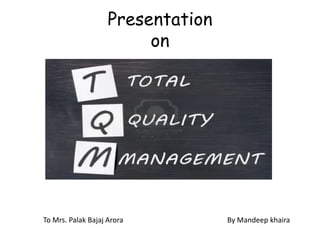
Presentation
on

To Mrs. Palak Bajaj Arora

By Mandeep khaira
What is quality?
Quantified definition of Quality:

Q=P/E
where,
Q = quality
P = performance
E = expectations
If Q is greater than 1, then the customer has a good feeling
about the quality of product or service.
Dimensions of quality
Dimensions of quality are the different features of product or
service.

Functionality:
Functionality refers to the core features and characteristics of
a product that satisfy the customer.

Reliability:
Reliability is measured by mean time between failures (MTBF)
and mean time to first failure. Reliability is an indicator of
durability of products.
Usability:
A product should be user friendly. The customer should be
able to use the product easily without the help of expert.

Maintainability:
It refers to the ease with which a product can be maintained
in the original condition. Maintainability is measured as
mean time to repair (MTTR).

Efficiency:
Efficiency is how much out put is taken by different products
on giving same input.
Aesthetics:
A product or service should not only perform well but also
appear attractive. It also includes color, finish and overall
look of product or service.

Serviceability:




It includes:
How well the customers are treated?
How complaints are handled and resolved?
How much time you take to resolve problem?
This feature plays a vital role in service organizations.
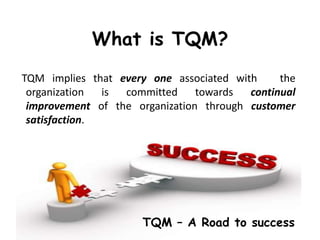
What is TQM?
TQM implies that every one associated with
the
organization
is
committed
towards
continual
improvement of the organization through customer
satisfaction.

TQM – A Road to success
Functions of TQM
•
•
•
•
•

Quality of design
Quality of planning
Quality of production
Quality of shipment
Quality of field service (market)
Evolution of TQM
• Quality Management philosophy was evolved in Japan after second
world war.
• An American expert Edwards Deming helped Japanese to apply
concepts of TQM.
• In 1968 the Japanese shaped the phrase Total Quality Control and
became the world quality leader.
• In the 1980 the U.S. Navel Air Systems coined the TQM phrase. The
Navy based most of the principles on the Japanese Total Quality
Control philosophy.
• In 80’s most companies in the world started applying this concept
and enhanced their productivity and profitability remarkably.
Role of leadership in TQM
•
•
•
•
•
•

Promoting cultural change
Leading from the front
Open communication
Removing barriers between departments
Instilling more customer focus
Aligning company goals with Vision and Mission
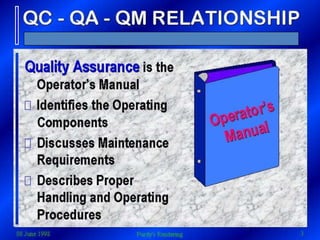
Quality Assurance
• Quality assurance refers to customers that the
products, parts, components, tools etc.
• It contain specified characteristics are fit for
the intended use.
Helpful factors of Quality
Assurance
•
•
•
•

Quality specifications
Inspections and testing procedures
Periodical evaluation
Chemical and physical properties
Quality Control
V’s
Quality Assurance
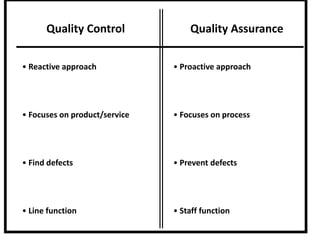
Quality Control

Quality Assurance

• Reactive approach

• Proactive approach

• Focuses on product/service

• Focuses on process

• Find defects

• Prevent defects

• Line function

• Staff function
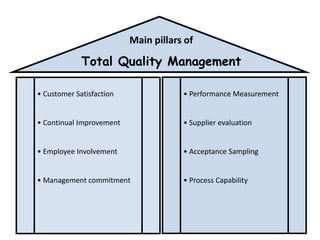
Main pillars of

Total Quality Management
• Customer Satisfaction

• Performance Measurement

• Continual Improvement

• Supplier evaluation

• Employee Involvement

• Acceptance Sampling

• Management commitment

• Process Capability
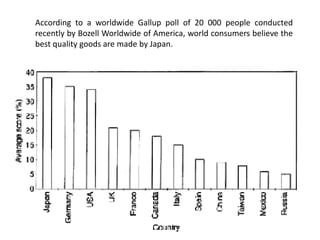
According to a worldwide Gallup poll of 20 000 people conducted
recently by Bozell Worldwide of America, world consumers believe the
best quality goods are made by Japan.
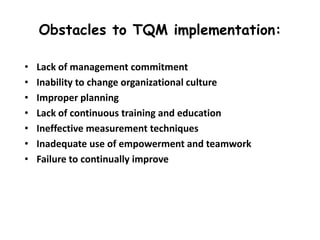
Obstacles to TQM implementation:
•
•
•
•
•
•
•

Lack of management commitment
Inability to change organizational culture
Improper planning
Lack of continuous training and education
Ineffective measurement techniques
Inadequate use of empowerment and teamwork
Failure to continually improve
Benefits of TQM include:
• Improves competitive position
• Increase adaptability to global markets
• Elevated productivity
• Eliminates defects
• Significantly reduces waste.
• Reduces quality costs
• Improves management communication
• Raises profits
• Customer loyalty
Some criticisms of TQM

1. Blind pursuit of TQM programs
2. Programs may not be linked to strategies
3. Quality-related decisions may not be tied to
market performance
4. Failure to carefully plan a program
Performance

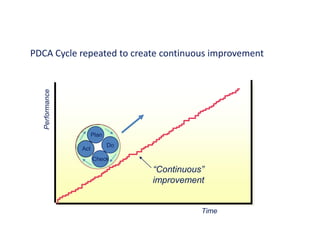
PDCA Cycle repeated to create continuous improvement

Plan
Act

Do
Check

“Continuous”
improvement

Time
Summary
•
•
•
•

TQM – a way of working
Involves everyone
High prominence on ‘customer’
Awards based upon TQM
total quality management

total quality management

  • 1.
    Presentation on To Mrs. PalakBajaj Arora By Mandeep khaira
  • 2.
  • 3.
    Quantified definition ofQuality: Q=P/E where, Q = quality P = performance E = expectations If Q is greater than 1, then the customer has a good feeling about the quality of product or service.
  • 4.
    Dimensions of quality Dimensionsof quality are the different features of product or service. Functionality: Functionality refers to the core features and characteristics of a product that satisfy the customer. Reliability: Reliability is measured by mean time between failures (MTBF) and mean time to first failure. Reliability is an indicator of durability of products.
  • 5.
    Usability: A product shouldbe user friendly. The customer should be able to use the product easily without the help of expert. Maintainability: It refers to the ease with which a product can be maintained in the original condition. Maintainability is measured as mean time to repair (MTTR). Efficiency: Efficiency is how much out put is taken by different products on giving same input.
  • 6.
    Aesthetics: A product orservice should not only perform well but also appear attractive. It also includes color, finish and overall look of product or service. Serviceability:    It includes: How well the customers are treated? How complaints are handled and resolved? How much time you take to resolve problem? This feature plays a vital role in service organizations.
  • 7.
    What is TQM? TQMimplies that every one associated with the organization is committed towards continual improvement of the organization through customer satisfaction. TQM – A Road to success
  • 9.
    Functions of TQM • • • • • Qualityof design Quality of planning Quality of production Quality of shipment Quality of field service (market)
  • 10.
    Evolution of TQM •Quality Management philosophy was evolved in Japan after second world war. • An American expert Edwards Deming helped Japanese to apply concepts of TQM. • In 1968 the Japanese shaped the phrase Total Quality Control and became the world quality leader. • In the 1980 the U.S. Navel Air Systems coined the TQM phrase. The Navy based most of the principles on the Japanese Total Quality Control philosophy. • In 80’s most companies in the world started applying this concept and enhanced their productivity and profitability remarkably.
  • 11.
    Role of leadershipin TQM • • • • • • Promoting cultural change Leading from the front Open communication Removing barriers between departments Instilling more customer focus Aligning company goals with Vision and Mission
  • 12.
    Quality Assurance • Qualityassurance refers to customers that the products, parts, components, tools etc. • It contain specified characteristics are fit for the intended use.
  • 13.
    Helpful factors ofQuality Assurance • • • • Quality specifications Inspections and testing procedures Periodical evaluation Chemical and physical properties
  • 14.
  • 15.
    Quality Control Quality Assurance •Reactive approach • Proactive approach • Focuses on product/service • Focuses on process • Find defects • Prevent defects • Line function • Staff function
  • 19.
    Main pillars of TotalQuality Management • Customer Satisfaction • Performance Measurement • Continual Improvement • Supplier evaluation • Employee Involvement • Acceptance Sampling • Management commitment • Process Capability
  • 20.
    According to aworldwide Gallup poll of 20 000 people conducted recently by Bozell Worldwide of America, world consumers believe the best quality goods are made by Japan.
  • 21.
    Obstacles to TQMimplementation: • • • • • • • Lack of management commitment Inability to change organizational culture Improper planning Lack of continuous training and education Ineffective measurement techniques Inadequate use of empowerment and teamwork Failure to continually improve
  • 22.
    Benefits of TQMinclude: • Improves competitive position • Increase adaptability to global markets • Elevated productivity • Eliminates defects • Significantly reduces waste. • Reduces quality costs • Improves management communication • Raises profits • Customer loyalty
  • 23.
    Some criticisms ofTQM 1. Blind pursuit of TQM programs 2. Programs may not be linked to strategies 3. Quality-related decisions may not be tied to market performance 4. Failure to carefully plan a program
  • 24.
    Performance PDCA Cycle repeatedto create continuous improvement Plan Act Do Check “Continuous” improvement Time
  • 25.
    Summary • • • • TQM – away of working Involves everyone High prominence on ‘customer’ Awards based upon TQM