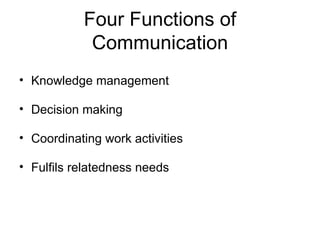
Four Functions of Communication Knowledge management Decision making  Coordinating work activities Fulfils relatedness needs
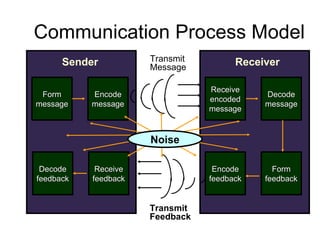
Communication Process Model Receiver Sender Form message Transmit Message Transmit Feedback Decode message Encode feedback Form feedback Encode message Decode feedback Receive encoded message Receive feedback Noise
Communication Barriers Perceptions Filtering Language Jargon Ambiguity Information Overload
The HURIER Model: Components of Effective Listening 9-14 Hearing (paying careful attention to what is being said) Understanding (comprehending the messages being sent) Remembering (being able to recall the message being sent) Effective Listening Responding (replying to the sender, letting him or her know you are paying attention) Evaluating (not immediately passing judgment on the message being sent) Interpreting (not reading anything into the message the sender is communicating)
Information Overload Episodes of information overload Employee’s information processing capacity Time Information Load
Overload: Problem Solved Gatekeeper Message C Overload (too many messages reaching a person at once) Use gatekeepers to control the number of incoming messages received Use queuing to  present messages  in order Problem: Solutions: Message C Message B Message A Person Message C Message B Message A Message A  Message B  Message C Person Person
Oral vs. Written Communication: Preference for Media Depends on the Message 9-5 Mean Percentage of Managers Preferring Media Extremely ambiguous messages Extremely clear messages Oral  Media Written Media Oral media are preferred for sending ambiguous messages. Written media are preferred for sending clear messages. (88.3) (11.3) (32.1) (67.9) 10 20 30 40 50 60 70 80 90
Communicating Through E-mail  Advantages of E-mail Messages quickly formed, edited, sent, and stored Needs little coordination Random information access Fewer social status barriers Problems with E-mail Information overload Flaming Interpreting emotions Lacks empathy or social support
Guessing E-Mail Emoticons Happy Smirk Dumb question OOPS! Tongue in cheek Hug :-) :-} <:-) :-X :-j {}
Nonverbal Communication Actions, gestures, facial expressions, etc. Transmits most info in face-to-face meetings  Influences meaning of verbal and written symbols Less rule bound than verbal communication Important part of emotional labour
Hierarchy of Media Richness Face-to-face Telephone E-mail Newsletters Oversimplified Zone Overloaded Zone Routine/ Clear Nonroutine/ Ambiguous Rich Lean Media Richness Situation
Communicating in Hierarchies Workspace design Employee surveys Newsletters and e-zines Management by walking around
Grapevine Characteristics Transmits information very rapidly in all directions Relatively accurate, but deletes details and exaggerates key points More active in homogeneous groups who easy communication access Most active when employees are anxious Usually follows a cluster chain pattern
Personal Communication Style The Senator (sometimes Noble and sometimes Reflective) The Candidate (blend between Socratic and Reflective) The Magistrate (blend between Noble and Socratic) The Reflective (someone who would rather say nothing than to hurt someone else’s feelings) The Socratic (someone who likes to argue his or her points fully) The Nobel (someone who says what’s on his or her mind)
Internal vs. External Communications: Is There a Difference? More Statements Fewer Statements Relative Proportion of Statements Threats were used more than opportunities when communicating internally. Opportunities were used more than threats when communicating externally. Threats Opportunities Focus of Statements Internal statements External statements
14 A MEMO THAT LEAVES YOU SCRATCHING YOUR HEAD: WHAT DID HE SAY? ORIGINAL MESSAGE: “ As per your subject memo; we are researching the history of Price Promotion #18B to  establish why the new price sheets were not received by the sales force in advance of the effective date of the promotion.  It is unclear from your memo how widespread the problem was or if it was just isolated in certain geographies.  Therefore, we will need additional facts on where you think the problem occurred.  As you know, we have  gotten complaints from sales people in the past that they did not receive the promotions only to find out later that they had lost them due to their own disorganization.” TRANSLATION: “ We screwed up but are not going to admit it.” IMPROVED MESSAGE: “ Thanks for bringing the problem with this promotion to my attention.  It looks like we screwed up at this end in getting the proofs to the printer on schedule.  My staff and I feel badly about this and will take steps to provide better service.”
Cross-Cultural Communication Verbal differences Language Nonverbal differences Voice intonation Interpreting nonverbal meaning Importance of verbal versus nonverbal Silence and conversational overlaps
Gender Communication Differences Men Women Gives advice quickly and directly  Gives advice indirectly and reluctantly  Report talk Rapport talk Avoids asking for information  Frequently asks for information Less sensitive to nonverbal cues  More sensitive to nonverbal cues
Gender Issues in Leadership Male and female leaders have similar task- and people-oriented leadership. Participative leadership is used more often by female leaders. Women rated less favourably than equivalent male leaders due to stereotyping.
Getting Your Message Across Empathize Repeat the message Use timing effectively Be descriptive
Active Listening Process and Strategies ACTIVE LISTENING SENSING • Postpone evaluation •  Avoid interruptions •  Maintain interest EVALUATING •  Empathize •  Organize information RESPONDING •  Show interest •  Clarify the message
Persuasive Communication Audience Characteristics •  Self-esteem •  Inoculated Communicator Characteristics •  Expert •  Credibility •  Attractive Communication Medium Message Content •  Present all sides •  Few arguments •  Emotional appeals •  Inoculation effect

Communication

  • 1.
    Four Functions ofCommunication Knowledge management Decision making Coordinating work activities Fulfils relatedness needs
  • 2.
    Communication Process ModelReceiver Sender Form message Transmit Message Transmit Feedback Decode message Encode feedback Form feedback Encode message Decode feedback Receive encoded message Receive feedback Noise
  • 3.
    Communication Barriers PerceptionsFiltering Language Jargon Ambiguity Information Overload
  • 4.
    The HURIER Model:Components of Effective Listening 9-14 Hearing (paying careful attention to what is being said) Understanding (comprehending the messages being sent) Remembering (being able to recall the message being sent) Effective Listening Responding (replying to the sender, letting him or her know you are paying attention) Evaluating (not immediately passing judgment on the message being sent) Interpreting (not reading anything into the message the sender is communicating)
  • 5.
    Information Overload Episodesof information overload Employee’s information processing capacity Time Information Load
  • 6.
    Overload: Problem SolvedGatekeeper Message C Overload (too many messages reaching a person at once) Use gatekeepers to control the number of incoming messages received Use queuing to present messages in order Problem: Solutions: Message C Message B Message A Person Message C Message B Message A Message A Message B Message C Person Person
  • 7.
    Oral vs. WrittenCommunication: Preference for Media Depends on the Message 9-5 Mean Percentage of Managers Preferring Media Extremely ambiguous messages Extremely clear messages Oral Media Written Media Oral media are preferred for sending ambiguous messages. Written media are preferred for sending clear messages. (88.3) (11.3) (32.1) (67.9) 10 20 30 40 50 60 70 80 90
  • 8.
    Communicating Through E-mail Advantages of E-mail Messages quickly formed, edited, sent, and stored Needs little coordination Random information access Fewer social status barriers Problems with E-mail Information overload Flaming Interpreting emotions Lacks empathy or social support
  • 9.
    Guessing E-Mail EmoticonsHappy Smirk Dumb question OOPS! Tongue in cheek Hug :-) :-} <:-) :-X :-j {}
  • 10.
    Nonverbal Communication Actions,gestures, facial expressions, etc. Transmits most info in face-to-face meetings Influences meaning of verbal and written symbols Less rule bound than verbal communication Important part of emotional labour
  • 11.
    Hierarchy of MediaRichness Face-to-face Telephone E-mail Newsletters Oversimplified Zone Overloaded Zone Routine/ Clear Nonroutine/ Ambiguous Rich Lean Media Richness Situation
  • 12.
    Communicating in HierarchiesWorkspace design Employee surveys Newsletters and e-zines Management by walking around
  • 13.
    Grapevine Characteristics Transmitsinformation very rapidly in all directions Relatively accurate, but deletes details and exaggerates key points More active in homogeneous groups who easy communication access Most active when employees are anxious Usually follows a cluster chain pattern
  • 14.
    Personal Communication StyleThe Senator (sometimes Noble and sometimes Reflective) The Candidate (blend between Socratic and Reflective) The Magistrate (blend between Noble and Socratic) The Reflective (someone who would rather say nothing than to hurt someone else’s feelings) The Socratic (someone who likes to argue his or her points fully) The Nobel (someone who says what’s on his or her mind)
  • 15.
    Internal vs. ExternalCommunications: Is There a Difference? More Statements Fewer Statements Relative Proportion of Statements Threats were used more than opportunities when communicating internally. Opportunities were used more than threats when communicating externally. Threats Opportunities Focus of Statements Internal statements External statements
  • 16.
    14 A MEMOTHAT LEAVES YOU SCRATCHING YOUR HEAD: WHAT DID HE SAY? ORIGINAL MESSAGE: “ As per your subject memo; we are researching the history of Price Promotion #18B to establish why the new price sheets were not received by the sales force in advance of the effective date of the promotion. It is unclear from your memo how widespread the problem was or if it was just isolated in certain geographies. Therefore, we will need additional facts on where you think the problem occurred. As you know, we have gotten complaints from sales people in the past that they did not receive the promotions only to find out later that they had lost them due to their own disorganization.” TRANSLATION: “ We screwed up but are not going to admit it.” IMPROVED MESSAGE: “ Thanks for bringing the problem with this promotion to my attention. It looks like we screwed up at this end in getting the proofs to the printer on schedule. My staff and I feel badly about this and will take steps to provide better service.”
  • 17.
    Cross-Cultural Communication Verbaldifferences Language Nonverbal differences Voice intonation Interpreting nonverbal meaning Importance of verbal versus nonverbal Silence and conversational overlaps
  • 18.
    Gender Communication DifferencesMen Women Gives advice quickly and directly Gives advice indirectly and reluctantly Report talk Rapport talk Avoids asking for information Frequently asks for information Less sensitive to nonverbal cues More sensitive to nonverbal cues
  • 19.
    Gender Issues inLeadership Male and female leaders have similar task- and people-oriented leadership. Participative leadership is used more often by female leaders. Women rated less favourably than equivalent male leaders due to stereotyping.
  • 20.
    Getting Your MessageAcross Empathize Repeat the message Use timing effectively Be descriptive
  • 21.
    Active Listening Processand Strategies ACTIVE LISTENING SENSING • Postpone evaluation • Avoid interruptions • Maintain interest EVALUATING • Empathize • Organize information RESPONDING • Show interest • Clarify the message
  • 22.
    Persuasive Communication AudienceCharacteristics • Self-esteem • Inoculated Communicator Characteristics • Expert • Credibility • Attractive Communication Medium Message Content • Present all sides • Few arguments • Emotional appeals • Inoculation effect