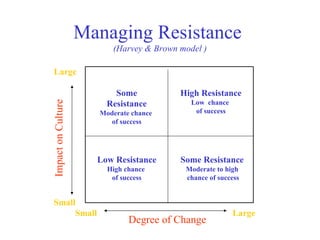
Managing Resistance  (Harvey & Brown  model  ) Low Resistance High chance  of success High Resistance Low  chance  of success Some Resistance Moderate chance  of success Some Resistance Moderate to high chance of success Degree   of Change Impact on Culture Small Small Large Large
The Pace of Change Change Champions Early  Adaptors Early  Majority Majority Late  Majority Laggards 10% + _ 10% + _ 10% + _ 45% + _ 15% + _ 10% + _
Kurt Lewin’s Model of Change New state Old state Unfreeze Change Re-freeze
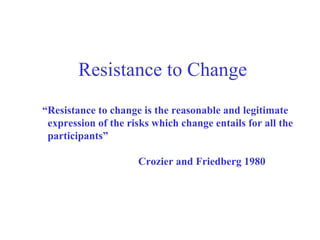
Resistance to Change “ Resistance to change is the reasonable and legitimate expression of the risks which change entails for all the  participants” Crozier and Friedberg 1980
Parochial self-interest (will lose something of value) Misunderstanding/lack of trust (whose interests are being served?) Different assessments (of costs, benefits, dangers) Low tolerance for change (different job, behaviour, relationships) (Kotter & Schlesinger) Reasons for Resistance  to Change
Education and Communication beforehand Participation and involvement in the process Facilitation and support Negotiation and agreement Manipulation and agreement Manipulation/co-optation  Explicit or implicit coercion (Kotter & Schlesinger) Methods of Overcoming Resistance
Ignore or resisting resistance; forging ahead with team building; pushing productivity too soon. Traps
Have a good reason Involve people Put a respected person in charge Create transition management teams Provide training in new values work methods Basic Guidelines
The reasonable person adapts himself to the world;  the unreasonable one persists in trying to adapt  the world to himself. Therefore, all  progress depends on the unreasonable person.  George Bernard Shaw

Managing Resistance Pauline Hall

  • 1.
    Managing Resistance (Harvey & Brown model ) Low Resistance High chance of success High Resistance Low chance of success Some Resistance Moderate chance of success Some Resistance Moderate to high chance of success Degree of Change Impact on Culture Small Small Large Large
  • 2.
    The Pace ofChange Change Champions Early Adaptors Early Majority Majority Late Majority Laggards 10% + _ 10% + _ 10% + _ 45% + _ 15% + _ 10% + _
  • 3.
    Kurt Lewin’s Modelof Change New state Old state Unfreeze Change Re-freeze
  • 4.
    Resistance to Change“ Resistance to change is the reasonable and legitimate expression of the risks which change entails for all the participants” Crozier and Friedberg 1980
  • 5.
    Parochial self-interest (willlose something of value) Misunderstanding/lack of trust (whose interests are being served?) Different assessments (of costs, benefits, dangers) Low tolerance for change (different job, behaviour, relationships) (Kotter & Schlesinger) Reasons for Resistance to Change
  • 6.
    Education and Communicationbeforehand Participation and involvement in the process Facilitation and support Negotiation and agreement Manipulation and agreement Manipulation/co-optation Explicit or implicit coercion (Kotter & Schlesinger) Methods of Overcoming Resistance
  • 7.
    Ignore or resistingresistance; forging ahead with team building; pushing productivity too soon. Traps
  • 8.
    Have a goodreason Involve people Put a respected person in charge Create transition management teams Provide training in new values work methods Basic Guidelines
  • 9.
    The reasonable personadapts himself to the world; the unreasonable one persists in trying to adapt the world to himself. Therefore, all progress depends on the unreasonable person. George Bernard Shaw