



Business C o mmunication  Shafqat Jilani
Business Communication  Shafqat Jilani Communication  for Businessmen &  Professionals
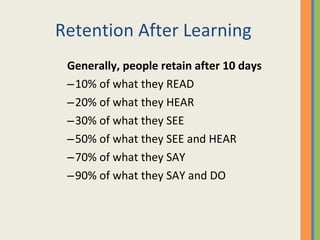
How much People Retain after ten days of learning… Retention After Learning
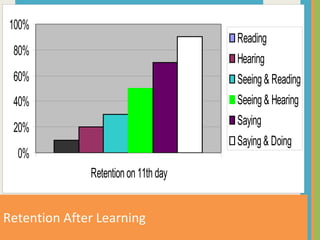
Retention After Learning Generally, people retain after 10 days 10% of what they READ 20% of what they HEAR 30% of what they SEE 50% of what they SEE and HEAR 70% of what they SAY 90% of what they SAY and DO
Retention After Learning
What is common among these?
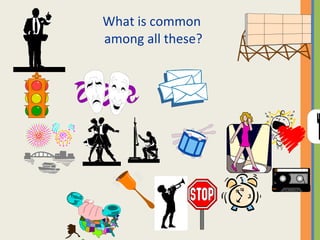
What is common  among all these?
What is Communication? Speaking  Writing   Calling e-mailing Talking News   Sharing Caring Loving Expressing    & even Communication is Smiling   Laughing   sitting   Promising   Watching
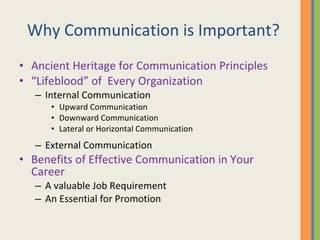
Why Communication is Important? Ancient Heritage for Communication Principles “ Lifeblood” of  Every Organization Internal Communication Upward Communication Downward Communication Lateral or Horizontal Communication External Communication Benefits of Effective Communication in Your Career A valuable Job Requirement An Essential for Promotion
Challenges of Communication in the Global Market Developing the Right Attitude Preparing Adequately Becoming Flexible
Theories of Communication: Electronic Theory / Mathematical Theory Social Environment Theory Rhetorical Theory (metaphorical or symbolic)
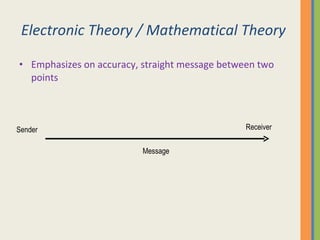
Electronic Theory / Mathematical Theory Emphasizes on accuracy, straight message between two points Sender Receiver Message
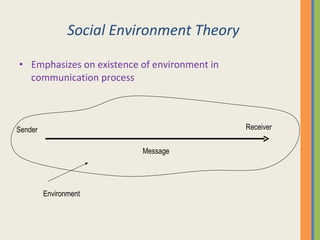
Social Environment Theory Emphasizes on existence of environment in communication process Sender Receiver Message Environment
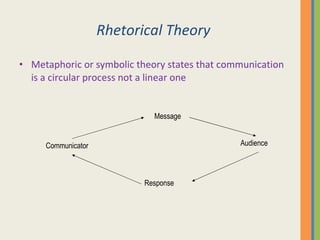
Rhetorical Theory Metaphoric or symbolic theory states that communication is a circular process not a linear one Communicator Audience Message Response
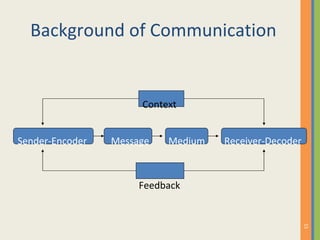
Background of Communication Context Sender-Encoder  Message  Medium  Receiver-Decoder  Feedback
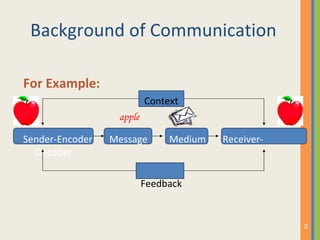
Background of Communication For Example: Context apple   Sender-Encoder  Message  Medium  Receiver-Decoder Feedback
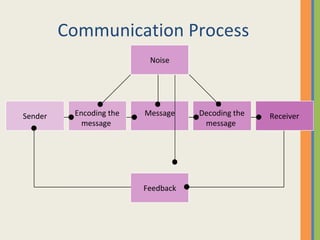
Communication Process Feedback Sender Encoding the message  Message Decoding the message  Noise Receiver
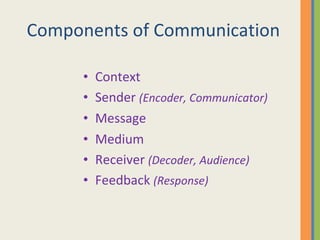
Components of Communication Context Sender  (Encoder, Communicator) Message Medium Receiver  (Decoder, Audience) Feedback  (Response)
What do you see in this picture?
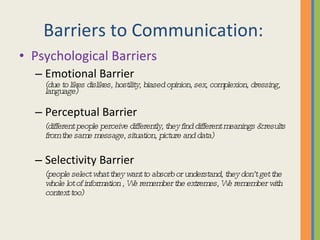
Barriers to Communication: Psychological Barriers Emotional Barrier (due to likes dislikes, hostility, biased opinion, sex, complexion, dressing, language) Perceptual Barrier (different people perceive differently, they find different meanings & results from the same message, situation, picture and data) Selectivity Barrier (people select what they want to absorb or understand, they don’t get the whole lot of information , We remember the extremes, We remember with context too)
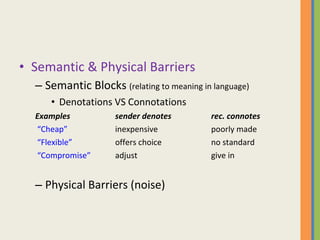
Semantic & Physical Barriers Semantic Blocks  (relating to meaning in language) Denotations VS Connotations  Examples sender denotes rec. connotes “ Cheap” inexpensive poorly made “ Flexible” offers choice no standard “ Compromise”   adjust give in Physical Barriers (noise)
Nonverbal Communication
Background of Communication Nonverbal Communication How Appearance Communicates How Body Language Communicates How Silence, Time, and Space Communicate
Nonverbal Communication Is an equally effective way of communication
Thank You
Q  &   A

Business communication 1 introduction

  • 1.
    Business C ommunication Shafqat Jilani
  • 2.
    Business Communication Shafqat Jilani Communication for Businessmen & Professionals
  • 3.
    How much PeopleRetain after ten days of learning… Retention After Learning
  • 4.
    Retention After LearningGenerally, people retain after 10 days 10% of what they READ 20% of what they HEAR 30% of what they SEE 50% of what they SEE and HEAR 70% of what they SAY 90% of what they SAY and DO
  • 5.
  • 6.
    What is commonamong these?
  • 7.
    What is common among all these?
  • 8.
    What is Communication?Speaking Writing Calling e-mailing Talking News Sharing Caring Loving Expressing    & even Communication is Smiling Laughing sitting Promising Watching
  • 9.
    Why Communication isImportant? Ancient Heritage for Communication Principles “ Lifeblood” of Every Organization Internal Communication Upward Communication Downward Communication Lateral or Horizontal Communication External Communication Benefits of Effective Communication in Your Career A valuable Job Requirement An Essential for Promotion
  • 10.
    Challenges of Communicationin the Global Market Developing the Right Attitude Preparing Adequately Becoming Flexible
  • 11.
    Theories of Communication:Electronic Theory / Mathematical Theory Social Environment Theory Rhetorical Theory (metaphorical or symbolic)
  • 12.
    Electronic Theory /Mathematical Theory Emphasizes on accuracy, straight message between two points Sender Receiver Message
  • 13.
    Social Environment TheoryEmphasizes on existence of environment in communication process Sender Receiver Message Environment
  • 14.
    Rhetorical Theory Metaphoricor symbolic theory states that communication is a circular process not a linear one Communicator Audience Message Response
  • 15.
    Background of CommunicationContext Sender-Encoder Message Medium Receiver-Decoder Feedback
  • 16.
    Background of CommunicationFor Example: Context apple Sender-Encoder Message Medium Receiver-Decoder Feedback
  • 17.
    Communication Process FeedbackSender Encoding the message Message Decoding the message Noise Receiver
  • 18.
    Components of CommunicationContext Sender (Encoder, Communicator) Message Medium Receiver (Decoder, Audience) Feedback (Response)
  • 19.
    What do yousee in this picture?
  • 20.
    Barriers to Communication:Psychological Barriers Emotional Barrier (due to likes dislikes, hostility, biased opinion, sex, complexion, dressing, language) Perceptual Barrier (different people perceive differently, they find different meanings & results from the same message, situation, picture and data) Selectivity Barrier (people select what they want to absorb or understand, they don’t get the whole lot of information , We remember the extremes, We remember with context too)
  • 21.
    Semantic & PhysicalBarriers Semantic Blocks (relating to meaning in language) Denotations VS Connotations Examples sender denotes rec. connotes “ Cheap” inexpensive poorly made “ Flexible” offers choice no standard “ Compromise” adjust give in Physical Barriers (noise)
  • 22.
  • 23.
    Background of CommunicationNonverbal Communication How Appearance Communicates How Body Language Communicates How Silence, Time, and Space Communicate
  • 24.
    Nonverbal Communication Isan equally effective way of communication
  • 25.
  • 26.
    Q & A