Communication in the
Workplace
2
Overview
Communication in the Workplace
1
The importance of communication
Three forms of communication in business
Formal and informal networks
The process of communication
Basic truths about communication
Importance of communication in Business
• To put it Simply , communication enables human beings to work together
• Surveys found that written communications like e-mail, agreements, agenda etc.
are the top/ near the top of the business skills needed for success
• NFI found that 94% of the respondents rank ‘communicating well’ the most
important skill for them
• A good leader must have good communication
• Many traditional managers and employees think they communicate well but
actually short fall.
All position of the business need to communicate with upper and lower level
3
Main Forms of
Communication in Business
1. Internal Operational-
within the business between
and among different
employees
• To create , implement and
track success of business
operational plan
• Discussions, instructions,
reports, e-mail etc
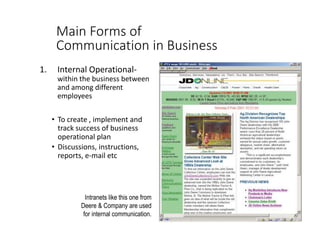
Intranets like this one from
Deere & Company are used
for internal communication.
2. External operational- with concerning parties out side the organization
• Suppliers, service companies, customers, governments, general publics
• Direct selling
• Advertising the business
• Coordinating with contractors, consultants and suppliers require skillful
communication
• Lobbing with government agencies, exchange commission, environmental
protection agencies etc.
5
3. Personal communication- other business communications
than operational
• Helps to make and retain relationship the business require much
• It affect the attitude of employees and attitude affect performance
• The culture of an organization affect the personal communication
among the employees
• Personal communication affect external communication
6
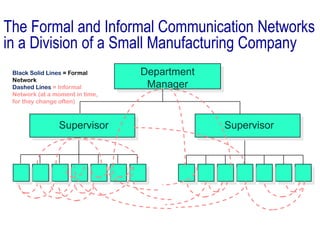
Department
Manager
Supervisor Supervisor
Black Solid Lines = Formal
Network
Dashed Lines = Informal
Network (at a moment in time,
for they change often)
The Formal and Informal Communication Networks
in a Division of a Small Manufacturing Company
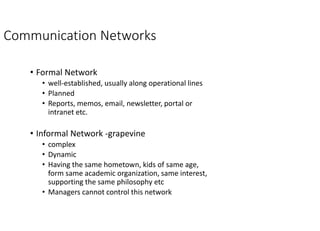
Communication Networks
• Formal Network
• well-established, usually along operational lines
• Planned
• Reports, memos, email, newsletter, portal or
intranet etc.
• Informal Network -grapevine
• complex
• Dynamic
• Having the same hometown, kids of same age,
form same academic organization, same interest,
supporting the same philosophy etc
• Managers cannot control this network
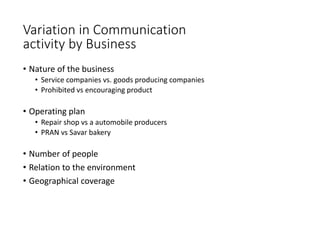
Variation in Communication
activity by Business
• Nature of the business
• Service companies vs. goods producing companies
• Prohibited vs encouraging product
• Operating plan
• Repair shop vs a automobile producers
• PRAN vs Savar bakery
• Number of people
• Relation to the environment
• Geographical coverage
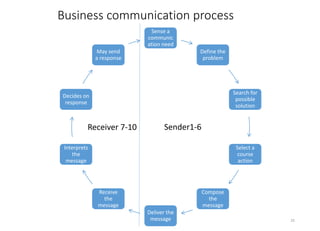
Business communication process
Sense a
communic
ation need
Define the
problem
Search for
possible
solution
Select a
course
action
Compose
the
message
Deliver the
message
Receive
the
message
Interprets
the
message
Decides on
response
May send
a response
10
Receiver 7-10 Sender1-6
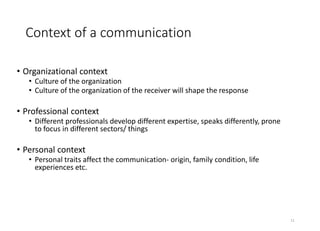
Context of a communication
• Organizational context
• Culture of the organization
• Culture of the organization of the receiver will shape the response
• Professional context
• Different professionals develop different expertise, speaks differently, prone
to focus in different sectors/ things
• Personal context
• Personal traits affect the communication- origin, family condition, life
experiences etc.
11
How Oral and Written Communication Differ
• is more likely to involve creative effort
• Need more time to complete the cycles
• and usually has fewer steps
“Writing is thinking on paper. Anyone who thinks
clearly should be able to write clearly about any
subject at all.”
--William Zinsser, Author
On Writing Well
12
Some Basic Truths about Communication
• Meanings sent are not always received
• Familiarity with the idea
• Use of mental resources
• Preconceptions
• The symbols of communication are imperfect.
• Emoji
• Symbol of language
• Brail for blind people, sign languages
• Communication is about information and relationship
Adaptation
• Unstable nature of language
• Uniqueness of each person
Filling every faced of your communication solution to
your intended recipients
Evidence of Communication
Weakness in Business
“I’m surprised how so many people struggle with communication.”
--Michael Rook, Production Manager
Hewlett Packard, San Diego, CA
“The first thing the Human Resources Department did was give me a
writing book.”
--Sam Reeves, IT Consultant
AMS, Denver, CO
The Importance of Communication Skills as Expressed by
Business Authorities
“Top executives from Fortune 500 companies rate
communications skills as the most important quality
for business leaders.”
--Business Section
New York Times
“There may be no single thing more important in our
efforts to achieve meaningful work and fulfilling
relationships than to learn and practice the art of
communication.”
--Max De Pree, Author
The Art of Leadership

Communication in the Workplace

  • 1.
  • 2.
    2 Overview Communication in theWorkplace 1 The importance of communication Three forms of communication in business Formal and informal networks The process of communication Basic truths about communication
  • 3.
    Importance of communicationin Business • To put it Simply , communication enables human beings to work together • Surveys found that written communications like e-mail, agreements, agenda etc. are the top/ near the top of the business skills needed for success • NFI found that 94% of the respondents rank ‘communicating well’ the most important skill for them • A good leader must have good communication • Many traditional managers and employees think they communicate well but actually short fall. All position of the business need to communicate with upper and lower level 3
  • 4.
    Main Forms of Communicationin Business 1. Internal Operational- within the business between and among different employees • To create , implement and track success of business operational plan • Discussions, instructions, reports, e-mail etc Intranets like this one from Deere & Company are used for internal communication.
  • 5.
    2. External operational-with concerning parties out side the organization • Suppliers, service companies, customers, governments, general publics • Direct selling • Advertising the business • Coordinating with contractors, consultants and suppliers require skillful communication • Lobbing with government agencies, exchange commission, environmental protection agencies etc. 5
  • 6.
    3. Personal communication-other business communications than operational • Helps to make and retain relationship the business require much • It affect the attitude of employees and attitude affect performance • The culture of an organization affect the personal communication among the employees • Personal communication affect external communication 6
  • 7.
    Department Manager Supervisor Supervisor Black SolidLines = Formal Network Dashed Lines = Informal Network (at a moment in time, for they change often) The Formal and Informal Communication Networks in a Division of a Small Manufacturing Company
  • 8.
    Communication Networks • FormalNetwork • well-established, usually along operational lines • Planned • Reports, memos, email, newsletter, portal or intranet etc. • Informal Network -grapevine • complex • Dynamic • Having the same hometown, kids of same age, form same academic organization, same interest, supporting the same philosophy etc • Managers cannot control this network
  • 9.
    Variation in Communication activityby Business • Nature of the business • Service companies vs. goods producing companies • Prohibited vs encouraging product • Operating plan • Repair shop vs a automobile producers • PRAN vs Savar bakery • Number of people • Relation to the environment • Geographical coverage
  • 10.
    Business communication process Sensea communic ation need Define the problem Search for possible solution Select a course action Compose the message Deliver the message Receive the message Interprets the message Decides on response May send a response 10 Receiver 7-10 Sender1-6
  • 11.
    Context of acommunication • Organizational context • Culture of the organization • Culture of the organization of the receiver will shape the response • Professional context • Different professionals develop different expertise, speaks differently, prone to focus in different sectors/ things • Personal context • Personal traits affect the communication- origin, family condition, life experiences etc. 11
  • 12.
    How Oral andWritten Communication Differ • is more likely to involve creative effort • Need more time to complete the cycles • and usually has fewer steps “Writing is thinking on paper. Anyone who thinks clearly should be able to write clearly about any subject at all.” --William Zinsser, Author On Writing Well 12
  • 13.
    Some Basic Truthsabout Communication • Meanings sent are not always received • Familiarity with the idea • Use of mental resources • Preconceptions • The symbols of communication are imperfect. • Emoji • Symbol of language • Brail for blind people, sign languages • Communication is about information and relationship
  • 14.
    Adaptation • Unstable natureof language • Uniqueness of each person Filling every faced of your communication solution to your intended recipients
  • 15.
    Evidence of Communication Weaknessin Business “I’m surprised how so many people struggle with communication.” --Michael Rook, Production Manager Hewlett Packard, San Diego, CA “The first thing the Human Resources Department did was give me a writing book.” --Sam Reeves, IT Consultant AMS, Denver, CO
  • 16.
    The Importance ofCommunication Skills as Expressed by Business Authorities “Top executives from Fortune 500 companies rate communications skills as the most important quality for business leaders.” --Business Section New York Times “There may be no single thing more important in our efforts to achieve meaningful work and fulfilling relationships than to learn and practice the art of communication.” --Max De Pree, Author The Art of Leadership