Communication
Presented by:
Kaavya L
G. Srinivas
K V Rajeev
Shruthi Koreth
Manjunath Pai
What is communication?
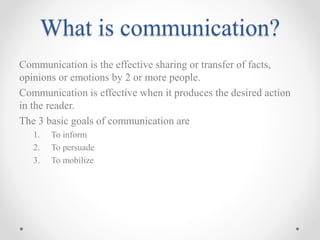
Communication is the effective sharing or transfer of facts,
opinions or emotions by 2 or more people.
Communication is effective when it produces the desired action
in the reader.
The 3 basic goals of communication are
1. To inform
2. To persuade
3. To mobilize
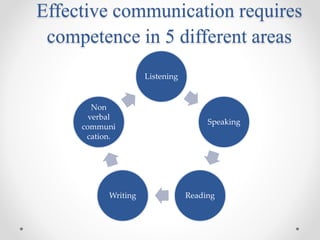
Effective communication requires
competence in 5 different areas
Listening
Speaking
ReadingWriting
Non
verbal
communi
cation.
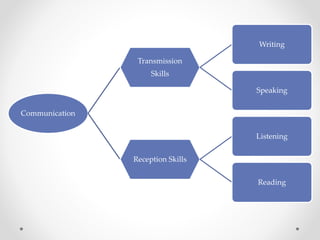
Communication
Transmission
Skills
Writing
Speaking
Reception Skills
Listening
Reading
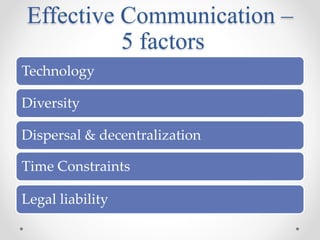
Effective Communication –
5 factors
Technology
Diversity
Dispersal & decentralization
Time Constraints
Legal liability
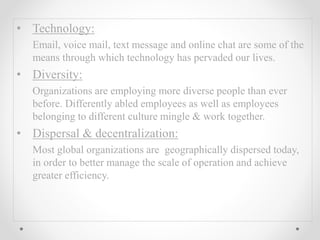
• Technology:
Email, voice mail, text message and online chat are some of the
means through which technology has pervaded our lives.
• Diversity:
Organizations are employing more diverse people than ever
before. Differently abled employees as well as employees
belonging to different culture mingle & work together.
• Dispersal & decentralization:
Most global organizations are geographically dispersed today,
in order to better manage the scale of operation and achieve
greater efficiency.
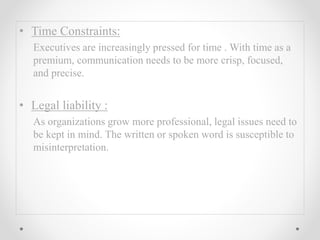
• Time Constraints:
Executives are increasingly pressed for time . With time as a
premium, communication needs to be more crisp, focused,
and precise.
• Legal liability :
As organizations grow more professional, legal issues need to
be kept in mind. The written or spoken word is susceptible to
misinterpretation.
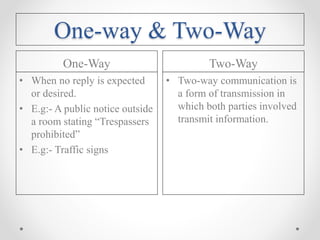
One-way & Two-Way
One-Way Two-Way
• When no reply is expected
or desired.
• E.g:- A public notice outside
a room stating “Trespassers
prohibited”
• E.g:- Traffic signs
• Two-way communication is
a form of transmission in
which both parties involved
transmit information.
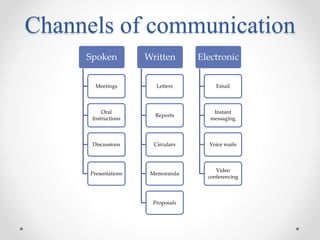
Channels of communication
Spoken
Meetings
Oral
Instructions
Discussions
Presentations
Written
Letters
Reports
Circulars
Memoranda
Proposals
Electronic
Email
Instant
messaging
Voice mails
Video
conferencing
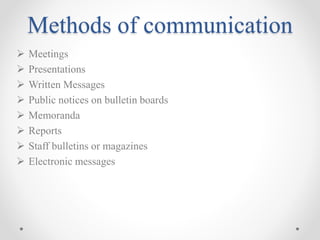
Methods of communication
 Meetings
 Presentations
 Written Messages
 Public notices on bulletin boards
 Memoranda
 Reports
 Staff bulletins or magazines
 Electronic messages
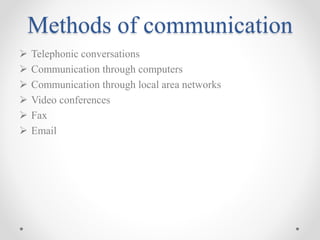
Methods of communication
 Telephonic conversations
 Communication through computers
 Communication through local area networks
 Video conferences
 Fax
 Email
Classification on the basis of flow
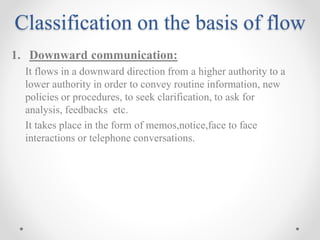
1. Downward communication:
It flows in a downward direction from a higher authority to a
lower authority in order to convey routine information, new
policies or procedures, to seek clarification, to ask for
analysis, feedbacks etc.
It takes place in the form of memos,notice,face to face
interactions or telephone conversations.
Classification on the basis of flow
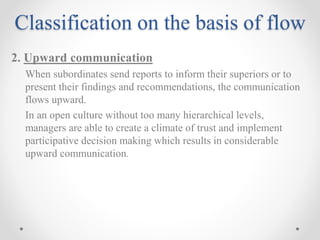
2. Upward communication
When subordinates send reports to inform their superiors or to
present their findings and recommendations, the communication
flows upward.
In an open culture without too many hierarchical levels,
managers are able to create a climate of trust and implement
participative decision making which results in considerable
upward communication.
Classification on the basis of flow
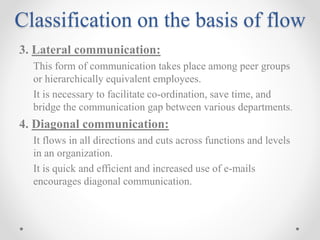
3. Lateral communication:
This form of communication takes place among peer groups
or hierarchically equivalent employees.
It is necessary to facilitate co-ordination, save time, and
bridge the communication gap between various departments.
4. Diagonal communication:
It flows in all directions and cuts across functions and levels
in an organization.
It is quick and efficient and increased use of e-mails
encourages diagonal communication.
Types of communication
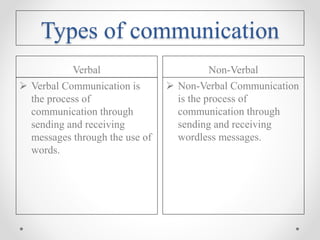
Verbal Non-Verbal
 Verbal Communication is
the process of
communication through
sending and receiving
messages through the use of
words.
 Non-Verbal Communication
is the process of
communication through
sending and receiving
wordless messages.
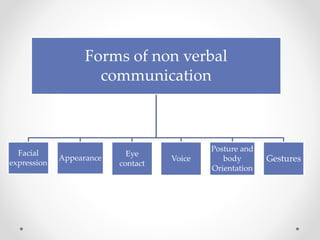
Forms of non verbal
communication
Facial
expression
Appearance
Eye
contact
Voice
Posture and
body
Orientation
Gestures
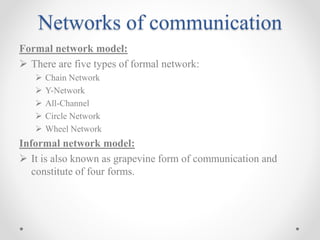
Networks of communication
Formal network model:
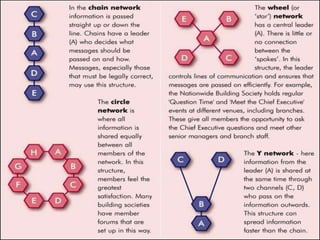
 There are five types of formal network:
 Chain Network
 Y-Network
 All-Channel
 Circle Network
 Wheel Network
Informal network model:
 It is also known as grapevine form of communication and
constitute of four forms.
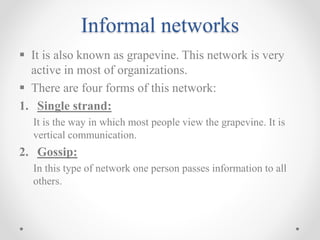
Informal networks
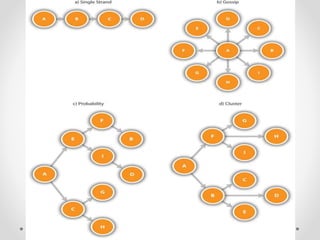
 It is also known as grapevine. This network is very
active in most of organizations.
 There are four forms of this network:
1. Single strand:
It is the way in which most people view the grapevine. It is
vertical communication.
2. Gossip:
In this type of network one person passes information to all
others.
Informal networks
3. Probability:
In this type of network each person tells others at random.
4. Cluster:
This type of network refers to that flow of information in
which some people tell a selected few of others. It is most
popular pattern of grapevine communication.
Barriers to communication
 The Noise Barrier –
 The Feedback Problem
 The Problem of Media Selection
 Mental Barriers
 The problems of Language and Articulation
 Use of improper words
 Use of jargons
 Ambiguity
 Physical Barriers
 Personal Barriers
 Cultural Barriers
 Interpersonal Barriers
“You can have brilliant ideas,
but if you can’t get them across,
your ideas won’t get you
anywhere.”
- Lee Iacocca
Thank-you

Communication behaviour

  • 1.
    Communication Presented by: Kaavya L G.Srinivas K V Rajeev Shruthi Koreth Manjunath Pai
  • 2.
    What is communication? Communicationis the effective sharing or transfer of facts, opinions or emotions by 2 or more people. Communication is effective when it produces the desired action in the reader. The 3 basic goals of communication are 1. To inform 2. To persuade 3. To mobilize
  • 3.
    Effective communication requires competencein 5 different areas Listening Speaking ReadingWriting Non verbal communi cation.
  • 4.
  • 5.
    Effective Communication – 5factors Technology Diversity Dispersal & decentralization Time Constraints Legal liability
  • 6.
    • Technology: Email, voicemail, text message and online chat are some of the means through which technology has pervaded our lives. • Diversity: Organizations are employing more diverse people than ever before. Differently abled employees as well as employees belonging to different culture mingle & work together. • Dispersal & decentralization: Most global organizations are geographically dispersed today, in order to better manage the scale of operation and achieve greater efficiency.
  • 7.
    • Time Constraints: Executivesare increasingly pressed for time . With time as a premium, communication needs to be more crisp, focused, and precise. • Legal liability : As organizations grow more professional, legal issues need to be kept in mind. The written or spoken word is susceptible to misinterpretation.
  • 8.
    One-way & Two-Way One-WayTwo-Way • When no reply is expected or desired. • E.g:- A public notice outside a room stating “Trespassers prohibited” • E.g:- Traffic signs • Two-way communication is a form of transmission in which both parties involved transmit information.
  • 9.
  • 10.
    Methods of communication Meetings  Presentations  Written Messages  Public notices on bulletin boards  Memoranda  Reports  Staff bulletins or magazines  Electronic messages
  • 11.
    Methods of communication Telephonic conversations  Communication through computers  Communication through local area networks  Video conferences  Fax  Email
  • 12.
    Classification on thebasis of flow 1. Downward communication: It flows in a downward direction from a higher authority to a lower authority in order to convey routine information, new policies or procedures, to seek clarification, to ask for analysis, feedbacks etc. It takes place in the form of memos,notice,face to face interactions or telephone conversations.
  • 13.
    Classification on thebasis of flow 2. Upward communication When subordinates send reports to inform their superiors or to present their findings and recommendations, the communication flows upward. In an open culture without too many hierarchical levels, managers are able to create a climate of trust and implement participative decision making which results in considerable upward communication.
  • 14.
    Classification on thebasis of flow 3. Lateral communication: This form of communication takes place among peer groups or hierarchically equivalent employees. It is necessary to facilitate co-ordination, save time, and bridge the communication gap between various departments. 4. Diagonal communication: It flows in all directions and cuts across functions and levels in an organization. It is quick and efficient and increased use of e-mails encourages diagonal communication.
  • 15.
    Types of communication VerbalNon-Verbal  Verbal Communication is the process of communication through sending and receiving messages through the use of words.  Non-Verbal Communication is the process of communication through sending and receiving wordless messages.
  • 16.
    Forms of nonverbal communication Facial expression Appearance Eye contact Voice Posture and body Orientation Gestures
  • 17.
    Networks of communication Formalnetwork model:  There are five types of formal network:  Chain Network  Y-Network  All-Channel  Circle Network  Wheel Network Informal network model:  It is also known as grapevine form of communication and constitute of four forms.
  • 19.
    Informal networks  Itis also known as grapevine. This network is very active in most of organizations.  There are four forms of this network: 1. Single strand: It is the way in which most people view the grapevine. It is vertical communication. 2. Gossip: In this type of network one person passes information to all others.
  • 20.
    Informal networks 3. Probability: Inthis type of network each person tells others at random. 4. Cluster: This type of network refers to that flow of information in which some people tell a selected few of others. It is most popular pattern of grapevine communication.
  • 22.
    Barriers to communication The Noise Barrier –  The Feedback Problem  The Problem of Media Selection  Mental Barriers  The problems of Language and Articulation  Use of improper words  Use of jargons  Ambiguity  Physical Barriers  Personal Barriers  Cultural Barriers  Interpersonal Barriers
  • 23.
    “You can havebrilliant ideas, but if you can’t get them across, your ideas won’t get you anywhere.” - Lee Iacocca
  • 24.