Made by:
Kasandra A. Royal
Student teacher
The Mico University College
Barriers to
Communication
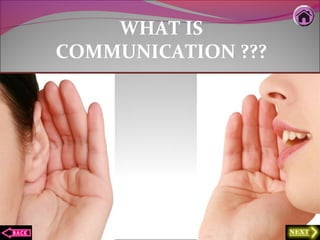
WHAT IS
COMMUNICATION ???
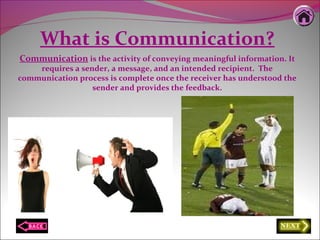
What is Communication?
Communication is the activity of conveying meaningful information. It
requires a sender, a message, and an intended recipient. The
communication process is complete once the receiver has understood the
sender and provides the feedback.
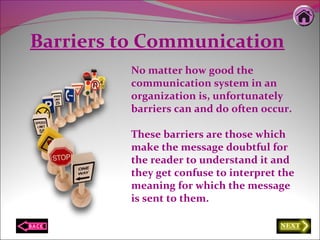
Barriers to Communication
No matter how good the
communication system in an
organization is, unfortunately
barriers can and do often occur.
These barriers are those which
make the message doubtful for
the reader to understand it and
they get confuse to interpret the
meaning for which the message
is sent to them.
Activity 1
Click on the link below to complete this activity.
http://kasandra1.edublogs.org/
Classification of Barriers
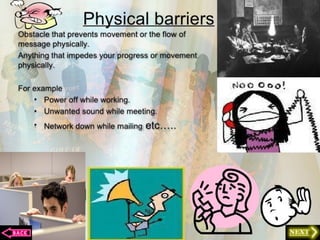
PHYSICAL BARRIERS
CULTURAL BARRIERS
LANGUAGE BARRIERS
GENDER BARRIERS
PERCEPTUAL BARRIERS
EMOTIONAL BARRIERS
ORGANIZATIONAL BARRIERS
Today we will be focusing on
Physical Barriers
Perceptual Barriers
Cultural Barriers
Language Barriers
Gender Barrier
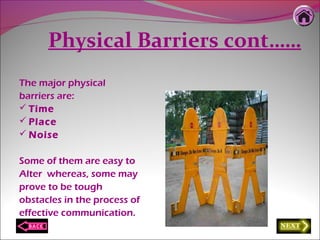
Physical Barriers cont……
The major physical
barriers are:
 Time
 Place
 Noise
Some of them are easy to
Alter whereas, some may
prove to be tough
obstacles in the process of
effective communication.
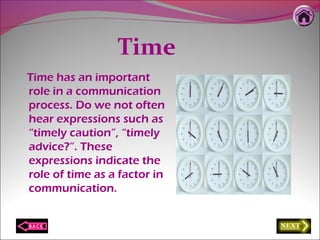
Time
Time has an important
role in a communication
process. Do we not often
hear expressions such as
“timely caution”, “timely
advice?”. These
expressions indicate the
role of time as a factor in
communication.
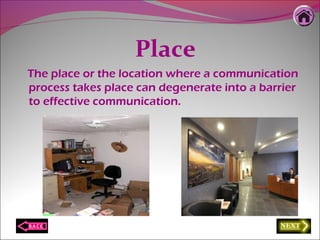
Place
The place or the location where a communication
process takes place can degenerate into a barrier
to effective communication.
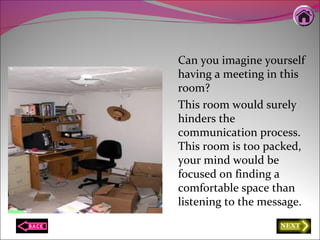
Can you imagine yourself
having a meeting in this
room?
This room would surely
hinders the
communication process.
This room is too packed,
your mind would be
focused on finding a
comfortable space than
listening to the message.
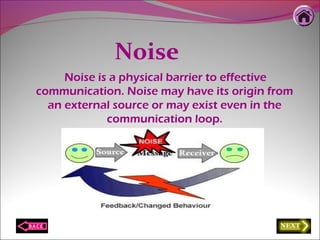
Noise
Noise is a physical barrier to effective
communication. Noise may have its origin from
an external source or may exist even in the
communication loop.
How to Overcome
Physical
Barriers ???
Appropriate Seating Arrangement
Ensure Visibility & Audibility
Environmental Comfort
Minimise Visual/Oral Distractions
Appropriate medium
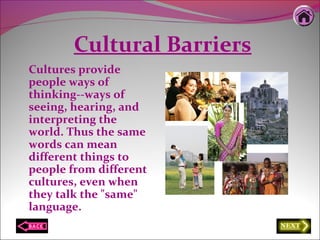
Cultural Barriers
Cultures provide
people ways of
thinking--ways of
seeing, hearing, and
interpreting the
world. Thus the same
words can mean
different things to
people from different
cultures, even when
they talk the "same"
language.
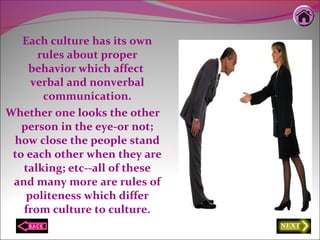
Each culture has its own
rules about proper
behavior which affect
verbal and nonverbal
communication.
Whether one looks the other
person in the eye-or not;
how close the people stand
to each other when they are
talking; etc--all of these
and many more are rules of
politeness which differ
from culture to culture.
How to Overcome
Cultural Barriers ???
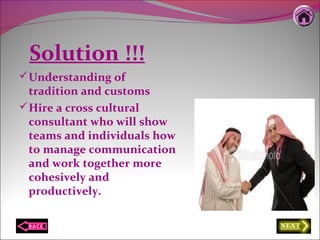
Solution !!!
Understanding of
tradition and customs
Hire a cross cultural
consultant who will show
teams and individuals how
to manage communication
and work together more
cohesively and
productively.
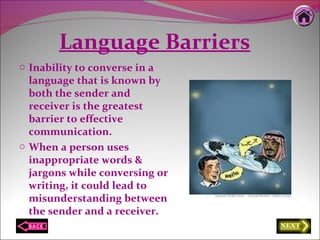
Language Barriers
o Inability to converse in a
language that is known by
both the sender and
receiver is the greatest
barrier to effective
communication.
o When a person uses
inappropriate words &
jargons while conversing or
writing, it could lead to
misunderstanding between
the sender and a receiver.
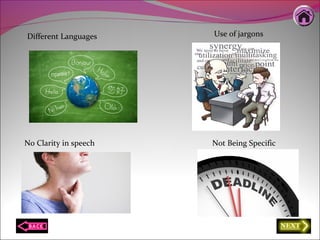
Different Languages Use of jargons
No Clarity in speech Not Being Specific
How to Overcome Language
Barriers ???
Solution !!!
Learn the language
Hire an interpreter
Carry a translating
dictionary
Instead of trying to
communicate with hand
signs and offend them,
research some different signs
that mean something polite
and respectful
Be careful of jargon
Activity #2
Go back to the site to complete this
activity or click on the link below.
http://popplet.com/app/#/2600559
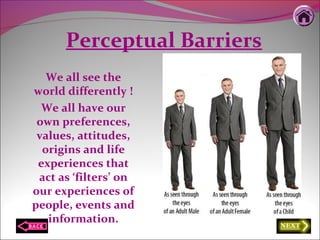
Perceptual Barriers
We all see the
world differently !
We all have our
own preferences,
values, attitudes,
origins and life
experiences that
act as ‘filters’ on
our experiences of
people, events and
information.
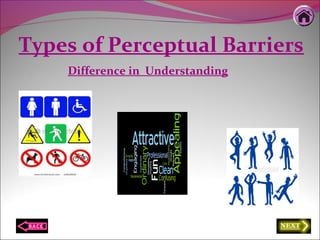
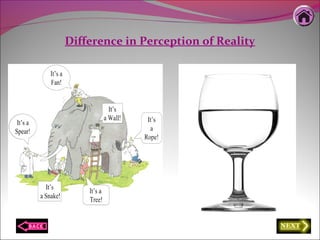
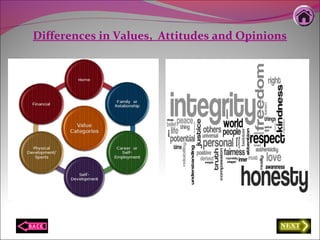
Types of Perceptual Barriers
Difference in Understanding
Difference in Perception of Reality
Differences in Values, Attitudes and Opinions
How
To
Overcome
Perceptual
Barriers?
Solution !!!
 Start by listening to others.
 Clarify if there is confusion.
 Stay calm and be positive.
An attitude of good will and
tolerance toward others goes
a long way--even if you
miscommunicate or do not
like another's words or
actions.
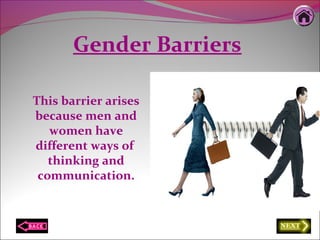
Gender Barriers
This barrier arises
because men and
women have
different ways of
thinking and
communication.
An example of gender barrier is that women are
considered to be house wife and to do jobs such as
being receptionist and men are considered to jobs
such as being construction worker or a
mechanical technician.
This is no longer valid, there are females who are
now well trained and qualified to be a
construction worker, vice versa.
How To Overcome Gender
Barriers???
Solution !!!
The process of
bridging the gap in
gender
communication
requires a great deal
of patience and
understanding that
only time and
attention will teach.
CONCLUSION
Working on improving your
communications is a broad-brush
activity. You have to change your
thoughts, your feelings, and your
physical connections.
That way, you can break down the
barriers that get in your way and
start building relationships that
really work.
Culminatory Activity
Now you will be tested to see what you have learnt.
Please click on the link below or go back to the site to
complete the assessment.
https://www.schoology.com/home.php
Thank You !Thank You !

Barriers to Communication

  • 1.
    Made by: Kasandra A.Royal Student teacher The Mico University College Barriers to Communication
  • 2.
  • 3.
    What is Communication? Communicationis the activity of conveying meaningful information. It requires a sender, a message, and an intended recipient. The communication process is complete once the receiver has understood the sender and provides the feedback.
  • 4.
    Barriers to Communication Nomatter how good the communication system in an organization is, unfortunately barriers can and do often occur. These barriers are those which make the message doubtful for the reader to understand it and they get confuse to interpret the meaning for which the message is sent to them.
  • 5.
    Activity 1 Click onthe link below to complete this activity. http://kasandra1.edublogs.org/
  • 6.
    Classification of Barriers PHYSICALBARRIERS CULTURAL BARRIERS LANGUAGE BARRIERS GENDER BARRIERS PERCEPTUAL BARRIERS EMOTIONAL BARRIERS ORGANIZATIONAL BARRIERS
  • 7.
    Today we willbe focusing on Physical Barriers Perceptual Barriers Cultural Barriers Language Barriers Gender Barrier
  • 9.
    Physical Barriers cont…… Themajor physical barriers are:  Time  Place  Noise Some of them are easy to Alter whereas, some may prove to be tough obstacles in the process of effective communication.
  • 10.
    Time Time has animportant role in a communication process. Do we not often hear expressions such as “timely caution”, “timely advice?”. These expressions indicate the role of time as a factor in communication.
  • 11.
    Place The place orthe location where a communication process takes place can degenerate into a barrier to effective communication.
  • 12.
    Can you imagineyourself having a meeting in this room? This room would surely hinders the communication process. This room is too packed, your mind would be focused on finding a comfortable space than listening to the message.
  • 13.
    Noise Noise is aphysical barrier to effective communication. Noise may have its origin from an external source or may exist even in the communication loop.
  • 14.
  • 15.
    Appropriate Seating Arrangement EnsureVisibility & Audibility Environmental Comfort Minimise Visual/Oral Distractions Appropriate medium
  • 16.
    Cultural Barriers Cultures provide peopleways of thinking--ways of seeing, hearing, and interpreting the world. Thus the same words can mean different things to people from different cultures, even when they talk the "same" language.
  • 17.
    Each culture hasits own rules about proper behavior which affect verbal and nonverbal communication. Whether one looks the other person in the eye-or not; how close the people stand to each other when they are talking; etc--all of these and many more are rules of politeness which differ from culture to culture.
  • 18.
  • 19.
    Solution !!! Understanding of traditionand customs Hire a cross cultural consultant who will show teams and individuals how to manage communication and work together more cohesively and productively.
  • 20.
    Language Barriers o Inabilityto converse in a language that is known by both the sender and receiver is the greatest barrier to effective communication. o When a person uses inappropriate words & jargons while conversing or writing, it could lead to misunderstanding between the sender and a receiver.
  • 21.
    Different Languages Useof jargons No Clarity in speech Not Being Specific
  • 22.
    How to OvercomeLanguage Barriers ???
  • 23.
    Solution !!! Learn thelanguage Hire an interpreter Carry a translating dictionary Instead of trying to communicate with hand signs and offend them, research some different signs that mean something polite and respectful Be careful of jargon
  • 24.
    Activity #2 Go backto the site to complete this activity or click on the link below. http://popplet.com/app/#/2600559
  • 25.
    Perceptual Barriers We allsee the world differently ! We all have our own preferences, values, attitudes, origins and life experiences that act as ‘filters’ on our experiences of people, events and information.
  • 26.
    Types of PerceptualBarriers Difference in Understanding
  • 27.
  • 28.
    Differences in Values,Attitudes and Opinions
  • 29.
  • 30.
    Solution !!!  Startby listening to others.  Clarify if there is confusion.  Stay calm and be positive. An attitude of good will and tolerance toward others goes a long way--even if you miscommunicate or do not like another's words or actions.
  • 31.
    Gender Barriers This barrierarises because men and women have different ways of thinking and communication.
  • 32.
    An example ofgender barrier is that women are considered to be house wife and to do jobs such as being receptionist and men are considered to jobs such as being construction worker or a mechanical technician. This is no longer valid, there are females who are now well trained and qualified to be a construction worker, vice versa.
  • 33.
    How To OvercomeGender Barriers???
  • 34.
    Solution !!! The processof bridging the gap in gender communication requires a great deal of patience and understanding that only time and attention will teach.
  • 35.
    CONCLUSION Working on improvingyour communications is a broad-brush activity. You have to change your thoughts, your feelings, and your physical connections. That way, you can break down the barriers that get in your way and start building relationships that really work.
  • 36.
    Culminatory Activity Now youwill be tested to see what you have learnt. Please click on the link below or go back to the site to complete the assessment. https://www.schoology.com/home.php
  • 37.