Social (Pragmatic)
Communication Disorder (SCD)
Laura Justus BA, B.Ed., OCT
SCD is characterized by a persistent difficulty with
verbal and nonverbal communication that cannot be
explained by low cognitive ability. Symptoms include
difficulty in the acquisition and use of spoken and written
language as well as problems with inappropriate
responses in conversation. The disorder limits effective
communication, social relationships, academic
achievement, or occupational performance. Symptoms
must be present in early childhood even if they are not
recognized until later when speech, language, or
communication demands exceed abilities.
Definition
"Social Communication Disorder: Parents Seek Guidance." Autism
Speaks. N.p., n.d. Web. 24 Oct. 2015.
<https://www.autismspeaks.org/blog/2014/01/31/social-communication-
disorder-parents-seek-guidance>.
Click Here
After Video
Characteristics
As an individual with Social
Communication Disorder I may:
• Have difficulty interacting with peers and/or adults
• Violate conventional conversational rules
• Have limited eye contact
• Interrupt frequently
• Make odd, irrelevant comments
• Repeat content
• Confuse listeners
• Have poor topic maintenance
• Dominate conversations
• Violate others personal space
• Be unable to interpret
and use non-verbal cues
Pragmatics refers to the understanding
and use of social language. It may
include eye contact, topic maintenance,
turn taking, and/or the appropriate use
of social cues. The following
characteristics may indicate that a child
is having difficulties with social
language.
"Communication Disorders Handbook." Student Support Services. Ontario Ministry
of Education, 1994. Web. 23 Oct. 2015.
<http://www.ed.gov.nl.ca/edu/k12/studentsupportservices/publications/Communicatio
nDisordersHandbook.pdf>.
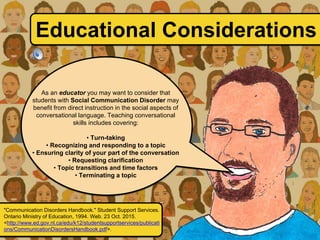
As an educator you may want to consider that
students with Social Communication Disorder may
benefit from direct instruction in the social aspects of
conversational language. Teaching conversational
skills includes covering:
• Turn-taking
• Recognizing and responding to a topic
• Ensuring clarity of your part of the conversation
• Requesting clarification
• Topic transitions and time factors
• Terminating a topic
Educational Considerations
"Communication Disorders Handbook." Student Support Services.
Ontario Ministry of Education, 1994. Web. 23 Oct. 2015.
<http://www.ed.gov.nl.ca/edu/k12/studentsupportservices/publicati
ons/CommunicationDisordersHandbook.pdf>.
Strategies & Additional Information
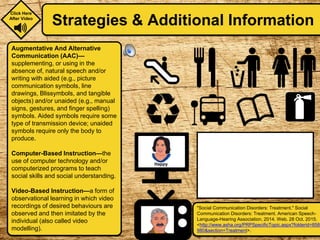
Augmentative And Alternative
Communication (AAC)—
supplementing, or using in the
absence of, natural speech and/or
writing with aided (e.g., picture
communication symbols, line
drawings, Blissymbols, and tangible
objects) and/or unaided (e.g., manual
signs, gestures, and finger spelling)
symbols. Aided symbols require some
type of transmission device; unaided
symbols require only the body to
produce.
Computer-Based Instruction—the
use of computer technology and/or
computerized programs to teach
social skills and social understanding.
Video-Based Instruction—a form of
observational learning in which video
recordings of desired behaviours are
observed and then imitated by the
individual (also called video
modelling).
Happy
"Social Communication Disorders: Treatment." Social
Communication Disorders: Treatment. American Speech-
Language-Hearing Association, 2014. Web. 28 Oct. 2015.
<http://www.asha.org/PRPSpecificTopic.aspx?folderid=8589
980&section=Treatment>.
Click Here
After Video

Social Pragmatic Communication Disorder Presentation

  • 1.
    Social (Pragmatic) Communication Disorder(SCD) Laura Justus BA, B.Ed., OCT
  • 2.
    SCD is characterizedby a persistent difficulty with verbal and nonverbal communication that cannot be explained by low cognitive ability. Symptoms include difficulty in the acquisition and use of spoken and written language as well as problems with inappropriate responses in conversation. The disorder limits effective communication, social relationships, academic achievement, or occupational performance. Symptoms must be present in early childhood even if they are not recognized until later when speech, language, or communication demands exceed abilities. Definition "Social Communication Disorder: Parents Seek Guidance." Autism Speaks. N.p., n.d. Web. 24 Oct. 2015. <https://www.autismspeaks.org/blog/2014/01/31/social-communication- disorder-parents-seek-guidance>. Click Here After Video
  • 3.
    Characteristics As an individualwith Social Communication Disorder I may: • Have difficulty interacting with peers and/or adults • Violate conventional conversational rules • Have limited eye contact • Interrupt frequently • Make odd, irrelevant comments • Repeat content • Confuse listeners • Have poor topic maintenance • Dominate conversations • Violate others personal space • Be unable to interpret and use non-verbal cues Pragmatics refers to the understanding and use of social language. It may include eye contact, topic maintenance, turn taking, and/or the appropriate use of social cues. The following characteristics may indicate that a child is having difficulties with social language. "Communication Disorders Handbook." Student Support Services. Ontario Ministry of Education, 1994. Web. 23 Oct. 2015. <http://www.ed.gov.nl.ca/edu/k12/studentsupportservices/publications/Communicatio nDisordersHandbook.pdf>.
  • 4.
    As an educatoryou may want to consider that students with Social Communication Disorder may benefit from direct instruction in the social aspects of conversational language. Teaching conversational skills includes covering: • Turn-taking • Recognizing and responding to a topic • Ensuring clarity of your part of the conversation • Requesting clarification • Topic transitions and time factors • Terminating a topic Educational Considerations "Communication Disorders Handbook." Student Support Services. Ontario Ministry of Education, 1994. Web. 23 Oct. 2015. <http://www.ed.gov.nl.ca/edu/k12/studentsupportservices/publicati ons/CommunicationDisordersHandbook.pdf>.
  • 5.
    Strategies & AdditionalInformation Augmentative And Alternative Communication (AAC)— supplementing, or using in the absence of, natural speech and/or writing with aided (e.g., picture communication symbols, line drawings, Blissymbols, and tangible objects) and/or unaided (e.g., manual signs, gestures, and finger spelling) symbols. Aided symbols require some type of transmission device; unaided symbols require only the body to produce. Computer-Based Instruction—the use of computer technology and/or computerized programs to teach social skills and social understanding. Video-Based Instruction—a form of observational learning in which video recordings of desired behaviours are observed and then imitated by the individual (also called video modelling). Happy "Social Communication Disorders: Treatment." Social Communication Disorders: Treatment. American Speech- Language-Hearing Association, 2014. Web. 28 Oct. 2015. <http://www.asha.org/PRPSpecificTopic.aspx?folderid=8589 980&section=Treatment>. Click Here After Video