Autism Spectrum
    Disorder

   Presented by:
  Steph Copeland
    Jen Hobbs
  Rosie Amstutz
   Lanre Oriowo
Definition of Autism
 The Individuals with Disabilities Education Act [IDEA 300.7
 ©(1)(i)]
 ―A developmental disability significantly affecting verbal and
  non-verbal communication and social interaction, generally
    evident before age three that adversely affects a child’s
                  educational performance.
Other characteristics often associated with autism are engagement
  in repetitive activities and stereotyped movements, resistance to
  environmental change, a change in daily routines and unusual
  responses to sensory experiences.‖
   (i) Autism does not apply if a child's educational performance is
    adversely affected primarily because the child has an
    emotional disability.
   (ii) A child who manifests the characteristics of autism after age 3 could
    be identified as having autism if the other criteria are satisfied.
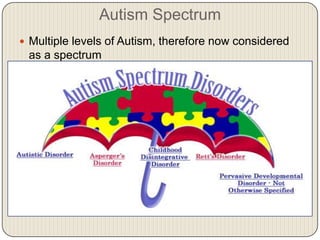
Autism Spectrum
 Multiple levels of Autism, therefore now considered
 as a spectrum
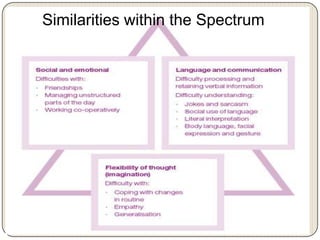
Similarities within the Spectrum
More similarities within the Spectrum
 Marked impairments in the use of multiple nonverbal behaviors
    eye-to- eye gaze,
    facial expression,
    body posture, and gestures to regulate social interaction.
 A lack of spontaneous seeking to share enjoyment, interests, or
  achievements with other people,
    e.g., by a lack of showing, bringing, or pointing out objects of interest to other people).
 A lack of social or emotional reciprocity
 Delay in or total lack of, the development of spoken language
    not accompanied by an attempt to compensate through alternative modes of communication
     such as gesture or mime
 Encompassing preoccupation with one or more stereotyped and
  restricted patterns of interest that is abnormal either in intensity or focus.
 Apparently inflexible adherence to specific, nonfunctional routines or
  rituals.
 Repetitive motor mannerisms
    Hand or finger flapping or twisting, or complex whole-body movements).
Uniqueness within the spectrum
 Asperger’s Syndrome
   Higher IQ
   Reach milestones at the right time
   Do not have communicative impairments

 Rett Syndrome
   Usually only found in girls
   Normal development until 6 – 18 months
     Hypotonia - loss of muscle tone, no eye contact, decelerated head growth
     Rapid developmental regression – hand wringing, unsteady walking, breathing
      irregularities, seizures.


 PDD – NOS
   Diagnosed when child displays some autistic behaviors and meets some but not all
    criteria for PDDs.
   Example from the book(pg 363) – an individual with severe impairments in social
    interactions and communication but no repetitive behavior

 CDD
   Normal development until a certain age (between 2 and 10) and then regress
Prevalence
 ASD Prevalence – 1 in 91 children is diagnosed
   1 in 58 boys is diagnosed with autism
   Boys 4 times more likely to have ASD


 In order of most to least
   PDD – NOS and Autism
     About 10 in 10000
   Asperger’s Syndrome
     About 2.5 in 10000
   Rett’s Syndrome & CDD
     Less than 1 in 10000
Autism on the RISE!
• Autism prevalence figures are growing
  • More children will be diagnosed with autism this year than
    with AIDS, diabetes & cancer combined.

• Autism costs the nation over $35 billion per year, a
  figure expected to significantly increase in the next
  decade.
  • Autism receives less than 5% of the research funding of
    many less prevalent childhood diseases.

 ASD - fastest growing disability category in the IDEA
   Greater awareness of Autism
   Improved methods of identification
   Increased awareness that autism can exist at different IQ
    levels
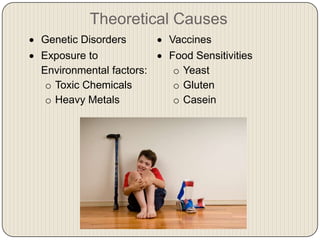
Theoretical Causes
Genetic Disorders        Vaccines
Exposure to              Food Sensitivities
Environmental factors:    o Yeast
 o Toxic Chemicals        o Gluten
 o Heavy Metals           o Casein
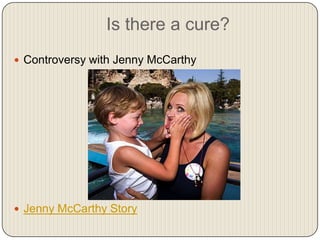
Is there a cure?
 Controversy with Jenny McCarthy


 Jenny McCarthy Story
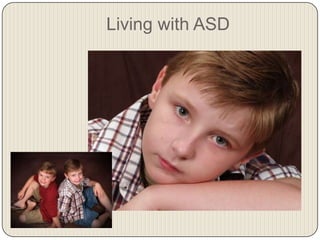
Living with ASD
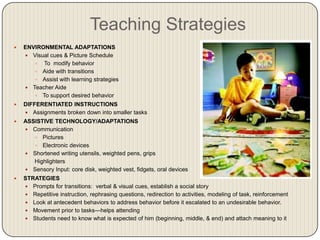
Teaching Strategies
   ENVIRONMENTAL ADAPTATIONS
     Visual cues & Picture Schedule
        To modify behavior
        Aide with transitions
        Assist with learning strategies
     Teacher Aide
        To support desired behavior
   DIFFERENTIATED INSTRUCTIONS
     Assignments broken down into smaller tasks
   ASSISTIVE TECHNOLOGY/ADAPTATIONS
     Communication
        Pictures
        Electronic devices
     Shortened writing utensils, weighted pens, grips
       Highlighters
     Sensory Input: core disk, weighted vest, fidgets, oral devices
   STRATEGIES
     Prompts for transitions: verbal & visual cues, establish a social story
     Repetitive instruction, rephrasing questions, redirection to activities, modeling of task, reinforcement
     Look at antecedent behaviors to address behavior before it escalated to an undesirable behavior.
     Movement prior to tasks—helps attending
     Students need to know what is expected of him (beginning, middle, & end) and attach meaning to it
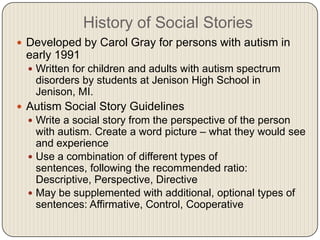
History of Social Stories
 Developed by Carol Gray for persons with autism in
 early 1991
   Written for children and adults with autism spectrum
   disorders by students at Jenison High School in
   Jenison, MI.
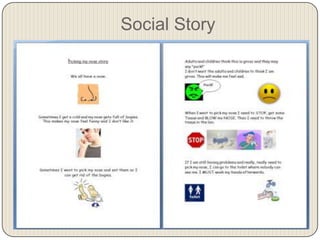
 Autism Social Story Guidelines
   Write a social story from the perspective of the person
    with autism. Create a word picture – what they would see
    and experience
   Use a combination of different types of
    sentences, following the recommended ratio:
    Descriptive, Perspective, Directive
   May be supplemented with additional, optional types of
    sentences: Affirmative, Control, Cooperative
Social Story
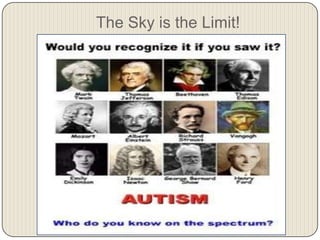
The Sky is the Limit!
Questions?
Resources
 http://www.aspergers.com/
 www.Autismspeaks.org
 http://www.cde.state.co.us/cdesped/SD-Autism.asp
 http://www.specialed.us/autism/asper/asper11.html
 http://www.rettsyndrome.org
 http://www.barberinstitute.org/autismINsight/disorder_pe
  rvasive.php
 http://www.barberinstitute.org/autismINsight/disorder_pe
  rvasive.php
 www.child-autism-parent-cafe.com/how-to-write-a-
  social-story.html

Autism Spectrum Disorder

  • 1.
    Autism Spectrum Disorder Presented by: Steph Copeland Jen Hobbs Rosie Amstutz Lanre Oriowo
  • 2.
    Definition of Autism The Individuals with Disabilities Education Act [IDEA 300.7 ©(1)(i)] ―A developmental disability significantly affecting verbal and non-verbal communication and social interaction, generally evident before age three that adversely affects a child’s educational performance. Other characteristics often associated with autism are engagement in repetitive activities and stereotyped movements, resistance to environmental change, a change in daily routines and unusual responses to sensory experiences.‖  (i) Autism does not apply if a child's educational performance is adversely affected primarily because the child has an emotional disability.  (ii) A child who manifests the characteristics of autism after age 3 could be identified as having autism if the other criteria are satisfied.
  • 3.
    Autism Spectrum  Multiplelevels of Autism, therefore now considered as a spectrum
  • 4.
  • 5.
    More similarities withinthe Spectrum  Marked impairments in the use of multiple nonverbal behaviors  eye-to- eye gaze,  facial expression,  body posture, and gestures to regulate social interaction.  A lack of spontaneous seeking to share enjoyment, interests, or achievements with other people,  e.g., by a lack of showing, bringing, or pointing out objects of interest to other people).  A lack of social or emotional reciprocity  Delay in or total lack of, the development of spoken language  not accompanied by an attempt to compensate through alternative modes of communication such as gesture or mime  Encompassing preoccupation with one or more stereotyped and restricted patterns of interest that is abnormal either in intensity or focus.  Apparently inflexible adherence to specific, nonfunctional routines or rituals.  Repetitive motor mannerisms  Hand or finger flapping or twisting, or complex whole-body movements).
  • 6.
    Uniqueness within thespectrum  Asperger’s Syndrome  Higher IQ  Reach milestones at the right time  Do not have communicative impairments  Rett Syndrome  Usually only found in girls  Normal development until 6 – 18 months  Hypotonia - loss of muscle tone, no eye contact, decelerated head growth  Rapid developmental regression – hand wringing, unsteady walking, breathing irregularities, seizures.  PDD – NOS  Diagnosed when child displays some autistic behaviors and meets some but not all criteria for PDDs.  Example from the book(pg 363) – an individual with severe impairments in social interactions and communication but no repetitive behavior  CDD  Normal development until a certain age (between 2 and 10) and then regress
  • 7.
    Prevalence  ASD Prevalence– 1 in 91 children is diagnosed  1 in 58 boys is diagnosed with autism  Boys 4 times more likely to have ASD  In order of most to least  PDD – NOS and Autism  About 10 in 10000  Asperger’s Syndrome  About 2.5 in 10000  Rett’s Syndrome & CDD  Less than 1 in 10000
  • 8.
    Autism on theRISE! • Autism prevalence figures are growing • More children will be diagnosed with autism this year than with AIDS, diabetes & cancer combined. • Autism costs the nation over $35 billion per year, a figure expected to significantly increase in the next decade. • Autism receives less than 5% of the research funding of many less prevalent childhood diseases.  ASD - fastest growing disability category in the IDEA  Greater awareness of Autism  Improved methods of identification  Increased awareness that autism can exist at different IQ levels
  • 9.
    Theoretical Causes Genetic Disorders Vaccines Exposure to Food Sensitivities Environmental factors: o Yeast o Toxic Chemicals o Gluten o Heavy Metals o Casein
  • 10.
    Is there acure?  Controversy with Jenny McCarthy  Jenny McCarthy Story
  • 11.
  • 12.
    Teaching Strategies  ENVIRONMENTAL ADAPTATIONS  Visual cues & Picture Schedule  To modify behavior  Aide with transitions  Assist with learning strategies  Teacher Aide  To support desired behavior  DIFFERENTIATED INSTRUCTIONS  Assignments broken down into smaller tasks  ASSISTIVE TECHNOLOGY/ADAPTATIONS  Communication  Pictures  Electronic devices  Shortened writing utensils, weighted pens, grips Highlighters  Sensory Input: core disk, weighted vest, fidgets, oral devices  STRATEGIES  Prompts for transitions: verbal & visual cues, establish a social story  Repetitive instruction, rephrasing questions, redirection to activities, modeling of task, reinforcement  Look at antecedent behaviors to address behavior before it escalated to an undesirable behavior.  Movement prior to tasks—helps attending  Students need to know what is expected of him (beginning, middle, & end) and attach meaning to it
  • 13.
    History of SocialStories  Developed by Carol Gray for persons with autism in early 1991  Written for children and adults with autism spectrum disorders by students at Jenison High School in Jenison, MI.  Autism Social Story Guidelines  Write a social story from the perspective of the person with autism. Create a word picture – what they would see and experience  Use a combination of different types of sentences, following the recommended ratio: Descriptive, Perspective, Directive  May be supplemented with additional, optional types of sentences: Affirmative, Control, Cooperative
  • 14.
  • 15.
    The Sky isthe Limit!
  • 16.
  • 17.
    Resources  http://www.aspergers.com/  www.Autismspeaks.org http://www.cde.state.co.us/cdesped/SD-Autism.asp  http://www.specialed.us/autism/asper/asper11.html  http://www.rettsyndrome.org  http://www.barberinstitute.org/autismINsight/disorder_pe rvasive.php  http://www.barberinstitute.org/autismINsight/disorder_pe rvasive.php  www.child-autism-parent-cafe.com/how-to-write-a- social-story.html