Understanding Hearing Impairment
3
1
2
4-5
The Basics of Hearing
Impairment: Learning
Characteristics
Dealing with a Hearing Impaired
Student in an Inclusive
Classroom
Practical Teaching
Strategies
Communicating with the H.I.
Training Outline
MODULE 1
Understanding Hearing
Impairment:
Myths and Facts of Hearing
Impairment
Over 5% of the world’s
population – 360 million people –
has disabling hearing loss.
Living with hearing loss is not a
big deal.
If someone has a hearing
impairment, he’d certainly
know about it
Deaf people are good
lipreaders.
Hearing aids can restore
hearing.
Sign Language is a universal or
international language.
If I shout, the deaf person can
understand me more clearly.
The deaf sometimes seem to
hear me only when they feel like
it.
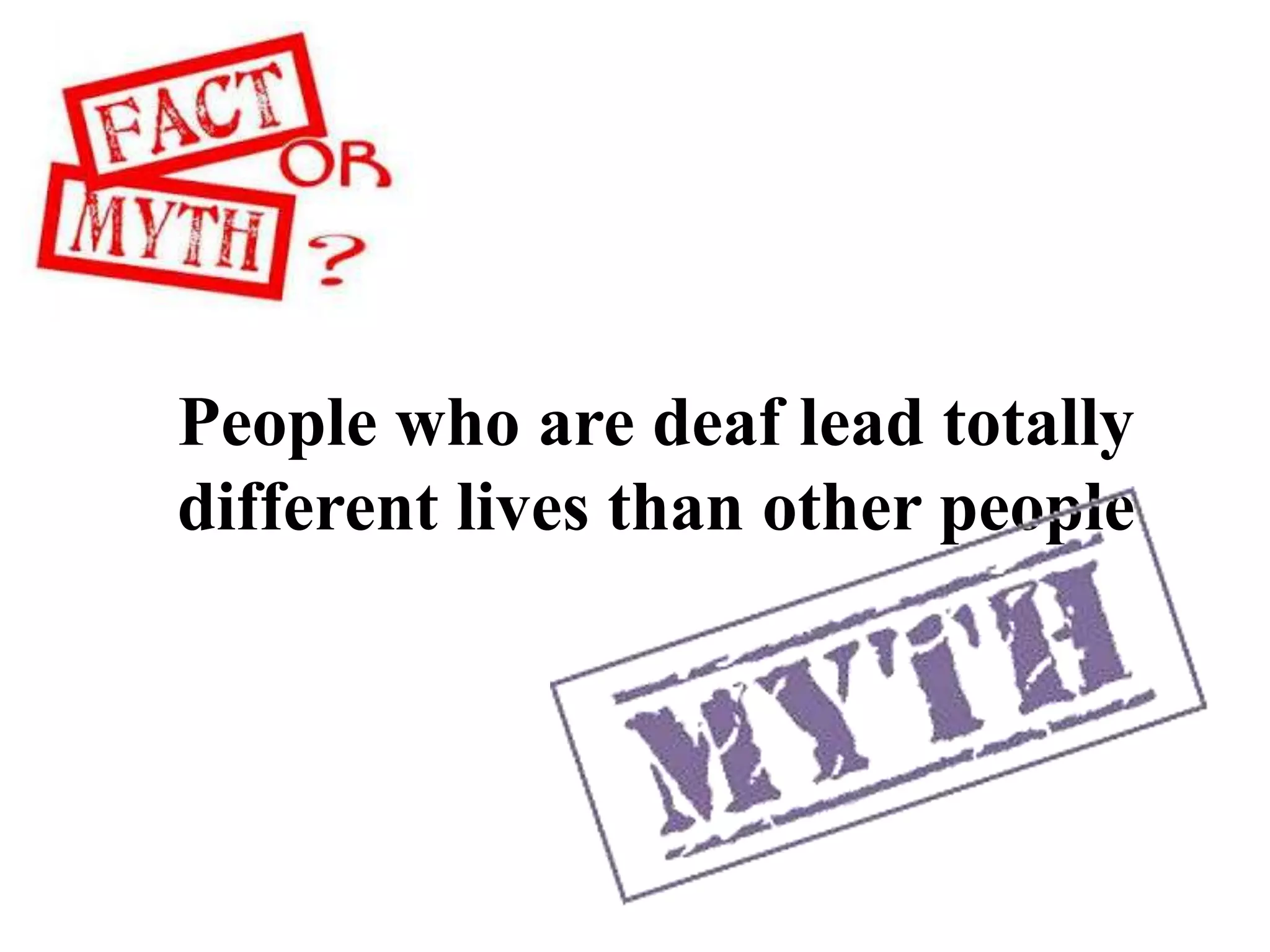
People who are deaf lead totally
different lives than other people
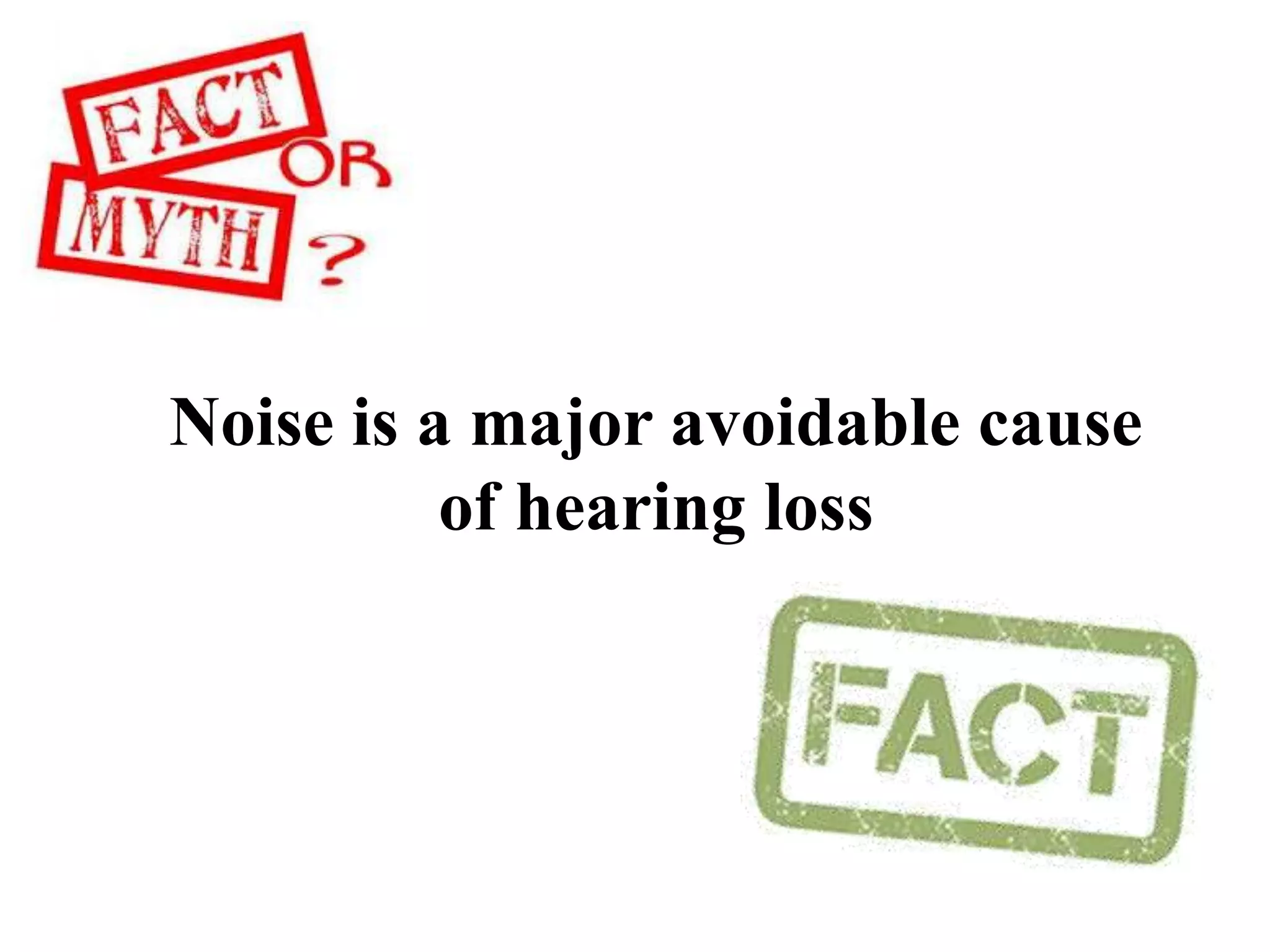
Noise is a major avoidable cause
of hearing loss
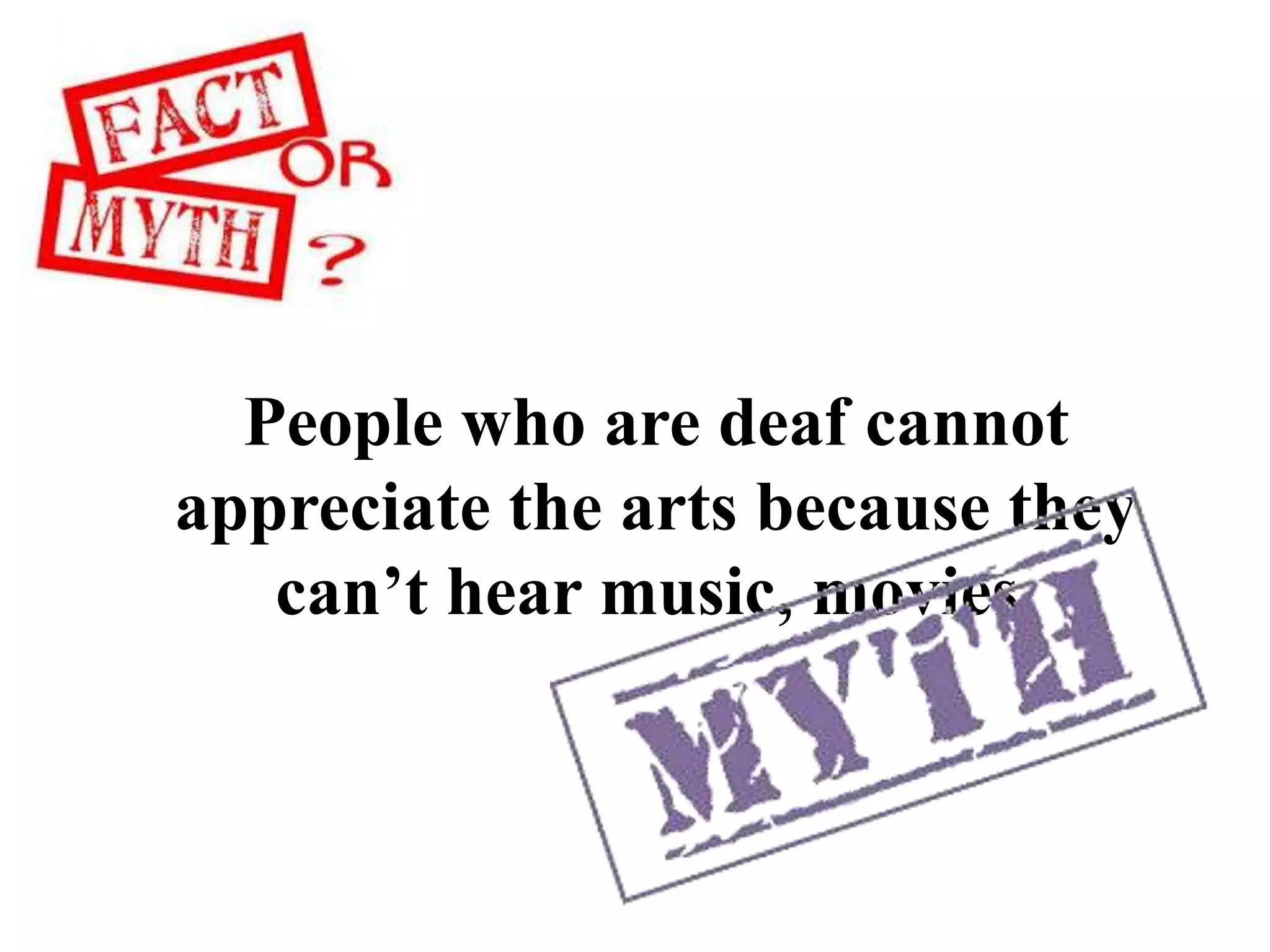
People who are deaf cannot
appreciate the arts because they
can’t hear music, movies.
People who are deaf are less
intelligent.
All people who are deaf use sign
language to communicate
Gradual hearing loss can affect
people of all ages .
Over 5% of the world’s
population – 360 million people –
has disabling hearing loss.
Living with hearing loss is not a
big deal.
If someone has a hearing
impairment, he’d certainly
know about it
Deaf people are good
lipreaders.
Hearing aids can restore
hearing.
Sign Language is a universal or
international language.
If I shout, the deaf person can
understand me more clearly.
The deaf sometimes seem to
hear me only when they feel like
it.
People who are deaf lead totally
different lives than other people
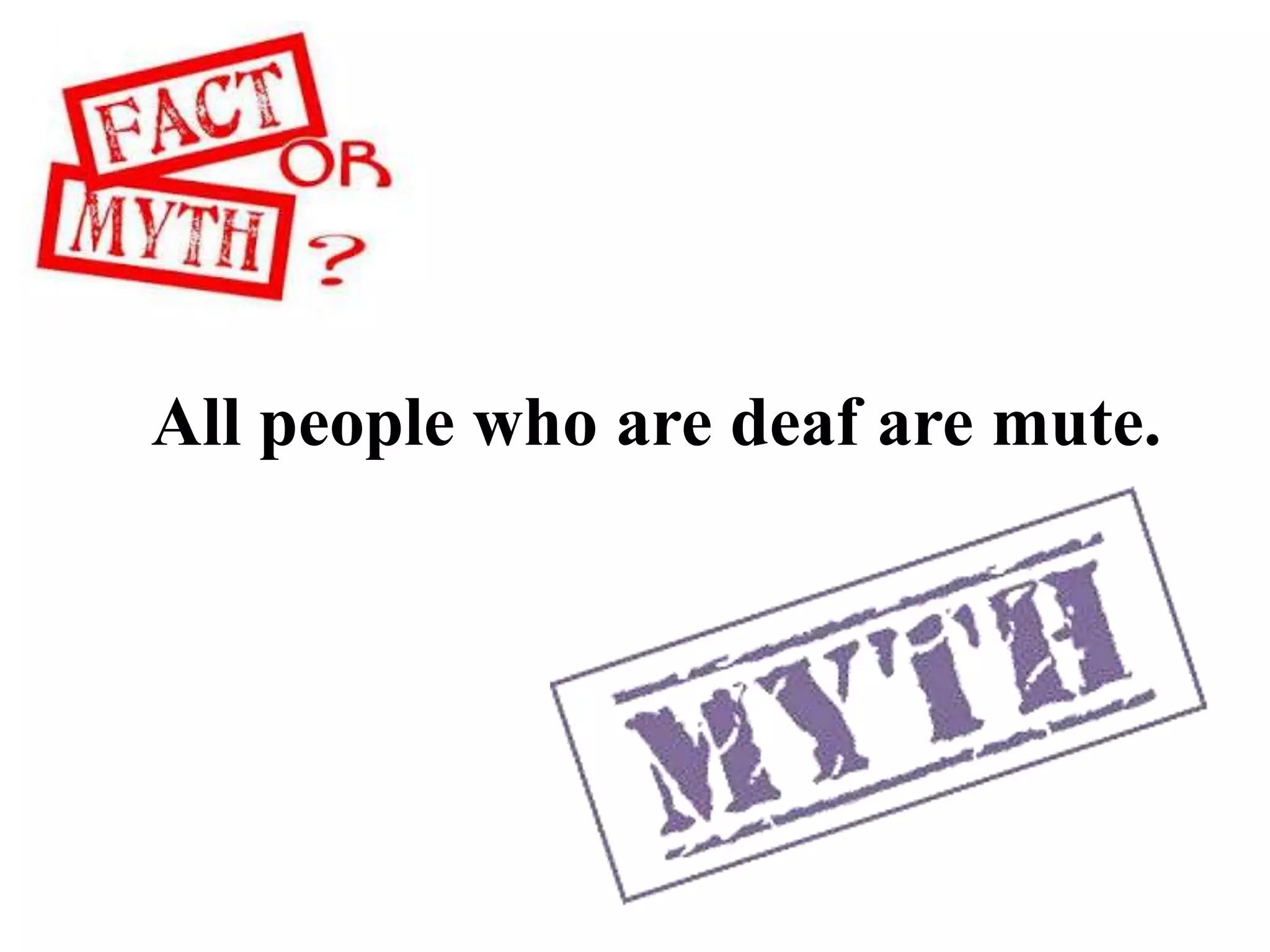
All people who are deaf are mute.
Noise is a major avoidable cause
of hearing loss
People who are deaf cannot
appreciate the arts because they
can’t hear music, movies.
People who are deaf are less
intelligent.
All people who are deaf use sign
language to communicate
Gradual hearing loss can affect
people of all ages .
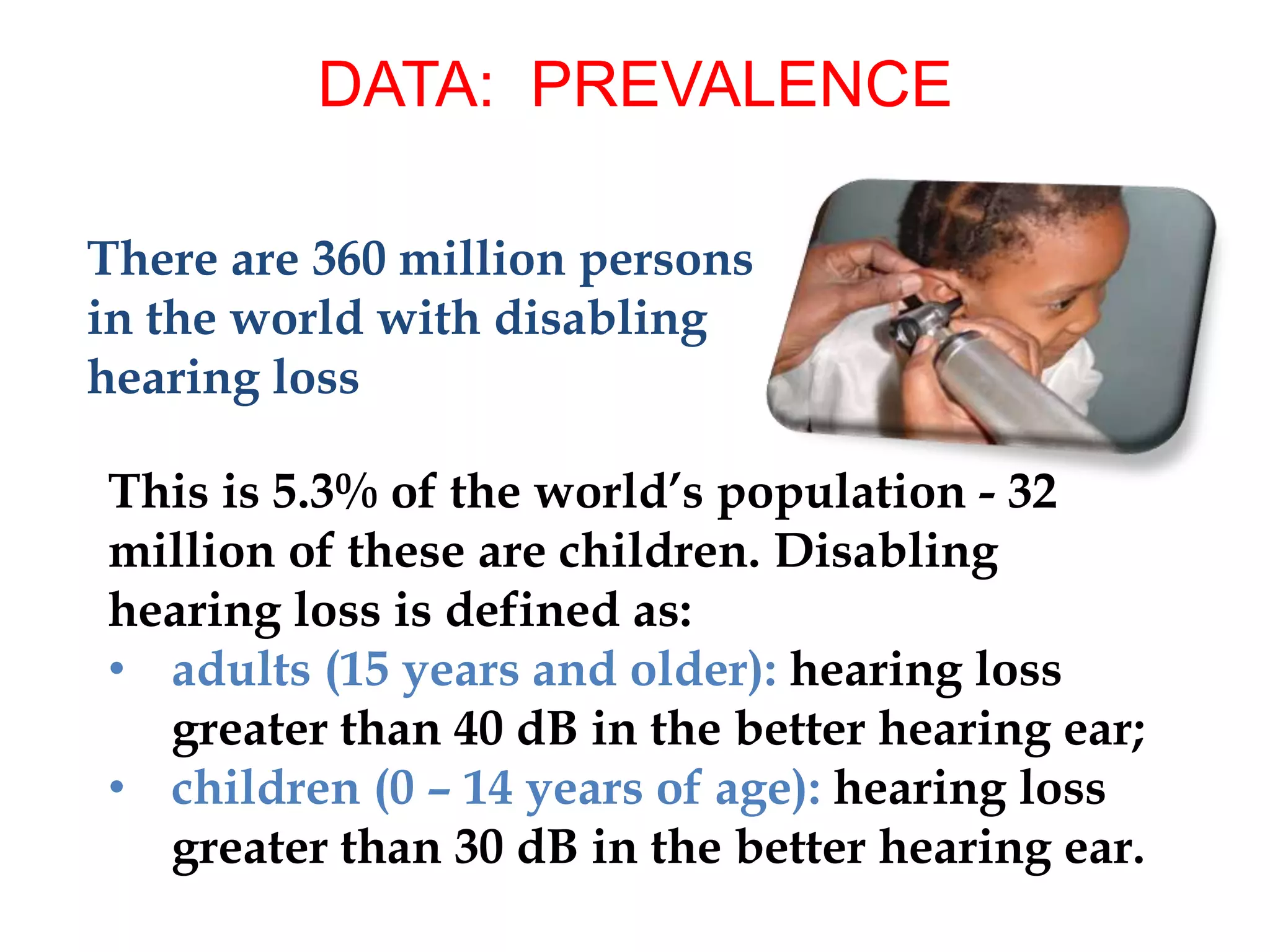
There are 360 million persons
in the world with disabling
hearing loss
DATA: PREVALENCE
This is 5.3% of the world’s population - 32
million of these are children. Disabling
hearing loss is defined as:
• adults (15 years and older): hearing loss
greater than 40 dB in the better hearing ear;
• children (0 – 14 years of age): hearing loss
greater than 30 dB in the better hearing ear.
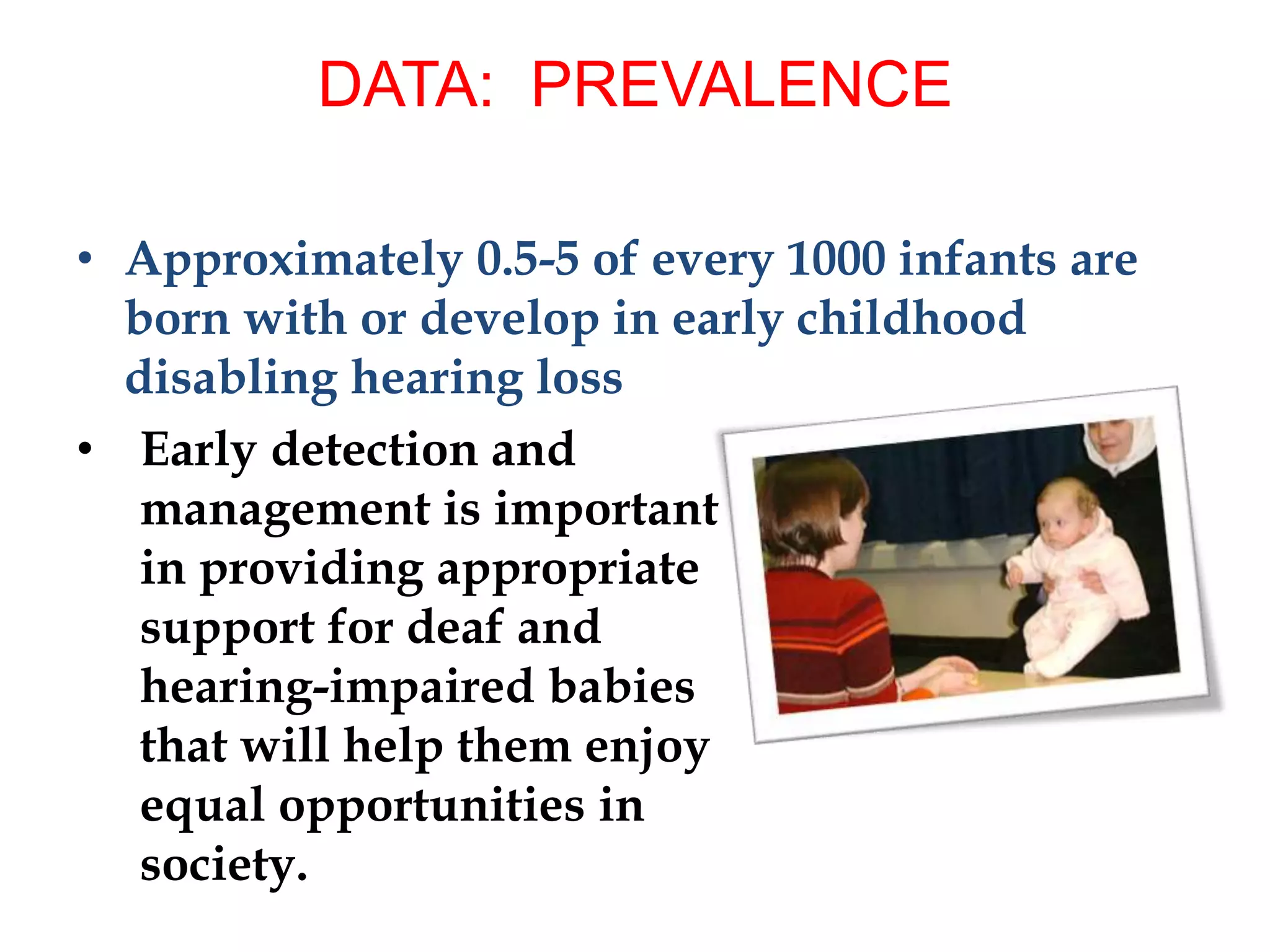
• Approximately 0.5-5 of every 1000 infants are
born with or develop in early childhood
disabling hearing loss
• Early detection and
management is important
in providing appropriate
support for deaf and
hearing-impaired babies
that will help them enjoy
equal opportunities in
society.
DATA: PREVALENCE
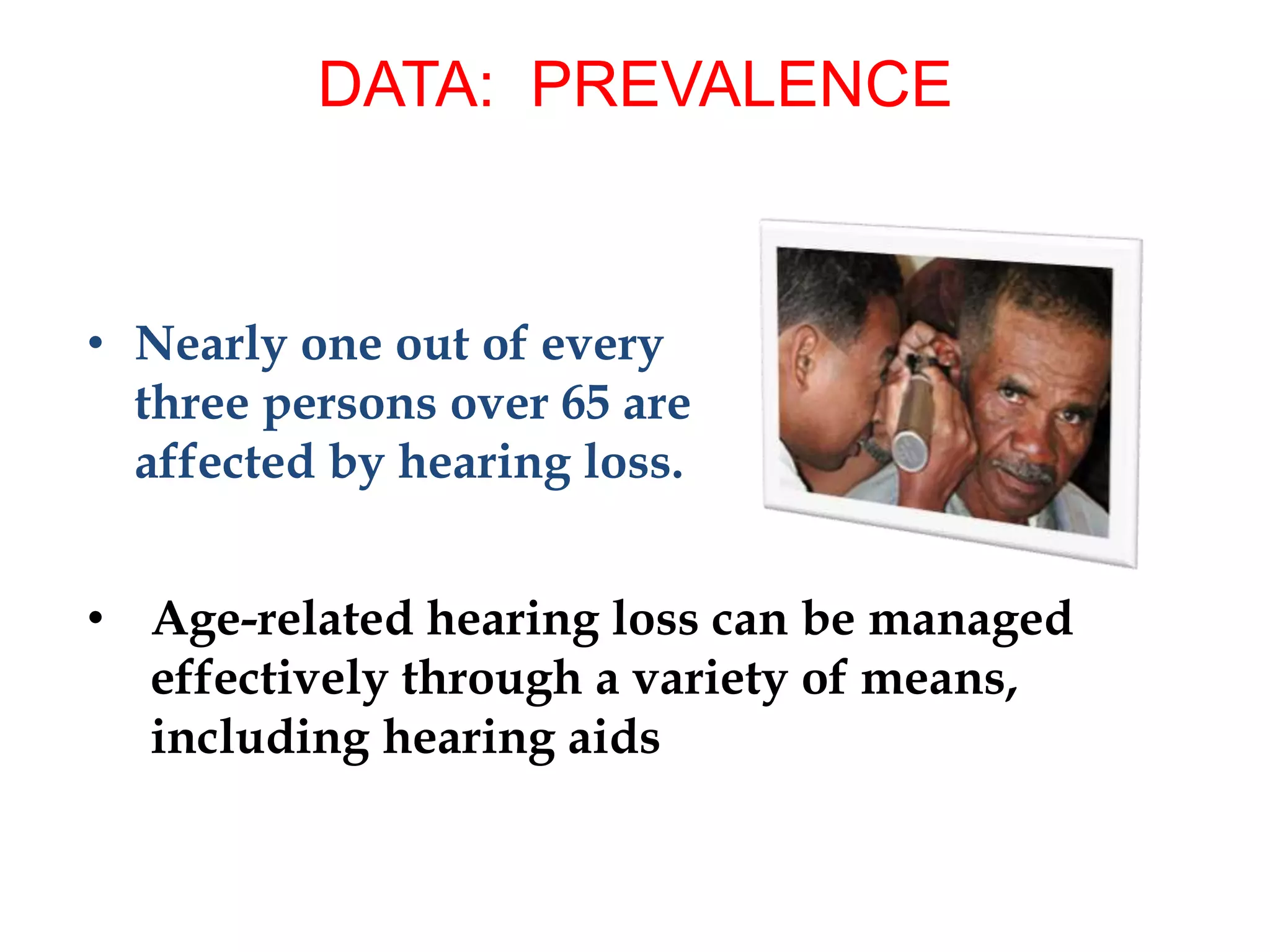
• Nearly one out of every
three persons over 65 are
affected by hearing loss.
• Age-related hearing loss can be managed
effectively through a variety of means,
including hearing aids
DATA: PREVALENCE
HEARING IMPAIRMENT AND DEAFNESS
• A person who is not able to hear as well as
someone with normal hearing – hearing
thresholds of 25dB or better in both ears – is
said to have hearing loss.
• ‘Hard of hearing’ refers to people with hearing
loss ranging from mild to severe.
• ‘Deaf’ people mostly have profound hearing
loss, which implies very little or no hearing.
•deaf- audiological condition of
not hearing.
•Deaf – particular group of
people who share a language
and culture
CLASSIFICATION OF H.I.
1. According to the age at onset of deafness
• Congenitally deaf – born deaf
• Adventitiously deaf – born with normal hearing and
became deaf through accident/illness
2. According to language development
• Prelingually deaf – born deaf oer lost hearing
before speech and language were developed
• Post lingually deaf- lost hearing after
development of spontaneous speech and
language
Classification
3. According to place of impairment
• conductive hearing loss – hearing loss due
to the interference in the transmission of
sound to and through the sense organ (outer
or middle ear)
• Sensory-neural hearing loss – due to the
abnormality of the inner ear or the auditory
nerve, or both
• mixed hearing loss - combination of both;
sometimes called a flat loss
Classification
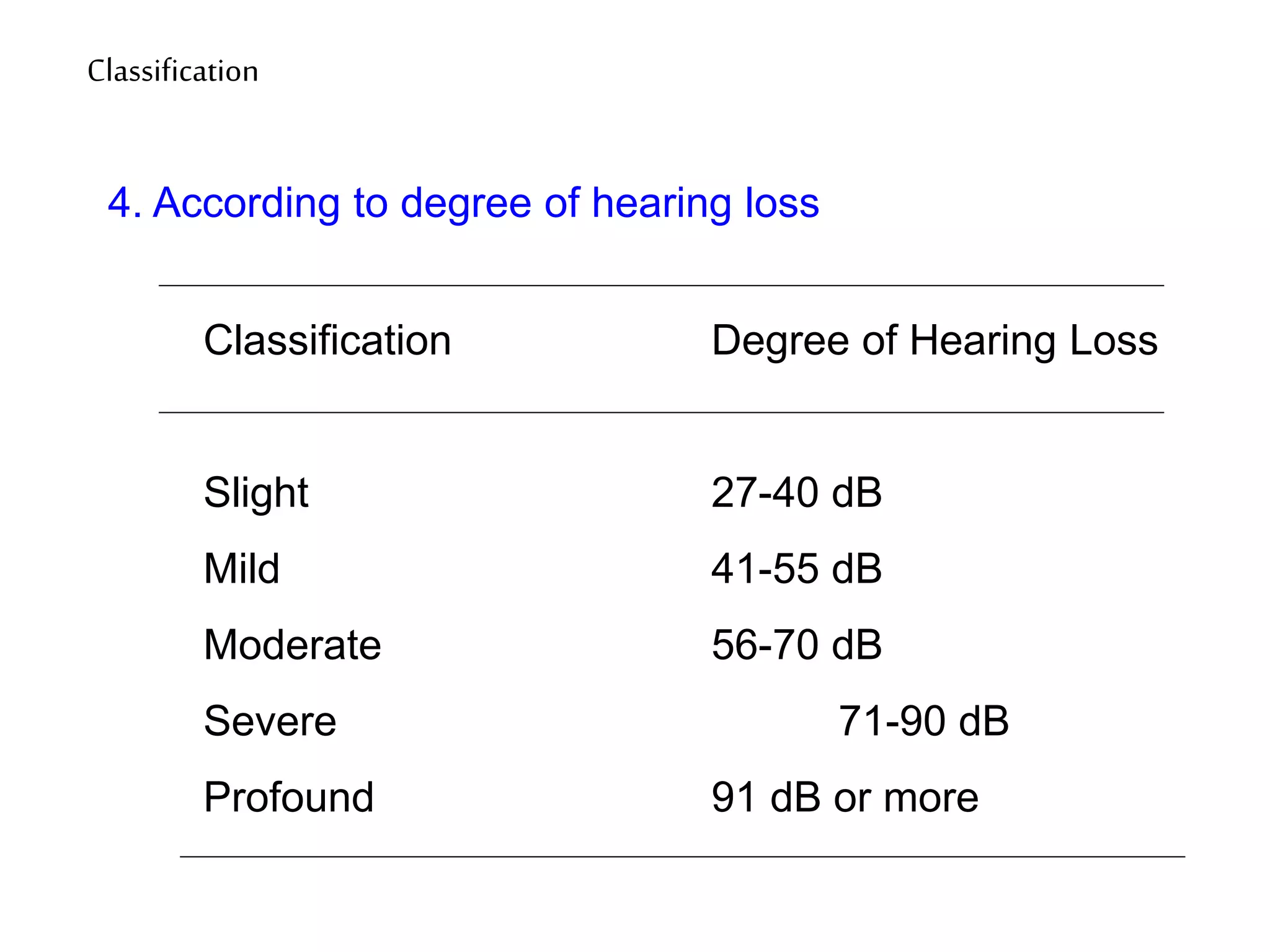
4. According to degree of hearing loss
Classification Degree of Hearing Loss
Slight 27-40 dB
Mild 41-55 dB
Moderate 56-70 dB
Severe 71-90 dB
Profound 91 dB or more
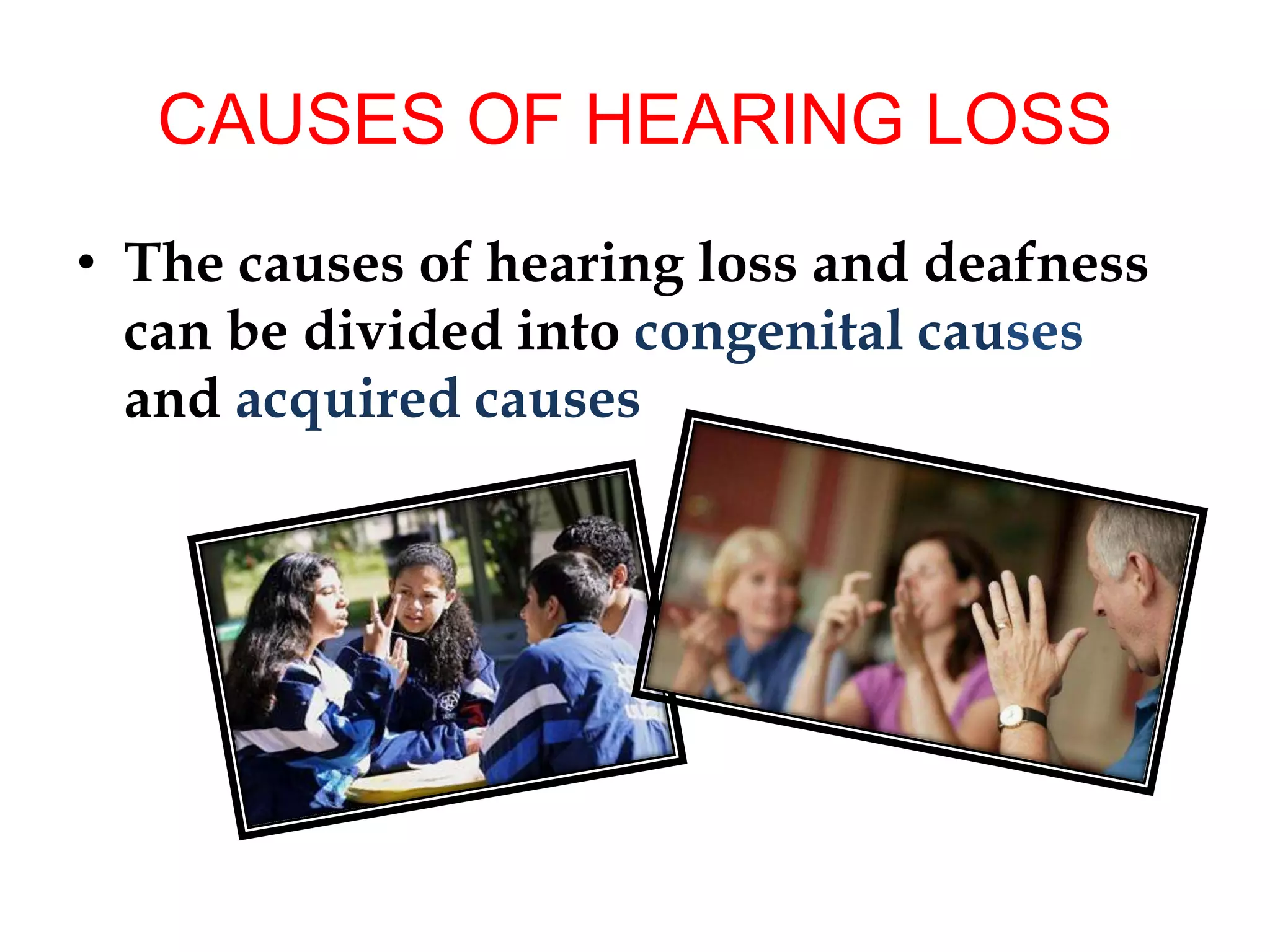
CAUSES OF HEARING LOSS
• The causes of hearing loss and deafness
can be divided into congenital causes
and acquired causes
CONGENITAL CAUSES
• Congenital causes lead to hearing loss being present at
or acquired soon after birth.
• Hearing loss can be caused by hereditary and non-
hereditary genetic factors or by certain complications
during pregnancy and childbirth, including:
• maternal rubella, syphilis or certain other
infections during pregnancy;
• low birth weight;
• birth asphyxia (a lack of oxygen at the time of
birth);
• inappropriate use of ototoxic drugs during
pregnancy; and
• severe jaundice in the neonatal period, which can
damage the hearing nerve in a newborn infant.
ACQUIRED CAUSES
• Infectious diseases
• Chronic ear infection
• Collection of fluid in the ear (otitis media) can cause hearing
loss.
• Use of ototoxic drugs at any age, such as some antibiotic and
antimalarial medicines for example, can damage the inner ear.
• Head injury or injury to the ear can cause hearing loss.
• Excessive noise
• Age-related hearing loss (presbycusis) is caused by
degeneration of sensory cells.
• Wax or foreign bodies blocking the ear canal
Among children, chronic otitis media is the
leading cause of hearing loss.
Half of all cases of hearing loss are
avoidable through primary prevention.
PRIMARY PREVENTION
• Immunization
• Early screening and treatment
• Improving antenatal and perinatal care
• Referring babies with high risk factors
• Reducing exposure (both occupational
and recreational) to loud noises
• Healthy ear and hearing care practices
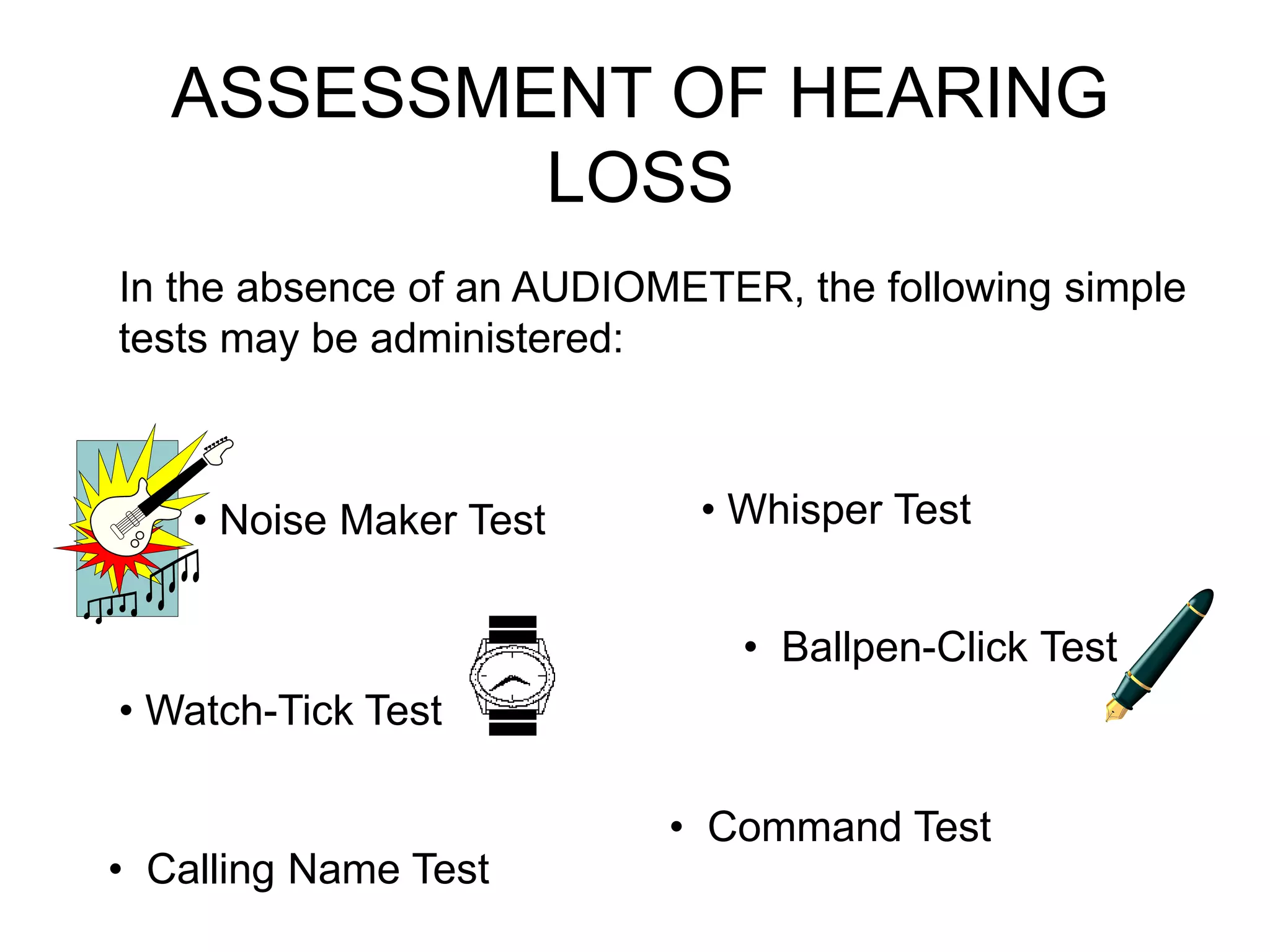
ASSESSMENT OF HEARING
LOSS
In the absence of an AUDIOMETER, the following simple
tests may be administered:
• Noise Maker Test • Whisper Test
• Calling Name Test
• Watch-Tick Test
• Ballpen-Click Test
• Command Test
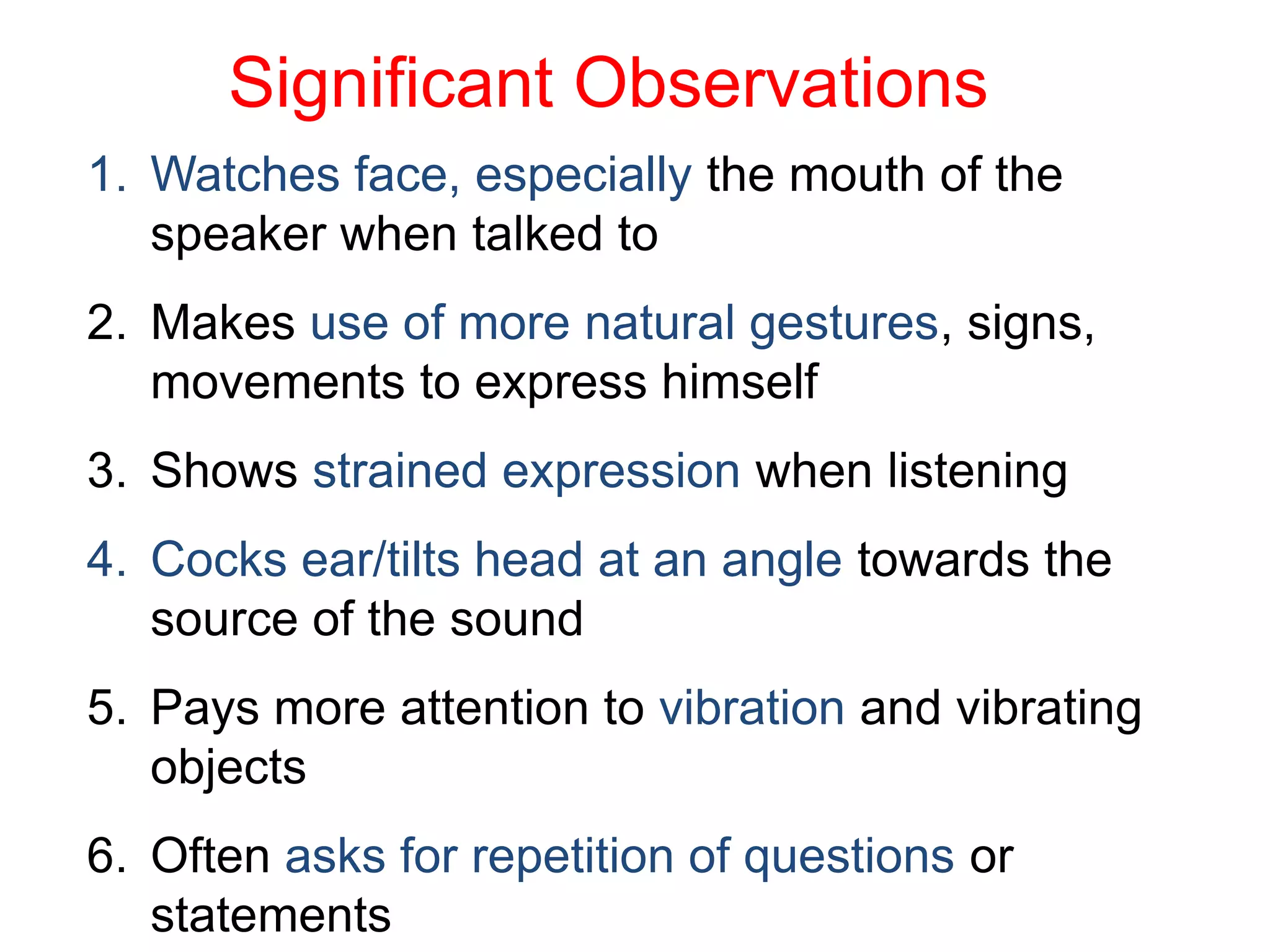
Significant Observations
1. Watches face, especially the mouth of the
speaker when talked to
2. Makes use of more natural gestures, signs,
movements to express himself
3. Shows strained expression when listening
4. Cocks ear/tilts head at an angle towards the
source of the sound
5. Pays more attention to vibration and vibrating
objects
6. Often asks for repetition of questions or
statements
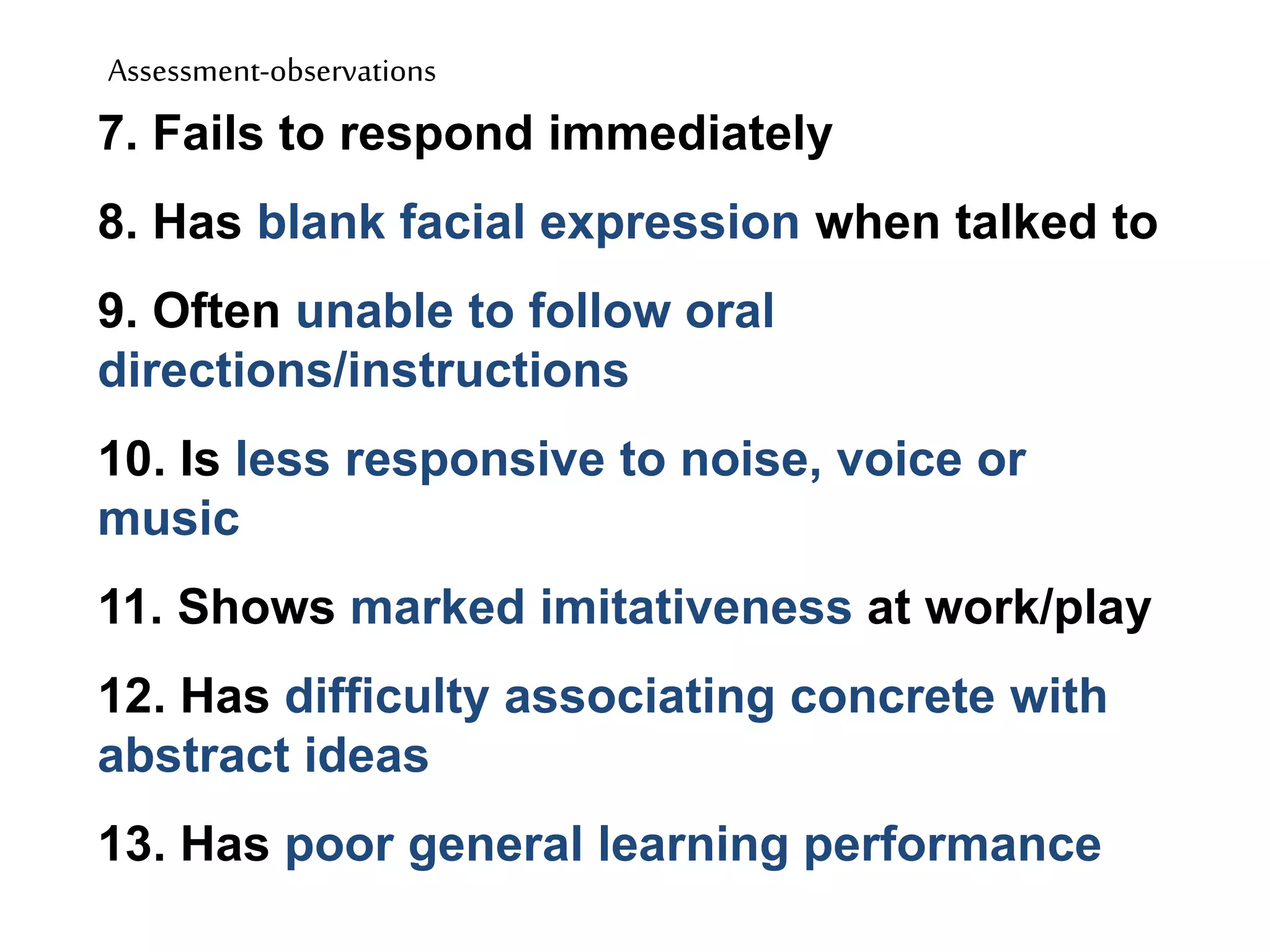
Assessment-observations
7. Fails to respond immediately
8. Has blank facial expression when talked to
9. Often unable to follow oral
directions/instructions
10. Is less responsive to noise, voice or
music
11. Shows marked imitativeness at work/play
12. Has difficulty associating concrete with
abstract ideas
13. Has poor general learning performance
MODULE 2
Understanding Hearing
Impairment:
Learning Characteristics
IMPACT OF HEARING LOSS
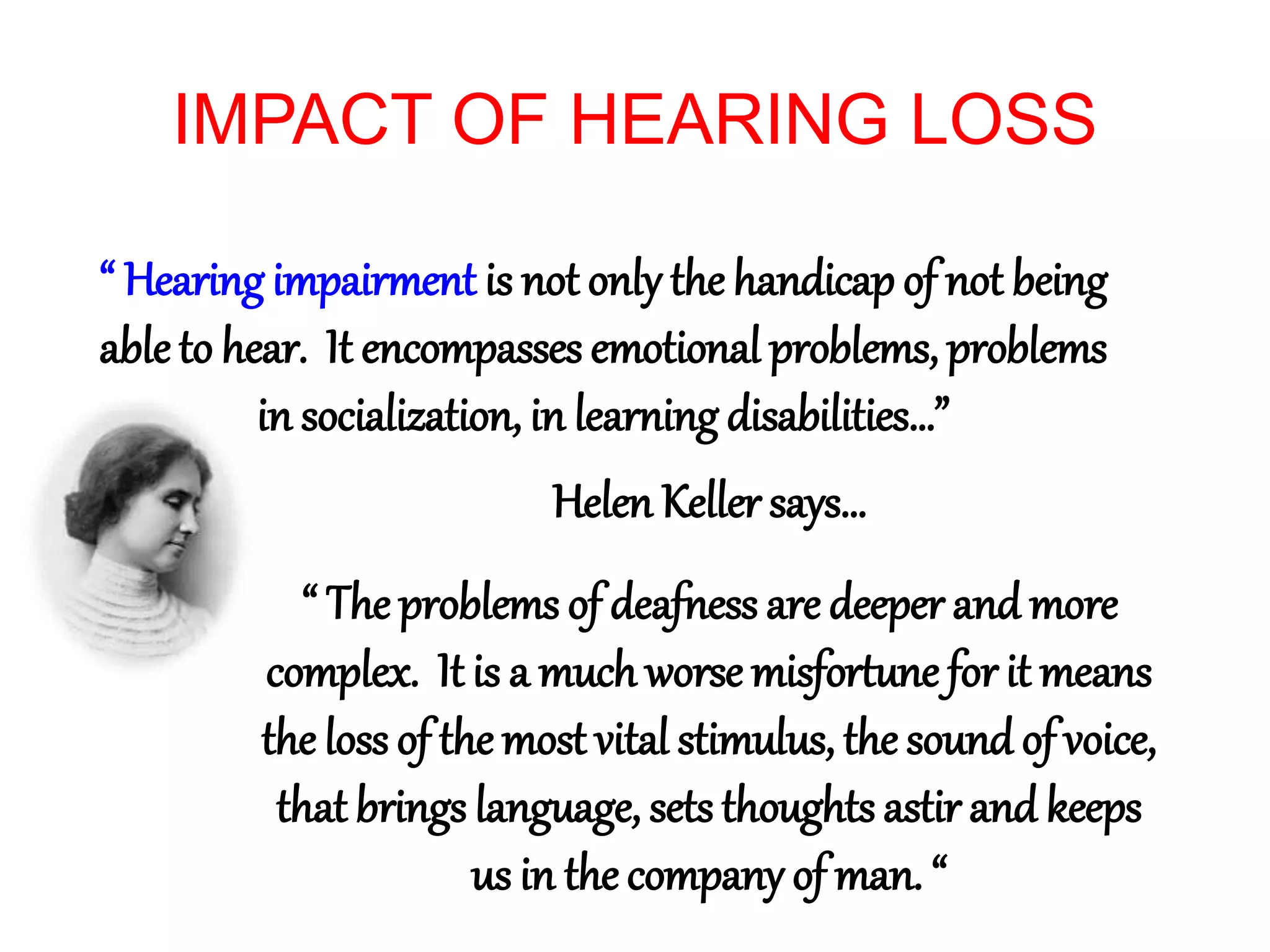
“ Hearing impairment is not only the handicap of not being
ableto hear. It encompasses emotional problems, problems
in socialization, in learning disabilities…”
Helen Keller says…
“ The problems of deafness are deeper and more
complex. It is a much worse misfortune for it means
the loss of the most vital stimulus, the sound of voice,
that brings language, sets thoughts astir and keeps
us in the company of man. “
Vocabulary Deficits
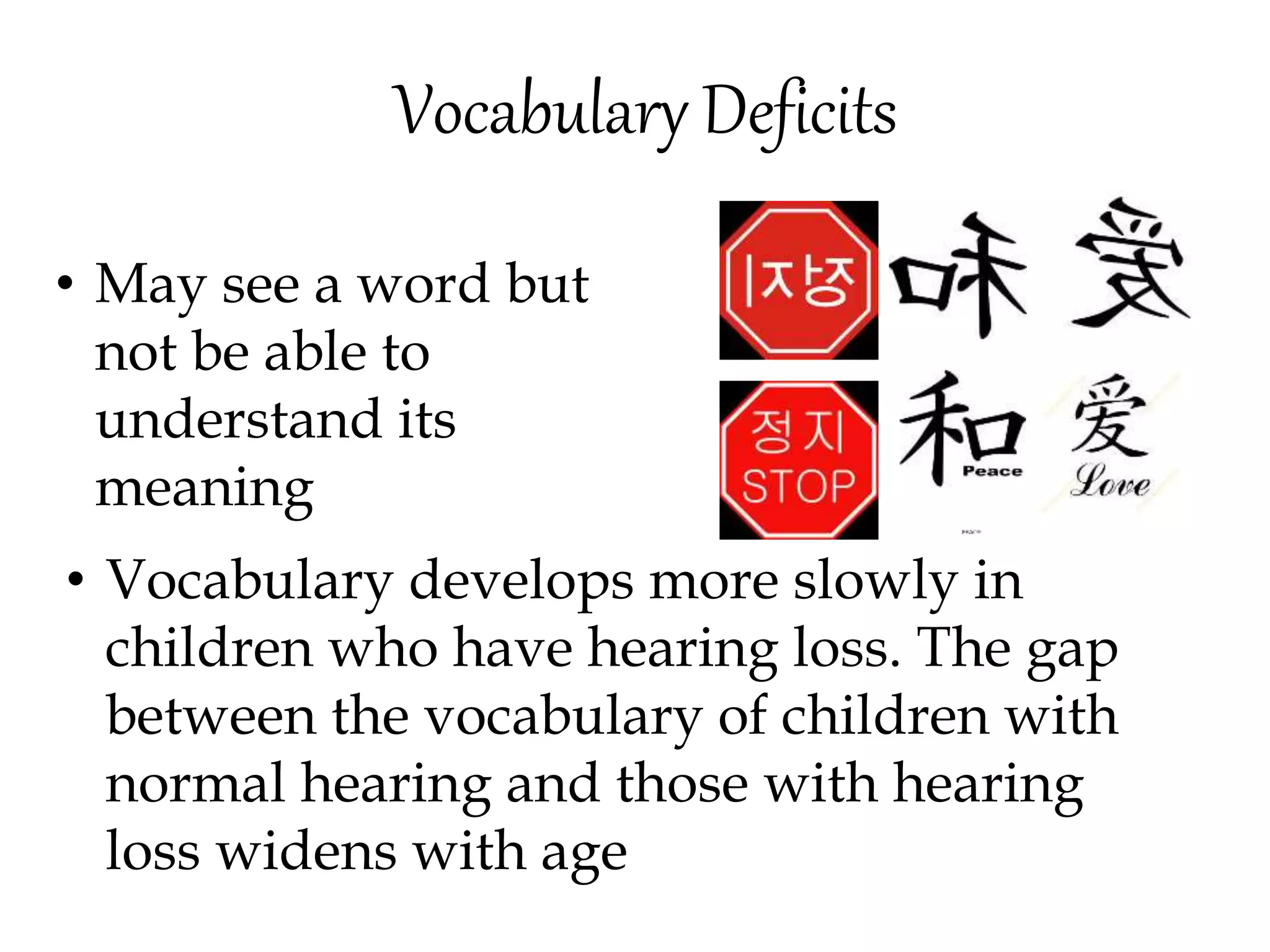
• May see a word but
not be able to
understand its
meaning
• Vocabulary develops more slowly in
children who have hearing loss. The gap
between the vocabulary of children with
normal hearing and those with hearing
loss widens with age
Improper use of words and their meanings
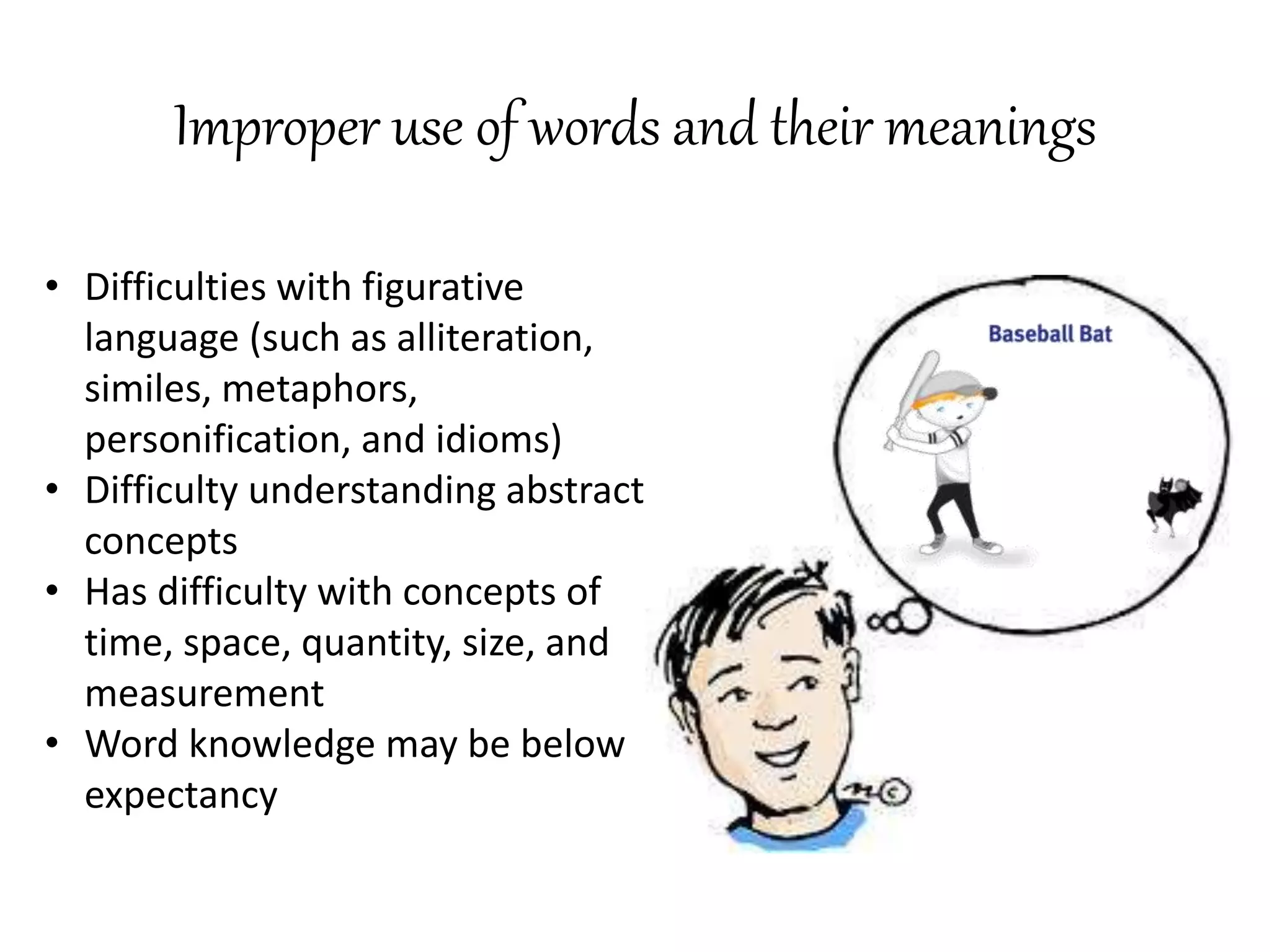
• Difficulties with figurative
language (such as alliteration,
similes, metaphors,
personification, and idioms)
• Difficulty understanding abstract
concepts
• Has difficulty with concepts of
time, space, quantity, size, and
measurement
• Word knowledge may be below
expectancy
Asks questions and/or responds inappropriately
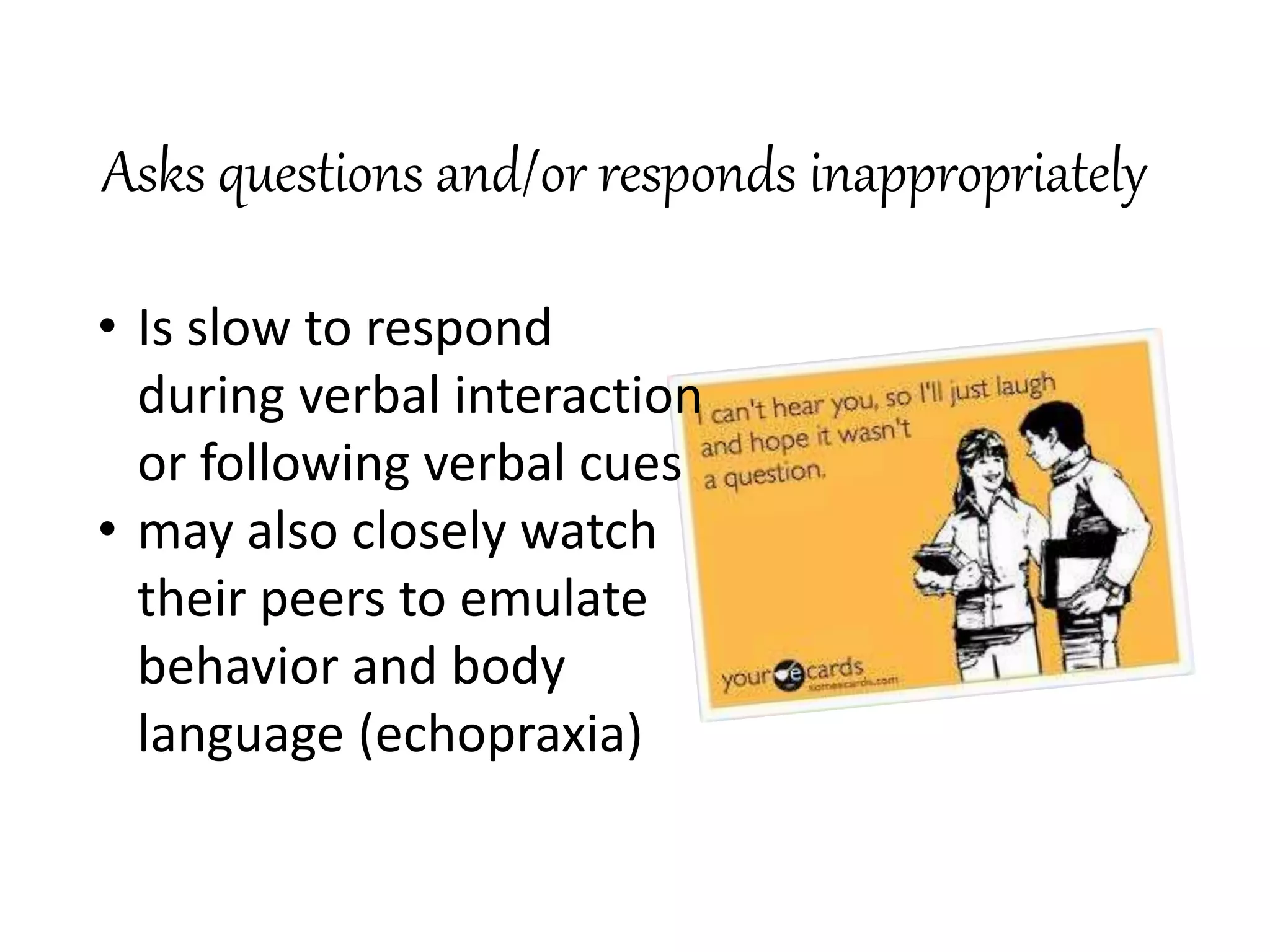
• Is slow to respond
during verbal interaction
or following verbal cues
• may also closely watch
their peers to emulate
behavior and body
language (echopraxia)
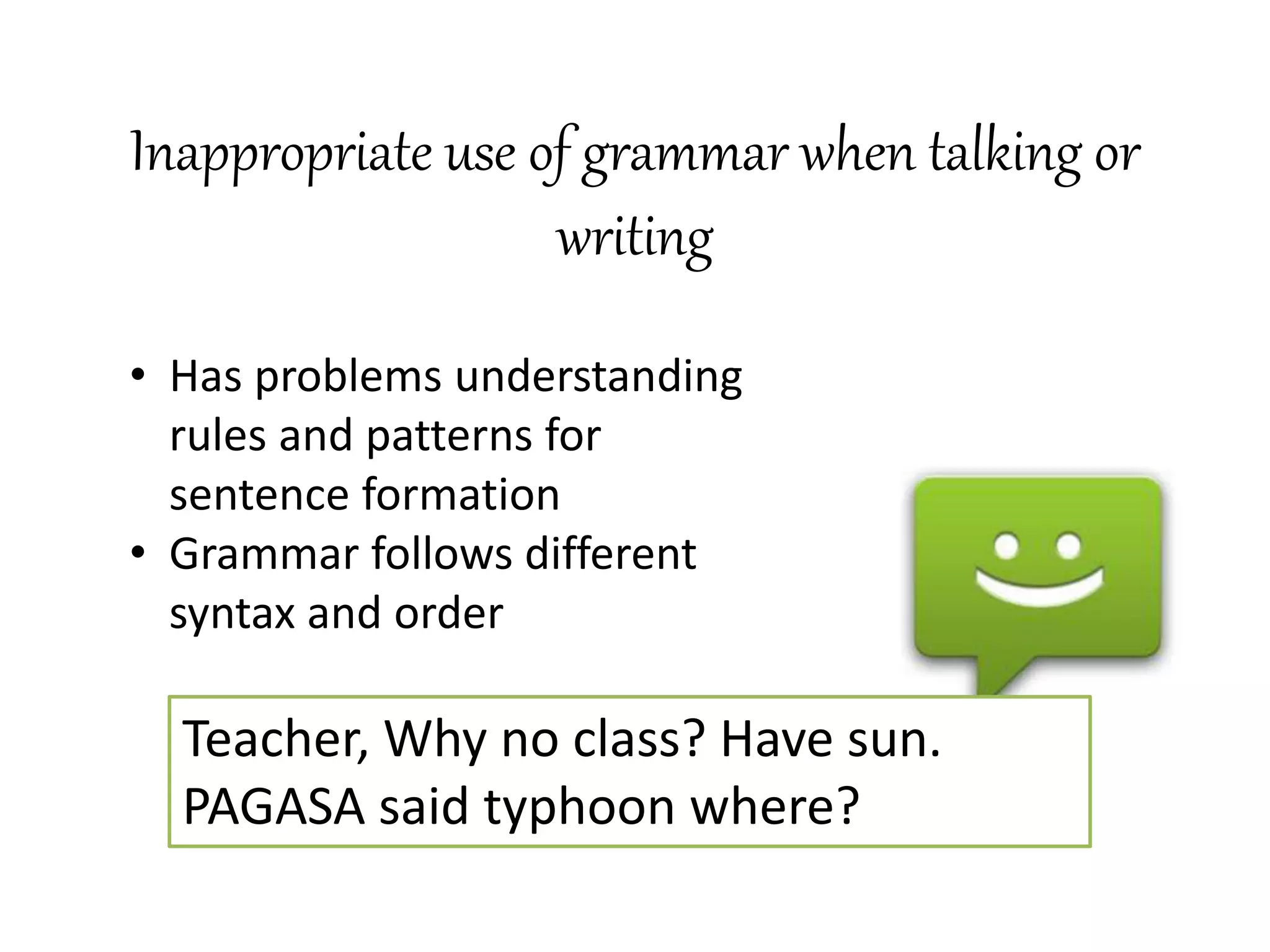
Inappropriate use of grammar when talking or
writing
Teacher, Why no class? Have sun.
PAGASA said typhoon where?
• Has problems understanding
rules and patterns for
sentence formation
• Grammar follows different
syntax and order
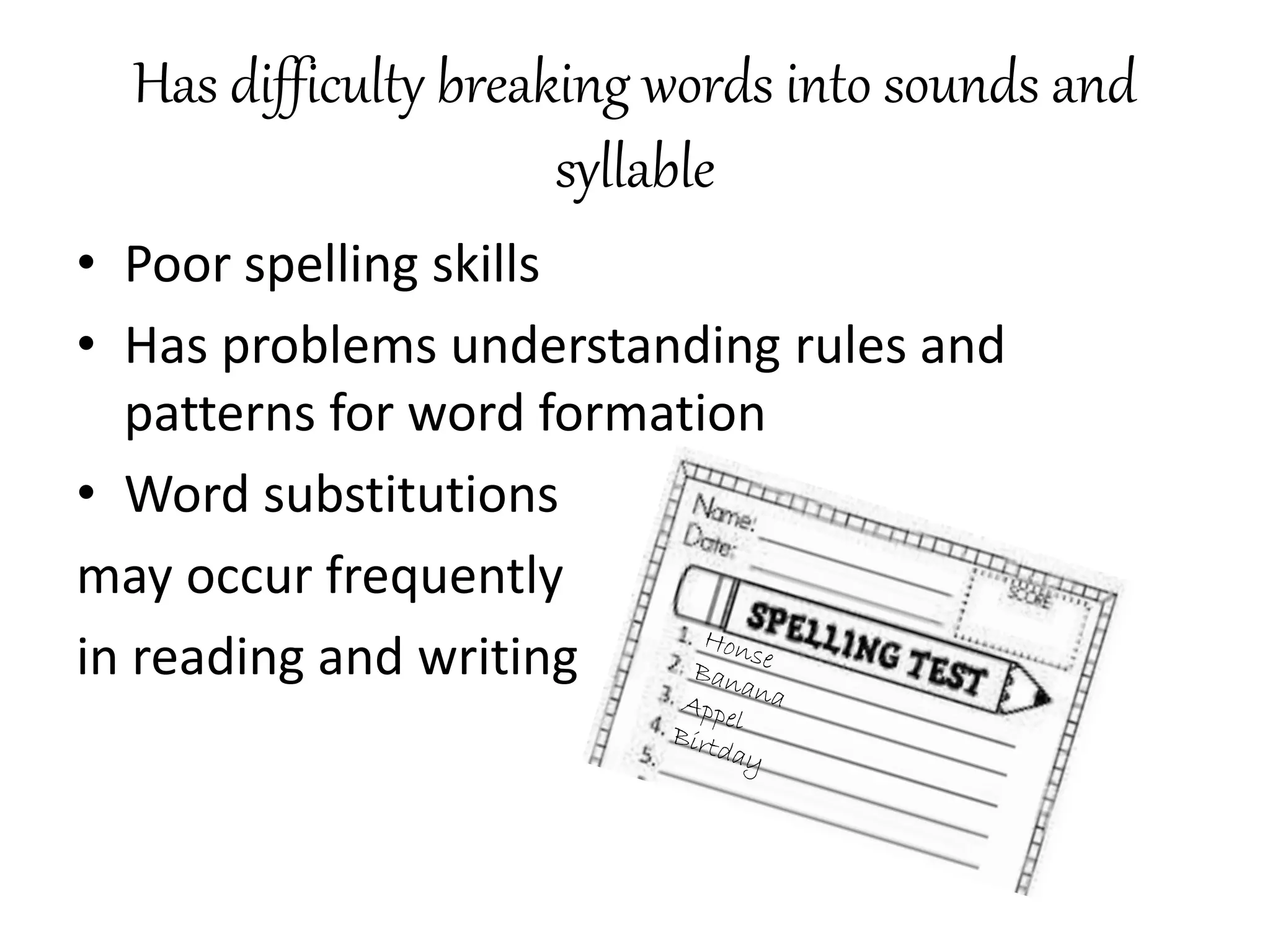
Has difficulty breaking words into sounds and
syllable
• Poor spelling skills
• Has problems understanding rules and
patterns for word formation
• Word substitutions
may occur frequently
in reading and writing
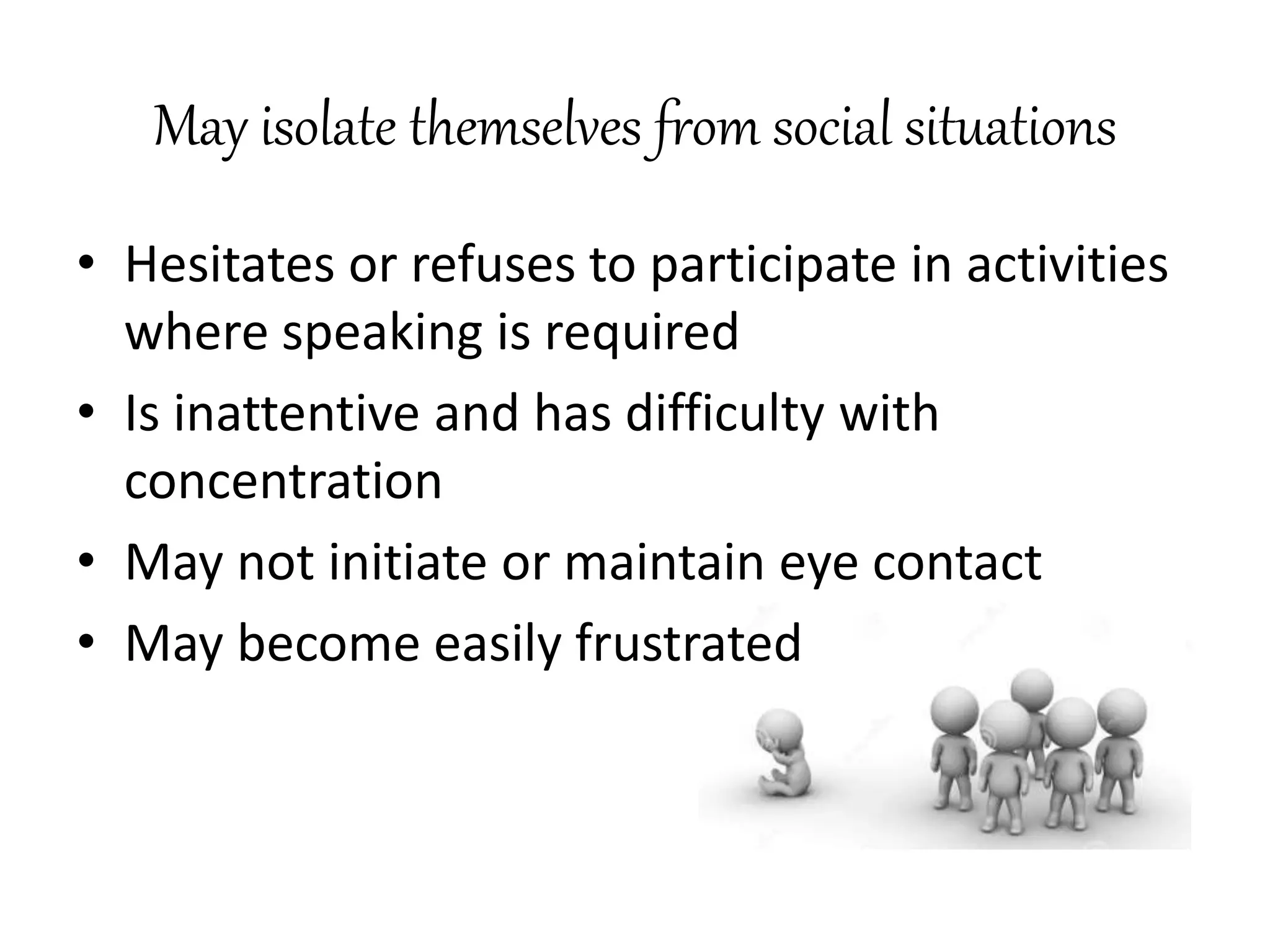
May isolate themselves from social situations
• Hesitates or refuses to participate in activities
where speaking is required
• Is inattentive and has difficulty with
concentration
• May not initiate or maintain eye contact
• May become easily frustrated
IMPACT OF HEARING LOSS
1. It causes delay in the development of
receptive and expressive communication
skills (speech and language).
2. The language deficit causes learning
problems that result in reduced academic
achievement.
3. Communication difficulties often lead to
social isolation and poor self-concept.
MODULE 3
HOW DO DEAF CHILDREN
DEVELOP CONCEPTS?
Deaf people are VISUAL learners
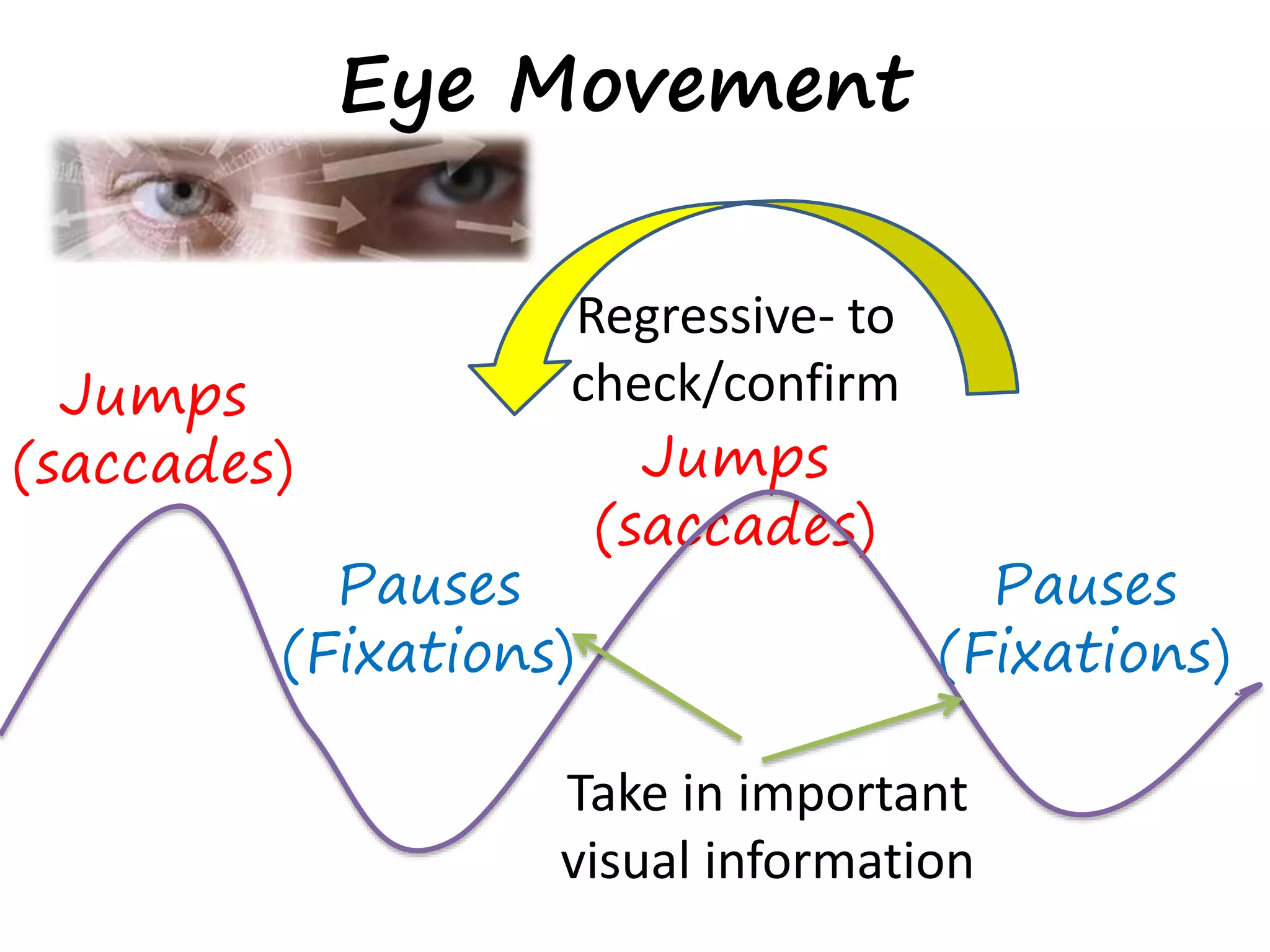
Eye Movement
Jumps
(saccades) Jumps
(saccades)
Pauses
(Fixations)
Pauses
(Fixations)
Take in important
visual information
Regressive- to
check/confirm
Help children
become more
rapid and
automatic in
unlocking the
meaning of
words
TEACHER’S CHALLENGE:
Enrich the
child’s
language
“experience”.
TEACHER’S CHALLENGE:
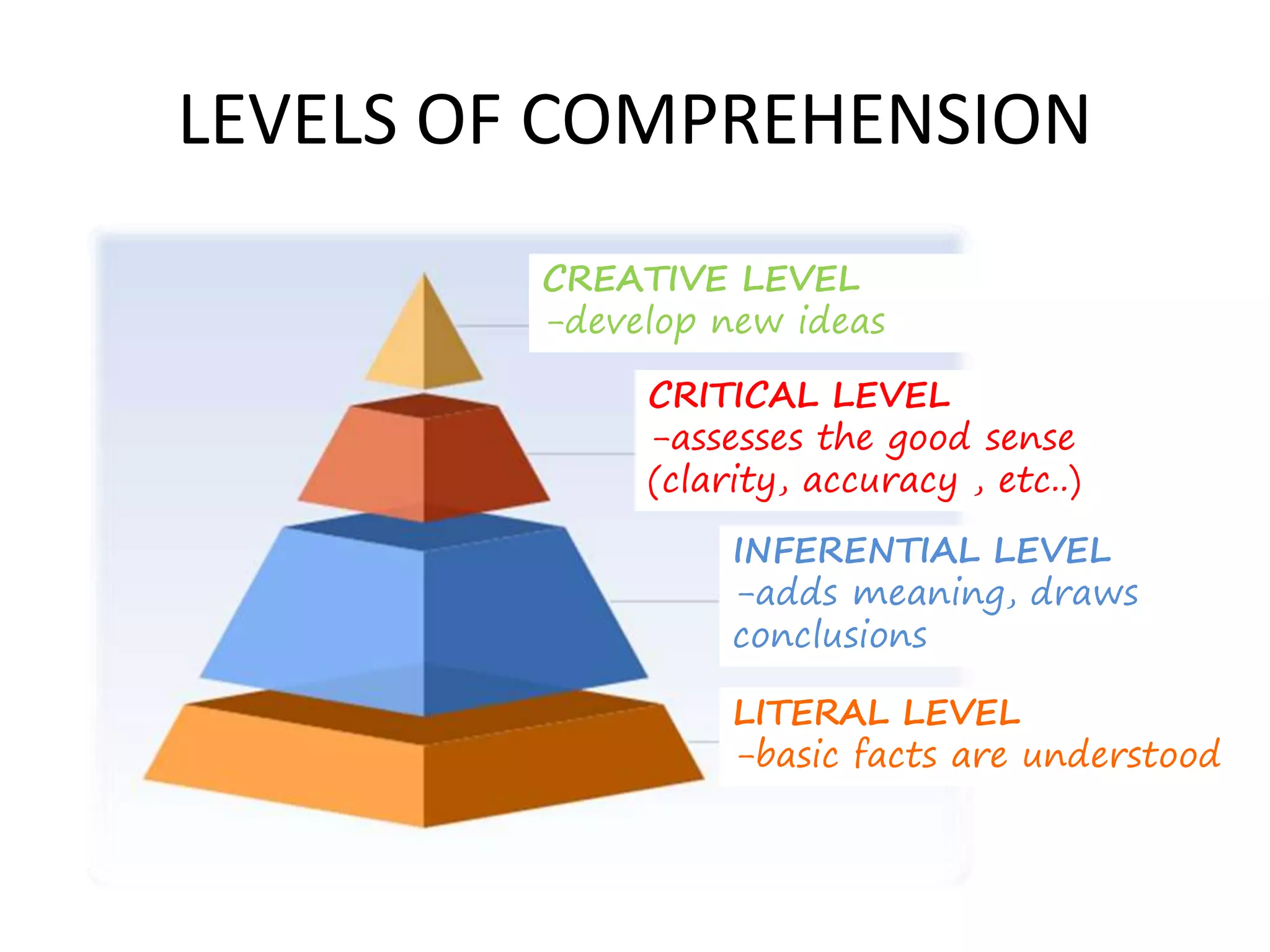
LEVELS OF COMPREHENSION
LITERAL LEVEL
-basic facts are understood
INFERENTIAL LEVEL
-adds meaning, draws
conclusions
CRITICAL LEVEL
-assesses the good sense
(clarity, accuracy , etc..)
CREATIVE LEVEL
-develop new ideas
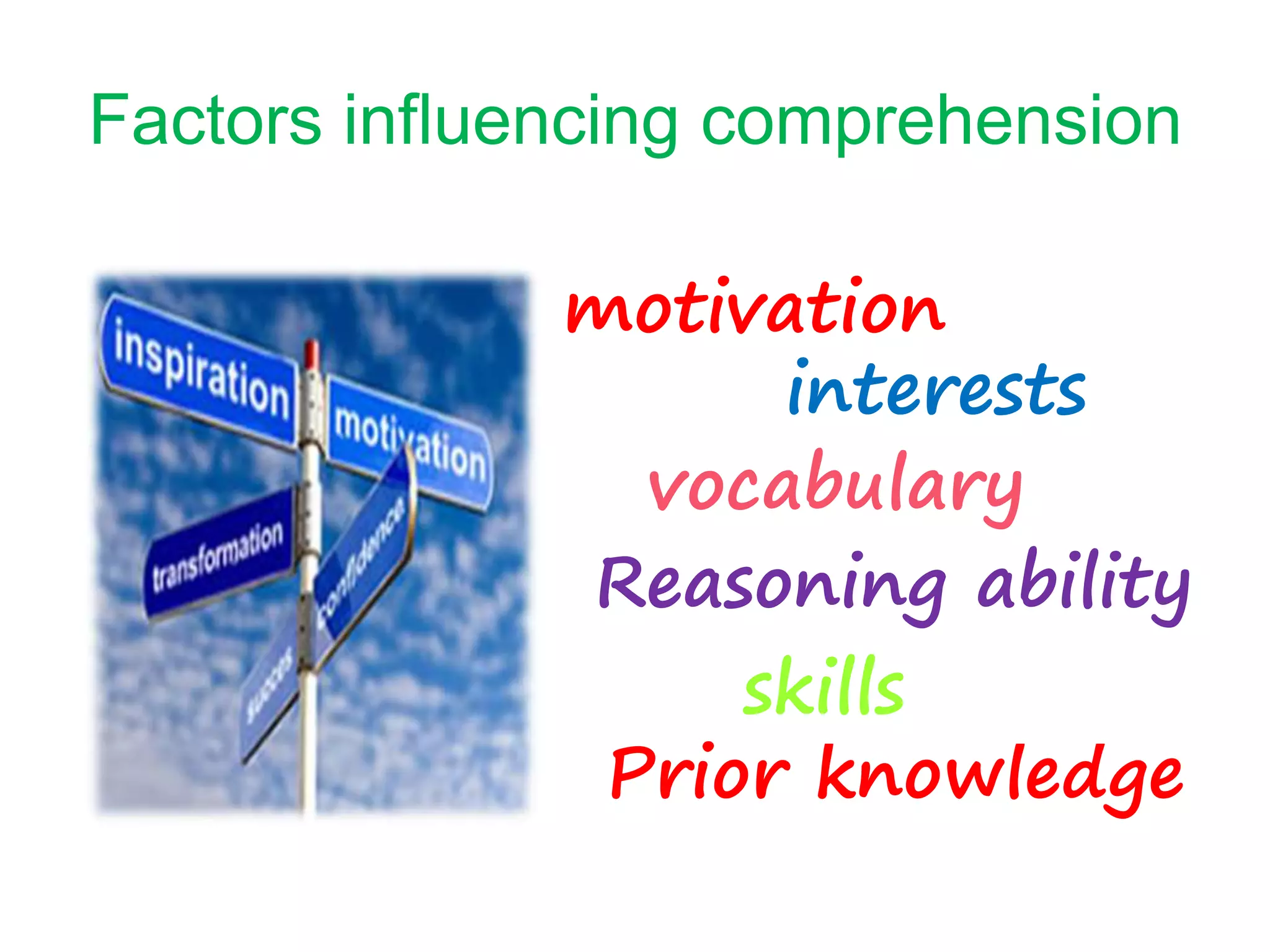
Factors influencing comprehension
motivation
Reasoning ability
interests
vocabulary
Prior knowledge
skills
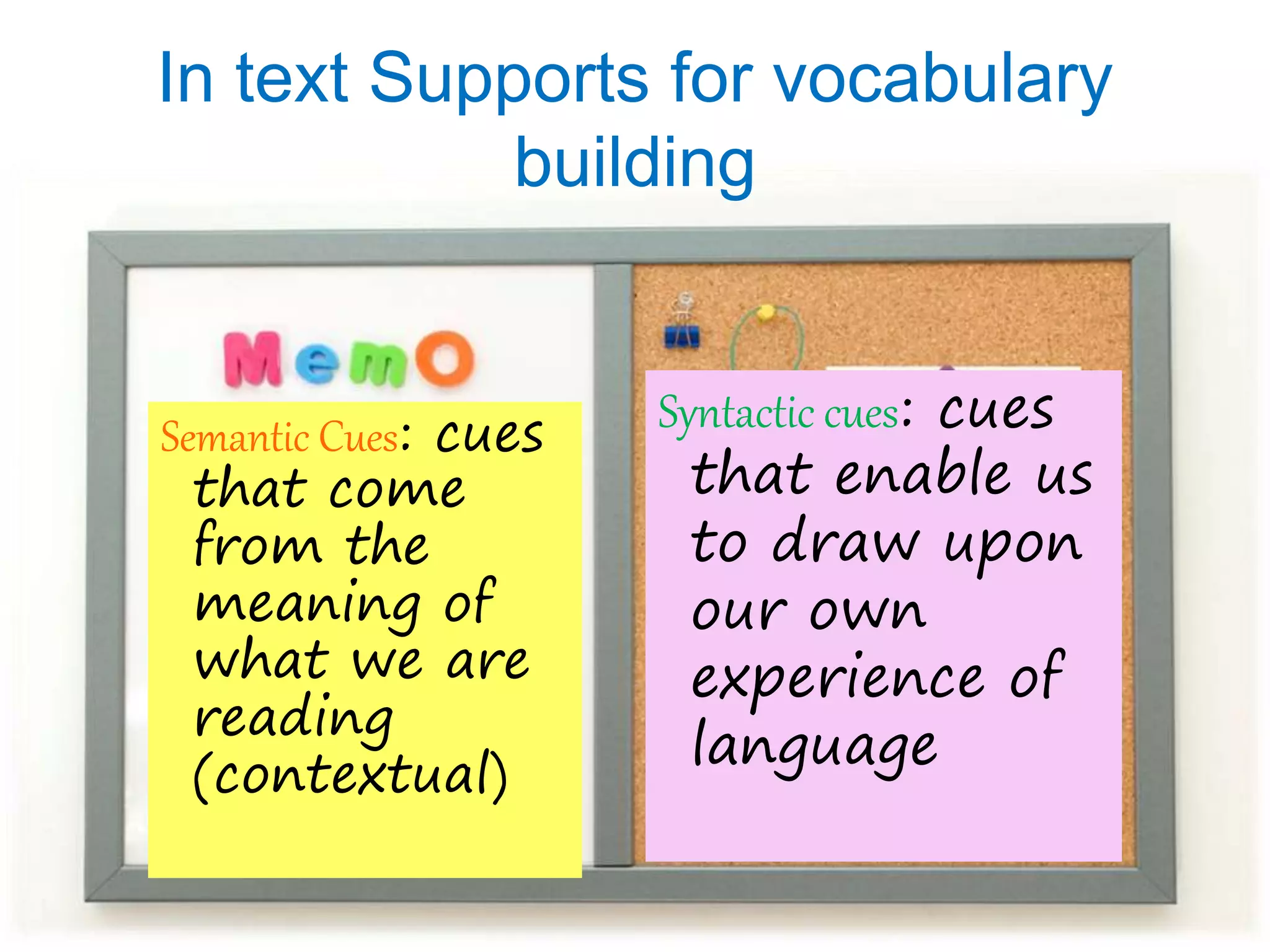
In text Supports for vocabulary
building
Semantic Cues: cues
that come
from the
meaning of
what we are
reading
(contextual)
Syntactic cues: cues
that enable us
to draw upon
our own
experience of
language
MODULE 4
Communicating with the Deaf
I CAN
I can live, I can love
I can reach the heaven’s above
I can right what is wrong, I can sing just any song
I can dance, I can fly
And touch the rainbow in the sky
I can be your good friend
I can love you until the end.
What took you so long to make me feel
I can give love, a love so real
What took you so long to let me know
What took you so long to make me see
How lucky I am cause I am free
Free to do the things I want to be
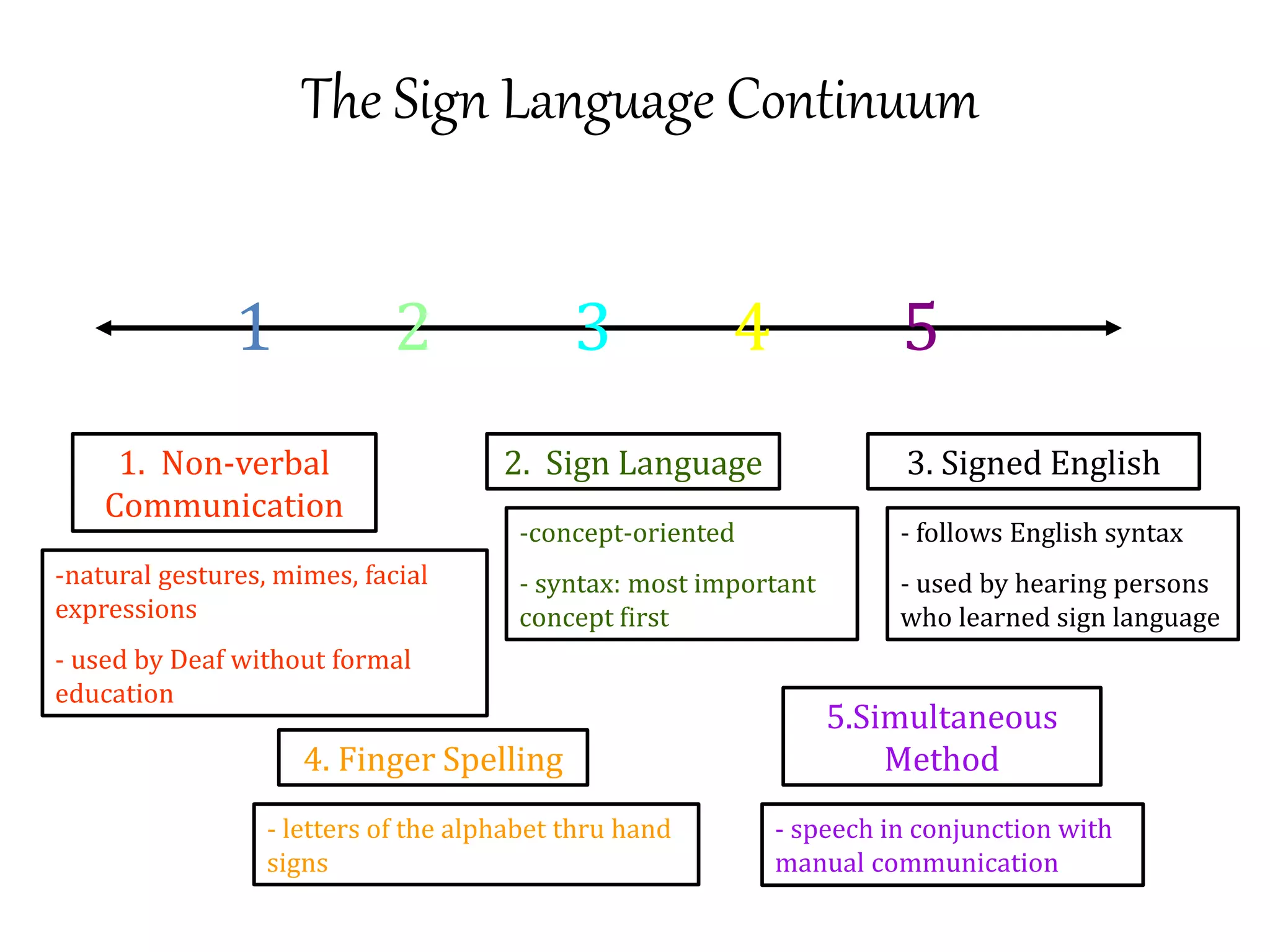
The Sign Language Continuum
1. Non-verbal
Communication
-natural gestures, mimes, facial
expressions
- used by Deaf without formal
education
2. Sign Language
-concept-oriented
- syntax: most important
concept first
1 52 3 4
3. Signed English
- follows English syntax
- used by hearing persons
who learned sign language
4. Finger Spelling
- letters of the alphabet thru hand
signs
5.Simultaneous
Method
- speech in conjunction with
manual communication
TheNature ofthe Language of Signs
1. It is a language of natural gestures and
pantomimes
2. Signs are made within the signing area:
top of the head and just above the waist
3. The sight-line is an imaginary line
between the signer and the observer
4. The body of the signer greatly aids in
manual signs (ex: tenses, tone, gender)
5. When the basic sign is initialized, it
attains a special meaning
Nature of Signs
6. Reduplication of signs denotes
plurality or continuous action
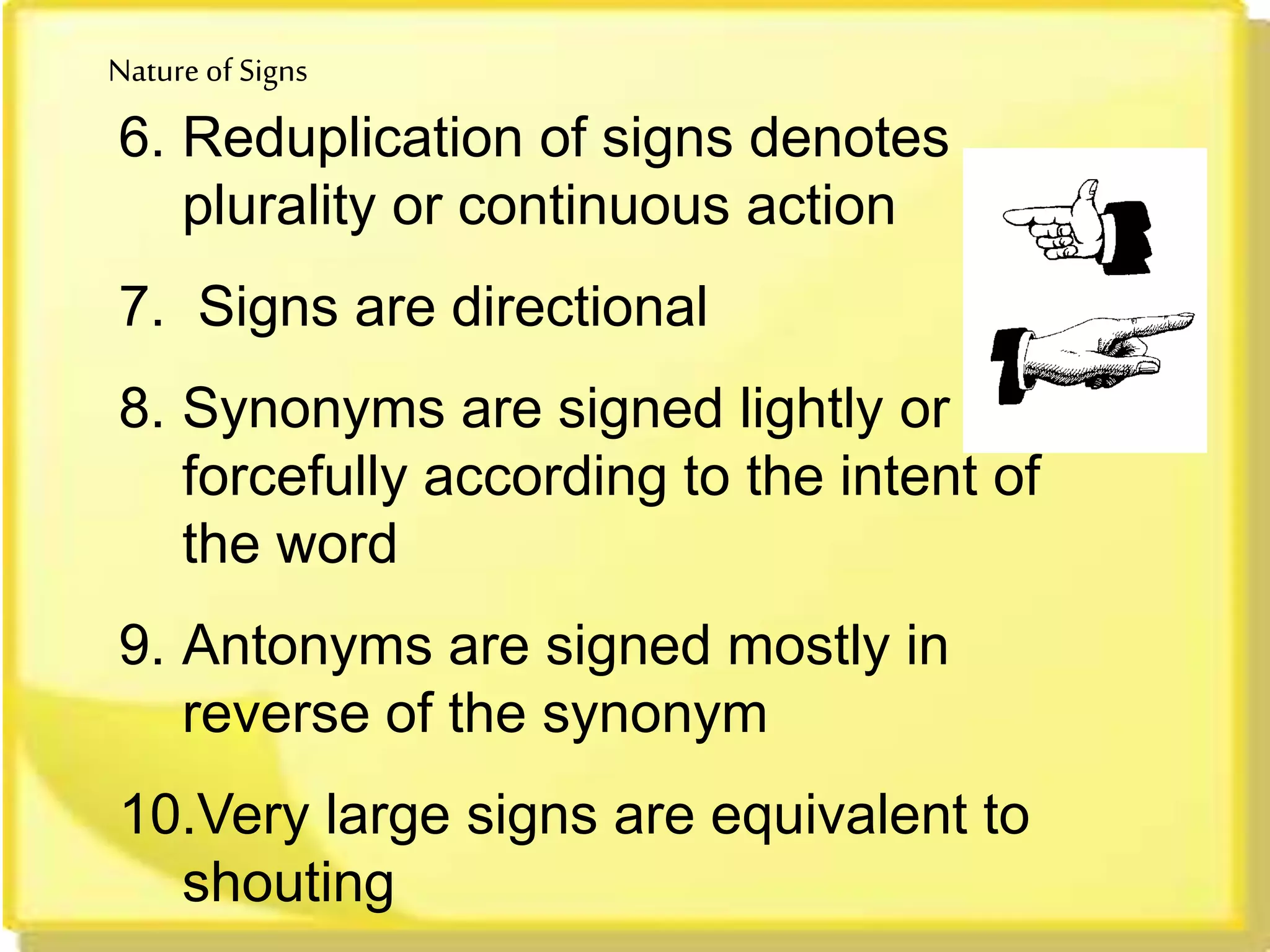
7. Signs are directional
8. Synonyms are signed lightly or
forcefully according to the intent of
the word
9. Antonyms are signed mostly in
reverse of the synonym
10.Very large signs are equivalent to
shouting
Conduct in Communicating By Signs
1. Get the deaf person’s attention before
signing
2. Keep your hands and face toward the
deaf person with whom you are
speaking
3. Keep your signs and finger spelling
smooth and flowing with appropriate
pauses and rhythm
4. Adjust your signs and finger spelling
within the language level of the deaf with
Conduct
5. Put across the proper amount of facial
expressions, body movements and
emphasis
6. Don’t get upset or confused when you
find that there are multiple variations in
a given sign
7. Be patient with the deaf when their
signs appear to be brutally frank in
their expressions.
8. Enjoy signing!
Conduct
5. Put across the proper amount of facial
expressions, body movements and
emphasis
6. Don’t get upset or confused when you
find that there are multiple variations in
a given sign
7. Be patient with the deaf when their
signs appear to be brutally frank in
their expressions.
8. Enjoy signing!
“Children with a hearing loss are normal
children who do not hear well. Though
this handicap may have a profound effect
on their overall development, they
develop ways to compensate and may
sometimes have a unique way of
assimilating what they see and learn…
So don’t forget to enjoy your teaching
experience. And by the end of the school
year, you will have made a friend for
life.”
-Amanda Mangiardi, SPED Teacher

Understanding hearing impairment

  • 1.
  • 2.
    3 1 2 4-5 The Basics ofHearing Impairment: Learning Characteristics Dealing with a Hearing Impaired Student in an Inclusive Classroom Practical Teaching Strategies Communicating with the H.I. Training Outline
  • 3.
    MODULE 1 Understanding Hearing Impairment: Mythsand Facts of Hearing Impairment
  • 4.
    Over 5% ofthe world’s population – 360 million people – has disabling hearing loss.
  • 5.
    Living with hearingloss is not a big deal.
  • 6.
    If someone hasa hearing impairment, he’d certainly know about it
  • 7.
    Deaf people aregood lipreaders.
  • 8.
    Hearing aids canrestore hearing.
  • 9.
    Sign Language isa universal or international language.
  • 10.
    If I shout,the deaf person can understand me more clearly.
  • 11.
    The deaf sometimesseem to hear me only when they feel like it.
  • 12.
    People who aredeaf lead totally different lives than other people
  • 13.
    Noise is amajor avoidable cause of hearing loss
  • 14.
    People who aredeaf cannot appreciate the arts because they can’t hear music, movies.
  • 15.
    People who aredeaf are less intelligent.
  • 16.
    All people whoare deaf use sign language to communicate
  • 17.
    Gradual hearing losscan affect people of all ages .
  • 18.
    Over 5% ofthe world’s population – 360 million people – has disabling hearing loss.
  • 19.
    Living with hearingloss is not a big deal.
  • 20.
    If someone hasa hearing impairment, he’d certainly know about it
  • 21.
    Deaf people aregood lipreaders.
  • 22.
    Hearing aids canrestore hearing.
  • 23.
    Sign Language isa universal or international language.
  • 24.
    If I shout,the deaf person can understand me more clearly.
  • 25.
    The deaf sometimesseem to hear me only when they feel like it.
  • 26.
    People who aredeaf lead totally different lives than other people
  • 27.
    All people whoare deaf are mute.
  • 28.
    Noise is amajor avoidable cause of hearing loss
  • 29.
    People who aredeaf cannot appreciate the arts because they can’t hear music, movies.
  • 30.
    People who aredeaf are less intelligent.
  • 31.
    All people whoare deaf use sign language to communicate
  • 32.
    Gradual hearing losscan affect people of all ages .
  • 34.
    There are 360million persons in the world with disabling hearing loss DATA: PREVALENCE This is 5.3% of the world’s population - 32 million of these are children. Disabling hearing loss is defined as: • adults (15 years and older): hearing loss greater than 40 dB in the better hearing ear; • children (0 – 14 years of age): hearing loss greater than 30 dB in the better hearing ear.
  • 35.
    • Approximately 0.5-5of every 1000 infants are born with or develop in early childhood disabling hearing loss • Early detection and management is important in providing appropriate support for deaf and hearing-impaired babies that will help them enjoy equal opportunities in society. DATA: PREVALENCE
  • 36.
    • Nearly oneout of every three persons over 65 are affected by hearing loss. • Age-related hearing loss can be managed effectively through a variety of means, including hearing aids DATA: PREVALENCE
  • 37.
    HEARING IMPAIRMENT ANDDEAFNESS • A person who is not able to hear as well as someone with normal hearing – hearing thresholds of 25dB or better in both ears – is said to have hearing loss. • ‘Hard of hearing’ refers to people with hearing loss ranging from mild to severe. • ‘Deaf’ people mostly have profound hearing loss, which implies very little or no hearing.
  • 38.
    •deaf- audiological conditionof not hearing. •Deaf – particular group of people who share a language and culture
  • 39.
    CLASSIFICATION OF H.I. 1.According to the age at onset of deafness • Congenitally deaf – born deaf • Adventitiously deaf – born with normal hearing and became deaf through accident/illness 2. According to language development • Prelingually deaf – born deaf oer lost hearing before speech and language were developed • Post lingually deaf- lost hearing after development of spontaneous speech and language
  • 40.
    Classification 3. According toplace of impairment • conductive hearing loss – hearing loss due to the interference in the transmission of sound to and through the sense organ (outer or middle ear) • Sensory-neural hearing loss – due to the abnormality of the inner ear or the auditory nerve, or both • mixed hearing loss - combination of both; sometimes called a flat loss
  • 41.
    Classification 4. According todegree of hearing loss Classification Degree of Hearing Loss Slight 27-40 dB Mild 41-55 dB Moderate 56-70 dB Severe 71-90 dB Profound 91 dB or more
  • 42.
    CAUSES OF HEARINGLOSS • The causes of hearing loss and deafness can be divided into congenital causes and acquired causes
  • 43.
    CONGENITAL CAUSES • Congenitalcauses lead to hearing loss being present at or acquired soon after birth. • Hearing loss can be caused by hereditary and non- hereditary genetic factors or by certain complications during pregnancy and childbirth, including: • maternal rubella, syphilis or certain other infections during pregnancy; • low birth weight; • birth asphyxia (a lack of oxygen at the time of birth); • inappropriate use of ototoxic drugs during pregnancy; and • severe jaundice in the neonatal period, which can damage the hearing nerve in a newborn infant.
  • 44.
    ACQUIRED CAUSES • Infectiousdiseases • Chronic ear infection • Collection of fluid in the ear (otitis media) can cause hearing loss. • Use of ototoxic drugs at any age, such as some antibiotic and antimalarial medicines for example, can damage the inner ear. • Head injury or injury to the ear can cause hearing loss. • Excessive noise • Age-related hearing loss (presbycusis) is caused by degeneration of sensory cells. • Wax or foreign bodies blocking the ear canal Among children, chronic otitis media is the leading cause of hearing loss.
  • 45.
    Half of allcases of hearing loss are avoidable through primary prevention.
  • 46.
    PRIMARY PREVENTION • Immunization •Early screening and treatment • Improving antenatal and perinatal care • Referring babies with high risk factors • Reducing exposure (both occupational and recreational) to loud noises • Healthy ear and hearing care practices
  • 47.
    ASSESSMENT OF HEARING LOSS Inthe absence of an AUDIOMETER, the following simple tests may be administered: • Noise Maker Test • Whisper Test • Calling Name Test • Watch-Tick Test • Ballpen-Click Test • Command Test
  • 48.
    Significant Observations 1. Watchesface, especially the mouth of the speaker when talked to 2. Makes use of more natural gestures, signs, movements to express himself 3. Shows strained expression when listening 4. Cocks ear/tilts head at an angle towards the source of the sound 5. Pays more attention to vibration and vibrating objects 6. Often asks for repetition of questions or statements
  • 49.
    Assessment-observations 7. Fails torespond immediately 8. Has blank facial expression when talked to 9. Often unable to follow oral directions/instructions 10. Is less responsive to noise, voice or music 11. Shows marked imitativeness at work/play 12. Has difficulty associating concrete with abstract ideas 13. Has poor general learning performance
  • 50.
  • 51.
    IMPACT OF HEARINGLOSS “ Hearing impairment is not only the handicap of not being ableto hear. It encompasses emotional problems, problems in socialization, in learning disabilities…” Helen Keller says… “ The problems of deafness are deeper and more complex. It is a much worse misfortune for it means the loss of the most vital stimulus, the sound of voice, that brings language, sets thoughts astir and keeps us in the company of man. “
  • 52.
    Vocabulary Deficits • Maysee a word but not be able to understand its meaning • Vocabulary develops more slowly in children who have hearing loss. The gap between the vocabulary of children with normal hearing and those with hearing loss widens with age
  • 53.
    Improper use ofwords and their meanings • Difficulties with figurative language (such as alliteration, similes, metaphors, personification, and idioms) • Difficulty understanding abstract concepts • Has difficulty with concepts of time, space, quantity, size, and measurement • Word knowledge may be below expectancy
  • 54.
    Asks questions and/orresponds inappropriately • Is slow to respond during verbal interaction or following verbal cues • may also closely watch their peers to emulate behavior and body language (echopraxia)
  • 55.
    Inappropriate use ofgrammar when talking or writing Teacher, Why no class? Have sun. PAGASA said typhoon where? • Has problems understanding rules and patterns for sentence formation • Grammar follows different syntax and order
  • 56.
    Has difficulty breakingwords into sounds and syllable • Poor spelling skills • Has problems understanding rules and patterns for word formation • Word substitutions may occur frequently in reading and writing
  • 57.
    May isolate themselvesfrom social situations • Hesitates or refuses to participate in activities where speaking is required • Is inattentive and has difficulty with concentration • May not initiate or maintain eye contact • May become easily frustrated
  • 58.
    IMPACT OF HEARINGLOSS 1. It causes delay in the development of receptive and expressive communication skills (speech and language). 2. The language deficit causes learning problems that result in reduced academic achievement. 3. Communication difficulties often lead to social isolation and poor self-concept.
  • 59.
    MODULE 3 HOW DODEAF CHILDREN DEVELOP CONCEPTS?
  • 60.
    Deaf people areVISUAL learners
  • 61.
    Eye Movement Jumps (saccades) Jumps (saccades) Pauses (Fixations) Pauses (Fixations) Takein important visual information Regressive- to check/confirm
  • 62.
    Help children become more rapidand automatic in unlocking the meaning of words TEACHER’S CHALLENGE:
  • 63.
  • 64.
    LEVELS OF COMPREHENSION LITERALLEVEL -basic facts are understood INFERENTIAL LEVEL -adds meaning, draws conclusions CRITICAL LEVEL -assesses the good sense (clarity, accuracy , etc..) CREATIVE LEVEL -develop new ideas
  • 65.
    Factors influencing comprehension motivation Reasoningability interests vocabulary Prior knowledge skills
  • 66.
    In text Supportsfor vocabulary building Semantic Cues: cues that come from the meaning of what we are reading (contextual) Syntactic cues: cues that enable us to draw upon our own experience of language
  • 67.
  • 68.
    I CAN I canlive, I can love I can reach the heaven’s above I can right what is wrong, I can sing just any song I can dance, I can fly And touch the rainbow in the sky I can be your good friend I can love you until the end. What took you so long to make me feel I can give love, a love so real What took you so long to let me know What took you so long to make me see How lucky I am cause I am free Free to do the things I want to be
  • 69.
    The Sign LanguageContinuum 1. Non-verbal Communication -natural gestures, mimes, facial expressions - used by Deaf without formal education 2. Sign Language -concept-oriented - syntax: most important concept first 1 52 3 4 3. Signed English - follows English syntax - used by hearing persons who learned sign language 4. Finger Spelling - letters of the alphabet thru hand signs 5.Simultaneous Method - speech in conjunction with manual communication
  • 70.
    TheNature ofthe Languageof Signs 1. It is a language of natural gestures and pantomimes 2. Signs are made within the signing area: top of the head and just above the waist 3. The sight-line is an imaginary line between the signer and the observer 4. The body of the signer greatly aids in manual signs (ex: tenses, tone, gender) 5. When the basic sign is initialized, it attains a special meaning
  • 71.
    Nature of Signs 6.Reduplication of signs denotes plurality or continuous action 7. Signs are directional 8. Synonyms are signed lightly or forcefully according to the intent of the word 9. Antonyms are signed mostly in reverse of the synonym 10.Very large signs are equivalent to shouting
  • 72.
    Conduct in CommunicatingBy Signs 1. Get the deaf person’s attention before signing 2. Keep your hands and face toward the deaf person with whom you are speaking 3. Keep your signs and finger spelling smooth and flowing with appropriate pauses and rhythm 4. Adjust your signs and finger spelling within the language level of the deaf with
  • 73.
    Conduct 5. Put acrossthe proper amount of facial expressions, body movements and emphasis 6. Don’t get upset or confused when you find that there are multiple variations in a given sign 7. Be patient with the deaf when their signs appear to be brutally frank in their expressions. 8. Enjoy signing!
  • 74.
    Conduct 5. Put acrossthe proper amount of facial expressions, body movements and emphasis 6. Don’t get upset or confused when you find that there are multiple variations in a given sign 7. Be patient with the deaf when their signs appear to be brutally frank in their expressions. 8. Enjoy signing!
  • 75.
    “Children with ahearing loss are normal children who do not hear well. Though this handicap may have a profound effect on their overall development, they develop ways to compensate and may sometimes have a unique way of assimilating what they see and learn… So don’t forget to enjoy your teaching experience. And by the end of the school year, you will have made a friend for life.” -Amanda Mangiardi, SPED Teacher